Search results
Search for "contaminants" in Full Text gives 196 result(s) in Beilstein Journal of Nanotechnology.
X-ray photoelectron spectroscopy of graphitic carbon nanomaterials doped with heteroatoms
Beilstein J. Nanotechnol. 2015, 6, 177–192, doi:10.3762/bjnano.6.17
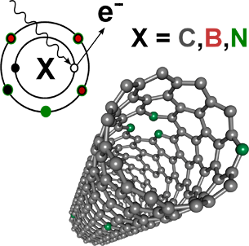
- subtraction and the formulations by Shirley [58] and Tougaard [59] are often used. For evaluating the concentration and the bonding of the dopants, the first sensible step is to focus on the carbon 1s response to evaluate contributions to the spectrum from synthesis byproducts or carbonaceous contaminants


Materials and characterization techniques for high-temperature polymer electrolyte membrane fuel cells
Beilstein J. Nanotechnol. 2015, 6, 68–83, doi:10.3762/bjnano.6.8
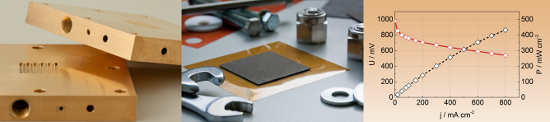
- clean hydrogen sources and a sizable hydrogen infrastructure limits the fuel-cell applications today. Due to their elevated operating temperatures, between 150 and 180 °C, HT-PEMFCs can tolerate fuel contaminants such as carbon monoxide (CO) and hydrogen sulfide (H2S) without significant loss of




Effect of channel length on the electrical response of carbon nanotube field-effect transistors to deoxyribonucleic acid hybridization
Beilstein J. Nanotechnol. 2014, 5, 2081–2091, doi:10.3762/bjnano.5.217
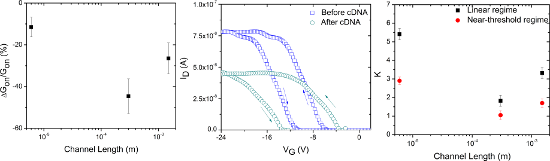
- from contaminants during signal analysis, which might affect the sensitivity and specificity of target detection. The efficacy of SWCNT-based FETs for hybridization detection depends on the number of hybridizations occurring on the SWCNT surface; therefore, it is important to understand the influence


Carbon nano-onions (multi-layer fullerenes): chemistry and applications
Beilstein J. Nanotechnol. 2014, 5, 1980–1998, doi:10.3762/bjnano.5.207
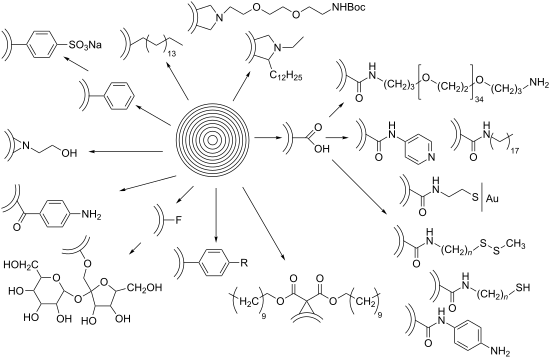
- the one of fullerene C60. These encouraging results could be a first step toward in situ remediation of heavy metal contaminants. Electronic applications Capacitors: Carbon materials are commonly used as electrode materials in capacitors, but the first study probing CNOs as electrode materials in


Carbon-based smart nanomaterials in biomedicine and neuroengineering
Beilstein J. Nanotechnol. 2014, 5, 1849–1863, doi:10.3762/bjnano.5.196
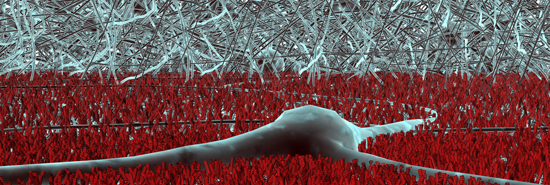
- size of the nanomaterial itself [87][88][89], as well as on the presence of metal contaminants and the residues of the GO preparation method in graphene samples [90]. Biomedical applications of graphene and its derivatives range from photothermal tumour ablation therapy to biosensors, from gene therapy


Purification of ethanol for highly sensitive self-assembly experiments
Beilstein J. Nanotechnol. 2014, 5, 1254–1260, doi:10.3762/bjnano.5.139
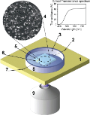
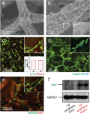
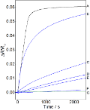
- 10.3762/bjnano.5.139 Abstract Ethanol is the preferred solvent for the formation of self-assembled monolayers (SAMs) of thiolates on gold. By applying a thin film sensor system, we could demonstrate that even the best commercial qualities of ethanol contain surface-active contaminants, which can compete
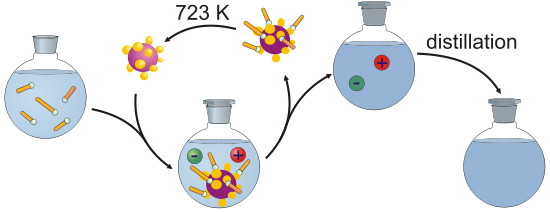
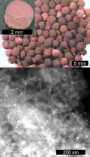
- with the desired thiolates for surface sites. Here we present that gold nanoparticles deposited onto zeolite X can be used to remove these contaminants by chemisorption. This nanoparticle-impregnated zeolite does not only show high capacities for surface-active contaminants, such as thiols, but can be
- bind strongly enough to replace most contaminants, making a thorough cleaning of the substrate unnecessary [4]. While this seems to be true for long-chained n-alkanethiols, which have been used (in combination with hydrogen plasma) to clean gold substrates [13], it has been reported for other systems

Electron-beam induced deposition and autocatalytic decomposition of Co(CO)3NO
Beilstein J. Nanotechnol. 2014, 5, 1175–1185, doi:10.3762/bjnano.5.129
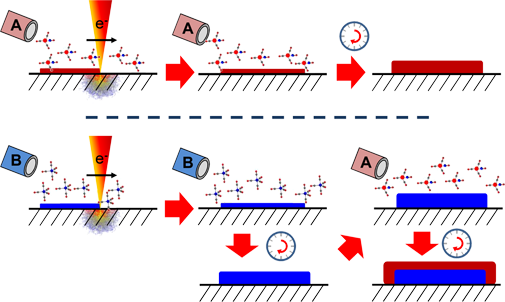
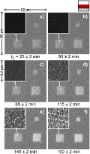
- contaminants in the deposit [21]. Based on the irradiation of cold (105 K) Co(CO)3NO films of about 2.5 nm thickness on amorphous carbon and Au substrates with 500 eV electrons under UHV conditions, the following decomposition mechanism was proposed [22]: At a low electron dose (<5 × 10¹⁶ e−/cm2), one or two




Highly NO2 sensitive caesium doped graphene oxide conductometric sensors
Beilstein J. Nanotechnol. 2014, 5, 1073–1081, doi:10.3762/bjnano.5.120
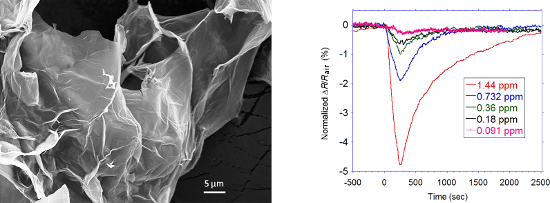
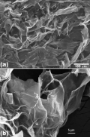
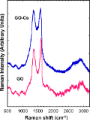
- ) confirms that the GO does not contain any contaminants and is largely oxidised with an oxygen content of ≈32%. A reduction of the oxygen content down to ≈24% is observed in the GO-Cs (Figure 3a, red line) survey spectrum, which confirm the presence of ≈5% Cs. In the high resolution XPS spectra of the C




Pyrite nanoparticles as a Fenton-like reagent for in situ remediation of organic pollutants
Beilstein J. Nanotechnol. 2014, 5, 855–864, doi:10.3762/bjnano.5.97
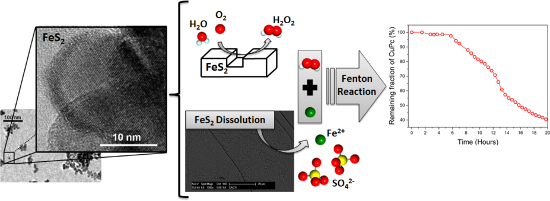
- growing interest in nanomaterials for green environmental remediation. For example, catalytically active synthetic nanoparticles inspired by natural minerals have been combined with in situ advanced oxidation processes (AOPs) as a potential strategy to remediate contaminants [1][2][3]. These AOPs generate
- ]. Practical interest in pyrite as a Fenton-type reagent depends on its capability to efficiently and sustainably generate H2O2 for oxidative degradation of contaminants. Figure 9 summarizes the proposed reaction mechanisms which are involved in the H2O2 generation and in the subsequent degradation of CuPc by
- 7, below [33]. In this sequence, Equation 5 and Equation 6 are the slowest and diminish the recycling between Fe2+ and Fe3+. Consequently, they form the rate-limiting step in the generation of free radical species and decrease the efficiency of the oxidative degradation of contaminants. When pyrite


Shape-selected nanocrystals for in situ spectro-electrochemistry studies on structurally well defined surfaces under controlled electrolyte transport: A combined in situ ATR-FTIR/online DEMS investigation of CO electrooxidation on Pt
Beilstein J. Nanotechnol. 2014, 5, 735–746, doi:10.3762/bjnano.5.86
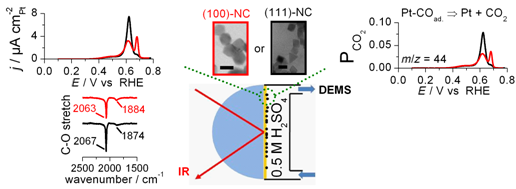
- reaction vessel was first cleaned by aqua regia to remove metal traces which could act as nucleation center, then with saturated alkaline solution to remove organic contaminants which could influence the growth process, and finally boiled in ultrapure water (MilliQ®, 18 MΩ cm). Briefly, the synthesis




A visible-light-driven composite photocatalyst of TiO2 nanotube arrays and graphene quantum dots
Beilstein J. Nanotechnol. 2014, 5, 689–695, doi:10.3762/bjnano.5.81
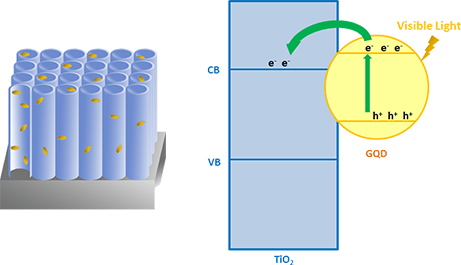
- % deionized (DI) water was used as electrolyte. Ti foil (2 cm × 3 cm) was used as a working electrode, and a Pt foil (1 cm × 1 cm) served as a counter electrode. Prior to anodization, Ti foils were washed with ethanol, acetone by ultrasonication to remove contaminants, subsequently rinsed with DI water and


Effects of the preparation method on the structure and the visible-light photocatalytic activity of Ag2CrO4
Beilstein J. Nanotechnol. 2014, 5, 658–666, doi:10.3762/bjnano.5.77
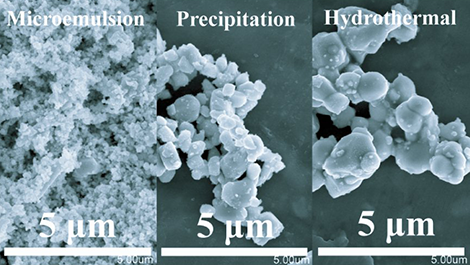
- contaminants both in air and aqueous solution. However, Ag2CrO4 is neglected although it has been explored as cathode for lithium cells in early years [37][38][39]. Actually, the band gap of Ag2CrO4 is narrow enough (about 1.75 eV) to obtain strong absorption in visible-light region [40], and thus may enable


Artificial sunlight and ultraviolet light induced photo-epoxidation of propylene over V-Ti/MCM-41 photocatalyst
Beilstein J. Nanotechnol. 2014, 5, 566–576, doi:10.3762/bjnano.5.67
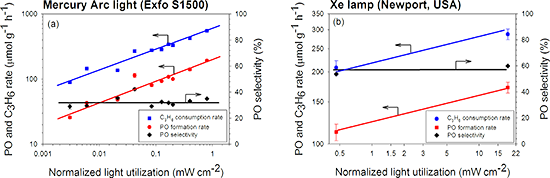
- electron–hole generation and consequently enhance the efficiency of the catalyst. This has been observed in the CO2 photo-reduction over Ag/TiO2 or TiO2 [11], the photo-degradation of 4-chlorophenol over TiO2 [12] and the photo-decomposition of organic contaminants over CaBi2O4 [13]. No previous study




Applicability and costs of nanofiltration in combination with photocatalysis for the treatment of dye house effluents
Beilstein J. Nanotechnol. 2014, 5, 476–484, doi:10.3762/bjnano.5.55
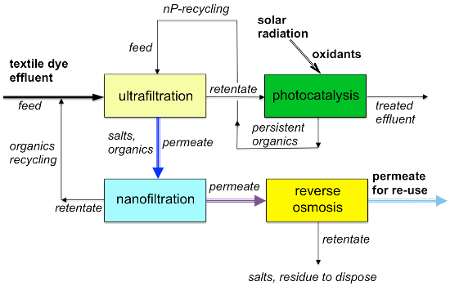
- membrane separation. Photocatalysis as the master process responsible for the reduction of organic and fouling matter with a nanofiltration and RO-step for further removal of residual contaminants. Nanofiltration as the master process responsible for the major reduction of colour and organic compounds


Plasma-assisted synthesis and high-resolution characterization of anisotropic elemental and bimetallic core–shell magnetic nanoparticles
Beilstein J. Nanotechnol. 2014, 5, 466–475, doi:10.3762/bjnano.5.54
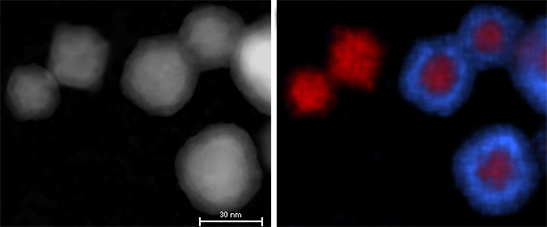
- ) and a transfer chamber (C), connected by two nozzles n1 and n2. Argon 5.0 (99.999%) is used as inert gas and additionally cleaned with an O2 purifier (Air Liquide) so that the final oxygen content in the stream falls below 0.1 ppm, the partial pressure of contaminants therefore being roughly the same


Extracellular biosynthesis of gadolinium oxide (Gd2O3) nanoparticles, their biodistribution and bioconjugation with the chemically modified anticancer drug taxol
Beilstein J. Nanotechnol. 2014, 5, 249–257, doi:10.3762/bjnano.5.27

- bioconjugate by HPLC The bioconjugate from other chemical contaminants was purified by HPLC (Waters model 2489 with UV–vis detector) by using Acetonitrile 5–95% on a C18 symmetry column. The compounds eluted from the columns were detected at 227 nm and 325 nm by using a dual wavelength detector. Results and


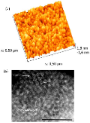
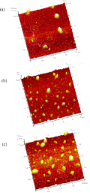
Study of mesoporous CdS-quantum-dot-sensitized TiO2 films by using X-ray photoelectron spectroscopy and AFM
Beilstein J. Nanotechnol. 2014, 5, 68–76, doi:10.3762/bjnano.5.6
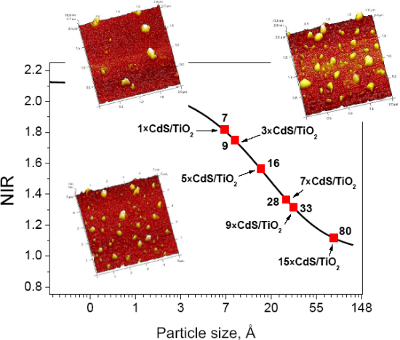
- under magnetic stirring at room temperature for 3 h before the films were spin-coated onto soda lime glass (SLG). Prior to use, the substrates were cleaned by ultrasonication (detergent, distilled water, acetone, ethanol, for 15 min in each medium) to remove hydrophobic contaminants at the surface and


Some reflections on the understanding of the oxygen reduction reaction at Pt(111)
Beilstein J. Nanotechnol. 2013, 4, 956–967, doi:10.3762/bjnano.4.108
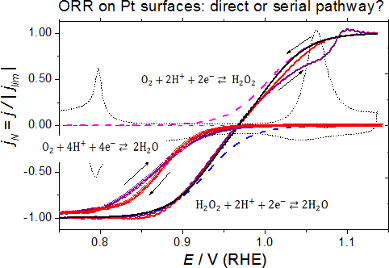
- in alkaline solutions deals with solution contaminants, which are more difficult to control than those in acidic solutions. This has been discussed in several cases and various interpretations were given. The first report on this problem was the result of a joint effort between Ulm and Alicante and


Evolution of microstructure and related optical properties of ZnO grown by atomic layer deposition
Beilstein J. Nanotechnol. 2013, 4, 690–698, doi:10.3762/bjnano.4.78
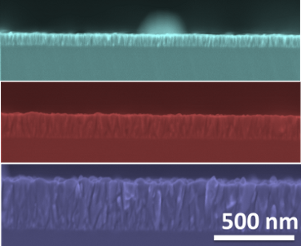
- obtained from the Korean MEMC company, ITO substrates from Sigma Aldrich, and glass substrates from RS (France) were used to prepare the samples for this study. In order to remove organic contaminants the substrates were pre-cleaned in acetone, ethanol and de-ionized water for 5 min. A tailored ALD reactor


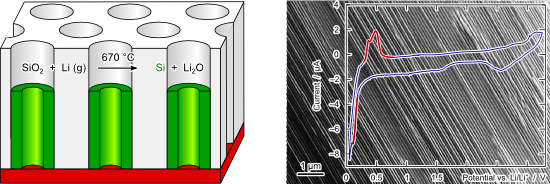
Preparation of electrochemically active silicon nanotubes in highly ordered arrays
Beilstein J. Nanotechnol. 2013, 4, 655–664, doi:10.3762/bjnano.4.73
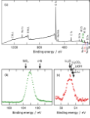
- contaminants. The Si 2p peak position of 102.2 eV (Figure 6b) unambiguously excludes a significant presence of either crystalline Si (99.3 eV) or SiO2 (103.3 eV) [25], in agreement with the 29Si NMR data. The peak position is compatible with amorphous silicon, the Si 2p XPS line of which has been found at a





Routes to rupture and folding of graphene on rough 6H-SiC(0001) and their identification
Beilstein J. Nanotechnol. 2013, 4, 625–631, doi:10.3762/bjnano.4.69
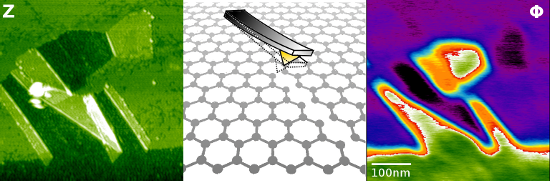
- ] imaging is performed simultaneously by applying an AC voltage of 1 V amplitude at a frequency of 1.2 kHz added to the DC bias regulated to minimize electrostatic forces. To remove volatile surface contaminants that can significantly influence LCPD measurements [25], the sample is heated in UHV to 500 K


Kelvin probe force microscopy of nanocrystalline TiO2 photoelectrodes
Beilstein J. Nanotechnol. 2013, 4, 418–428, doi:10.3762/bjnano.4.49
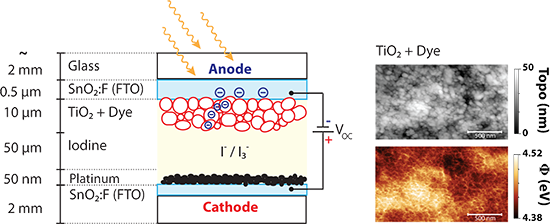
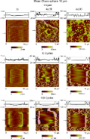
- , appear for both samples and are visible as dark regions in the measurements. They are highlighted in the cross sections in the lower part of the image. Such a local work function shift can be attributed to local variations of chemisorbed contaminants resulting in a decrease of the local vacuum energy
- , Evac, and the electron affinity, χ. A thin water layer consisting of chemisorbed and physisorbed H2O molecules on the nc-TiO2 is known to be present even inside a dry nitrogen glove box [44]. Solvent residues are further possible contaminants that can be locally attached to the TiO2 surface, or the
- -thienyl)-2,2′-bipyridine)2]+ [43]. In order to remove weakly adsorbed contaminants, the sensitized TiO2 was rinsed with ethanol and dried under nitrogen. Kelvin probe force microscopy AFM measurements were carried out inside a glove box (labmaster 130, mBraun) maintaining a dry nitrogen atmosphere (<1 ppm


Catalytic activity of nanostructured Au: Scale effects versus bimetallic/bifunctional effects in low-temperature CO oxidation on nanoporous Au
Beilstein J. Nanotechnol. 2013, 4, 111–128, doi:10.3762/bjnano.4.13
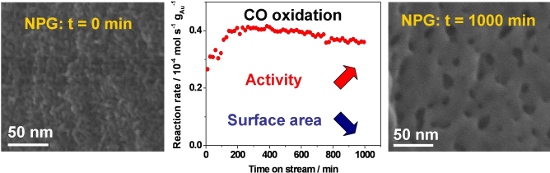
- activation to the removal of moisture in the pores or of contaminants stemming from the leaching process. The first suggestion, removal of moisture, appears to be unlikely considering the results of additional kinetic measurements performed in our laboratory, in which we used an additional drying


Growth behaviour and mechanical properties of PLL/HA multilayer films studied by AFM
Beilstein J. Nanotechnol. 2012, 3, 778–788, doi:10.3762/bjnano.3.87
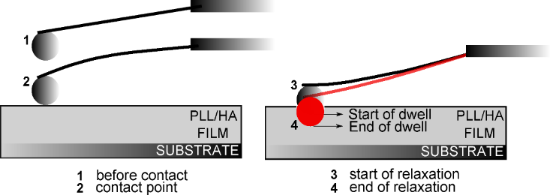
- order to get rid of any organic contaminants on their surface so that the glue spreads and adheres better. A two-component epoxy adhesive (UHU plus endfest 300, UHU GmbH, Bühl, Germany) was prepared and stored for 20 min under ambient conditions so that it is less fluid and easier to handle. The silica


Effect of spherical Au nanoparticles on nanofriction and wear reduction in dry and liquid environments
Beilstein J. Nanotechnol. 2012, 3, 759–772, doi:10.3762/bjnano.3.85
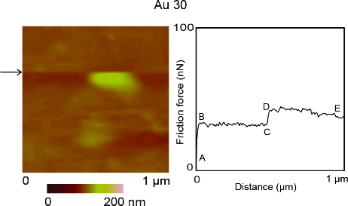
- include, but are not limited to, their use in targeted drug delivery and chemical sensors in the identification of oil, removal of contaminants and enhanced oil recovery (EOR). Au, iron oxide, polymer and silica nanoparticles have been studied in targeted drug delivery [3][4][5][6][7][8]. In cancer