


Search results
Search for "core–shell" in Full Text gives 259 result(s) in Beilstein Journal of Nanotechnology. Showing first 200.
Cationic PEGylated polycaprolactone nanoparticles carrying post-operation docetaxel for glioma treatment
Beilstein J. Nanotechnol. 2017, 8, 1446–1456, doi:10.3762/bjnano.8.144
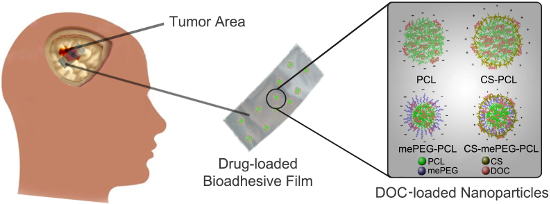
- treat brain tumors and prevent tumor recurrence. The aim of this study was to develop core–shell polymeric nanoparticles with positive charge by employing a chitosan coating. Additionally, an implantable formulation for the chemotherapeutic nanoparticles was developed as a bioadhesive film to be applied
- than 100 nm and a net positive surface charge to facilitate cellular internalization of drug-loaded nanoparticles. Hydroxypropyl cellulose films were prepared to incorporate these nanoparticle dispersions to complete the implantable drug delivery system. Results: The diameter of core–shell
- suggested to result in a more effective brain tumor treatment when compared to chemotherapeutics administered as an intravenous bolus infusion. Keywords: bioadhesive film; cationic nanoparticle; core–shell nanoparticle; docetaxel; glioma; Introduction A brain tumor is known as an abnormal growth of




Synthesis of [Fe(Leq)(Lax)]n coordination polymer nanoparticles using blockcopolymer micelles
Beilstein J. Nanotechnol. 2017, 8, 1318–1327, doi:10.3762/bjnano.8.133
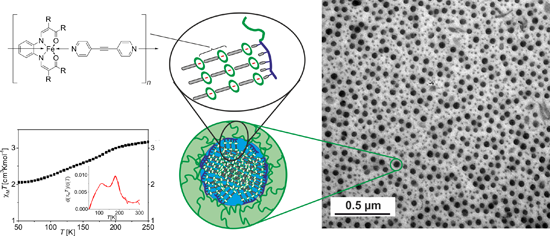
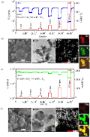
- (bpey)]n@BCP, five cycles) is given as typical representative of all samples. A detailed characterisation of all samples with TEM is given in Supporting Information File 1, Table S3. The TEM picture of 3e in Figure 2a clearly reveals the formation of spherical nanoparticles with a core–shell nature. The
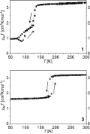
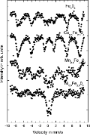
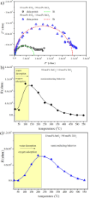
- with a Mythen 1K detector. Magnetic susceptibility data for the coordination polymers [FeLeq(bpea)]n (1) and [FeLeq(bpey)]n (3), which undergo spin crossover. Characterisation of CP–BCP composite micelles. a) TEM picture of 3e ([FeLeq(bpey)]n@BCP, five cycles) illustrating the core–shell nature of the



Fabrication of hierarchically porous TiO2 nanofibers by microemulsion electrospinning and their application as anode material for lithium-ion batteries
Beilstein J. Nanotechnol. 2017, 8, 1297–1306, doi:10.3762/bjnano.8.131
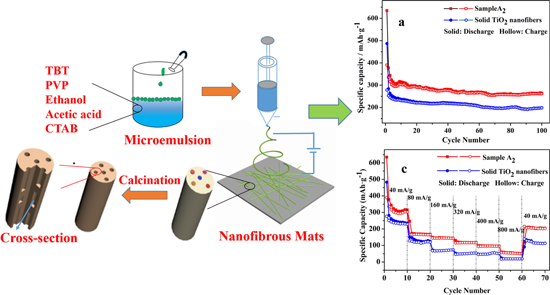
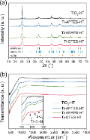
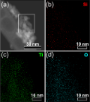
- widely used in fabricating various nanostructures. The structure of nanofibers can be conveniently adjusted by changing the experimental parameters, the composition of the precursor solution and the structure of the spinneret [23][24][25]. Core–shell nanofibers are normally prepared by coaxial
- electrospinning. However, coaxial electrospinning limits the further development of core–shell nanofibers because of its complicated spinneret, the limited number of suitable fluids and the unstable structure of the fibers. Recently the method of ME-ES has been developed to fabricate hierarchical nanofibers




Bright fluorescent silica-nanoparticle probes for high-resolution STED and confocal microscopy
Beilstein J. Nanotechnol. 2017, 8, 1283–1296, doi:10.3762/bjnano.8.130
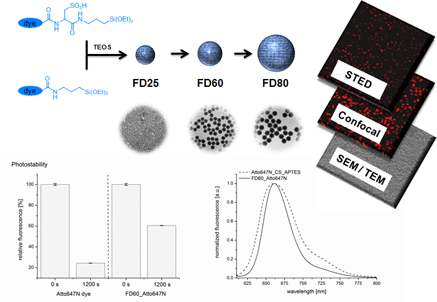
- fluorescence silica nanoparticles [36][37][38]. One of the most outstanding methods was developed by Wiesner et al., who designed new small fluorescent core–shell silica nanoparticles [39][40][41]. These so called “Cornell dots” (C-dots) have recently been approved as an "investigational new drug" (IND) by the
- nanoparticles (FD25_Atto647N): The synthesis of 25 nm large Atto647N dyed silica particles was realised analogous to the procedure described above. Only the temperature of the heating process was changed to 60 °C. Synthesis of fluorescent silica core–shell particles using multiple regrowth steps (FD45; FD60 and


Characterization of ferrite nanoparticles for preparation of biocomposites
Beilstein J. Nanotechnol. 2017, 8, 1257–1265, doi:10.3762/bjnano.8.127
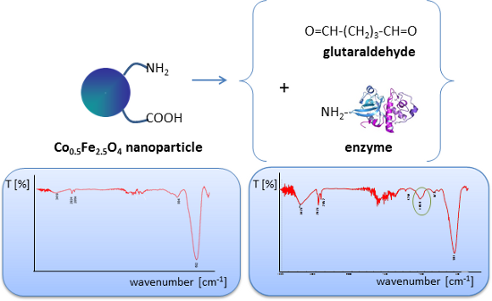
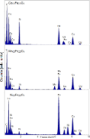
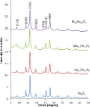
- papers, where core–shell ferrite nanoparticles were tested in similar manner [15][16]. Results and Discussion Characterization of ferrite nanoparticles Transmission electron microscopy (TEM) Each type of ferrite nanoparticle studied was imaged by TEM. The resulting pictures are collected in Figure 1. The



Evaluation of quantum dot conjugated antibodies for immunofluorescent labelling of cellular targets
Beilstein J. Nanotechnol. 2017, 8, 1238–1249, doi:10.3762/bjnano.8.125
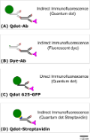
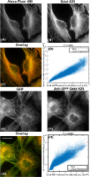
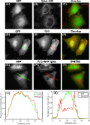
- equipment. We would also like to thank Dr Sumaira Ashraf for acquiring the TEM images of core/shell Qdot 625, Dr Mark Wilkinson for performing SEC-HPLC of Qdot 625-Ab, and Dr James Boyd for advice on FCS measurements of Qdot 625-Ab; all from University of Liverpool. The epifluorescence microscope used in




Synthesis of graphene–transition metal oxide hybrid nanoparticles and their application in various fields
Beilstein J. Nanotechnol. 2017, 8, 688–714, doi:10.3762/bjnano.8.74
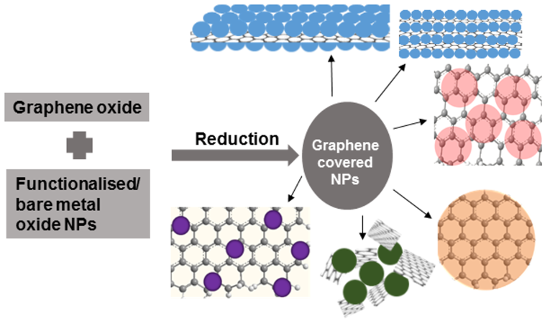
- @Fe2O3 core–shell NP–graphene hybrids which show good reversible lithium storage [160]. Another core–shell hollow nanomaterial, a γ-Fe2O3@graphene hybrid, was prepared through the Kirkendall process by Hu et al. and showed high performance as an anode material for LIBs [161]. The improved performance of
- the oxygen functional group of GO, leading to the formation of Zn–O–C bonds. During the reaction, sections of graphene detach from the GO through a layer-by-layer chemical peel-off process (chemical exfoliation) and partially encircle the ZnO NPs. The quasi-core–shell structure of the hybrid was






Gas sensing properties of MWCNT layers electrochemically decorated with Au and Pd nanoparticles
Beilstein J. Nanotechnol. 2017, 8, 592–603, doi:10.3762/bjnano.8.64
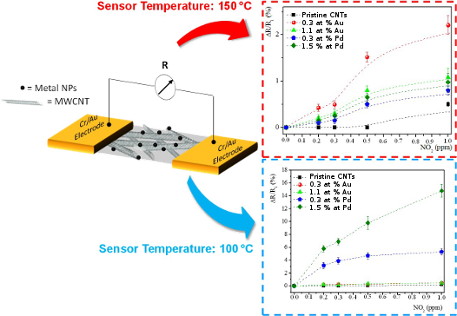
- detection in environmental monitoring. TEM images of electrochemically synthesized core–shell A) Au NPs and B) Pd NPs. Schematic view of the two-pole chemiresistor based on a MWCNT network functionalized with metal NPs. XPS core level spectrum of A) Au 4f and B) Pd 3d on functionalized MWCNTs. SEM images of


Modeling of the growth of GaAs–AlGaAs core–shell nanowires
Beilstein J. Nanotechnol. 2017, 8, 506–513, doi:10.3762/bjnano.8.54
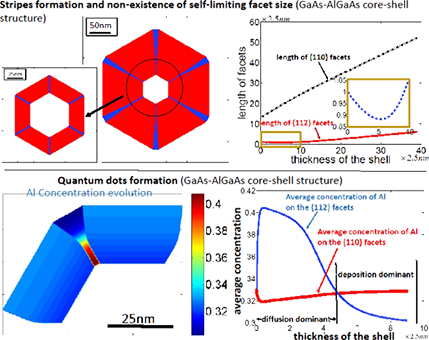
- 60208-3030, USA 10.3762/bjnano.8.54 Abstract Heterostructured GaAs–AlGaAs core–shell nanowires with have attracted much attention because of their significant advantages and great potential for creating high performance nanophotonics and nanoelectronics. The spontaneous formation of Al-rich stripes
- along certain crystallographic directions and quantum dots near the apexes of the shell are observed in AlGaAs shells. Controlling the formation of these core–shell heterostructures remains challenging. A two-dimensional model valid on the wire cross section, that accounts for capillarity in the faceted
- the attachment rate of Al atoms is smaller there. Keywords: core–shell nanowires; heterostructures; mechanisms; quantum dots; Findings Core–shell nanowires with heterostructures hold great promise in photonic and electronic applications because of their high sensitivity to electronic and magnetic


Self-assembly of silicon nanowires studied by advanced transmission electron microscopy
Beilstein J. Nanotechnol. 2017, 8, 440–445, doi:10.3762/bjnano.8.47
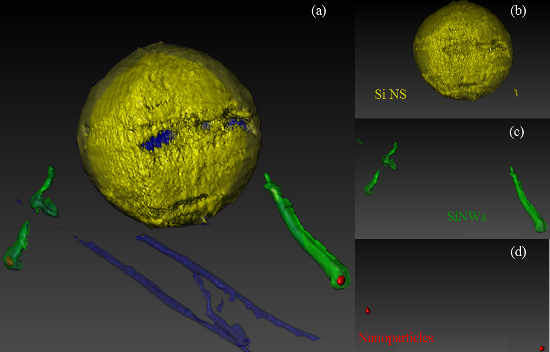
- of silicon nanowires (SiNWs) that were self-assembled during an inductively coupled plasma (ICP) process. The ICP-synthesized SiNWs were found to present a Si–SiO2 core–shell structure and length varying from ≈100 nm to 2–3 μm. The shorter SiNWs (maximum length ≈300 nm) were generally found to
- . Energy-filtered TEM (EFTEM) images, acquired in correspondence to the Si plasmon loss (17 eV) and SiO2 plasmon loss (23 eV), display a common core–shell Si–SiO2 internal structure for both the NSs and the NWs (see Figure 1b and Figure 1c). Further EFTEM investigations conducted on hundreds of NWs
- Visualiser Kai software was used for visualization. (a) Typical SEM image showing the morphology of the as-collected sample; EFTEM images obtained at (b) the Si plasmon loss (17 eV) and (c) the SiO2 plasmon loss (23 eV), revealing the Si–SiO2 core–shell structure and the structural continuity between the Si


Methods for preparing polymer-decorated single exchange-biased magnetic nanoparticles for application in flexible polymer-based films
Beilstein J. Nanotechnol. 2017, 8, 408–417, doi:10.3762/bjnano.8.43
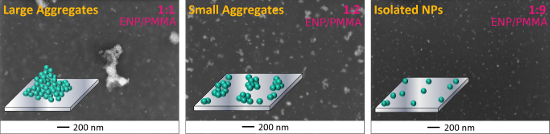
- for technological applications is of primary importance. Results: In this work, well-characterized exchange-biased perfectly epitaxial CoxFe3−xO4@CoO core@shell NPs, which were isotropic in shape and of about 10 nm in diameter, were decorated by two different polymers, poly(methyl methacrylate) (PMMA
- magnetic NPs to decrease interparticle interactions, particularly dipolar ones [7][8]. The general strategy for such a purpose consists of forming core–shell hybrid structures in which the shell consists of a corona of polymer chains grafted onto the inorganic NP surface. Among the available polymer
- C 1s peak prior to functionalization indicates that organic residues (polyol and acetate molecules) are present at the core–shell NP surface. The Co 2p and Fe 2p peaks are much weaker after polymerization due the presence of a significant polymer coating. The decomposition of the C 1s peak for


Functionalized TiO2 nanoparticles by single-step hydrothermal synthesis: the role of the silane coupling agents
Beilstein J. Nanotechnol. 2017, 8, 304–312, doi:10.3762/bjnano.8.33
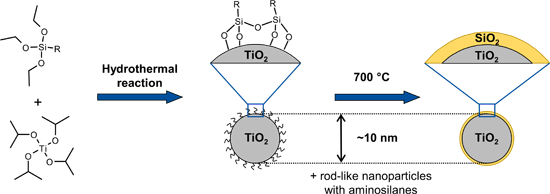
- route was demonstrated, and by selecting the type of silane coupling agent the surface properties of the TiO2 nanoparticles could be tailored. This synthesis route has been further developed into a two-step synthesis to TiO2–SiO2 core–shell nanoparticles. Combustion of the silane coupling agents up to
- 700 °C leads to the formation of a nanometric amorphous SiO2 layer, preventing growth and phase transition of the in situ functionalized nanoparticles. Keywords: core–shell nanoparticles; functionalized nanoparticles; hydrothermal synthesis; oriented attachment; silane coupling agent; Introduction
- , surface coverage, and hydrophobicity. Tuning the surface properties of the nanoparticles for different applications by selecting the silane coupling agent is discussed. We further report the effect of heat treatment of the nanoparticles for the formation of core–shell TiO2–SiO2 nanoparticles. Experimental



Phosphorus-doped silicon nanorod anodes for high power lithium-ion batteries
Beilstein J. Nanotechnol. 2017, 8, 222–228, doi:10.3762/bjnano.8.24
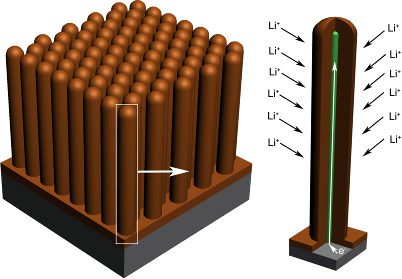
- the shell and the particles, allowing for the expansion of Si without deforming the carbon shell. Such an anode shows a capacity retention of 74% after 1000 cycles at a rate of C/10 [9]. Yang et al. fabricated a Si-based anode with a core–shell–shell heterostructure of Si nanoparticles as the core
- Figure 1b, it can be seen that the Si layer was totally amorphous. The structural information of the obtained Si anode was further identified by transmission electron microscopy (TEM). Figure 2a clearly shows that the Si was conformally coated on the CuO nanorods, resulting in a core–shell nanorod
- electrochemical performance of the obtained Si anode could be ascribed to the following factors. First, the transport paths for electrons and Li ions were significantly shortened in the nanorod core–shell-structured electrode. Then, the transport velocity for electrons and Li ions was enhanced by the phosphorus


Nanocrystalline TiO2/SnO2 heterostructures for gas sensing
Beilstein J. Nanotechnol. 2017, 8, 108–122, doi:10.3762/bjnano.8.12
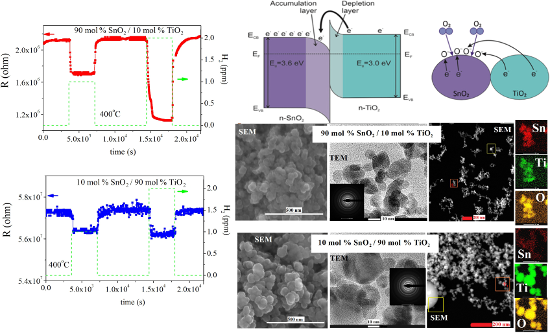
- as core–shell particles. Table 1 presents some of the examples of the latest papers dealing with TiO2–SnO2 materials for the detection of different gases. The performance of a resistive-type gas sensor is inherently related to the form and number of oxygen species adsorbed at the surface of the




From iron coordination compounds to metal oxide nanoparticles
Beilstein J. Nanotechnol. 2016, 7, 2074–2087, doi:10.3762/bjnano.7.198
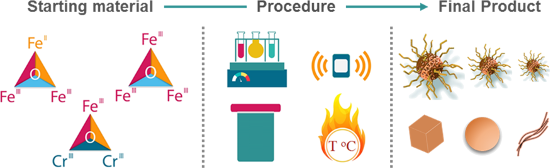
- appear as core–shell type materials, where the core has a higher contrast (indicating the presence of metal), and the shell has a lower contrast, characteristic for organic compounds (in this case, the stabilizer). In Figure 3a–c the TEM images are shown and the histograms of the distribution by diameter
- 3d). The core–shell morphology is visible in Figure 3c, with an inorganic core covered by the surfactant. Nanoparticle samples (NPT4) were obtained starting from a FeAc2 ([Fe3O(CH3COO)6(H2O)3]NO3∙4H2O) cluster. TEM observations (Figure 4) revealed particles in the form of spheres with hair-like


Organoclay hybrid materials as precursors of porous ZnO/silica-clay heterostructures for photocatalytic applications
Beilstein J. Nanotechnol. 2016, 7, 1971–1982, doi:10.3762/bjnano.7.188
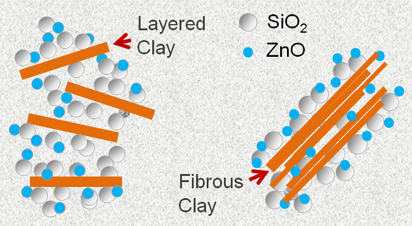
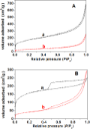
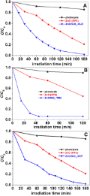
- may remain assembled to ZnO particles, perhaps organized even as core–shell structures (Figure 4C). EDX analysis of ZnO/silica-clay heterostructures shows the presence of Zn in a significant amount with respect to the Si content in all the samples. However, it is complicated to estimate the precise





Diameter-driven crossover in resistive behaviour of heavily doped self-seeded germanium nanowires
Beilstein J. Nanotechnol. 2016, 7, 1284–1288, doi:10.3762/bjnano.7.119
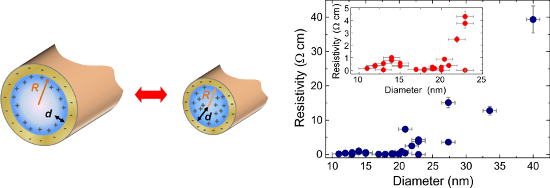
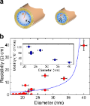
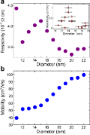
- ]. To describe our findings, we first recall that in self-seeded Ge NWs the majority charge carriers are free holes whose concentration depends on the number of charge traps at the NW core/shell interface [11][18]. In particular, for larger diameter NWs those free holes will be predominantly located in
- coordinates [20][21] and for simplicity assuming a constant free-hole concentration nh. One finds the expression [22] where Φ0 is the electrostatic potential at the core/shell interface, ε0 is the vacuum permittivity, εr the dielectric constant of germanium, and e the elementary charge. The confinement of
- free holes into the space-charge region close to the NW surface only, however, cannot remain for all diameters. The available volume for the free holes and the number of charge-traps at the core/shell interface scale with NW diameter. Therefore, with decreasing diameter the holes will extend further

Mesoporous hollow carbon spheres for lithium–sulfur batteries: distribution of sulfur and electrochemical performance
Beilstein J. Nanotechnol. 2016, 7, 1229–1240, doi:10.3762/bjnano.7.114
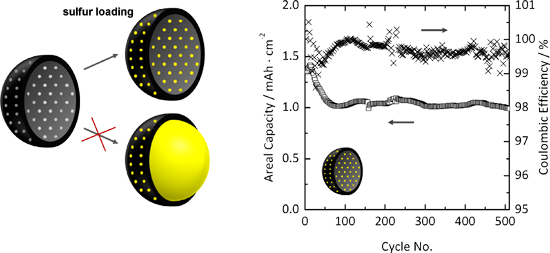
- mg·cm−2 was investigated. Results and Discussion Silica template and hollow carbon spheres Hollow carbon spheres with a mesoporous shell were obtained by impregnation of silica spheres with a core–shell structure with phenol and formaldehyde (first step in Figure 1). Carbonization under inert atmosphere
- [35]. In the second step a mesoporous shell was grown on the spheres by employing tetraethyl orthosilicate in presence of cetyltrimethylammonium bromide (CTAB) as a structure-directing agent. Combustion of CTAB in air generated the core–shell silica spheres. The diameter of the solid core was
- determined to be 380 nm by dynamic light scattering, while the diameter of the core–shell particles was about 515 nm. From SEM images (Figure S1 in Supporting Information File 1) a diameter of about 490 nm was determined for the core–shell spheres. Further characterization of the SCMS silica can be found in


Development of highly faceted reduced graphene oxide-coated copper oxide and copper nanoparticles on a copper foil surface
Beilstein J. Nanotechnol. 2016, 7, 1010–1017, doi:10.3762/bjnano.7.93
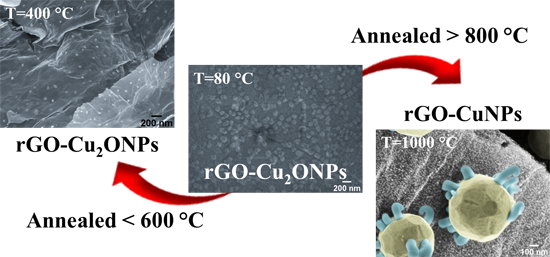
- the particle size and shape strongly depend on the process temperature. Characterization with transmission electron microscopy and scanning electron microscopy indicates that Cu or Cu2O nanoparticles take rGO sheets from the rGO network to form core–shell Cu–rGO or Cu2O–rGO nanostructures. It is noted
- ; copper(II) oxide; core–shell; reduced graphene oxide; Introduction In the last years, graphene oxide (GO) and reduced graphene oxide (rGO) have emerged as suitable candidates to prepare graphene-based nanocomposites [1][2], including those based on GO/inorganic nanoparticles [3]. The opportunity to
- or metal oxide nanoparticles [11]. In particular, rGO–Cu core–shell nanostructures have been synthesized by CVD [12][13], hydrothermal synthesis [14] and pyrolysis of an organocopper compound [15][16][17]. In a previous work, the authors reported the effective reduction of chemically exfoliated GO


Selective photocatalytic reduction of CO2 to methanol in CuO-loaded NaTaO3 nanocubes in isopropanol
Beilstein J. Nanotechnol. 2016, 7, 776–783, doi:10.3762/bjnano.7.69
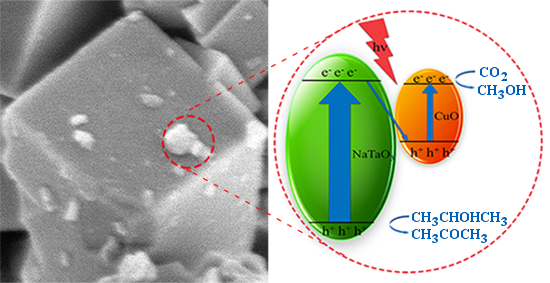
- irradiation at 25 °C. Ru-Shi Liu and co-workers [19] prepared a series of nanostructured core–shell materials (Ni@NiO/N-doped InTaO4 photocatalysts) for the reduction of CO2 to methanol in pure water. In these structures, the core–shell nanostructure might offer a new reaction center transferred from the


Early breast cancer screening using iron/iron oxide-based nanoplatforms with sub-femtomolar limits of detection
Beilstein J. Nanotechnol. 2016, 7, 364–373, doi:10.3762/bjnano.7.33
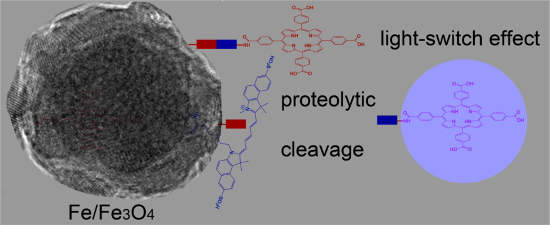
- is a vital strategy for early cancer detection. Water-dispersable Fe/Fe3O4-core/shell based nanoplatforms for protease detection are capable of detecting protease activity down to sub-femtomolar limits of detection. They feature one dye (tetrakis(carboxyphenyl)porphyrin (TCPP)) that is tethered to
- of detecting protease activities over a wide activity range down to sub-femtomolar LOD’s. These nanoplatforms consist of dopamine-covered, water-dispersable iron/iron oxide core/shell nanoparticles, to which one fluorescent dye (TCPP, tetrakis(carboxyphenyl)porphyrin) is tethered via a consensus
- central core/shell nanoparticle. For these specific consensus sequences, this effect exceeds the quenching effects (SET and FRET). Therefore, these two nanoplatforms show decreases of TCPP fluorescence upon cleavage. However, this decrease can still be utilized to measure the activities of uPA and MMP 9


Hydration of magnesia cubes: a helium ion microscopy study
Beilstein J. Nanotechnol. 2016, 7, 302–309, doi:10.3762/bjnano.7.28
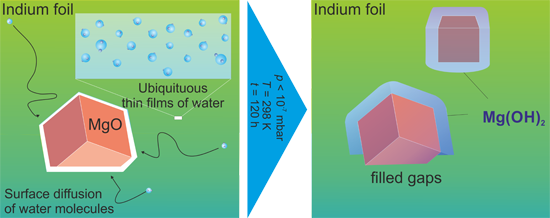
- , the MgO cubes have expanded presumably due to the formation of MgO/Mg(OH)2 core–shell structures, and a thick Mg(OH)2 layer coats the MgO cubes, leading to a partial fusion of the particles. As shown in Figure 3, the expansion of the MgO cubes is significant. We measured an average edge length
- substrate for imaging. Depending on their size the MgO-based cubes [21] become subject to significant volume expansion effects (up to a factor of 2.5) that are attributed to oxide transformation into hydroxides and the generation MgO/Mg(OH)2 core–shell structures as a result of the Kirkendall effect. These


Case studies on the formation of chalcogenide self-assembled monolayers on surfaces and dissociative processes
Beilstein J. Nanotechnol. 2016, 7, 263–277, doi:10.3762/bjnano.7.24
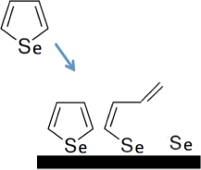
- chalcogenized interface layer on which molecules are then adsorbed. One can expect that capping nanoparticles with these molecules would lead to formation of metal–metal chalcogenide, core/shell nanoparticles, which has been shown to have interesting specific properties. In the case of chalcogenophene molecules


pH-Triggered release from surface-modified poly(lactic-co-glycolic acid) nanoparticles
Beilstein J. Nanotechnol. 2015, 6, 2504–2512, doi:10.3762/bjnano.6.260
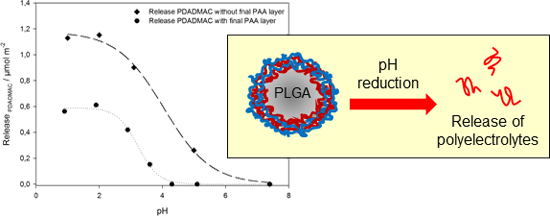
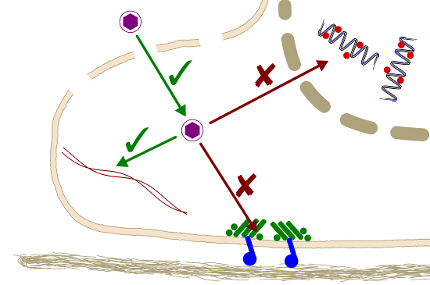
- . We present here the idea of a two-step delivery system consisting of core–shell nanoparticles. The outer shell is susceptible to changes of the pH value, such that the release of a membrane-toxic cationic compound is triggered by a reduced pH value in the endolysosomal compartment of the cells. The


Surface-enhanced Raman scattering by colloidal CdSe nanocrystal submonolayers fabricated by the Langmuir–Blodgett technique
Beilstein J. Nanotechnol. 2015, 6, 2388–2395, doi:10.3762/bjnano.6.245
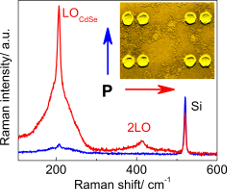
- previously observed for several CdSe-based NCs, including pure CdSe and core–shell CdSe/CdZnS NCs deposited on Au or Ag substrates of various morphology [20][21][22][23]. Resonant SERS enables the observation of LO phonon modes of the CdSe core in a monolayer of core–shell CdSe/ZnS NCs deposited on





