Search results
Search for "gain" in Full Text gives 466 result(s) in Beilstein Journal of Nanotechnology. Showing first 200.
The importance of design in nanoarchitectonics: multifractality in MACE silicon nanowires
Beilstein J. Nanotechnol. 2019, 10, 2094–2102, doi:10.3762/bjnano.10.204
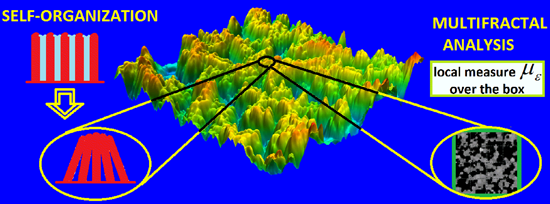
- (AFM). Among the scanning probe techniques, AFM shows a peculiar capability to quantitatively characterize features with nanoscaled dimensions. To gain insight over the emergence of the organized nanoarchitectures we applied multifractal analysis to the AFM images. We have found that a single fractal




Green and scalable synthesis of nanocrystalline kuramite
Beilstein J. Nanotechnol. 2019, 10, 2073–2083, doi:10.3762/bjnano.10.202
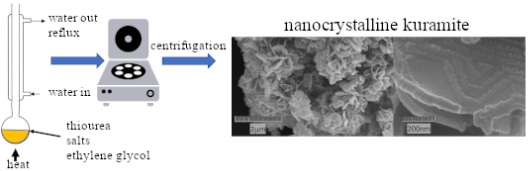
- , similar to that performed here, is necessary to gain a deeper understanding of the phase and chemical sample composition. On this basis, we were able to assign kuramite as the main phase in each sample with only a minor presence of associated phases in sample S3. We showed that to limit the amount of


Gold-coated plant virus as computed tomography imaging contrast agent
Beilstein J. Nanotechnol. 2019, 10, 1983–1993, doi:10.3762/bjnano.10.195
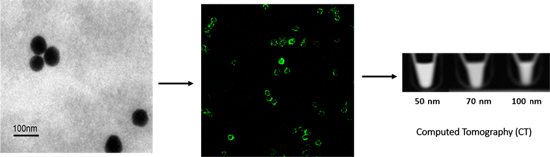
- with camera setting of 380 gain and shutter speed of 15 ms with auto particle detection settings. The instrument was calibrated with 100 nm standard polystyrene beads with known concentrations prior to sample recordings. Scanning transmission electron microscopy A FEI Titan 80-300 TEM/STEM (spherical




Porous silver-coated pNIPAM-co-AAc hydrogel nanocapsules
Beilstein J. Nanotechnol. 2019, 10, 1973–1982, doi:10.3762/bjnano.10.194
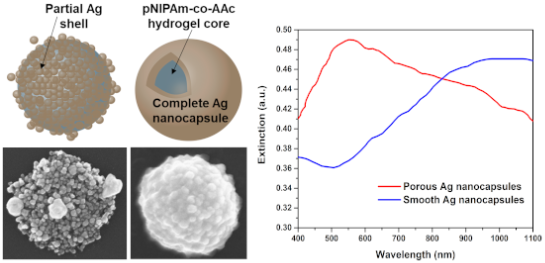
- , the structural morphology, and the optical absorption of the silver nanocapsules, as discussed in the following sections. Size and morphology of the pNIPAM-co-AAc hydrogel cores. SEM measurements were taken to determine the size of the hydrogel cores as well as to gain insight into the morphology of


Processing nanoporous organic polymers in liquid amines
Beilstein J. Nanotechnol. 2019, 10, 1844–1850, doi:10.3762/bjnano.10.179
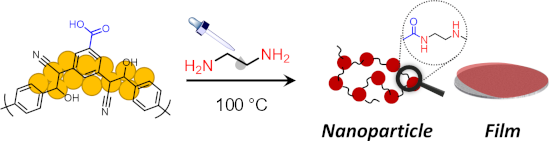
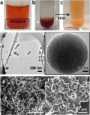
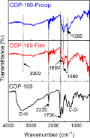
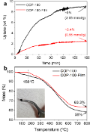
- EDA residue incorporated within the film. The final mass of the film at 800 °C was about 63%, which corresponds to the 5% mass gain compared to that of COP-100 at 800 °C (58%), indicating that the actual amount of EDA reacted with COP-100 was about 5% in mass. The film treated at 800 °C under inert



Toxicity and safety study of silver and gold nanoparticles functionalized with cysteine and glutathione
Beilstein J. Nanotechnol. 2019, 10, 1802–1817, doi:10.3762/bjnano.10.175
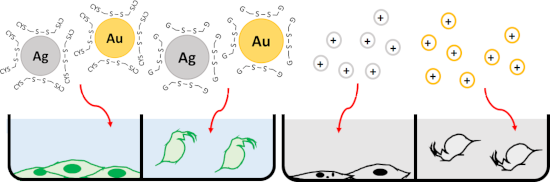
- were related to studies on the nano–bio interface between biothiols and AgNPs or AuNPs (Figure S1 in Supporting Information File 1). To gain further insight into the effect of biothiols on safety or toxicity of bioactive metallic NPs, this study aims to comprehensively investigate the mechanism of
- accumulation of CYS-AuNPs even in the cell nucleus (Figure 5), which can explain their genotoxicity and apoptosis induction ability (see discussion below). To gain better insight into the toxicity mechanism of silver and gold NPs and their counter ions, the percentage of live, early apoptotic and late


Biocatalytic oligomerization-induced self-assembly of crystalline cellulose oligomers into nanoribbon networks assisted by organic solvents
Beilstein J. Nanotechnol. 2019, 10, 1778–1788, doi:10.3762/bjnano.10.173
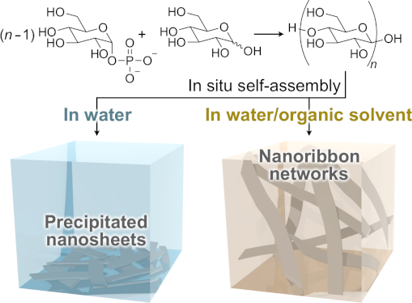
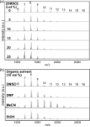
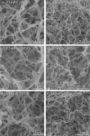
- . To gain insight into the mechanism underlying the nanoribbon network formation, we focused on the Kamlet–Taft solvent parameters, which are the most comprehensive and frequently used quantitative measure of solvent properties [58][59]. Among the three parameters, namely, the hydrogen bond donation





Synthesis of nickel/gallium nanoalloys using a dual-source approach in 1-alkyl-3-methylimidazole ionic liquids
Beilstein J. Nanotechnol. 2019, 10, 1754–1767, doi:10.3762/bjnano.10.171
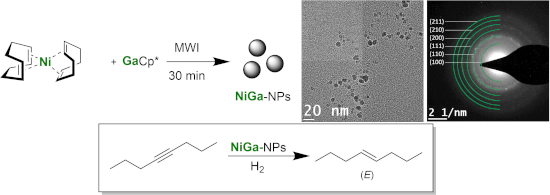
- deficient with a ratio of 28:72 atom % (±2 atom %). After 24 h of dispersion, the initial 1:1 ratio led to almost exclusively NiGa nanoparticles. Thus, a dispersion time of 24 h before microwave decomposition is needed to gain phase-pure NiGa nanoparticles without Ga(Ni) nanoparticles as by-products. We
- -decomposition yielded phase-pure NiGa nanoparticles of 5 ± 1 nm. In order to gain crystalline NiGa nanoparticles, 30 min of microwave-induced decomposition were found to be required. With dispersion times of 1 or 12 h before the microwave-induced decomposition, Ga(Ni) nanoparticles were formed as a by-product
- for a chosen time (30 min, 1 h, 12 h or 24 h) in the dried and desoxygenated IL or PC before microwave decomposition to gain 0.5–1.5 wt % dispersion of the nanoparticles. All precursor dispersions were decomposed at a power of 50 W to a temperature of 230 °C for a chosen time (10 min, 20 min, 30 min




Remarkable electronic and optical anisotropy of layered 1T’-WTe2 2D materials
Beilstein J. Nanotechnol. 2019, 10, 1745–1753, doi:10.3762/bjnano.10.170
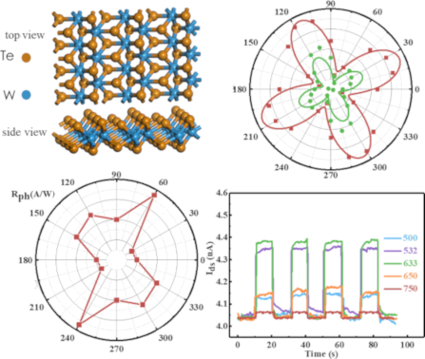
- parameters to be a ≈ 3.49 Å and b ≈ 6.32 Å, respectively, which are in excellent agreement with a previous report [28]. In order to gain further information on the crystal structure, Raman spectroscopy was performed on 1T’-WTe2 nanosheets, as shown Figure 1d. All of the peak positions are consistent with


Stationary beam full-field transmission helium ion microscopy using sub-50 keV He+: Projected images and intensity patterns
Beilstein J. Nanotechnol. 2019, 10, 1648–1657, doi:10.3762/bjnano.10.160
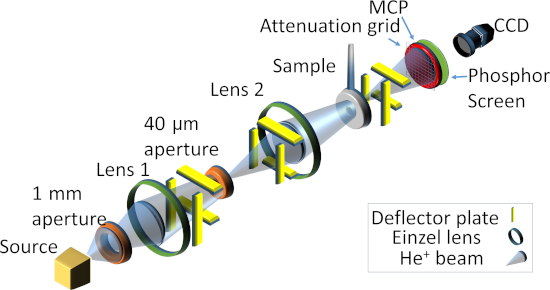
- there is potential to gain information about surface morphology from the spot patterns in deflected He+ ion images. The results presented here indicate that the final deflected intensity distribution in the far field carries contributions from sample morphology in addition to other possible phenomena


Development of a new hybrid approach combining AFM and SEM for the nanoparticle dimensional metrology
Beilstein J. Nanotechnol. 2019, 10, 1523–1536, doi:10.3762/bjnano.10.150
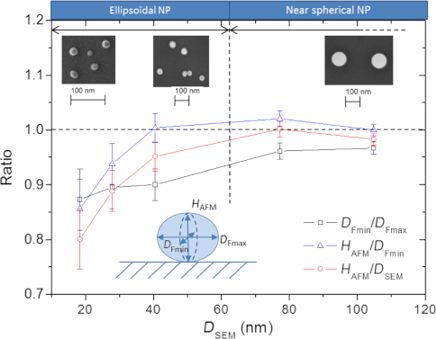
- -vibration table. The pixel size was set to 5.0 nm for all AFM measurements. Moreover, the scanning parameters are fixed regardless of the NP population under study. The scan speed is equal to 4 µm/s with constant PID parameters set at 0.8 for integral gain and 10 for the proportional one. Laboratory




Hierarchically structured 3D carbon nanotube electrodes for electrocatalytic applications
Beilstein J. Nanotechnol. 2019, 10, 1475–1487, doi:10.3762/bjnano.10.146
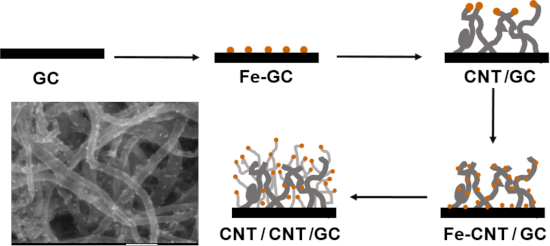
- ., colloidal synthesis [29][30][31], a galvanic replacement process [32][33][34][35] or microwave-assisted preparation [20][21][36], have been proposed to gain control over the structural features of the active nanoparticles. However, from heterogeneous catalysis it is generally known that a suitable catalyst
- between the conducting components [42][43][44][45]. The modification of the electronic and structural properties of Pt due to interaction with the support may also play a role. To take advantage of the properties of novel carbon materials, and at the same time gain control over the electrode structure
- reference experiments (not shown). Cyclohexane is brought into the CVD furnace using a H2/Ar gas mixture saturated at room temperature. To gain control over the CVD process, the influence of growth time, gas flow rate and H2/Ar ratio were studied. In a series of experiments, using a growth time of 120 min





Selective gas detection using Mn3O4/WO3 composites as a sensing layer
Beilstein J. Nanotechnol. 2019, 10, 1423–1433, doi:10.3762/bjnano.10.140
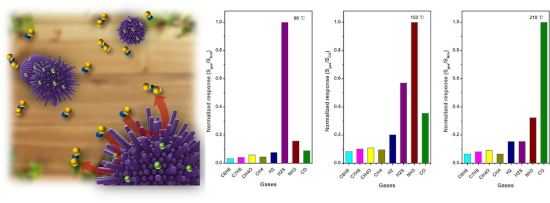
- nanoparticles increases further. Transmission electron microscopy (TEM) was employed to gain further insight into the crystallographic features of the Mn3O4/WO3 composites. Figure 3a exhibits a low-magnification TEM image of the 5 atom % Mn3O4/WO3 composite. The structural and crystallographic properties were


Nanoscale spatial mapping of mechanical properties through dynamic atomic force microscopy
Beilstein J. Nanotechnol. 2019, 10, 1332–1347, doi:10.3762/bjnano.10.132
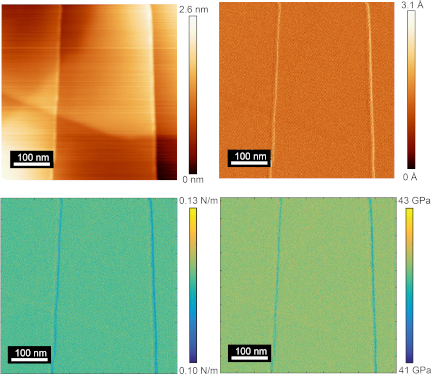
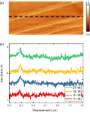
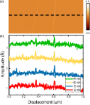
- be made in calibrating those results. To gain further insight into the amplitude and phase variations that were detected over covered and uncovered steps, line profiles were extracted along the dashed black lines in Figure 4c and Figure 4d in both forward and reverse scan directions. Figure 5a shows




Molecular attachment to a microscope tip: inelastic tunneling, Kondo screening, and thermopower
Beilstein J. Nanotechnol. 2019, 10, 1243–1250, doi:10.3762/bjnano.10.124
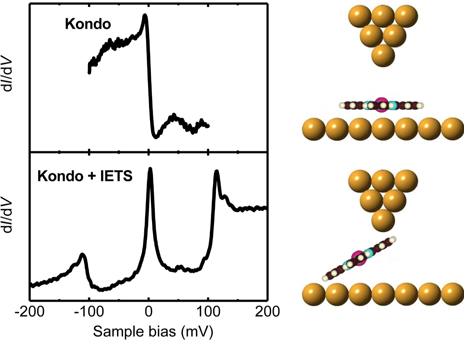
- tunneling through excitation of molecular vibration modes. Parameter-dependent transport in a molecular junction In order to gain additional information about the kinetics of carriers not contained in the current–voltage characteristics we want to evaluate the impact of the zero-bias peak on the thermopower


Pure and mixed ordered monolayers of tetracyano-2,6-naphthoquinodimethane and hexathiapentacene on the Ag(100) surface
Beilstein J. Nanotechnol. 2019, 10, 1188–1199, doi:10.3762/bjnano.10.118
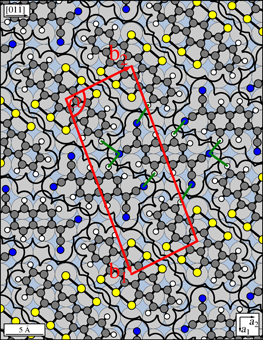
- intermolecular interactions compared to a commensurate structure. Briefly speaking, this is due to the fact that the lattice of the adsorbate and the substrate have less common Fourier components and that the energy gain related to the interfacial interactions is thus smaller [33]. STM images (Figure 4c) show
- transforms into a compressed structure of the point-on-line type with a by 9% smaller unit cell. Presumably, the related gain in the adsorption energy per area overcompensates the loss in interfacial energy due to the lifting of the registry of the structure with the substrate (commensurate/point-on-line


Tailoring the stability/aggregation of one-dimensional TiO2(B)/titanate nanowires using surfactants
Beilstein J. Nanotechnol. 2019, 10, 1024–1037, doi:10.3762/bjnano.10.103
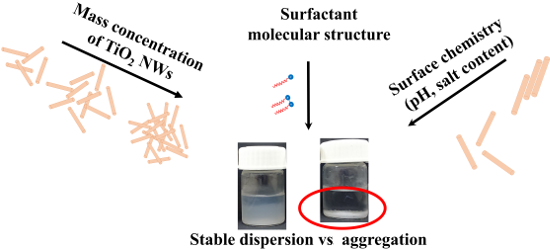
- behavior. In order to gain more insight into changes in the surface properties after surfactant adsorption on the TNW surface, a surface complexation model was employed. With this first attempt to quantify the contribution of the surfactant structure on the adsorption equilibrium according to the observed
- adsorption of the highest investigated monomer concentration of DTAB and 12-2-12 on TNWs led to charge reversal and the zeta potential became positive over the entire pH region studied. In order to gain insight into the adsorption of the applied surfactants on the TNW surface and the respective interfacial


In situ AFM visualization of Li–O2 battery discharge products during redox cycling in an atmospherically controlled sample cell
Beilstein J. Nanotechnol. 2019, 10, 930–940, doi:10.3762/bjnano.10.94
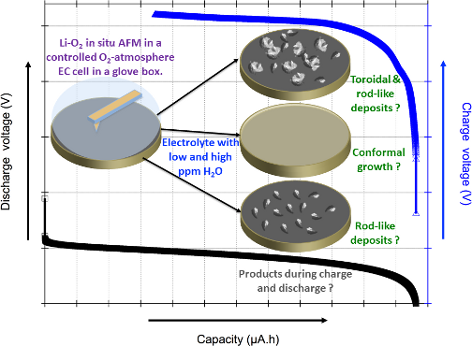
- electrons) and reduction (gain of electrons) reactions. Hence electrochemical phenomena form the basis of battery technologies that provide power to modern day mobile electronics. Being inherently atomic/molecular in origin, there has been significant interest in understanding electrochemical phenomena of


Nanoscale optical and structural characterisation of silk
Beilstein J. Nanotechnol. 2019, 10, 922–929, doi:10.3762/bjnano.10.93
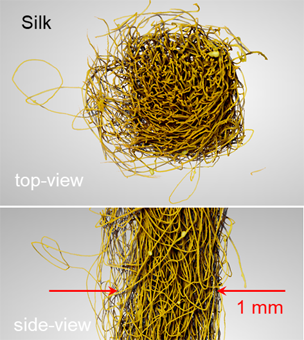
- properties of a material are interrelated. By using a wide spectrum of electromagnetic waves from visible light to terahertz radiation, it is possible to gain insights into complex hierarchical structures of composite materials. For materials with strong structural anisotropy, defined by the molecular
- -resolution technique is essential in order to gain a better understanding of the fibril structure of silk [8]. Experimental Silk slices White Bombyx mori cocoons were purchased from the silk rearing house in Jiangsu, China, and brown Antheraea pernyi silkworm cocoons were collected from Liaoning Province


Trapping polysulfide on two-dimensional molybdenum disulfide for Li–S batteries through phase selection with optimized binding
Beilstein J. Nanotechnol. 2019, 10, 774–780, doi:10.3762/bjnano.10.77
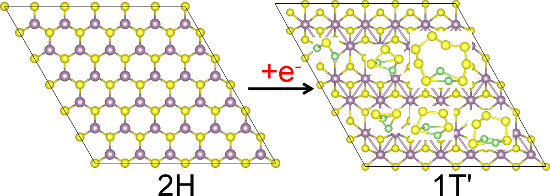
- charge gain and loss, respectively. It can be observed that there is charge depletion in Li2Sx and the 2H-MoS2 monolayer, and that charge accumulates between the Li atoms and the S atoms of 2H-MoS2, suggesting a chemical Li–S bond between Li2Sx and the 2H-MoS2 monolayer. With increasing x the charge
- green surfaces correspond to charge gain and loss, respectively. Isosurface (0.0005 e/Å3) of the charge distributions of Li2Sx absorbed on 1T'-MoS2 monolayer. The red and green surfaces correspond to charge gain and loss, respectively. Acknowledgements This work was financially supported by the


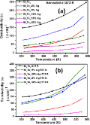
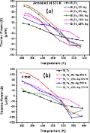
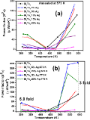
Enhancement in thermoelectric properties due to Ag nanoparticles incorporated in Bi2Te3 matrix
Beilstein J. Nanotechnol. 2019, 10, 634–643, doi:10.3762/bjnano.10.63
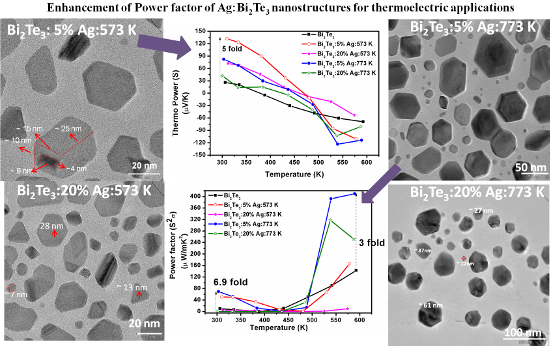
- conduction transition. In order to gain further knowledge about phase transitions and carrier types, further studies such as synchrotron powder X-ray diffraction, heat capacity, Raman spectroscopy, Hall effect and or positron annihilation spectroscopy measurements would be required, which can be the part of



Quantification and coupling of the electromagnetic and chemical contributions in surface-enhanced Raman scattering
Beilstein J. Nanotechnol. 2019, 10, 549–556, doi:10.3762/bjnano.10.56
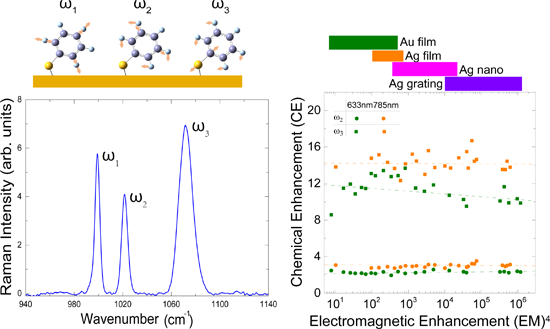
- systematic approach based on engineered substrates covering a wide range of enhancement values to gain access to the relative contributions of chemical and electromagnetic enhancement in SERS. It allows one to extract and distinguish values of the relative chemical enhancement, ranging from 2 to 14, for


Mo-doped boron nitride monolayer as a promising single-atom electrocatalyst for CO2 conversion
Beilstein J. Nanotechnol. 2019, 10, 540–548, doi:10.3762/bjnano.10.55
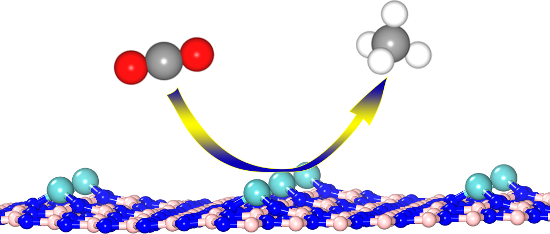
- ) is the Mo atom and the three N atoms that the Mo atom linked with, and BN monolayer (moiety 3), as shown in Figure 5a. The variation of the charge distribution is illustrated in Figure 5b. The step 0 is the charge transfer to the adsorbed CO2. The CO2 molecule and the MoN3 gain 0.482 and 0.018


Nanocomposite–parylene C thin films with high dielectric constant and low losses for future organic electronic devices
Beilstein J. Nanotechnol. 2019, 10, 428–441, doi:10.3762/bjnano.10.42
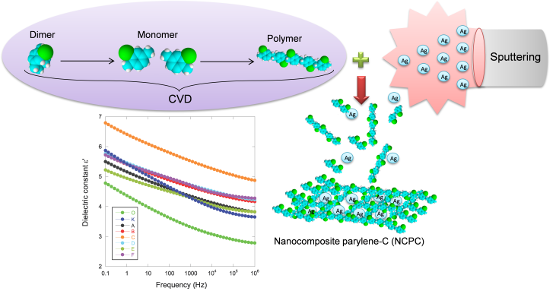
- final result, a gain in the gate insulation capacitance is expected for OFETs with the addition of conductive particles inside the native parylene C insulating gate. Results and Discussion Silver-PPXC co-deposition: film composition and structure Table 1 gives the experimental parameters of deposited
- constant ε’HF (value at 1 MHz); b) the dielectric strength Δε. Frequency dependence of the dissipation factor for pure parylene C and NCPC samples. Electrical conductivity of pure parylene C and NCPCs. Gain in the gate insulation capacitance by replacing conventionally processed parylene C (sample O) with
- plasma-combined CVD process incorporating silver-oxide nanoparticles. Accuracy in the gain due to geometric dimensions of samples is in the range ±0.1 (sample F) to ±0.18 (sample C). Depostion of nanocomposite–parylene C (NCPC) by a combined CVD and RF sputtering technique. Experimental parameters of




Biocompatible organic–inorganic hybrid materials based on nucleobases and titanium developed by molecular layer deposition
Beilstein J. Nanotechnol. 2019, 10, 399–411, doi:10.3762/bjnano.10.39
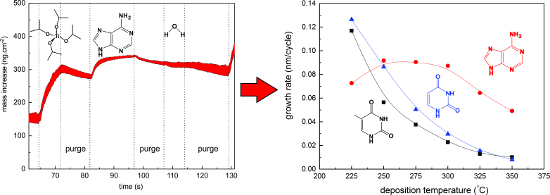
- mass increase during pulsing of uracil and adenine is hardly notable in comparison to what is observed when thymine is pulsed. However, the overall growth is not determined by what is gained during an individual pulse, but its overall gain during a complete cycle. In an initial attempt to explain the
- gain of one organic molecule. The mass of isopropanol is 60.10 u, while thymine, uracil and adenine is 126.12, 112.08 and 135.13 u, respectively, approximately twice that of isopropanol. Based on the QCM long-pulse sequences, the overall mass gain during pulsing of any of the organic molecules is