Search results
Search for "mass spectrometry" in Full Text gives 163 result(s) in Beilstein Journal of Nanotechnology.
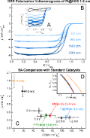
Shape-selected nanocrystals for in situ spectro-electrochemistry studies on structurally well defined surfaces under controlled electrolyte transport: A combined in situ ATR-FTIR/online DEMS investigation of CO electrooxidation on Pt
Beilstein J. Nanotechnol. 2014, 5, 735–746, doi:10.3762/bjnano.5.86
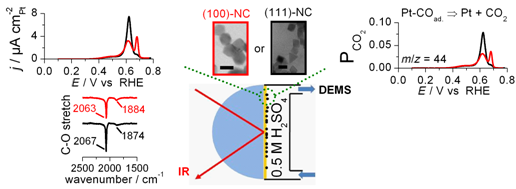
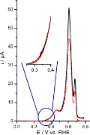
- spectroscopy of adsorbed reaction intermediates and side products in an attenuated total reflection configuration (ATR-FTIRS) and differential electrochemical mass spectrometry (DEMS) measurements of volatile reaction products. Batches of shape-selected Pt nanocrystals with different shapes and hence different
- flat side of an IR-transparent reflecting element, as had been demonstrated, e.g., for Pt [12][16][17] or Au [18][19] films. We had later shown that in this geometry the reaction cell can be coupled in addition with a DEMS (differential electrochemical mass spectrometry) setup, allowing electrochemical
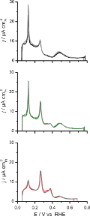
- . Finally, the difference in anion re-adsorption for the three different samples illustrates also the structure sensitivity of this process. Conclusion Employing in situ ATR-FTIR spectroscopy and mass spectrometry in a combined ATR-FTIR/DEMS flow cell set-up, we could demonstrate that shape-selected and




Chemi- vs physisorption in the radical functionalization of single-walled carbon nanotubes under microwaves
Beilstein J. Nanotechnol. 2014, 5, 537–545, doi:10.3762/bjnano.5.63
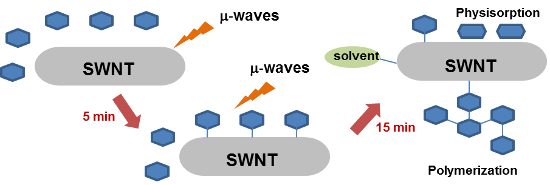
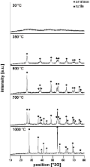
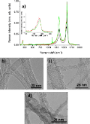
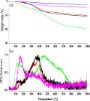
- (chemical formula) of the adsorbed/grafted functional groups was determined. According to thermogravimetric analysis coupled with mass spectrometry and Raman spectroscopy, the optimal functionalization level was reached after 5 min of reaction. Prolonged reaction times can lead to undesired reactions such
- microwave-assisted diazonium chemistry [31][32], chlorophenyl groups were grafted at the CNT surface and the functionalization level was followed by thermogravimetric analysis coupled with mass spectrometry (TGA–MS) (Scheme 1). The present work highlights the importance of controlling the reaction times
- means of mass spectrometry data (see Figure 4). As expected, the raw SWNTs bear very few surface groups and thus progressively lost 2.2 wt % during heating under helium. Table 1 recalls the weight losses corresponding to i) the low temperature range (below 200 °C) assigned to the departure of the groups




Mesoporous cerium oxide nanospheres for the visible-light driven photocatalytic degradation of dyes
Beilstein J. Nanotechnol. 2014, 5, 517–523, doi:10.3762/bjnano.5.60
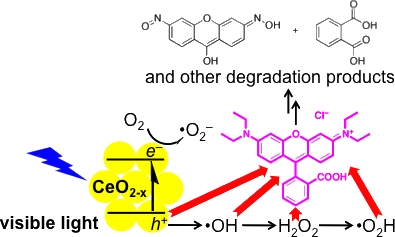
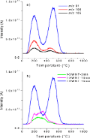
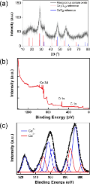
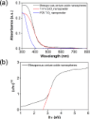
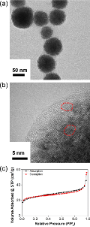
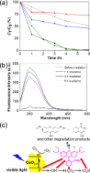
- under visible light and ambient conditions after equilibration, and the activity cannot be accounted to the presence of CeO2 or adsorption alone. Gas chromatography mass spectrometry (GC–MS) and electrospray ionisation mass spectrometry (ESI–MS) were used to identify some of the organic products during

3D-nanoarchitectured Pd/Ni catalysts prepared by atomic layer deposition for the electrooxidation of formic acid
Beilstein J. Nanotechnol. 2014, 5, 162–172, doi:10.3762/bjnano.5.16
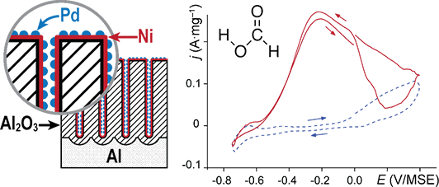
- quadrupole mass spectrometry (QMS) [35]. Since the precursors used for this deposition are close to those employed in the present study, the Martinson mechanism may be adapted to the deposition of NiO using NiCp2 and O3. Therefore, the S1 period could be ascribed to the adsorption of NiCp2 on the whole


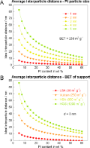
Design criteria for stable Pt/C fuel cell catalysts
Beilstein J. Nanotechnol. 2014, 5, 44–67, doi:10.3762/bjnano.5.5




Simulation of electron transport during electron-beam-induced deposition of nanostructures
Beilstein J. Nanotechnol. 2013, 4, 781–792, doi:10.3762/bjnano.4.89
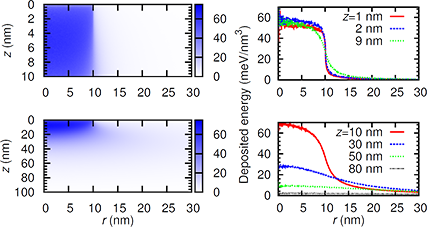
- ., amorphous tungsten oxycarbides with varying carbon and oxygen contents. W(CO)6 belongs to the class of organometallic compounds that are well established for the EBID process [14][15][16]. It has been studied in detail by mass spectrometry [17][18][19] and photoelectron or photoionization spectroscopy [20

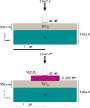


Site-selective growth of surface-anchored metal-organic frameworks on self-assembled monolayer patterns prepared by AFM nanografting
Beilstein J. Nanotechnol. 2013, 4, 638–648, doi:10.3762/bjnano.4.71
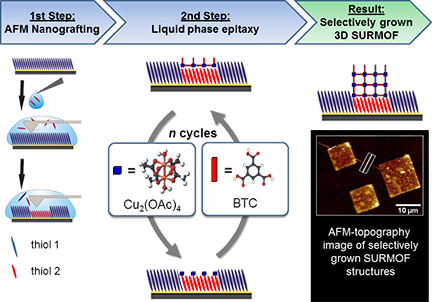
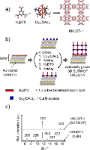
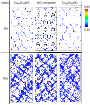
- growth of the SURMOF is observed. In the latter case the roughness of the HKUST-1 is found to be significantly higher than for the 1-mercaptopropionic acid. The successful grafting process was verified by time-of-flight secondary ion mass spectrometry and atomic force microscopy. The SURMOF structures
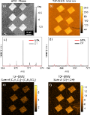
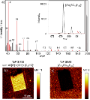
- . In addition to the AFM investigations, which provided information about topography and material contrast of the grafted sample, a chemical characterization was carried out by time-of-flight secondary ion mass spectrometry (ToF-SIMS). For that purpose a sample with grafted rectangular structures of 10
- pixel FPA detector sensitive to a range of 900–3800 cm−1 was used. 4096 spectra were aquired in one measurement over a field of view of 32 × 32 µm, 4 × 64 scans were collected over an area of 64 × 64 µm with a spectral resolution of 4 cm−1. ToF-SIMS Time-of-flight secondary ion mass spectrometry was





Nanoglasses: a new kind of noncrystalline materials
Beilstein J. Nanotechnol. 2013, 4, 517–533, doi:10.3762/bjnano.4.61
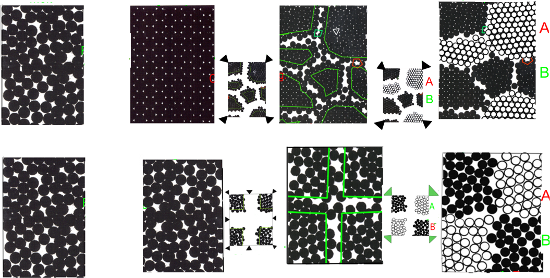
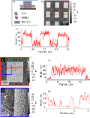
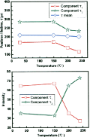
- nanoglass, the formation of such a by-product did not occur. His conclusion was suggested by the fact that the by-products were not detected at all by gas-chromatography–mass-spectrometry. Moreover, the oxidation process seems to have occurred exclusively at the surface of the Au52Ag5Pd2Cu25Si10Al6






Continuous parallel ESI-MS analysis of reactions carried out in a bespoke 3D printed device
Beilstein J. Nanotechnol. 2013, 4, 285–291, doi:10.3762/bjnano.4.31
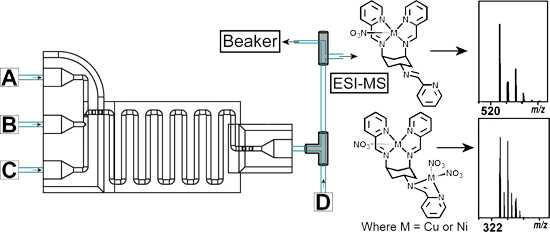
- purity. Electrospray ionisation mass spectrometry (ESI-MS) is an excellent analytical tool for flow chemistry due to its high sensitivity, allowing for low sample concentrations and production of structural information that you may not get from other techniques. There are several reports in which ESI-MS
- form the species Cu(C24H24N6)(NO3)]+ (1), m/z 521.1, which can be observed in the mass spectrometry data approximately 5 min after initiation. Analysis of the continuous parallel ESI-MS data collected showed both the species [Ni(C24H24N6)(NO3)]+ (2), m/z 516.1, and [Cu(C24H24N6)(NO3)]+ (1), m/z 521.1


Diamond nanophotonics
Beilstein J. Nanotechnol. 2012, 3, 895–908, doi:10.3762/bjnano.3.100
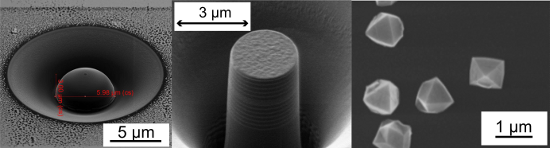
- decrease of the nickel signal after lowering the argon flux at both 40 min and 50 min indicates the absence of unwanted hysteresis effects. 5.3 Verification of nickel incorporation The incorporation of nickel into the as-grown diamond layers was verified by secondary ion mass spectrometry (SIMS). An



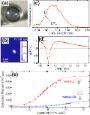
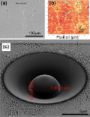


Magnetic-Fe/Fe3O4-nanoparticle-bound SN38 as carboxylesterase-cleavable prodrug for the delivery to tumors within monocytes/macrophages
Beilstein J. Nanotechnol. 2012, 3, 444–455, doi:10.3762/bjnano.3.51
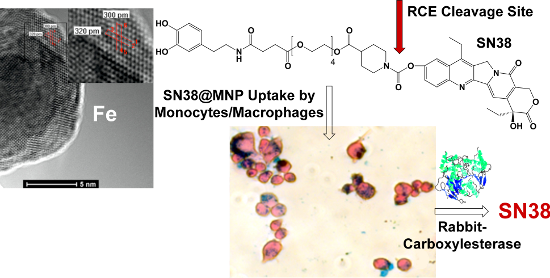
- of the hydroxyl groups by Pd/C-catalyzed hydrogenation, and was used as ligand II to incorporate SN38 to the MNPs. Compound 13 was fully characterized with 1H NMR, 13C NMR, and mass spectrometry. Loading SN38 to Fe/Fe3O4 magnetic nanoparticles (MNPs) Loading of SN38 to core/shell Fe/Fe3O4 magnetic
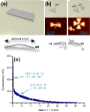
- -binding SN38 prodrug was achieved in a 10-stage synthesis with overall 32% yield. The final product was fully characterized by 1H NMR, 13C NMR, and mass spectrometry. Characterization of the nanoparticles Figure 1a shows a low-resolution transmission electron microscope (TEM) image of the nanoparticles


Femtosecond time-resolved photodissociation dynamics of methyl halide molecules on ultrathin gold films
Beilstein J. Nanotechnol. 2011, 2, 618–627, doi:10.3762/bjnano.2.65
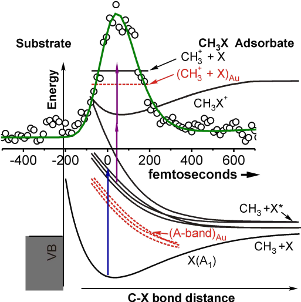
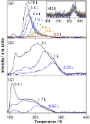
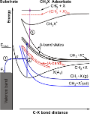
- chloride, adsorbed on a metal surface was investigated in real time by means of femtosecond-laser pump–probe mass spectrometry. A weakly interacting gold surface was employed as substrate because the intact adsorption of the methyl halide molecules was desired prior to photoexcitation. The gold surface was
- at all. Keywords: femtosecond laser spectroscopy; gold; methyl halide photodissociation; surface chemistry; time-of-flight mass spectrometry; Introduction The understanding of the mechanisms involved in the light-induced excitation and fragmentation of organic molecules on metal substrates is of
- free molecule [3] cannot be energetically lowered enough to become accessible to the 4.7 eV photons of the 266 nm pump laser beam. Conclusion The present investigation demonstrates that time resolved pump–probe fs-laser time-of-flight mass spectrometry is able to probe the photodissociation dynamics of


Nanostructured, mesoporous Au/TiO2 model catalysts – structure, stability and catalytic properties
Beilstein J. Nanotechnol. 2011, 2, 593–606, doi:10.3762/bjnano.2.63
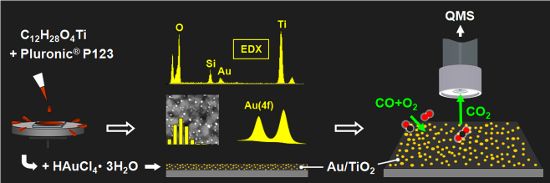
- room temperature, and in particular on ii) exploring the role of transport effects in these films on the reaction characteristics, both by locally resolved measurements on microstructured samples by means of higher resolution scanning mass spectrometry and by time-resolved measurements, e.g., in a