


Search results
Search for "material properties" in Full Text gives 196 result(s) in Beilstein Journal of Nanotechnology.
Mandibular gnathobases of marine planktonic copepods – feeding tools with complex micro- and nanoscale composite architectures
Beilstein J. Nanotechnol. 2015, 6, 674–685, doi:10.3762/bjnano.6.68
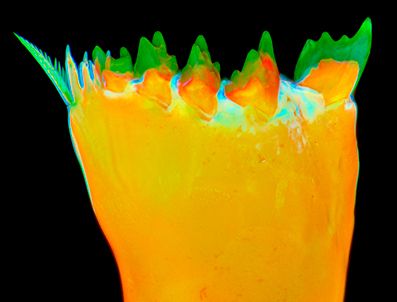
- decades ago the application of simple preparation methods and microscopy techniques resulted in the assumption that such teeth are composed of silica [27]. However, it was not until many years later that the presence of gnathobase tooth structures with similar material properties was mentioned and
- gradient in the material properties) can make these systems more resistant to damage and wear because such an architecture minimises the probability of local stress concentrations and, in the case of an initial damage, prevents further crack propagation [47][48]. It is conceivable that the soft and elastic


Tm-doped TiO2 and Tm2Ti2O7 pyrochlore nanoparticles: enhancing the photocatalytic activity of rutile with a pyrochlore phase
Beilstein J. Nanotechnol. 2015, 6, 605–616, doi:10.3762/bjnano.6.62
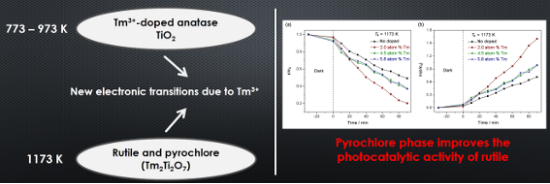
- as those reported for other ions (of up to 10 atom %) because the Tm3+ ion is substantially larger than the Ti4+ ion that it replaces in the crystalline lattice, as will be discussed below. The atomic percentage values are used in the discussion below to determine the dependence of the material
- properties on the doping concentration. X-ray diffraction Figure 1 shows the XRD patterns of the synthesized samples. In accordance with the references, JCPDS 21-1272 for anatase and JCPDS 21-1276 for rutile, the peaks of both phases of TiO2 are identified in Figure 1. The samples annealed at 773 K were


Biological responses to nanoscale particles
Beilstein J. Nanotechnol. 2015, 6, 380–382, doi:10.3762/bjnano.6.37

- characterization of nanoparticles using state-of-the-art technologies were paramount in order to assess their biological action. Moreover, the aim was to correlate detailed material properties with their biological effects in order to elucidate the biological response to the material challenge. The nanoparticles
Dynamic force microscopy simulator (dForce): A tool for planning and understanding tapping and bimodal AFM experiments
Beilstein J. Nanotechnol. 2015, 6, 369–379, doi:10.3762/bjnano.6.36
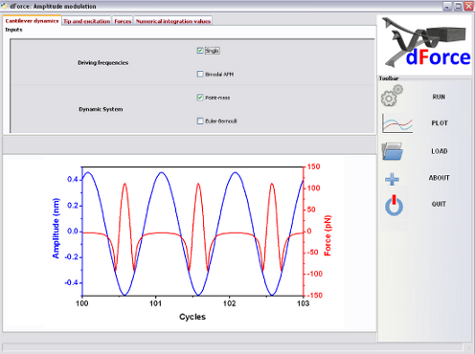
- material properties [25][26][27] in obtaining the maximum force. Simulations can generate maps that provide the estimation of the peak forces for a large variety of conditions [27][28]. The range of applicability of the force reconstruction methods has also been verified by numerical simulations [29]. The
- mode is the observable used in heterogeneous samples to separate regions of different material properties. Figure 7 shows the dependence of the phase shift as a function of the set-point amplitude and the material properties (changes in the Hamaker constant). The phase shift (attractive regime) has a
- years on a wide variety of different AFM conditions. The simulator will help to clarify and understand any arising complexity in the tip motion found in both amplitude modulation and bimodal AFM and, in the process, to establish the relationship between material properties, forces and observables for a




Kelvin probe force microscopy in liquid using electrochemical force microscopy
Beilstein J. Nanotechnol. 2015, 6, 201–214, doi:10.3762/bjnano.6.19
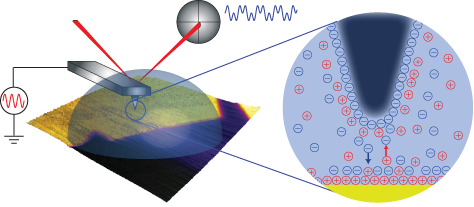
- necessitates the development of characterization techniques capable of operating in ionically-active liquids across multiple length scales from a single step edge or point defect up to the device level. While macroscopic electrochemical measurements are capable of probing material properties on the device
- technique of material-dependent electrostatic and electrochemical response is investigated. The resultant high dimensional dataset is visualized using a purely statistical approach that does not require a priori physical models, allowing for qualitative mapping of electrostatic and electrochemical material
- properties at the solid–liquid interface. Keywords: diffuse charge dynamics; double layer charging; electrochemical force microscopy; electrochemistry; Kelvin probe force microscopy; Introduction Many important physical, chemical and biological processes including wetting, adsorption, electronic transfer


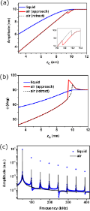
![[Graphic 6]](/bjnano/content/inline/2190-4286-6-19-i11.png?max-width=637&scale=1.18182) response collected 200 nm above a grounded Au electrode in (a, b, c) air, (d, e, f) decane an...
response collected 200 nm above a grounded Au electrode in (a, b, c) air, (d, e, f) decane an...


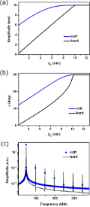
![[Graphic 22]](/bjnano/content/inline/2190-4286-6-19-i27.png?max-width=637&scale=1.18182) spectra [bias-on] collected 500 nm above HOPG in aqueous solutions of increasing salt concent...
spectra [bias-on] collected 500 nm above HOPG in aqueous solutions of increasing salt concent...

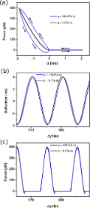
![[Graphic 25]](/bjnano/content/inline/2190-4286-6-19-i30.png?max-width=637&scale=1.18182) spectra [bias-on] collected 500 nm above (a) HOPG and (b) Au in milli-Q water (vertical color...
spectra [bias-on] collected 500 nm above (a) HOPG and (b) Au in milli-Q water (vertical color...

![[Graphic 27]](/bjnano/content/inline/2190-4286-6-19-i32.png?max-width=637&scale=1.18182) spectra [bias-on] recorded 500 nm above a HOPG/Au boundary in milli-Q water. T...
spectra [bias-on] recorded 500 nm above a HOPG/Au boundary in milli-Q water. T...

Aquatic versus terrestrial attachment: Water makes a difference
Beilstein J. Nanotechnol. 2014, 5, 2424–2439, doi:10.3762/bjnano.5.252
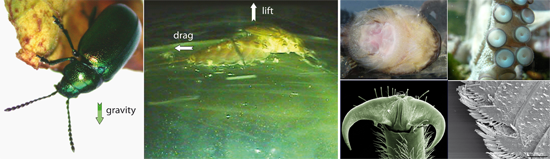
- ignores the material properties of the surfaces and is limited to unrealistic shapes. Smooth, and rigid plates are not what we usually find in nature, and elastic and structured surfaces of different shape will show a different behaviour. Moreover, other effects can cause failure sooner than predicted by
- matters. The real contact area is defined by topography, material properties and normal load. Normal load is the sum of external load and adhesion [59]. There is a close relationship between friction and adhesion, and solids with a high frictional coefficient usually have stronger adhesive properties [38


Advances in NO2 sensing with individual single-walled carbon nanotube transistors
Beilstein J. Nanotechnol. 2014, 5, 2179–2191, doi:10.3762/bjnano.5.227
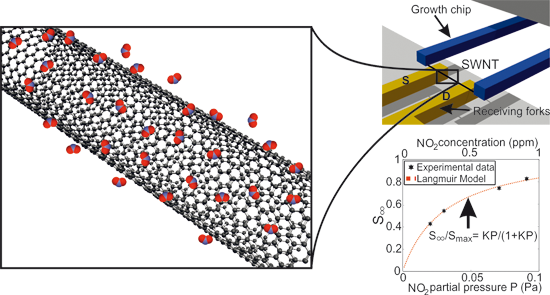
- often generate entirely new possibilities, pushing the limits of the accepted boundaries of material properties within which engineers operate. The identification of carbon nanotubes (CNTs) [1][2][3][4] and later, single-walled nanotubes (SWNTs) [5][6] is one example of this phenomenon. One such


Modeling viscoelasticity through spring–dashpot models in intermittent-contact atomic force microscopy
Beilstein J. Nanotechnol. 2014, 5, 2149–2163, doi:10.3762/bjnano.5.224
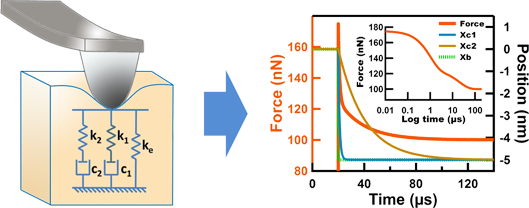
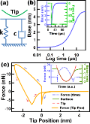
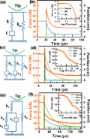
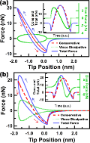
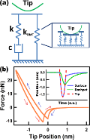
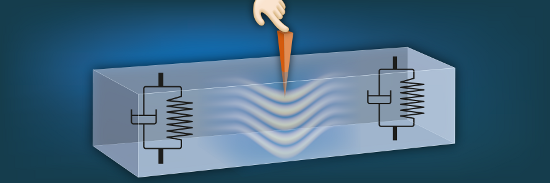
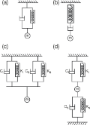
- utilization of that information to derive material properties is not trivial in tapping mode AFM. The nature of the technique with its intermittent contact, during which the probe interacts with nonlinear tip–sample forces ranging from attractive to repulsive, hinders the derivation of simple relationships
- evident, along with the presence of two force minima, as in the spring–dashpot models. Dissipation-based analysis Extracting material properties in a fast and accurate way is one of the ultimate goals in AFM. In order to accomplish this for viscoelastic surfaces, physically accurate models are a
- link the observables (phase and amplitude) to the energy dissipated [9][35], and these relationships have been widely used [10][11][36][37]. Although the amount of dissipation is an important hint to the nature of the material, it is not possible to derive unambiguous conclusions about the material


Dynamic calibration of higher eigenmode parameters of a cantilever in atomic force microscopy by using tip–surface interactions
Beilstein J. Nanotechnol. 2014, 5, 1899–1904, doi:10.3762/bjnano.5.200
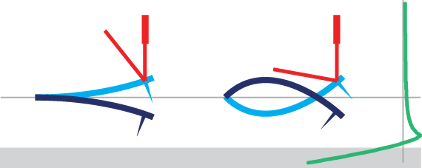
- by using a microcantilever with a sharp tip at the free end. Measuring cantilever deflections allows not only for the reconstruction of the surface topography but also provides insight into various material properties [2][3]. If deflection is measured near one of the cantilevers resonance frequencies


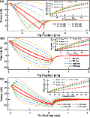
![[Graphic 25]](/bjnano/content/inline/2190-4286-5-200-i35.png?max-width=637&scale=1.18182) , using Equation 9 for two different cantilevers: ...
, using Equation 9 for two different cantilevers: ...
Cathode lens spectromicroscopy: methodology and applications
Beilstein J. Nanotechnol. 2014, 5, 1873–1886, doi:10.3762/bjnano.5.198

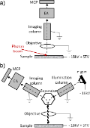
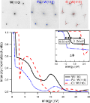
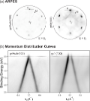
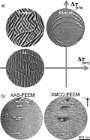
- (SPELEEM). In SPELEEM, the structural sensitivity of LEEM perfectly complements the chemical and magnetic information provided by XPEEM, thus creating a complete characterization tool of material properties at the nanometer length scale. The following provides an overview on SPELEEM methods along with the
- growth of nanostructured FeOx offers a versatile means to tune the material properties. Recently, SPELEEM techniques were applied to characterize the reactive growth of FeOx on Ru(0001) [71]. Fe growth in an oxygen ambient (5 × 10⁻⁷ mbar) at 900 K resulted in the formation of perfectly triangular



Probing viscoelastic surfaces with bimodal tapping-mode atomic force microscopy: Underlying physics and observables for a standard linear solid model
Beilstein J. Nanotechnol. 2014, 5, 1649–1663, doi:10.3762/bjnano.5.176
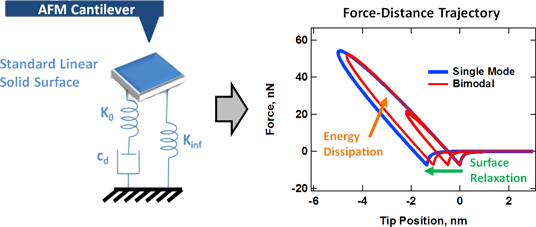
- generally not possible to attribute with certainty the changes in the observables to the variation in surface material properties. Results This section comprises two main sub-sections. The first sub-section provides an analysis of the tip–sample interaction physics for ideal (prescribed) and numerically
- for a range of values of Kinf, K0 and Cdiss, respectively. As the results suggest, it is possible for the trends to be non-monotonic and non-smooth, such that simple mappings of these observables do not provide an accurate picture of the variation of material properties across the sample (see comment


Multi-frequency tapping-mode atomic force microscopy beyond three eigenmodes in ambient air
Beilstein J. Nanotechnol. 2014, 5, 1637–1648, doi:10.3762/bjnano.5.175
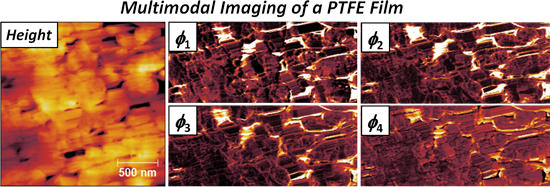
- interpretation of the additional contrast channels in terms of material properties, as there still remain important open questions even for the bimodal and trimodal methods [20][21][22][23]. Overall, our findings are promising and open the door to increasing sophistication and greater versatility in multi
- in turn lead to non-steady-state tip oscillations. These unsettled oscillations are problematic in the development of generalized theories that relate the measurement observables (amplitudes, phases, frequency shifts, etc.) to material properties because the transients depend on the particular sample



Organic and inorganic–organic thin film structures by molecular layer deposition: A review
Beilstein J. Nanotechnol. 2014, 5, 1104–1136, doi:10.3762/bjnano.5.123
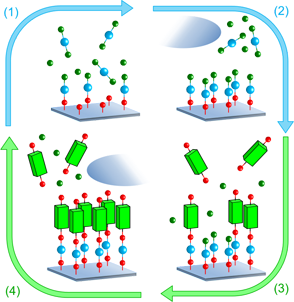
- inorganic and organic monolayers (Figure 2). The hybrid thin films may not only possess properties combined from those of the two parent materials, but may also have completely new material properties, making them excellent candidates for a wide range of applications. Possible uses for the hybrid ALD/MLD
- ][16]. Further tuning of material properties may be achieved by combining different inorganic, organic and hybrid layers into various thin-film mixtures, superstructures and nanolaminates. For example, precise control of the refractive index is extremely important in optical applications [17], while




Dry friction of microstructured polymer surfaces inspired by snake skin
Beilstein J. Nanotechnol. 2014, 5, 1091–1103, doi:10.3762/bjnano.5.122
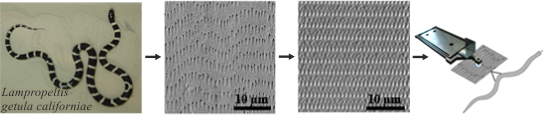
- scale [11]. These properties must be kept up over a longer period of time until new skin is moulted. Frictional properties of snake skin in contact with a solid partner depend on (i) the surface energy, (ii) material properties, and (iii) surface topography of the tribo-pair [12][13]. The surface energy
- to which the real contact area is influence by the load force depends strongly on material properties [41][46][47][48]. These properties are also affected by the surface geometry [49]. There are numerous experimental studies on the roughness effect on friction of technical surfaces. Etsion [50] and


Insect attachment on crystalline bioinspired wax surfaces formed by alkanes of varying chain lengths
Beilstein J. Nanotechnol. 2014, 5, 1031–1041, doi:10.3762/bjnano.5.116
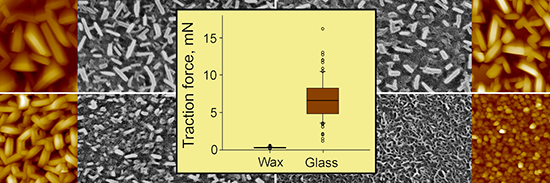
- on wax samples when compared to insect attachment forces measured on these surfaces. We explain these results by the differences in material properties between polydimethylsiloxane probes and tenent setae of C. septempunctata beetles. Among wax surfaces, force experiments showed stronger insect
- on wax samples compared to insect attachment forces measured on these surfaces. These force values were either close or equal to those measured on glass. We explain these results by differences in the material properties between PDMS and tenent setae of C. septempunctata beetles. The PDMS probes


Fibrillar adhesion with no clusterisation: Functional significance of material gradient along adhesive setae of insects
Beilstein J. Nanotechnol. 2014, 5, 837–845, doi:10.3762/bjnano.5.95
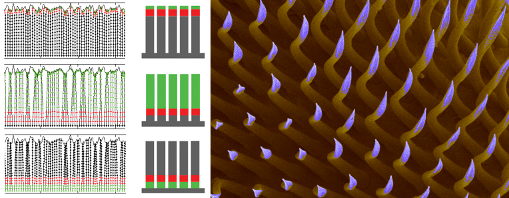
- fibers with longer soft tips on the stiff bases and fibers with stiff tips on the soft bases. This study not only manifests the crucial role of gradients in material properties along the setae in beetle fibrillar adhesive system, but predicts that similar gradients must have been convergently evolved in
- stability [9]: insect setae made of too soft material can buckle and collapse resulting in so called clusterisation/condensation [10][11]. Due to such clusterisation, functional advantage from multiple adhesive contacts may strongly decrease. That is why, material properties of insect adhesive setae
- gradient along the setae contribute to the proper contact formation? Which particular gradient reduces clusterisation of setae? Results and Discussion Structure and material properties of biological system Previous CLSM analysis of the setal tips has clearly demonstrated the presence of the rubber-like


Calibration of quartz tuning fork spring constants for non-contact atomic force microscopy: direct mechanical measurements and simulations
Beilstein J. Nanotechnol. 2014, 5, 507–516, doi:10.3762/bjnano.5.59
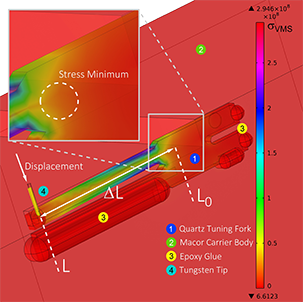
- rim and behind the tuning fork (1) fixing it to the Macor carrier (2). The sophisticated geometry is meshed with a tetrahedral elements (cf. inset) to better account for the transition between the individual geometry elements. The material properties were taken from literature, as for the Young’s




Friction behavior of a microstructured polymer surface inspired by snake skin
Beilstein J. Nanotechnol. 2014, 5, 83–97, doi:10.3762/bjnano.5.8
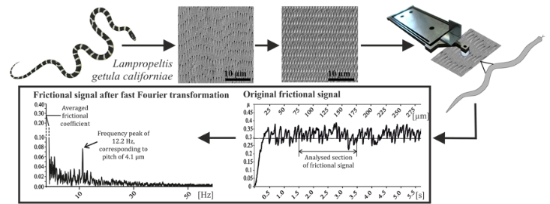
- the skin scales, so called microornamentation [1][4][5][6][7][8][9][10][11][12][13], and specific adaptations of the material architecture of the skin, like highly ordered embedded fibers [14], which can potentially influence material properties [15][16], might contribute to the frictional anisotropy
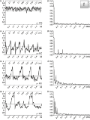
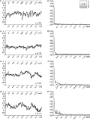
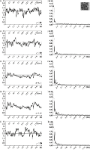
- strongly depend on material properties of the sliding partners, the optimal stick-slip reducing dimension of microstructures must be engineered for every single technical application. Nevertheless, it could be a very effective way to reduce frictional energy loss and friction-induced wear. In the present




Design criteria for stable Pt/C fuel cell catalysts
Beilstein J. Nanotechnol. 2014, 5, 44–67, doi:10.3762/bjnano.5.5
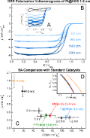
- material properties. The specific activity values as a function of the ECSA in 0.1 M HClO4 are plotted in Figure 2C (for the according plot in 0.1 M H2SO4 see Figure S2 in Supporting Information File 1). The unsupported Pt-poly and Pt-black catalysts clearly present a higher specific activity than all
- microstructural analysis, as presented in the next section is, therefore, necessary to support this hypothesis. Stability investigation on the nanoscale The above described tests focused on the macroscopic differences in loss of ECSA for catalysts with different material properties. To gain insight into the
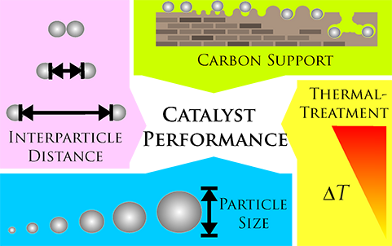
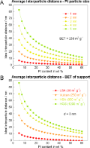
- from catalysts from other IL-TEM studies, to evaluate the effect of material properties on the activity and degradation behavior of Pt/C catalysts. Effect of inter-particle distance Particles can agglomerate due to migration on or shrinkage of the carbon support. When particles establish contact or are




Static analysis of rectangular nanoplates using trigonometric shear deformation theory based on nonlocal elasticity theory
Beilstein J. Nanotechnol. 2013, 4, 968–973, doi:10.3762/bjnano.4.109
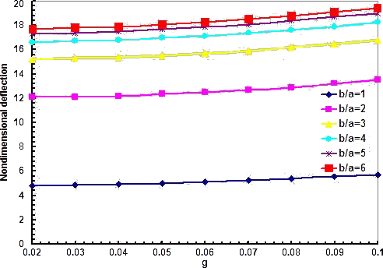
- for functionally graded plates. Similar to the most of studies on FG structures, the material properties were assumed to vary in the thickness direction according to the power law distribution. Mantari et al. [5] modeled a new type of trigonometric shear deformation theory (TSDT) for studying plates
- with different material properties such as sandwich plates. It is assumed that this new type of displacement field depends on a parameter which is calculated according to the results of three dimensional elasticity theory. Kharde et al. [6] published an exponential shear deformation theory for the free


Dynamic nanoindentation by instrumented nanoindentation and force microscopy: a comparative review
Beilstein J. Nanotechnol. 2013, 4, 815–833, doi:10.3762/bjnano.4.93
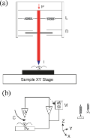
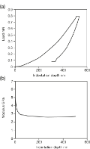
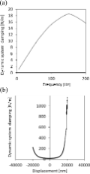
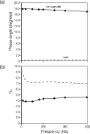
- viscoelastic/plastic deformation, as well as capillary and adhesive forces. The analysis of AFM force–distance curves of polydimethylsiloxane (PDMS) showed a strong influence of the measurement conditions such as the loading–unloading rate and the dwell time, as well as intrinsic material properties like the




Preparation of electrochemically active silicon nanotubes in highly ordered arrays
Beilstein J. Nanotechnol. 2013, 4, 655–664, doi:10.3762/bjnano.4.73
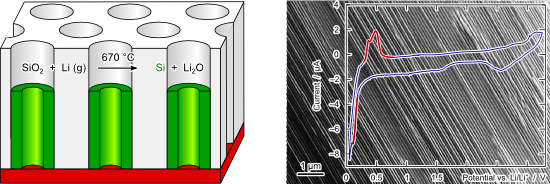
- gray line, the second cycle in blue and red, and the third charge in black. The red color highlights the main reduction (charge) and oxidation (discharge) events of the material. Properties of the metals M = Mg and M = Li of relevance to the thermal reduction of SiO2: standard Gibbs free energies of





k-space imaging of the eigenmodes of sharp gold tapers for scanning near-field optical microscopy
Beilstein J. Nanotechnol. 2013, 4, 603–610, doi:10.3762/bjnano.4.67
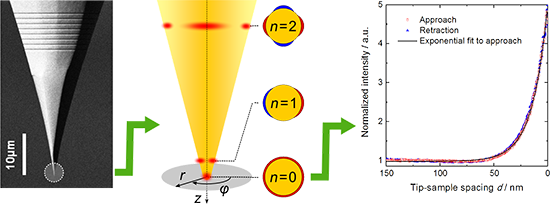
- ]. It yields the propagation constant kz along the tapered wire as a function of the dielectric material properties, the wire radius, and the frequency of the SPP mode. Based on this approach we have numerically calculated the propagation constant for a gradually decreasing wire radius, R. The results


Molecular dynamics simulations of mechanical failure in polymorphic arrangements of amyloid fibrils containing structural defects
Beilstein J. Nanotechnol. 2013, 4, 429–440, doi:10.3762/bjnano.4.50
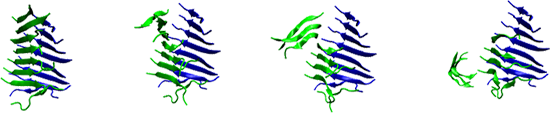
- fibrils [9]. Before we can design fibrils with bespoke material properties, however, we first need to understand how the arrangement of the individual β-sheets modulates their mechanical behaviour. Amyloid fibrils, like many crystalline materials, exhibit polymorphism. The predominant polymorph obtained
- develop an understanding of how the polymorphic form influences the mechanical properties of fibrils. A wealth of information on the material properties of amyloid is already available from extensive pathological and biological studies that focus on the diseases aspect of amyloid, as summarised in a
- able to characterise how the nature and presence of such defects influences their mechanical response. However, this precludes the investigation of effects such as crack propagation on the material properties of the model fibrils, because these occur over longer length scales. Our simulations suggest a


Kelvin probe force microscopy of nanocrystalline TiO2 photoelectrodes
Beilstein J. Nanotechnol. 2013, 4, 418–428, doi:10.3762/bjnano.4.49
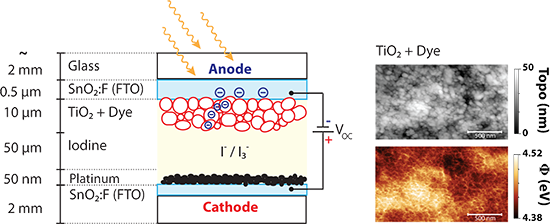
- variations may be due to varying material properties in general. In any case, such variations, which are clearly detectable by KPFM, may obstruct the optimal attachment of dye molecules and thus reduce the solar cell performance [25]. Microscopic surface photovoltage By combining a tunable illumination





