Search results
Search for "melting" in Full Text gives 247 result(s) in Beilstein Journal of Nanotechnology. Showing first 200.
CVD transfer-free graphene for sensing applications
Beilstein J. Nanotechnol. 2017, 8, 1015–1022, doi:10.3762/bjnano.8.102
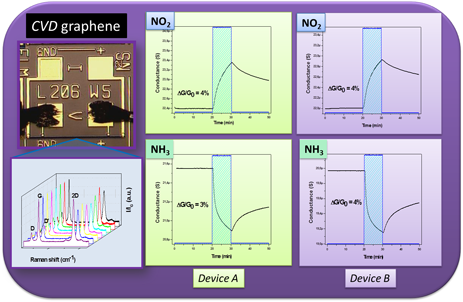
- made as thin as 50 nm without any segregation at the graphene CVD temperature (≈1000 °C), because of the higher melting point of Mo (2623 °C) compared to that of other conventional catalysts such as Cu (1085 °C) or Ni (1455 °C). Moreover, this allows a pre-patterning the film for the selective growth


Vapor-phase-synthesized fluoroacrylate polymer thin films: thermal stability and structural properties
Beilstein J. Nanotechnol. 2017, 8, 933–942, doi:10.3762/bjnano.8.95
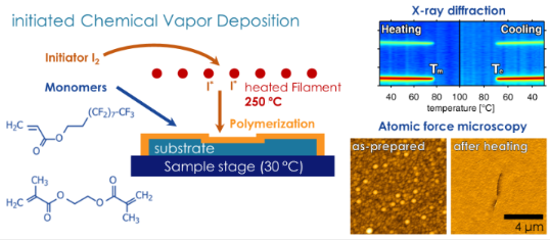
- thus larger lattice distances) upon temperature increase, corresponding to thermal expansion of the unit cell. At 76 ± 2 °C, a sudden decrease in the diffracted intensity is then observed, denoting the melting point of the lamella. As the temperature is further increased to 100 °C, no change is
- the data. These points correspond to melting, and respectively, crystallization of the lamella. These thermal transition points are in reasonable agreement with those determined from the X-ray diffraction experiment (76 ± 2 and 69 ± 2 °C). The difference is attributed to general sensitivity and
- depend linearly on temperature. Figure 8 displays the change in thermal expansion coefficients as a function of EGDMA content in the regions below and above the thermal transitions points ((10–45 °C) and 110–150 °C), respectively). Below the melting point, the PFDA homopolymer exhibits the highest


Investigation of growth dynamics of carbon nanotubes
Beilstein J. Nanotechnol. 2017, 8, 826–856, doi:10.3762/bjnano.8.85
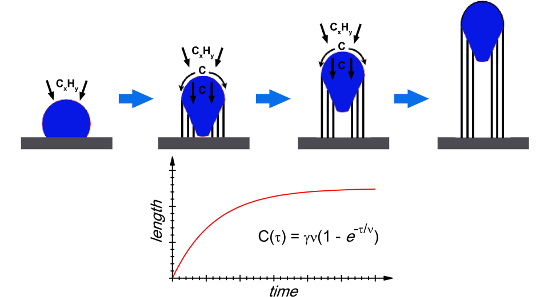
- the nanometer scale leads to an increase in the ratio of surface atoms to internal atoms [50]. The surface atoms are electronically and coordinatively unsaturated. This leads to changed physical and chemical properties of nanoparticles in comparison to the bulk metal, for example, lower melting
- temperature and higher carbon solubility [50]. The melting temperature of metallic catalytic particles is lowered by two effects. Firstly, the melting temperature of the particle (Tp) with the radius r is decreased by the Gibbs–Thomson effect by the equation: where T0 is the bulk melting temperature of a
- metal, ΔHfusion is the latent heat of fusion, ρs and ρl are the densities of solid and liquid metal, respectively, σsl is the solid–liquid interfacial energy and σl is the surface energy of the liquid [50][51]. Figure 2 demonstrates the melting temperature of iron, nickel, gold and silver particles as a


Modeling adsorption of brominated, chlorinated and mixed bromo/chloro-dibenzo-p-dioxins on C60 fullerene using Nano-QSPR
Beilstein J. Nanotechnol. 2017, 8, 752–761, doi:10.3762/bjnano.8.78
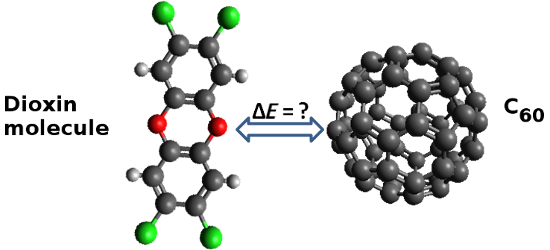
- definition, is an experimentally measured or calculated numerical parameter describing a particular molecule (e.g., dipole moment, number of halogen atoms, melting temperature, molecular mass, total energy). The list of 26 descriptors used in the project and more detailed information about their calculation



First examples of organosilica-based ionogels: synthesis and electrochemical behavior
Beilstein J. Nanotechnol. 2017, 8, 736–751, doi:10.3762/bjnano.8.77
- by simple variation of the respective ions. This facilitates the tailoring of their properties, e.g., viscosity, ionic conductivity, solubility, or melting and glass points and therefore makes ILs perfect media for task-specific applications [1][4]. Additionally, compared to many systems based on
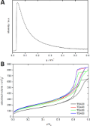
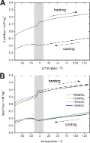
- crystallization or melting peaks are visible in the range of −170 to 150 °C. The fact that the glass transition is less visible in the cooling curves is due to supercooling and indicates rather slow dynamics of the IL due to high viscosity, similar to our previous example [25]. Table 2 shows that the glass








Dispersion of single-wall carbon nanotubes with supramolecular Congo red – properties of the complexes and mechanism of the interaction
Beilstein J. Nanotechnol. 2017, 8, 636–648, doi:10.3762/bjnano.8.68
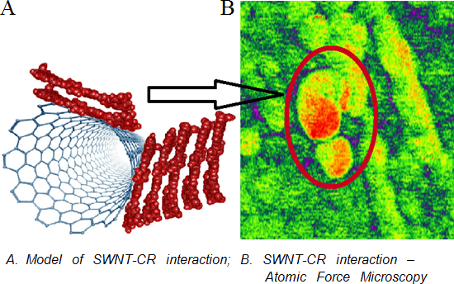
- increasing temperature. Using DSC we can observe changes in the heat capacity that accompany heating or cooling of the sample, and thus analyse the melting or the formation of supramolecular structures for both free CR and CR attached to the carbon nanotube surface. We analysed heat capacity changes in two
- formation of the ordered structures - which lowers the heat capacity (downward peaks), and melting of supramolecular structures (endothermic processes – upward peaks). Thermograms for free and SWNT-bound CR at two concentrations (2 and 5 mg/mL) are presented in Figure 6. The “first heating” thermogram was
- . Melting of an ordered supramolecular CR takes place at about 50 °C – this is clearly visible for the 5 mg/mL sample (Figure 6B, curve 1 and 3). In previously published results (for 10 mg/mL CR solutions) melting took place at 40 to 60 °C, depending upon the ionic strength of the solution [32]. When


Anodization-based process for the fabrication of all niobium nitride Josephson junction structures
Beilstein J. Nanotechnol. 2017, 8, 539–546, doi:10.3762/bjnano.8.58
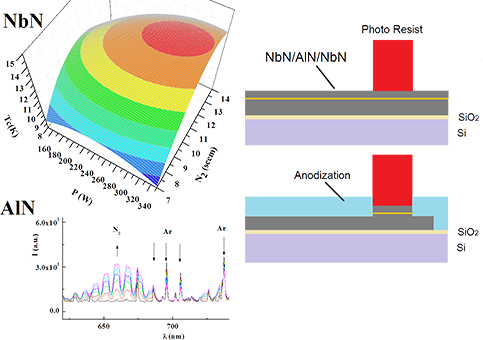
- vacuum conditions. Temperature control is particularly relevant when lithographic patterns impressed by photoresist (an organic polymeric compound melting above 120 °C) are present on the substrate because the degassing of the polymer pollutes the deposition chamber. For this reason the temperature of


The longstanding challenge of the nanocrystallization of 1,3,5-trinitroperhydro-1,3,5-triazine (RDX)
Beilstein J. Nanotechnol. 2017, 8, 452–466, doi:10.3762/bjnano.8.49
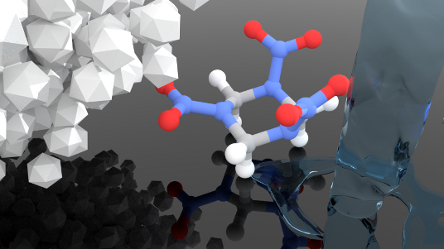
- extraction system (ASES), sorted among the supercritical processes for a better understanding. Melting and milling processes for producing sub-micrometer energetic materials require one or more additional liquids, therefore these techniques are classified as wet methods. Wet production methods
- triggered by supercritical CO2 drying. Even if the sensitivity and the density were not improved, the increase of the heat of explosion measured and the originality of the approach make the formation of a nanocomposite based entirely on energetic materials through chemical binding promising. Melting Many
- high energetic materials degrade very close to their melting point. Therefore, only a few such as 2,4,6-trinitrotoluene (TNT) or TNB can be used in the molten state since the melting temperature is at least 100 °C away from the exothermic decomposition. The melt–cast process of TNT-based compositions


Association of aescin with β- and γ-cyclodextrins studied by DFT calculations and spectroscopic methods
Beilstein J. Nanotechnol. 2017, 8, 348–357, doi:10.3762/bjnano.8.37
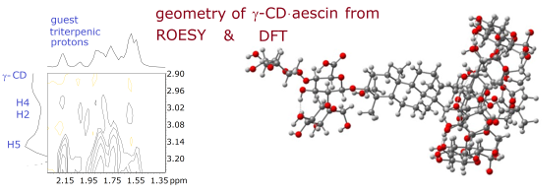
- the seeds of the horse chestnut tree, Aesculus hippocastanum (Hippocastanaceae). It is a natural mixture of acylated triterpene glycosides. In early studies, the saponins present in aescin were divided into two forms, α-aescin and β-aescin, with distinct melting point, hemolytic index, specific


Laser irradiation in water for the novel, scalable synthesis of black TiOx photocatalyst for environmental remediation
Beilstein J. Nanotechnol. 2017, 8, 196–202, doi:10.3762/bjnano.8.21
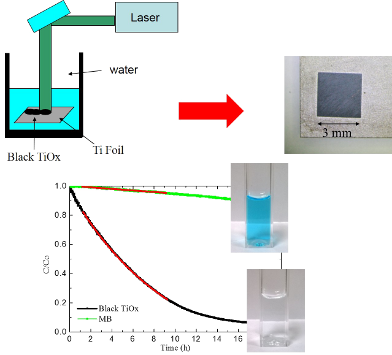
- melting and oxidation on the metallic titanium surface and, at the same time, the process is fast enough to allow the formation of substoichiometric oxides. We have demonstrated that the proposed methodology allows for the successful synthesis of a black TiOx material suitable for water purification


Structural and tribometric characterization of biomimetically inspired synthetic "insect adhesives"
Beilstein J. Nanotechnol. 2017, 8, 45–63, doi:10.3762/bjnano.8.6
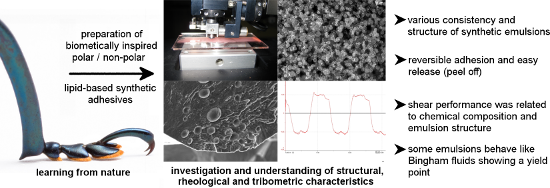
- (w/o) emulsion SG4. Despite its large amount of gelatin, the addition of squalane (fluid at room temperature) together with the ionic emulsifier AOT kept this emulsion in an oily state. Similar to gelatin, the addition of high-melting microcrystalline wax (WG20, WP20) led to a solid (rubber- to
- certainly attributable to the high-melting temperature of octacosane (>60 °C). Such colloidal suspension-like behaviour corresponds well to the assumed nature of the outer lipid layer of the insect cuticle [4][28][39][40] and can also be assumed for insect tarsal adhesives being mere derivatives of the
- outer free lipid layer of the general body cuticle [41][42][43]. Such mixtures of high-melting straight n-alkanes with low-melting alkenes or methyl-branched alkanes keep the suspensions in a semi-solid condition over a broad range of temperatures. The in situ phase differentiation of alkanes and


Effect of nanostructured carbon coatings on the electrochemical performance of Li1.4Ni0.5Mn0.5O2+x-based cathode materials
Beilstein J. Nanotechnol. 2016, 7, 1960–1970, doi:10.3762/bjnano.7.187
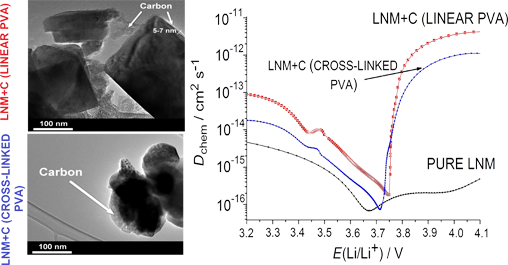
- allows one to identify a small “endo”-effect at 230 °C before the decomposition of the linear PVA (Figure 2A) that could be associated with its melting [32]. The corresponding effect is absent in the DSC curve of the cross-linked polymer (Figure 2B). The reasons for the different localization of carbon
- in the samples can be associated with the observed features of the pyrolysis of precursors. Melting of linear PVA causes a wetting of LNM grains with the polymer melt followed by a relatively uniform pyrolysis of the thin polymer films on the surface of oxide crystallites. In the case of cross-linked
- PVA, the polymer pyrolysis tentatively occurs without preliminary melting. The pyrolysis of PVA particles allocated in the voids between LNM crystallites results in forming mesoporous particulates of amorphous carbon in the interparticular space. Another difference between the pyrolysis products of



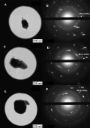
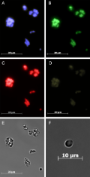
Facile fabrication of luminescent organic dots by thermolysis of citric acid in urea melt, and their use for cell staining and polyelectrolyte microcapsule labelling
Beilstein J. Nanotechnol. 2016, 7, 1905–1917, doi:10.3762/bjnano.7.182
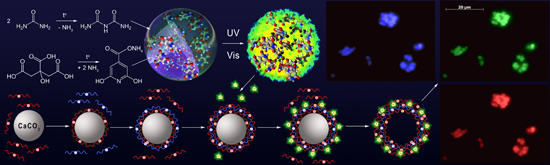
- temperatures, in the excess of urea melt, (melting point 133 °C). The duration of the process strongly depends on the temperature. The optimum temperature range was found to be 150–180 °C. In this temperature range, the process of O-dot formation was completed in 1–2 h. Upon changing the molar ratio of citric




Development of adsorptive membranes by confinement of activated biochar into electrospun nanofibers
Beilstein J. Nanotechnol. 2016, 7, 1556–1563, doi:10.3762/bjnano.7.149
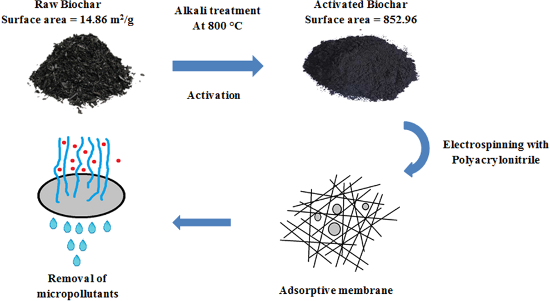
- behavior of electrospun PAN nanofibers During DSC PAN is heated in the presence of oxygen and begins to degrade near its melting point through an exothermic reaction that can obscure its endothermic melting. Therefore, the melting point cannot be observed for PAN. However, if DSC is conducted in N2




In situ characterization of hydrogen absorption in nanoporous palladium produced by dealloying
Beilstein J. Nanotechnol. 2016, 7, 1197–1201, doi:10.3762/bjnano.7.110
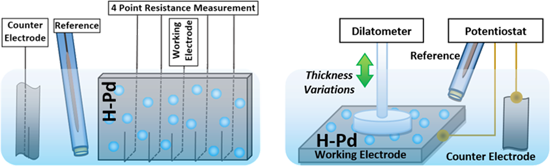
- alloy (80 wt % Co–20 wt % Pd) was prepared by electron beam melting (EBM) high purity wires of Co and Pd (ChemPur, 99.99%). The resulting alloy droplet was rolled to a thickness of 280 μm in several steps. Between each rolling step, the alloy was annealed for 1 h at 800 °C. From this master alloy sample

Reasons and remedies for the agglomeration of multilayered graphene and carbon nanotubes in polymers
Beilstein J. Nanotechnol. 2016, 7, 1174–1196, doi:10.3762/bjnano.7.109
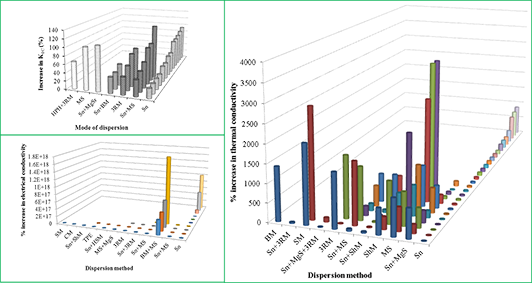
- (ABS) at 260 °C. Pellets were made from the extrudate and test samples were made by injection molding. TEM revealed a very good dispersion of the nanotubes [59]. The nanotube powder may adhere to walls of the mixer making shear mixing difficult. A combination of melting and solution techniques could be


Fast diffusion of silver in TiO2 nanotube arrays
Beilstein J. Nanotechnol. 2016, 7, 1129–1140, doi:10.3762/bjnano.7.105
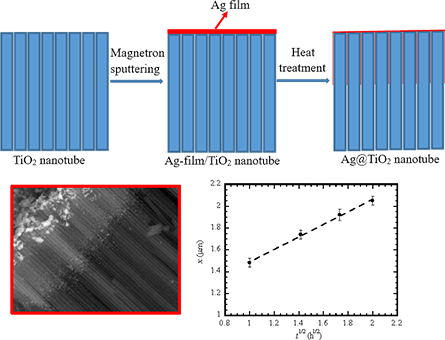
- during the heat treatment, as observed in Figure 5 and Figure 6. According to the theory of thermodynamics [37], the melting point of a material is a function of the size of the material. The size dependence of the melting point of a material in spherical shape can be expressed as [38] with Here, Tm(r
- ) is the melting temperature of the material in a spherical shape of radius r, Tm(∞) is the melting temperature of the material in bulk shape, R is the gas constant, Svib(∞) is the vibrational melting entropy of the material, h is the atomic radius of the material, and d = 0 for nanoparticles. As shown
- in Figure S7 of Supporting Information File 1, the radius of Ag nanoparticles is in the range from 2.6 ± 0.2 to 5 ± 2 nm. From Equation 1 and Equation 2, one can note that the smaller the size of nanoparticle, the lower is the melting point. Using the parameters of h = 0.2898 nm [39], Tm(∞) = 1234 K


Development of highly faceted reduced graphene oxide-coated copper oxide and copper nanoparticles on a copper foil surface
Beilstein J. Nanotechnol. 2016, 7, 1010–1017, doi:10.3762/bjnano.7.93
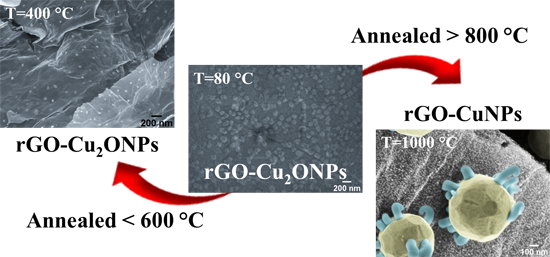
- –1000 °C develop from the preformed copper oxide nanoparticles, which grew during the GO–copper foil sample preparation. It was reported that the melting process of bulk materials involves a pre-melting stage in which the surface melts at temperatures lower than the bulk material melting point [22][23
- ]. In fact, kinetics studies on metal melting revealed that the pre-melting temperature depends partly on the surface microstructure and partly on surface-adsorbed impurities [24]. It has also been reported that, for nanostructured materials, the melting point strongly depends on the size and it is
- lower than that of the bulk counterpart [25]. For instance, bulk Cu melts around 1084 °C [26], whereas 40 nm size CuNPs were found to melt at 190 °C, and the surface melting begins around 180 °C [27]. As shown in Figure 1a, the copper foil surface displays a fine-grained morphology probably comprising


Reconstitution of the membrane protein OmpF into biomimetic block copolymer–phospholipid hybrid membranes
Beilstein J. Nanotechnol. 2016, 7, 881–892, doi:10.3762/bjnano.7.80
- of 100 mL of purified toluene in a 2-neck 250 mL reaction flask connected to the vacuum line, the desired volume (see Table 4) of purified isoprene was added at −140 °C. Just at the melting point of the isoprene solution, sec-butyllithium was added under an Ar atmosphere via syringe at 5 °C through a



The role of morphology and coupling of gold nanoparticles in optical breakdown during picosecond pulse exposures
Beilstein J. Nanotechnol. 2016, 7, 869–880, doi:10.3762/bjnano.7.79
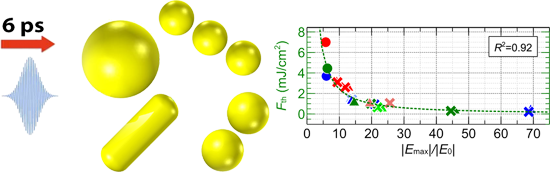
- electrons from a photo-thermal emission of hot electrons off the surface of the nanoparticles [31][37]. During nanoparticle-mediated LIOB with pulses shorter than 10 ps the lattice temperature of the nanoparticle is kept below the melting point (1337 K for gold nanoparticles with a diameter above 10 nm [38
- volume (Figure 4f–h). For all nanostructures, the maximum lattice temperature was below the 1337 K, the bulk melting point of gold (Figure 5b), which is still valid for nanoparticles with radii of more than 5 nm [38]. The lowest heating was produced using a gold nanosphere trimer, s25t@532, exposed at
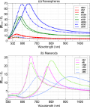
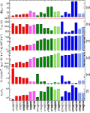
- the hot zone of the particle (Figure 4e–h) (the red line marks the melting temperature of gold at 1337 K [38]). Bar plot (c) compares the volumes of the nanoparticles, Vnp. Bar plot (d) shows the absorption cross-section, σabs, of the nanoparticles and their assemblies. Bar plot (e) compares the laser




Assembling semiconducting molecules by covalent attachment to a lamellar crystalline polymer substrate
Beilstein J. Nanotechnol. 2016, 7, 784–798, doi:10.3762/bjnano.7.70
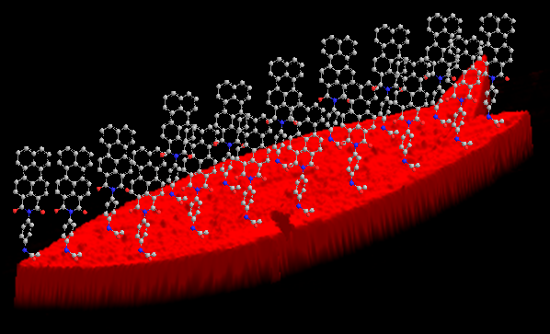
- not by a low yield of the chemical reaction. In order to allow for the reordering of the fold surfaces of the CPE45 nanocrystals, the films were annealed at 85 °C (which is close to the bulk polymer melting point) for 24 hours. To prevent chains, which have eventually melted during annealing, from
- observed by AFM. However, after longer grafting times (e.g., after three days) islands of 1 molecules formed percolating pathways on the crystal surface. We note that the π–π stacking energy of perylene molecules is rather high [25], consistent with a high melting point and poor solubility of the resulting


Hierarchical coassembly of DNA–triptycene hybrid molecular building blocks and zinc protoporphyrin IX
Beilstein J. Nanotechnol. 2016, 7, 697–707, doi:10.3762/bjnano.7.62
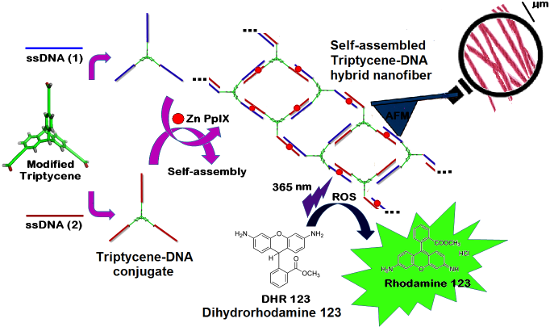
- native PAGE, circular dichroism (CD), thermal melting analysis, mung bean nuclease digestion (MBN), computational studies and atomic force microscopy (AFM). These comprehensive experimental and computational studies provided detailed information pertaining to the formation of composite DNA nanostructures
- involve Zn–protoporphyrin (Zn PpIX), the compound was added during the annealing process of the DNA conjugates at a temperature of 60 °C. Thermal melting The self-assembly of DNA–TPA hybrid structures was studied by optical melting experiments using a Peltier controlled UV–vis spectrophotometer (Bioquest
- added during assembly. Hybridized mixtures were denatured by heating the annealed samples from 20 to 90 °C while monitoring the UV absorbance at 260 nm to observe the melting progress. The temperature inside the cuvette was determined with a platinum probe. The absorbance data were analyzed to obtain


Nanoscale effects in the characterization of viscoelastic materials with atomic force microscopy: coupling of a quasi-three-dimensional standard linear solid model with in-plane surface interactions
Beilstein J. Nanotechnol. 2016, 7, 554–571, doi:10.3762/bjnano.7.49
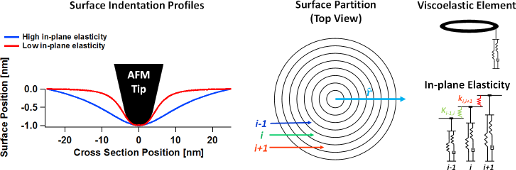
- materials, all the analyses are based on linear material behaviors that may fall short in the treatment of specific problems. Consider, for example, a tapping-mode experiment, which may involve local stresses and strains that are too large to be treated linearly, or local heating and melting of the sample


Plasticity-mediated collapse and recrystallization in hollow copper nanowires: a molecular dynamics simulation
Beilstein J. Nanotechnol. 2016, 7, 228–235, doi:10.3762/bjnano.7.21
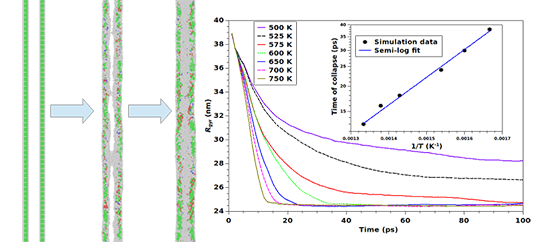
- in the present study, e.g., stacking fault energy, vacancy formation energy, elastic constants and melting point. The hollow wire is first optimized to a minimum-energy structure and then exposed to a constant temperature maintained by means of the Nosé–Hoover thermostat [20][21]. The simulation cell
- stages considering the representative case at a temperature of 700 K, which is about 150 K below the melting point of the studied wire as computed through MD simulation [6]. Stage 1 Figure 1 shows the initial stage of the simulation. The hollow structure shows an almost immediate collapse, within the


Mismatch detection in DNA monolayers by atomic force microscopy and electrochemical impedance spectroscopy
Beilstein J. Nanotechnol. 2016, 7, 220–227, doi:10.3762/bjnano.7.20
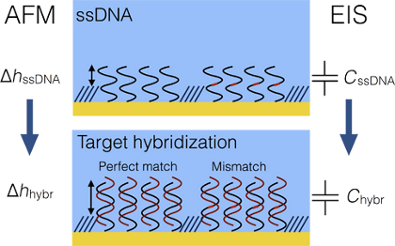
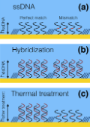
- than the melting temperature of the used DNA sequence. The differential capacitance after the regeneration treatment maintains its original value within the error bars (Figure S2, Supporting Information File 1). Results and Discussion Atomic force microscopy-based assay In Figure 1 we report a
- structures (hafter treatment, Figure 1c). Since the non-perfectly matching sequence will have a reduced melting temperature with respect to the perfectly matched (PM) sequence (Tm(MM) < Tm(PM)), its de-hybridization will be favoured upon annealing to a temperature (Tann) close or slightly higher than the
- melting temperature of the perfect matched sequence (Tm(MM) < Tm(PM) ≤ Tann). We have used our AFM-based nanomechanical approach to distinguish single mismatched DNA base pairs of single nucleotide polymorphisms (SNPs), in particular a T–G mismatch. In particular, we chose to immobilize on the surface two