


Search results
Search for "migration" in Full Text gives 209 result(s) in Beilstein Journal of Nanotechnology. Showing first 200.
Viability and proliferation of endothelial cells upon exposure to GaN nanoparticles
Beilstein J. Nanotechnol. 2016, 7, 1330–1337, doi:10.3762/bjnano.7.124
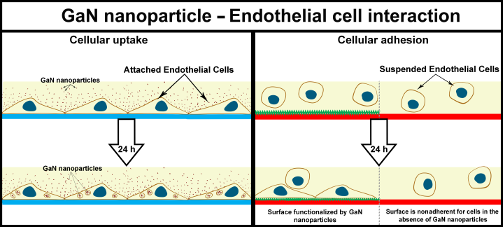
- the mechanical load of incorporated nanoparticles, which could result in reduced migration and slowed proliferation process with increasing quantities of incorporated nanoparticles [20]. When nanoparticles were added after the cellular layer reached 50% confluence, we clearly observed how the same


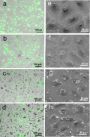
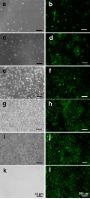

High antiviral effect of TiO2·PL–DNA nanocomposites targeted to conservative regions of (−)RNA and (+)RNA of influenza A virus in cell culture
Beilstein J. Nanotechnol. 2016, 7, 1166–1173, doi:10.3762/bjnano.7.108
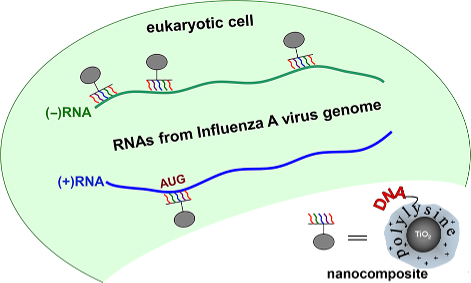
- . Segments 1, 2, 3, 5, and 7, encoding RNA-dependent RNA polymerases (PB2, PB1, and PA), nucleoprotein (NP), and matrix protein M1, respectively, comprise the largest number of conserved sequences [6]. The NP plays a key role in the migration of the viral RNAs to cell nuclei of infected cells and in the


Fast diffusion of silver in TiO2 nanotube arrays
Beilstein J. Nanotechnol. 2016, 7, 1129–1140, doi:10.3762/bjnano.7.105
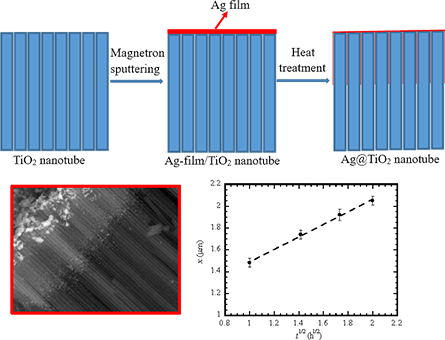
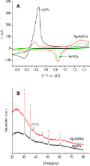
- the outmost surface of TiO2 nanotubes. Probably there are hardly any Ag nanocrystals formed inside the TiO2 nanotubes through the migration of Ag. Keywords: activation energy; fast diffusion; magnetron sputtering; silver; TiO2 nanotube; Introduction Titanium dioxide (TiO2) has gained great attention
- migration of atoms (dopants), which determine the functionality of TiO2-based materials. Although recent success in improving the photocatalytic activity and energy storage of Li ions in TiO2-based materials has been reported [26][27][28][29], the understanding of the migration of atoms (dopants) in TiO2
- of the TiO2 nanotube arrays. Without heat treatment, there is little Ag migrating through the TiO2 nanotubes, as shown in Figure 5a. The outmost surface of the TiO2 nanotubes remains relatively clean and smooth. The magnetron sputtering did not cause any significant migration/diffusion of Ag through


Improved biocompatibility and efficient labeling of neural stem cells with poly(L-lysine)-coated maghemite nanoparticles
Beilstein J. Nanotechnol. 2016, 7, 926–936, doi:10.3762/bjnano.7.84
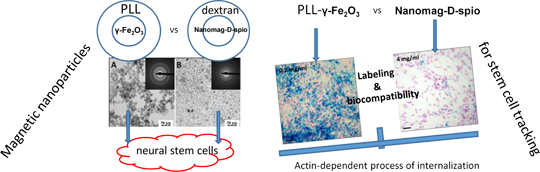
- , 16206 Prague 6, Czech Republic 10.3762/bjnano.7.84 Abstract Background: Cell tracking is a powerful tool to understand cellular migration, dynamics, homing and function of stem cell transplants. Nanoparticles represent possible stem cell tracers, but they differ in cellular uptake and side effects
- follow the stem cells through their migration, distribution, proliferation and differentiation is an essential prerequisite to characterize the biology and behavior of stem cells, to design the therapeutic approaches and minimize possible side effects [8][9][10]. Magnetic nanoparticles are widely used to




Reorientation of single-wall carbon nanotubes in negative anisotropy liquid crystals by an electric field
Beilstein J. Nanotechnol. 2016, 7, 825–833, doi:10.3762/bjnano.7.74
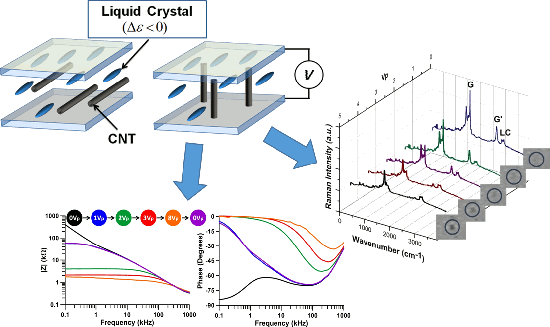
- current (AC) signal is set on a bias (offset) direct current (DC) voltage. But the use of DC voltages as a bias in LC materials is not recommendable because ion generation and migration lead to electrolytic degeneration. A low frequency (1 Hz) AC square wave is used instead. The AC wave amplitude varies


Tight junction between endothelial cells: the interaction between nanoparticles and blood vessels
Beilstein J. Nanotechnol. 2016, 7, 675–684, doi:10.3762/bjnano.7.60
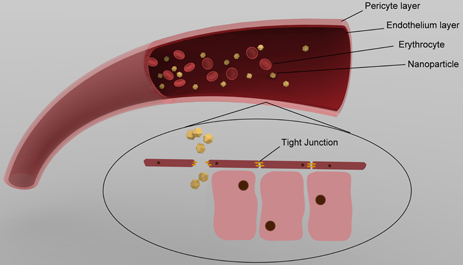
- inhibited (79%) by silver nanoparticles (2–6 nm) [80]. Also, AuNPs have the ability to prevent vascular endothelial growth factor (VEGF)- and interleukin-1 beta (IL-1β)-induced proliferation and migration in bovine retinal pigment epithelial cells (BRPEs) through the suppression of the Src kinase pathway

Fabrication and properties of luminescence polymer composites with erbium/ytterbium oxides and gold nanoparticles
Beilstein J. Nanotechnol. 2016, 7, 630–636, doi:10.3762/bjnano.7.55
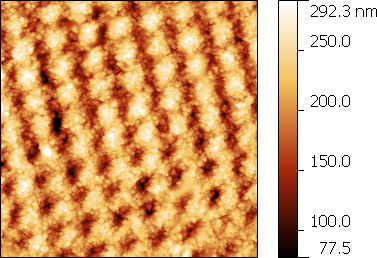
- level even at Er3+ concentrations as low as ca. 0.02 atom % [4], results in depopulation by energy exchange between two excited Er3+ ions. Also, the concentration quenching in Er-doped silicon is related to energy migration to defect states or OH-groups by resonant interaction between closely spaced Er3


In situ observation of deformation processes in nanocrystalline face-centered cubic metals
Beilstein J. Nanotechnol. 2016, 7, 572–580, doi:10.3762/bjnano.7.50
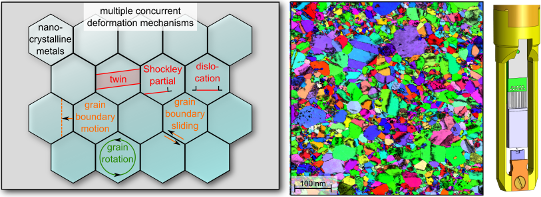
- grain rotation. Large-angle grain rotations with ≈39° and ≈60° occur and can be related to twin formation, twin migration and twin–twin interaction as a result of partial dislocation activity. Furthermore, plastic deformation in nanocrystalline thin films was found to be partially reversible upon
- ]. Modified or even unexpected deformation mechanisms are ascribed to the increasing influence of grain boundaries (GBs) on mechanical properties [3][4][6][7][8][9][10][11][12][13][14][15][16][17][18][19][20]. GB-mediated deformation mechanisms, such as GB sliding and migration, grain growth and rotation [21
- ] have been discussed (Figure 1a). Dislocation-mediated plasticity in the grain interior is reported to be based on dislocation nucleation at GBs, propagation and eventual absorption in the surrounding GB network, as well as twin nucleation, migration and detwinning (Figure 1a). Such twin activity and


Active multi-point microrheology of cytoskeletal networks
Beilstein J. Nanotechnol. 2016, 7, 484–491, doi:10.3762/bjnano.7.42

- migration, reaction to external influences and transport of vesicles. In this work we showed the theoretical idea behind the method, the experimental implementation and in addition its limits via calculations of the SNR. These preliminary results open a wide field of applications in all kinds of different


Determination of the compositions of the DIGM zone in nanocrystalline Ag/Au and Ag/Pd thin films by secondary neutral mass spectrometry
Beilstein J. Nanotechnol. 2016, 7, 474–483, doi:10.3762/bjnano.7.41
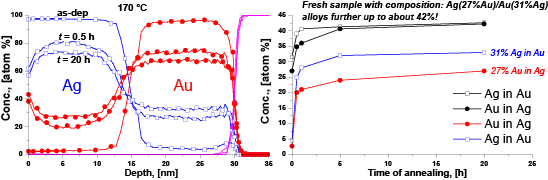
- by grain boundary diffusion-induced grain boundary migration is investigated by secondary neutral mass spectrometry depth profiling in Ag/Au and Ag/Pd nanocrystalline thin film systems. It is shown that the compositions in zones left behind the moving boundaries can be determined by this technique if
- the process takes place at low temperatures where solely the grain boundary transport is the contributing mechanism and the gain size is less than the half of the grain boundary migration distance. The results in Ag/Au system are in good accordance with the predictions given by the step mechanism of
- grain boundary migration, i.e., the saturation compositions are higher in the slower component (i.e., in Au or Pd). It is shown that the homogenization process stops after reaching the saturation values and further intermixing can take place only if fresh samples with initial compositions, according to


Influence of calcium on ceramide-1-phosphate monolayers
Beilstein J. Nanotechnol. 2016, 7, 236–245, doi:10.3762/bjnano.7.22
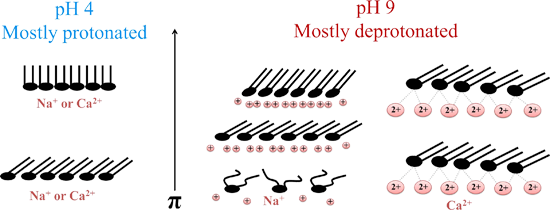
- kinase [1][2]. Several reviews about the function of C1P describe its role in a number of biological functions as cell growth, survival and mediation of macrophage migration and control of inflammatory responses [3][4][5]. According to the work of Chalfant and co-workers [6][7], C1P mediates inflammatory


Plasticity-mediated collapse and recrystallization in hollow copper nanowires: a molecular dynamics simulation
Beilstein J. Nanotechnol. 2016, 7, 228–235, doi:10.3762/bjnano.7.21
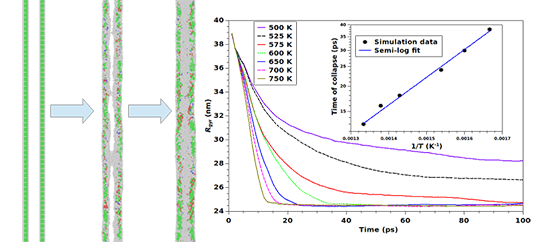
- with hollow core is thermodynamically unstable due to the internal free surface, and shows the tendency to collapse. The kinetics of the collapse has been assumed to proceed through the slow diffusive route, where the migration of vacancies from the hollow core to the outer surface is considered to be
- the dominating mechanism. Accordingly, analytical theories and Monte Carlo simulations based on the process of thermally activated diffusion process have been developed and carried out [12]. However, the proposed mechanism of collapse via migration of vacancies from the inner core to the outer surface
- , thereby discarding the proposed mechanism of a slow diffusive route of vacancy migration. On the other hand, the collapse is found to proceed through creation of disordered atoms and plastic slips. Upon collapse, the hollow nanowire becomes partially amorphous, which heals through the recrystallization of


Single pyrimidine discrimination during voltage-driven translocation of osmylated oligodeoxynucleotides via the α-hemolysin nanopore
Beilstein J. Nanotechnol. 2016, 7, 91–101, doi:10.3762/bjnano.7.11
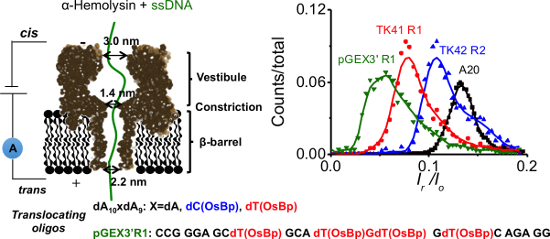
- that migrates last, OsBp is neutral and migrates early. The reaction product (osmylated oligo) migrates ahead of the intact oligo. Oligo dA10dCdA9 used in this reaction was PAGE-purified with confirmed purity by CE at 97%. The small spikes, at about 1 mAU with no steady migration time, are due to noise
- comparable, but not identical, concentrations. Migration is in the order of intact oligo last, R2 early, and R1 in the middle. Traces are shown at two wavelengths, at 272 and 312 nm, to illustrate that DNA exhibits about 1% absorbance, whereas R1 and R2 absorb substantially, and R2 > R1. The detail in the R1



Self-organization of gold nanoparticles on silanated surfaces
Beilstein J. Nanotechnol. 2015, 6, 2345–2353, doi:10.3762/bjnano.6.242
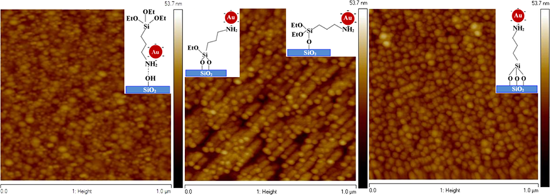
- physical properties such as enthalpy, mechanical modulus, dielectric constant and specific volume [31]. The migration of AuNPs observed here was due to the changes in its physical properties. Upon annealing under vacuum, sample substrates reached to transition temperature, though due to the absence of


Selective porous gates made from colloidal silica nanoparticles
Beilstein J. Nanotechnol. 2015, 6, 2105–2112, doi:10.3762/bjnano.6.215
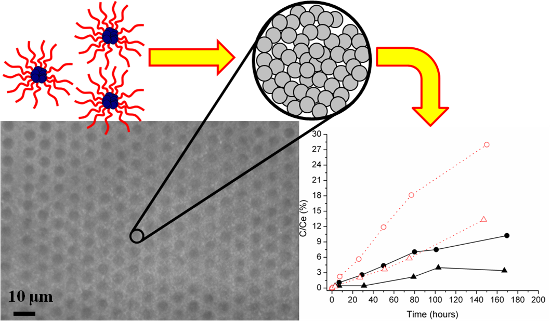
- surface and probe molecules are weak and labile interactions that can be broken by mild treatments. Also because of this, the membrane selectivity is here mainly attributed to steric effects, while specific interactions and adsorption phenomena have been ignored. In addition, the migration properties of
- the membrane were tested by applying an electric field as external stimulus. It was found that it is possible to accelerate the passage of both probes trough the membrane without any loss in selectivity. In fact, at the time value of 147 h the migration of MB is ca. 28%, showing an increase of 18
- % with respect to the plain diffusion, whereas for RNAse migration is ca. 13%, corresponding to an increase of 10% with respect to the diffusion. By making a comparison between diffusion and migration conditions, two main aspects deserve to be stressed. First, the application of an electric field


Formation of pure Cu nanocrystals upon post-growth annealing of Cu–C material obtained from focused electron beam induced deposition: comparison of different methods
Beilstein J. Nanotechnol. 2015, 6, 1508–1517, doi:10.3762/bjnano.6.156
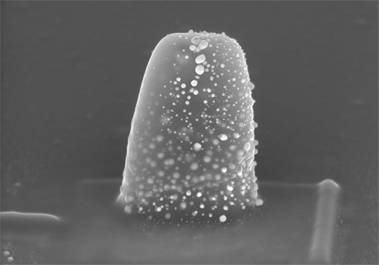
- 150–200 °C all deposits showed the formation of pure Cu nanocrystals at the outer surface of the initial deposit due to the migration of Cu atoms from the carbonaceous matrix containing the elements carbon, oxygen, and fluorine. Post-irradiation of deposits with 200 keV electrons in a transmission
- annealing of Cu–C FEBID material from Cu(II) and Cu(I) precursors with respect to nanostructural changes and conductivity showing the potential of fabricating pure copper nanodots, from the as-grown amorphous Cu–C deposit. The thermal energy input favors the migration of Cu atoms to coalesce to pure Cu
- dropped by four to five orders of magnitude to hundreds of kiloohms. At the current densities, used in the experiments (less than 0.1 MA/cm2) the migration process of Cu atoms is rather slow. Gazzadi and Frabboni [47] reported grain formation and electromigration in Pt–C material at current densities




Atomic force microscopy as analytical tool to study physico-mechanical properties of intestinal cells
Beilstein J. Nanotechnol. 2015, 6, 1457–1466, doi:10.3762/bjnano.6.151
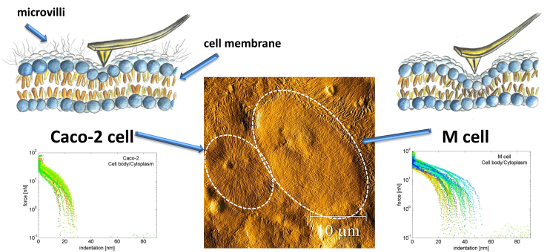
- surface of the cellular membrane. The rosette triggers migration and phagocytic processes and shows a 5-fold decreased elasticity compared to podosome-free regions (nuclear area). This is in accordance with our study. Since M cells are also immune cells, it seems that the arrangement of the sparse


Formation of substrate-based gold nanocage chains through dealloying with nitric acid
Beilstein J. Nanotechnol. 2015, 6, 1362–1368, doi:10.3762/bjnano.6.140
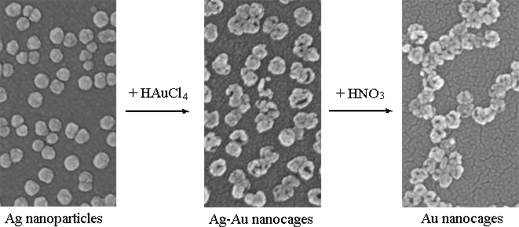
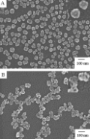
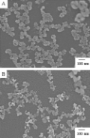
- structure evolution mechanism are not clear. Therefore, the treatment with dilute HNO3 not only removes the residual Ag in the Ag–Au NCs but also initiates the migration of the nanocages. Conclusion In conclusion, Ag–Au NCs were produced through substrate-based galvanic replacement reactions performed on

The Kirkendall effect and nanoscience: hollow nanospheres and nanotubes
Beilstein J. Nanotechnol. 2015, 6, 1348–1361, doi:10.3762/bjnano.6.139
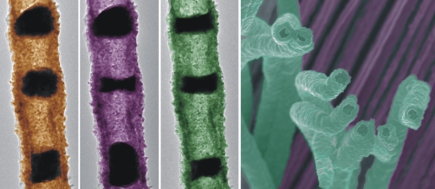
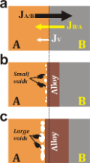
- ]. The Kirkendall effect describes the motion of the boundary between two metals due to a thermally activated, unbalanced diffusion. Upon annealing of two stacked metals, A and B, at a temperature high enough to thermally activate the diffusion of atoms, atomic migration can occur at the interface where
- , vacancies are created and injected at the Co(core)/CoSe(shell) interface. The migration and agglomeration of vacancies result in the formation and merging of the initial voids located at the interface and extended along the Co core (Figure 4a). The increase in size of these voids was found to lead to the
- -diffusion coefficient of Ni (i.e., diffusion of Ni ions in Ni) (Figure 5f). Since this ratio is quite low compared to other metals, they concluded that the generation/migration rate of vacancies is well-balanced [32]. This led to the conclusion that when the generation and the migration rate of vacancies



Structural transitions in electron beam deposited Co–carbonyl suspended nanowires at high electrical current densities
Beilstein J. Nanotechnol. 2015, 6, 1298–1305, doi:10.3762/bjnano.6.134
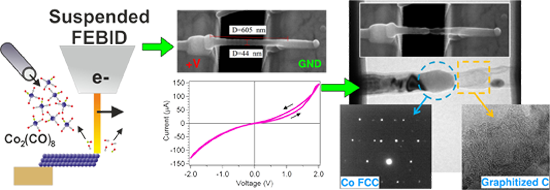
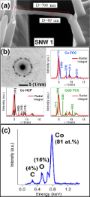
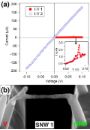
- shows graphite planes arranged in a rounded cage structure with a hollow/amorphous-like interior. This carbon structure, strongly resembling the one of carbon-encapsulated metal nanoparticles [29], was probably hosting a Co grain before its migration. From this analysis, the effect of electromigration

Tattoo ink nanoparticles in skin tissue and fibroblasts
Beilstein J. Nanotechnol. 2015, 6, 1183–1191, doi:10.3762/bjnano.6.120

- the resultant bleeding to form a clot. Then the skin tissue swells (edema) followed by a migration of immune system cells to the wound site (neutrophils and macrophages) in order to phagocytose foreign substances, cell debris and microbes. Any damaged collagen in the wounded papillary dermis is then


Magnetic properties of iron cluster/chromium matrix nanocomposites
Beilstein J. Nanotechnol. 2015, 6, 1158–1163, doi:10.3762/bjnano.6.117
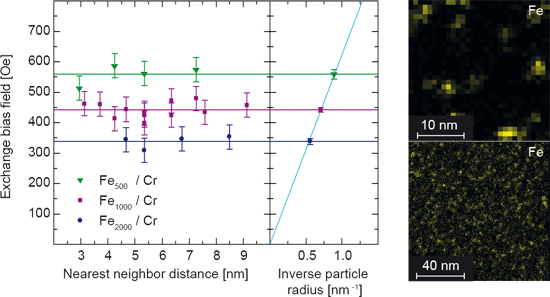
- resolution depends on the cluster size and can be estimated to be better than 1/10 for the utilized clusters. Prior to deposition the clusters are decelerated to 50 eV and then soft-landed on a silicon substrate with a native oxide layer (still conducting). To avoid migration and agglomeration of the


Electrical characterization of single molecule and Langmuir–Blodgett monomolecular films of a pyridine-terminated oligo(phenylene-ethynylene) derivative
Beilstein J. Nanotechnol. 2015, 6, 1145–1157, doi:10.3762/bjnano.6.116
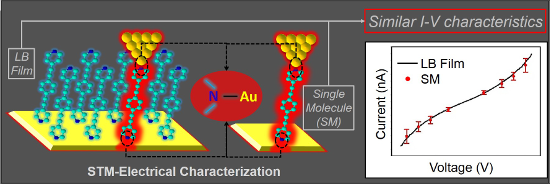
- molecular junctions [37][38], exciton migration control [39], top-contact metallization [24][40][41], optical and opto-electronic applications [42][43], modulation of the electrical properties of the junction [24], inclusion of a metal atom in the organic structure of a molecular wire [44], and electrical


Electronic interaction in composites of a conjugated polymer and carbon nanotubes: first-principles calculation and photophysical approaches
Beilstein J. Nanotechnol. 2015, 6, 1138–1144, doi:10.3762/bjnano.6.115
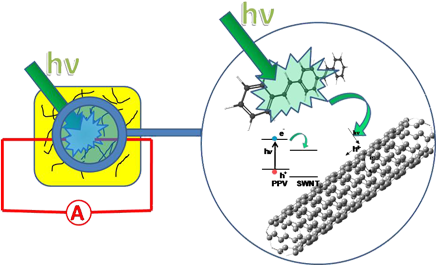
- green-yellow range, and photoconduction under UV or blue light excitation. In this report we present an investigation of the photoexcitation and exciton migration processes in composites of PPV and single-walled carbon nanotubes (SWNT) by means of time-resolved photoluminescence (PL) and
- photoconductivity measurements. These techniques are appropriate tools to understand the energy transfer mechanisms involved by the introduction of SWNTs into the PPV polymer matrix. In particular, time-resolved PL measurements give crucial information about the nature of photogenerated charges and their migration
- bandgap depending of their chirality. This fundamental physical difference will have tremendous importance as concerns the electronic coupling, the energy transfer and the migration of excitons between the semi-conducting polymer and the nanotubes [15]. Therefore, the results are compared with original


Characterization of nanostructured ZnO thin films deposited through vacuum evaporation
Beilstein J. Nanotechnol. 2015, 6, 971–975, doi:10.3762/bjnano.6.100
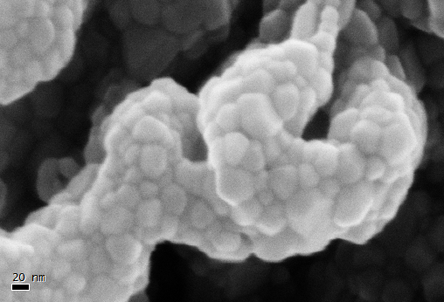
- films. The peaks correspond directly to the hexagonal structure of the ZnO. This is due the nature of the source material, and it is assumed that only nanoparticles migration from the source to the substrate takes place. Morphology of the films Figure 2 shows the HRSEM pictures for a) un-annealed films
- , and films annealed at b) 200 °C, c) 400 °C, d) 600°C with a zoom in on the thin film, e) 800 °C and f) 1000 °C. From Figure 2a, it can be seen that there is a migration from the source to the substrate. It is hypothesized that the nanoparticles only decompose into particles small enough to cross the
- distance between the boat and glass substrate, this is supposed because the temperature in the resistor is not enough to decompose ZnO into ions. This decomposition takes place at 1500 °C and the resistor only reaches 800 °C. At these temperatures only migration takes place. However, this deposit is a mesh





