Search results
Search for "signal-to-noise ratio" in Full Text gives 179 result(s) in Beilstein Journal of Nanotechnology.
Towards 4-dimensional atomic force spectroscopy using the spectral inversion method
Beilstein J. Nanotechnol. 2013, 4, 87–93, doi:10.3762/bjnano.4.10
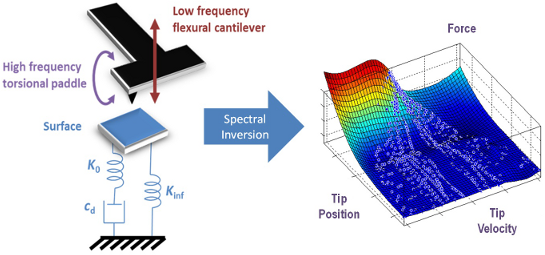
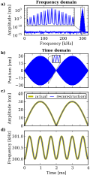
- a single 2-dimensional (2D) surface scan. Although signal-to-noise ratio limitations can currently prevent the accurate experimental implementation of the 4D method, and the extraction of rate-dependent material properties from the force maps is a formidable challenge, the spectral inversion method
- interaction force as a component of the driving force acting on the cantilever and was demonstrated with standard cantilevers, although the low signal-to-noise ratio of certain regions of the spectrum limited its accuracy. In 2007, Sahin and co-workers [8] introduced a T-shaped cantilever with an off-centered
- frequency deviates from the resonance frequency (recall that harmonic oscillators exhibit a Lorentzian frequency response). As a result, the high-frequency peaks in Zp(ω) become smaller and smaller as ω increases, such that their signal-to-noise ratio decreases rapidly as ω increases. Thus, in order to


Interpreting motion and force for narrow-band intermodulation atomic force microscopy
Beilstein J. Nanotechnol. 2013, 4, 45–56, doi:10.3762/bjnano.4.5
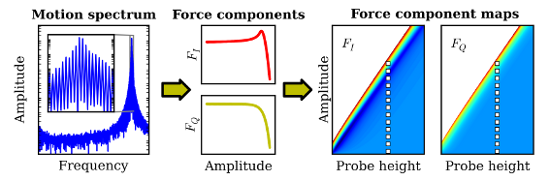
- off-resonance components have small signal-to-noise ratio and their measurement requires special cantilevers [20], high interaction forces [21] or highly damped environments [22]. To increase the number of Fourier components with good signal-to-noise ratio, on-resonance techniques utilize multiple
- –surface interaction maps a drive-frequency comb to a response-frequency comb, both having the same base frequency Δω. Different drive-frequency combs can be used to place many response frequency components close to a resonance of the cantilever where they can be detected with good signal-to-noise ratio
- methods in the future that will take advantage of the high signal-to-noise ratio and the high acquisition speed of ImAFM. Experimental The PS sample was spin cast from toluene solution on a silicon oxide substrate. Both PS (Mw = 280 kDa) and toluene were obtained from Sigma-Aldrich and used as purchased




Nanostructure-directed chemical sensing: The IHSAB principle and the dynamics of acid/base-interface interaction
Beilstein J. Nanotechnol. 2013, 4, 20–31, doi:10.3762/bjnano.4.3
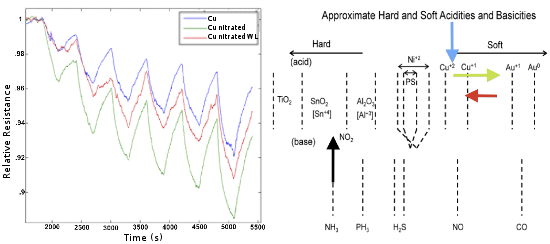
- in the supply line. The sensors respond to the analyte gas on a time scale of much less than two seconds. The change in resistance is measured in one-second intervals by using a DC current. The voltage bias used in these experiments is 3 V to obtain an optimum signal-to-noise ratio. A NI DAQPad-6015


Characterization of the mechanical properties of qPlus sensors
Beilstein J. Nanotechnol. 2013, 4, 1–9, doi:10.3762/bjnano.4.1
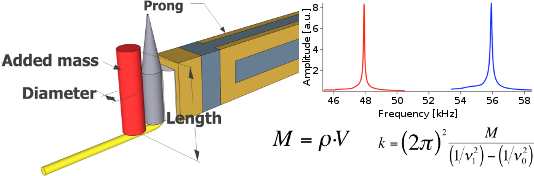
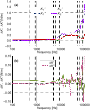
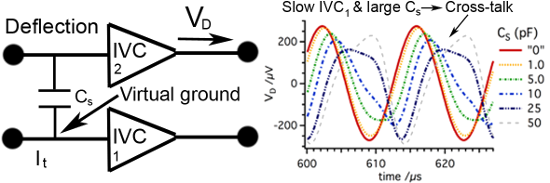
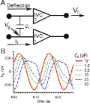
- optionally enhanced up to 103 times. Due to the electrode configuration of the prong, the signals from the first stage are in inverse phase with respect to each other. Therefore the application of a differential amplifier leads to a better signal-to-noise ratio [30]. Furthermore, the two OPAs in the first
- signal-to-noise ratio [30] and can eliminate the driving signal, which is coupled by stray capacitances, from the deflection channel. A plot of added mass versus (2πν)−2(10−10s2) for a single commercial sensor. A simple linear regression of the measured data gives a stiffness, in this case the slope of


Tuning the properties of magnetic thin films by interaction with periodic nanostructures
Beilstein J. Nanotechnol. 2012, 3, 831–842, doi:10.3762/bjnano.3.93
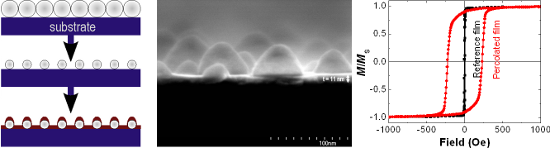
- magnetic grains with parallel magnetization either pointing up- or downwards. Increasing areal densities of recording bits, while maintaining the signal-to-noise ratio, demands a reduction of the grain size [1]. As a result of the miniaturization, however, the grain size approaches the superparamagnetic


Spring constant of a tuning-fork sensor for dynamic force microscopy
Beilstein J. Nanotechnol. 2012, 3, 809–816, doi:10.3762/bjnano.3.90
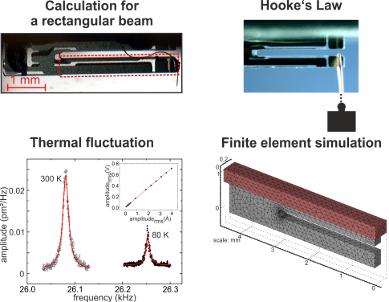
- resonance frequency [12][13][14]. By measuring the amplitude of the thermal noise, k can be evaluated in situ, e.g., in a vacuum system prior to the measurement, without any modification of the experimental arrangement [15][16][17][18][19][20]. However, this requires a good signal-to-noise ratio for the




The memory effect of nanoscale memristors investigated by conducting scanning probe microscopy methods
Beilstein J. Nanotechnol. 2012, 3, 722–730, doi:10.3762/bjnano.3.82
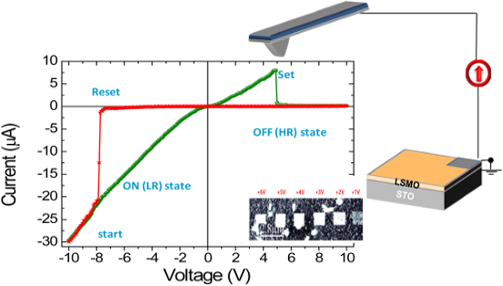
- resistive state of a given modification is altered if the total range exceeds the absolute value of the corresponding Vwr. Therefore, in order to explore the true I–V curve by improving the signal-to-noise ratio and using an adequate voltage range for each HR state, we also measured individual I–V curves


Zeolites as nanoporous, gas-sensitive materials for in situ monitoring of DeNOx-SCR
Beilstein J. Nanotechnol. 2012, 3, 667–673, doi:10.3762/bjnano.3.76
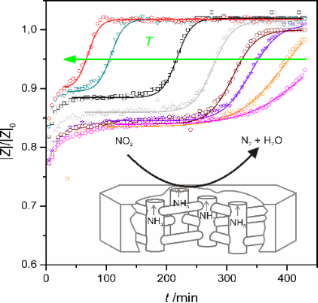
- temperature of 85 °C, observations at lower temperatures were not feasible due to the poor data quality (low signal-to-noise ratio, since the current-resolution limit of the impedance analyser is approached) at very low temperatures. Hence, the Fe-loaded catalyst shows a NH3 loss by SCR reaction at


Imaging ultra thin layers with helium ion microscopy: Utilizing the channeling contrast mechanism
Beilstein J. Nanotechnol. 2012, 3, 507–512, doi:10.3762/bjnano.3.58
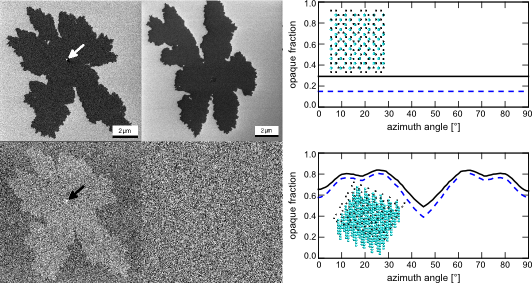
- , the BSHe data presented here was recorded with lower PEs between 10 keV and 20 keV. This results in a better signal-to-noise ratio for the BSHe images. Patterns of self-assembled monolayers (SAM) were created by using a PDMS stamp and gas-phase silanization. Orthogonal stripes with an identical width


Channeling in helium ion microscopy: Mapping of crystal orientation
Beilstein J. Nanotechnol. 2012, 3, 501–506, doi:10.3762/bjnano.3.57
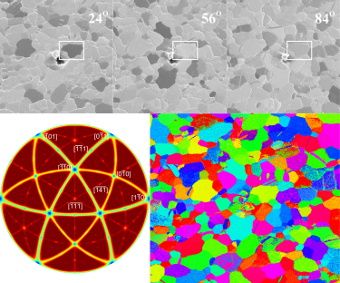
- PE of 15 keV. This increases the scattering probability and results in a better signal-to-noise ratio for ion-channeling contrast images. Commercially available polycrystalline gold{111} films on glass, with a chromium interlayer, were flame annealed in a hydrogen flame before the samples were loaded
- channeling contrast image recorded with the MCP detector is presented in Figure 2. Although, there is excellent contrast at the selected acceleration voltage of 20 keV and the mild dose of 1.11 × 1015 cm−2, the signal-to-noise ratio is considerably worse compared to the SE images presented above. The reason
- . First, the required ion dose for a high-quality image with a good signal-to-noise ratio is significantly lower. This is particularly important for light materials. The gold sample that has been used here has a comparatively large backscattering probability for helium atoms. The situation changes




Repulsive bimodal atomic force microscopy on polymers
Beilstein J. Nanotechnol. 2012, 3, 456–463, doi:10.3762/bjnano.3.52
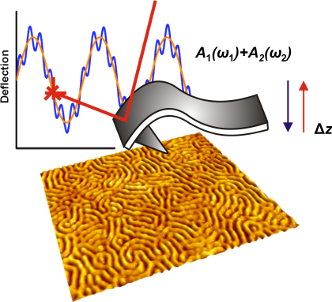
- that the image contrast is related to the signal-to-noise ratio and thus difficult to quantify for heterogeneous samples. The conclusions drawn here are on the basis of the optical impression of the authors. Comparing these observations with the bimodal-spectroscopy measurements on polystyrene from the
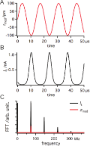
- 6a makes clear that the cantilever response under bimodal operation was sinusoidal in both the first (f1 = 113.5 kHz) and second eigenmodes (f2 = 705.6 kHz). Furthermore, a Fourier analysis of the time traces (Figure 6b) helps to assess the signal-to-noise ratio of the signals. For the first



X-ray absorption spectroscopy by full-field X-ray microscopy of a thin graphite flake: Imaging and electronic structure via the carbon K-edge
Beilstein J. Nanotechnol. 2012, 3, 345–350, doi:10.3762/bjnano.3.39
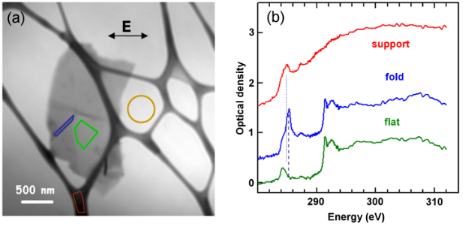
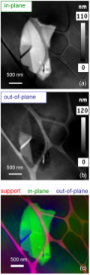
- , but with sufficient stability and signal integration it should be possible to measure the carbon K-edge NEXAFS of a single layer of graphene. The thickness of the studied sample ensures a good signal-to-noise ratio allowing detailed analysis of the peak form and composition. Figure 2a shows an average


Pulse-response measurement of frequency-resolved water dynamics on a hydrophilic surface using a Q-damped atomic force microscopy cantilever
Beilstein J. Nanotechnol. 2012, 3, 260–266, doi:10.3762/bjnano.3.29
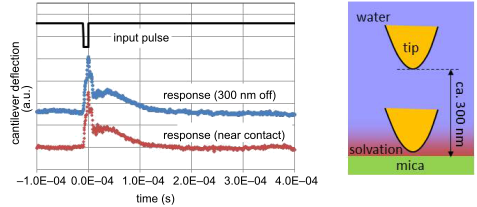
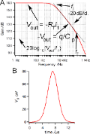
- disadvantageous with respect to the signal-to-noise ratio. In the previous report of the step-response measurement the inferior signal-to-noise ratio of the signal hindered detailed analysis. In the present report a pulse-response measurement in which differentiation of the response signal can be dispensed with




Simultaneous current, force and dissipation measurements on the Si(111) 7×7 surface with an optimized qPlus AFM/STM technique
Beilstein J. Nanotechnol. 2012, 3, 249–259, doi:10.3762/bjnano.3.28
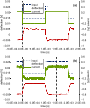
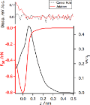
- the important oscillation stability [8][9][10]. The key factor to achieve atomic resolution is the proper choice of several parameters, for example, the spring constant and the oscillation amplitude (see Table I in [11]). Theoretically, the optimal signal-to-noise ratio (SNR) is achieved at a value of


![[Graphic 7]](/bjnano/content/inline/2190-4286-3-28-i11.png?max-width=637&scale=1.18182) can...
can...


Analysis of force-deconvolution methods in frequency-modulation atomic force microscopy
Beilstein J. Nanotechnol. 2012, 3, 238–248, doi:10.3762/bjnano.3.27
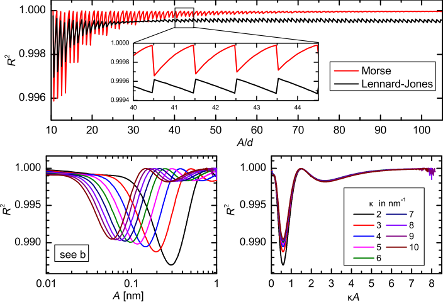
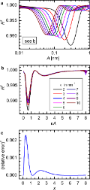
- ≈ 0.59 κ−1. The deconvolution quality rises again for larger amplitudes A > 7 κ−1. However, usually amplitudes in the order of the characteristic decay length of the force are desired to obtain the best signal-to-noise ratio [24]. Therefore, in a real experiment it is difficult to judge whether the Sader


Variations in the structure and reactivity of thioester functionalized self-assembled monolayers and their use for controlled surface modification
Beilstein J. Nanotechnol. 2012, 3, 213–220, doi:10.3762/bjnano.3.24
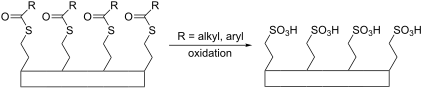
- , merged signal (Figure 4B and Figure 4C). Deconvolution reveals the thiophene sulfurs at 164.5 ± 0.2 eV and 165.6 ± 0.2 eV. The overlap among the four peaks in the spectra, together with their inherently problematic signal-to-noise ratio, leads to a situation in which the expected 2:1 peak intensity ratio


qPlus magnetic force microscopy in frequency-modulation mode with millihertz resolution
Beilstein J. Nanotechnol. 2012, 3, 174–178, doi:10.3762/bjnano.3.18
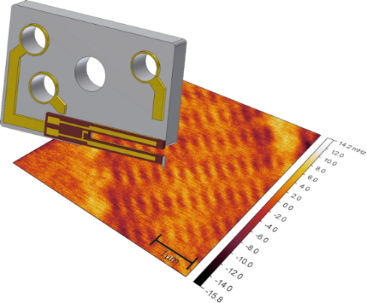
- frequency noise is inversely proportional to the oscillation amplitude A of the force sensor. Thus, we can reduce frequency noise by using large amplitudes and therefore minimize the . Moreover, one achieves the best signal-to-noise ratio by using an amplitude that is on the order of the decay length of the


Lifetime analysis of individual-atom contacts and crossover to geometric-shell structures in unstrained silver nanowires
Beilstein J. Nanotechnol. 2011, 2, 740–745, doi:10.3762/bjnano.2.81
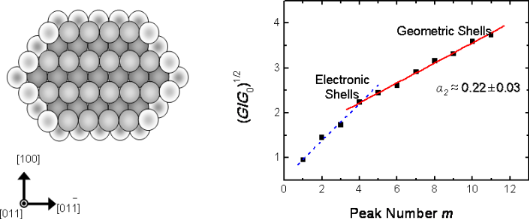
- , comparable results were obtained, though with a somewhat reduced signal-to-noise ratio. Conductance histogram of electrochemically deposited atomic-scale silver contacts giving evidence for different individual-atom and electronic-shell configurations. The histogram was obtained from >21000 conductance


Distinction of nucleobases – a tip-enhanced Raman approach
Beilstein J. Nanotechnol. 2011, 2, 628–637, doi:10.3762/bjnano.2.66
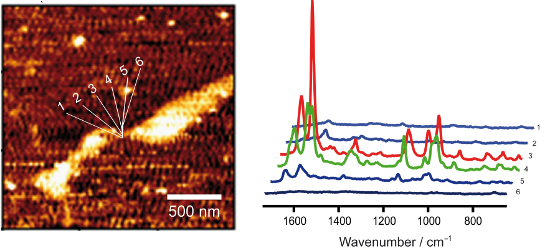
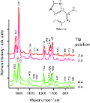
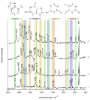
- found, and consequently a sequence-specific detection is only restricted by the lateral resolution and ultimately by the signal-to-noise ratio of the spectra recorded at subsequent positions. Conclusion Our results present several important steps towards a direct and label-free sequencing of RNA/DNA



Femtosecond time-resolved photodissociation dynamics of methyl halide molecules on ultrathin gold films
Beilstein J. Nanotechnol. 2011, 2, 618–627, doi:10.3762/bjnano.2.65
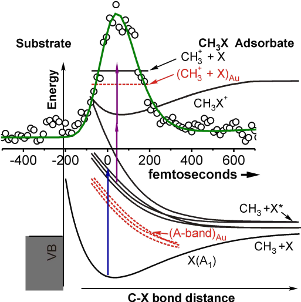
- single transients were averaged to improve the signal-to-noise ratio. The transient was obtained with 2 mW/cm² pump (266 nm) and 200 mW/cm² probe (333 nm) laser power. Intensity of the CH3+ signal as a function of (a) pump power and (b) probe power. Both measurements (a) and (b) were performed for a pump


Room temperature excitation spectroscopy of single quantum dots
Beilstein J. Nanotechnol. 2011, 2, 516–524, doi:10.3762/bjnano.2.56
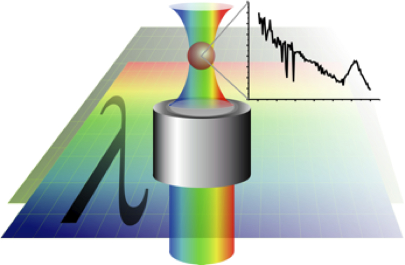
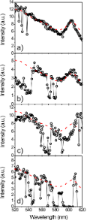
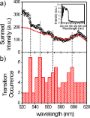
- devices. The primary challenge has been the intrinsic difficulty in measuring the absorption of a single emitter at room temperature due to the extremely low signal to noise ratio. Although recent reports have demonstrated the detection of single molecule absorbance [25][26][27], a complete single

Tip-enhanced Raman spectroscopic imaging of patterned thiol monolayers
Beilstein J. Nanotechnol. 2011, 2, 509–515, doi:10.3762/bjnano.2.55
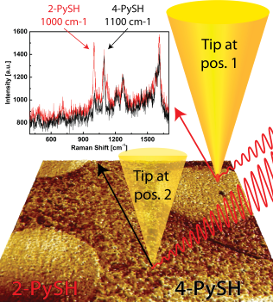
- enhancement can in principle be reached. An attempt was made to visualize the distribution of molecules using SERS, but this did not yield satisfactory results. However, the large signal-to-noise ratio in every pixel of a TERS image allows one to obtain enough information to distinguish a full monolayer from
- each TERS map, laser power and exposure time per spectrum were adapted according to the enhancement of the tip and the activity of the analyte. The laser power used ranged between 0.1–2.0 mW and collection times of 0.1–2.0 s per spectrum were chosen to yield a sufficient signal-to-noise ratio for the




Simulation of bonding effects in HRTEM images of light element materials
Beilstein J. Nanotechnol. 2011, 2, 394–404, doi:10.3762/bjnano.2.45
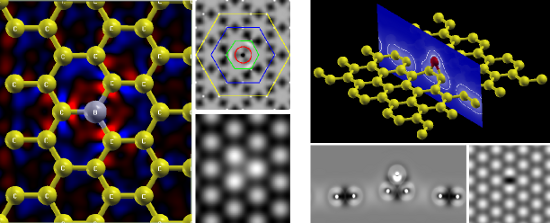
- remains stable enough under the electron beam to obtain a sufficient high signal to noise ratio, this might be achievable by applying higher defocus (see second row in Figure 10) or a phase plate (see third row in Figure 10). Conclusion We presented a practical method to include chemical bonding in the


Effect of large mechanical stress on the magnetic properties of embedded Fe nanoparticles
Beilstein J. Nanotechnol. 2011, 2, 268–275, doi:10.3762/bjnano.2.31
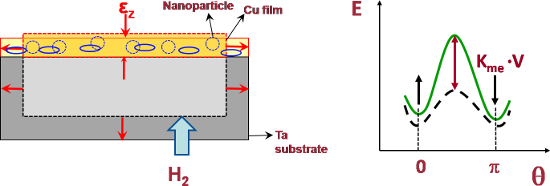
- films, each bit comprises a large number of magnetic grains, which are coupled by dipolar interactions and, to some extent, by inter granular exchange coupling. The necessity for incorporation of many grains in each bit arises from the requirement for a sufficiently large signal-to-noise ratio. A


Extended X-ray absorption fine structure of bimetallic nanoparticles
Beilstein J. Nanotechnol. 2011, 2, 237–251, doi:10.3762/bjnano.2.28
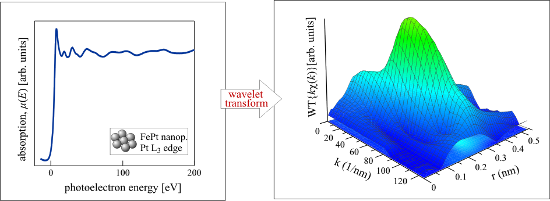
- 2. In this case, the data have to be multiplied by a window function W since for low values of k (XANES regime) the resonant absorption dominates the scattering effects, and for high values of k the signal-to-noise ratio becomes too small. The data are shown only in the region of non-vanishing