


Search results
Search for "attachment" in Full Text gives 339 result(s) in Beilstein Journal of Nanotechnology. Showing first 200.
Interactions of low-energy electrons with the FEBID precursor chromium hexacarbonyl (Cr(CO)6)
Beilstein J. Nanotechnol. 2017, 8, 2583–2590, doi:10.3762/bjnano.8.258
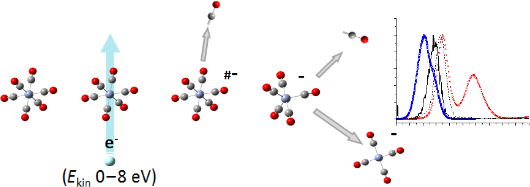
- spectrometer with reverse geometry. Dissociative electron attachment leads to the formation of a series of anions by the loss of CO ligand units. The bare chromium anion is formed by electron capture at an electron energy of about 9 eV. Metastable decays of Cr(CO)5− into Cr(CO)4−, Cr(CO)4− into Cr(CO)3− and Cr
- ; dissociative electron attachment; electron ionization; FEBID; metastable decay; Introduction Organometallic compounds have been extensively studied since they are used for a broad field of applications. Among the variety of applications, nanotechnologies have caught special attention since organometallic
- backscattered electrons with the precursor molecules. LEE initiate chemical reactions on the surface by dissociative electron attachment (DEA) and dissociative electron ionization, as well as neutral dissociation. Those processes need to be well understood, in order to maximise the quality of deposited metal as



Amplified cross-linking efficiency of self-assembled monolayers through targeted dissociative electron attachment for the production of carbon nanomembranes
Beilstein J. Nanotechnol. 2017, 8, 2562–2571, doi:10.3762/bjnano.8.256
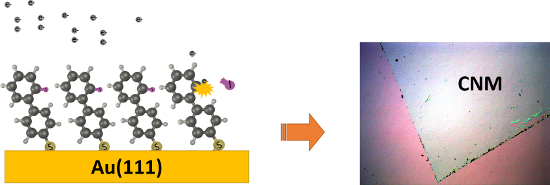
- 10.3762/bjnano.8.256 Abstract The determination of the negative ion yield of 2′-chloro-1,1′-biphenyl (2-Cl-BP), 2′-bromo-1,1′-biphenyl (2-Br-BP) and 2′-iodo-1,1′-biphenyl (2-I-BP) upon dissociative electron attachment (DEA) at an electron energy of 0 eV revealed cross section values that were more than
- nanomembrane; dissociative electron attachment; dissociative ionization; helium ion microscopy; self-assembled monolayers; X-ray photoelectron spectroscopy; Introduction Carbon nanomembranes (CNMs) are two-dimensional molecular sheets with a thickness of one to a few nanometers, high mechanical strength, and
- ]. In the energy range from about 0–100 eV, electron-induced bond rupture may proceed through four distinctly different initiating processes: dissociative ionization (DI), neutral or dipolar dissociation upon electronic excitation (ND and DD, respectively) or through dissociative electron attachment


Electron beam induced deposition of silacyclohexane and dichlorosilacyclohexane: the role of dissociative ionization and dissociative electron attachment in the deposition process
Beilstein J. Nanotechnol. 2017, 8, 2376–2388, doi:10.3762/bjnano.8.237
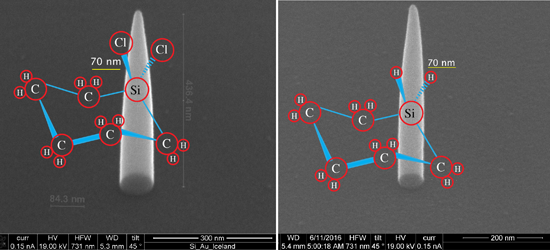
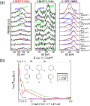
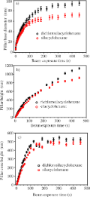
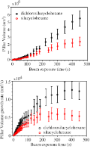
- dissociative electron attachment, SCH is inert with respect to this process. We discuss our deposition experiments in context of the efficiency of these different electron-induced fragmentation processes. With regards to the deposition dynamics, we observe a substantially faster growth from DCSCH and a higher
- attachment; dissociative ionization; electron beam induced deposition; low-energy electrons; silacyclohexane; Introduction Focused electron beam induced deposition (FEBID) [1][2] is a 3-D direct writing method suitable for the fabrication of nanostructures, even on non-planar surfaces. This approach is in
- features: a maximum well below 10 eV with still a significant contribution close to 0 eV and a high-energy tail extending well above 100 eV [3][5][12]. In this energy range electron induced molecular fragmentation may proceed through four different processes: dissociative electron attachment (DEA; Equation





Surfactant-induced enhancement of droplet adhesion in superhydrophobic soybean (Glycine max L.) leaves
Beilstein J. Nanotechnol. 2017, 8, 2345–2356, doi:10.3762/bjnano.8.234
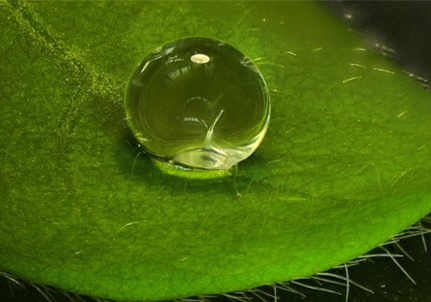
- mechanical stability [5]. Furthermore, the cuticle interacts with its biotic environment and plays a crucial role for insect signaling [6] and insect attachment [7][8][9]. The leaf surfaces are composed of epidermis cells covered by a cuticle, which is a continuous extracellular membrane on primary plant


Dissociative electron attachment to coordination complexes of chromium: chromium(0) hexacarbonyl and benzene-chromium(0) tricarbonyl
Beilstein J. Nanotechnol. 2017, 8, 2257–2263, doi:10.3762/bjnano.8.225
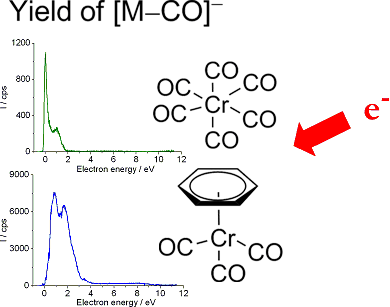
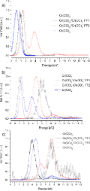
- we report the results of dissociative electron attachment (DEA) to gas-phase chromium(0) hexacarbonyl (Cr(CO)6) and benzene-chromium(0) tricarbonyl ((η6-C6H6)Cr(CO)3) in the energy range of 0–12 eV. Measurements have been performed utilizing an electron-molecular crossed beam setup. It was found that
- ; dissociative electron attachment; gas phase reactions; mass spectrometry; Introduction Organometallic compounds are a large class of compounds with numerous applications such as homogeneous catalysts for the synthesis of fine chemicals or even enantiomerically pure products used in the pharmaceutical industry
- molecules via various decomposition processes such as dissociative ionization (DI), dipolar dissociation (DD), neutral dissociation (ND), and dissociative electron attachment (DEA) [8]. These reactions occur with relatively high cross sections and typically result in partial fragmentation of the precursor
Comprehensive investigation of the electronic excitation of W(CO)6 by photoabsorption and theoretical analysis in the energy region from 3.9 to 10.8 eV
Beilstein J. Nanotechnol. 2017, 8, 2208–2218, doi:10.3762/bjnano.8.220
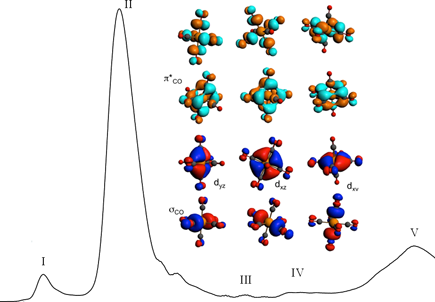
- beam impinging on the surface where dissociative electron attachment (DEA) processes are relevant, although at those energies electron impact excitations yielding neutral dissociation are prevalent in detriment to DEA [25]. Gas-phase DEA studies in the electron energy range from 0 to 14 eV reported by
- Wnorowski et al. [26] revealed the strong dissociation character of W(CO)6, with no formation of bare W− metal anions. Negative ion states of transition-metal hexacarbonyls have been obtained by electron transmission spectroscopy (ETS) with W(CO)6 attachment energies of 1.53, 2.46 and 4.26 eV [27]. We note


Suppression of low-energy dissociative electron attachment in Fe(CO)5 upon clustering
Beilstein J. Nanotechnol. 2017, 8, 2200–2207, doi:10.3762/bjnano.8.219
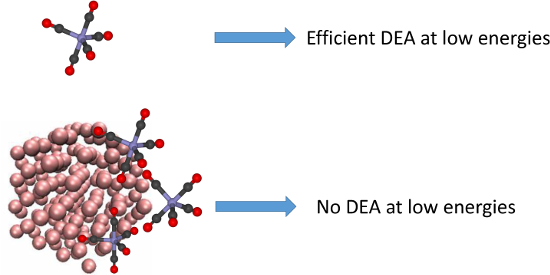
- the most attention in recent years (i.e., dissociative electron attachment at energies close to 0 eV) becomes suppressed upon increasing aggregation of iron pentacarbonyl. We attribute this suppression to the electrostatic shielding of a long-range interaction that strongly enhances the dissociative
- electron attachment in isolated Fe(CO)5. Keywords: aggregation effects; dissociative electron attachment; FEBID; iron pentacarbonyl; long-range interactions; Introduction In recent years a number of gas-phase studies on molecules that are commonly used as precursors in electron-induced nanofabrication
- have stressed the importance of electrons with energy below 1 eV [1][2][3]. In many cases, these cause the cleavage of one metal–ligand bond via dissociative electron attachment (DEA) and corresponding cross sections reach unusually high values [2][3]. Iron pentacarbonyl, Fe(CO)5, is no exception: the


A comparative study of the nanoscale and macroscale tribological attributes of alumina and stainless steel surfaces immersed in aqueous suspensions of positively or negatively charged nanodiamonds
Beilstein J. Nanotechnol. 2017, 8, 2045–2059, doi:10.3762/bjnano.8.205
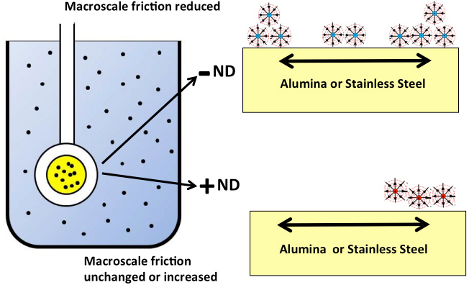
- consistent with strong attachment of NDs and/or chemical changes to the surfaces. AFM images of the surfaces indicated slight increases in the surface roughness upon an exposure to both +ND and −ND suspensions. A suggested mechanism for these observations is that carboxylated −NDs from aqueous suspensions
- studied and act as passivation agents. They also reveal that −ND and +ND may act as neutralizing or removal agents for one another. In order to probe ND attachment/film formation and/or polishing effects for the surfaces as a whole and to separate this from effects confined within the contact region, AFM
- surface aggregates in regions where they are present. The AFM and SEM data are consistent with the results from nanodiamond seeding literature [46], where it has been reported that the particle attachment density can, for example, vary from very low (108 cm−2) for hydrogen treated nanodiamonds (+ND) to


Carbon nano-onions as fluorescent on/off modulated nanoprobes for diagnostics
Beilstein J. Nanotechnol. 2017, 8, 1878–1888, doi:10.3762/bjnano.8.188
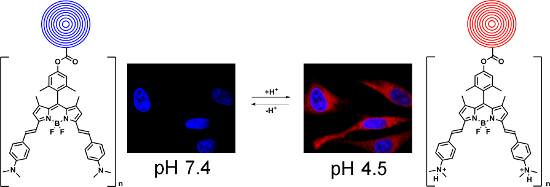
- functionalization of the CNOs. The high degree of surface functionalization of the oxi-CNOs and the successful attachment of the dye molecules on the oxi-CNOs was observed by TGA analysis. The TGA spectrum of the oxi-CNOs performed in air (Figure 3, blue) showed a decrease in decomposition temperature from 686 °C


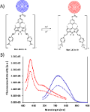


Application of visible-light photosensitization to form alkyl-radical-derived thin films on gold
Beilstein J. Nanotechnol. 2017, 8, 1863–1877, doi:10.3762/bjnano.8.187
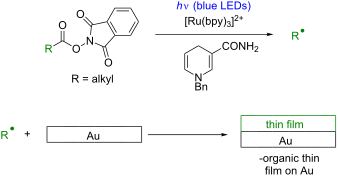
- arenediazonium ion can accept a single electron from a cathode to generate aryl radical and N2 at relatively high potentials. Rapid covalent bonding [11][12][13][14] of aryl radical to surfaces followed by further attachment of radicals to already-grafted arenes results in polymerization and generates dense
- a liquid N2-cooled MCT probe and an 80Spec attachment from Pike Technologies. The angle of incidence was 80°. For each sample, 2056 scans were accumulated with a spectral resolution of 4 cm−1. Contact angle goniometry (water contact angles): Water contact angles were measured with a VCA Optima
- , the film is robust possibly due to strong attachment or crosslinking. A control experiment was conducted to examine the outcome of thin film deposition in the absence of the photosensitizer Ru(bpy)3Cl2. The sample exhibits spontaneous surface attachment of components of the mixture on gold (Figure 3a



Methionine-mediated synthesis of magnetic nanoparticles and functionalization with gold quantum dots for theranostic applications
Beilstein J. Nanotechnol. 2017, 8, 1734–1741, doi:10.3762/bjnano.8.174
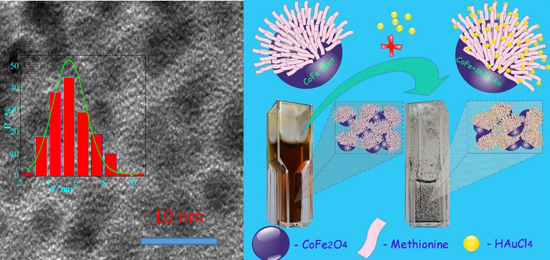
- attachment of gold species. In recent publications amino acids such as methionine [19] and lysine [24] have been reported to be effective capping agents to control the size of magnetite [19] and Co ferrite [24] NPs during co-precipitation synthesis [25]. The main goal of the methionine capping was the
- , peaked near 1515 cm−1, belongs to δs(NH3) mode and is indicative of the presence of charged amino groups [35][37]. The symmetric C–H deformation mode is also observed at 1341 cm−1 in the FTIR spectra of both pure methionine and CoFe2O4@Met. The attachment of methionine molecules during the synthesis of


Three-in-one approach towards efficient organic dye-sensitized solar cells: aggregation suppression, panchromatic absorption and resonance energy transfer
Beilstein J. Nanotechnol. 2017, 8, 1705–1713, doi:10.3762/bjnano.8.171
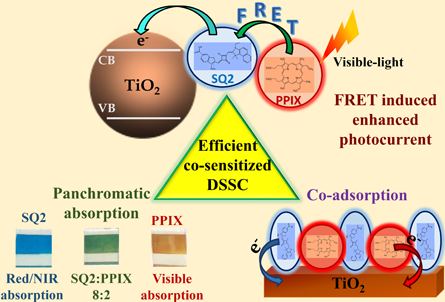
- carried out to explore the dynamical processes occurring between these two dyes after the attachment to the TiO2 surface. PPIX is an environmentally friendly organic sensitizer that has a strong absorption in the visible region of the solar spectrum. Application of PPIX as a sensitizer in DSSCs has been
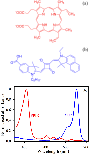
- of the photoanodes S8P2 and S6P4, it can be observed that the simultaneous attachment of PPIX and SQ2 on the TiO2 surface can significantly reduce the aggregation of the SQ2 dye. It can be noted that after the addition of PPIX, the absorption region of SQ2 becomes narrower and the prominent peak
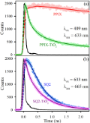
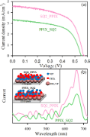
- timescale of 60 ps (64%) was obtained after attachment of SQ2 on the TiO2 surface. All the lifetime components and their relative percentages are summarized in Table 2. Figure 5a presents the current density (J) vs voltage (V) characteristics of the co-sensitized DSSCs. Sample S8P2 shows the highest



Effect of the fluorination technique on the surface-fluorination patterning of double-walled carbon nanotubes
Beilstein J. Nanotechnol. 2017, 8, 1688–1698, doi:10.3762/bjnano.8.169
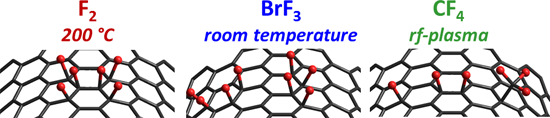
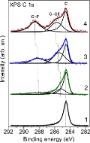
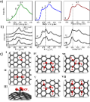
- . Results and Discussion Raman spectroscopy detected a growth of the intensity of the D band corresponding to out-of-plane vibrations of carbon hexagons after fluorination of the DWCNT sample (Figure 1). This is due to development of sp3-hybridized carbon defect sites as the result of covalent attachment of
- disruption of the uniformity of the π-system due to attachment of fluorine atoms to the CNT surface [40]. The appearance of a set of C–F absorption bands in the FTIR spectra reflects a co-existence of various types of bonds in samples. Chamssedine et al. identified three types of C–F bonding for fluorinated
- promoting the attachment of fluorine atoms one by one. For the DWCNTs treated with CF4 plasma we suppose fluorination of the rope surfaces only, since the plasma deposition is directional and the sample exposure time was relatively short. This did not allow us to choose a single model well suited to all



Uptake and intracellular accumulation of diamond nanoparticles – a metabolic and cytotoxic study
Beilstein J. Nanotechnol. 2017, 8, 1649–1657, doi:10.3762/bjnano.8.165
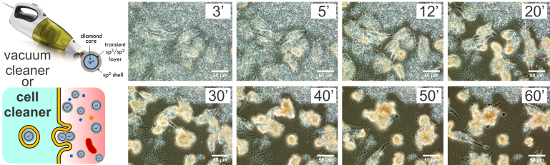
- concentration-dependent manner. This was explained by the fact that MWCNTs at higher concentrations covered most of the bottom of the culture well and left only limited space for cell attachment and spreading [38]. Influence of particle type Figure 3 and Figure 4 show a comparison between the cell metabolic


Oxidative stabilization of polyacrylonitrile nanofibers and carbon nanofibers containing graphene oxide (GO): a spectroscopic and electrochemical study
Beilstein J. Nanotechnol. 2017, 8, 1616–1628, doi:10.3762/bjnano.8.161
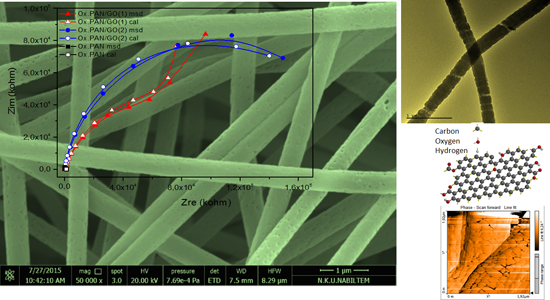
- reflectance Fourier transform infrared spectroscopy (ATR-FTIR) (Perkin Elmer, Spectrum One, with a Universal ATR attachment with a diamond and ZnSe crystal). The microstructure of the carbonized nanofiber webs was investigated by Raman spectroscopy (DXR Raman spectrometer, Thermo Scientific, at 532 nm). The


A biofunctionalizable ink platform composed of catechol-modified chitosan and reduced graphene oxide/platinum nanocomposite
Beilstein J. Nanotechnol. 2017, 8, 1508–1514, doi:10.3762/bjnano.8.151
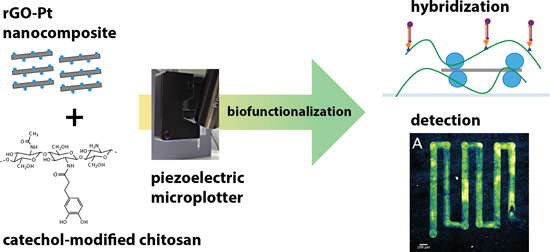
- polymerase chain reaction (PCR) products and low non-specific binding. Our results demonstrate that catechol-modified chitosan/rGO–Pt nanocomposites can be used as inks for piezoelectric printing and facilitate the attachment of biorecognition elements for biosensor applications. Keywords: biosensing


Micro- and nano-surface structures based on vapor-deposited polymers
Beilstein J. Nanotechnol. 2017, 8, 1366–1374, doi:10.3762/bjnano.8.138
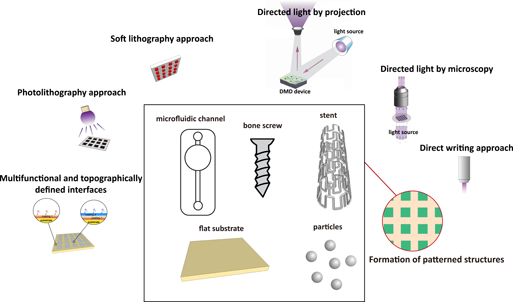
- for the pattern formation of polyethylene glycol (PEG)-like polymer derivatives to guide fibroblast attachment [21]. A photodefinable polymer of poly(4-benzoyl-p-xylylene-co-p-xylylene) was synthesized by CVD, and a combined soft lithographical and UV light process was performed to create the
- –Arg–Glu–Asp–Val (CREDV) peptide showed the synergic anti-fouling property and preferentially enhanced attachment of endothelial cells in such patterned areas [50]. In another report, a multifunctional coating was realized via CVD copolymerization to deposit a poly(p-xylylene) copolymer, which


Miniemulsion copolymerization of (meth)acrylates in the presence of functionalized multiwalled carbon nanotubes for reinforced coating applications
Beilstein J. Nanotechnol. 2017, 8, 1328–1337, doi:10.3762/bjnano.8.134
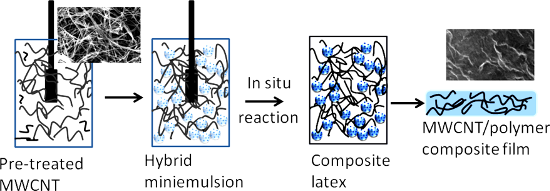
- covalent attachment or through the supramolecular adsorption or wrapping of suitable functionalities and even surface active substances [1][2][4][5]. Various techniques have been developed for the synthesis of CNT–polymer composites, including solution mixing [6][7], melt blending [8][9][10][11][12], latex


Characterization of ferrite nanoparticles for preparation of biocomposites
Beilstein J. Nanotechnol. 2017, 8, 1257–1265, doi:10.3762/bjnano.8.127
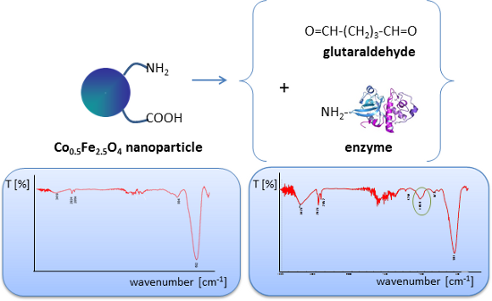
- signal at 1052 cm−1 that originates from –CH=O in this compound [32]. The last spectra (d) were collected after the attachment of trypsin, and here a small signal at 1056 cm−1 occurs, which suggests the presence of the tested enzyme in the sample. Similar changes in the IR spectra were observed
- mixture was mixed for 3 h at RT [34]. After that, the nanoparticles were once again washed with Tris-HCl solution and dried at RT overnight. Attachment of the tested enzymes In the present studies, enzymes were attached to the nanoparticles in two ways. In the first one, via glutaraldehyde, and in the
- second, without it, directly to the –COOH obtained via surface modification with oleic acid, which is schematically presented in Figure 8. Below, we present the methods for attachment of the various enzymes. Albumin: Nanoparticles were washed with Tris-HCl solution, then the mixture of albumin (17 g/L



Synthesis, spectroscopic characterization and thermogravimetric analysis of two series of substituted (metallo)tetraphenylporphyrins
Beilstein J. Nanotechnol. 2017, 8, 1191–1204, doi:10.3762/bjnano.8.121
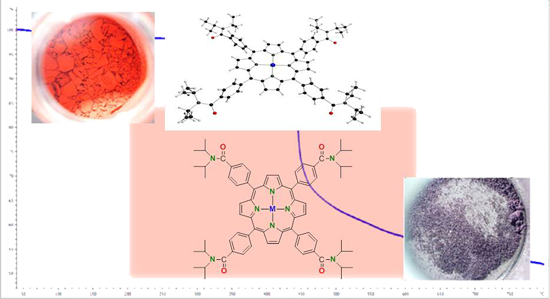
- Information File 1 shows the IR spectra of 2/3 and of 2a–d/3a–d as obtained by FTIR measurements with a Nicolet iS10 spectrometer (ATR attachment, ZnSe crystal) for comparison. For the porphyrins 2 and 3 three different N–H vibrations at 3310–3326 cm−1, 975–990 cm−1 and 675–700 cm−1 are expected according to


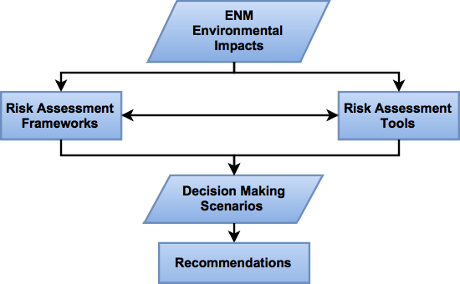
Needs and challenges for assessing the environmental impacts of engineered nanomaterials (ENMs)
Beilstein J. Nanotechnol. 2017, 8, 989–1014, doi:10.3762/bjnano.8.101

Vapor-phase-synthesized fluoroacrylate polymer thin films: thermal stability and structural properties
Beilstein J. Nanotechnol. 2017, 8, 933–942, doi:10.3762/bjnano.8.95
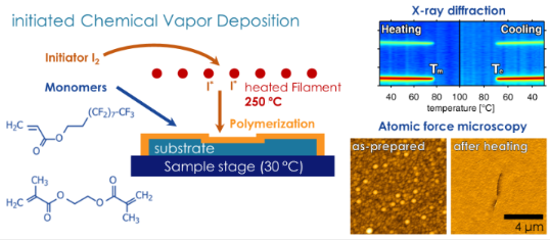
- , whereby qz = 4π·sin(θ)/λ. The index z indicates that only net planes parallel to the substrate surface were probed in the experiment (specular scan). In situ, temperature-dependent XRD studies were performed with a DHS900 heating stage attachment (Anton-Paar, Austria), using a heating rate of 2 °C/min


3D Nanoprinting via laser-assisted electron beam induced deposition: growth kinetics, enhanced purity, and electrical resistivity
Beilstein J. Nanotechnol. 2017, 8, 801–812, doi:10.3762/bjnano.8.83
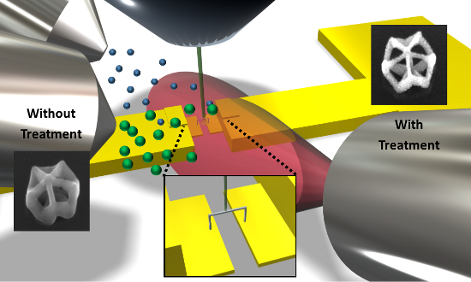
- resultant grain structure and carbon removal. In standard EBID using the MeCpPt(IV)Me3 precursor, the initial reaction leading to condensation occurs with the cleavage of a single bond between a methyl group and the platinum atom, surmised to occur primarily through dissociative electron attachment (DEA


Silicon microgrooves for contact guidance of human aortic endothelial cells
Beilstein J. Nanotechnol. 2017, 8, 675–681, doi:10.3762/bjnano.8.72
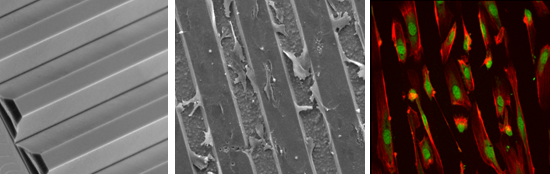
- , macroporous and micropillars, to study the effect of topography on the behaviour of endothelial cells. Collagen was found to stimulate cell adhesion and promote an enhanced cell attachment [32][33]. Herein, to mimic the elongated endothelium in natural lineal vessels, human aortic endothelial cells (HAECs
- ,d) V-shaped grooves. Cytotoxicity observed after D1–D7 of cells incubation on a regular well-plate (blank condition), on flat substrate (Flat) or on different patterned substrates (S15, S40, V15 and V40). No statistical differences were found in any condition tested. a) Attachment of HAECs after 2


Optimizing qPlus sensor assemblies for simultaneous scanning tunneling and noncontact atomic force microscopy operation based on finite element method analysis
Beilstein J. Nanotechnol. 2017, 8, 657–666, doi:10.3762/bjnano.8.70
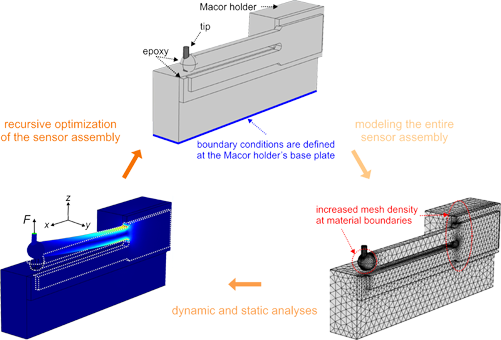
- numerical analysis of qPlus-style setups without tips, this work quantifies the influence of tip attachment on the operational characteristics of the sensor. The results using finite element modeling show in particular that for setups that include a metallic tip that is connected via a separate wire to
- throughout this work at typical values of ethick = 100 µm and eover = 40 µm to solely focus on the effect the tip attachment has. All calculations were carried out using the COMSOL Multiphysics 4.4 structural mechanics software package (COMSOL Multiphysics GmbH, Berlin, and Germany). Table 1 summarizes the
- as in the recently introduced tuned-oscillator mode [38]), other priorities for the evolution of f0, k, and Q may exist. The first attachment choice studied in this paper is depicted in Figure 2a–c. Here, the blunt tungsten rod of 100 µm diameter and 400 µm length standing in for the tip is mounted





