


Search results
Search for "cells" in Full Text gives 1112 result(s) in Beilstein Journal of Nanotechnology. Showing first 200.
unDrift: A versatile software for fast offline SPM image drift correction
Beilstein J. Nanotechnol. 2023, 14, 1225–1237, doi:10.3762/bjnano.14.101
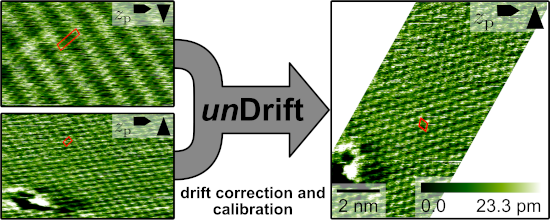
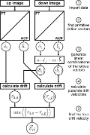
- to choose whether the algorithm operates based on Fourier transform or autocorrelation. This choice mostly depends on the size of the image relative to the size of the observed periodic structure. For images showing many unit cells, we find that the Fourier transform yields better results, while the
- autocorrelation is superior for images containing very few unit cells. In between these extremes, there is a range where both methods work well as shown in our examples in Figure 2. The dependence of the optimal transformation for peak extraction on the image size is caused by the finite resolution of the
- measured SPM images. For images containing many unit cells, each unit cell only consists of few pixels; thus, the maxima in the autocorrelation are difficult to separate, as they also consist of few pixels. The Fourier transform, in contrast, works in the inverse space, which is why the maxima are very


Fluorescent bioinspired albumin/polydopamine nanoparticles and their interactions with Escherichia coli cells
Beilstein J. Nanotechnol. 2023, 14, 1208–1224, doi:10.3762/bjnano.14.100
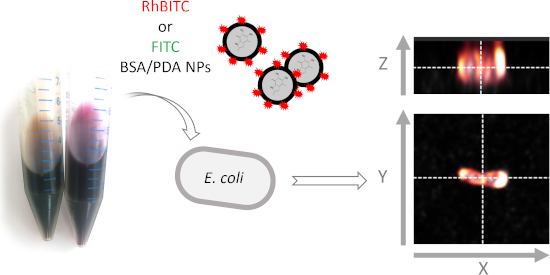
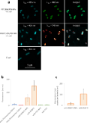
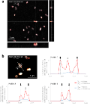
- applications, especially because of their biocompatibility. We synthesized and characterized fluorescent PDA NPs of 10–25 nm diameter based on a protein containing a lysine–glutamate diad (bovine serum albumin, BSA) and determined whether they can penetrate and accumulate in bacterial cells to serve as a
- and RhBITC-BSA/PDA NPs penetrated and accumulated in both cell wall and inner compartments of Escherichia coli (E. coli) cells. The fluorescence signals were diffuse or displayed aggregate-like patterns with both labelled NPs and free dyes. RhBITC-BSA/PDA NPs led to the most intense fluorescence in
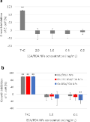
- cells. Penetration and accumulation of NPs was not accompanied by a bactericidal or inhibitory effect of growth as demonstrated with the Gram-negative E. coli species and confirmed with a Gram-positive bacterial species (Staphylococcus aureus). Altogether, these results allow us to envisage the use of



Hierarchically patterned polyurethane microgrooves featuring nanopillars or nanoholes for neurite elongation and alignment
Beilstein J. Nanotechnol. 2023, 14, 1157–1168, doi:10.3762/bjnano.14.96
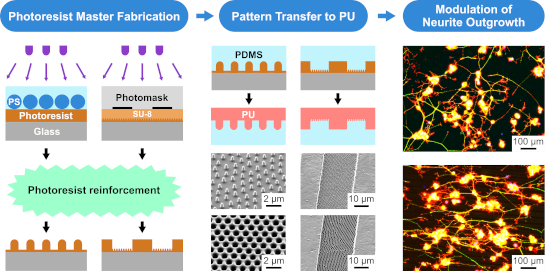
- “reinforcement” methods for overcoming the inherent drawbacks of using photoresist masters. We show that the PU nanopillars and nanoholes increase the neurite length of pheochromocytoma 12 (PC12) cells through unique growth cone interactions. Moreover, we demonstrate, for the first time, that hierarchically
- positively affect neural functions and neurite outgrowth [3]. Studies on in vitro models for peripheral neurons show promising results for such structures, to wit, poly(3,4-ethylenedioxythiophene) nanotubes and SU-8 nanoholes resulted in significantly longer neurites in pheochromocytoma 12 (PC12) cells [5][6
- ], poly(lactic-co-glycolic acid) nanodots enhanced the proliferation and neurite sprouting of Neuro-2a cells [7], and oriented elliptical Si microcones induced alignment and increased fasciculation in rat superior cervical ganglion axons [8]. With their effects complementing those of continuous structures


Elasticity, an often-overseen parameter in the development of nanoscale drug delivery systems
Beilstein J. Nanotechnol. 2023, 14, 1149–1156, doi:10.3762/bjnano.14.95
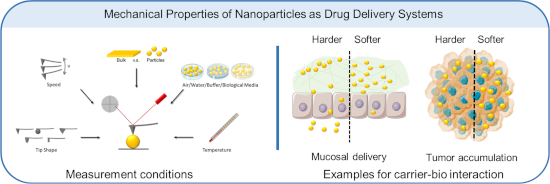
- , demonstrating the impact of these characteristics, is the life span of red blood cells. Juvenile red blood cells are able to flow through capillaries much smaller in diameter than their size due to sufficient elasticity. During their life span, they gain rigidity leading to their filtration out of the blood
- system when they reach the end of their lifetime [11][12]. Similar data were reported for nanoparticulate systems [13]. Other examples are viruses [14] and cancer cells which can adapt their mechanical properties multiple times during the process of metastasis formation [15]. Looking at these examples
- uptake for softer particles [30]. Cell uptake is often the first biological evaluation during the development phase besides toxicity and biocompatibility. However, after application, particles first need to reach the cells and overcome several other biological barriers. During uptake, other biological


Curcumin-loaded albumin submicron particles with potential as a cancer therapy: an in vitro study
Beilstein J. Nanotechnol. 2023, 14, 1127–1140, doi:10.3762/bjnano.14.93
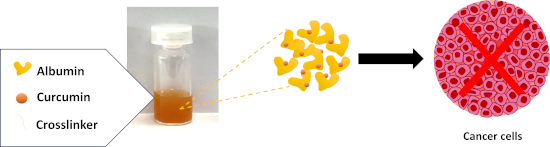
- to confirm the uptake of CUR-HSA-MPs by cancer cells. Our studies revealed that HSA-MPs are potentially promising vehicles for increasing the solubility and bioavailability of CUR. Keywords: albumin submicron particles; cancer therapy; curcumin; drug delivery; Introduction Curcumin (CUR) is a
- especially anticancer potential [1][2]. Several in vivo and in vitro studies in recent years have demonstrated that CUR can influence cancer cell proliferation, invasion, angiogenesis, and metastasis [3]. It has been reported that CUR exerts anticancer effects in human breast cancer cells (MCF-7) by
- regulating the expression through a miRNA-mediated mechanism [4]. Furthermore, recent studies have shown that CUR induces apoptosis in human hepatocellular carcinoma cells (Huh-7) by activating p38, leading to FasL-associated apoptosis [5]. However, the clinical application of CUR is restricted by




A bifunctional superconducting cell as flux qubit and neuron
Beilstein J. Nanotechnol. 2023, 14, 1116–1126, doi:10.3762/bjnano.14.92
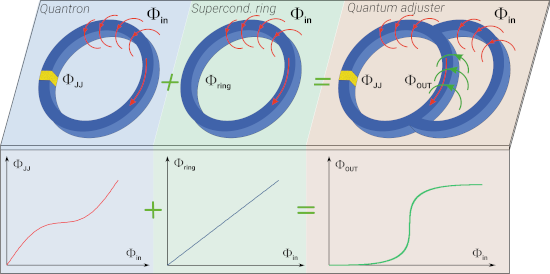
- millikelvin temperatures with zeptojoule energy efficiency [11][12][13][14][15][16][17]. In addition, the basic cells of adiabatic superconducting circuits can be used as a part of neuromorphic co-processors [18][19][20][21][22][23] working in conjunction with quantum computing systems [24][25][26][27][28][29
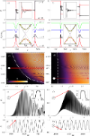
- operating temperatures. For example, the dark blue region in Figure 4b is only suitable for T ∼ 0.1 K. Note that for the parameters used and a Josephson junction quality factor of Q ∼ 105, the relaxation time is tr ∼ 1 μs. From this rough estimate it can be seen that in the future, adiabatic cells of tuning
- -type neural network to process signals received from qubits. Such a cell can be used in quantum mode also as an auxiliary qubit with relatively fast “flux” control. Future research will address the problem of using more advanced adiabatic superconducting logic cells for such purposes. In addition



Density functional theory study of Au-fcc/Ge and Au-hcp/Ge interfaces
Beilstein J. Nanotechnol. 2023, 14, 1093–1105, doi:10.3762/bjnano.14.90
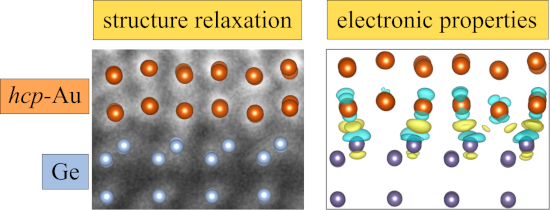
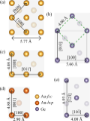
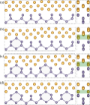
- ) grid for crystallographic cells of bulk crystal to a (4,4,4) grid for larger superlattices that model the Au-fcc(011)/Ge(001) and Au-hcp(010)/Ge(111) heterostructures. The slabs with vacuum were calculated using (8,8,2) or (4,4,2) k-points grids depending on the size of the cross section. A vacuum
- its side length matches the gold lattice constant. Again, multiple cells are needed in the perpendicular direction. There is no obvious way to build the Au-hcp/Ge interface using low-index Au-hcp and Ge surfaces. Thus, we decided to make calculations for the experimentally found Au-hcp(010)/Ge(111





Properties of tin oxide films grown by atomic layer deposition from tin tetraiodide and ozone
Beilstein J. Nanotechnol. 2023, 14, 1085–1092, doi:10.3762/bjnano.14.89
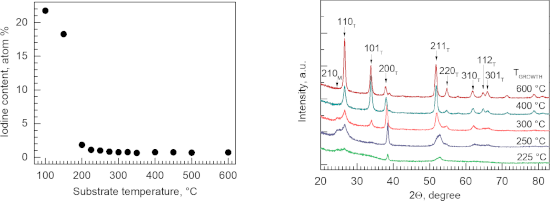
- have been studied from many perspectives. For example, one can mention anodes for Li-ion batteries [1], gas sensors [2], catalytic activities [3], and stable buffer [4] or base [5] layers in solar cells. More applications can be found, when SnO2 is considered as constituent of a nanostructure or a


Dual-heterodyne Kelvin probe force microscopy
Beilstein J. Nanotechnol. 2023, 14, 1068–1084, doi:10.3762/bjnano.14.88
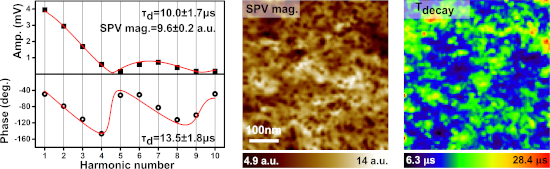
- to this, they are very promising for the use in many applications, such as LEDs, solar cells, and photodetectors. Reducing their size down to the nanoscale by synthesizing colloidal nanocrystals in solution can allow high control over the perovskite crystallinity and access to various morphologies




Recognition mechanisms of hemoglobin particles by monocytes – CD163 may just be one
Beilstein J. Nanotechnol. 2023, 14, 1028–1040, doi:10.3762/bjnano.14.85
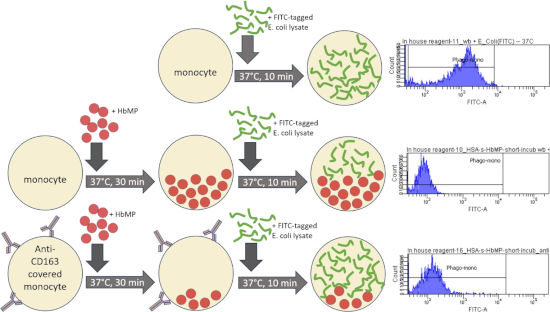
- CD163 is probably within the β chain of Hb (binding of Hb to Hp via a binding site within the Hb α chain) [27]. Furthermore, not only cells of the monocyte/macrophage lineage appear to be involved in sequestering Hb, but also hepatocytes [25][26]. It can be speculated that the same could be true for
- when using HbMPs as oxygen carriers [34]. In addition to transporting oxygen, HbMPs can also be used as drug carriers. However, in a pharmacokinetic study with HbMPs, accumulation of the particles in the sinusoids of the liver, where the Kupffer cells are located, was observed [35]. The mechanisms of
- and CD91 for Hpx, and taken up by phagocytes (e.g., Kupffer cells in liver sinoids), where Hb or heme are subsequently degraded. If this mechanism cannot be bypassed, Hp and Hpx must be fully saturated to achieve and maintain the effect of the HBOCs. Here is an example calculation with commercially




A visible-light photodetector based on heterojunctions between CuO nanoparticles and ZnO nanorods
Beilstein J. Nanotechnol. 2023, 14, 1018–1027, doi:10.3762/bjnano.14.84
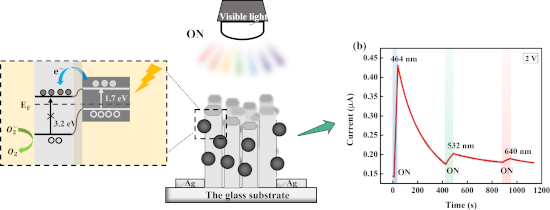
- development of many technologies in the future, such as solar cells [1][2], light-emitting diodes (LEDs) [3][4], laser diodes [5], and optical fibers [6]. Optoelectronics devices contribute to meeting requirements in telecommunications, medical equipment, sensors, and military services. Among those


Nanoarchitectonics of photothermal materials to enhance the sensitivity of lateral flow assays
Beilstein J. Nanotechnol. 2023, 14, 988–1003, doi:10.3762/bjnano.14.82
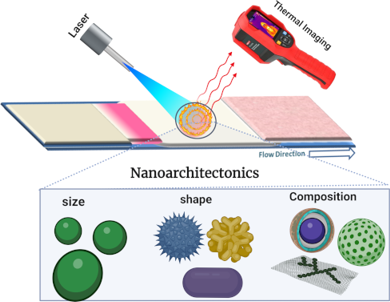
- cancer cells under 650 and 808 nm laser irradiation [54] (Figure 5B). The nanoparticles with a size of 2 nm showed a 5–6% higher photothermal conversion efficiency than the 80 nm particles. The higher photothermal effect of smaller nanoparticles can be explained by the Mie theory, which states that as
- on cancer cells generating two to five times more heat than from magnetic stimulation alone [70]. In another study, clustered iron oxide nanoparticles exhibited a higher PCE than separate iron oxide particles [71]. A study was conducted to analyse how a poly(acrylic acid) coating on iron oxide
- such as photothermal therapy, imaging, and LFAs [73]. Composition-dependent photothermal properties Recently, nanocomposite materials have been employed for the development of photothermal biosensors for the detection of cancer biomarkers or whole cancerous cells, antibiotic residues, and toxins [74


Prediction of cytotoxicity of heavy metals adsorbed on nano-TiO2 with periodic table descriptors using machine learning approaches
Beilstein J. Nanotechnol. 2023, 14, 939–950, doi:10.3762/bjnano.14.77
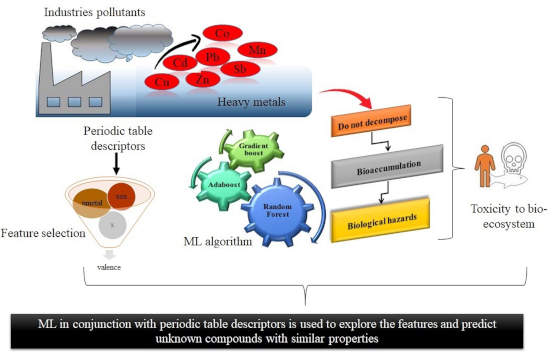
- ) cells. The ensemble learning approach implements gradient boosting and bagging algorithms; that is, random forest, AdaBoost, Gradient Boost, and Extreme Gradient Boost were constructed and utilized to establish statistically significant relationships between the structural properties of NPs and the
- living cells, and their cytotoxicity may inhibit cell growth cycles, leading to death of organisms. Considering this fact, the cytotoxicity of TiO2 in combination with other pollutants has been evaluated. TiO2 is the most commonly manufactured nanoparticle material. It is assumed that because of the
- was added to HK-2 cells in Hyclone DMEM medium supplemented with 10% fetal bovine serum (FBS) and 100 mg penicillin/streptomycin and maintained at 37 °C in the presence of 5% carbon dioxide. Nine concentrations of heavy metal salts were added to a constant amount of nano-TiO2 (25 µmol/L). The details


Upscaling the urea method synthesis of CoAl layered double hydroxides
Beilstein J. Nanotechnol. 2023, 14, 927–938, doi:10.3762/bjnano.14.76
- -M) and the Generalitat Valenciana (CIDEGENT/2018/001, and Agència Valenciana de la Innovació, AVI, through the project: INNVA1/2021/18, LDHPACK). We thank the CELLS-ALBA (Spain) for making all the facilities available for the synchrotron radiation experiment number 2022097096. M.M. is a research


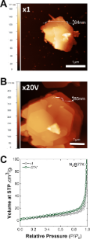
Antibody-conjugated nanoparticles for target-specific drug delivery of chemotherapeutics
Beilstein J. Nanotechnol. 2023, 14, 912–926, doi:10.3762/bjnano.14.75
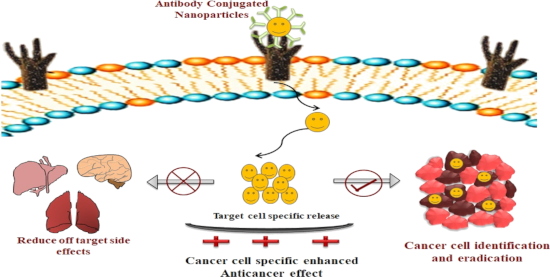
- , India Academy of Scientific & Innovative Research (AcSIR), Ghaziabad-201002, India 10.3762/bjnano.14.75 Abstract Nanotechnology provides effective methods for precisely delivering chemotherapeutics to cancer cells, thereby improving efficacy and reducing off-target side effects. The targeted delivery
- chemotherapeutics specifically to the targeted cancer cells. ACNPs combine the benefits of NPs and mAbs to provide high drug loads at the tumor site with better selectivity and delivery efficiency. The mAbs on the NP surfaces recognize their specific receptors expressed on the target cells and release the
- drug delivery because of their high specificity, recognition ability, and intracellular stability [9][10]. The mAb-mediated targeted drug delivery specifically eradicates tumor cells without causing systemic toxicity associated with conventional chemotherapeutic agents [11]. Complete mAbs or just the



Green SPIONs as a novel highly selective treatment for leishmaniasis: an in vitro study against Leishmania amazonensis intracellular amastigotes
Beilstein J. Nanotechnol. 2023, 14, 893–903, doi:10.3762/bjnano.14.73
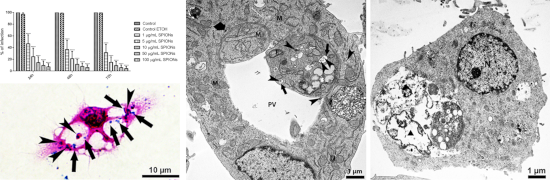
- behavior at room temperature, and are taken up by macrophages without being toxic for these mammalian cells [9]. The application of SPIONs in treating leishmaniasis has been studied by different groups over the past few years, showing promising and satisfactory results [10][11][12][13]; thus, using SPIONs
- ability of both promastigotes and intracellular amastigotes to uptake SPIONs from the culture medium. The acquisition of iron by Leishmania intracellular amastigotes that live inside mammalian host cells is important for cell differentiation and the pathogenesis of the disease [19][20][21]. Thus, it is
- software to estimate them. CC50 values are essential to calculate the selective index (SI), and both quantities are important to understand how effective the nanoparticles are against the parasite while being less toxic for mammalian cells (Table 1). The SI revealed that the SPIONs were highly selective


Biomimetics on the micro- and nanoscale – The 25th anniversary of the lotus effect
Beilstein J. Nanotechnol. 2023, 14, 850–856, doi:10.3762/bjnano.14.69

- biological processes and surface interactions involved in the bioselective adhesion of mammalian cells. The second topic of the review was on repellence of microbes on protein-based material surfaces, highlighting the importance of materials made of recombinant spider silk proteins. Biomaterials that
- the hierarchically structured surface of a lotus leaf. The first level of the surface structure consists of papillae formed by epidermal cells with a height and diameter of several microns. c) This structure is covered by wax crystals, leading to the extreme superhydrophobicity of the surface


Nanostructured lipid carriers containing benznidazole: physicochemical, biopharmaceutical and cellular in vitro studies
Beilstein J. Nanotechnol. 2023, 14, 804–818, doi:10.3762/bjnano.14.66
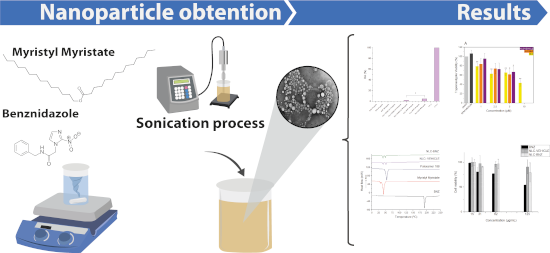
- . cruzi compared to free BNZ. No formulation-related cytotoxic effects were observed on either Vero or CHO cells. Moreover, BNZ showed a 50% reduction in CHO cell viability at 125 µg/mL, whereas NLC-BNZ and non-loaded NLC did not exert a significant effect on cell viability at the same concentration
- repulsion after adding a non-ionic surfactant [41]. Cytotoxicity and hemolytic activity Cytotoxicity assays using the tetrazolium 3-[4,5-dimethylthiazol-2-yl]-2,5-diphenyltetrazolium bromide salt method (MTT) showed that Chinese hamster ovary cells (CHO) viability was affected by BNZ concentration in a dose
- attributed to the release profile of BNZ from NLC, exposing cells to lower doses of BNZ during the first stages of cellular division. This is a remarkable result, as toxic effects of BZN are a major cause of treatment discontinuation in the clinical setting [42]. Additionally, cytotoxicity was evaluated in


Silver nanoparticles loaded on lactose/alginate: in situ synthesis, catalytic degradation, and pH-dependent antibacterial activity
Beilstein J. Nanotechnol. 2023, 14, 781–792, doi:10.3762/bjnano.14.64
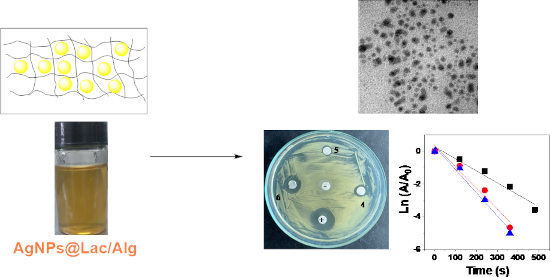
- release of silver ions or electrostatic interaction between AgNPs and microbial cells, have been proposed [21][22]. The AgNPs might release silver ions capable of binding to nucleic acids, thereby, exhibiting antibacterial activity [23][24]. Consequently, any silver-containing composite material with
- antibacterial properties can serve as a source of silver ions. Another mechanism involves the electrostatic attraction between negatively charged microbial cells and positively charged AgNPs [25]. Because of their affinity to sulfur proteins and through electrostatic attraction, silver ions can bind to both


Carboxylic acids and light interact to affect nanoceria stability and dissolution in acidic aqueous environments
Beilstein J. Nanotechnol. 2023, 14, 762–780, doi:10.3762/bjnano.14.63
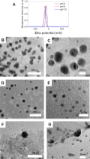
- , distribution, and toxicity of nanoceria within biological systems. Cellular uptake studies of nanoceria in lung adenocarcinoma (A549) cells favored particles with a negative zeta potential. However, positively charged particles resulted in greater bovine serum albumin adsorption. This suggests that surface
In situ magnesiothermic reduction synthesis of a Ge@C composite for high-performance lithium-ion batterie anodes
Beilstein J. Nanotechnol. 2023, 14, 751–761, doi:10.3762/bjnano.14.62
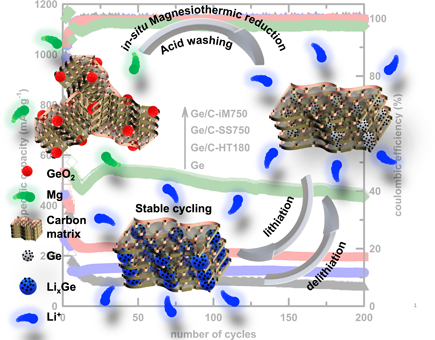
- electrodes. The obtained slurry was cast onto copper foil using an automatic film coater and dried in a vacuum oven at 80 °C for 10 h. Discs (diameter of 12 mm with a mass loading of the active material of around 1.2 mg·cm−2) punched from the film were used as a working electrodes. CR2032 coin cells, in half
- . Electrochemical impedance spectroscopy (EIS) was carried out at the open-circuit voltage of the assembled cells after 6 h of resting on a Biologic VSP3 potentiostat. A sinusoidal signal with an amplitude of 10.0 mV and a frequency varying exponentially from 10 mHz to 100 kHz was used. (a) XRD patterns, (b) FTIR


Nanoarchitectonics for advanced applications in energy, environment and biology: Method for everything in materials science
Beilstein J. Nanotechnol. 2023, 14, 738–740, doi:10.3762/bjnano.14.60
- systems [36], nanoarchitectonics to entrap living cells [37], among other papers in which the concept of nanoarchitectonics has been applied to a variety of targets. Nanoarchitectonics integrates many existing disciplines and bridges nanotechnology and materials science. Due to the universality of the

Cross-sectional Kelvin probe force microscopy on III–V epitaxial multilayer stacks: challenges and perspectives
Beilstein J. Nanotechnol. 2023, 14, 725–737, doi:10.3762/bjnano.14.59
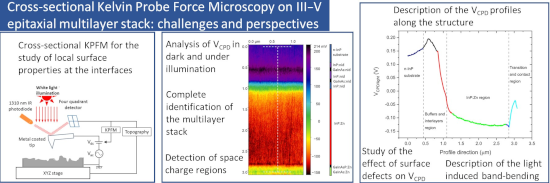
- Electronique de Paris, 91192, Gif-sur-Yvette, France Sorbonne Université CNRS, Laboratoire de Génie Electrique et Electronique de Paris, 75252, Paris, France III-V Lab, 1 Avenue Augustin Fresnel, 97167 Palaiseau, France 10.3762/bjnano.14.59 Abstract Multilayer III–V-based solar cells are complex devices
- ; surface photovoltage; Introduction The development of photovoltaic (PV) technologies has progressed significantly over the past twenty years as a result of considerable advancements in solar cell device engineering and material science. As a consequence, solar cells have turned into complex structures


Nanomaterials for photocatalysis and applications in environmental remediation and renewable energy
Beilstein J. Nanotechnol. 2023, 14, 722–724, doi:10.3762/bjnano.14.58
- semiconductor materials for sustainable applications; for instance, dye solar cells, solar-driven water splitting, NOx removal, and contaminant degradation. The synthesis of semiconductor nanomaterials published on this thematic issue indicates a wide range of synthetic routes. The as-prepared nanomaterials
- with various morphologies demonstrated many preeminent features in the above applications. In detail, the MoS2 with a honeycomb-like structure was first synthesized by an electrochemical route and applied in dye-sensitized solar cells [19], which expressed a higher applicability than that of other
- nanomaterials for environmental remediation and sustainable applications; for instance, dye solar cells, solar-driven water splitting, NOx removal, and contaminant degradation. This Thematic Issue will make a good reference material and be of great use for scientists in nanomaterials fields. Viet Van Pham and

Humidity-dependent electrical performance of CuO nanowire networks studied by electrochemical impedance spectroscopy
Beilstein J. Nanotechnol. 2023, 14, 683–691, doi:10.3762/bjnano.14.54
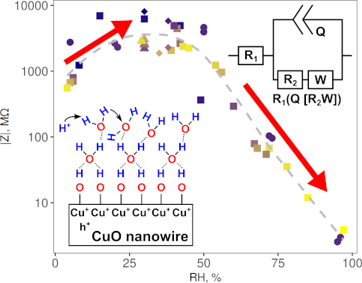
- −12, and “pseudo chi imaginary” was less than 1.0 × 10⁻¹⁰, meaning that these spectra are valid for further analysis [36]. The EIS model of the whole tested sample consisted of 152 electrochemical cells, formed by nanowires interconnecting a pair of electrodes, connected in a parallel circuit. Using





