Search results
Search for "dynamic" in Full Text gives 808 result(s) in Beilstein Journal of Nanotechnology. Showing first 200.
Interaction between honeybee mandibles and propolis
Beilstein J. Nanotechnol. 2022, 13, 958–974, doi:10.3762/bjnano.13.84
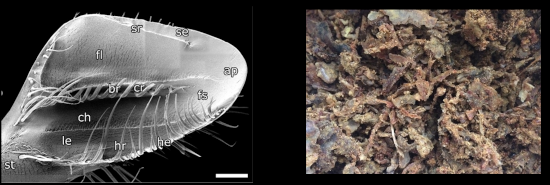
- the two dynamic components, and ν is the Poisson ratio assumed to be equal to 0.49 [33]. The data were statistically analysed using the software R, version 3.6.1. Data was tested for normal distribution and variance homogeneity using Kolmogorov–Smirnov and Levene's tests, respectively. The comparison


Bioselectivity of silk protein-based materials and their bio-inspired applications
Beilstein J. Nanotechnol. 2022, 13, 902–921, doi:10.3762/bjnano.13.81
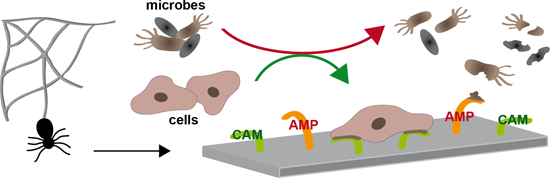
- including reproduction, growth and settlement, dynamic attachment during locomotion, self-healing, protection against as well as attachment of microbes, and prey hunting [1][2][3][4][5][6]. A variety of different adhesion mechanisms exist to manage the different challenges of interfacial adhesion. In turn


Numerical modeling of a multi-frequency receiving system based on an array of dipole antennas for LSPE-SWIPE
Beilstein J. Nanotechnol. 2022, 13, 865–872, doi:10.3762/bjnano.13.77
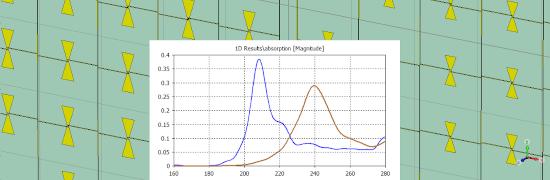
- ) [5][6] integrated into the dipole antennas. The advantages of CEB over other types of bolometers are, in particular, their high sensitivity with background-limited operation [6][7][8] and a wide dynamic range. These qualities are largely determined by the presence of an internal self-cooling of the
- matching of the CEB array with the SQUID readout system. The mismatching can happen if there is dynamic resistance of the CEB array at the working point with a parasitic resistance of connecting wires higher than 1 Ohm. Then the noise of the SQUID readout system is multiplied by the square root of the
- ratio of the obtained dynamic resistance of the CEB array and the connecting wires to the required value of 1 Ohm. The NEP estimations for different numbers of CEBs in a parallel array for 145, 210, and 240 GHz frequency channels accounting for possible mismatching with the SQUID readout system are


Gelatin nanoparticles with tunable mechanical properties: effect of crosslinking time and loading
Beilstein J. Nanotechnol. 2022, 13, 778–787, doi:10.3762/bjnano.13.68
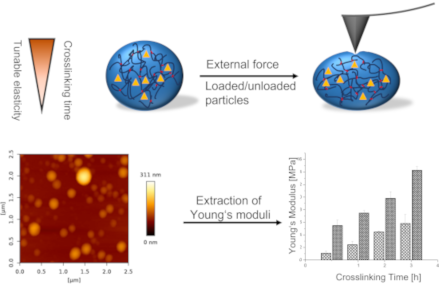
- . Measurement of size and zeta-potential Particle size and size distribution were measured based on dynamic light scattering using a ZetaSizer® Ultra (Malvern Panalytics, Malvern, United Kingdom). 50 µL of GNP dispersion was diluted 20-fold, the pH was adjusted to 7.5, and the samples were measured in the


A nonenzymatic reduced graphene oxide-based nanosensor for parathion
Beilstein J. Nanotechnol. 2022, 13, 730–744, doi:10.3762/bjnano.13.65
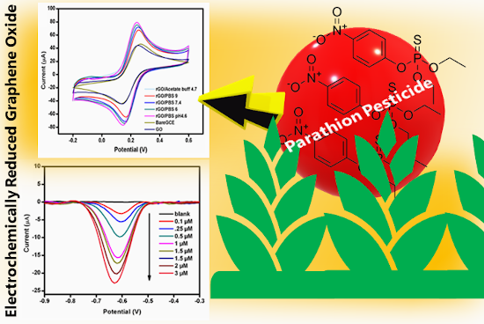
- stability (≈180 days), good reproducibility, and repeatability for interference-free detection of PT residues in actual samples. This electrochemical nanosensor is suitable for point-of-care detection of PT in a wide dynamic range of 3 × 10⁻¹¹–11 × 10−6 M with a lower detection limit of 10.9 pM. The


A superconducting adiabatic neuron in a quantum regime
Beilstein J. Nanotechnol. 2022, 13, 653–665, doi:10.3762/bjnano.13.57
- is an important parameter that determines the possibility of the ANN dynamic adaptation. Such tunability is required when working with rapidly changing content. The corresponding information flow naturally arises, for example, within the framework of novel telecommunication paradigms, such as
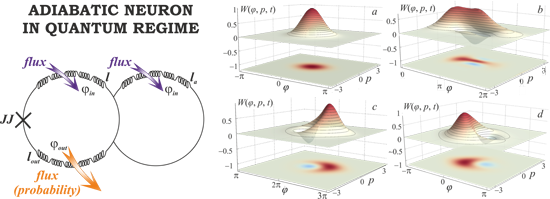
- of the Schrödinger equation, we investigate dynamic processes in a quantum neuron. We pay special attention to the analysis of the activation function of the cell for two main modes (with one and two minima of the potential energy of the system). We use Wigner functions for a visual interpretation of
- the dynamics of the neuron. The range of the operating parameters for the proposed neuron circuit under the action of unipolar magnetic flux pulses is found. Finally, the influence of the dissipation on the features of the dynamic processes and characteristics of the cell is revealed. Methods Neuron


Antibacterial activity of a berberine nanoformulation
Beilstein J. Nanotechnol. 2022, 13, 641–652, doi:10.3762/bjnano.13.56
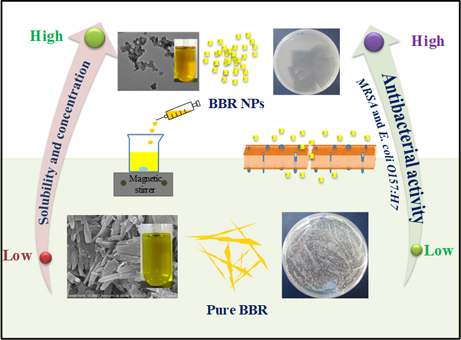
- 156 nm at a concentration of 2.0 mg/mL, measured by dynamic light scattering. After nanoformulation, the concentration of BBR NPs could reach up to 5.0 mg/mL, which is much higher than the saturation concentration without treatment. Results show a strongly enhanced antibacterial activity of BBR NPs
- BBR NPs. The mean size of the particles measured by DLS was 156 nm for BBR NPs at a concentration of 2.0 mg/mL. The particle size measured by DLS was larger than the size obtained from TEM analysis because this dynamic measurement is affected by the concentration of the solution, surface properties of
- BBR NPs was significantly enhanced. Thus, the concentration of BBR NPs could reach up to 5.0 mg/mL, which was much higher than the saturation concentration of pure BBR. The diameter of the BBR NPs measured with dynamic light scattering was 156 nm at a concentration of 2.0 mg/mL. BBR NPs at a



Fabrication and testing of polymer microneedles for transdermal drug delivery
Beilstein J. Nanotechnol. 2022, 13, 629–640, doi:10.3762/bjnano.13.55
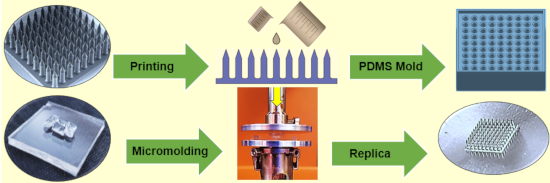
- , including dynamic impact insertion using a commercial applicator and insertion using an in-house designed and manufactured spring-loaded prototype applicator. A custom skin stretching mechanism was built to mimic skin in vivo conditions in a controlled manner. MN arrays were applied on the full-thickness



Comparative molecular dynamics simulations of thermal conductivities of aqueous and hydrocarbon nanofluids
Beilstein J. Nanotechnol. 2022, 13, 620–628, doi:10.3762/bjnano.13.54
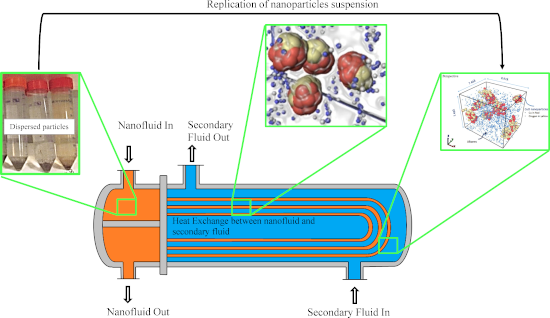
- nanoparticles can enhance the properties of both polar and nonpolar fluids. In the current paper, dispersions of nanoparticles were carried out in hydrocarbon and aqueous-based fluids using molecular dynamic simulations (MDS). The MDS results have been validated using the autocorrelation function and previous
- of both nanofluids. Moreover, this research gives insights regarding the accuracy of thermal conductivities of aqueous and nonaqueous fluids predicted by molecular dynamic simulation. Finally, these MD simulation results were compared with experimental data [43] and previously reported simulation
- alkanes. The large-scale atomic/molecular massively parallel simulator (LAMMPS) molecular dynamic package provided by the Sandia group, created by Plimpton et al. [46][47][48], was used for simulating the dispersion of nanoparticles in water and alkanes. The water/CuO system consisted of 463 transferable


Quantitative dynamic force microscopy with inclined tip oscillation
Beilstein J. Nanotechnol. 2022, 13, 610–619, doi:10.3762/bjnano.13.53
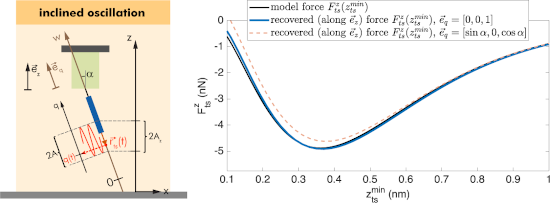
- Philipp Rahe Daniel Heile Reinhard Olbrich Michael Reichling Fachbereich Physik, Universität Osnabrück, Barbarastrasse 7, 49076 Osnabrück, Germany 10.3762/bjnano.13.53 Abstract In the mathematical description of dynamic atomic force microscopy (AFM), the relation between the tip–surface normal
- . Experimentally, however, the sampling path representing the tip oscillating trajectory is often inclined with respect to the surface normal and the data recording path. Here, we extend the mathematical description of dynamic AFM to include the case of an inclined sampling path. We find that the inclination of
- path perpendicular to the surface, provide quantitative information about the details of the tip–surface interaction when properly analysed [2]. Recently, a universal description of quantitative dynamic force microscopy based on the harmonic approximation has been developed [3], yielding three central


![[Graphic 38]](/bjnano/content/inline/2190-4286-13-53-i79.svg?max-width=637&scale=1.18182) and the axis w....
and the axis w....


Sodium doping in brookite TiO2 enhances its photocatalytic activity
Beilstein J. Nanotechnol. 2022, 13, 599–609, doi:10.3762/bjnano.13.52
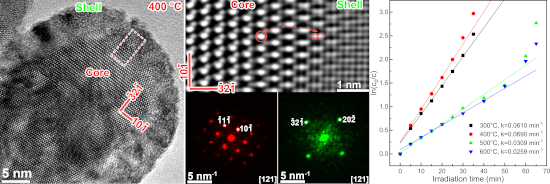
- activity. Results and Discussion Enhanced photocatalytic activity The photocatalytic activity of the samples calcinated at 300–600 °C for 2 h was measured by the photodegradation of MB under UV light at room temperature. Figure 1a and Figure 1b display the dynamic changes in the absorption spectra of MB


A new method for obtaining the magnetic shape anisotropy directly from electron tomography images
Beilstein J. Nanotechnol. 2022, 13, 590–598, doi:10.3762/bjnano.13.51
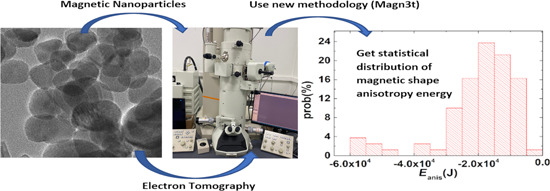
- , X-ray diffraction, magnetometry [4], transmission/scanning electron imaging [5][6], small-angle scattering techniques [7], dynamic light scattering, laser diffraction [8][9], resonant mass measurement, and spatial filter velocimetry. Each of these has certain features (i.e., ease of access, ease of


Stimuli-responsive polypeptide nanogels for trypsin inhibition
Beilstein J. Nanotechnol. 2022, 13, 538–548, doi:10.3762/bjnano.13.45
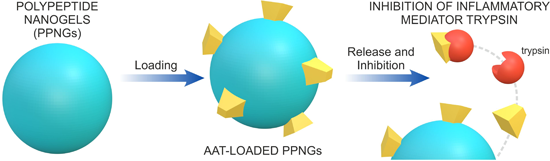
- confirmed by dynamic light scattering and zeta potential measurements. The loading capacity of PHEG-Tyr and Nα-Lys-NG nanogels and their release profiles were first optimized with bovine serum albumin. The nanogels were then used for loading and release of AAT. PHEG-Tyr and Nα-Lys-NG nanogels showed


Influence of thickness and morphology of MoS2 on the performance of counter electrodes in dye-sensitized solar cells
Beilstein J. Nanotechnol. 2022, 13, 528–537, doi:10.3762/bjnano.13.44
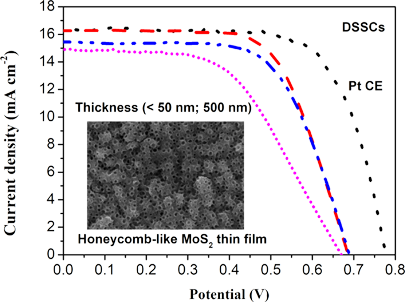
- including 1.25:7.5 (solution 1.25), 2.5:15 (solution 2.5), and 5:30 (solution 5.0). The CV measurement was performed under a dynamic potential between −1.0 V and 1.0 V for ten cycles at a scan rate of 100 mV·s−1 in a nitrogen atmosphere. Fabrication of DSSCs DSSCs with an active area of 0.25 cm2 were


Zinc oxide nanostructures for fluorescence and Raman signal enhancement: a review
Beilstein J. Nanotechnol. 2022, 13, 472–490, doi:10.3762/bjnano.13.40
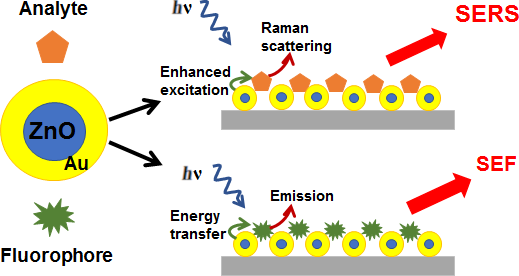
- absorb the visible-emission energy, transferring the electrons to a higher energy state. Second, because the work function of ZnO is 5.2 eV and the work function of Au is 5.1 eV, ZnO can receive energy from Au until these two systems achieve a dynamic equilibrium. Thus, the electrons are transferred into




Investigation of electron-induced cross-linking of self-assembled monolayers by scanning tunneling microscopy
Beilstein J. Nanotechnol. 2022, 13, 462–471, doi:10.3762/bjnano.13.39
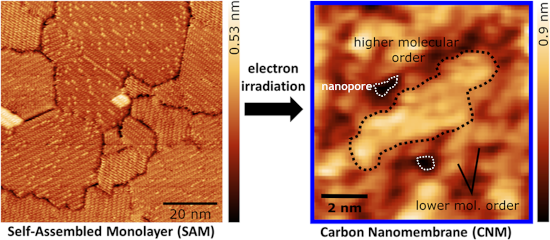
- . Brighter islands of 5–10 nm in size were still visible, separated by darker structures with a branched form, which can be considered remainders of the ordered layer. Many voids can be observed here. Unlike the dynamic free volume pores of polymers, these voids remain stable after multiple STM scans. By


Tunable superconducting neurons for networks based on radial basis functions
Beilstein J. Nanotechnol. 2022, 13, 444–454, doi:10.3762/bjnano.13.37
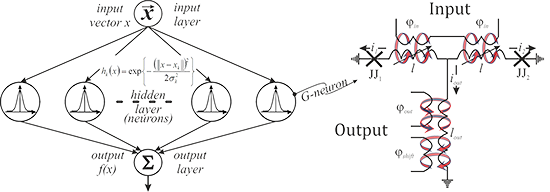
- relevant for a number of niche tasks where performance and energy efficiency are critically important. In this paper, we consider the basic elements for superconducting neural networks on radial basis functions. We examine the static and dynamic activation functions of the proposed neuron. Special
- tracking performance in control systems for a class of nonlinear and non-Gaussian stochastic dynamic processes [6]. An important example for this work is the cognitive radio, which is able to receive information about the features of the “radio environment” and adjust its operating parameters based on this
- ][25] as well as read-out circuits for quantum computing [26][27][28][29][30][31][32][33]. They realize a unique combination of a wide dynamic range and high sensitivity when receiving signals, with high performance and energy efficiency at the stage of the processing. It seems reasonable to implement


A chemiresistive sensor array based on polyaniline nanocomposites and machine learning classification
Beilstein J. Nanotechnol. 2022, 13, 411–423, doi:10.3762/bjnano.13.34
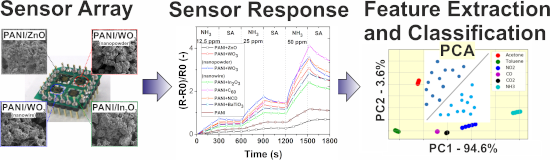
- room temperature. The response of the sensing layers was calculated by the relative resistance change: where R0 is the resistance at room temperature in synthetic air and Rg is the resistance of the sensor in the presence of the specific gas. The dynamic responses of sensing layers for gases are




Effect of sample treatment on the elastic modulus of locust cuticle obtained by nanoindentation
Beilstein J. Nanotechnol. 2022, 13, 404–410, doi:10.3762/bjnano.13.33
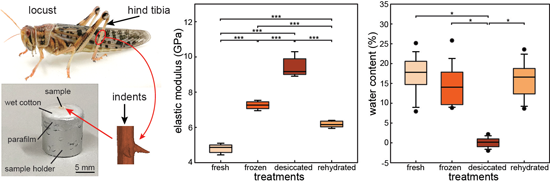
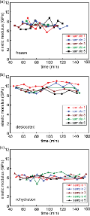
- elastic modulus continuously as a function of the indentation depth (Figure 1d). The method involves applying a dynamic load on the top of the static load while loading. The dynamic unloading part is then used to measure the stiffness, which is further processed to calculate the elastic modulus of the


Micro- and nanotechnology in biomedical engineering for cartilage tissue regeneration in osteoarthritis
Beilstein J. Nanotechnol. 2022, 13, 363–389, doi:10.3762/bjnano.13.31
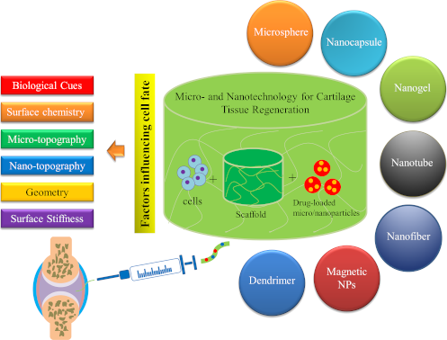
- and growth, thus shortening the expansion process [30][31][32]. In this regard, Sulaiman et al. explored the 3D culture of MSCs on gelatin microspheres (GMs) in a dynamic culture system for the fast generation of a higher amount of MSCs and the improvement of their chondrogenic differentiation [31
- ]. The results showed that MSCs cultured on GMs in a dynamic culture displayed a faster proliferation rate and higher stemness properties compared with those in two dimensional (2D) and 3D static culture systems [31]. Moreover, culturing MSCs on GMs in a dynamic system with the chondrogenic induction
- medium (CIM) enhanced their in vitro chondrogenesis compared to a static culture system [31]. Therefore, the combination of the 3D culture system (GM), CIM, and dynamic culture would be an ideal design for MSC based therapies for articular cartilage defects. 3.1.2 Nanomaterial-assisted cartilage TE


Alcohol-perturbed self-assembly of the tobacco mosaic virus coat protein
Beilstein J. Nanotechnol. 2022, 13, 355–362, doi:10.3762/bjnano.13.30
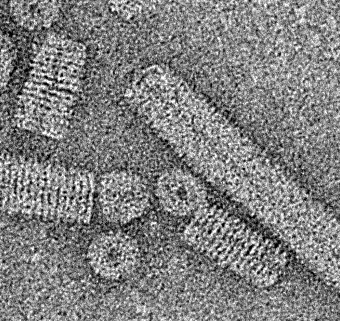
- TEM and dynamic light scattering (DLS). The TMV-cp samples in this work are polydisperse and non-spherical, which complicates the interpretation of DLS data. Because DLS is a light scattering technique, the signal intensity is proportional to the sixth power of the radius [39]. This means that the


A broadband detector based on series YBCO grain boundary Josephson junctions
Beilstein J. Nanotechnol. 2022, 13, 325–333, doi:10.3762/bjnano.13.27
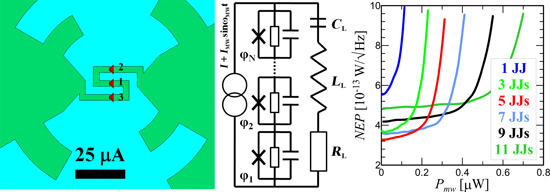
- dynamic range by a factor of 5. For typical YBaCuO Josephson junctions fabricated on a ZrYO bicrystal substrate by magnetron deposition, the following parameters were obtained at a temperature of 77 K: responsivity = 9 kV/W; NEP = 3·10−13 W/Hz(1/2); power dynamic range = 1·106. Keywords: array
- the electromagnetic analysis and numerical simulation of the broadband detector based on a series of HTSC bicrystal Josephson junctions to maximize response, power dynamic range, and noise-equivalent power. Electromagnetic Simulation Figure 1a–c shows options for the geometry of a log-periodic antenna
- despite the fact that the responsivity decreases with increasing power, the NEP remains almost unchanged over a wide range of PMW. Another important characteristic is the power dynamic range D = PS/P0. Here PS is the upper limit for which the detector response deviates from linearity. The 3 dB criterion



Coordination-assembled myricetin nanoarchitectonics for sustainably scavenging free radicals
Beilstein J. Nanotechnol. 2022, 13, 284–291, doi:10.3762/bjnano.13.23
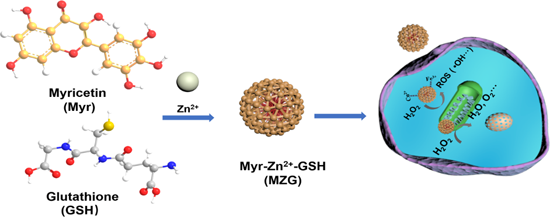
- dynamic light scattering were used to record absorption spectra and size change. Cytotoxicity experiment in vitro The cytotoxicity of the as-prepared MZG nanoparticles was assessed against 3T3 cells. 3T3 cells were cultivated with Dulbecco's Modified Eagle Medium (DMEM) containing 10% (v/v) fetal bovine
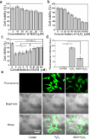
- shows spherical MZG nanoparticles. Size and zeta potential value of the MZG nanoparticles were 44.6 ± 26.5 nm and −23.1 ± 3.4 mV, respectively, measured by dynamic light scattering (DLS) (Figure 2b) and consistent with the TEM results. Importantly, the co-assembly mechanism was further revealed through


Systematic studies into uniform synthetic protein nanoparticles
Beilstein J. Nanotechnol. 2022, 13, 274–283, doi:10.3762/bjnano.13.22
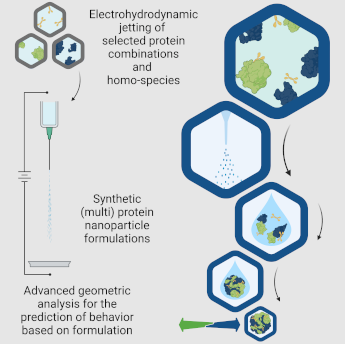
- thorough shape analysis into the assessment of emerging platforms from the very onset of their expansion into the general nano-bio research. The solution-based corollary to dry-state imaging that can provide the above parameters is dynamic light scattering (DLS). DLS uses the deconvolution of a correlation
- process. Dynamic light scattering DLS measurements were performed on particles in their hydrated state using a Zetasizer Nano ZS (Malvern Panalytical). The solution in which the particles were suspended was DPBS. DLS was employed to measure the particle size distribution after particle collection and


Photothermal ablation of murine melanomas by Fe3O4 nanoparticle clusters
Beilstein J. Nanotechnol. 2022, 13, 255–264, doi:10.3762/bjnano.13.20
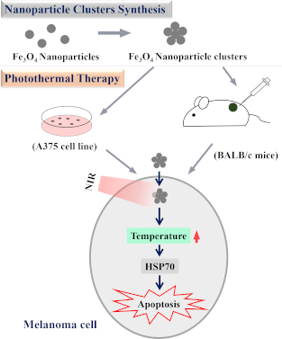
- 59.4 emu/g (Figure 1c) and stronger absorption intensities at the NIR wavelength of 808 nm than individual nanoparticles [17]. In addition, the dynamic light scattering (DLS) analysis of NPCs suspended in aqueous culture medium reflected good dispersion (Figure 1d). The colloidal stability of our
- morphology of the as-synthesized nanoparticle clusters was characterized with a JEOL JEM-2100 transmission electron microscopy (TEM). Dynamic light scattering (DLS) The synthesized Fe3O4 NPCs were diluted in RPMI 1640 medium to a final concentration of 0.25 mg/mL. The particle size distribution was