Search results
Search for "mechanical" in Full Text gives 1136 result(s) in Beilstein Journal of Nanotechnology. Showing first 200.
TEM sample preparation of lithographically patterned permalloy nanostructures on silicon nitride membranes
Beilstein J. Nanotechnol. 2024, 15, 1–12, doi:10.3762/bjnano.15.1
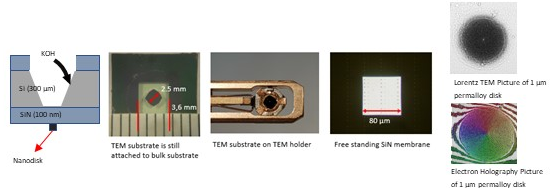
- away from the nanostructures can affect the overall mechanical stability of the membrane. Dry etching is generally better suited for bulk substrate applications as discussed in section “Preparation of nanostructures starting from a bulk substrate”. Stencil lithography Stencil lithography was
- etching can yield nanodisks as small as 200 nm with high precision. However, it is important to consider that the IBE process may result in thinner SiN membranes, potentially compromising their mechanical stability. Furthermore, IBE, which is a physical etching process, redeposits a non-volatile metal


Determination of the radii of coated and uncoated silicon AFM sharp tips using a height calibration standard grating and a nonlinear regression function
Beilstein J. Nanotechnol. 2023, 14, 1200–1207, doi:10.3762/bjnano.14.99
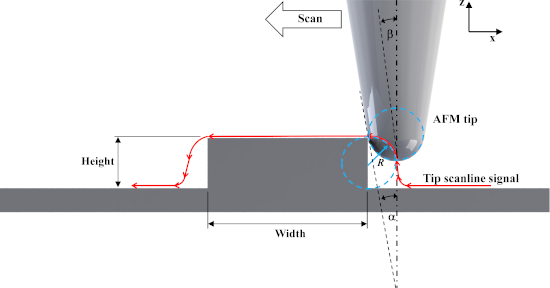
- Perawat Boonpuek Jonathan R. Felts School of Manufacturing Engineering, Institute of Engineering, Suranaree University of Technology, 111 University Avenue, Muang, Nakhon Ratchasima 30000, Thailand Advanced Manufacturing Laboratory, J. Mike Walker ’66 Department of Mechanical Engineering, College
- of Engineering, Texas A&M University, College Station, Texas, 77843, USA 10.3762/bjnano.14.99 Abstract AFM sharp tips are used to characterize nanostructures and quantify the mechanical properties of the materials in several areas of research. The analytical results can show unpredicted errors if we
- nanostructured materials, for example, graphene, carbon nanotubes, nanoscale semiconductors, biomaterials, and molecules. Mechanical properties such as surface stiffness, adhesion, friction, electrostatics, and electrowetting can be measured [1][2][3][4]. In contact mode scanning, the contact area between the


A combined gas-phase dissociative ionization, dissociative electron attachment and deposition study on the potential FEBID precursor [Au(CH3)2Cl]2
Beilstein J. Nanotechnol. 2023, 14, 1178–1199, doi:10.3762/bjnano.14.98
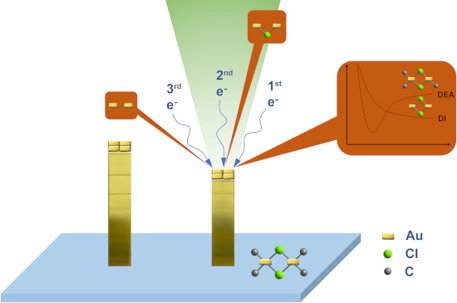
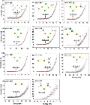
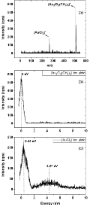
- gas-phase experiments under single-collision conditions and quantum mechanical calculations for data interpretation, in combination with FEBID in an UHV setup. The results of this study demonstrated that at 5 keV electron energy, FEBID deposits with 31–34 atom % Au content were attainable with this



Elasticity, an often-overseen parameter in the development of nanoscale drug delivery systems
Beilstein J. Nanotechnol. 2023, 14, 1149–1156, doi:10.3762/bjnano.14.95
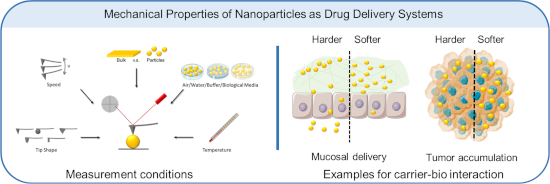
- drug delivery can be achieved, are mechanical properties of nanoparticles. Even though this is often not even considered during formulation development, and it is not requested for approval, an increasing number of studies show that it is important to have knowledge about these characteristics. In this
- article, we discuss examples highlighting the influence of elasticity in nanoscale biological interactions focusing on mucosal delivery and on tumor targeting. Besides this, we discuss the influence of different measurement settings using atomic force microscopy for the determination of mechanical
- properties of drug carriers. Keywords: atomic force microscopy; drug delivery; elasticity; mechanical properties; nanomedicine; nanoparticles; stiffness measurement; tissue/body distribution; Introduction Drug delivery systems are developed with the aim to transport a given drug to the site of action


A multi-resistance wide-range calibration sample for conductive probe atomic force microscopy measurements
Beilstein J. Nanotechnol. 2023, 14, 1141–1148, doi:10.3762/bjnano.14.94
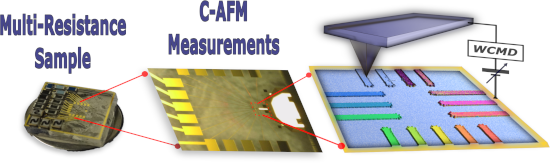
- commonly observed in C-AFM because of highly localized electric fields at the tip apex leading to structural damage considerably affecting the measurement reliability. These effects are further amplified during scanning in contact mode due to shear forces and strong mechanical stress imposed on the tip


Dual-heterodyne Kelvin probe force microscopy
Beilstein J. Nanotechnol. 2023, 14, 1068–1084, doi:10.3762/bjnano.14.88
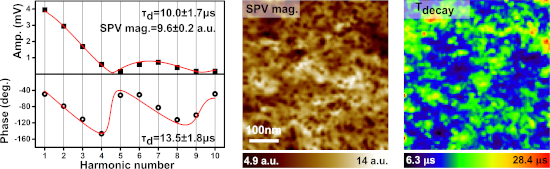
- time-periodic surface electrostatic potential generated under optical (or electrical) pumping with an atomic force microscope. The modulus and phase coefficients are probed by exploiting a double heterodyne frequency mixing effect between the mechanical oscillation of the cantilever, modulated
- measurements [16], which consists in analysing the intermodulation products between the mechanical oscillation of the cantilever and the photogenerated surface potential. In short, intermodulation spectroscopy allows working in the frequency domain (instead of the time domain) by extracting, during a single
- effect between the cantilever mechanical oscillation, the surface photovoltage harmonics, and an ac bias modulation signal. The frequency of the modulated bias can be set so that any given spectral component of the surface potential (or intermodulation product) can be “transferred” to the second




Spatial mapping of photovoltage and light-induced displacement of on-chip coupled piezo/photodiodes by Kelvin probe force microscopy under modulated illumination
Beilstein J. Nanotechnol. 2023, 14, 1059–1067, doi:10.3762/bjnano.14.87
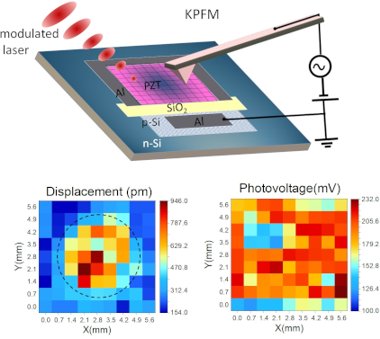
- mechanical oscillation of the piezoelectric membrane with vertical atomic resolution in real-time. This technique offers the opportunity to measure concurrently the optoelectronic and mechanical response of the device at the nanoscale. Furthermore, time-dependent atomic force microscopy (AFM) was employed to
- ); time-dependent AFM; Introduction Light has been recognized as a versatile external energy source to actuate micro/nanorobots with outstanding merits of wireless, remote, and precise controllability [1][2][3][4]. Light-driven micro/nanorobots convert light into mechanical motion and are able to perform
- ]. However, the working principle of these techniques is based on optical interferometry mapping which can be challenging for light-sensitive devices. Furthermore, it can be advantageous to employ a method that also allows for mechanical contact and manipulation. Atomic force microscopy (AFM) [11][12][13][14


Experimental investigation of usage of POE lubricants with Al2O3, graphene or CNT nanoparticles in a refrigeration compressor
Beilstein J. Nanotechnol. 2023, 14, 1041–1058, doi:10.3762/bjnano.14.86
- Kayhan Dagidir Kemal Bilen Department of Mechanical Engineering, Tarsus University, Mersin, Turkey Department of Mechanical Engineering, Ankara Yıldırım Beyazıt University, Ankara, Turkey 10.3762/bjnano.14.86 Abstract In this study, the use of nanolubricants containing Al2O3, graphene, and carbon
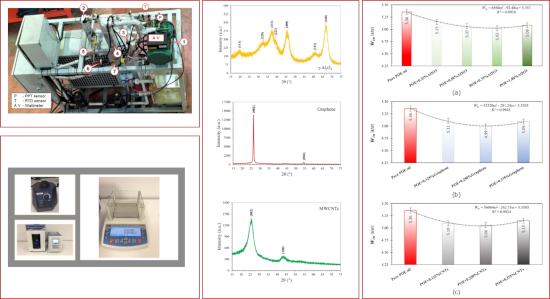
- . Firstly, the POE oil and nanoparticles were stirred in a mechanical stirrer, then the mixture was stirred with an ultrasonic stirrer. The mechanical mixing process was applied with the TOPTION MX-S mechanical mixer. Also, an ultrasonic mixing process was applied with the TOPTION TU-900E4 sonic mixer. The
- . The a) FE-SEM micrograph with a scale bar of 200 nm, b) FE-SEM micrograph with a scale bar of 400 nm, and c) EDS analysis of the CNT nanoparticles. XRD pattern of the CNT nanoparticles. The devices used to implement the two-step method are a) mechanical stirrer, b) ultrasonic stirrer, and c) precision





Exploring internal structures and properties of terpolymer fibers via real-space characterizations
Beilstein J. Nanotechnol. 2023, 14, 1004–1017, doi:10.3762/bjnano.14.83
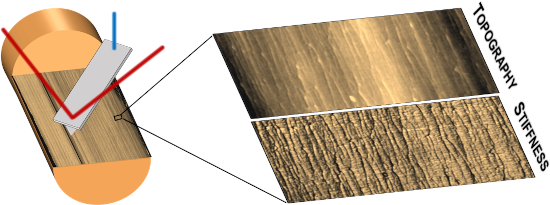
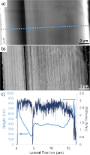
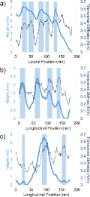
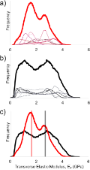
- microscope mapping to characterize the internal structure and local mechanical properties within Technora® fibers. We find a highly fibrillated structure that appears to connect with both the fiber’s molecular chemistry and full-fiber mechanical properties. In addition, through detailed comparisons with
- ; structure–property relationships; Technora®; Introduction High-performance polymer fibers have enabled groundbreaking advancements in numerous applications, from personal armor to tires to sports equipment, that aim to maximize mechanical performance while minimizing weight. The successes achieved with
- molecular chains rather than optimizing crystallites. This strategy aimed to explore new chemistries that could enhance multifunctional aspects of fibers without adversely affecting fiber mechanical properties. Indeed, in developing Technora®, Teijin Ltd. had four principal aims: to manufacture a (i) cost






Nanoarchitectonics of photothermal materials to enhance the sensitivity of lateral flow assays
Beilstein J. Nanotechnol. 2023, 14, 988–1003, doi:10.3762/bjnano.14.82
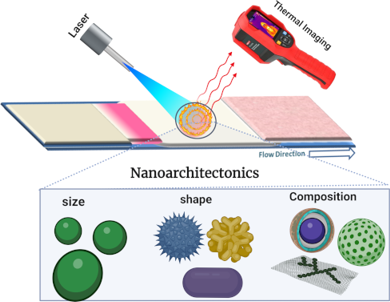
- highest photothermal conversion efficiency. In addition, these materials also possess high thermal and electrical conductivity, high aspect ratio, light weight, and high mechanical strength, because of which these materials are used for photothermal applications [36]. Polyhydroxylated fullerenes were


Metal-organic framework-based nanomaterials for CO2 storage: A review
Beilstein J. Nanotechnol. 2023, 14, 964–970, doi:10.3762/bjnano.14.79

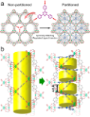
- fabrication of MOF/graphene-based composites. Figure 5 was reproduced from [41], R. Kumar et al., “Remarkable Improvement in the Mechanical Properties and CO2 Uptake of MOFs Brought About by Covalent Linking to Graphene”, Angew. Chem., Int. Ed., with permission from John Wiley and Sons. Copyright © 2016 WILEY




Prediction of cytotoxicity of heavy metals adsorbed on nano-TiO2 with periodic table descriptors using machine learning approaches
Beilstein J. Nanotechnol. 2023, 14, 939–950, doi:10.3762/bjnano.14.77
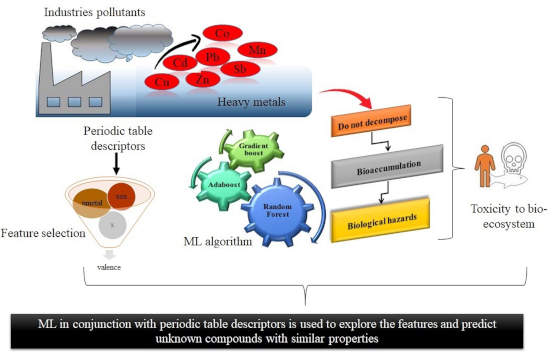
- random forest algorithm and the AdaBoost algorithm for QSAR modeling using quantum mechanical descriptors. In contrast, the present study involved the random forest algorithm, the AdaBoost algorithm along with Gradient Boost and XGBoost algorithms using simple periodic table descriptors that are easy to
- -effective and have a clear and straightforward physical meaning, which facilitates the mechanical interpretation of the QSAR models. A direct comparison was not possible due to different dataset division and descriptors but the results obtained in the present work for the RF method was superior to that of


Industrial perspectives for personalized microneedles
Beilstein J. Nanotechnol. 2023, 14, 857–864, doi:10.3762/bjnano.14.70
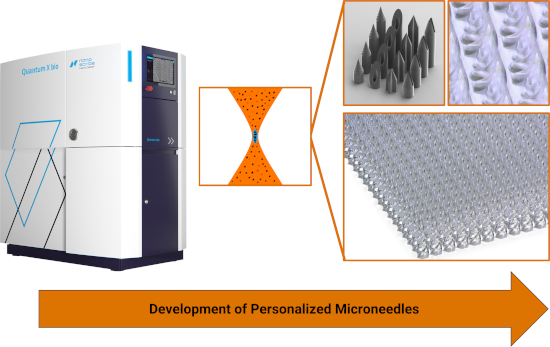
- microneedles are most often directly printed onto the medical device and aligned to specific features, such as pores, on the device. Direct microneedle printing has its own set of extensive requirements (e.g., biocompatibility of the material, mechanical robustness, and surface adhesion). Also, FDA’s 510(k


Biomimetics on the micro- and nanoscale – The 25th anniversary of the lotus effect
Beilstein J. Nanotechnol. 2023, 14, 850–856, doi:10.3762/bjnano.14.69

- pest insects by reducing the frictional forces experienced when they walk on the leaves. This structure might also provide mechanical stability to the growing plant organs and has an impact on the wettability of the leaves. Using polymer replicas of adaxial leaf surfaces at various scales, the surface
- treatment on the elastic modulus of locust cuticle obtained by nanoindentation”, investigate the mechanical properties of the cuticle that builds the surface of insects and related groups of animals. The cuticle is one of the most abundant, but least studied biological composites. In their study, the
- authors use a nanoindentation technique to investigate the effect of freezing, desiccation, and rehydration on the elastic modulus of the hind tibial cuticle of locusts. All of the treatments significantly influenced the mechanical properties of the latter. Gorb et al. [7], in the paper “Hierachical


A wearable nanoscale heart sound sensor based on P(VDF-TrFE)/ZnO/GR and its application in cardiac disease detection
Beilstein J. Nanotechnol. 2023, 14, 819–833, doi:10.3762/bjnano.14.67
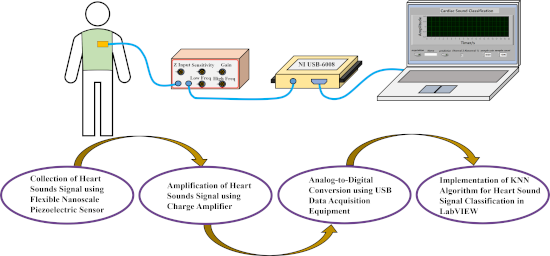
- mechanical vibration signals into voltage signals, have become one of the primary materials for creating heart sound sensors [9]. Piezoelectric materials are essential components in heart sound auscultation equipment. When pressure is applied to piezoelectric materials, they generate a voltage, a phenomenon
- area (S), and the applied mechanical stress (ΔF) [35]: Under short-circuit conditions, the current can be expressed by Equation 3 [35]: To determine the piezoelectric coefficient of the piezoelectric film, a dynamic measurement method was utilized in this study. The piezoelectric film was exposed to


Control of morphology and crystallinity of CNTs in flame synthesis with one-dimensional reaction zone
Beilstein J. Nanotechnol. 2023, 14, 741–750, doi:10.3762/bjnano.14.61
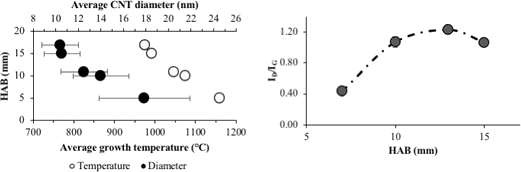
- Muhammad Hilmi Ibrahim Norikhwan Hamzah Mohd Zamri Mohd Yusop Ni Luh Wulan Septiani Mohd Fairus Mohd Yasin Department of Thermo-Fluids, Faculty of Mechanical Engineering, Universiti Teknologi Malaysia, 81310 Johor Bahru, Malaysia High Speed Reacting Flow Laboratory (HiREF), Universiti Teknologi
- ; synthesis control; Introduction Carbon nanotubes have been a research topic for a few decades since their discovery by Iijima in 1991 [1]. The CNT structure enables remarkable mechanical, electrical, and thermal properties. Studies of CNT syntheses using different methods yielding nanotubes with varying
- multi-walled CNTs (MWCNTs) with carboxyl functionalization [3]. The aerospace industry utilizes CNTs with high thermal, chemical, mechanical, and electrical performance as a nanocomposite additive to overcome problems in aircraft coatings, such as corrosion, ice accretion, lightning strike, and erosion


Cross-sectional Kelvin probe force microscopy on III–V epitaxial multilayer stacks: challenges and perspectives
Beilstein J. Nanotechnol. 2023, 14, 725–737, doi:10.3762/bjnano.14.59
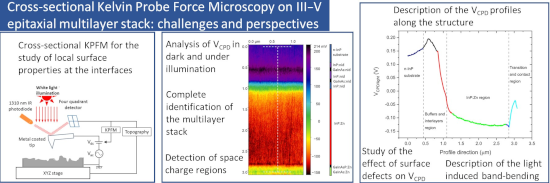
- + dc potential is applied, the KPFM tip scans across a surface. The ac signal is sinusoidal with a frequency that equals the mechanical resonance of the cantilever. The four-quadrant detector gives feedback in order to minimize cantilever oscillation modifying the dc signal providing the sample surface


Current-induced mechanical torque in chiral molecular rotors
Beilstein J. Nanotechnol. 2023, 14, 711–721, doi:10.3762/bjnano.14.57
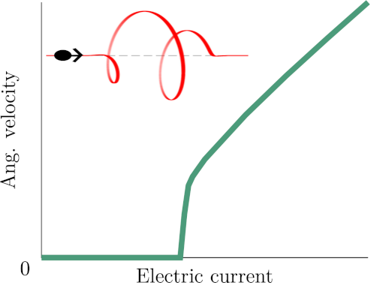
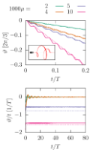
- qualitative description of the current-induced mechanical torque within a toy model framework. We consider a classical model of the molecular rotor where the molecule is modeled as a one-dimensional curve (“molecular wire”) that guides the flow of the charge carriers (see Figure 1 (left) for illustration
- , specifically the velocity–current characteristics and threshold currents. Our results can support the design of nanoscale mechanical devices. Model Model geometry (kinematics) Our classical model contains a particle (mass m) moving on a rigid path, which can rotate around an axis, see left part of Figure 1




![[Graphic 29]](/bjnano/content/inline/2190-4286-14-57-i54.svg?max-width=637&scale=1.18182)


The microstrain-accompanied structural phase transition from h-MoO3 to α-MoO3 investigated by in situ X-ray diffraction
Beilstein J. Nanotechnol. 2023, 14, 692–700, doi:10.3762/bjnano.14.55
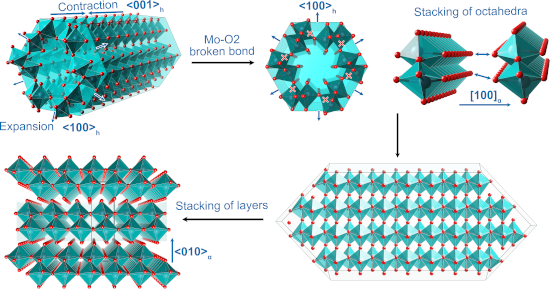
- transition from h-MoO3 to α-MoO3 Anisotropic thermal expansion and first-order phase transition The coefficient of thermal expansion (CTE) is an important mechanical parameter for the application of MoO3 thin films, as it can increase the mismatch between thin films and the substrate, causing microdevices to


Humidity-dependent electrical performance of CuO nanowire networks studied by electrochemical impedance spectroscopy
Beilstein J. Nanotechnol. 2023, 14, 683–691, doi:10.3762/bjnano.14.54
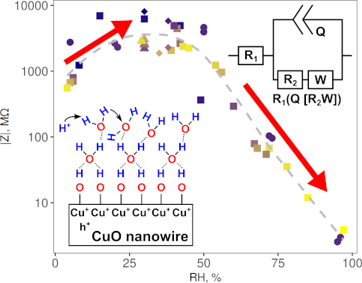
- sensitive and fast responding nanowire-based gas sensors for the detection of CO, C2H5OH, H2S, and NO2 [10][11][12][13][14]. Unusually strong space-charge-limited currents observed in individual CuO nanowires [15] in combination with the mechanical strength [9][16] motivate their application as durable


Metal-organic framework-based nanomaterials as opto-electrochemical sensors for the detection of antibiotics and hormones: A review
Beilstein J. Nanotechnol. 2023, 14, 631–673, doi:10.3762/bjnano.14.52
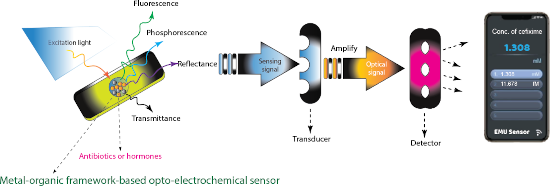
- extremely low densities (0.1–1 g·cm−3), the highest specific surface areas (165–7800 m2·g−1) currently known, tunable surface properties, good mechanical and thermal stability, intriguing and controllable morphologies, and uniform yet tunable pores that are created by the self-assembly of metal ions or


Suspension feeding in Copepoda (Crustacea) – a numerical model of setae acting in concert
Beilstein J. Nanotechnol. 2023, 14, 603–615, doi:10.3762/bjnano.14.50
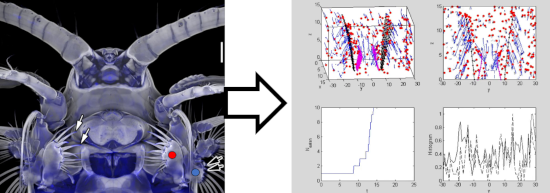
- mechanical property gradients, the mechanical behavior and the adhesion of setae, and the feeding efficiency of the system. In this context, we set-up a simple dynamic numerical model that takes all of these parameters into account and describes the interaction with food particles and their delivery into the
- mouth opening. By altering the parameters, it was unraveled that the system performs best when the long and short setae have different mechanical properties and different degrees of adhesion since the long setae generate the feeding current and the short ones establish the contact with the particle
- field of filtration technologies. Keywords: adhesion; confocal laser scanning microscopy (CLSM); feeding efficiency; feeding structures; mechanical properties; Introduction Particle capture mechanisms are common in a huge variety of aquatic animals, such as polychaetes, bryozoans, bivalves, sponges


Transferability of interatomic potentials for silicene
Beilstein J. Nanotechnol. 2023, 14, 574–585, doi:10.3762/bjnano.14.48
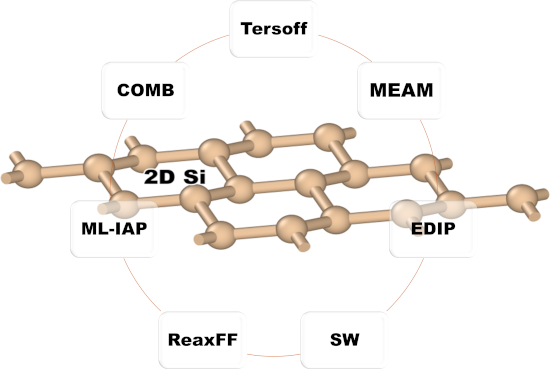
- single-layer silicon, polymorphs was examined. Structural and mechanical properties of flat, low-buckled, trigonal dumbbell, honeycomb dumbbell, and large honeycomb dumbbell silicene phases, were obtained using density functional theory and molecular statics calculations with Tersoff, MEAM, Stillinger
- –Weber, EDIP, ReaxFF, COMB, and machine-learning-based interatomic potentials. A quantitative systematic comparison and a discussion of the results obtained are reported. Keywords: 2D materials; DFT; force fields; interatomic potentials; mechanical properties; silicene; Introduction We are living in
- silicon to reproduce 2D silicon is poorly studied. There are several papers in which the quality of potentials for 3D silicon has been assessed [10][11][12], but not for silicene. The intention of this work is first to determine the structural and mechanical properties of 2D silicon using the first
![[Graphic 3]](/bjnano/content/inline/2190-4286-14-48-i7.svg?max-width=637&scale=1.18182)

Carbon nanotube-cellulose ink for rapid solvent identification
Beilstein J. Nanotechnol. 2023, 14, 535–543, doi:10.3762/bjnano.14.44
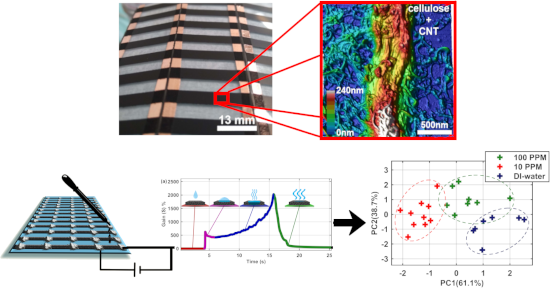
- properties of carbon nanostructured materials with the polymer’s distinguished mechanical properties. These composites are usually non-selective and can react to various ambient stimuli [20][22][23][24][25][26][27][28][29]. Among polymers, cellulose is the most abundant natural organic polymer on earth. It
- has resurfaced recently as a smart material because of its excellent thermal-mechanical properties, biocompatibility, biodegradability, and flexibility [22][23][30][31]. Composites based on carbon nanotubes or graphene and cellulose have been reported for, among other things, humidity and vapor


Nanoarchitectonics to entrap living cells in silica-based systems: encapsulations with yolk–shell and sepiolite nanomaterials
Beilstein J. Nanotechnol. 2023, 14, 522–534, doi:10.3762/bjnano.14.43
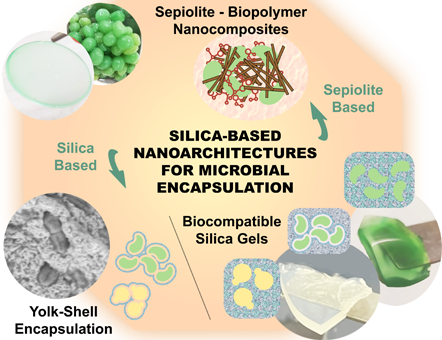
- gel matrix. This behaviour is highly interesting, since it could be exploited in further studies where post-synthesis pseudohyphal growth of yeast cells can generate an intricate tridimensional network of living cells, providing higher mechanical stability and biological robustness, and even an
- biological viability (“gas release” as a measurement of active metabolism and “cell leakage” measuring the encapsulation strength). Physical-structural robustness focuses on the evolution of physical appearance and mechanical resistance of the bulk material with time. Macroscopic appearance corresponds to a
- brief description of the material aspect, while stability corresponds to the observed overall resistance of the material to mechanical strain. Biological viability focuses on the survival state of the encapsulated biological entities. Both yeast and cyanobacteria release gases as products of their