Search results
Search for "metal oxides" in Full Text gives 228 result(s) in Beilstein Journal of Nanotechnology. Showing first 200.
The convenient preparation of stable aryl-coated zerovalent iron nanoparticles
Beilstein J. Nanotechnol. 2015, 6, 1192–1198, doi:10.3762/bjnano.6.121
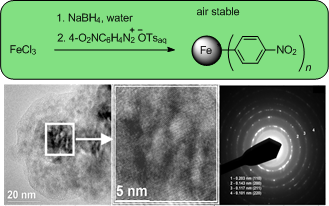
- diazonium salts (ADSs) are excellent agents for the covalent grafting of organic functional groups onto carbon, metal and metal oxides surfaces [12][13]. Wide applicability of ADSs is due to their ease of preparation, possibility of fast electrolytic reduction, wide range of functional groups of diazonium


Pt- and Pd-decorated MWCNTs for vapour and gas detection at room temperature
Beilstein J. Nanotechnol. 2015, 6, 919–927, doi:10.3762/bjnano.6.95
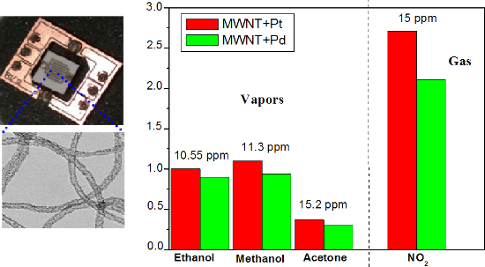
- that they can now be produced at relatively low cost [10][11][12][13][14] with a wide range of structures that can be used for different sensing applications [15][16][17]. Moreover, carbon nanotubes can operate at room temperature (in contrast to metal oxides that must be operated at relatively high



Morphological and structural characterization of single-crystal ZnO nanorod arrays on flexible and non-flexible substrates
Beilstein J. Nanotechnol. 2015, 6, 720–725, doi:10.3762/bjnano.6.73
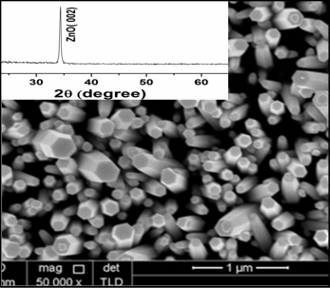
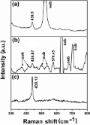
- realized by adjusting the synthesis conditions. Keywords: chemical bath deposition (CBD); nanorods; Raman; XRD; ZnO; Introduction Metal oxides are multifunctional materials with a wide range of applications encompassing photonic devices, high-K dielectrics, sensors, implants, and solar cells [1][2]. It
- is currently perceived that nanoscale control of metal oxide architectures can be used to enhance their performance in these applications. In particular, zinc oxide (ZnO) can be considered the most important among all valve metal oxides. ZnO has been fabricated as nanowires, nanorods, nanoparticles


Self-assembled anchor layers/polysaccharide coatings on titanium surfaces: a study of functionalization and stability
Beilstein J. Nanotechnol. 2015, 6, 617–631, doi:10.3762/bjnano.6.63
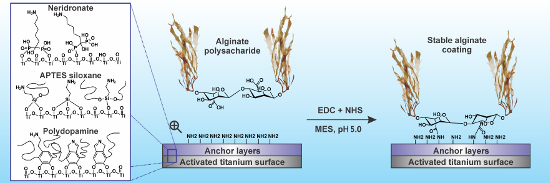
- ) confluent films as a substrate-independent modification approach. The ability of PDA to adhere to solid surfaces stems from the reactivity of ortho-quinone/catechol moieties that form coordination bonds with surface metal oxides and covalent bonds with nucleophilic groups. In addition to this, the different




Nanoparticle shapes by using Wulff constructions and first-principles calculations
Beilstein J. Nanotechnol. 2015, 6, 361–368, doi:10.3762/bjnano.6.35
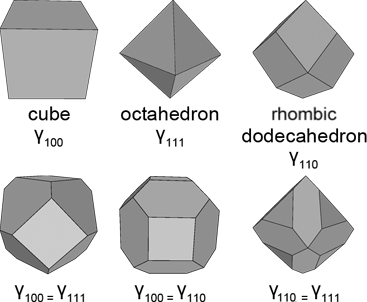
- . The surface energy of the low-index facets of LiBH4 was reported and the most consistent data point out that for (100), (010), (101), (011) facets the surface energy is below 0.115 J/m2 [64]. The shape of the nanocrystallite is presented in Figure 4. Contrary to the pure elements or metal oxides, for


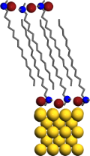

Comparative evaluation of the impact on endothelial cells induced by different nanoparticle structures and functionalization
Beilstein J. Nanotechnol. 2015, 6, 300–312, doi:10.3762/bjnano.6.28
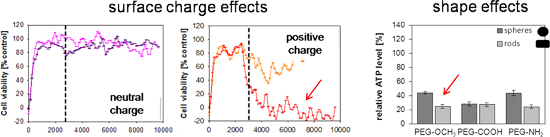
- characterization of the different nanoparticle formulations To investigate the effects of the shape, functionalization, size and composition of various nanoparticles on endothelial cells we used gold colloids (GNP), asymmetric gold@metal oxide Janus particles (Au@MnO or Au@Fe3O4), spherical metal oxides (MnO or
- elongated shape and consist of a gold domain with a core size of 3.5 nm or 8 nm. The gold domain was synthesized according to Peng et al. [65] and functionalized with 1-octadecanethiole baring a hydrophobic surface. The linkage of metal oxides (Fe3O4 or MnO) of 15 nm or 30 nm in diameter to the gold domain





Tunable light filtering by a Bragg mirror/heavily doped semiconducting nanocrystal composite
Beilstein J. Nanotechnol. 2015, 6, 193–200, doi:10.3762/bjnano.6.18
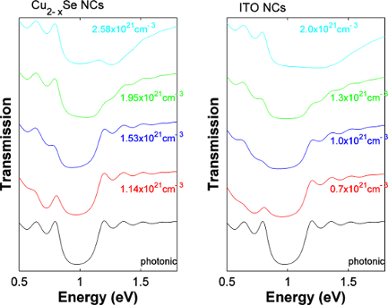
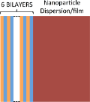
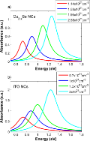
- . The refractive index dispersion for these two metal oxides was not considered since they are approximately constant in the energy range considered in this study. The absorption spectrum of the multilayer shows a peak centred at 1 eV (blue curves in Figure 3), due to the occurrence of the photonic band


Synthesis of boron nitride nanotubes and their applications
Beilstein J. Nanotechnol. 2015, 6, 84–102, doi:10.3762/bjnano.6.9
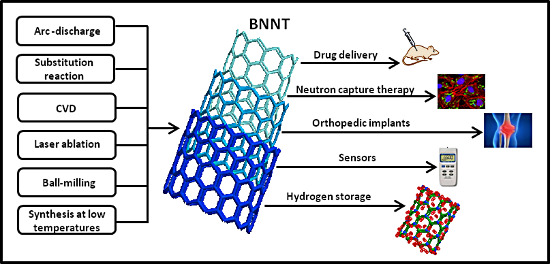
- that B3N3H6 and decaborane could be used as precursors [51]. In a recent study, a large scale, high-yield BNNT synthesis method was demonstrated based on CVD using boron and metal oxides to produce so-called BOCVD methods [43][52][53][54][55]. The chemical mechanism of BOCVD [43] is shown below. This




Inorganic Janus particles for biomedical applications
Beilstein J. Nanotechnol. 2014, 5, 2346–2362, doi:10.3762/bjnano.5.244
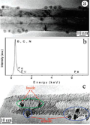
- contains two or more chemical species with a combination of metals, metal oxides, or chalcogenides, the composition and distribution of each of those phases are crucial parameters in addition to crystal structure, size, and shape. The most commonly studied morphology of inorganic hetero-structured


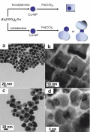


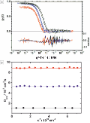


Influence of stabilising agents and pH on the size of SnO2 nanoparticles
Beilstein J. Nanotechnol. 2014, 5, 2192–2201, doi:10.3762/bjnano.5.228
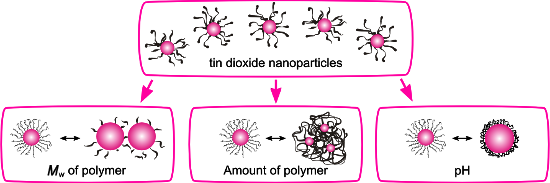
- high charging capacity, however, this ability slightly diminishes after 60 cycles. It is expected that the SnO2 nanoparticles have the potential to replace conventional graphite anodes in lithium-ion cells [4]. In sensor research, many semiconducting metal oxides are used of which tin dioxide is the
- reaction is one of the oldest preparation methods for various, poorly soluble, chemical compounds, including metal oxides. Currently, it is also one of the "bottom-up" preparation methods for colloidal systems of metal oxides. The advantage of this method lies undoubtedly in its simplicity, but also the
- metal oxides occurring in polymeric micelles [20]. The second theory, although less popular, describes the stabilisation of polymers by molecules that results from the polymerisation of monomers which occur in the presence of nanoparticles. In this article, synthetic polymers were used as stabilisers


Biopolymer colloids for controlling and templating inorganic synthesis
Beilstein J. Nanotechnol. 2014, 5, 2129–2138, doi:10.3762/bjnano.5.222

- formed on the biomacromolecular chain, while in polymer-controlled crystallization processes the inorganic material is significantly larger than the macromolecules, which may get engulfed by the growing crystals. DNA chains have been coated by in situ deposition with different metals, metal oxides, and


Towards bottom-up nanopatterning of Prussian blue analogues
Beilstein J. Nanotechnol. 2014, 5, 1933–1943, doi:10.3762/bjnano.5.204
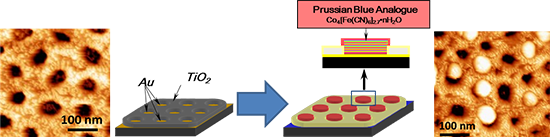
- between hexacyanometalates and hydrated cations of the transition metal series in aqueous solution. The resulting solid exhibits the well-known face centered cubic structure of Prussian blue [9]. The sol–gel process is a method for producing metal oxides from small molecules via inorganic polymerization


Room temperature, ppb-level NO2 gas sensing of multiple-networked ZnSe nanowire sensors under UV illumination
Beilstein J. Nanotechnol. 2014, 5, 1836–1841, doi:10.3762/bjnano.5.194
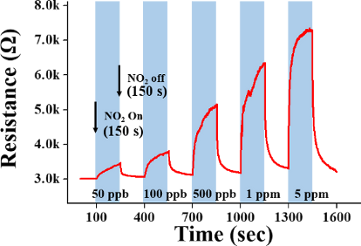
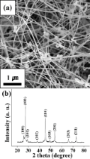
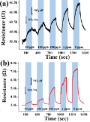
- -dimensionally (1D) nanostructured, metal oxide semiconductor sensors have been studied extensively because of the associated higher sensitivity due to the high surface-to-volume ratios as compared to thin film gas sensors [8][9][10][11][12][13]. Most metal oxides exhibit some sensitivity to many gases at high



Quasi-1D physics in metal-organic frameworks: MIL-47(V) from first principles
Beilstein J. Nanotechnol. 2014, 5, 1738–1748, doi:10.3762/bjnano.5.184
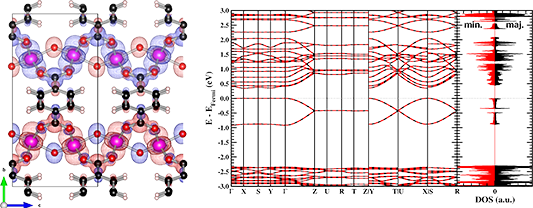
- interesting systems to observe and study exotic and low-dimensional physics [23][24][25][26][27][28][29][30][31][32][33][34][35][36][37]. Transition-metal oxides, on the other hand, have proven to be a rich source of multiferroic materials [38][39][40][41]. Such materials, which combine at least two magnetic
- and/or electronic ordering phenomena, are of great interest for technological applications. MOFs containing transition-metal oxides as nodes are therefore expected to show physically interesting behavior. For example Canepa et al. [36] investigated the MOF-74 frameworks with Fe, Ni and Co at their


Current state of laser synthesis of metal and alloy nanoparticles as ligand-free reference materials for nano-toxicological assays
Beilstein J. Nanotechnol. 2014, 5, 1523–1541, doi:10.3762/bjnano.5.165
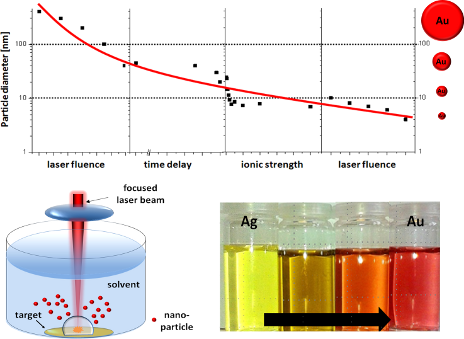
- ≈30 nm. However, PLML primarily yields particles in a submicrometer size range from 200–400 nm (sub-micrometer spheres, SMS), which could be obtained from multiple metals [75][76] and metal oxides [77][78][79]. In case of gold, SMS were primarily obtained from citrate-capped nanoparticles [74], while


Characterization and photocatalytic study of tantalum oxide nanoparticles prepared by the hydrolysis of tantalum oxo-ethoxide Ta8(μ3-O)2(μ-O)8(μ-OEt)6(OEt)14
Beilstein J. Nanotechnol. 2014, 5, 1082–1090, doi:10.3762/bjnano.5.121
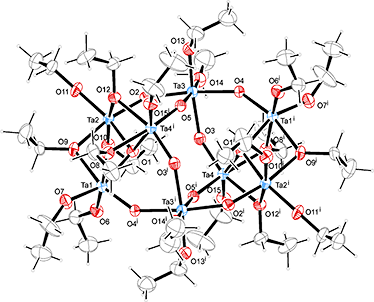
- the organic dye rhodamine B. Keywords: bandgap; tantalum-oxo-ethoxide; Tauc plot; tantalum pentoxide (Ta2O5); Introduction Metal alkoxides, being excellent precursors in the sol–gel process for preparation of metal oxides have attained huge attention of researchers. Several attempts have been made
- in order to modify the highly moisture sensitive metal alkoxides into less sensitive species [1][2][3][4] as precursors for metal oxides with new and better properties. However, due to the fast kinetics of the hydrolysis and condensation reactions in the sol–gel route, relatively little information
- -species being treated as intermediates between the metal alkoxides and the metal oxides are very significant as they clearly indicate the route for the formation of oxides through hydrolysis. It is suggested that the hydrolysis of a metal alkoxide starts with the formation of a hydroxo derivative, which


Photocatalysis
Beilstein J. Nanotechnol. 2014, 5, 1071–1072, doi:10.3762/bjnano.5.119

- and morphological tuning, in particular for hybrid materials systems such as Ag–ZnO, VTi/MCM-41, are important toward achieving higher solar energy conversion efficiencies. In a couple of reports, materials alternative to conventional metal oxides, for example, reduced graphene oxide, graphene quantum
A nanometric cushion for enhancing scratch and wear resistance of hard films
Beilstein J. Nanotechnol. 2014, 5, 1005–1015, doi:10.3762/bjnano.5.114
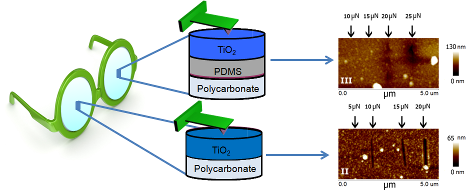
- friction reduction when one of the opposing surfaces is much harder than the other, as well as the role of wear particles. In order to reduce wear, hard coatings such as metal oxides and hard carbon or diamond coatings are often employed. The adhesion term arises from the growth of junctions forming




Growth and characterization of CNT–TiO2 heterostructures
Beilstein J. Nanotechnol. 2014, 5, 946–955, doi:10.3762/bjnano.5.108
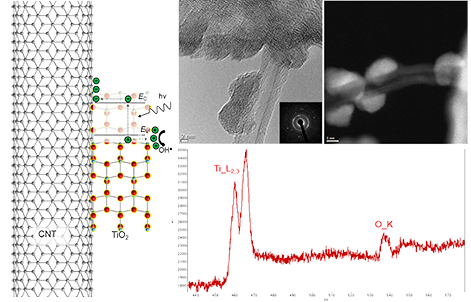
- transmission electron microscopy (TEM) techniques with a focus on the TiO2–CNT material system. The mechanisms of efficiency enhancement for photocatalysis by using the ensemble are reviewed. Methods to fabricate nanocomposites consisting of CNTs and metal/metal oxides are surveyed. In particular, an atomic
- interface using EELS are also discussed. Review Photocatalysis using TiO2–CNT Among all the nanocomposites consisting of CNTs and metal/metal oxides, CNT–TiO2 has attracted most research interest because of its unique properties and potential applications such as photocatalysis, especially since the recent
- nanomaterials To fundamentally understand the interface between CNTs and metal/metal oxides on the nanometer or even on the atomic level, TEM plays an irreplaceable role due to its high spatial resolution. With the development of spherical aberration correctors, atomic-resolution imaging at a sub-0.5 Å level


Integration of ZnO and CuO nanowires into a thermoelectric module
Beilstein J. Nanotechnol. 2014, 5, 927–936, doi:10.3762/bjnano.5.106
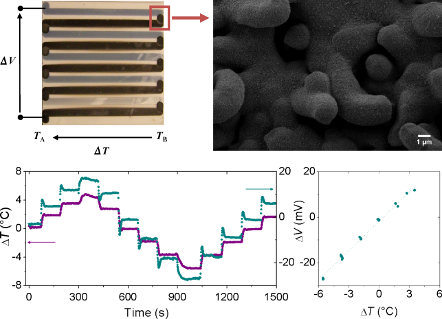
- , respectively (being T the temperature). State-of-the-art bulk materials-based thermoelectric generators have been demonstrated to possibly reach energy conversion efficiency values of 5.2% and higher, with materials characterized by a ZT factor approaching a unitary value [3][4]. Transition metal oxides (TMOs
- crystalline structure. In order to fabricate zinc oxide nanowires, we used thermal evaporation process, which involves both vapour-phase (VP) and vapour-liquid-solid (VLS) growth mechanisms [36][37]. The deposition technique consists of the evaporation of bulk metal oxides powder followed by condensation of


Antimicrobial properties of CuO nanorods and multi-armed nanoparticles against B. anthracis vegetative cells and endospores
Beilstein J. Nanotechnol. 2014, 5, 789–800, doi:10.3762/bjnano.5.91
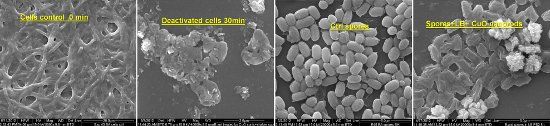
- from 10 to 100 mg per 2000 cells. Haggstrom et al. [14] have reported sporicidal activity of corrosive halogen adducts of nanometer-scaled active metal oxides Al2O3, TiO2 and CeO2 in a solid based interaction on microfiltration membranes. The ratio of bacterial agents to metal oxide is not clear from


Visible light photooxidative performance of a high-nuclearity molecular bismuth vanadium oxide cluster
Beilstein J. Nanotechnol. 2014, 5, 711–716, doi:10.3762/bjnano.5.83

- photocatalysts is a well-established method which gives access to materials for which light absorption, catalytic activity and selectivity can be tuned by structural and chemical modifications [1][2][3][4][5][6]. Prime examples for this approach are molecular metal oxides, so-called polyoxometalates (POMs) [7][8


Nanostructure sensitization of transition metal oxides for visible-light photocatalysis
Beilstein J. Nanotechnol. 2014, 5, 696–710, doi:10.3762/bjnano.5.82
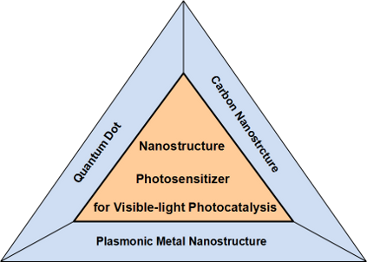
- photocatalysts has recently attracted a lot of interest. The photosensitization of transition metal oxides is a promising approach for achieving effective visible-light photocatalysis. This review article primarily discusses the recent progress in the realm of a variety of nanostructured photosensitizers such as
- quantum dots, plasmonic metal nanostructures, and carbon nanostructures for coupling with wide-bandgap transition metal oxides to design better visible-light active photocatalysts. The underlying mechanisms of the composite photocatalysts, e.g., the light-induced charge separation and the subsequent
- dots; transition metal oxides; visible-light photocatalysis; Introduction In response to the decreasing supply of fossil fuels and the environmental problems caused by their exploitation, the search for a renewable and sustainable energy supply has been intensified in the past decades. Solar energy is




Artificial sunlight and ultraviolet light induced photo-epoxidation of propylene over V-Ti/MCM-41 photocatalyst
Beilstein J. Nanotechnol. 2014, 5, 566–576, doi:10.3762/bjnano.5.67
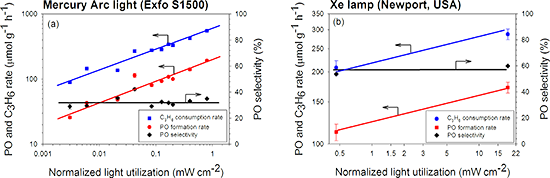
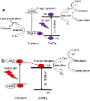
- the first systematic investigation of the photo-epoxidation of propylene over more than 50 silica-supported metal oxides, in which TiOx/SiO2 was the most effective photocatalyst [20]. Amano et al. reported that Rb-ion-modified V2O5/SiO2 was their best photo-epoxidation catalyst under UV-C light [24




Mesoporous cerium oxide nanospheres for the visible-light driven photocatalytic degradation of dyes
Beilstein J. Nanotechnol. 2014, 5, 517–523, doi:10.3762/bjnano.5.60
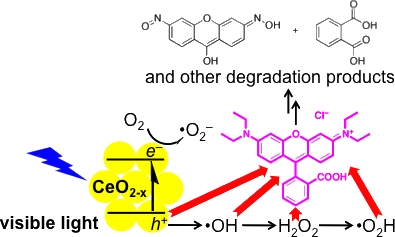
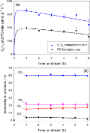
- , including Ce2O3 and Ce7O12, are known to have band gaps in the visible region [13][19][20][21]. Our team has maintained a keen interest in alternative affordable, earth-abundant, visible light absorbing metal oxides to be used in two-photon ‘Z-schemes’ for dye-sensitized photoelectrosynthesis cells (DSPECs