


Search results
Search for "orbital" in Full Text gives 259 result(s) in Beilstein Journal of Nanotechnology. Showing first 200.
High electronic couplings of single mesitylene molecular junctions
Beilstein J. Nanotechnol. 2015, 6, 2431–2437, doi:10.3762/bjnano.6.251
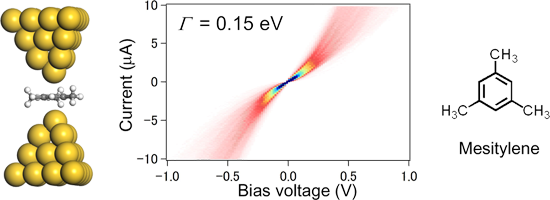
- , electronic conductance of the single molecular junction can be described by two parameters of (i) the electronic coupling between electrodes and molecule and (ii) the relative energy level alignment of the conduction orbital of molecule with respect to the Fermi level of the metal electrodes. By fitting the
- experimentally obtained I–V characteristics to the Breit-Wigner model, the metal–molecule coupling Γ, and energy difference between Fermi level and conduction orbital ε0 are obtained. This I–V analysis has been applied for molecular junctions with a variety of anchoring groups. For example Γ = 60 meV and ε0
- of the conduction orbital, and the strength of the coupling between molecule and left and right electrodes, respectively. The current in the molecular junction is represented by where n is the number of bridging molecules. The formula for the current in molecular junctions (Equation 3) is obtained




Vibration-mediated Kondo transport in molecular junctions: conductance evolution during mechanical stretching
Beilstein J. Nanotechnol. 2015, 6, 2417–2422, doi:10.3762/bjnano.6.249
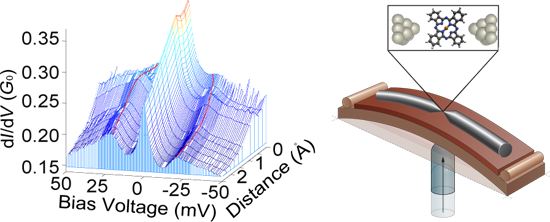
- response to stretching and the molecular orbital on which the single spin is localized [23]. Such coupling may explain why two different quantities, namely, the side peak voltage that indicates the onset of vibration activation and the zero-bias Kondo amplitude, change their evolution trends at the same
- tunneling between the Ag electrodes can also be considered as a source for background conduction [35]. We speculate that the different response of the background and the Kondo conductance to junction elongation (Figure 2c,d) comes from the different response of the orbital hybridization at the metal


Evidence for non-conservative current-induced forces in the breaking of Au and Pt atomic chains
Beilstein J. Nanotechnol. 2015, 6, 2338–2344, doi:10.3762/bjnano.6.241
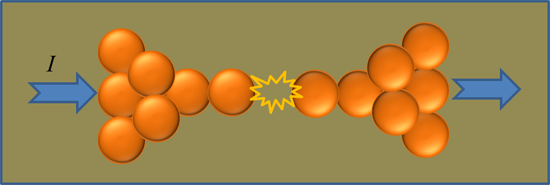
- is due to the difference in numbers of conductance channels per atom and their associated transmission probabilities [12][13]. Au has just one conductance channel with nearly perfect transmission associated with the 6s orbital, while for Pt the 5d orbitals give rise to additional conductance channels


Core-level spectra and molecular deformation in adsorption: V-shaped pentacene on Al(001)
Beilstein J. Nanotechnol. 2015, 6, 2242–2251, doi:10.3762/bjnano.6.230
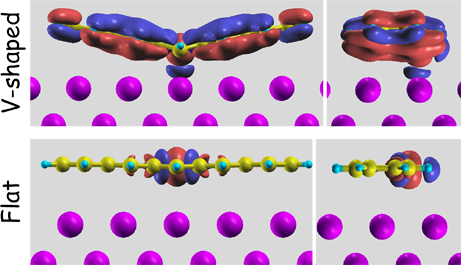
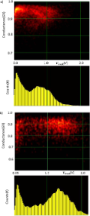
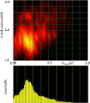
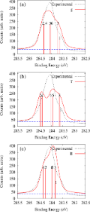
- contributions from the non-equivalent C atoms provide evidence of the molecular orbital filling, hybridization, and interchange induced by distortion. The alteration of the C–C bond lengths due to the V-shaped bending decreases by a factor of two the azimuthal dichroism of NEXAFS spectra, i.e., the energy
- , which increases by 0.07 Å from g to B. Such an elongation occurs because the C1 orbital modifies from sp2 to sp3 hybridization, which results in a displacement of the valence electron density of C1 from the C1–C2 bond to the newly formed C1–Al bond, as recently discussed for self-assembled monolayers
- appreciable filling was observed as this state displays an energy range as large as 4 eV with its main peak below the Fermi energy level [15]. From the results in Figure 3 we add that the orbital corresponding to the LUMO+2 of the undistorted free molecule becomes the LUMO+3 of the V-shaped gas phase molecule




Nonconservative current-driven dynamics: beyond the nanoscale
Beilstein J. Nanotechnol. 2015, 6, 2140–2147, doi:10.3762/bjnano.6.219
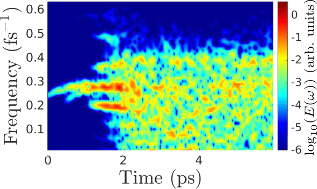
- -boundary quantum Liouville equation [17]. These approaches will be discussed in more detail later. Electrons are described within a spin-degenerate single-orbital orthogonal nearest-neighbour tight-binding model with parameters fitted to the elastic properties of bulk gold [18]. The nearest-neighbour




Thermoelectricity in molecular junctions with harmonic and anharmonic modes
Beilstein J. Nanotechnol. 2015, 6, 2129–2139, doi:10.3762/bjnano.6.218
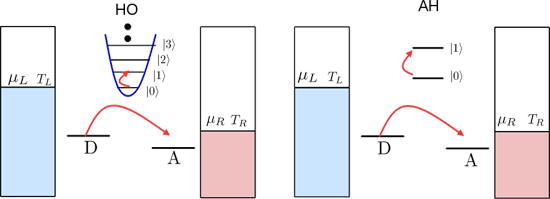
- based on minimal model Hamiltonians are largely focused on the Anderson impurity dot model which consists a single molecular electronic orbital directly coupled to biased metal leads, as well as to a particular vibrational mode [1]. Since the same molecular orbital is assumed to extend both contacts
- thermopower, a linear response quantity, also referred to as the Seebeck coefficient, is utilized as an independent tool for probing the energetics of molecular junctions [17][18][19][20][21][22][23][24]. Experimental efforts identified orbital hybridization, contact-molecule energy coupling and geometry, and


Controlled switching of single-molecule junctions by mechanical motion of a phenyl ring
Beilstein J. Nanotechnol. 2015, 6, 2088–2095, doi:10.3762/bjnano.6.213
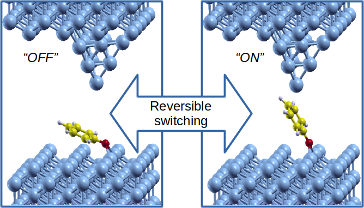
- ascribed to a stronger hybridization with the substrate states as revealed by the increased projected density of states (PDOS) onto the chalcogen atom near EF (Figure 6b,d; more extended atomic orbitals of S than of O) as well as by the larger width of the lowest unoccupied molecular orbital (LUMO


Conductance through single biphenyl molecules: symmetric and asymmetric coupling to electrodes
Beilstein J. Nanotechnol. 2015, 6, 1690–1697, doi:10.3762/bjnano.6.171
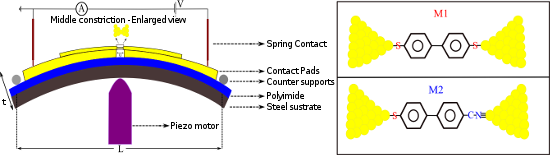
- orbital with energy E0 governs electronic transmission, the transmission function is given by the Breit–Wigner formula, For the symmetric molecule, the coupling parameters to both sides are equal: Γ = Γ1 = Γ2. Using the single level model, Γ and E0 were varied in order to obtain a best fit to all measured


The eNanoMapper database for nanomaterial safety information
Beilstein J. Nanotechnol. 2015, 6, 1609–1634, doi:10.3762/bjnano.6.165


Electrical properties and mechanical stability of anchoring groups for single-molecule electronics
Beilstein J. Nanotechnol. 2015, 6, 1558–1567, doi:10.3762/bjnano.6.159
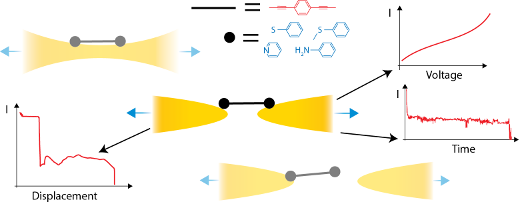
- electrodes EF and the energy of the closest frontier orbital in the molecule ε0 = |EF−ε|, where ε is the energy of the molecular level. In the Landauer transport formalism [44], at zero temperature, the current is given by: where T(E) is the transmission, that in the single-level model is a Lorentzian peak


Transformations of PTCDA structures on rutile TiO2 induced by thermal annealing and intermolecular forces
Beilstein J. Nanotechnol. 2015, 6, 1498–1507, doi:10.3762/bjnano.6.155
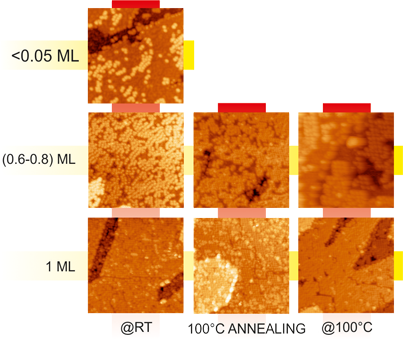
- outstanding oxygen rows. However, when a higher resolution is achieved the single molecule is imaged as a characteristic double lobe feature, as noted by a dashed circle in Figure 2b. This finding enables us to determine the molecule orientation on the surface, as the lowest unoccupied molecular orbital (LUMO
- ) should contribute mostly to the STM appearance when imaging of empty states is performed. The charge density contour of the PTCDA LUMO orbital comprises 14 lobes located symmetrically with respect to the longer molecular axis, where the orbital wave function changes its sign. As a result, the charge


Molecular materials – towards quantum properties
Beilstein J. Nanotechnol. 2015, 6, 1485–1486, doi:10.3762/bjnano.6.153

- . In some of the proposed device materials, quantum information is carried by the spin and the orbital degree of freedom of the electron. The challenge consists in circumventing the strong coupling of the latter one with the environment in order to achieve the needed long coherence times to carry out
Current–voltage characteristics of manganite–titanite perovskite junctions
Beilstein J. Nanotechnol. 2015, 6, 1467–1484, doi:10.3762/bjnano.6.152
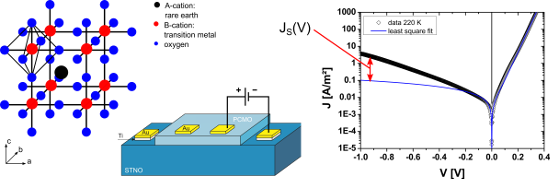
- rates), the electronic overlap of narrow bands can be very small. In other words, the orbital mismatch of the electronic states on both sides of the interface may strongly affect the charge transfer process. The width of the space charge region (SCR) at the junctions of conventional semiconductors can





Enhanced fullerene–Au(111) coupling in (2√3 × 2√3)R30° superstructures with intermolecular interactions
Beilstein J. Nanotechnol. 2015, 6, 1421–1431, doi:10.3762/bjnano.6.147
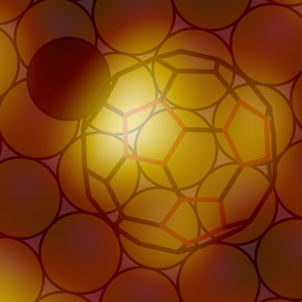
- , in case of fullerenes it is also possible to identify the orbital symmetry, whose appearance strongly depends on the rotational orientation of single C60, like shown in simulations of empty-state STM-images of free fullerenes [15]. Therefore, it was possible to identify this (√589 × √589)R14.5
- superstructures of C60 on Au(111) surfaces, we investigate in detail the orbital symmetry and thus, the rotational orientation and interface interactions of fullerenes in disordered and uniform (2√3 × 2√3)R30° superstructures. These structural investigations are complemented by conductance measurements sheding
- measured for a positive sample bias (Ubias > 1.0 V), when electrons are tunneling from the tip into the lowest unoccupied molecular orbital (LUMO) of C60. However, the apparent height difference between hex-vac and 6:6-top C60 depends strongly on the applied bias voltage and exhibits the steepest slope


Electron and heat transport in porphyrin-based single-molecule transistors with electro-burnt graphene electrodes
Beilstein J. Nanotechnol. 2015, 6, 1413–1420, doi:10.3762/bjnano.6.146
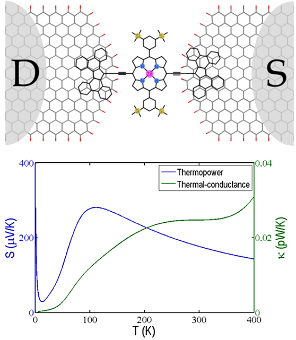
- ][12][13][14][15][16] is the close match of their Fermi energy with the highest occupied molecular orbital (HOMO) or lowest unoccupied molecular orbital (LUMO) energy levels of organic molecules. Furthermore, in comparison to the more bulky metallic electrodes, graphene electrodes promote electrostatic
- electronic structure of the prophyrin molecule. Then we study the electro-burnt graphene electrodes and finally the two-terminal device in which the anchor groups of the porphyrin molecule bind to the graphene electrodes by p-orbital overlap. We then discuss the contribution of each part of the molecule to
- EBG electrode. The electrode is a 3 nm wide, zigzag, semi-infinite, graphene nanoribbon terminated by oxygen and connected to a half-ellipse-like structure as shown in Figure 3a. The molecular orbital levels in the Fermi energy, EF = 0 eV, indicate that the orbitals are mostly localized in the edges


High photocatalytic activity of V-doped SrTiO3 porous nanofibers produced from a combined electrospinning and thermal diffusion process
Beilstein J. Nanotechnol. 2015, 6, 1281–1286, doi:10.3762/bjnano.6.132
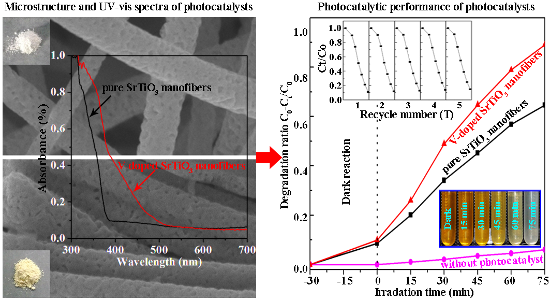
- unoccupied conduction band (CB) are composed of the O 2p and Ti 3d-t2g states, respectively [15]. Due to the small contribution of Sr to the orbital characteristics of the conduction band, the energy difference between the O 2p and Ti 3d states mainly causes the band structure and insulation characteristic


Can molecular projected density of states (PDOS) be systematically used in electronic conductance analysis?
Beilstein J. Nanotechnol. 2015, 6, 1247–1259, doi:10.3762/bjnano.6.128
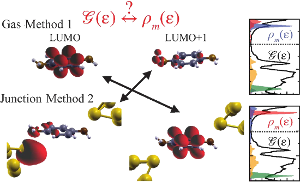
- of the zero-bias conductance. A very common approach for providing such an interpretation proceeds as follows. A set of molecular orbitals (MOs) associated to the central molecule are identified and classified according to the energy levels (e.g., the highest occupied molecular orbital (HOMO), or the
- lowest unoccupied molecular orbital (LUMO), or the next LUMO (LUMO+1), etc.). Then, the total electronic density of states (DOS) is decomposed into the projected density of states (PDOS) associated with each different MO. Finally, by directly comparing the conductance profile, , with the various PDOS
- molecular orbital m is defined as where n runs over all the states of the central extended molecule with wavefunction and energy εn. In Equation 1, the Dirac delta function is usually replaced by a Gaussian function with a given broadening. As discussed above, is primarily determined by the electronic





Electrical characterization of single molecule and Langmuir–Blodgett monomolecular films of a pyridine-terminated oligo(phenylene-ethynylene) derivative
Beilstein J. Nanotechnol. 2015, 6, 1145–1157, doi:10.3762/bjnano.6.116
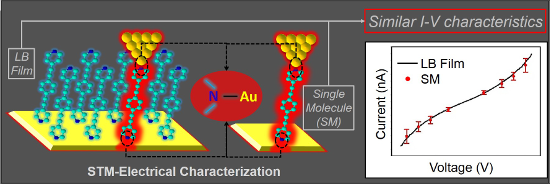
- efficient pyridyl–Au contacts. Previous contributions in the field have shown that the charge transport in molecular wires incorporating electron-withdrawing pyridyl-type anchoring groups is preferentially controlled by the lowest unoccupied molecular orbital (LUMO). That is, the pyridyl group decreases the
- frontier orbital energies and promotes electron transport by reducing the energy offset between the molecular LUMO and the Fermi level of electrodes [102][103][104]. In particular, DFT-based studies of 1 in single molecule junctions have shown that the total conductance is controlled by eigenchannels


Electronic interaction in composites of a conjugated polymer and carbon nanotubes: first-principles calculation and photophysical approaches
Beilstein J. Nanotechnol. 2015, 6, 1138–1144, doi:10.3762/bjnano.6.115
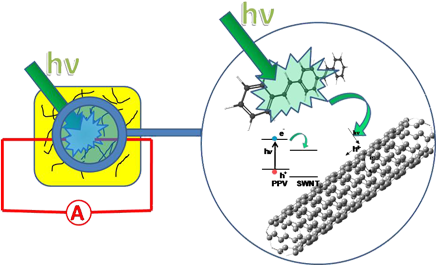
- that these are ground state calculations and do not take into account the electron dynamics involved in exciton formation and separation, calculations that are unfortunately inaccessible with our available computing resources. The highest occupied molecular orbital (HOMO) and lowest occupied molecular
- orbital (LUMO) states for the (7,0) and (4,4) nanotubes in the presence of the triphenyl PPV oligomer are shown in Figure 3. It can be seen that in the presence of the (7,0) tube the system HOMO is primarily localized on the vinyl double bonds along the PPV backbone. Curvature in the PPV oligomer will


Charge carrier mobility and electronic properties of Al(Op)3: impact of excimer formation
Beilstein J. Nanotechnol. 2015, 6, 1107–1115, doi:10.3762/bjnano.6.112
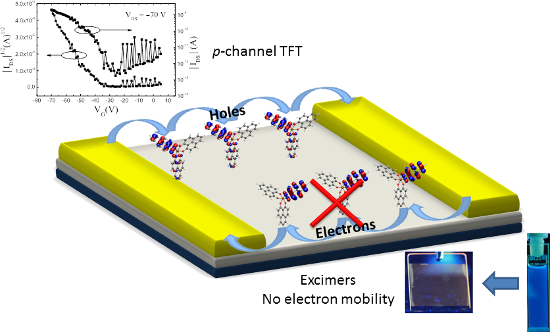
- = 5.54 eV and EA = 1.94 eV in environment. Additional charges in the system, which can be considered as SOMO+ and SOMO− orbital energies, lead to values of −6.47 eV for the oxidized state (hole) and −0.79 eV for the reduced state (electron). The self-consistently evaluated HOMO and LUMO levels in an Alq3
- and 5.55 ± 0.91 D for Alq3. The increase of the dipole moment of Al(Op)3 is much more dramatic, indicating a break in the intrinsic, vacuum symmetry, which is reflected in the orbital localization and is clearly observable in Figure 7b. As we treated the molecules in the matrix to be rigid, the


Superluminescence from an optically pumped molecular tunneling junction by injection of plasmon induced hot electrons
Beilstein J. Nanotechnol. 2015, 6, 1100–1106, doi:10.3762/bjnano.6.111
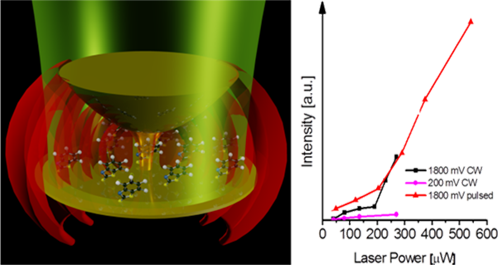
- emission intensity depends non-linearly on the optical pump power. The enhanced emission can be modelled by rate equations taking into account hole injection from the tip (anode) into the highest occupied orbital of the closest substrate-bound molecule (lower level) and radiative recombination with an
- substrate indeed confirm that the energetic distribution of the highest occupied molecular orbital (HOMO) with respect to the Fermi level of the Au substrate lies between −1.2 and −2.0 eV and the d-bands of Au lie below −2.0 eV (see Figure S6, Supporting Information File 1). These values are consistent with


Tunable magnetism on the lateral mesoscale by post-processing of Co/Pt heterostructures
Beilstein J. Nanotechnol. 2015, 6, 1082–1090, doi:10.3762/bjnano.6.109
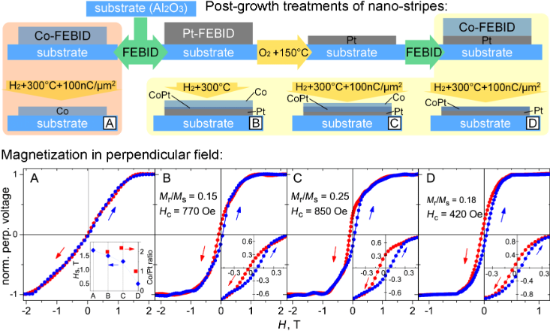
- out easier to deposit self-assembled Co nanoparticles on top of Pt thin films [38] and thereby fabricate surface alloys formed at step edges of Pt single crystalline substrates. In that work [38], an increase of the coercive field and of the Co orbital magnetic momentum was observed and attributed to


Graphene on SiC(0001) inspected by dynamic atomic force microscopy at room temperature
Beilstein J. Nanotechnol. 2015, 6, 901–906, doi:10.3762/bjnano.6.93
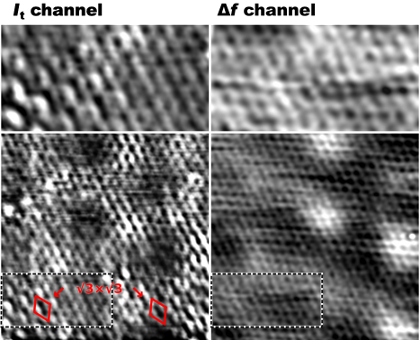
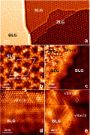
- sample. KPFM parabola was measured by sweeping the bias voltage and measuring the Δf value [24]. In order to estimate the SLG corrugation we carried out large scale total energy density functional theory (DFT) calculations. We used local-orbital FIREBALL code [25][26]. FIREBALL uses an optimized [27
- ] spatially-confined pseudo-atomic numerical orbital basis set. In our case, an ss* basis set was used for the H atoms, a sp basis set for the Si and C atoms. The cutoff radii of the pseudo-atomic basis functions were as follows: R(H,s) = 4.5 a.u., R(H,s*) = 4.5 a.u., R(C,s) = 4.5 a.u, R(C,s) = 4.5 a.u., R(Si


![[Graphic 1]](/bjnano/content/inline/2190-4286-6-93-i1.png?max-width=637&scale=1.18182) × 6
× 6Magnetic properties of self-organized Co dimer nanolines on Si/Ag(110)
Beilstein J. Nanotechnol. 2015, 6, 777–784, doi:10.3762/bjnano.6.80
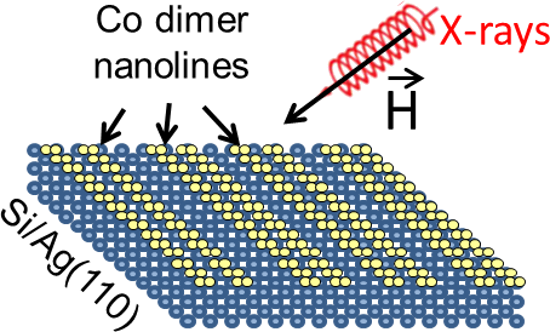
- -dimensional (2D) and one-dimensional (1D) Co nanostructures has shown that magnetic properties are highly size dependent, due to the low coordination of the atoms of atomic-scale nanostructures [1][18]. For such nanostructures, enhanced magnetic anisotropy energy (MAE) and orbital moment have been evidenced
- light gives access to the magnetization direction and magnitude of a specific element. According to the magnetic sum rules [38][39], the spin (μS) and orbital (μL) moments can indeed be quantitatively determined. In this work, we have applied the formalism described by Chen et al. [35] in order to
- evaluate the spin and orbital contributions to the magnetization of the Co nanolines. The number of holes in the Co 3d band is estimated to be 2.5, which corresponds to the average theoretical value for bulk Co [40][41]. Note that a similar value of 2.4 has been found for the case of Co adatoms on Pt(111


Statistics of work and orthogonality catastrophe in discrete level systems: an application to fullerene molecules and ultra-cold trapped Fermi gases
Beilstein J. Nanotechnol. 2015, 6, 755–766, doi:10.3762/bjnano.6.78
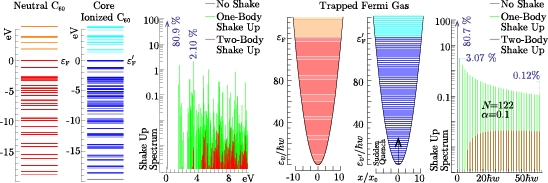
- particular, we consider the highest and lowest occupied MOs of the neutral molecule and some MOs of the ionized molecule to have similar binding energies relative to the perturbed Fermi level. The squared overlap between these states are listed in Table 1, while some of their orbital shapes are shown in

![[Graphic 22]](/bjnano/content/inline/2190-4286-6-78-i30.png?max-width=637&scale=1.18182) ) fullerene molecules, as com...
) fullerene molecules, as com...





