


Search results
Search for "polycrystalline" in Full Text gives 259 result(s) in Beilstein Journal of Nanotechnology. Showing first 200.
Influence of the shape and surface oxidation in the magnetization reversal of thin iron nanowires grown by focused electron beam induced deposition
Beilstein J. Nanotechnol. 2015, 6, 1319–1331, doi:10.3762/bjnano.6.136
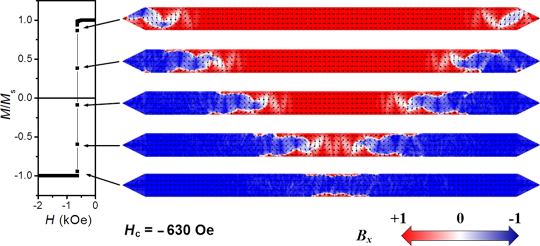
- producing the magnetization reversal. Most of magnetic devices work by producing a voltage output when the magnetization reversal occurs. In the case of cobalt deposits, it was previously found that the coercive field is governed by shape anisotropy [24] due to the polycrystalline microstructure [25], and
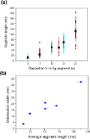
- . All results shown in Figure 2 correspond to the average of more than 100 hysteresis loops. Given the sharp switching transitions observed, a high level of reproducibility can be inferred. The observed decrease of HC with the width was also observed in polycrystalline cobalt nanowires grown by FEBID
- the actual geometry of the Fe nanowires of batch 2. The GPMagnet software package [42] was used to perform the simulations employing the following magnetic parameters for polycrystalline pure iron [43]: saturation magnetization = 1.7 × 10⁶ A/m, exchange constant = 2.1 × 10⁻¹¹ J/m, anisotropy constant


Structural transitions in electron beam deposited Co–carbonyl suspended nanowires at high electrical current densities
Beilstein J. Nanotechnol. 2015, 6, 1298–1305, doi:10.3762/bjnano.6.134
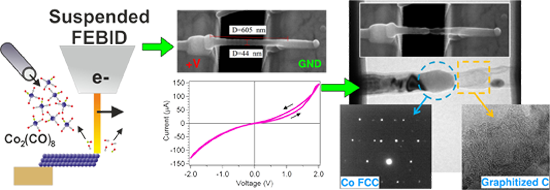
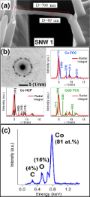
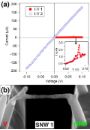
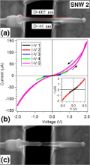
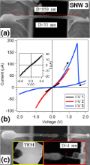
- SNWs, depending on the I–V history. A single measurement with a sudden current burst leads to a polycrystalline FCC Co structure extended over the whole wire. Repeated measurements at increasing currents produce wires with a split structure: one half is polycrystalline FCC Co and the other half is
- measurements is reported in Figure 3. The bright-field image of SNW 1 is completely changed from the grainy structure observed after deposition. Now it has the typical appearance of a polycrystalline material, with regions of well-defined contrast extending for tens of nanometers along the wire, and separated
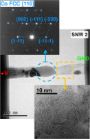
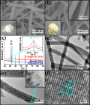
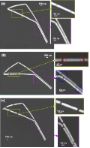
- opaque portion on the left is polycrystalline cobalt while the transparent region on the right is graphitized carbon. The SAED pattern taken on the big central grain (55 nm wide and 65 nm long, blue circled), after a tilt of the sample, is shown in the upper panel. The spots arranged in a diamond lattice

High photocatalytic activity of V-doped SrTiO3 porous nanofibers produced from a combined electrospinning and thermal diffusion process
Beilstein J. Nanotechnol. 2015, 6, 1281–1286, doi:10.3762/bjnano.6.132
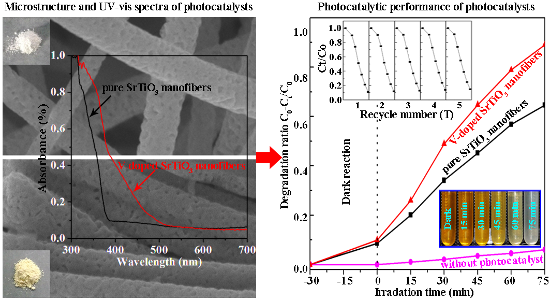
- patterns of two samples. All the diffraction peaks could be indexed to the standard perovskite phase of SrTiO3 (JCPDS No. 35-0734) [25] without any indication of other impurity phases. Both samples show a polycrystalline structure, while the peaks of the V-doped SrTiO3 nanofibers are stronger and


Growth and morphological analysis of segmented AuAg alloy nanowires created by pulsed electrodeposition in ion-track etched membranes
Beilstein J. Nanotechnol. 2015, 6, 1272–1280, doi:10.3762/bjnano.6.131
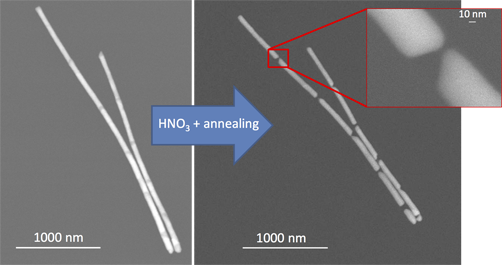
- TEM image of one of the wires corresponding to the same array as the wires in Figure 2d. The figure reveals the polycrystalline structure of our wires. To investigate the symmetry of the created nanostructures, the histogram in Figure 2e shows for about 60 nanowires the ratio between the lengths L1

Preparation of Ni/Cu composite nanowires
Beilstein J. Nanotechnol. 2015, 6, 1268–1271, doi:10.3762/bjnano.6.130
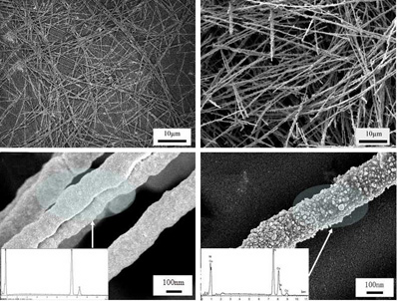
- from the Figure 3b, which further confirmed that the copper grains are not simply attached to the surface of Ni nanowires. Conclusion Polycrystalline Ni/Cu composite nanowires of approximately 200 nm in diameter and 80 µm in length were synthesized for the first time through a new method combining the
- self-assembly of nickel particles under an external magnetic field and the reduction of Cu2+ on the surface of prepared nickel nanowires. It is found that an external magnetic field can make nickel particles self-assemble in one dimension, leading to the formation of polycrystalline nickel nanowires


Nano-contact microscopy of supracrystals
Beilstein J. Nanotechnol. 2015, 6, 1229–1236, doi:10.3762/bjnano.6.126
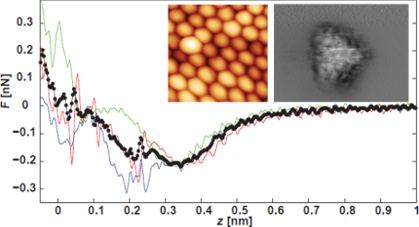
- changes during scanning. As such, we cannot assume a priori that a simple single atom “point-like” contact is responsible for the observed contrast. Finally, the supracrystal is composed of a mixture of single domain and polycrystalline nanocrystals [40], complicating the analysis of the DFM images. We

![[Graphic 1]](/bjnano/content/inline/2190-4286-6-126-i1.png?max-width=637&scale=1.18182) = 20 pA, ...
= 20 pA, ...


Synthesis, characterization and in vitro effects of 7 nm alloyed silver–gold nanoparticles
Beilstein J. Nanotechnol. 2015, 6, 1212–1220, doi:10.3762/bjnano.6.124
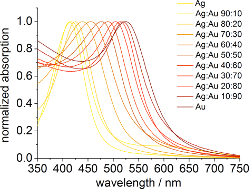
- size and morphology of the nanoparticles were determined by transmission electron microscopy (TEM), differential centrifugal sedimentation (DCS) and dynamic light scattering (DLS). TEM showed that the nanoparticles were nearly monodisperse, quasi-spherical, polycrystalline, and had a uniform diameter


Tunable magnetism on the lateral mesoscale by post-processing of Co/Pt heterostructures
Beilstein J. Nanotechnol. 2015, 6, 1082–1090, doi:10.3762/bjnano.6.109
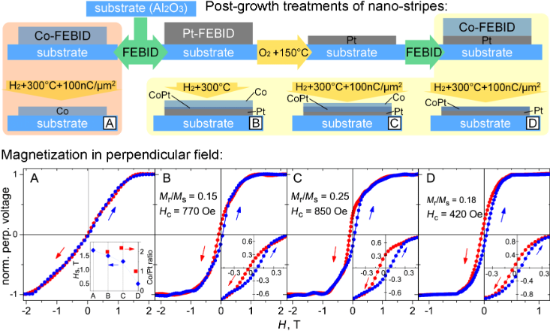
- carbon. Thus, in the course of the reaction, carbon is partially removed from the deposit causing a reduction of the deposit thickness. The magnetic behavior of the thin polycrystalline Co stripe A is dominated not by the magnetocrystalline anisotropy, but rather by the shape anisotropy causing the


Fabrication of high-resolution nanostructures of complex geometry by the single-spot nanolithography method
Beilstein J. Nanotechnol. 2015, 6, 976–986, doi:10.3762/bjnano.6.101
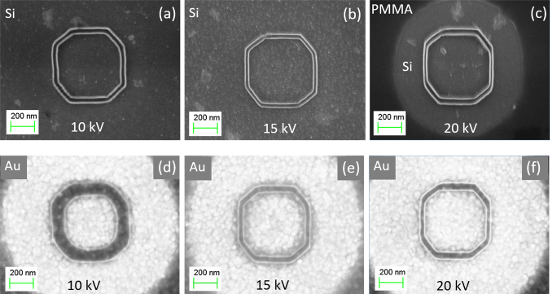
- outer edges vary significantly. In the case of a monocrystalline Si substrate, the ring has a sharp edge with a small resist undercut (Figure 1a). As seen in Figure 1b, exposure of the resist on the polycrystalline Au film leads to a deep undercut and rough edges after development. The physics behind
- substrates, respectively. As seen in Figure 6, the use of a polycrystalline conductive substrate, such as bulk Si coated with a thin Au film, gives the advantage of fabrication of rings with an outer diameter of less than 1 µm due to the saturation effect caused by a partial absorption of electrons in the
- carbonized resist for both substrates (Figure 7d,h). A few examples of nanostructures with a line width ranging from 10–30 nm patterned on Si and Au-coated substrates are shown in Figure 8. Patterns having the same resolution can be produced on monocrystalline Si and polycrystalline Au substrates, but at


Characterization of nanostructured ZnO thin films deposited through vacuum evaporation
Beilstein J. Nanotechnol. 2015, 6, 971–975, doi:10.3762/bjnano.6.100
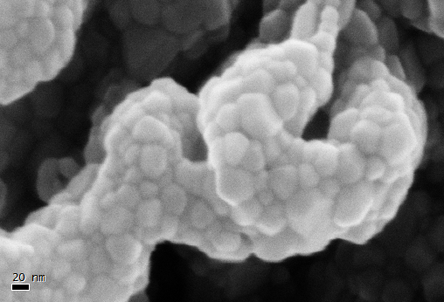
- 45 nm and 123 nm by varying the deposition time (5 to 25 min). The XRD results show that this is a polycrystalline nanostructured thin film, and this is confirmed with the HRSEM images, but it is formed only at 600°C and disappears as the annealing temperature increases. From the photoluminescence we


A simple approach to the synthesis of Cu1.8S dendrites with thiamine hydrochloride as a sulfur source and structure-directing agent
Beilstein J. Nanotechnol. 2015, 6, 881–885, doi:10.3762/bjnano.6.90
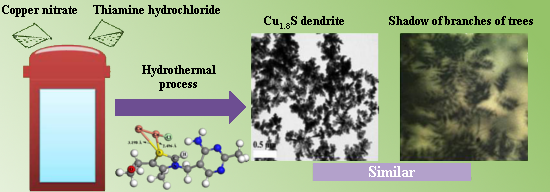
- temperature [4]. Polycrystalline Cu1.8S powder was prepared by mechanical alloying and subsequent spark plasma sintering and it exhibited excellent thermoelectric properties as a p-type sulfide [5]. An aqueous ammonia assisted approach was developed for the synthesis of Cu1.8S with triangular and rod-like


Structure and mechanism of the formation of core–shell nanoparticles obtained through a one-step gas-phase synthesis by electron beam evaporation
Beilstein J. Nanotechnol. 2015, 6, 874–880, doi:10.3762/bjnano.6.89
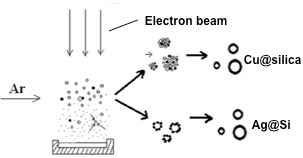
- monocrystals rather than randomly oriented polycrystalline grains or a single monocrystal. The shell thickness was about 11 nm for most particles. As the shell is amorphous, it was not possible to measure its crystallographic structure. There were also a few small particles not connected to a core which had


Microwave assisted synthesis and characterisation of a zinc oxide/tobacco mosaic virus hybrid material. An active hybrid semiconductor in a field-effect transistor device
Beilstein J. Nanotechnol. 2015, 6, 785–791, doi:10.3762/bjnano.6.81
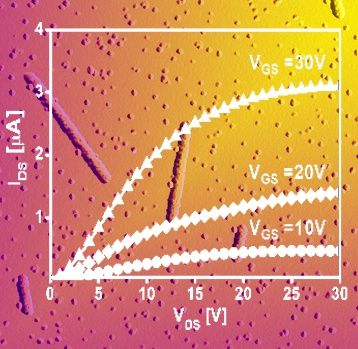
- diffractometry (GI-XRD) analysis was employed to gain a deeper insight into the crystallinity of the as deposited ZnO thin film. The ZnO films display a polycrystalline nature of the ZnO being essential for the formation of an active semiconducting layer. Reflection peaks corresponding to the (100), (002) and


Morphological and structural characterization of single-crystal ZnO nanorod arrays on flexible and non-flexible substrates
Beilstein J. Nanotechnol. 2015, 6, 720–725, doi:10.3762/bjnano.6.73
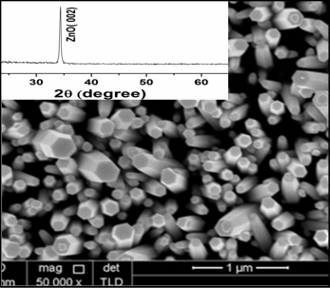
- superior to polycrystalline architectures in a unique way: the decrease of the number of grain boundaries ameliorates charge-carrier transport by permitting a direct and quick charge transport pathway and thus decreases the carrier path length, which in turn decreases recombination losses. To this end
- , various methods have been reported in the literature to produce amorphous and polycrystalline ZnO nanomaterials, especially in the form of nanorods. Also, several deposition methods have been reported to fabricate single-crystal ZnO nanorods, such as RF and DC sputtering [6], chemical vapor deposition


A versatile strategy towards non-covalent functionalization of graphene by surface-confined supramolecular self-assembly of Janus tectons
Beilstein J. Nanotechnol. 2015, 6, 632–639, doi:10.3762/bjnano.6.64
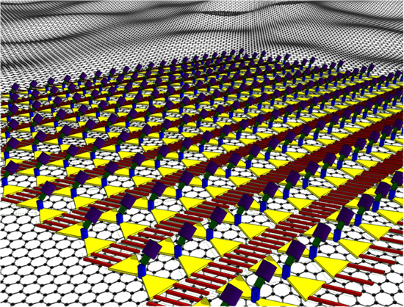
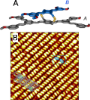
- upper level, terpyridine unit) can partially explain these features. All of the upper units are size-compatible with the huge footprint value. Finally, the self-assembly of the Janus tectons onto a graphene monolayer, grown by chemical vapor deposition onto a polycrystalline foil, was investigated. As
- illustrate the agreement between all Janus tecton lattices. Figure adapted with permission from [25], copyright 2014 Wiley-VCH Verlag GmbH & Co. Self-assembly on graphene. Drift-corrected STM images obtained in air on a monolayer graphene substrate grown by chemical vapor deposition on a polycrystalline




Nanoporous Ge thin film production combining Ge sputtering and dopant implantation
Beilstein J. Nanotechnol. 2015, 6, 336–342, doi:10.3762/bjnano.6.32
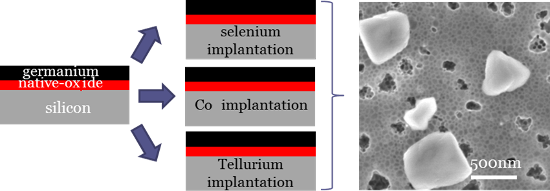
- semiconductor. In the present work, the impact of high dose selenium and tellurium (3.5 × 10¹⁵ atoms/cm2) implantations on the morphology of polycrystalline Ge thin films is presented, as well as the evolution of the film morphology with thermal annealing conditions (temperature and time). Results and
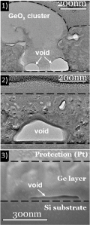
- annealing, leaving deep holes in the Ge film. The image contrast is affected by the variation of both local diffraction conditions and absorption. The moiré pattern visible in various areas of the deposited layer confirms its polycrystalline structure. The pores are difficult to observe in the cross
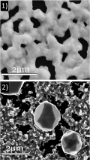
- present facets when in contact with polycrystalline Ge, and present a spherical shape when in contact with amorphous GeOx. They can be related to the initial Ge dewetting mechanism, and thus, are expected to form during annealing. Figure 5.1 presents an SEM plan-view image obtained on a 340 nm thick Ge


Multifunctional layered magnetic composites
Beilstein J. Nanotechnol. 2015, 6, 134–148, doi:10.3762/bjnano.6.13
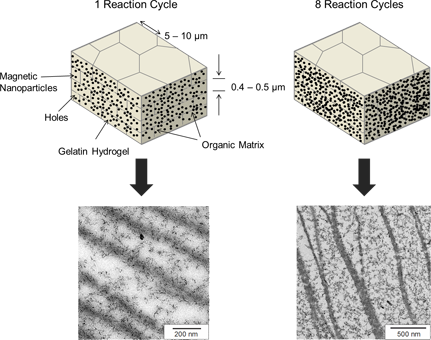
- areas in between the layers show the presence of polycrystalline nanoparticles with no preferred orientation (see Figure S5, Supporting Information File 1). The iron oxides magnetite and maghemite show very similar diffraction patterns and d-spacings, therefore it is not possible to differentiate these





Materials and characterization techniques for high-temperature polymer electrolyte membrane fuel cells
Beilstein J. Nanotechnol. 2015, 6, 68–83, doi:10.3762/bjnano.6.8
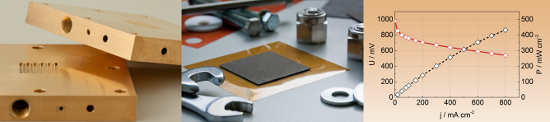
- conducted on model systems that used single crystal electrodes [61] or polycrystalline films at low electrolyte concentrations. They help us understand fundamental aspects of the interactions between phosphoric acid and the catalyst, but these model systems are far away from realistic conditions in HT




Low cost, p-ZnO/n-Si, rectifying, nano heterojunction diode: Fabrication and electrical characterization
Beilstein J. Nanotechnol. 2014, 5, 2216–2221, doi:10.3762/bjnano.5.230
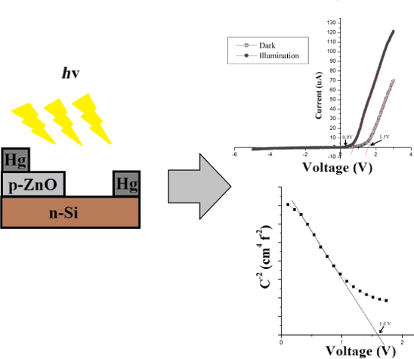
- number 790208. The number of peaks observed in the XRD pattern indicates a polycrystalline nature of the ZnO [3]. The crystallite size was determined to be 26.07 nm using the Scherrer equation. The width of the diffraction peaks and crystallite size together indicate the formation of ZnO nanoparticles


Optical properties and electrical transport of thin films of terbium(III) bis(phthalocyanine) on cobalt
Beilstein J. Nanotechnol. 2014, 5, 2070–2078, doi:10.3762/bjnano.5.215
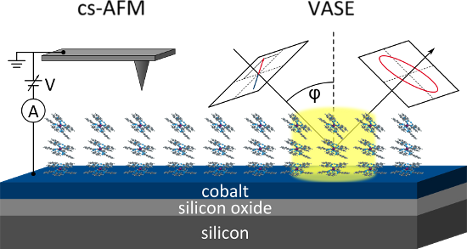
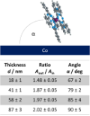
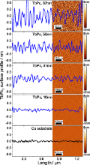
- the Tb couples antiferromagnetically to the Co substrate [11]. In this work we focus on the study of other device-relevant aspects: the influence of the film thickness, morphology, and molecular orientation on the electrical transport in TbPc2 layers on polycrystalline cobalt films. The TbPc2 molecule
- evaporated on polycrystalline gold and cobalt as well as standing molecules in a 200 nm thick film by exploiting synchrotron methods [17][18]. Thus, we expect that the first TbPc2 layers will similarly lie on the polycrystalline Co films due to their low roughness (rms: 0.4 nm, obtained by AFM measurements



Cathode lens spectromicroscopy: methodology and applications
Beilstein J. Nanotechnol. 2014, 5, 1873–1886, doi:10.3762/bjnano.5.198

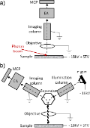
- , investigating the carburisation of the Re(0001) substrate as a function of temperature [45]. The literature shows a plethora of other experiments exploiting the LEED capabilities of LEEM with notable examples of graphene on single and polycrystalline copper [46][47][48], nickel [49] and on non-threefold
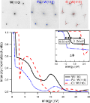


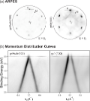
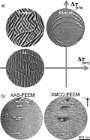

Synthesis of Pt nanoparticles and their burrowing into Si due to synergistic effects of ion beam energy losses
Beilstein J. Nanotechnol. 2014, 5, 1864–1872, doi:10.3762/bjnano.5.197
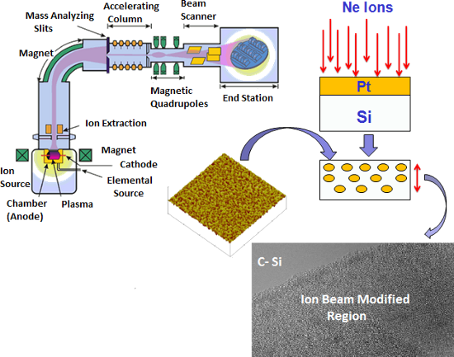
- polycrystalline in nature and (111) and (200) planes are clearly visible in the XRD pattern [47]. The reduced intensities and the broadening of the Pt peaks in the irradiated film confirm the Pt loss on the surface and the formation of NPs. The peak at around 2θ = 56º in the irradiated film is due to the Si



Carbon-based smart nanomaterials in biomedicine and neuroengineering
Beilstein J. Nanotechnol. 2014, 5, 1849–1863, doi:10.3762/bjnano.5.196
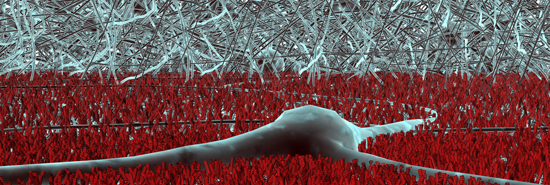
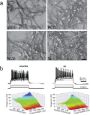
- ). Reproduced and modified from [121] with permission. Copyright 2009 Nature Publishing Group. Scanning electron micrographs show that, when exposed to animal blood serum proteins, polycrystalline (PCD) and nanocrystalline diamond (NCD) substrates performed as good as glass or silicon substrates (a). NDs


On the structure of grain/interphase boundaries and interfaces
Beilstein J. Nanotechnol. 2014, 5, 1603–1615, doi:10.3762/bjnano.5.172
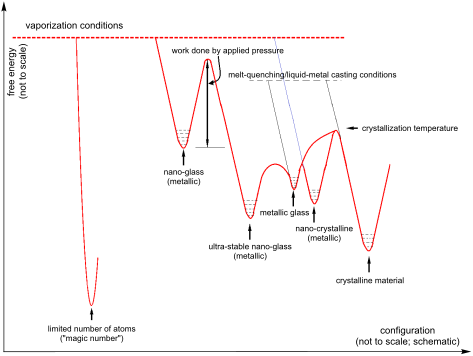
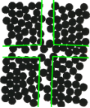
- the experiments are on boundaries of metallic materials. These restrictions require a careful consideration whether an approach based on crystallographic concepts is applicable. In a grain boundary of a polycrystalline material, the structure is periodic because the boundary conditions, i.e., those


Restructuring of an Ir(210) electrode surface by potential cycling
Beilstein J. Nanotechnol. 2014, 5, 1349–1356, doi:10.3762/bjnano.5.148
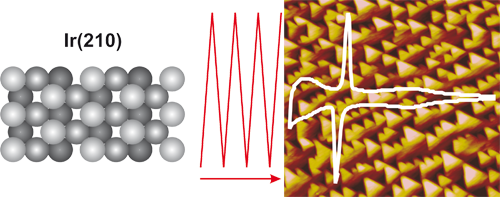
- cycling; scanning tunnelling microscopy; surface restructuring; Introduction The surface structure of metal electrodes is a decisive factor for kinetics of many electrochemical processes and electrocatalytical reactions [1][2][3]. Since the behaviour of polycrystalline material is often quite complex





