


Search results
Search for "STEM-EDX" in Full Text gives 14 result(s) in Beilstein Journal of Nanotechnology.
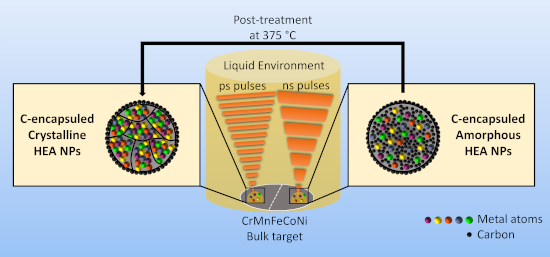
Crystalline and amorphous structure selectivity of ignoble high-entropy alloy nanoparticles during laser ablation in organic liquids is set by pulse duration
Beilstein J. Nanotechnol. 2025, 16, 1141–1159, doi:10.3762/bjnano.16.84
- solution; EELS; electron energy loss spectroscopy; laser processing in liquids; multicomponent alloy; STEM-EDX; selected area electron diffraction; X-ray diffraction; Introduction High-entropy alloys (HEAs), also referred to as compositionally complex solid solutions (CCSS) [1], are of great interest in
- . Nanoparticle characterization is done by high-resolution transmission electron microscopy (HRTEM), energy-dispersive X-ray spectroscopy (STEM-EDX), selected-area electron diffraction (SAED), X-ray diffraction (XRD), and electron energy loss spectroscopy (EELS), complemented by tempering and laser post
- determined by STEM-EDX and were similar for both laser pulse durations, namely Cr22Mn17Fe21Co20Ni20 for colloids made by ps-LAL and Cr21Mn21Fe20Co19Ni19 for colloids fabricated by ns-LAL (global values determined via STEM-EDX displayed in Supporting Information File 1, Table S1 and Table S2). These values




Water-assisted purification during electron beam-induced deposition of platinum and gold
Beilstein J. Nanotechnol. 2024, 15, 884–896, doi:10.3762/bjnano.15.73
- % ratio correction can be found in Supporting Information File 1 (pp S3–S5). TEM A TEM lamella was prepared in a TFS Helios dual-beam system. A PtCx layer was deposited from MeCpPtMe3 as a protection layer. Transmission electron microscopy (TEM) and STEM-EDX analysis were performed in an FEI Titan Cubed
- Cs-corrected TEM at 300 keV. STEM-EDX was performed with a Thermo Fisher Scientific EDX super-X detector in the ChemiSTEM configuration. For EDX mapping, three-pixel averaging was used. Results and Discussion Water-assisted purification of gold deposits In order to validate the compatibility of the
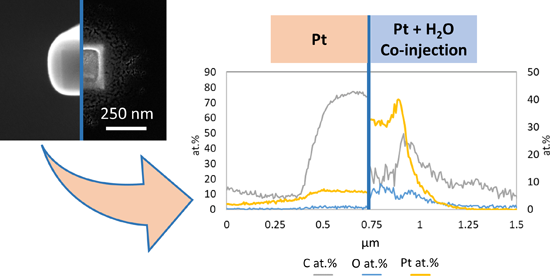
- increase the electron flux while keeping the precursor supply constant, such as increasing the dwell time [56], were not explored further. The composition of the material was confirmed by STEM-EDX of a lamella cut from deposit 1g. The C/Pt atom % ratio in this deposit is consistently in the range of 0.22





Nickel nanoparticles supported on a covalent triazine framework as electrocatalyst for oxygen evolution reaction and oxygen reduction reactions
Beilstein J. Nanotechnol. 2020, 11, 770–781, doi:10.3762/bjnano.11.62
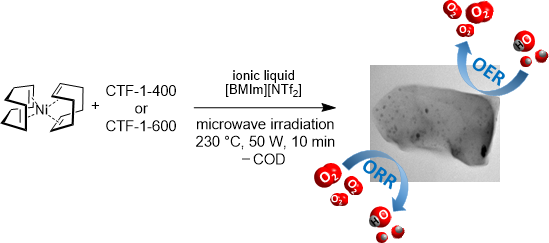
- microscopy (STEM)-EDX elemental mapping. The element compositions of defined areas (orange square) showing both a single Ni particle and its CTF support in the background are displayed in Figure S11, Supporting Information File 1. A possible reason why Ni NPs outside the NP agglomerates are not visible in


Gold-coated plant virus as computed tomography imaging contrast agent
Beilstein J. Nanotechnol. 2019, 10, 1983–1993, doi:10.3762/bjnano.10.195
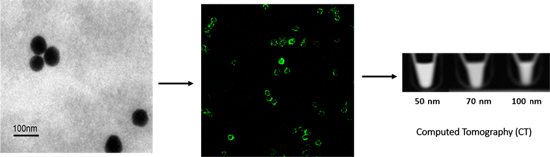
- conclude that the prepared VCAM1-PEG5000Au-CPMV is an acceptable targeting model for further in vivo studies. STEM–EDX elemental maps Low-voltage STEM offers a contrast enhancement over conventional TEM analysis due to lower energy (20–30 kV). The higher electron scattering provides better insight into the
- that gold and sulfur are at the surface as a consequence of the modification of Au-CPMV with the antibody linker. Furthermore, STEM-EDX analysis provided compositional and topographical 3-D elemental distributions (Figure 5). CT Imaging Iodine-containing compounds are routinely used as CT imaging




Synthesis of nickel/gallium nanoalloys using a dual-source approach in 1-alkyl-3-methylimidazole ionic liquids
Beilstein J. Nanotechnol. 2019, 10, 1754–1767, doi:10.3762/bjnano.10.171
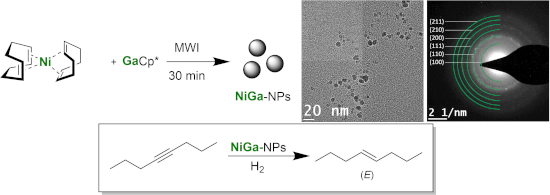
- to NiGa nanoparticles. To complete this investigation, GaCp* was successfully decomposed in [BMIm][NTf2] to Ga2O3-doped Ga particles with a size of 350 ± 100 nm. The formation of core–shell sparticles can be ruled out by HRTEM/STEM-EDX-measurements. Phase-pure NiGa nanoparticles were tested in the
- diffraction rings for space group: Cmce) and Ga2O3 (blue diffraction rings for space group: ). Bottom: Particle size distribution of 350 ± 100 nm (221 particles counted) and EDX spectrum. Top: HAADF-STEM images of Ga(O) nanoparticles from 0.5 wt % dispersion of GaCp* in [BMIm][Ntf2]. HAADF-STEM-EDX-line-scan
- (left, green line) with element counts (Ga (K) orange, O (K) red) depending on position (right). Bottom: HAADF-STEM-EDX-mapping: Ga (K) orange, O (K) red. TEM images: a) Ni nanoparticles from 1 wt % dispersion of Ni(COD)2 and GaCp* in [EMIm][B(CN)4] after 30 min of dispersion and 30 min microwave




Alloyed Pt3M (M = Co, Ni) nanoparticles supported on S- and N-doped carbon nanotubes for the oxygen reduction reaction
Beilstein J. Nanotechnol. 2019, 10, 1251–1269, doi:10.3762/bjnano.10.125
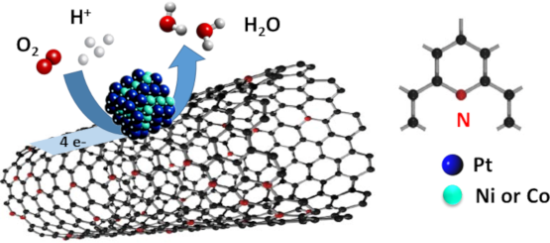
- samples were characterized using transmission electron microscopy (TEM, JEOL, JEM-1011 at 100 kV) and high-resolution TEM (HRTEM, JEM-ARM200F Cold FEG, STEM-EDX CENTURIO-X, GATAN Gif quantum ER), chemical analysis (CHN Perkin Elmer elemental analyzer), Raman spectroscopy at 633 nm (SmartsSPM-1000 AIST-NT







Synthesis of MnO2–CuO–Fe2O3/CNTs catalysts: low-temperature SCR activity and formation mechanism
Beilstein J. Nanotechnol. 2019, 10, 848–855, doi:10.3762/bjnano.10.85
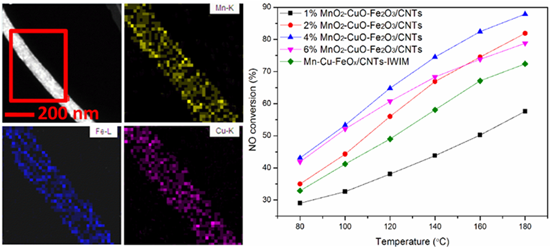
- formation of metal oxide catalysts on CNTs. The STEM-EDX mappings (Figure 5b–g) exhibit a series of columnar element-distribution images, further proving that the metal oxide catalysts have been successfully loaded on the CNTs. Hydrogen temperature-programmed reduction analysis In SCR reaction, the redox




A differential Hall effect measurement method with sub-nanometre resolution for active dopant concentration profiling in ultrathin doped Si1−xGex and Si layers
Beilstein J. Nanotechnol. 2018, 9, 1926–1939, doi:10.3762/bjnano.9.184
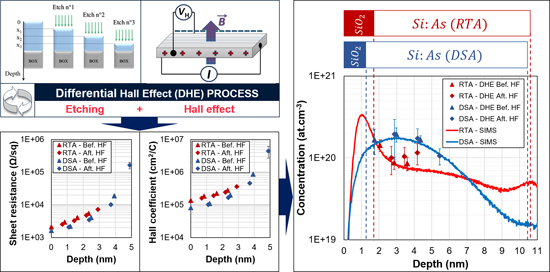
- the top Si/BOX interfaces in correspondence of the maximum slope of the oxygen signal. The position of the SiO2/Si interfaces determined in this way (1.2 nm and 1.6 nm below the surface for the DSA- and RTA-annealed wafers, respectively) are in perfect agreement with those found by STEM-EDX


Direct writing of gold nanostructures with an electron beam: On the way to pure nanostructures by combining optimized deposition with oxygen-plasma treatment
Beilstein J. Nanotechnol. 2017, 8, 2530–2543, doi:10.3762/bjnano.8.253
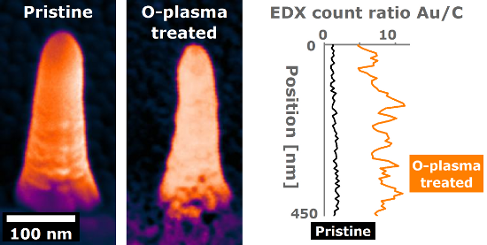
- independent of the direction of EDX scanning and the relative position of the sample to the EDX detector. We note that very similar composition values and gradients were found by STEM EDX performed on long straight (uniform diameter) sections of NPs deposited on silicon nitride TEM grids in our previous study

Self-assembly of silicon nanowires studied by advanced transmission electron microscopy
Beilstein J. Nanotechnol. 2017, 8, 440–445, doi:10.3762/bjnano.8.47
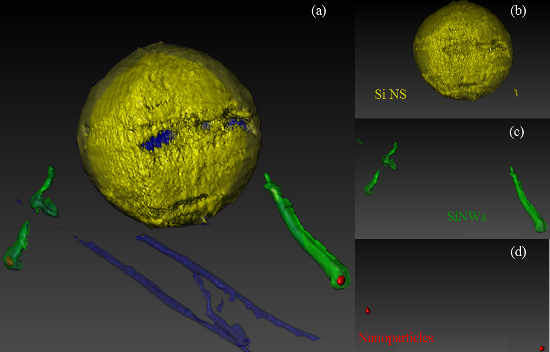
- within the plasma reactor. Both the STEM tomography and STEM-EDX analysis contributed to gain further insight into the self-assembly process. In the long-term, this approach might be used to optimize the synthesis of VLS-grown SiNWs via ICP as a competitive technique to the well-established bottom-up
- ) spectroscopy, it is possible to gather both imaging and analytical information at the same time. In the present work, ET combined with STEM-EDX and energy-filtered TEM (EFTEM) enabled the structural characteristics of SiNWs spontaneously assembled during an inductively coupled plasma (ICP) process to be
- or located at the tip. To unequivocally resolve this point, 3D STEM tomography characterization at the nanoscale was employed. Finally, the metallic composition of such nanoparticles was ascertained via the synergetic use of EFTEM and STEM-EDX. The ensemble of our results suggests that the vapor


Heterometal nanoparticles from Ru-based molecular clusters covalently anchored onto functionalized carbon nanotubes and nanofibers
Beilstein J. Nanotechnol. 2015, 6, 1287–1297, doi:10.3762/bjnano.6.133
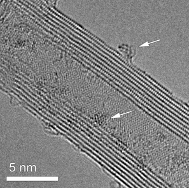
- submitted to activation. In order to confirm the elemental composition of the ultrasmall nanoparticles, STEM-EDX spot analysis is performed over individual nanoparticles of diameter of approximately 2–3 nm, as shown in Figure 6a. The EDX spectrum taken from spot 1 confirms the presence of both Ru and Pt
- and STEM-EDX analysis to prove their bimetal nature on the scale of an individual nanoparticle. This demonstrated that mixed-metal clusters are suitable precursors for ultrasmall heterometal nanoparticles of controlled composition if their reactivity is taken into account. The obtained Ru–Pt
- , (b) an amorphous layer can be seen around the nanoparticles at higher magnification. HAADF-STEM image of Ru–Pt/MWNT derived from Ru5PtC(CO)14(COD) (4). STEM-EDX of individual nanoclusters. (a) HAADF-STEM image of a nanotube with metal clusters. The spectra were collected from point 1 (larger




Tunable magnetism on the lateral mesoscale by post-processing of Co/Pt heterostructures
Beilstein J. Nanotechnol. 2015, 6, 1082–1090, doi:10.3762/bjnano.6.109
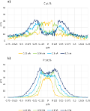
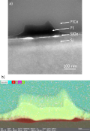
- -EDX along the direction depicted by the arrows in Figure 5b are shown in Figure 6. We now consider the TEM and EDX data in detail. From the cross-sectional STEM-EDX elemental peak intensities in Figure 6a it follows that the top layer of sample C predominantly consists of Co with a very minor content
- dark field mode. In (a), elements with higher atomic numbers Z are brighter in the image. The light regions in the Pt layer in (b) correspond to Co-rich channels embedded in the Pt-rich matrix. The arrows depict the directions along which the STEM-EDX elemental peak intensities in Figure 6 have been
- sample C, once its magneto-resistance measurements had been completed, we inspected sample C by STEM. Figure 5 presents cross-sectional TEM images of sample C in the high angle annular dark field mode (a) and in the annular dark field mode (b). The respective elemental peak intensities obtained by STEM


Hybrid spin-crossover nanostructures
Beilstein J. Nanotechnol. 2014, 5, 2230–2239, doi:10.3762/bjnano.5.232
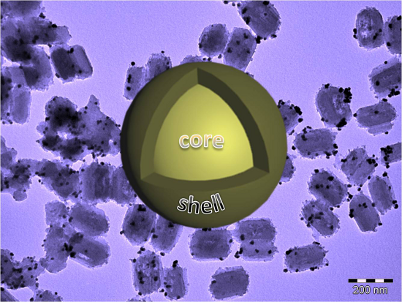
- SCO systems. Synthesis route and schematic representation of the luminescent, SCO, SiO2 nanoparticles. Reproduced with permission from [21], copyright 2011 Wiley-VCH. a) Schematic overview of the formation of the nanocomposite, gold-decorated SCO–SiO2 nanoparticles. b) TEM and c) STEM–EDX images of



Synthesis, characterization, and growth simulations of Cu–Pt bimetallic nanoclusters
Beilstein J. Nanotechnol. 2014, 5, 1371–1379, doi:10.3762/bjnano.5.150
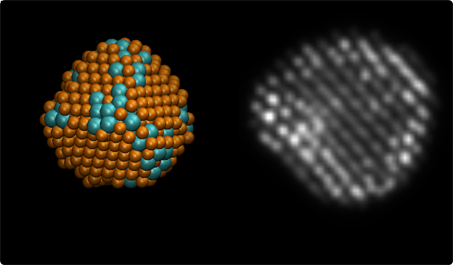
- aberration-corrected STEM, in combination with high resolution spectral and chemical analysis, has allowed us to study the atomic structure of the Cu–Pt bimetallic nanoclusters, and the chemical compositions of the particles were measured by STEM-EDX analysis. HAADF-STEM imaging allowed us to study the





