


Search results
Search for "argon" in Full Text gives 378 result(s) in Beilstein Journal of Nanotechnology. Showing first 200.
Enhanced erosion resistance and radiation stability of WC–WO3 nanocomposite films under 100 keV Kr+ ion irradiation
Beilstein J. Nanotechnol. 2026, 17, 922–934, doi:10.3762/bjnano.17.65
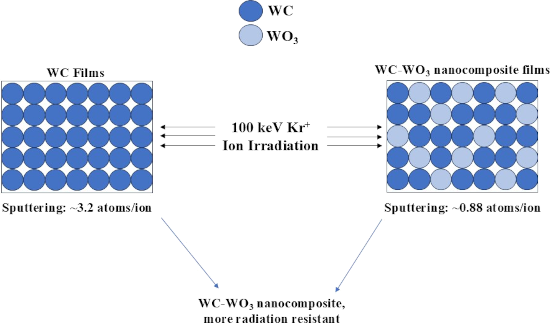
- backed by a rotary pump. The deposition was done under 3 × 10⁻² mbar pressure with a power of 150 W RF for 30 min in the presence of argon gas having flow rate of 30 sccm. The WC–WO3 nanocomposite films were synthesized using sputter deposition of WC films at room temperature (RT) and its subsequent



Tuning the electronic properties of defect-rich MoS2
Beilstein J. Nanotechnol. 2026, 17, 796–805, doi:10.3762/bjnano.17.56
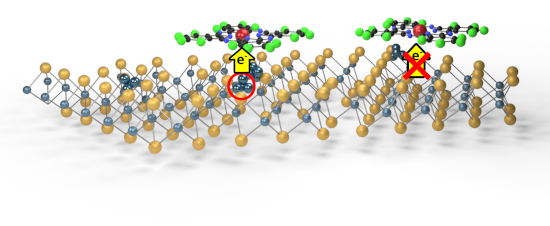
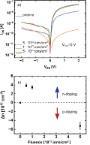
- perfluorinated cobalt phthalocyanine (CoPcF16). Defects were introduced in synthetic MoS2 bulk crystals by gentle argon and neon sputtering. Although the band structure is still visible after sputtering, especially SXPS reveals structural and electronic disturbances of the topmost MoS2 layer. We show how the
- in multilayered MoS2 by gentle ion sputtering with argon or neon and analyze the electronic structure after each treatment with PES, XAS, and ARPES. Subsequently, cobalt(II) hexadecafluorophthalocyanine (CoPcF16) is deposited, and the interfacial electronic structure of the defect-rich MoS2/TMPc


Substrate-dependent pore formation in molybdenum disulfide monolayers under ion irradiation
Beilstein J. Nanotechnol. 2026, 17, 769–780, doi:10.3762/bjnano.17.54
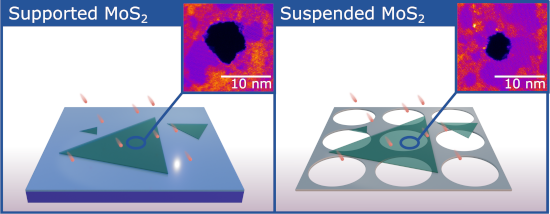
- . In the first zone ≈60 mg of sulfur is placed. An argon flow of 500 sccm is used to purge the quartz tube containing the reagents and as a means to transport the precursors. During the 30 min process, the first zone reaches 150 °C, while the second zone reaches 750 °C. After the process has finished


Tailoring Ag–Pt nanoalloys through solid-state dewetting: structural and optical insights
Beilstein J. Nanotechnol. 2026, 17, 748–759, doi:10.3762/bjnano.17.52

- under an argon atmosphere. The process induced the transformation of continuous bilayers into isolated nanoislands through solid-state dewetting. Scanning electron microscopy and transmission electron microscopy analyses revealed the formation of well-defined, nearly spherical nanoislands with a
- were employed for optical investigations. Both types of substrates were cleaned with acetylacetone, subsequently rinsed with ethanol, and dried. Thin Pt and Ag thin films were sputtered using a table-top DC magnetron sputtering coater (EM SCD 500, Leica) in a pure Ar plasma environment (Argon, Air
- content [61][62][72]. In addition, the suppression and a near UV shift of the resonance in the case of Pt further justified this approach [62][63][64]. The deposited layers were subjected to thermal annealing in a hot furnace under an argon atmosphere (Argon, Air Products, 99.99%) for 15 min at a




Defects and defect-mediated engineering of two-dimensional materials: challenges and open questions
Beilstein J. Nanotechnol. 2026, 17, 454–488, doi:10.3762/bjnano.17.31
- residues and other contaminants may alter the XPS spectra, leading to misinterpretation of defect characteristics. To mitigate this, careful sample preparation in controlled environments and in situ cleaning methods, such as argon ion sputtering, are essential. However, these approaches must be applied





Interconnection morphology effects on the radio frequency response of carbon nanotube sponges
Beilstein J. Nanotechnol. 2026, 17, 343–351, doi:10.3762/bjnano.17.23
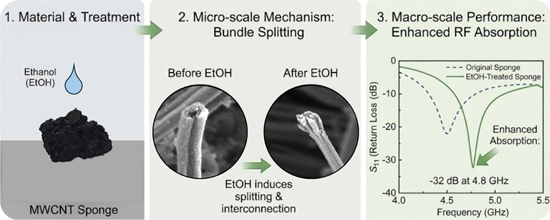
- . Before the growth process, the pressure was brought to 1 atm by introducing a mixture of argon and hydrogen (30 and 20 sccm, respectively) through a stainless steel pipe. A solution containing ferrocene (2.3 wt %) dispersed in 10 mL of ethanol and stirred for 4 h was injected at a constant rate (5 mL·h−1
- pipe during the growth process. (3) The pressure of the gas mixture (argon, acetylene, and hydrogen at 200, 80, and 100 sccm, respectively) was higher than that adopted for the growth of the CNT film. (4) The process duration was 2 h. After cooling down the system, the reaction products were directly




Capabilities of the 3D-MLSI software tool in superconducting neuron design
Beilstein J. Nanotechnol. 2026, 17, 122–138, doi:10.3762/bjnano.17.8

- thicknesses of the superconducting layers were 200, 250, and 350 nm for M1, M2, and M3, respectively. The SiO2 insulating layers had thicknesses of 200 nm (I1) and 300 nm (I2). Deposition of metallic layers was performed via magnetron sputtering in argon atmosphere, while insulating layers were thermally



Reduced graphene oxide paper electrode for lithium-ion cells – towards optimized thermal reduction
Beilstein J. Nanotechnol. 2026, 17, 24–37, doi:10.3762/bjnano.17.3
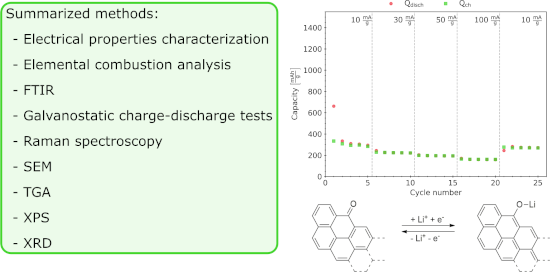
- measurements. Galvanostatic charge–discharge tests The prototype cells (Swagelok-type with stainless steel current collectors) for the galvanostatic charge–discharge tests were prepared in an argon-filled glovebox (MBraun). The materials were tested in a two-electrode configuration in a full-cell setup for



Improving magnetic properties of Mn- and Zn-doped core–shell iron oxide nanoparticles by tuning their size
Beilstein J. Nanotechnol. 2025, 16, 2285–2295, doi:10.3762/bjnano.16.157
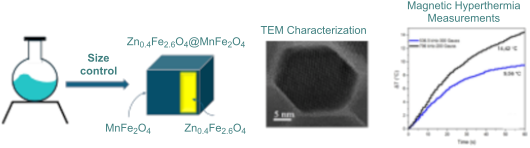
- NPs (see Table 1) and 52.61 mL of benzyl ether (276.77 mol) [14][15]. The mixture was heated under an argon atmosphere (flow rate of ≈100 mL·min−1) at a rate of 5 °C·min−1 to 290 °C and maintained at this temperature for 30 min. After cooling to room temperature under ambient conditions, ethanol (100
- was heated in an argon atmosphere (flow rate of ca. 100 mL·min−1) at a rate of 5 °C·min−1 to 290 °C and maintained at this temperature for 30 min. After cooling to room temperature under ambient conditions, ethanol (100 mL) was added to precipitate the nanoparticles. The resulting black solid was



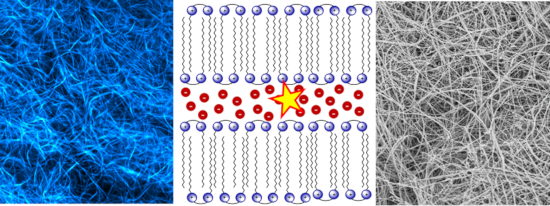
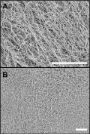
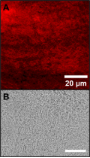
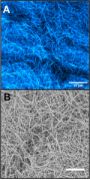
Visualizing nanostructures in supramolecular hydrogels: a correlative study using confocal and cryogenic scanning electron microscopy
Beilstein J. Nanotechnol. 2025, 16, 2274–2284, doi:10.3762/bjnano.16.156
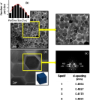
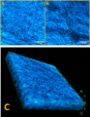
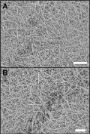
- PP3010. The gel sample underwent 5 min of etching via sublimation at −100 °C followed by sputtering in an argon environment using platinum for 60 s at a current of 10 mA. Once coated, the shuttle was transferred to the cryo-stage in the SEM chamber and maintained at −170 °C. Finally, the microstructure



Optical bio/chemical sensors for vitamin B12 analysis in food and pharmaceuticals: state of the art, challenges, and future outlooks
Beilstein J. Nanotechnol. 2025, 16, 2207–2244, doi:10.3762/bjnano.16.153



Stereodiscrimination of guests in chiral organosilica aerogels studied by ESR spectroscopy
Beilstein J. Nanotechnol. 2025, 16, 2034–2054, doi:10.3762/bjnano.16.140
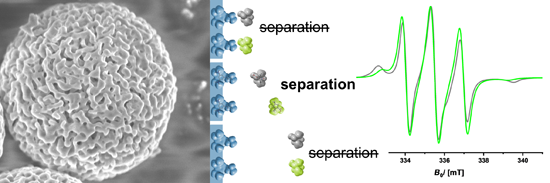
- atmosphere. The solvents were dried according to the standard literature and stored under argon. All starting materials used for the synthesis were purchased from commercial sources (Merck or TCI). SIL: In a snap lid vial, dissolve 2.0 mL tetramethoxysilane (2.04 g, 13.4 mmol, 1 equiv) in 1.5 mL methanol
- Bruker Magnetech MS 5000 equipped with a variable temperature unit (TC-H03 Temperature Controller, magnetech GmbH). Prior to use, all materials and solutions were degassed under argon by at least 10 pump–freeze–thaw cycles. For each measurement, 50




Evaluating metal-organic precursors for focused ion beam-induced deposition through solid-layer decomposition analysis
Beilstein J. Nanotechnol. 2025, 16, 1942–1951, doi:10.3762/bjnano.16.135

- . Gas-phase interactions between [Fe(CO)5] molecules and ions of helium, neon, argon, and krypton were carried out. However, the authors noted that these results may not accurately reflect the behavior of the precursor on the surface during actual FIBID processing since the conditions under which the


Automated collection and categorisation of STM images and STS spectra with and without machine learning
Beilstein J. Nanotechnol. 2025, 16, 1367–1379, doi:10.3762/bjnano.16.99
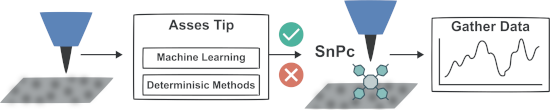
- was operated using an RC5 Nanonis controller, with all experiments carried out in UHV (base pressure ≤5 × 10⁻¹¹ mbar) cooled to 5 K. Gold and silver crystals (spl.eu) were prepared via repeated sputter–anneal cycles, sputtering under an argon pressure of ≈5 × 10⁻⁵ mbar, with a beam energy of 1.5 kV




Deep-learning recognition and tracking of individual nanotubes in low-contrast microscopy videos
Beilstein J. Nanotechnol. 2025, 16, 1316–1324, doi:10.3762/bjnano.16.96
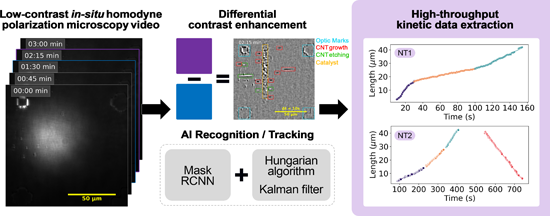
- , horizontally aligned carbon nanotubes (HA-CNTs) were synthesized inside a miniature chemical vapor deposition (CVD) cell with an optical window (Linkam TS1500). ST-cut quartz and iron nanoparticles served as substrate and catalyst, respectively. Ethanol and argon were, respectively, used as carbon precursor


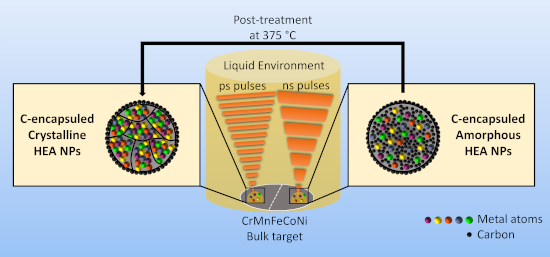
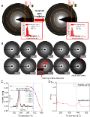
Crystalline and amorphous structure selectivity of ignoble high-entropy alloy nanoparticles during laser ablation in organic liquids is set by pulse duration
Beilstein J. Nanotechnol. 2025, 16, 1141–1159, doi:10.3762/bjnano.16.84




Ar+ implantation-induced tailoring of RF-sputtered ZnO films: structural, morphological, and optical properties
Beilstein J. Nanotechnol. 2025, 16, 872–886, doi:10.3762/bjnano.16.66
- 2.5 × 10¹⁵ ions·cm−2. Gupta et al. [14] have investigated the activation of the A1 (LO) mode and the production of a broad band at the lower Raman shift side in ZnO films implanted with 300 keV argon and 1.2 MeV xenon ions with varying fluence from 1 × 10¹⁴ to 3 × 10¹⁵ ions·cm−2. Gautam et al. [15
- + ions for implantation, which produce less lattice distortions than nitrogen ions. This is because argon ions are heavier and larger than nitrogen ions. Also, in the above-quoted studies the authors did not study the effect of the evolution of longitudinal optical A1 (LO) and symmetry-disallowed Raman
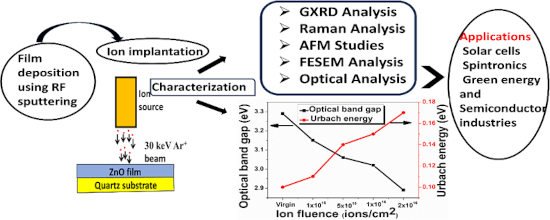
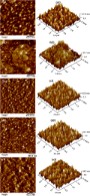
- correlation with morphological and optical properties using low-energy Ar+ beams in ZnO films. Here, argon ions were chosen because of the inert nature, which means that any changes in properties of the implanted ZnO films are attributed solely to implantation-induced effects. In the present study, ZnO films






Synchrotron X-ray photoelectron spectroscopy study of sodium adsorption on vertically arranged MoS2 layers coated with pyrolytic carbon
Beilstein J. Nanotechnol. 2025, 16, 847–859, doi:10.3762/bjnano.16.64
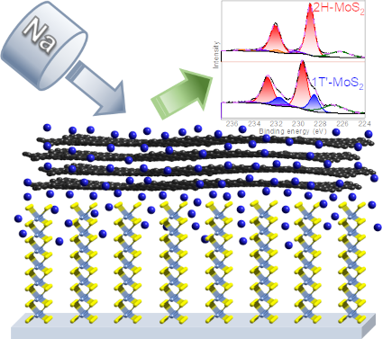
- , molybdenum was sputtered from a Mo target with a purity of 99.9% for 10 s at a magnetron power of 100 W and an argon partial pressure of 5.4 × 10⁻¹ Pa. The output pressure in the chamber was controlled by the argon flow. The MoS2 films were synthesized by sulfurization of molybdenum layers deposited on SiO2
- /Si substrates in a two-zone quartz reactor. The substrate was placed in the high-temperature zone and annealed there at 423 K for 30 min in an argon flow of 250 sccm. Then, this zone was heated to 873 K. 200 mg of sulfur powder (99.9% purity) were placed in a quartz crucible in the low-temperature
- reactor zone heated to 473 K. A flow of 24 sccm argon was passed through both reactor zones for 30 min at atmospheric pressure. After this time, sulfurization of the Mo layer was complete. Both zones were cooled to room temperature in a flow of 250 sccm argon. To remove polysulfide impurities and form a


Synthesis and magnetic transitions of rare-earth-free Fe–Mn–Ni–Si-based compositionally complex alloys at bulk and nanoscale
Beilstein J. Nanotechnol. 2025, 16, 823–836, doi:10.3762/bjnano.16.62
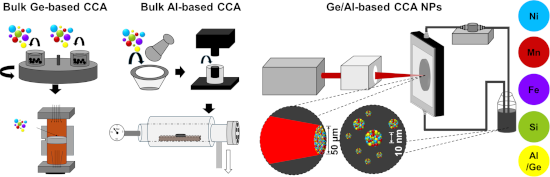
- process. Initially, elemental Mn (99.2%, 3 µm), Fe (99.96%, 10–20 µm), Ni (99.5%, 45–60 µm), Si (99.999%, 45–60 µm), and Ge (99.99%, <250 µm) powders were mixed in the desired stoichiometric proportions and underwent HEBM in a planetary ball mill for 90 min under argon atmosphere and a ball-to-powder


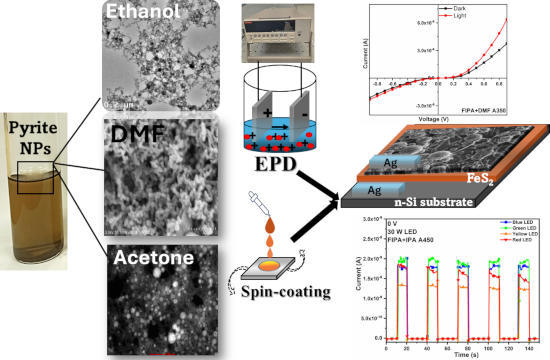
Morphology and properties of pyrite nanoparticles obtained by pulsed laser ablation in liquid and thin films for photodetection
Beilstein J. Nanotechnol. 2025, 16, 785–805, doi:10.3762/bjnano.16.60
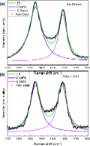
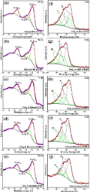
- argon ions is provided in Figure 7. The Fe 2p spectra of pyrite NPs in all solvents (Figure 7a–e) show two major peaks of Fe 2p3/2 and Fe 2p1/2 at 709 and 722 eV, respectively, which denotes the Fe2+ chemical state [44] with a separation ΔE of 13.1 eV. The peak fitting of the Fe 2p3/2 peak reveals a






The impact of tris(pentafluorophenyl)borane hole transport layer doping on interfacial charge extraction and recombination
Beilstein J. Nanotechnol. 2025, 16, 678–689, doi:10.3762/bjnano.16.52
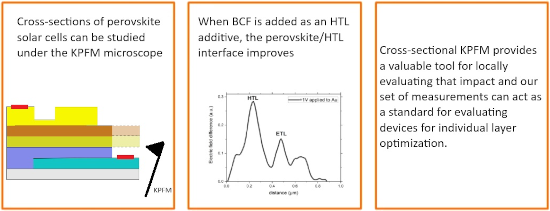
- -sections by means of argon ion polishing. To get results that closely simulate the operation of working devices, we used a comprehensive static KPFM measurement protocol (See Supporting Information File 1, Section 2) and measured potential profiles across all layers while applying a voltage or under
- , which diminish the HTL/perovskite junction quality [40][41]. To investigate the microscopic origins of these effects at the interfaces, we performed cross-sectional KPFM. A well-performing solar cell was selected from each batch and after cleaving, it was subjected to argon ion milling in order to get a
- fluorine-doped tin oxide (FTO) substrates on thin (1.1 mm) glass from Ossila (11–13 Ω/cm2) with Zn powder and a 2 M HCl solution. Then, we brushed it thoroughly using a liquid alkaline concentrate (Hellmanex), followed by a 30 min argon plasma cleaning (200-G TePla Plasma System, Technics Plasma GmbH, at


Aprepitant-loaded solid lipid nanoparticles: a novel approach to enhance oral bioavailability
Beilstein J. Nanotechnol. 2025, 16, 652–663, doi:10.3762/bjnano.16.50
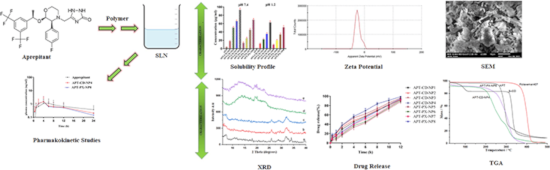
- . Scanning electron microscopy (SEM) photographs of APT-NPs were obtained on a JSM-6380A, Joel, Japan operating at a voltage of 10.0 kV. The specimens were mounted on a metallic stub with double-sided adhesive tape and gold-coated in an argon atmosphere prior to observation [28]. Drug excipient interaction



N2+-implantation-induced tailoring of structural, morphological, optical, and electrical characteristics of sputtered molybdenum thin films
Beilstein J. Nanotechnol. 2025, 16, 495–509, doi:10.3762/bjnano.16.38
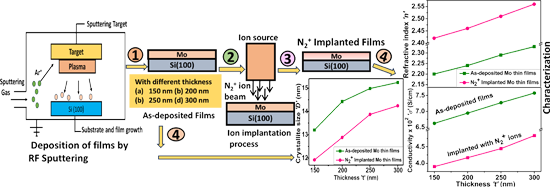
- remarkable thermal stability, high melting point, and chemical inertness. In the present study, Mo thin films of different thicknesses (150, 200, 250, and 300 nm) have been deposited on Si(100) substrates via radio frequency sputtering in an argon atmosphere at room temperature. Some of these films have been
- ] investigated the effects of argon ion bombardment on the characteristics of Mo thin films. Films with reduced porosity and larger grains demonstrated increased reflectance and decreased resistivity, consistent with electron mean free path analysis results. Navin et al. [15] investigated self-organized pattern
- generation in Mo thin films with a low-energy argon ion beam (1 keV) across different ion fluences (1016–1018 ions·cm−2). Thornton et al. [16] examined a transition from tensile to compressive stress in argon-ion-implanted Mo thin films as the sputtering gas pressure decreased. Sun et al. [17] also analyzed


ReactorAFM/STM – dynamic reactions on surfaces at elevated temperature and atmospheric pressure
Beilstein J. Nanotechnol. 2025, 16, 397–406, doi:10.3762/bjnano.16.30
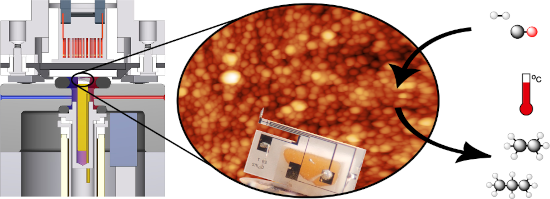
- annealing at 1000 K for 5 min. The oxide is deposited ex situ (in a nearby setup, transfer is done in air) by physical vapor deposition using an aluminum oxide sputter target and NiAl(110) as substrate. The deposition was performed at a 10−3 mbar argon pressure for a duration of 40 min. Once placed back in


Enhancing mechanical properties of chitosan/PVA electrospun nanofibers: a comprehensive review
Beilstein J. Nanotechnol. 2025, 16, 286–307, doi:10.3762/bjnano.16.22

- chitosan/PVA nanofibers using dielectric barrier discharge (DBD) plasma and reported enhanced wettability, mechanical properties, and biocompatibility of the fibers. The argon and oxygen plasma treatments led to significant cross-linking of the fibers, which improved tensile strength and Young’s modulus





