Search results
Search for "bandgap" in Full Text gives 289 result(s) in Beilstein Journal of Nanotechnology. Showing first 200.
Nanoglasses: a trail towards uncharted regions of vitreous materials and their properties?
Beilstein J. Nanotechnol. 2026, 17, 1047–1062, doi:10.3762/bjnano.17.72



Synthesis and characterization of RF-sputtered ZnTe/Cu2−xTe thin films for solar cell applications
Beilstein J. Nanotechnol. 2026, 17, 1016–1027, doi:10.3762/bjnano.17.69
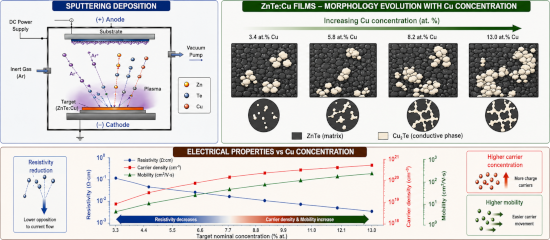
- : back contact materials; Cu2−xTe phases; phase segregation; RF magnetron sputtering; ZnTe thin films; Introduction CdTe solar cells remain one of the leading thin-film photovoltaic technologies due to the near-optimal direct bandgap of CdTe (≈1.45 eV) and its high absorption coefficient (>104 cm−1
- investigated as alternative back contact materials. Although ZnTe exhibits intrinsic p-type conductivity and a wide bandgap (2.24 eV), its relatively low conductivity and the diffusion of Cu during growth remain limiting factors for device performance [6][7][8]. ZnTe has attracted considerable attention not
- in materials such as CdTe, CdSe, and ZnTe, without evidence of excessive Cu2+ formation, thereby favoring improved electrical stability. Previous studies on Cu-doped ZnTe thin films have mainly focused on the influence of Cu incorporation on crystallinity, optical bandgap, and electrical transport



Materials challenges in solid-state sensors for continuous monitoring of ions in water
Beilstein J. Nanotechnol. 2026, 17, 935–973, doi:10.3762/bjnano.17.66
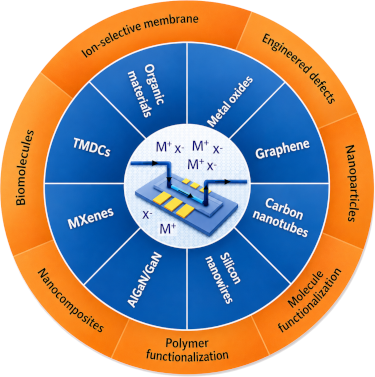
- mechanical integrity during repeated cycling to deliver long-term performance [107]. Inorganic materials Semiconducting metal oxides. Metal-oxide thin films (such as ZnO, SnO2, IGZO, In2O3) are classified as classic inorganic semiconductors with a wide bandgap (3–4 eV). The surface of a semiconducting metal
- atoms tend to rearrange, react, or adsorb species to reduce surface free energy, leading to non-ideal, defect-rich surfaces. These defects often cause the film to be n-type doped and form surface states inside the bandgap, affecting charge trapping, catalytic activity, and sensing behavior. Due to their
- reduces the ZnO bandgap (from ≈3.7 eV to ≈2.2 eV), thereby enhancing charge transfer and overall electrochemical activity. The homogeneous dispersion of nanoscale ZnO on graphene provides a large active surface area for Pb2+ adsorption and reduction, resulting in improved sensitivity. Cyclic voltammetry



Light-driven ammonia electrooxidation via carbon nitride–ruthenium molecular interfaces
Beilstein J. Nanotechnol. 2026, 17, 854–862, doi:10.3762/bjnano.17.61
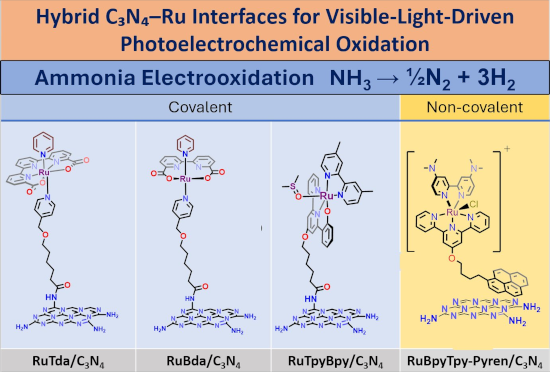
- material is a two-dimensional polymer composed of heptazine (tri-s-triazine) or s-triazine building block units linked by tertiary amines into extended graphitic sheets, with a bandgap of approximately 2.7 eV with optical absorption onset at 460 nm (Figure 2b), firmly within the visible range of the solar
- is not a single material but a rich structural landscape (Figure 2c). Polymeric C3N4 (Table 1), the most widely studied form, is semicrystalline, with moderate charge carrier mobility and a bandgap tunable between 2.6 and 2.8 eV, depending on synthesis conditions [12][18]. Poly(heptazine imide) (PHI
- photoelectrocatalytic performance [19]. Amorphous sulfur-doped C3N4 (S-C3N4, Table 1), prepared from sulfur-containing precursors such as purpald, achieves a narrower bandgap of 1.8–2.0 eV and a higher surface area, accessing a larger fraction of the solar spectrum at the cost of somewhat reduced charge transport


Glycerol photoelectrochemical oxidation reaction at carbon nitrides/BiVO4 materials
Beilstein J. Nanotechnol. 2026, 17, 806–817, doi:10.3762/bjnano.17.57
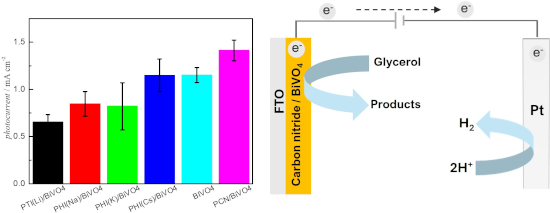
- acetylacetonate at 500 °C for 2 h. The CN/BiVO4 heterojunctions presented bandgap energy values, Eg, similar to pure BiVO4. X-ray diffraction analysis also revealed that the BiVO4 phase was not altered by the presence of the CN. However, scanning electron microscopy analysis coupled to energy-dispersive X-ray
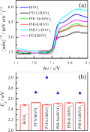
- images indicate that the analysis is near the detection limit of the instrument; therefore, the data should be qualitatively interpreted. Figure 5 shows the Tauc plots derived from the diffuse reflectance spectra collected for the CN/BiVO4 materials, assuming an indirect allowed transition. The bandgap
- films deposited onto FTO at 500 °C without the Bi overlayer leads to the complete thermal degradation of the CN layer. Furthermore, we also confirmed that the PTI-Li powder retains its original bandgap energy (Eg = 3.0 eV) after the thermal treatment at 500 °C for 2 h (Supporting Information File 1




Environmental applications of silver nanoparticles: state-of-the-art review and emerging trends
Beilstein J. Nanotechnol. 2026, 17, 697–736, doi:10.3762/bjnano.17.49
- mechanism includes strong light absorption, a lower bandgap energy, and the generation of UV-induced electron–hole pairs [118]. The role of persulfate-conjugated Ag+ in removing the carboxylic PFAS perfluorooctanoic acid was demonstrated through Fenton oxidation at 20 °C, where fluorine was released along


Cellulose as a photocatalyst support material: extraction, structural features, and environmental applications
Beilstein J. Nanotechnol. 2026, 17, 635–652, doi:10.3762/bjnano.17.44
- commonly applied in both photocatalysis and energy storage due to its affordability, non-toxicity, strong activity, and environmentally friendly nature [97]. Despite these advantages, TiO2 faces notable limitations as its relatively wide bandgap of about 3.2 eV and rapid electron–hole recombination rate
- TiO2/CdS heterojunctions with a porous structure, high crystallinity, and a reduced bandgap, features that contributed to enhanced catalytic degradation efficiency. When tested with methyl orange, the TiO2/CdS composite demonstrated strong stability, excellent photocatalytic activity, and reliable


Two-step laser synthesis of Ag@TiO2 nanomaterials for the photocatalytic degradation of rhodamine B
Beilstein J. Nanotechnol. 2026, 17, 622–634, doi:10.3762/bjnano.17.43
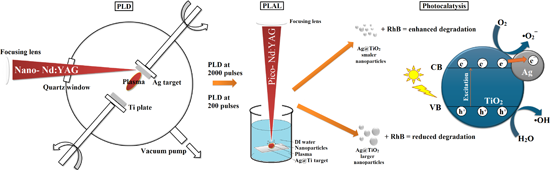
- TiO2 suffers from intrinsic drawbacks. Its bandgap is large (≈3.2 eV [9]); hence, it absorbs only UV light (a small fraction of sunlight, only 3–4%) and shows very limited visible-light response. Also, photogenerated electrons and holes recombine rapidly [7]. To address this, researchers have developed
- resonance effects and facilitates the formation of Schottky barriers at the metal–semiconductor interface, both of which contribute to an extended light absorption range and enhanced charge carrier separation. The improved activity is primarily attributed to the narrowing of TiO2’s effective bandgap and the
- a state of initial instability. Influence of Ag on the bandgap energy of TiO2 UV–vis spectroscopy was employed to investigate the effect of Ag doping on TiO2 and to determine the bandgaps of both TiO2 and Ag@TiO2 samples. Figure 7a displays the absorption spectra of TiO2 and Ag-modified TiO2 samples


Recent progress in enhancing built-in electric fields of perovskite solar cells via junction engineering
Beilstein J. Nanotechnol. 2026, 17, 602–621, doi:10.3762/bjnano.17.42
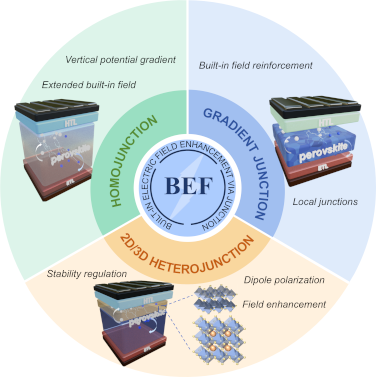
- controlled doping and orientation modulation, thereby suppressing nonradiative recombination and improving carrier extraction. Gradient junctions introduce continuous compositional or bandgap tilts across the film thickness, enabling depth-extended electric fields and improved spatial continuity of charge
- advantages include a continuous potential distribution, fewer additional interfaces, and good compatibility with existing fabrication processes. In contrast, gradient junctions employ gradual variations in composition, ion concentration, dimensionality, or bandgap along the film thickness to create a
- -dimensional phases along the film’s thickness. The SnSe layer interacts with the surface low-dimensional phase, suppressing its disordered aggregation and promoting the gradual extension of the high-dimensional phase toward the bottom of the film, thereby creating a smooth transition from a high-bandgap, low



Synthesis of Cu–Mo/TiO2 and Co–Mo/TiO2 photocatalysts for the efficient degradation of organic pollutants in water
Beilstein J. Nanotechnol. 2026, 17, 559–570, doi:10.3762/bjnano.17.37
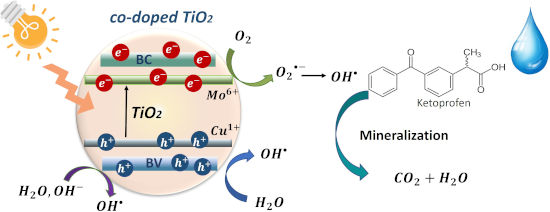
- most organic compounds [2]. Among AOPs, TiO2 photocatalysis is one of the most viable environmental technologies due to its low cost and the stability of TiO2. Limitations of TiO2 in photocatalysis applications come from rapid charge recombination and the wide bandgap [3]. Various strategies have been
- developed to overcome these limitations, including doping, noble-metal deposition, heterogeneous structures, and surface sensitization. Doping is a widely employed method to generate impurity states in the forbidden region or to reduce the effective bandgap. Doping TiO2 with transition metal ions can adjust
- the optical bandgap, broaden the light absorption range, and enhance the quantum efficiency [4]. However, the partially occupied impurity states generated can act as recombination centers for photoexcited carriers, leading to band-to-band recombination [3]. To prevent charge recombination effects, the



Probing internal continua and atomic ultrafast charge transfer within size-controlled nanoparticles by post-collision interaction in core-hole clock spectroscopy
Beilstein J. Nanotechnol. 2026, 17, 505–514, doi:10.3762/bjnano.17.33
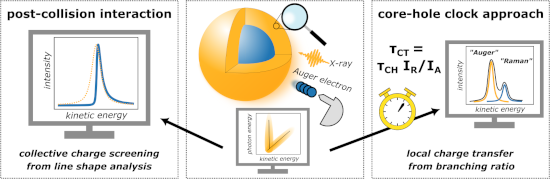
- transfer rates. An energy level diagram of CdSe/ZnS QDs is schematically shown in Figure 2c. Owing to its smaller bandgap, the CdSe core is expected to have a higher density of states at a given energy compared to the wider-bandgap ZnS shell. From this perspective, charge transfer toward the core is



Defects and defect-mediated engineering of two-dimensional materials: challenges and open questions
Beilstein J. Nanotechnol. 2026, 17, 454–488, doi:10.3762/bjnano.17.31
- (ODMR) has overcome this limitation by exploiting spin-selective non-radiative pathways, enabling optical initialization and single-spin readout in wide-bandgap materials [149]. Yet, ODMR is not universal: It requires both optically bright transitions and spin-dependent relaxation channels, restricting





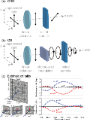
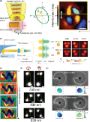
Chiral plasmonic nanostructures fabricated with circularly polarized light
Beilstein J. Nanotechnol. 2025, 16, 2245–2264, doi:10.3762/bjnano.16.154
- vicinity of the Au nanostructures [56]. However, the drawback of the Au/PbO2 heterostructures is evident: PbO2 is an indirect-bandgap semiconductor and, therefore, does not significantly contribute to the total extinction cross section of the nanostructure compared to Ag and Au. It would be more beneficial





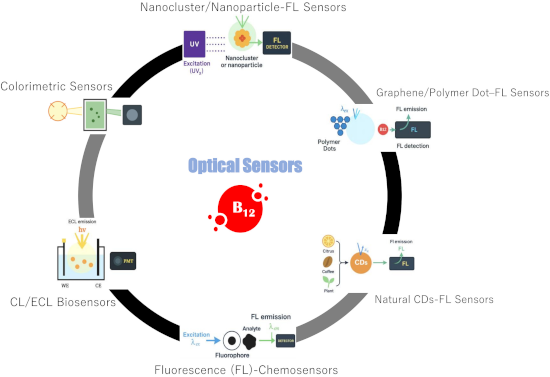
Optical bio/chemical sensors for vitamin B12 analysis in food and pharmaceuticals: state of the art, challenges, and future outlooks
Beilstein J. Nanotechnol. 2025, 16, 2207–2244, doi:10.3762/bjnano.16.153


Electron transport through nanoscale multilayer graphene and hexagonal boron nitride junctions
Beilstein J. Nanotechnol. 2025, 16, 2132–2143, doi:10.3762/bjnano.16.147
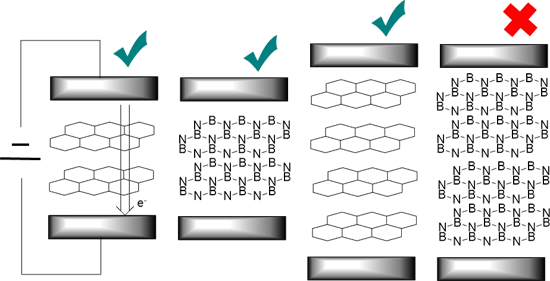
- and Stone–Wales defects. Nitrogen doping transforms graphene from a zero-bandgap semiconductor to a metal, while Stone–Wales defects open the bandgap. For h-BN, we considered Stone–Wales defects. A detailed comparison of electron transport through five materials, that is, multilayer nanoscale graphene
- [2], nanoscale electronics and electronic components [3], thermoelectric devices [4], and transparent films [5]. Graphene is a two-dimensional zero-bandgap semiconductor with excellent bulk conductivity. Its in-plane electron transport strongly depends on lattice order, lattice defects, and three
- sites and hinders the electron mobility [7]. In addition, zigzag and armchair edges in graphene nanoribbons will open the bandgap and create trapping sites. Thus, small graphene nanoribbons will show higher electrical resistance compared to larger nanoribbons and infinite two-dimensional sheets. The in


Further insights into the thermodynamics of linear carbon chains for temperatures ranging from 13 to 300 K
Beilstein J. Nanotechnol. 2025, 16, 1818–1825, doi:10.3762/bjnano.16.125
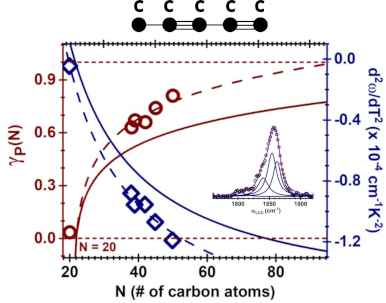
- with distinct N (LCC have their bandgap proportional to N−1; the smaller the chain, the larger the bandgap). Figure 2 corroborates this claim: ωLCC for similar LCC possess similar dependence on T. As previously discussed, ωLCC associated with each identified LCC is used as a probe to obtain the


![[Graphic 23]](/bjnano/content/inline/2190-4286-16-125-i25.svg?max-width=637&scale=1.18182)
Electrical, photocatalytic, and sensory properties of graphene oxide and polyimide implanted with low- and medium-energy silver ions
Beilstein J. Nanotechnol. 2025, 16, 1794–1811, doi:10.3762/bjnano.16.123
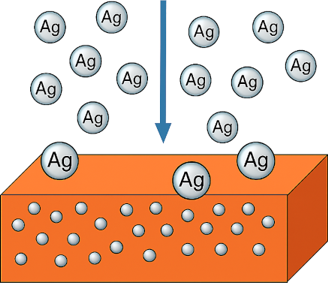
- bandgap and an increased density of states near the Fermi level, promotes absorption in the visible region and facilitates the generation of electron–hole (e−–h+) pairs upon light irradiation. The silver clusters also exhibit plasmonic resonances, which amplify the local electromagnetic field and promote
- the generation of excited states with longer lifetimes [18]. Photocatalysis is a surface-driven process in which the absorption of photons with energy equal to or greater than the material’s bandgap results in the generation of e−–h+ pairs. These photogenerated charge carriers migrate to the surface
- semiconducting properties of the polymer matrix and reduces the bandgap width. Following the PI implantation with the lowest fluence, the Ag ions have the ability to bond with the newly created free bonds (C–C), resulting in the formation of oxides [21]. This process can lead to a reduction in the bandgap and


Nanotechnology-based approaches for the removal of microplastics from wastewater: a comprehensive review
Beilstein J. Nanotechnol. 2025, 16, 1607–1632, doi:10.3762/bjnano.16.114
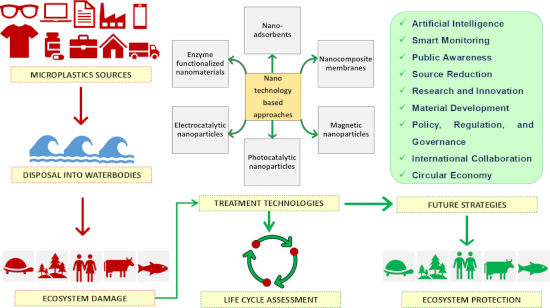
- . Nanoparticles, owing to their high surface-to-volume ratio, demonstrate superior catalytic performance compared to bulk materials. Furthermore, the particle size of semiconductors influences their bandgap energy and crystalline structure, which in turn affects their redox potential and the spatial distribution


Photocatalytic degradation of ofloxacin in water assisted by TiO2 nanowires on carbon cloth: contributions of H2O2 addition and substrate absorbability
Beilstein J. Nanotechnol. 2025, 16, 1567–1579, doi:10.3762/bjnano.16.111
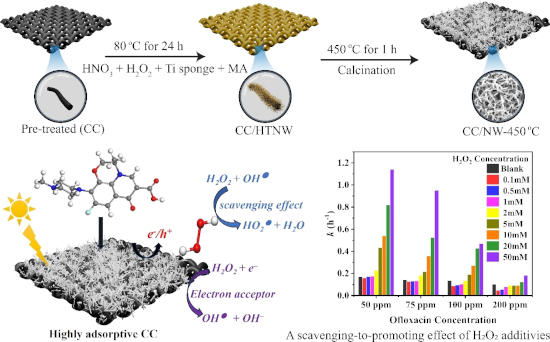
- and CC/NW-450 °C. The black carbon cloth absorbs light in the wavelength range of 250–800 nm, and the UV adsorption edge can be seen clearly after TiO2 precipitations. According to the Kubelka–Munk formula, assuming an indirect transition between valence and conduction bands [24], the bandgap for the
- CC/NW-450 °C is evaluated to be 2.97 eV (Figure 3a inset). This value is smaller than the bandgap of 3.2 eV for anatase TiO2, which can be attributed to the strong interaction between TiO2 and the carbon cloth, which may induce localized states within the bandgap and potentially introduce defects
- ) XRD patterns and (b) Raman spectra of hydrogen titanate nanowires (CC/HTNW) and TiO2 nanowires (CC/NW-450 °C) grown on carbon cloth. (a) UV–vis diffuse absorbance spectrum of the CC/NW-450 °C. The inset shows the replotting of (a) in (αhν)1/2 ~ hν coordinates to evaluate the bandgap of CC/NW-450 °C


Transient electronics for sustainability: Emerging technologies and future directions
Beilstein J. Nanotechnol. 2025, 16, 1545–1556, doi:10.3762/bjnano.16.109
- circuits, such as ring oscillators, entirely composed of water-soluble materials, supporting its applicability in future bioelectronic devices. Nevertheless, the currently known repertoire of bioresorbable semiconductors remains narrow, both in material selection and bandgap range. Expanding the library to
- include materials with diverse bandgap properties remains a key challenge as it would enable wavelength-specific and electrically optimized device designs across a wide array of applications, including sensors, radio frequency (RF) devices, energy harvesters, and optoelectronic systems. For instance, low
- -bandgap bioresorbable semiconductors based on magnesium–silicon alloys, such as Mg2Si, could be promising candidates to fill this gap (Figure 2a) [49][50]. However, further exploration is needed to discover and engineer additional semiconducting materials, including a broader range of silicon- or


Influence of laser beam profile on morphology and optical properties of silicon nanoparticles formed by laser ablation in liquid
Beilstein J. Nanotechnol. 2025, 16, 1533–1544, doi:10.3762/bjnano.16.108
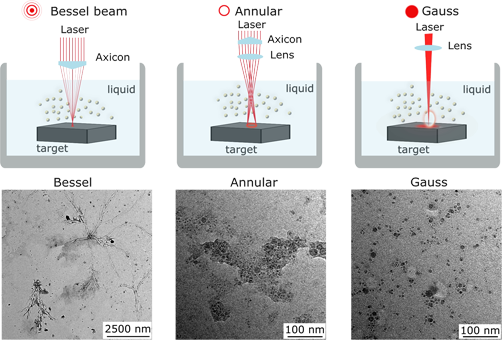
- , provides the information about the bandgap energies of the prepared Si NPs. Here, α, h, and ν are absorption coefficient, Planck constant, and frequency, respectively; n depends on the type of bandgap and can be 2 for indirect or 1/2 for direct bandgaps, respectively (Figure 6b). For silicon, indirect
- bandgap characteristics are typical; therefore, the value of n was chosen as 2. Note that silicon is known to have different crystal structures, whose optical properties may vary. Furthermore, size effects are also influencing the optical properties of the resulting NPs [42]. As shown in [42], the bandgap
- of nanocrystals increases with decreasing size due to quantum confinement. Accordingly, the estimated bandgaps for all the prepared colloids was found to be in the range of 1.8–2.2 eV, which is larger than the bandgap of bulk Si (1.12 eV) and can be attributed to the NPs size effects (Figure 6b). The


Laser processing in liquids: insights into nanocolloid generation and thin film integration for energy, photonic, and sensing applications
Beilstein J. Nanotechnol. 2025, 16, 1428–1498, doi:10.3762/bjnano.16.104
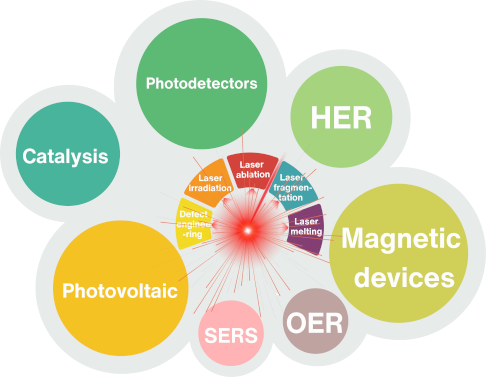
- characteristics, are influenced by the NP size and crystalline quality (Figure 3b,c). LFL also plays a crucial role in tuning the optical properties of NPs. Laser processing affects the defect density and optical bandgap of the particles, as demonstrated by changes in the optical transmission spectra before and
- , which in turn altered the optical properties of the films. This resulted in a decrease in the optical bandgap (1.5 eV) compared to the NPs in colloidal form [129]. AFM images acquired from MoO3 NPs film confirmed the uniform distribution of the spherical particles onto the substrate. A variable grain






Enhancing the photoelectrochemical performance of BiOI-derived BiVO4 films by controlled-intensity current electrodeposition
Beilstein J. Nanotechnol. 2025, 16, 1289–1301, doi:10.3762/bjnano.16.94
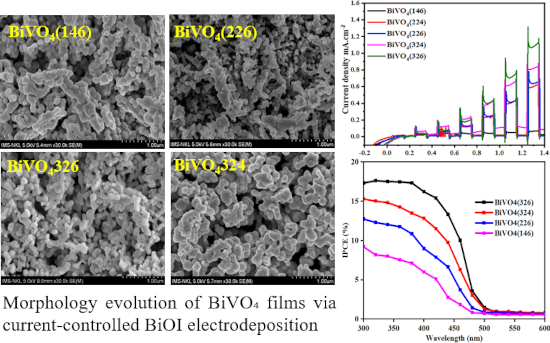
- absorption, moderate bandgap (≈2.4 eV), high theoretical photocurrent density (≈7.5 mA·cm−2), and chemical stability in aqueous environments [7][8][9]. Nevertheless, BiVO4 suffers from intrinsic drawbacks such as low charge carrier mobility, limited conductivity, and rapid recombination of photogenerated
- ). Bandgap values were determined using Tauc plots for indirect allowed transitions, based on (αhν)2 ∝ (hν – Eg), where α is the absorption coefficient, h is Planck’s constant, ν is the frequency, and Eg is the bandgap energy. The (αhν)2 values plotted against the photon energy determined Eg at the
- improvements through stronger peaks, suggesting fewer defects. The decrease in the bandgap (≈0.16 eV) is consistent with research linking oxygen vacancies to band tailing in BiVO4 films [26]. Besides, Figure 3a shows that the BiVO4(326) and BiVO4(324) samples have absorption that goes beyond 520 nm, with some



Electronic and optical properties of chloropicrin adsorbed ZnS nanotubes: first principle analysis
Beilstein J. Nanotechnol. 2025, 16, 1184–1196, doi:10.3762/bjnano.16.87
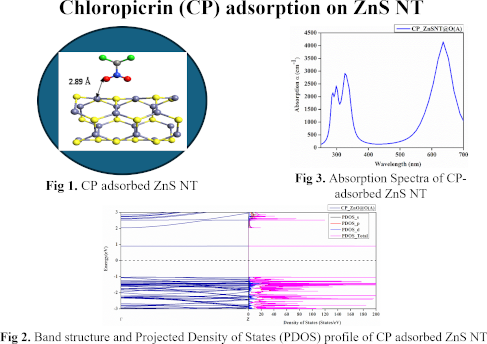
- , optical absorption, and optical conductivity of the ZnS NT-CP system. Our findings reveal that the interaction between CP and ZnS NT induces notable changes in the electronic and optical properties of the nanotube, including a substantial bandgap reduction of up to ≈40% for the specific orientation A. The
- for applications ranging from ultraviolet light-emitting diodes and injection lasers to flat-panel displays and sensors [15][16][17][18][19]. ZnS, a promising transition metal chalcogenide with a wide bandgap of approximately 3.7 eV, has shown remarkable potential in gas sensing applications
- Figure 4. The pristine ZnS NT exhibits a bandgap of 3.03 eV (Figure 3i), consistent with previous studies [38][40][54][55][56][57][58]. Upon CP adsorption, the bandgap values for orientations A, B, C, and D were reduced to 1.92, 2.27, 2.31, and 2.47 eV, respectively. This reduction in the bandgap is


Influence of ion beam current on the structural, optical, and mechanical properties of TiO2 coatings: ion beam-assisted vs conventional electron beam evaporation
Beilstein J. Nanotechnol. 2025, 16, 1097–1112, doi:10.3762/bjnano.16.81
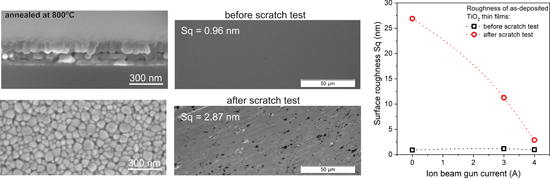
- transmitted through the coating, but also information about the band structure of the materials from which it is made of. Therefore, to perform a comprehensive analysis of the band structure of the prepared titania films, optical bandgap energy (Egopt) and Urbach energy (Eu) were analyzed. The value of Egopt
- was calculated by extrapolating the linear portion of the curves [42] based on the plot of (αhν)1/2 as a function of photon energy (hν) (Figure 5). Based on the literature [43][44][45], titanium dioxide in the anatase phase is an indirect-bandgap semiconductor. In the case of the films deposited using
- the conventional EBE method and an additional Iibg of 3 A, the optical bandgap energy was equal to 3.23 eV, while increasing Iibg to 4 A led to a slight decrease of Egopt to 3.16 eV. After post-process annealing, the value of the optical bandgap energy decreased for the film deposited without any