


Search results
Search for "charge transfer" in Full Text gives 375 result(s) in Beilstein Journal of Nanotechnology. Showing first 200.
Supramolecular one-dimensional conducting nanofibers from a C3-symmetric tetrathiafulvalene derivative
Beilstein J. Nanotechnol. 2026, 17, 872–881, doi:10.3762/bjnano.17.63
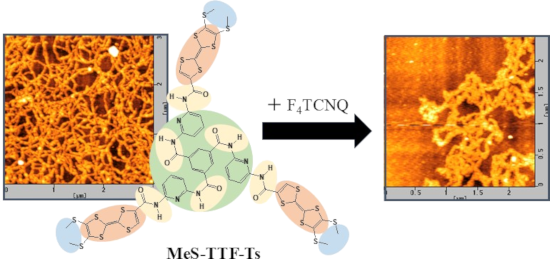
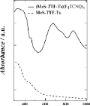
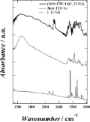
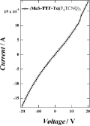
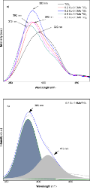
- resulting morphologies. Furthermore, MeS-TTF-Ts was combined with the strong electron acceptor F4TCNQ to form a charge-transfer complex, (MeS-TTF-Ts)(F4TCNQ)3, which yielded well-defined one-dimensional nanofibers. UV–vis and FTIR spectroscopic analyses confirmed substantial charge transfer from MeS-TTF-Ts
- S·cm−1. These findings demonstrate that rational molecular design combined with controlled supramolecular self-assembly provides an effective strategy for constructing one-dimensional conductive nanostructures based on organic charge-transfer systems. Keywords: charge-transfer complex; conducting
- (TTF) derivatives are representative redox-active molecules capable of forming charge-transfer complexes, and their charge-transfer salts have long been known to exhibit high electrical conductivity [11][12][13][14]. In recent years, TTF derivatives functionalized with amide groups or long alkyl chains


Glycerol photoelectrochemical oxidation reaction at carbon nitrides/BiVO4 materials
Beilstein J. Nanotechnol. 2026, 17, 806–817, doi:10.3762/bjnano.17.57
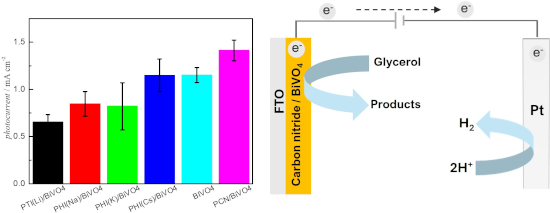
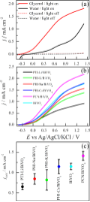
- [6]. These strategies include the synthesis of new photocatalysts, such as metal oxides, doped oxides, heterojunctions, and protective layers to enhance charge transfer at both interfaces and in the bulk, thereby lowering the activation energy barriers [7]. In this sense, bismuth vanadate (BiVO4) has
- -defined long-range order [15][16][39]. Although it was not possible to confirm these CN structural features by XRD analysis, the photoactivity toward glycerol oxidation follows this trend. In this scenario, the dependence of photoactivity with the CN type could arise from the charge transfer dynamics




Tuning the electronic properties of defect-rich MoS2
Beilstein J. Nanotechnol. 2026, 17, 796–805, doi:10.3762/bjnano.17.56
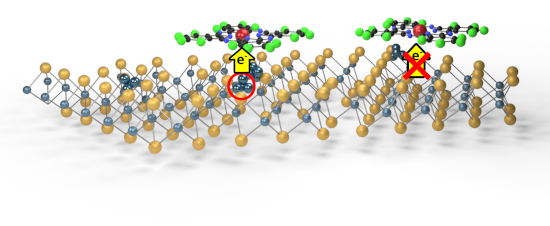
- Fermi energy in such defect-rich MoS2 can be tuned by the subsequent deposition of CoPcF16, which is verified by a shift in Fermi level for the Ne sputtered surface, under complex charge rearrangements including a charge transfer from all the substrates towards the cobalt atom of the organic molecule
- fabrication of ultrafast photodetectors [4][5]. To tune their electronic structure for such applications, the adsorption of organic molecules is a versatile strategy [6][7], resulting, for example, in dipole-induced doping or (complex) charge transfer [8]. Photoelectron spectroscopy (PES), X-ray absorption
- strong local interactions accompanied by (integer) charge transfer [9]. A convenient side effect of this heterostructure is the strong interaction of the central Co atom of CoPcF16 with many metals such as Au, Ag, Cu, or Ni [11][12][13][14][15][16] such that it can be used as a probe for PES studies of


Substrate-dependent pore formation in molybdenum disulfide monolayers under ion irradiation
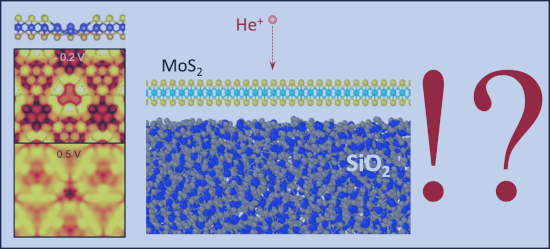
Beilstein J. Nanotechnol. 2026, 17, 769–780, doi:10.3762/bjnano.17.54
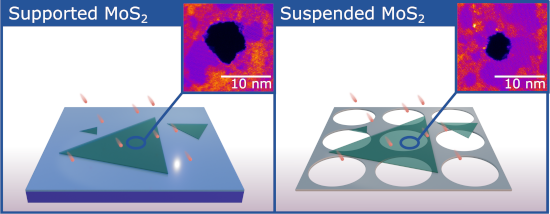
- across the graphene/MoS2 interface is two orders of magnitude smaller than the in-plane conductance of the individual layers. Consistent with limited charge transfer between MoS2 and graphene, no strong PL quenching through loss of photoexcited charge carriers from the MoS2 into the graphene is observed
- this coupling has been attributed to Fermi-level pinning arising from interface–dipole formation and the appearance of Mo d-orbital gap states due to metal–S interactions at the interface [61][65]. Whether these equilibrium coupling mechanisms directly govern the efficiency of transient charge transfer


Decontamination from water pollutants and pathogens by electrospun nanofibers doped with heavy-atom-free borafluorene-BODIPY photosensitizers
Beilstein J. Nanotechnol. 2026, 17, 668–682, doi:10.3762/bjnano.17.46
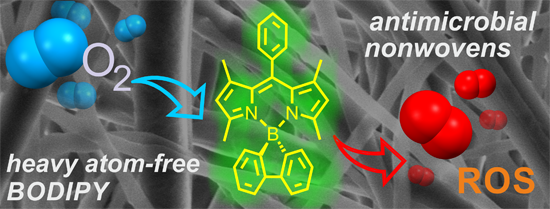
- ) and acceptor (dipyrromethene ligand) sites (Figure 1a) [32][33][34][35]. Importantly, the proposed systems produce triplet states via an alternative to the SOC-ISC mechanism, that is, through a spin–orbit charge transfer intersystem crossing (SOCT-ISC, Figure 1b) resulting from the electron hopping



Cellulose as a photocatalyst support material: extraction, structural features, and environmental applications
Beilstein J. Nanotechnol. 2026, 17, 635–652, doi:10.3762/bjnano.17.44
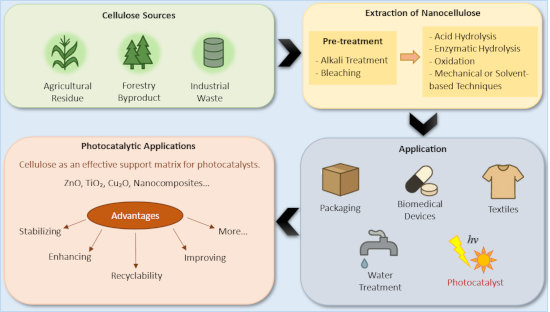
- enhancing charge-transfer dynamics [89]. Recently, nanocellulose has emerged as a promising support material for the synthesis of metal, metal oxide, and non-metallic nanoparticles, and when these components are combined, they often act synergistically to enhance photodegradation processes. Noble and
- photocatalytic nanoparticles, creating favorable conditions for efficient charge transfer and overall reaction performance [90]. In photocatalysis, raw photocatalysts are typically fine nanopowders. They are excellent at using light to degrade pollutants, but they suffer from three major functional flaws. They


Impacts of annealing on structural and photophysical properties of zinc phthalocyanine adsorbed on graphene
Beilstein J. Nanotechnol. 2026, 17, 576–585, doi:10.3762/bjnano.17.39
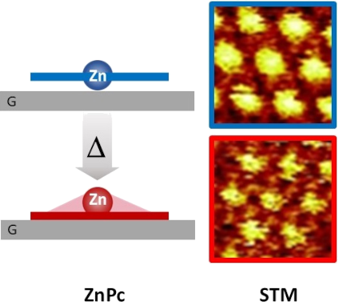
- treatments, as often shown for example with α and β phases of zinc phthalocyanines (ZnPc), with consequences on molecule orientations relative to the substrate and absorbance efficiency [21] or dynamics of charge migration and charge transfer to substrate [22]. Even inside a given phase, minute structural
- variations in phthalocyanine-based materials can strongly impact their absorption and luminescence spectra, in particular by allowing or not the formation of intermolecular Frenkel charge-transfer excitons [23]. 2D assemblies of self-organized adsorbed conjugated molecules on graphene has attracted


Synthesis of Cu–Mo/TiO2 and Co–Mo/TiO2 photocatalysts for the efficient degradation of organic pollutants in water
Beilstein J. Nanotechnol. 2026, 17, 559–570, doi:10.3762/bjnano.17.37
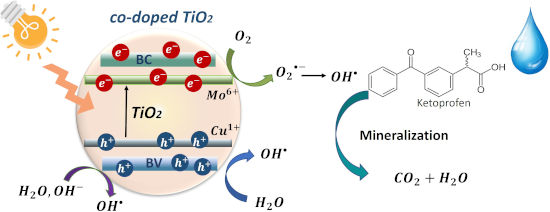
- -doping TiO2 with the high-valence Mo ions and the Cu or Co ions with low valence can be used to address the shortcomings of individual doping systems to optimize charge transfer and reduce recombination. Metal/metal co-doping has not received much attention; however, it is a promising alternative since
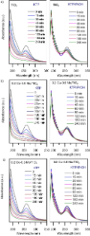
- properties were determined. Finally, the photocatalytic behavior of the materials was studied in the photocatalytic oxidation of ketoprofen (KTP) under UV irradiation, with the aim of studying the charge-transfer improvement. Ketoprofen degradation, adsorption, kinetics, and reaction pathways have been



Electrochemical determination of ciprofloxacin using a MIL-101/reduced graphene oxide-modified electrode
Beilstein J. Nanotechnol. 2026, 17, 541–554, doi:10.3762/bjnano.17.35
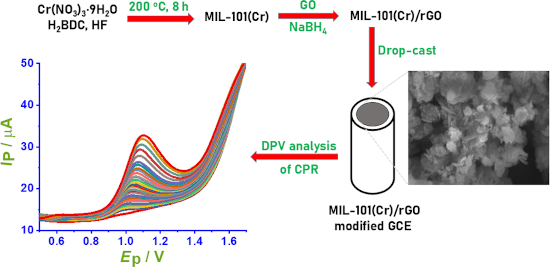
- electrochemical performance of the composite material. This combination can promote efficient analyte adsorption and fast charge transfer at the electrode interface. Consistent with this idea, Gu et al. reported that MIL-101/rGO composites exhibit enhanced electrocatalytic activity toward the reduction of
- results from both figures confirm the successful formation of MIL-101/rGO composites. This structural combination is beneficial for electrochemical applications because rGO improves electrical conductivity and promotes charge transfer. The Raman spectra of GO, rGO, MIL-101, and the MIL-101/rGO composites
- confirms the irreversible nature of the oxidation process (Figure 7c). For an irreversible electrochemical system, the charge-transfer coefficient (α) was assumed to be 0.5, as is common in the literature [30]. From the slope of the ECPR–ln v plot, the product of α and the number of transferred electrons


Fractional shot noise of an SU(N) Kondo system
Beilstein J. Nanotechnol. 2026, 17, 515–540, doi:10.3762/bjnano.17.34
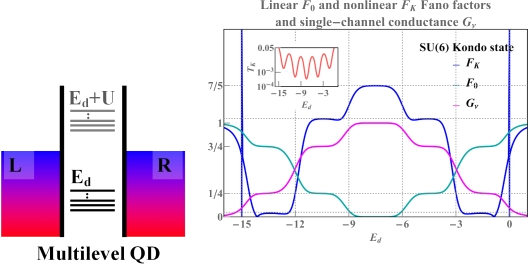
- , 15/8, 12/5, 35/12, …} and bN = {2, 1, 2/3, 1/2, 14/5, …}. is the quadratic Casimir operator in the free pseudospin momentum limit (t = 0). We see that, for Q = 1e, the inter-state charge transfer correlator is Qik = QiQk = 0. Correspondingly, successive values of N reach the numbers TχN ≈ aN. In


![[Graphic 127]](/bjnano/content/inline/2190-4286-17-34-i187.svg?max-width=637&scale=1.18182)

Probing internal continua and atomic ultrafast charge transfer within size-controlled nanoparticles by post-collision interaction in core-hole clock spectroscopy
Beilstein J. Nanotechnol. 2026, 17, 505–514, doi:10.3762/bjnano.17.33
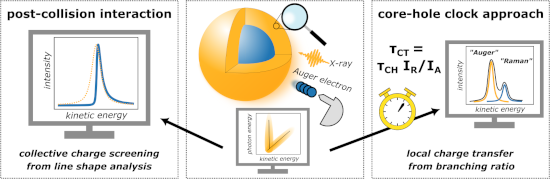
- local charge transfer dynamics and internal continuum states. We observe an acceleration of charge transfer times by almost one order of magnitude in thin-shell quantum dots, comprising only one or three double layers of ZnS, before reaching a size-independent limit. This size-dependence is governed by
- the existence of a faster charge transfer channel toward the CdSe core, only accessible for the inner-most shell layers, rather than a quantum confinement effect. By extending the traditional PCI model from free-electron systems to bound-state continua, we further establish a framework for
- -collision-interaction; quantum dots; resonant Auger spectroscopy; Introduction The interplay of electron localization, itinerance, and charge transfer is essential to functional nanoparticles and quantum dots (QDs) [1][2][3][4][5][6]. In terms of electronic structure properties, materials on the nanoscale



Defects and defect-mediated engineering of two-dimensional materials: challenges and open questions
Beilstein J. Nanotechnol. 2026, 17, 454–488, doi:10.3762/bjnano.17.31
- valence band maximum and conduction band minimum between bulk and monolayer WS2 affect the relative position of the O2 LUMO responsible for the charge transfer. This can affect the barrier of O2 dissociation and requires further studies. The mechanisms of propagation of oxidation front from the surface of





Polycatecholamine nanocoatings on stainless steel: the effect on attachment of human fibroblasts and platelets
Beilstein J. Nanotechnol. 2026, 17, 365–380, doi:10.3762/bjnano.17.25
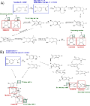
- aggregates stabilized by charge transfer, hydrogen bonding and π–π stacking interactions [12][27][28]. Mechanistic studies indicate that the first step of ʟ-tyrosine polymerization involves hydroxylation of the aromatic ring at the C3 position [12][28][29], after which the pathway resembles dopamine




Gold nanoparticle-decorated reduced graphene oxide as a highly effective catalyst for the selective α,β-dehydrogenation of N-alkyl-4-piperidones
Beilstein J. Nanotechnol. 2026, 17, 218–238, doi:10.3762/bjnano.17.15
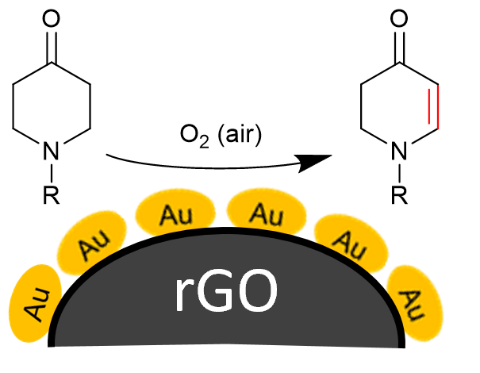
- facilitate charge transfer between the metal and the support, enhancing the activation of molecular oxygen and promoting the oxidative dehydrogenation (ODH) pathway. This synergistic interaction should not only improve the intrinsic catalytic activity but also allow the catalyst to achieve high efficiency
- metallic AuNPs (3–13 nm), assisted by electron donation from rGO’s π-conjugated and oxygenated domains, provide sufficient but not excessive charge transfer to partially activate O2, yet without full reduction to the peroxido form. This balance maintains high selectivity while preventing overoxidation or
- nanoparticles but also sustains dynamic charge transfer (rGO→Au→O2), preserving the redox flexibility of Au sites throughout the catalytic cycle. A very important point to consider when using carbon supports in catalysis is the gold loading in the support. Compared to AC and CB, rGO exhibits a lower bulk


Reduced graphene oxide paper electrode for lithium-ion cells – towards optimized thermal reduction
Beilstein J. Nanotechnol. 2026, 17, 24–37, doi:10.3762/bjnano.17.3
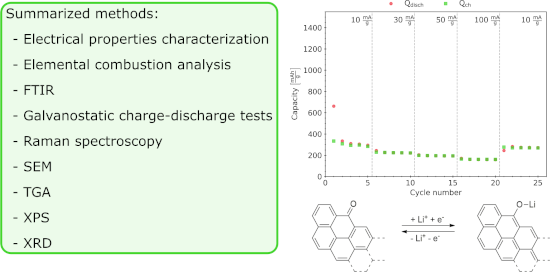
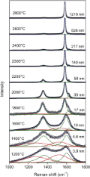
- stability of the cell’s performance was improved with increasing reduction temperature. Changes in structural properties revealed by Raman spectroscopy influenced the electrochemical properties of these materials, probably due to the decreased charge transfer resistance and balanced electronic and ionic



Quantum circuits with SINIS structures
Beilstein J. Nanotechnol. 2025, 16, 1931–1941, doi:10.3762/bjnano.16.134
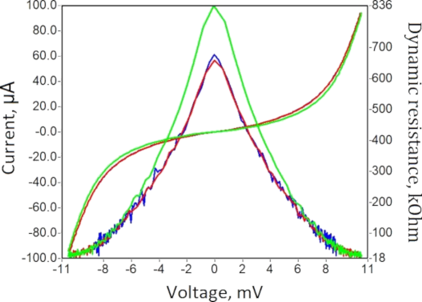
- the charge transfer by electrons during tunneling through the tunnel SIN junction and the thermal noise of these same electrons as heat carriers: δIω2 is the power spectral density (PSD) of current fluctuations due to shot noise, δPω2 is the PSD of thermal fluctuations, and ⟨δPωδIω⟩ is the correlation


Piezoelectricity of layered double hydroxides: perspectives regarding piezocatalysis and nanogenerators
Beilstein J. Nanotechnol. 2025, 16, 1812–1817, doi:10.3762/bjnano.16.124

- evidence demonstrated that dual oxygen vacancies in Ni/Fe-LDHs create interfacial bonds that mitigate carrier localization effects and unfavorable influences during piezocatalysis and photocatalysis. These features promote exciton dissociation and charge transfer. Furthermore, the strong electronic
- carrier localization effects), or to interfacial electronic interactions that facilitate charge transfer. While these mechanisms may coexist, many publications lack the necessary control experiments (e.g., mechanical stimulation without light/oxidant, photocatalysis without stress, or defect-free samples

Electrical, photocatalytic, and sensory properties of graphene oxide and polyimide implanted with low- and medium-energy silver ions
Beilstein J. Nanotechnol. 2025, 16, 1794–1811, doi:10.3762/bjnano.16.123
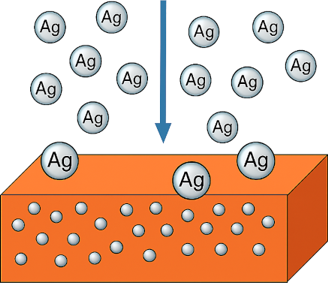
- catalytically active sites resulting from the carbonization of the polymer matrix, together with the silver clusters formed during ion implantation, provide suitable conditions for reactant adsorption and efficient charge transfer. Silver ions exhibit strong localized surface plasmon resonance in the visible
- the implanted samples. This suggests that the material itself without any intervention has limited ability to generate reactive oxygen species or facilitate charge transfer, which are both essential for efficient photocatalysis. There is a noticeable increase in the rate constant when low-energy Ag
- ions of 20 keV are implanted. This increase can be explained by the formation of defects in the GO surface layer, which increase the rate of electron excitation and facilitate subsequent charge transfer. At the same time, the implanted Ag ions can act as catalytic centers that improve the process of


Ambient pressure XPS at MAX IV
Beilstein J. Nanotechnol. 2025, 16, 1677–1694, doi:10.3762/bjnano.16.118
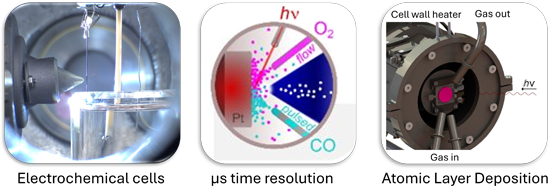
- photocatalyst, it is essential to combine the photocatalyst’s performance with mechanistic knowledge under operando reaction conditions. APXPS is uniquely suited to investigate such systems. Its surface sensitivity enables the detection of charge transfer processes, reaction intermediates, and active sites
- under operando conditions. Additionally, the kinetics of charge transfer and the role of specific chemical species or components functioning as charge donors or acceptors during photocatalytic reactions can be clarified using APXPS. At MAX IV, external light sources (e.g., UV lamps or solar simulators
- provides unique insight into surface reactions, charge transfer, and interface stability, which are central to the performance and degradation mechanisms of electrochemical systems. Electrochemical interfaces can be studied by APXPS using two primary cell types, namely, membrane-based flow cells and “dip





Influence of laser beam profile on morphology and optical properties of silicon nanoparticles formed by laser ablation in liquid
Beilstein J. Nanotechnol. 2025, 16, 1533–1544, doi:10.3762/bjnano.16.108
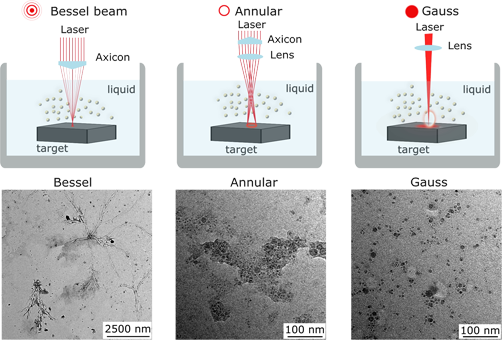
- charge and discharge, facilitating the charge transfer processes [47][48][49]. As a result, parameters such as specific capacitance and cycling stability are enhanced [13]. In our case, high values of specific capacitance can be expected because of the developed surface of the silicon NPs prepared by


Laser processing in liquids: insights into nanocolloid generation and thin film integration for energy, photonic, and sensing applications
Beilstein J. Nanotechnol. 2025, 16, 1428–1498, doi:10.3762/bjnano.16.104






The role of biochar in combating microplastic pollution: a bibliometric analysis in environmental contexts
Beilstein J. Nanotechnol. 2025, 16, 1401–1416, doi:10.3762/bjnano.16.102
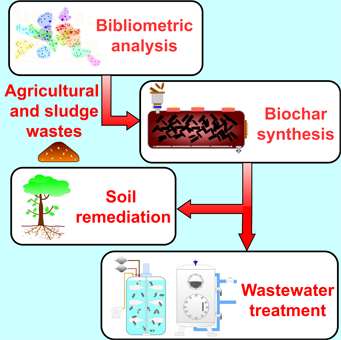
- and surface area, compared to other materials [37]. Biochar produced from carbon-, oxygen- and nitrogen-rich straw at low pyrolysis temperatures retains a large number of functional groups, which enhance charge transfer potential and adsorption stability through increased surface charge density



Automated collection and categorisation of STM images and STS spectra with and without machine learning
Beilstein J. Nanotechnol. 2025, 16, 1367–1379, doi:10.3762/bjnano.16.99
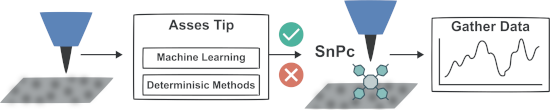
- closer to the surface, where the atom binds to the Ag(111), at which point charge transfer from the substrate to the molecule will return it to its neutral state [21]. Whilst carrying out bias spectroscopy over these SnPc molecules, it was found that a switch could occasionally be induced, even if the




Enhancing the photoelectrochemical performance of BiOI-derived BiVO4 films by controlled-intensity current electrodeposition
Beilstein J. Nanotechnol. 2025, 16, 1289–1301, doi:10.3762/bjnano.16.94
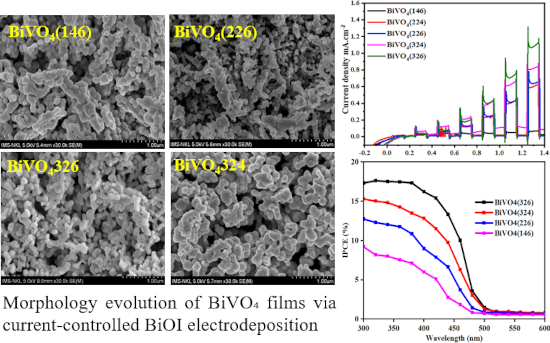
- higher current densities and larger VO(acac)₂ volumes. This observation suggests that improved crystallinity enhances the structural uniformity of the VO4− tetrahedra, leading to more efficient charge-transfer pathways. Furthermore, the appearance of sharper and more intense Raman peaks with increasing
- the BiVO4(326) photoanode at 1.23 V vs RHE was 47%, which was higher than that under other conditions. This indicates that the formation of films with larger surface areas reduces the charge recombination rate and facilitates faster charge transfer rates. AC impedance measurements were performed on
- the photoanodes to assess their charge transfer capabilities. As shown in Figure 5d, BiVO4(326) exhibited a smaller impedance arc under illumination, indicating a minimal charge-transfer resistance. This is favorable for the rapid utilization of photogenerated holes in water oxidation reactions



Electronic and optical properties of chloropicrin adsorbed ZnS nanotubes: first principle analysis
Beilstein J. Nanotechnol. 2025, 16, 1184–1196, doi:10.3762/bjnano.16.87
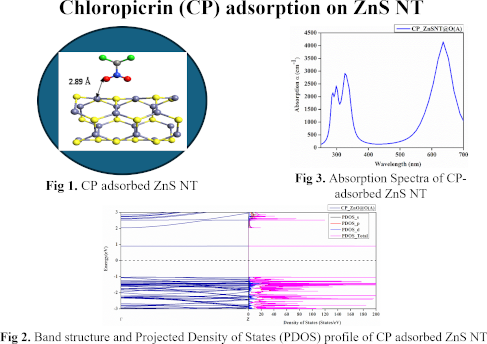
- functional theory (DFT) to explore the sensing capabilities of a ZnS (3,3) nanotube (ZnS NT) for detecting chloropicrin (CP, CCl3NO2), a highly toxic gas. To elucidate the sensing mechanism, we systematically analyze the adsorption configurations, Mulliken charge transfer, band structure, density of states
- adsorption energy ranges from −0.389 to −0.657 eV, indicating weak physisorption. The Mulliken charge transfer varies between 0.06e and 0.109e, confirming effective but nondestructive interaction. A favorable recovery time of ≈3.533 μs at room temperature, along with a significant red shift in the absorption
- highly toxic chemical warfare agent, remains an area with untapped potential. Addressing this gap, the present work constructs an armchair ZnS NT to investigate its adsorption configurations, charge transfer, band structure, density of states, optical absorption, and optical conductivity using a density





