


Search results
Search for "kinetic inductance" in Full Text gives 12 result(s) in Beilstein Journal of Nanotechnology.
Programmable soliton dynamics in all-Josephson-junction logic cells and networks
Beilstein J. Nanotechnol. 2025, 16, 1883–1893, doi:10.3762/bjnano.16.131

- diverse dynamical modes. By introducing a structural asymmetry into a transmission line, we implement a Josephson diode that enforces unidirectional soliton propagation. The programmability of the kinetic inductance then provides a crucial mechanism to selectively enable or disable this diode
- functionality. By engineering artificial inhomogeneity into the circuit architecture, we enhance robustness in all-JJ logic circuits, 2D transmission line all-JJ lattices, and neuromorphic computing systems. Keywords: Josephson-based diode; kinetic inductance; soliton dynamics; superconducting electronics
- the concept of applying a small number of key cells, which should create precisely engineered tunable inhomogeneities. Such inhomogeneity may be designed as an element of tunable kinetic inductance [17]. This element has high inductance at small scales and can be controlled using currents [18][19


Low-temperature AFM with a microwave cavity optomechanical transducer
Beilstein J. Nanotechnol. 2025, 16, 1873–1882, doi:10.3762/bjnano.16.130
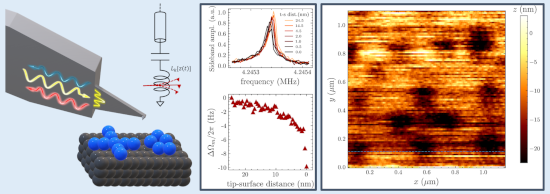
- edge of the plate, giving rise to a modulation of its kinetic inductance due to surface strain generated by cantilever bending. A Pt–C tip with curvature radius below 10 nm at its apex is formed at the free end of the cantilever through a series of electron-beam-assisted depositions. Figure 1d shows a


Transfer function of an asymmetric superconducting Gauss neuron
Beilstein J. Nanotechnol. 2025, 16, 1160–1170, doi:10.3762/bjnano.16.85
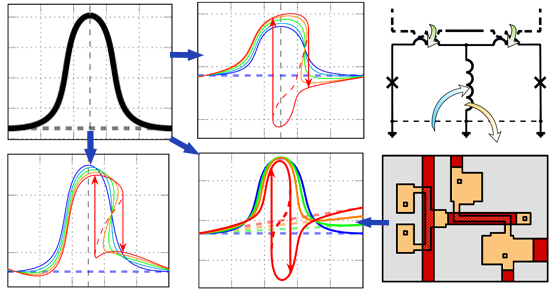
- slightly different shapes, which allows them to be distinguished during the initial analysis of experimental data. In recent years, a number of superconducting devices have been proposed based on very thin superconducting films whose kinetic inductance may be comparable to the magnetic one [11][25][26
- ]. Indeed, the inductance of a superconducting film carrying an electric current consists of two components, namely, the magnetic inductance (originating from the magnetic field energy) and the kinetic inductance (originating from the kinetic energy of the superconducting electrons). Should one want to
- account for the kinetic inductance, the initial Equation 1–Equation 3 remain unchanged, as it is the total inductance value that determines the phase balance conditions in Equation 2 and Equation 3. However, the value of ϕout in Equation 13 has then the meaning of the phase difference across the output



Design, fabrication, and characterization of kinetic-inductive force sensors for scanning probe applications
Beilstein J. Nanotechnol. 2024, 15, 242–255, doi:10.3762/bjnano.15.23
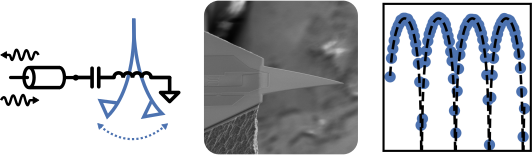
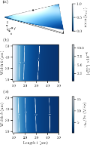
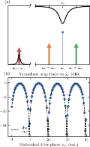
- microscopy based on electromechanical coupling due to a strain-dependent kinetic inductance of a superconducting nanowire. The force sensor is a bending triangular plate (cantilever) whose deflection is measured via a shift in the resonant frequency of a high-Q superconducting microwave resonator at 4.5 GHz
- . We present design simulations including mechanical finite-element modeling of surface strain and electromagnetic simulations of meandering nanowires with large kinetic inductance. We discuss a lumped-element model of the force sensor and describe the role of an additional shunt inductance for tuning
- ; kinetic inductance; optomechanics; superconductivity; Introduction Cavity optomechanics [1] deals with the detection and manipulation of massive “test objects” at the fundamental limits imposed by quantum physics [2]. By detecting the motion of the test object, we can sense an external force, for example



Measurements of dichroic bow-tie antenna arrays with integrated cold-electron bolometers using YBCO oscillators
Beilstein J. Nanotechnol. 2024, 15, 26–36, doi:10.3762/bjnano.15.3
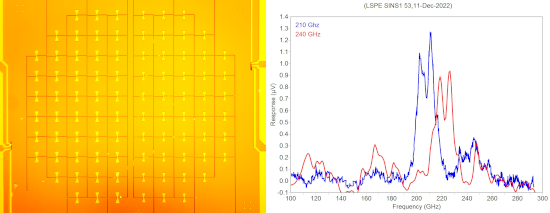
- microwave superconducting quantum interference device (SQUID) readout if transition-edge sensors (TESs) detectors are installed. Otherwise, on-wafer RF multiplexing may be used with thermal kinetic inductance detectors [2]. The LSPE mission [3] is a project of the Italian Space Agency aimed at studying the


A distributed active patch antenna model of a Josephson oscillator
Beilstein J. Nanotechnol. 2023, 14, 151–164, doi:10.3762/bjnano.14.16
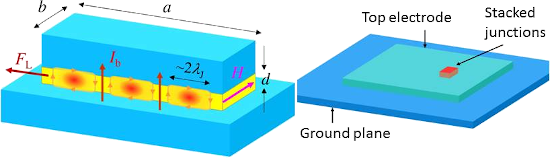
- and the flux-flow phenomenon. (iii) The slow propagation speed of EMWs inside the JJ, c0 ≪ c. This is caused by a large kinetic inductance of superconducting electrodes. For Nb-based JJs, c/c0 ≈ 40 (see the estimation in section Discussion). For atomic-scale intrinsic JJs in layered cuprates, c0 can


Numerical modeling of a multi-frequency receiving system based on an array of dipole antennas for LSPE-SWIPE
Beilstein J. Nanotechnol. 2022, 13, 865–872, doi:10.3762/bjnano.13.77
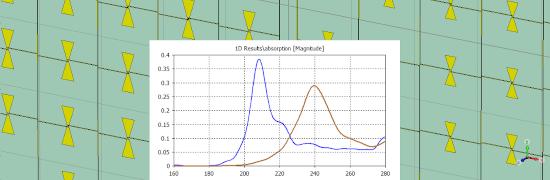
- the working temperature of the 3He cryostat used for the LSPE project. One of main candidates for LSPE-SWIPE is a transition-edge sensor (TES) with a spiderweb antenna [2][3]. For the OLIMPO mission, kinetic inductance detectors (KIDs) were used [4]. We propose to use cold-electron bolometers (CEBs


Tunable superconducting neurons for networks based on radial basis functions
Beilstein J. Nanotechnol. 2022, 13, 444–454, doi:10.3762/bjnano.13.37
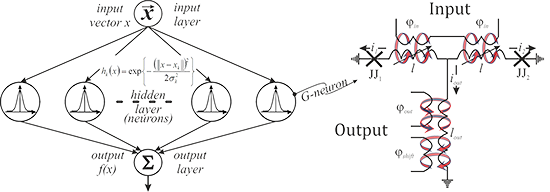
- operation of the cell (tRF up to 8000tC, where tC is the characteristic time for the Josephson junction). The dissipation during the operation of the Gauss-neuron remains small, which justifies classifying the proposed cell as adiabatic (Figure 4b). Realization of tunability: adjustable kinetic inductance
- the chip. In thin layers of superconductors used to create parts of a neuron, the kinetic inductance is relatively large compared to the geometric one [52]. This is important for us since one can change the kinetic inductance relatively simply by controlling the concentration of superconducting charge
- carriers (Cooper pairs or superconducting correlations). This approach is the basis of the concept of our tunable in situ Gauss-neuron. A similar idea is used in kinetic inductance devices, which are based on thin superconducting strips [53][54]. They are commonly used for the design of photon detectors


Superconductor–insulator transition in capacitively coupled superconducting nanowires
Beilstein J. Nanotechnol. 2020, 11, 1402–1408, doi:10.3762/bjnano.11.124
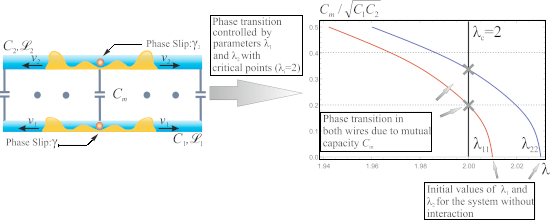
- quasi-one-dimensional superconducting wires [5] with geometric capacitance C and kinetic inductance is controlled by the parameter [5] which is proportional to the square root of the wire cross section, s. It follows immediately from the analysis of [5] that, provided the two superconducting wires


Controlling the proximity effect in a Co/Nb multilayer: the properties of electronic transport
Beilstein J. Nanotechnol. 2020, 11, 1336–1345, doi:10.3762/bjnano.11.118
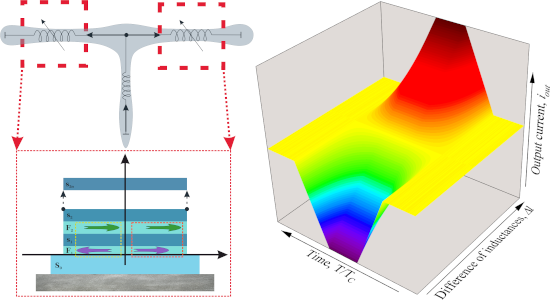
- stacking periods. It is demonstrated that the magnetization switching results in modulation of superconductivity in the superlattice with a corresponding change in the kinetic inductance of the superconducting parts of the wire core, due to the inverse proximity effect. We argue that this effect
- , l2 are the normalized inductance values of two TKIs, and lp is the stray geometric inductance of a splitter branch. For this device to function properly, it is critically important to find conditions in which the kinetic inductance changes significantly due to the controlled proximity effect in the S
- screening length directly depends on the proximity of the superconducting order parameter in the system [25], given by Hence, the screening length and the kinetic inductance of the considered s-layers are significantly higher in the P case compared to the AP case. This leads to a redistribution of the



High dynamic resistance elements based on a Josephson junction array
Beilstein J. Nanotechnol. 2020, 11, 417–420, doi:10.3762/bjnano.11.32
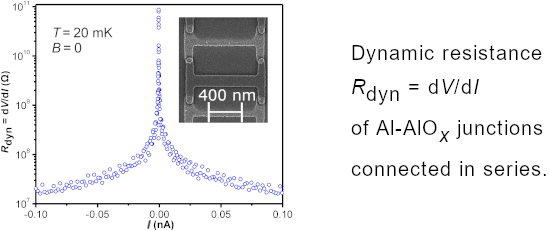
- higher than for CMOS-based devices. It is universally accepted that the limiting factor for the speed of operation of various superconducting devices is the high-frequency impedance, e.g., originating from kinetic inductance. The effect should be taken into consideration for various cryoelectronic
- observation of a pronounced Coulomb blockade has been observed in JJs using both a high-resistive dissipative environment [7][8] and nonlinear Josephson elements with high dynamic resistance and/or kinetic inductance [6][18]. However, extended attempts to observe Bloch oscillation phenomena at finite currents
- suggested which take advantage of the high kinetic inductance of superconducting quantum interference devices (SQUIDs) [21][22] (Lk = cos−1(Φ/Φ0) at a degeneracy point when Φ/Φ0 → π/2, where Φ is the magnetic flux through the SQUID area and Φ0 is the magnetic flux quantum, Φ0 = h/2e = 2 × 10⁻¹⁵ Wb). Hence

Beyond Moore’s technologies: operation principles of a superconductor alternative
Beilstein J. Nanotechnol. 2017, 8, 2689–2710, doi:10.3762/bjnano.8.269

- area (similar to LV-RSFQ). Possible solutions of this problem are an increase of the number of wiring layers and/or the utilization of superconducting materials having high kinetic inductance. These materials can be also used for further miniaturization of logic cells themselves [19]. Energy-efficient
- direction of the research is the substitution of the conventional loop inductance with a kinetic inductance or the inductance of the Josephson junction [19]. This also allows one to make the





