


Search results
Search for "microscopies" in Full Text gives 17 result(s) in Beilstein Journal of Nanotechnology.
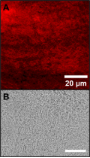
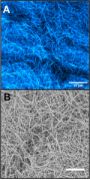
Visualizing nanostructures in supramolecular hydrogels: a correlative study using confocal and cryogenic scanning electron microscopy
Beilstein J. Nanotechnol. 2025, 16, 2274–2284, doi:10.3762/bjnano.16.156
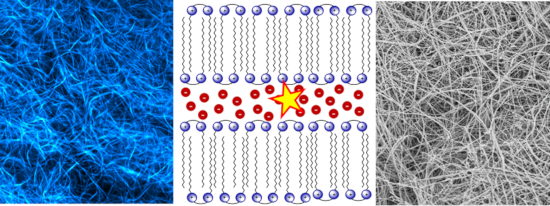
- ; microscopies; nanostructure; supramolecular hydrogel; Introduction Hydrogels, whether based on self-assembling molecules or cross-linked polymers, are useful in fields ranging from tissue engineering to drug delivery and biosensing [1][2][3][4][5]. Their high water content and soft, porous structure make them



Deep learning for enhancement of low-resolution and noisy scanning probe microscopy images
Beilstein J. Nanotechnol. 2025, 16, 1129–1140, doi:10.3762/bjnano.16.83
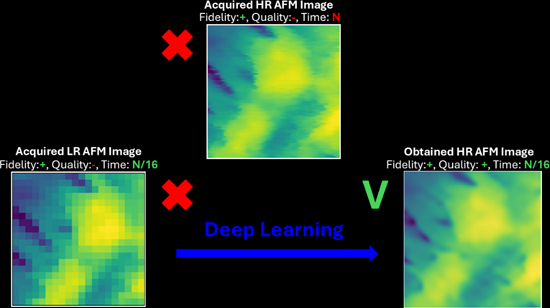
- beneficial to authenticate results using other microscopies such as electron microscopy, or spectroscopic techniques, where relevant. Importantly, computationally, PSNR average values are very close to 30 for the Celgard® 2400 membrane surface and above 32 for the titanium film, putting them within the


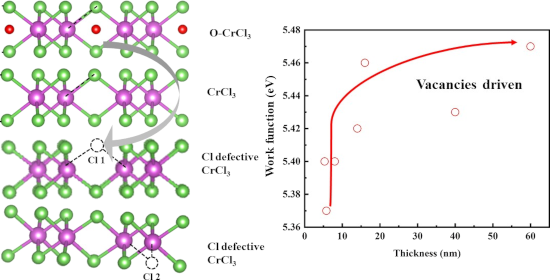
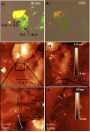
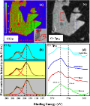
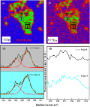
Thickness dependent oxidation in CrCl3: a scanning X-ray photoemission and Kelvin probe microscopies study
Beilstein J. Nanotechnol. 2025, 16, 749–761, doi:10.3762/bjnano.16.58





Elastic modulus of β-Ga2O3 nanowires measured by resonance and three-point bending techniques
Beilstein J. Nanotechnol. 2024, 15, 704–712, doi:10.3762/bjnano.15.58
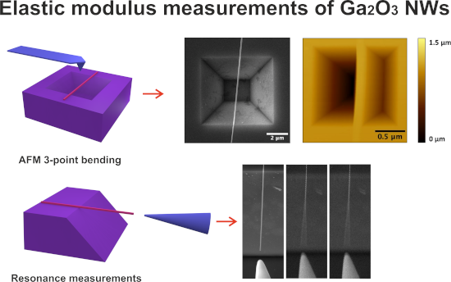
- of the synthesised NWs were investigated using X-ray diffraction, transmission and scanning electron microscopies. The resonance tests yielded the mean elastic modulus of 34.5 GPa, while 75.8 GPa mean value was obtained via three-point bending. The measured elastic moduli values indicate the need for


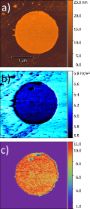
Mapping the local dielectric constant of a biological nanostructured system
Beilstein J. Nanotechnol. 2021, 12, 139–150, doi:10.3762/bjnano.12.11
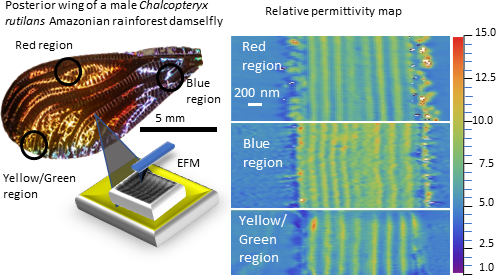
- Minas Gerais for providing the equipment and technical support for experiments involving electron and scanning probe microscopies. Funding The financial support of the agencies FAPEMIG, CNPq, CAPES, and FINEP allowed this research to be realized.




Numerical analysis of single-point spectroscopy curves used in photo-carrier dynamics measurements by Kelvin probe force microscopy under frequency-modulated excitation
Beilstein J. Nanotechnol. 2018, 9, 1834–1843, doi:10.3762/bjnano.9.175
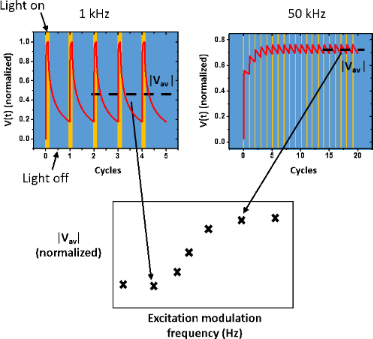
- this context, few teams around the world have recently began to develop time-resolved scanning probe microscopies (SPM) techniques, aimed at addressing the photo-carrier dynamics at the local scale in photoactive materials and devices. At this point, Kelvin probe force microscopy (KPFM) emerged as a


Comparative study of post-growth annealing of Cu(hfac)2, Co2(CO)8 and Me2Au(acac) metal precursors deposited by FEBID
Beilstein J. Nanotechnol. 2018, 9, 91–101, doi:10.3762/bjnano.9.11
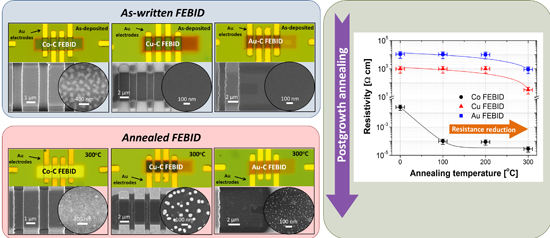
- the chamber. It can be attributed to the thermally induced formation of hydrocarbons driven by a Fischer–Tropsch-like reaction [64]. The hydrocarbons are volatile and escape from the FEBID material above 300 °C. Figure 5c presents optical and scanning electron microscopies of the as-written and H2
- signal from the chamber, thus highlighting the efficiency of the H2-based purification method. Silicon and oxygen signals originate from the SiO2/Si substrate. (c) Optical (top) and scanning electron (bottom) microscopies of both as-deposited and annealed at 360 °C Au–C FEBID material. This annealing


Scanning probe microscopy studies on the adsorption of selected molecular dyes on titania
Beilstein J. Nanotechnol. 2016, 7, 1642–1653, doi:10.3762/bjnano.7.156
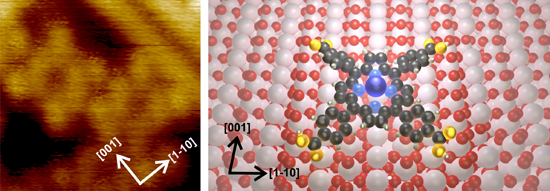
- microscopies, it is indispensable to use other techniques such as Kelvin probe force microscopy, which allows measuring the local work function with high resolution. Such a measurement may shed some light on fundamental processes taking place in an organic DSSC upon photon absorption. Quite often, in


Dynamic force microscopy simulator (dForce): A tool for planning and understanding tapping and bimodal AFM experiments
Beilstein J. Nanotechnol. 2015, 6, 369–379, doi:10.3762/bjnano.6.36
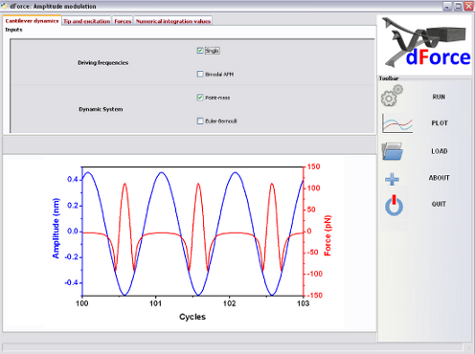
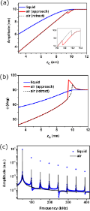
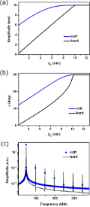
- simulate the full cantilever dynamics in both amplitude modulation and bimodal AM force microscopies. The code is both robust and numerically accurate. It incorporates the most relevant interaction force models that apply for dynamic AFM experiments in air and liquid. The simulator has been tested over the




Cathode lens spectromicroscopy: methodology and applications
Beilstein J. Nanotechnol. 2014, 5, 1873–1886, doi:10.3762/bjnano.5.198

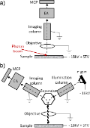
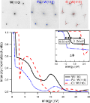
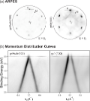
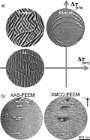
- decelerating/accelerating potential for the incident/scattered electrons. Besides the electron energy, the backscattering geometry at normal incidence distinguishes LEEM from other more conventional electron microscopies. This necessitates a beam separator, which is used to separate the incident and the



Precise quantification of silica and ceria nanoparticle uptake revealed by 3D fluorescence microscopy
Beilstein J. Nanotechnol. 2014, 5, 1616–1624, doi:10.3762/bjnano.5.173
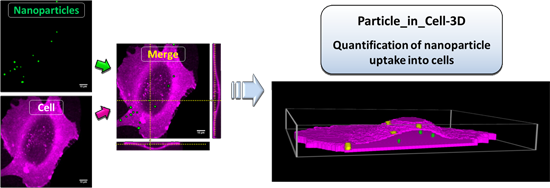
- flow cytometry, mass spectroscopy, electron and light microscopies [32][33][34][35][36][37][38][39]. Flow cytometry provides sound statistics due to the large number of cells evaluated in a short time. Nevertheless, it does not deliver spatial information about the position of nanoparticles interacting


Gas sensing with gold-decorated vertically aligned carbon nanotubes
Beilstein J. Nanotechnol. 2014, 5, 910–918, doi:10.3762/bjnano.5.104
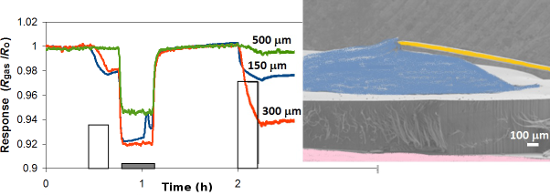
- morphology of the active layer and its chemical composition was characterized by using scanning and transmission electron microscopies (SEM and TEM), and X-ray photoelectron spectroscopy (XPS), respectively. Experimental Vertically aligned carbon nanotube growth VA-CNT synthesis was carried out in a thermal


The softening of human bladder cancer cells happens at an early stage of the malignancy process
Beilstein J. Nanotechnol. 2014, 5, 447–457, doi:10.3762/bjnano.5.52
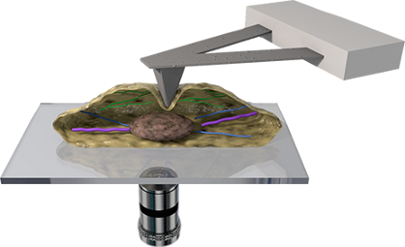
- between 200 and 400 nm. It is worth to mention that cells treated with Cyt-D had similar Young’s moduli for both cell lines (HCV29 and HTB-9). Discussion The integration of force and fluorescence microscopies enables one to obtain comprehensive information about the morphology of the cells. The latter


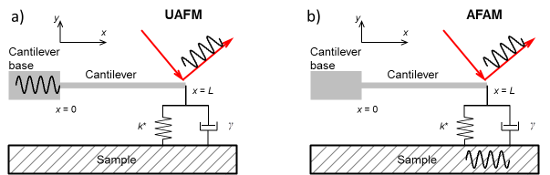
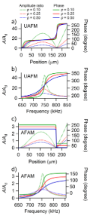
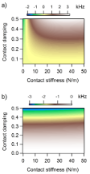
Frequency, amplitude, and phase measurements in contact resonance atomic force microscopies
Beilstein J. Nanotechnol. 2014, 5, 278–288, doi:10.3762/bjnano.5.30


Adsorption of the ionic liquid [BMP][TFSA] on Au(111) and Ag(111): substrate effects on the structure formation investigated by STM
Beilstein J. Nanotechnol. 2013, 4, 903–918, doi:10.3762/bjnano.4.102
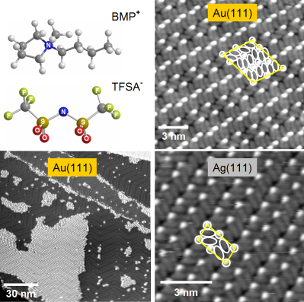
- spectroscopic techniques such as ultraviolet photoelectron spectroscopy (UPS) [15][16], X-ray photoelectron spectroscopy (XPS) [17][18][19][20][21], or temperature programmed desorption (TPD) [22], as well as scanning probe microscopies (scanning tunnelling microscopy (STM) and atomic force microscopy (AFM




Tuning the properties of magnetic thin films by interaction with periodic nanostructures
Beilstein J. Nanotechnol. 2012, 3, 831–842, doi:10.3762/bjnano.3.93
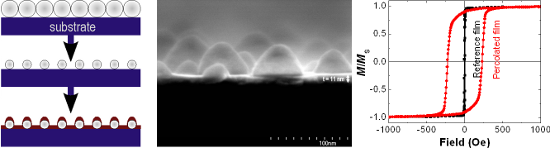
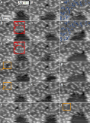
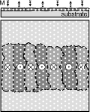
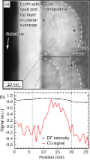
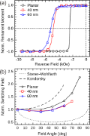
- reversal mechanism. In summary, the applied nanostructuring methods have proven very effective in limiting domain sizes by pinning domain walls at defect structures for both in-plane- and out-of-plane-magnetized thin films, as demonstrated by integral magnetometry and magnetic microscopies. The individual


The role of the cantilever in Kelvin probe force microscopy measurements
Beilstein J. Nanotechnol. 2011, 2, 252–260, doi:10.3762/bjnano.2.29
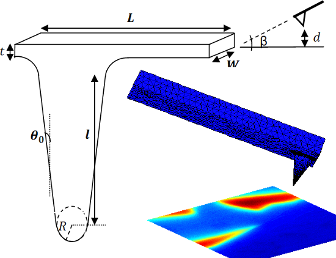
- calculated and found to be relatively small. Keywords: boundary elements method; cantilever; convolution; Kelvin probe force microscopy; point spread function; Introduction The effect of the measuring probe in electrostatic force based microscopies, such as Kelvin probe force microscopy (KPFM) [1], is very





