Abstract
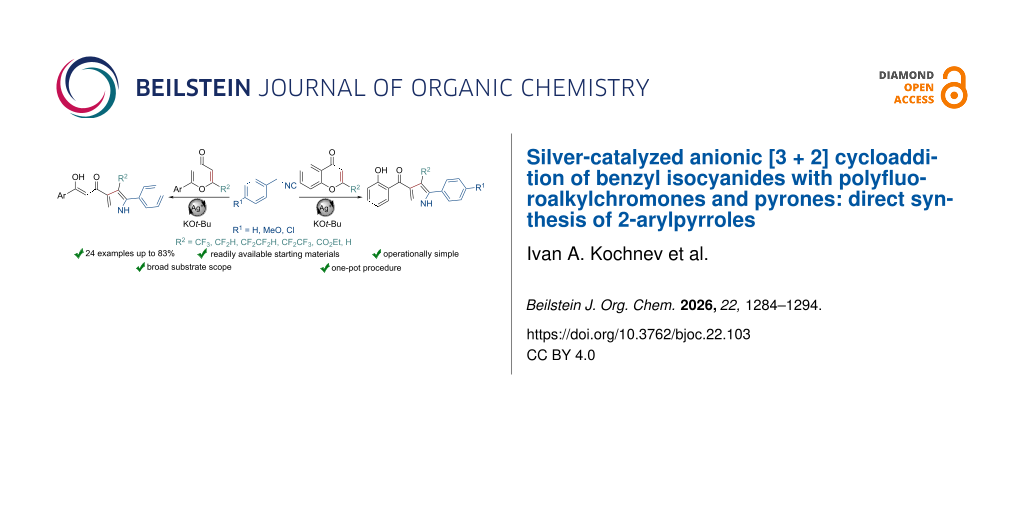
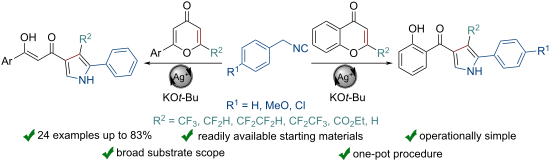
A silver-catalyzed anionic [3 + 2] cycloaddition of benzyl isocyanides has been developed, providing direct one-pot access to 2-arylpyrroles – a privileged scaffold pervasive in medicinal chemistry and functional materials. Despite high demand, general one-step routes to this motif remain rare, and the synthetic potential of benzyl isocyanides in cycloaddition chemistry has been severely limited by their low reactivity. We herein show that the combination of AgOAc (10 mol %) and KOt-Bu efficiently promote the reaction of benzyl isocyanides with 2-polyfluoroalkylchromones and 6-(trifluoromethyl)-4H-pyrones, delivering 2-arylpyrroles in yields of up to 83% with complete chemo- and regioselectivity. The protocol is operationally simple and extends readily to chromones and pyrones lacking a trifluoromethyl group, demonstrating a broad substrate scope. This work establishes a practical catalytic entry to an important heterocyclic class and unlocks the underexplored utility of benzyl isocyanides in cycloaddition reactions.
Graphical Abstract
Introduction
The pyrrole scaffold is a valuable heterocyclic framework occurring in a diverse array of natural products, pharmaceutical substances, and functional materials [1-5]. Natural and synthetic molecules containing a functionalized pyrrole core are of great interest in medicinal chemistry due to their broad spectrum of biological and pharmaceutical activities [1-4,6-9] (Figure 1a). In particular, the 2-arylpyrrole framework is a ubiquitous pharmacophore found in bioactive compounds and commercial drugs, exhibiting multi-faced biological properties, such as analgesic, anti-ulcer and antiviral [10-16] (Figure 1a). Beyond their medicinal use, 2-arylpyrroles serve as versatile building blocks for the synthesis of heterocyclic ensembles and dyes [5,9,17-20]. In recent decades, many strategies for the synthesis of these compounds have been developed. The main approaches for the synthesis of 2-arylpyrroles include classical Paal–Knorr and Hantzsch methods, multicomponent reactions, transition-metal-catalyzed cyclization, palladium-catalyzed cross-coupling reactions and [3 + 2] cycloaddition reactions [9,21-34].
![[1860-5397-22-103-1]](/bjoc/content/figures/1860-5397-22-103-1.svg?scale=2.0&max-width=1024&background=FFFFFF)
Figure 1: a) Examples of biologically active 2-arylpyrroles. b) Synthesis of five-membered heterocycles via [3 + 2] cycloaddition of benzyl isocyanides. c) This work: [3 + 2] cycloaddition of benzyl isocyanides to chromones and 4-pyrones.
Figure 1: a) Examples of biologically active 2-arylpyrroles. b) Synthesis of five-membered heterocycles via [...
The [3 + 2] cycloaddition reaction is a straightforward one-pot strategy for the construction of functionalized pyrrole cores [38,39]. The distinctive features of this approach are great regioselectivity, a wide range of available substrates, and simple synthetic procedures [32-34,38-43]. One of the most employed approaches for the synthesis of pyrroles via [3 + 2] cycloaddition is the reaction of activated isocyanides with electron-deficient alkenes or alkynes. This synthetic methodology, first demonstrated by Barton and Zard, includes the [3 + 2] cycloaddition of isocyanoacetates with nitroalkenes under basic conditions [40,41]. Subsequently, the groups of Armin de Meijere, Lei, and Bi successfully applied this approach to other alkenes and alkynes bearing electron-withdrawing groups [42-46]. Moreover, in the past decade, the use of synthetic equivalents to activated alkynes, including enamines, chromones, aurones and allenes, has been demonstrated in the [3 + 2] isocyanide cycloaddition reaction [33,34,47-50]. However, previous works have primarily focused on the synthetic application of the most reactive methylene isocyanides, such as isocyanoacetates and tosylmethyl isocyanide (TosMIC). On the other hand, there are limited reports on the systematic use of benzyl isocyanides in [3 + 2] cycloaddition reactions [32-34,38-50]. This is likely due to a decreased reactivity stemming from the lower acidity of the benzyl proton compared to isocyanoacetates and TosMIC [33,35-37,42-46,51]. However, previous reports have demonstrated that the [3 + 2] cycloaddition of benzyl isocyanides offers a promising route to the synthesis of different five-membered heterocycles, including oxazoles, imidazoles, imidazopyridines, imidazoquinolines and 2-arylpyrroles [33,35-37] (Figure 1b). Consequently, developing efficient methodologies for the [3 + 2] cycloaddition of benzyl isocyanides is an important aspect of organic synthesis and medicinal chemistry.
2-Trifluoromethylchromones and 6-(trifluoromethyl)-4H-pyrones are versatile building blocks for the synthesis of carbo- and heterocyclic compounds [52,53]. They are of great interest for organic synthesis owing to their easy accessibility and multifaceted reactivity [52-60]. In general, 2-trifluoromethylchromones and 6-(trifluoromethyl)-4H-pyrones can act as masked carbonyl compounds, Michael acceptors, and substrates in [3 + 2] cycloaddition reactions [34,54-59]. The presence of a trifluoromethyl group increases the reactivity of these compounds, which makes them convenient reagents for the construction of trifluoromethyl-containing products [34,52-60]. It should be noted that trifluoromethylation of carbo- and heterocyclic compounds has significant effects on biological properties, including lipophilicity, metabolic stability, and bioavailability [60,61]. Therefore, the development of efficient protocols for the synthesis of new trifluoromethyl-containing heterocyclic compounds is a significant objective of medicinal and agricultural chemistry [58-61]. We already successfully employed 2-trifluoromethylchromones and 6-(trifluoromethyl)-4H-pyrones in the synthesis of trifluoromethyl-containing pyrroles via a metal-catalyzed [3 + 2] cycloaddition of ethyl isocyanoacetate [34].
Herein, we report a new method for the synthesis of trifluoromethylated 2-arylpyrroles via the silver-catalyzed [3 + 2] cycloaddition of benzyl isocyanides to 2-trifluoromethylchromones and 6-(trifluoromethyl)-4H-pyrones (Figure 1c).
Results and Discussion
Initially, we investigated the model [3 + 2] cycloaddition reaction of benzyl isocyanide using different bases, solvents, and catalysts in accordance with literature data [33,34,42-50]. In the first experiments, it was shown that the desired product 3a does not form when potassium carbonate, cesium carbonate, and DBU are used without a catalyst (Table 1, entries 1–3.). This is likely due to the insufficient basicity of these reagents for the deprotonation of benzyl isocyanide [33,35-37,51]. It is noteworthy that the use of transition metals such as copper or silver increases the reactivity of methyl isocyanide in [3 + 2] cycloaddition reactions [34,38,39,43,45,48]. In this work, copper iodide and silver acetate were used as catalysts, as they had demonstrated the highest efficiency in the cycloaddition of ethyl isocyanoacetate to chromones [34,44,50]. Nevertheless, the use of copper iodide and silver acetate in the presence of weak bases allowed for the production of 2-arylpyrrole 3a with yields of 15–27% (Table 1, entries 4–7). Heating the reaction did slightly increase the yield of the product (Table 1, entries 8–10 and 23–26).
Table 1: Optimization of the reaction conditions.a
![[Graphic 1]](/bjoc/content/inline/1860-5397-22-103-i6.svg?max-width=637&scale=1.0)
|
|||||
| entry | solvent | T [°C] | base | catalyst | yield [%]b |
| 1c | MeCN | rt | K2CO3 | – | NDd |
| 2c | MeCN | rt | Cs2CO3 | – | NDd |
| 3c | MeCN | rt | DBU | – | NDd |
| 4 | MeCN | rt | K2CO3 | CuI | 15 |
| 5 | MeCN | rt | K2CO3 | AgOAc | 22 |
| 6 | MeCN | rt | Cs2CO3 | CuI | 27 |
| 7 | MeCN | rt | DBU | CuI | 25 |
| 8 | MeCN | 70 | K2CO3 | AgOAc | 34 |
| 9 | MeCN | 70 | Cs2CO3 | AgOAc | 41 |
| 10 | MeCN | 70 | DBU | AgOAc | 37 |
| 11c | MeCN | rt | KOt-Bu | – | 32 |
| 12 | MeCN | rt | KOt-Bu | AgOAc | 40 |
| 13 | MeCN | rt | KOt-Bu | CuI | 61 |
| 14 | MeCN | 0–5 | KOt-Bu | CuI | 68 |
| 15 | MeCN | 0–5 | KOt-Bu | AgOAc | 60 |
| 16c | MeCN | 0–5 | KOt-Bu | – | 35 |
| 17 | MeCN | 0–5 | KOt-Bu | CuI | 40 |
| 18 | THF | 0–5 | KOt-Bu | CuI | 30 |
| 19 | THF | 0–5 | KOt-Bu | AgOAc | 42 |
| 20 | THF | –5 to –10 | KOt-Bu | CuI | 52 |
| 21 | THF | –5 to –10 | KOt-Bu | AgOAc | 55 |
| 22 | THF | 0–5 | NaH | CuI | 25 |
| 23 | DMF | 70 | K2CO3 | AgOAc | 37 |
| 24 | DMF | 70 | Cs2CO3 | AgOAc | 47 |
| 25 | DMF | 70 | DBU | AgOAc | 43 |
| 26 | DMF | 100 | DBU | AgOAc | 30 |
| 27b | DMF | 0–5 | KOt-Bu | – | 40 |
| 28 | DMF | 0–5 | KOt-Bu | CuI | 70 |
| 29 | DMF | 0–5 | KOt-Bu | AgOAc | 62 |
| 30 | DMF | –5 to –10 | KOt-Bu | CuI | 78 |
| 31 | DMF | –5 to –10 | KOt-Bu | AgOAc | 83 |
| 32 | DMF | –15 to –20 | KOt-Bu | AgOAc | 35 |
| 33 | DMF | 0–5 | NaH | CuI | 65 |
| 34 | DMF | 0–5 | NaH | AgOAc | 67 |
| 35 | DMF | –5 to –10 | NaH | CuI | 63 |
| 36 | DMF | –5 to –10 | NaH | AgOAc | 68 |
aReaction conditions: benzyl isocyanide (1a, 88 mg, 0.75 mmol, 1.5 equiv), chromone 2a (107 mg, 0.5 mmol, 1.0 equiv), catalyst (0.05 mmol, 0.1 equiv, 10 mol %), base (1.0 mmol, 2.0 equiv), solvent (3 mL). bAll stated yields refer to isolated yields. cThe reaction was carried out without catalyst. dNot detected.
Next, we studied the effect of strong non-nucleophilic bases in polar aprotic solvents. Indeed, when potassium tert-butoxide used without a catalyst, pyrrole 3a is obtained in higher yields (Table 1, entries 11, 16, 27 vs entries 1–3). However, when using a catalyst, the yield of 3a increased to 25–83% (Table 1, entries 12–15, 17–26 and 28–36). Moreover, the highest yield was achieved when using silver acetate as a catalyst (Table 1, entries 12, 15, 19, 21, 29, 31, 32, 34, 36). The increase in yield when using a catalyst is likely due to the formation of a complex that stabilizes the anion formed after the deprotonation of benzyl isocyanide.
It is noteworthy that the reaction temperature has a significant effect on the yield of pyrrole 3a. For example, when the reaction is carried out at 0−5 °C, the yield of the product increases to 30–70% (Table 1, entries 14–19, 27–29, 33, 34). Moreover, further reduction of the reaction temperature from −5 to −10 °C leads to an increase in the yield of the product to 52–83% (Table 1, entries 20, 21, 30, 31, 35, 36). However, reducing the temperature from −15 to −20 °C leads to a decrease in the yield of pyrrole to 35% (Table 1, entry 32). The effect of the solvent was also demonstrated. The use of MeCN and THF results in comparable yields of the product (Table 1, entries 10–22). Nevertheless, the best yields of pyrrole were obtained in DMF (Table 1, entries 27–36). It should be noted that the [3 + 2] cycloaddition of benzyl isocyanide (1a) to chromone is characterized by great chemo- and regioselectivity, and pyrrole 3a was the only product regardless of the solvent, base and catalyst used. Based on the reaction screening, the optimized conditions for the synthesis of 3-(trifluoromethyl)-2-phenylpyrrole 3a were identified: 2.0 equiv of potassium tert-butoxide and 10 mol % of silver acetate in DMF at −5 to −10 °C for 4 hours.
Next, we investigated the scope of the methodology by using various benzyl isocyanides 1a–c and chromones 2a–l (Scheme 1). A series of 2-arylpyrroles were obtained in up to 83% yield. The reaction proceeds with benzyl isocyanides possessing both an electron-donor substituent and a halogen atom. The presence of a donor substituent in the benzyl isocyanide leads to a significant decrease in the yields of pyrroles 3b, 3e, 3h and 3p to 10–39%. This is probably due to the decrease in the acidity of the methylene group of isocyanide 1b due to the electron-donating effects of the methoxy group. A similar effect is observed for p-chlorobenzyl isocyanide used in the [3 + 2] cycloaddition reaction. However, the yields of pyrroles 3c, 3f, 3i and 3q are 37–53%. The decrease in the yields of pyrroles 3c, 3f, 3i and 3q is owing to the lower reactivity of the anion formed from isocyanide 1c caused by the electronic acceptor effect of the chlorine atom.
![[1860-5397-22-103-i1]](/bjoc/content/inline/1860-5397-22-103-i1.svg?scale=2.0&max-width=1024&background=FFFFFF)
Scheme 1: Cycloaddition of benzyl isocyanides 1a–c with chromones 2a–l. Reaction conditions: benzyl isocyanides 1a–c (0.75 mmol, 1.5 equiv), chromones 2a–l (0.5 mmol, 1.0 equiv), silver acetate (8 mg, 0.05 mmol, 0.1 equiv, 10 mol %), potassium tert-butoxide (112 mg, 1.0 mmol, 2.0 equiv), DMF (3 mL), −5 to −10 °C, 4 hours. All stated yields refer to isolated yields.
Scheme 1: Cycloaddition of benzyl isocyanides 1a–c with chromones 2a–l. Reaction conditions: benzyl isocyanid...
The effect of substituents in chromones has been demonstrated. Namely, the presence of a donor substituent in the aromatic core of the chromone has little effect on the yield of products 3a and 3g. On the other hand, the use of chromones containing a halogen atom or an acceptor substituent leads to decreased yields of pyrroles 3d–f and 3j to 16–60%. The same results were obtained when polysubstituted and fused chromones were used in the synthesis of 2-arylpyrroles 3k–m with 40–53% yields. Moreover, the azachromone smoothly reacted with benzyl isocyanide to form the desired pyrrole 3n with 60% yield. The effect of fluoroalkyl substituents has been demonstrated. When 2-trifluoromethylchromones were used, the highest yields were obtained due to their high reactivity. On the other hand, non-trifluoromethylated chromones were also successfully used in the synthesis of pyrroles 3s and 3t. It is noteworthy that when polyfluoroalkyl-containing chromones were used, the yields of pyrroles 3o–r decreased to 10–60% (Scheme 1), which is likely due to steric hindrance and side elimination reactions that lead to the polymerization of intermediates and reaction products. In particular, when using 2-difluoromethylchromone (2u), a complex mixture of difluoromethyl pyrrole 3u and the hydrolysis product of the difluoromethyl group, pyrrole-3-carbaldehyde 4u, was obtained (Scheme 2 and Supporting Information File 1). The structures and ratio of products 3u and 4u were determined based on literature data [62,63] and by using 1H, 13C, and 19F NMR spectra and high-resolution mass spectrometry (Figure 2 and Supporting Information File 1).
![[1860-5397-22-103-i2]](/bjoc/content/inline/1860-5397-22-103-i2.svg?scale=2.0&max-width=1024&background=FFFFFF)
Scheme 2: Reaction of benzyl isocyanide with chromone 2u. Reaction conditions: benzyl isocyanide (1a, 88 mg.,0.75 mmol, 1.5 equiv), chromone 2u (98 mg, 0.5 mmol, 1.0 equiv), silver acetate (8 mg, 0.05 mmol, 0.1 equiv, 10 mol %), potassium tert-butoxide (112 mg, 1.0 mmol, 2.0 equiv), DMF (3 mL), –5 to –10 °C, 4 hours. aThe structures and ratio of products 3u and 4u were determined by use of 1H, 19F, and 13C NMR spectra and HRMS. bStated yield refers to isolated yield.
Scheme 2: Reaction of benzyl isocyanide with chromone 2u. Reaction conditions: benzyl isocyanide (1a, 88 mg.,...
![[1860-5397-22-103-2]](/bjoc/content/figures/1860-5397-22-103-2.svg?scale=2.0&max-width=1024&background=FFFFFF)
Figure 2: The image of 1H NMR spectrum and high-resolution mass spectra of a mixture of pyrroles 3u and 4u.
Figure 2: The image of 1H NMR spectrum and high-resolution mass spectra of a mixture of pyrroles 3u and 4u.
In the 1H NMR spectrum of the mixture of pyrroles 3u and 4u, two types of peaks were observed. Thus, the characteristic signals of difluoromethylpyrrole 3u include the singlet of the phenolic proton 1 at 11.92 ppm, a broad singlet of the NH proton 3 of the pyrrole ring at 8.75 ppm and a triplet of the proton of the difluoromethyl group 2 with a spin-spin coupling constant J = 54.6 Hz (Figure 2 and Supporting Information File 1). Similarly, in the 13C NMR spectrum, characteristic signals of difluoromethylpyrrole 3u were observed, such as a singlet of the carbonyl group at 192.3 ppm, a triplet of the C-3 atom of the pyrrole ring at 113.2 ppm with a spin-spin coupling constant J = 24.1 Hz and a characteristic triplet of the difluoromethyl group at 111.98 ppm with a spin-spin coupling constant J = 231.0 Hz. In addition, a single doublet of the difluoromethyl group of pyrrole 3u was observed in the 19F NMR spectra (Supporting Information File 1). On the other hand, the structure of pyrrole-3-carbaldehyde 4u was determined by using combined data from 1H and 13C NMR spectroscopy. Namely, the 1H NMR signals include a singlet of the phenolic proton 1’ at 12.09 ppm, a singlet of the aldehyde proton 2’ at 10.02 ppm and a broad singlet of the NH proton 3’ of the pyrrole ring at 8.87 ppm (Figure 2 and Supporting Information File 1). In the 13C NMR spectra, a second set of aromatic signals and two signals of carbonyl groups at 194.7 and 186.3 ppm were observed (Supporting Information File 1). These structural assignments of products 3u and 4u were confirmed by high-resolution mass spectrometry. Molecular ions of pyrroles 3u and 4u were successfully detected in the mass spectrum of the mixture (Figure 2 and Supporting Information File 1). Moreover, the structure of 2-aryl-3-polyfluoroalkylpyrroles 3a–u was unambiguously established by X-ray single-crystal analysis (CCDC 2297092. Figure 3 and Supporting Information File 1).
![[1860-5397-22-103-3]](/bjoc/content/figures/1860-5397-22-103-3.png?scale=2.0&max-width=1024&background=FFFFFF)
Figure 3: The X-ray crystal structure of compound 3f (CCDC 2297092).
Figure 3: The X-ray crystal structure of compound 3f (CCDC 2297092).
It should be noted that 6-(trifluoromethyl)-4H-pyrones may undergo different transformations, exhibiting reactivity similar to that of chromones [34,53,59]. In particular, they have been successfully used in [3 + 2] cycloaddition reactions, but pyrones remain less studied substrates due to their lower synthetic availability [34,59]. Previously, we reported a new method for the synthesis of 4-pyrones based on the dehydrative cyclization of 1,3,5-triketones [61]. Therefore, the use of pyrones in the [3 + 2] cycloaddition reaction of benzyl isocyanide increases the scope of the proposed methodology and provides structural diversity of the desired pyrroles (Scheme 3).
![[1860-5397-22-103-i3]](/bjoc/content/inline/1860-5397-22-103-i3.svg?scale=2.0&max-width=1024&background=FFFFFF)
Scheme 3: Cycloaddition of benzyl isocyanide (1a) with 4-pyrones 5a–d. Reaction conditions: benzyl isocyanide (1a, 88 mg, 0.75 mmol, 1.5 equiv), 4-pyrones 5a–d (0.5 mmol, 1.0 equiv), silver acetate (8 mg, 0.05 mmol, 0.1 equiv, 10 mol %), potassium tert-butoxide (112 mg, 1.0 mmol, 2.0 equiv), DMF (3 mL), −5 to −10 °C, 4 hours. All stated yields refer to isolated yields.
Scheme 3: Cycloaddition of benzyl isocyanide (1a) with 4-pyrones 5a–d. Reaction conditions: benzyl isocyanide...
The use of 4-pyrones 5a–c in the reaction with benzyl isocyanide (1a) under standard conditions produced 2-arylpyrroles 6a–c with 63–72% yield. The presence of a methoxy group and a chlorine atom in the aromatic ring of the pyrone had only little effect on the yields of pyrroles 6b and 6c. Moreover, this methodology was successfully used in the synthesis of pyrrole 6d from the ethyl ester of 6-phenylcomanic acid.
The structures of 2-arylpyrroles 3a–u and 6a–d were determined based on literature data and combined information from X-ray single-crystal analysis (CCDC 2297092, Figure 3), values of 1H,1H coupling constants as well as 1H, 19F and 13C chemical shifts (Supporting Information File 1) [33,34,48,62,63]. It is noteworthy that products 6a–d were obtained as the enol tautomer with a Z-configuration of the double bond owing to the reaction mechanism and the stability of this tautomer due to an intramolecular hydrogen bond (Supporting Information File 1). Finally, to demonstrate the synthetic utility of this methodology, we scaled up the reaction to a 3.0 mmol scale, whereby 0.615 g of 2-arylpyrrole 3a was obtained in 62% yield (Scheme 4. Supporting Information File 1).
![[1860-5397-22-103-i4]](/bjoc/content/inline/1860-5397-22-103-i4.svg?scale=2.0&max-width=1024&background=FFFFFF)
Scheme 4: Large scale reaction of the [3 + 2] cycloaddition reaction. Reaction conditions: benzyl isocyanide (1a, 0.527 g, 4.5 mmol, 1.5 equiv), chromone 2a (0.642 g, 3.0 mmol, 1.0 equiv), silver acetate (0.0240 mg, 0.15 mmol, 0.1 equiv, 10 mol %), base (1.0 mmol, 2.0 equiv), DMF (10 mL).
Scheme 4: Large scale reaction of the [3 + 2] cycloaddition reaction. Reaction conditions: benzyl isocyanide (...
The plausible reaction mechanism can be proposed based on literature data [33,34,38-50] (Scheme 5). The formation of 2-arylpyrroles 3a–u and 6a–d involves a catalytic cycle. In this cycle, silver acetate initially reacts with benzyl isocyanides, which leads to the formation of complex A. Complex A further interacts with potassium tert-butoxide and gives anion B. It is likely that the use of a catalyst is necessary both to increase the acidity of the benzyl proton and to stabilize anion B. Complex B subsequently undergoes Michael addition to chromones 2a–u or pyrones 5a–d, forming intermediate C. Complex C is transformed to D through intramolecular cyclization. After cleavage of the metal ion from D, the catalytic cycle is completed, and pyrroline E is formed. Then the chromane/pyran ring opens after deprotonation of pyrroline E to give intermediate F. Finally, intermediate F after a 1,3-hydrogen shift and subsequent acidification, affords 2-arylpyrroles 3a–u and 6a–d.
![[1860-5397-22-103-i5]](/bjoc/content/inline/1860-5397-22-103-i5.svg?scale=2.0&max-width=1024&background=FFFFFF)
Scheme 5: Proposed mechanism of [3 + 2] cycloaddition reaction.
Scheme 5: Proposed mechanism of [3 + 2] cycloaddition reaction.
Conclusion
We have developed a one-pot, silver-catalyzed base-induced anionic [3 + 2] cycloaddition of benzyl isocyanides with 2-polyfluoroalkylchromones and 6-(trifluoromethyl)-4H-pyrones for the direct synthesis of 2-arylpyrroles. The reaction proceeds under mild conditions (10 mol % of AgOAc, 2.0 equiv of KOt-Bu, DMF) and furnishes 2-arylpyrroles 3a–t in yields of up to 83% with high chemo- and regioselectivity. The scope was extended to 6-(trifluoromethyl)-4H-pyrones, affording the corresponding pyrroles 6a–c in up to 72% yield, and further to chromones and 4-pyrones lacking polyfluoroalkyl groups, yielding pyrroles 3s, 3t and 6d. This operationally simple method provides a versatile and practical entry to the 2-arylpyrrole scaffold, a privileged motif in medicinal chemistry and materials science.
Supporting Information
CCDC 2297092 contains the supplementary crystallographic data for this paper. These data can be obtained free of charge via https://www.ccdc.cam.ac.uk/data_request/cif, or by emailing data_request@ccdc.cam.ac.uk, or by contacting The Cambridge Crystallographic Data Centre, 12 Union Road, Cambridge CB2 1EZ, UK; fax: +44 1223336033.
| Supporting Information File 1: Materials and methods, detailed optimization table, experimental procedure, characterization data, сopies of 1H NMR, 19F NMR and 13C NMR spectra for all new compounds. | ||
| Format: PDF | Size: 4.7 MB | Download |
Data Availability Statement
All data that supports the findings of this study is available in the published article and/or the supporting information of this article.
References
-
Seipp, K.; Geske, L.; Opatz, T. Mar. Drugs 2021, 19, 514. doi:10.3390/md19090514
Return to citation in text: [1] [2] -
Bailey, D. M.; Johnson, R. E.; Salvador, U. J. J. Med. Chem. 1973, 16, 1298–1300. doi:10.1021/jm00269a018
Return to citation in text: [1] [2] -
Bianco, M. d. C. A. D.; Marinho, D. I. L. F.; Hoelz, L. V. B.; Bastos, M. M.; Boechat, N. Pharmaceuticals 2021, 14, 893. doi:10.3390/ph14090893
Return to citation in text: [1] [2] -
Baird, W.; Turek, D. J. Clin. Pharmacol. 1980, 20, 243–249. doi:10.1002/j.1552-4604.1980.tb01704.x
Return to citation in text: [1] [2] -
Shamova, L. I.; Zatsikha, Y. V.; Nemykin, V. N. Dalton Trans. 2021, 50, 1569–1593. doi:10.1039/d0dt03964k
Return to citation in text: [1] [2] -
Tramontano, E.; Esposito, F.; Badas, R.; Di Santo, R.; Costi, R.; La Colla, P. Antiviral Res. 2005, 65, 117–124. doi:10.1016/j.antiviral.2004.11.002
Return to citation in text: [1] -
Olszewska, P.; Cal, D.; Zagórski, P.; Mikiciuk-Olasik, E. Eur. J. Pharmacol. 2020, 871, 172943. doi:10.1016/j.ejphar.2020.172943
Return to citation in text: [1] -
Tarzia, G.; Duranti, A.; Tontini, A.; Spadoni, G.; Mor, M.; Rivara, S.; Vincenzo Plazzi, P.; Kathuria, S.; Piomelli, D. Bioorg. Med. Chem. 2003, 11, 3965–3973. doi:10.1016/s0968-0896(03)00413-9
Return to citation in text: [1] -
Hunjan, M. K.; Panday, S.; Gupta, A.; Bhaumik, J.; Das, P.; Laha, J. K. Chem. Rec. 2021, 21, 715–780. doi:10.1002/tcr.202100010
Return to citation in text: [1] [2] [3] -
Echizen, H. Clin. Pharmacokinet. 2016, 55, 409–418. doi:10.1007/s40262-015-0326-7
Return to citation in text: [1] -
Black, B. C.; Hollingworth, R. M.; Ahammadsahib, K. I.; Kukel, C. D.; Donovan, S. Pestic. Biochem. Physiol. 1994, 50, 115–128. doi:10.1006/pest.1994.1064
Return to citation in text: [1] -
Wang, C.; Quan, Y.; Wang, L.; Li, G. Eur. J. Clin. Pharmacol. 2023, 79, 1641–1656. doi:10.1007/s00228-023-03575-4
Return to citation in text: [1] -
Joharapurkar, A.; Patel, V.; Kshirsagar, S.; Patel, M. S.; Savsani, H.; Jain, M. Eur. J. Pharmacol. 2021, 899, 174032. doi:10.1016/j.ejphar.2021.174032
Return to citation in text: [1] -
Huffman, J. W.; Padgett, L. W.; Isherwood, M. L.; Wiley, J. L.; Martin, B. R. Bioorg. Med. Chem. Lett. 2006, 16, 5432–5435. doi:10.1016/j.bmcl.2006.07.051
Return to citation in text: [1] -
Curreli, F.; Belov, D. S.; Ramesh, R. R.; Patel, N.; Altieri, A.; Kurkin, A. V.; Debnath, A. K. Bioorg. Med. Chem. 2016, 24, 5988–6003. doi:10.1016/j.bmc.2016.09.057
Return to citation in text: [1] -
Saccoliti, F.; Madia, V. N.; Tudino, V.; De Leo, A.; Pescatori, L.; Messore, A.; De Vita, D.; Scipione, L.; Brun, R.; Kaiser, M.; Mäser, P.; Calvet, C. M.; Jennings, G. K.; Podust, L. M.; Pepe, G.; Cirilli, R.; Faggi, C.; Di Marco, A.; Battista, M. R.; Summa, V.; Costi, R.; Di Santo, R. J. Med. Chem. 2019, 62, 1330–1347. doi:10.1021/acs.jmedchem.8b01464
Return to citation in text: [1] -
Efimov, I. V.; Sultanova, Y. V.; Cicolella, A.; Talarico, G.; Voskressensky, L. G. Org. Biomol. Chem. 2024, 22, 6331–6341. doi:10.1039/d4ob00717d
Return to citation in text: [1] -
Matveeva, M. D.; Zheleznova, T. Y.; Kostyuchenko, A. S.; Miftyakhova, A. R.; Zhilyaev, D. I.; Voskressensky, L. G.; Talarico, G.; Efimov, I. V. ChemistrySelect 2023, 8, e202204465. doi:10.1002/slct.202204465
Return to citation in text: [1] -
Komatsubara, M.; Umeki, T.; Fukuda, T.; Iwao, M. J. Org. Chem. 2014, 79, 529–537. doi:10.1021/jo402181w
Return to citation in text: [1] -
Jia, L.; Li, B.; Wang, X.; Zhao, J.; Qu, J.; Zhou, Y. Org. Biomol. Chem. 2024, 22, 8749–8754. doi:10.1039/d4ob01174k
Return to citation in text: [1] -
Philkhana, S. C.; Badmus, F. O.; Dos Reis, I. C.; Kartika, R. Synthesis 2021, 53, 1531–1555. doi:10.1055/s-0040-1706713
Return to citation in text: [1] -
Knorr, L. Justus Liebigs Ann. Chem. 1886, 236, 290–332. doi:10.1002/jlac.18862360303
Return to citation in text: [1] -
Knorr, L. Ber. Dtsch. Chem. Ges. 1884, 17, 2863–2870. doi:10.1002/cber.188401702254
Return to citation in text: [1] -
Paal, C. Ber. Dtsch. Chem. Ges. 1884, 17, 2756–2767. doi:10.1002/cber.188401702228
Return to citation in text: [1] -
Hantzsch, A. Ber. Dtsch. Chem. Ges. 1890, 23, 1474–1476. doi:10.1002/cber.189002301243
Return to citation in text: [1] -
Yu, Z.; Li, J.; Cao, Y.; Dong, T.; Xiao, Y. J. Org. Chem. 2023, 88, 15501–15506. doi:10.1021/acs.joc.3c01790
Return to citation in text: [1] -
Korotaev, V. Y.; Barkov, A. Y.; Kotovich, I. V.; Sosnovskikh, V. Y. J. Fluorine Chem. 2012, 138, 42–47. doi:10.1016/j.jfluchem.2012.03.012
Return to citation in text: [1] -
Zeng, W.; Li, H.; Wang, D.; Zhou, L. J. Org. Chem. 2023, 88, 14088–14095. doi:10.1021/acs.joc.3c01611
Return to citation in text: [1] -
Wu, W.; Wen, S.; Zhang, X.; Lin, Q.; Weng, Z. Org. Lett. 2021, 23, 6352–6356. doi:10.1021/acs.orglett.1c02136
Return to citation in text: [1] -
Bheeter, C. B.; Bera, J. K.; Doucet, H. Tetrahedron Lett. 2012, 53, 509–513. doi:10.1016/j.tetlet.2011.11.081
Return to citation in text: [1] -
Özdemir, I.; Gürbüz, N.; Kaloğlu, N.; Doğan, Ö.; Kaloğlu, M.; Bruneau, C.; Doucet, H. Beilstein J. Org. Chem. 2013, 9, 303–312. doi:10.3762/bjoc.9.35
Return to citation in text: [1] -
Ling, S.; Zhang, Y.; Chen, Z.; Wu, X.-F. Adv. Synth. Catal. 2023, 365, 3382–3386. doi:10.1002/adsc.202300759
Return to citation in text: [1] [2] [3] -
Efimov, I. V.; Matveeva, M. D.; Luque, R.; Bakulev, V. A.; Voskressensky, L. G. Eur. J. Org. Chem. 2020, 1108–1113. doi:10.1002/ejoc.201901776
Return to citation in text: [1] [2] [3] [4] [5] [6] [7] [8] [9] [10] -
Kochnev, I. A.; Barkov, A. Y. New J. Chem. 2025, 49, 20254–20263. doi:10.1039/d5nj03333k
Return to citation in text: [1] [2] [3] [4] [5] [6] [7] [8] [9] [10] [11] [12] [13] [14] -
dos Santos, A.; El Kaïm, L.; Grimaud, L.; Ronsseray, C. Chem. Commun. 2009, 3907. doi:10.1039/b904699b
Return to citation in text: [1] [2] [3] -
Pooi, B.; Lee, J.; Choi, K.; Hirao, H.; Hong, S. H. J. Org. Chem. 2014, 79, 9231–9245. doi:10.1021/jo501652w
Return to citation in text: [1] [2] [3] -
Li, Y.; Chao, A.; Fleming, F. F. Chem. Commun. 2016, 52, 2111–2113. doi:10.1039/c5cc08724d
Return to citation in text: [1] [2] [3] -
Lygin, A. V.; de Meijere, A. Angew. Chem., Int. Ed. 2010, 49, 9094–9124. doi:10.1002/anie.201000723
Return to citation in text: [1] [2] [3] [4] [5] -
Efimov, I. V.; Kulikova, L. N.; Zhilyaev, D. I.; Voskressensky, L. G. Eur. J. Org. Chem. 2020, 7284–7303. doi:10.1002/ejoc.202000890
Return to citation in text: [1] [2] [3] [4] [5] -
Barton, D. H. R.; Zard, S. Z. J. Chem. Soc., Chem. Commun. 1985, 21, 1098–1100. doi:10.1039/c39850001098
Return to citation in text: [1] [2] [3] [4] -
Oldenziel, O. H.; Van Leusen, D.; Van Leusen, A. M. J. Org. Chem. 1977, 42, 3114–3118. doi:10.1021/jo00439a002
Return to citation in text: [1] [2] [3] [4] -
Larionov, O. V.; de Meijere, A. Angew. Chem., Int. Ed. 2005, 44, 5664–5667. doi:10.1002/anie.200502140
Return to citation in text: [1] [2] [3] [4] [5] [6] -
Lygin, A. V.; Larionov, O. V.; Korotkov, V. S.; de Meijere, A. Chem. – Eur. J. 2009, 15, 227–236. doi:10.1002/chem.200801395
Return to citation in text: [1] [2] [3] [4] [5] [6] [7] -
Gao, M.; He, C.; Chen, H.; Bai, R.; Cheng, B.; Lei, A. Angew. Chem., Int. Ed. 2013, 52, 6958–6961. doi:10.1002/anie.201302604
Return to citation in text: [1] [2] [3] [4] [5] [6] -
Liu, J.; Fang, Z.; Zhang, Q.; Liu, Q.; Bi, X. Angew. Chem., Int. Ed. 2013, 52, 6953–6957. doi:10.1002/anie.201302024
Return to citation in text: [1] [2] [3] [4] [5] [6] -
Kamijo, S.; Kanazawa, C.; Yamamoto, Y. J. Am. Chem. Soc. 2005, 127, 9260–9266. doi:10.1021/ja051875m
Return to citation in text: [1] [2] [3] [4] [5] -
Markitanov, Y. N.; Timoshenko, V. M.; Rusanov, E. B.; Shermolovich, Y. G. Chem. Heterocycl. Compd. 2021, 57, 253–260. doi:10.1007/s10593-021-02901-x
Return to citation in text: [1] [2] [3] [4] -
Qi, X.; Xiang, H.; Yang, Y.; Yang, C. RSC Adv. 2015, 5, 98549–98552. doi:10.1039/c5ra21915a
Return to citation in text: [1] [2] [3] [4] [5] [6] -
Wang, Z.-P.; He, Y.; Shao, P.-L. Org. Biomol. Chem. 2018, 16, 5422–5426. doi:10.1039/c8ob01558a
Return to citation in text: [1] [2] [3] [4] -
Liao, J.-Y.; Shao, P.-L.; Zhao, Y. J. Am. Chem. Soc. 2015, 137, 628–631. doi:10.1021/ja511895q
Return to citation in text: [1] [2] [3] [4] [5] -
Kamer, P. C. J.; Nolte, R. J. M.; Drenth, W. J. Am. Chem. Soc. 1988, 110, 6818–6825. doi:10.1021/ja00228a035
Return to citation in text: [1] [2] -
Sosnovskikh, V. Y. Russ. Chem. Rev. 2003, 72, 489–516. doi:10.1070/rc2003v072n06abeh000770
Return to citation in text: [1] [2] [3] -
Usachev, B. I. J. Fluorine Chem. 2015, 172, 80–91. doi:10.1016/j.jfluchem.2015.01.012
Return to citation in text: [1] [2] [3] [4] -
Sosnovskikh, V. Y.; Usachev, B. I.; Sizov, A. Y.; Barabanov, M. A. Synthesis 2004, 942–948. doi:10.1055/s-2004-822321
Return to citation in text: [1] [2] [3] -
Sosnovskikh, V. Y.; Usachev, B. I. Synthesis 2002, 2341–2343. doi:10.1055/s-2002-35233
Return to citation in text: [1] [2] [3] -
Usachev, S. A.; Usachev, B. I.; Eltsov, O. S.; Sosnovskikh, V. Y. Tetrahedron 2014, 70, 8863–8871. doi:10.1016/j.tet.2014.09.093
Return to citation in text: [1] [2] [3] -
Wang, J.; Zhou, Y.; Wang, X.; Duan, L.; Duan, J.; Li, W.; Zhang, A. J. Agric. Food Chem. 2020, 68, 3071–3078. doi:10.1021/acs.jafc.9b08057
Return to citation in text: [1] [2] [3] -
Zhao, C.; Zhao, F.; Yang, L.; Wang, Y.; Wang, H.; Fang, F.; Zuo, H.; Li, Z.; He, G.; Zhan, W.; Ma, X. J. Med. Chem. 2024, 67, 11751–11768. doi:10.1021/acs.jmedchem.4c00272
Return to citation in text: [1] [2] [3] [4] -
Usachev, S. A.; Nigamatova, D. I.; Mysik, D. K.; Naumov, N. A.; Obydennov, D. L.; Sosnovskikh, V. Y. Molecules 2021, 26, 4415. doi:10.3390/molecules26154415
Return to citation in text: [1] [2] [3] [4] [5] [6] -
Meanwell, N. A. J. Med. Chem. 2018, 61, 5822–5880. doi:10.1021/acs.jmedchem.7b01788
Return to citation in text: [1] [2] [3] [4] -
Kochnev, I. A.; Zavyalova, L. S.; Avkhadieva, A. I.; Tverdokhlebov, N. A.; Barkov, A. Y. J. Fluorine Chem. 2024, 280, 110368. doi:10.1016/j.jfluchem.2024.110368
Return to citation in text: [1] [2] [3] -
Melanson, J. A.; Figliola, C.; Smithen, D. A.; Kajetanowicz, A. K.; Thompson, A. Org. Biomol. Chem. 2017, 15, 144–152. doi:10.1039/c6ob01441k
Return to citation in text: [1] [2] -
Ge, D.; Liu, S.; Jiang, Y.-S.; Wang, X.; Huang, X.-Y.; Ma, M.; Mao, X.; Chu, X.-Q. Adv. Synth. Catal. 2026, 368, e70556. doi:10.1002/adsc.70556
Return to citation in text: [1] [2]
| 61. | Kochnev, I. A.; Zavyalova, L. S.; Avkhadieva, A. I.; Tverdokhlebov, N. A.; Barkov, A. Y. J. Fluorine Chem. 2024, 280, 110368. doi:10.1016/j.jfluchem.2024.110368 |
| 33. | Efimov, I. V.; Matveeva, M. D.; Luque, R.; Bakulev, V. A.; Voskressensky, L. G. Eur. J. Org. Chem. 2020, 1108–1113. doi:10.1002/ejoc.201901776 |
| 34. | Kochnev, I. A.; Barkov, A. Y. New J. Chem. 2025, 49, 20254–20263. doi:10.1039/d5nj03333k |
| 48. | Qi, X.; Xiang, H.; Yang, Y.; Yang, C. RSC Adv. 2015, 5, 98549–98552. doi:10.1039/c5ra21915a |
| 62. | Melanson, J. A.; Figliola, C.; Smithen, D. A.; Kajetanowicz, A. K.; Thompson, A. Org. Biomol. Chem. 2017, 15, 144–152. doi:10.1039/c6ob01441k |
| 63. | Ge, D.; Liu, S.; Jiang, Y.-S.; Wang, X.; Huang, X.-Y.; Ma, M.; Mao, X.; Chu, X.-Q. Adv. Synth. Catal. 2026, 368, e70556. doi:10.1002/adsc.70556 |
| 33. | Efimov, I. V.; Matveeva, M. D.; Luque, R.; Bakulev, V. A.; Voskressensky, L. G. Eur. J. Org. Chem. 2020, 1108–1113. doi:10.1002/ejoc.201901776 |
| 34. | Kochnev, I. A.; Barkov, A. Y. New J. Chem. 2025, 49, 20254–20263. doi:10.1039/d5nj03333k |
| 38. | Lygin, A. V.; de Meijere, A. Angew. Chem., Int. Ed. 2010, 49, 9094–9124. doi:10.1002/anie.201000723 |
| 39. | Efimov, I. V.; Kulikova, L. N.; Zhilyaev, D. I.; Voskressensky, L. G. Eur. J. Org. Chem. 2020, 7284–7303. doi:10.1002/ejoc.202000890 |
| 40. | Barton, D. H. R.; Zard, S. Z. J. Chem. Soc., Chem. Commun. 1985, 21, 1098–1100. doi:10.1039/c39850001098 |
| 41. | Oldenziel, O. H.; Van Leusen, D.; Van Leusen, A. M. J. Org. Chem. 1977, 42, 3114–3118. doi:10.1021/jo00439a002 |
| 42. | Larionov, O. V.; de Meijere, A. Angew. Chem., Int. Ed. 2005, 44, 5664–5667. doi:10.1002/anie.200502140 |
| 43. | Lygin, A. V.; Larionov, O. V.; Korotkov, V. S.; de Meijere, A. Chem. – Eur. J. 2009, 15, 227–236. doi:10.1002/chem.200801395 |
| 44. | Gao, M.; He, C.; Chen, H.; Bai, R.; Cheng, B.; Lei, A. Angew. Chem., Int. Ed. 2013, 52, 6958–6961. doi:10.1002/anie.201302604 |
| 45. | Liu, J.; Fang, Z.; Zhang, Q.; Liu, Q.; Bi, X. Angew. Chem., Int. Ed. 2013, 52, 6953–6957. doi:10.1002/anie.201302024 |
| 46. | Kamijo, S.; Kanazawa, C.; Yamamoto, Y. J. Am. Chem. Soc. 2005, 127, 9260–9266. doi:10.1021/ja051875m |
| 47. | Markitanov, Y. N.; Timoshenko, V. M.; Rusanov, E. B.; Shermolovich, Y. G. Chem. Heterocycl. Compd. 2021, 57, 253–260. doi:10.1007/s10593-021-02901-x |
| 48. | Qi, X.; Xiang, H.; Yang, Y.; Yang, C. RSC Adv. 2015, 5, 98549–98552. doi:10.1039/c5ra21915a |
| 49. | Wang, Z.-P.; He, Y.; Shao, P.-L. Org. Biomol. Chem. 2018, 16, 5422–5426. doi:10.1039/c8ob01558a |
| 50. | Liao, J.-Y.; Shao, P.-L.; Zhao, Y. J. Am. Chem. Soc. 2015, 137, 628–631. doi:10.1021/ja511895q |
| 1. | Seipp, K.; Geske, L.; Opatz, T. Mar. Drugs 2021, 19, 514. doi:10.3390/md19090514 |
| 2. | Bailey, D. M.; Johnson, R. E.; Salvador, U. J. J. Med. Chem. 1973, 16, 1298–1300. doi:10.1021/jm00269a018 |
| 3. | Bianco, M. d. C. A. D.; Marinho, D. I. L. F.; Hoelz, L. V. B.; Bastos, M. M.; Boechat, N. Pharmaceuticals 2021, 14, 893. doi:10.3390/ph14090893 |
| 4. | Baird, W.; Turek, D. J. Clin. Pharmacol. 1980, 20, 243–249. doi:10.1002/j.1552-4604.1980.tb01704.x |
| 5. | Shamova, L. I.; Zatsikha, Y. V.; Nemykin, V. N. Dalton Trans. 2021, 50, 1569–1593. doi:10.1039/d0dt03964k |
| 9. | Hunjan, M. K.; Panday, S.; Gupta, A.; Bhaumik, J.; Das, P.; Laha, J. K. Chem. Rec. 2021, 21, 715–780. doi:10.1002/tcr.202100010 |
| 21. | Philkhana, S. C.; Badmus, F. O.; Dos Reis, I. C.; Kartika, R. Synthesis 2021, 53, 1531–1555. doi:10.1055/s-0040-1706713 |
| 22. | Knorr, L. Justus Liebigs Ann. Chem. 1886, 236, 290–332. doi:10.1002/jlac.18862360303 |
| 23. | Knorr, L. Ber. Dtsch. Chem. Ges. 1884, 17, 2863–2870. doi:10.1002/cber.188401702254 |
| 24. | Paal, C. Ber. Dtsch. Chem. Ges. 1884, 17, 2756–2767. doi:10.1002/cber.188401702228 |
| 25. | Hantzsch, A. Ber. Dtsch. Chem. Ges. 1890, 23, 1474–1476. doi:10.1002/cber.189002301243 |
| 26. | Yu, Z.; Li, J.; Cao, Y.; Dong, T.; Xiao, Y. J. Org. Chem. 2023, 88, 15501–15506. doi:10.1021/acs.joc.3c01790 |
| 27. | Korotaev, V. Y.; Barkov, A. Y.; Kotovich, I. V.; Sosnovskikh, V. Y. J. Fluorine Chem. 2012, 138, 42–47. doi:10.1016/j.jfluchem.2012.03.012 |
| 28. | Zeng, W.; Li, H.; Wang, D.; Zhou, L. J. Org. Chem. 2023, 88, 14088–14095. doi:10.1021/acs.joc.3c01611 |
| 29. | Wu, W.; Wen, S.; Zhang, X.; Lin, Q.; Weng, Z. Org. Lett. 2021, 23, 6352–6356. doi:10.1021/acs.orglett.1c02136 |
| 30. | Bheeter, C. B.; Bera, J. K.; Doucet, H. Tetrahedron Lett. 2012, 53, 509–513. doi:10.1016/j.tetlet.2011.11.081 |
| 31. | Özdemir, I.; Gürbüz, N.; Kaloğlu, N.; Doğan, Ö.; Kaloğlu, M.; Bruneau, C.; Doucet, H. Beilstein J. Org. Chem. 2013, 9, 303–312. doi:10.3762/bjoc.9.35 |
| 32. | Ling, S.; Zhang, Y.; Chen, Z.; Wu, X.-F. Adv. Synth. Catal. 2023, 365, 3382–3386. doi:10.1002/adsc.202300759 |
| 33. | Efimov, I. V.; Matveeva, M. D.; Luque, R.; Bakulev, V. A.; Voskressensky, L. G. Eur. J. Org. Chem. 2020, 1108–1113. doi:10.1002/ejoc.201901776 |
| 34. | Kochnev, I. A.; Barkov, A. Y. New J. Chem. 2025, 49, 20254–20263. doi:10.1039/d5nj03333k |
| 52. | Sosnovskikh, V. Y. Russ. Chem. Rev. 2003, 72, 489–516. doi:10.1070/rc2003v072n06abeh000770 |
| 53. | Usachev, B. I. J. Fluorine Chem. 2015, 172, 80–91. doi:10.1016/j.jfluchem.2015.01.012 |
| 54. | Sosnovskikh, V. Y.; Usachev, B. I.; Sizov, A. Y.; Barabanov, M. A. Synthesis 2004, 942–948. doi:10.1055/s-2004-822321 |
| 55. | Sosnovskikh, V. Y.; Usachev, B. I. Synthesis 2002, 2341–2343. doi:10.1055/s-2002-35233 |
| 56. | Usachev, S. A.; Usachev, B. I.; Eltsov, O. S.; Sosnovskikh, V. Y. Tetrahedron 2014, 70, 8863–8871. doi:10.1016/j.tet.2014.09.093 |
| 57. | Wang, J.; Zhou, Y.; Wang, X.; Duan, L.; Duan, J.; Li, W.; Zhang, A. J. Agric. Food Chem. 2020, 68, 3071–3078. doi:10.1021/acs.jafc.9b08057 |
| 58. | Zhao, C.; Zhao, F.; Yang, L.; Wang, Y.; Wang, H.; Fang, F.; Zuo, H.; Li, Z.; He, G.; Zhan, W.; Ma, X. J. Med. Chem. 2024, 67, 11751–11768. doi:10.1021/acs.jmedchem.4c00272 |
| 59. | Usachev, S. A.; Nigamatova, D. I.; Mysik, D. K.; Naumov, N. A.; Obydennov, D. L.; Sosnovskikh, V. Y. Molecules 2021, 26, 4415. doi:10.3390/molecules26154415 |
| 60. | Meanwell, N. A. J. Med. Chem. 2018, 61, 5822–5880. doi:10.1021/acs.jmedchem.7b01788 |
| 5. | Shamova, L. I.; Zatsikha, Y. V.; Nemykin, V. N. Dalton Trans. 2021, 50, 1569–1593. doi:10.1039/d0dt03964k |
| 9. | Hunjan, M. K.; Panday, S.; Gupta, A.; Bhaumik, J.; Das, P.; Laha, J. K. Chem. Rec. 2021, 21, 715–780. doi:10.1002/tcr.202100010 |
| 17. | Efimov, I. V.; Sultanova, Y. V.; Cicolella, A.; Talarico, G.; Voskressensky, L. G. Org. Biomol. Chem. 2024, 22, 6331–6341. doi:10.1039/d4ob00717d |
| 18. | Matveeva, M. D.; Zheleznova, T. Y.; Kostyuchenko, A. S.; Miftyakhova, A. R.; Zhilyaev, D. I.; Voskressensky, L. G.; Talarico, G.; Efimov, I. V. ChemistrySelect 2023, 8, e202204465. doi:10.1002/slct.202204465 |
| 19. | Komatsubara, M.; Umeki, T.; Fukuda, T.; Iwao, M. J. Org. Chem. 2014, 79, 529–537. doi:10.1021/jo402181w |
| 20. | Jia, L.; Li, B.; Wang, X.; Zhao, J.; Qu, J.; Zhou, Y. Org. Biomol. Chem. 2024, 22, 8749–8754. doi:10.1039/d4ob01174k |
| 34. | Kochnev, I. A.; Barkov, A. Y. New J. Chem. 2025, 49, 20254–20263. doi:10.1039/d5nj03333k |
| 54. | Sosnovskikh, V. Y.; Usachev, B. I.; Sizov, A. Y.; Barabanov, M. A. Synthesis 2004, 942–948. doi:10.1055/s-2004-822321 |
| 55. | Sosnovskikh, V. Y.; Usachev, B. I. Synthesis 2002, 2341–2343. doi:10.1055/s-2002-35233 |
| 56. | Usachev, S. A.; Usachev, B. I.; Eltsov, O. S.; Sosnovskikh, V. Y. Tetrahedron 2014, 70, 8863–8871. doi:10.1016/j.tet.2014.09.093 |
| 57. | Wang, J.; Zhou, Y.; Wang, X.; Duan, L.; Duan, J.; Li, W.; Zhang, A. J. Agric. Food Chem. 2020, 68, 3071–3078. doi:10.1021/acs.jafc.9b08057 |
| 58. | Zhao, C.; Zhao, F.; Yang, L.; Wang, Y.; Wang, H.; Fang, F.; Zuo, H.; Li, Z.; He, G.; Zhan, W.; Ma, X. J. Med. Chem. 2024, 67, 11751–11768. doi:10.1021/acs.jmedchem.4c00272 |
| 59. | Usachev, S. A.; Nigamatova, D. I.; Mysik, D. K.; Naumov, N. A.; Obydennov, D. L.; Sosnovskikh, V. Y. Molecules 2021, 26, 4415. doi:10.3390/molecules26154415 |
| 10. | Echizen, H. Clin. Pharmacokinet. 2016, 55, 409–418. doi:10.1007/s40262-015-0326-7 |
| 11. | Black, B. C.; Hollingworth, R. M.; Ahammadsahib, K. I.; Kukel, C. D.; Donovan, S. Pestic. Biochem. Physiol. 1994, 50, 115–128. doi:10.1006/pest.1994.1064 |
| 12. | Wang, C.; Quan, Y.; Wang, L.; Li, G. Eur. J. Clin. Pharmacol. 2023, 79, 1641–1656. doi:10.1007/s00228-023-03575-4 |
| 13. | Joharapurkar, A.; Patel, V.; Kshirsagar, S.; Patel, M. S.; Savsani, H.; Jain, M. Eur. J. Pharmacol. 2021, 899, 174032. doi:10.1016/j.ejphar.2021.174032 |
| 14. | Huffman, J. W.; Padgett, L. W.; Isherwood, M. L.; Wiley, J. L.; Martin, B. R. Bioorg. Med. Chem. Lett. 2006, 16, 5432–5435. doi:10.1016/j.bmcl.2006.07.051 |
| 15. | Curreli, F.; Belov, D. S.; Ramesh, R. R.; Patel, N.; Altieri, A.; Kurkin, A. V.; Debnath, A. K. Bioorg. Med. Chem. 2016, 24, 5988–6003. doi:10.1016/j.bmc.2016.09.057 |
| 16. | Saccoliti, F.; Madia, V. N.; Tudino, V.; De Leo, A.; Pescatori, L.; Messore, A.; De Vita, D.; Scipione, L.; Brun, R.; Kaiser, M.; Mäser, P.; Calvet, C. M.; Jennings, G. K.; Podust, L. M.; Pepe, G.; Cirilli, R.; Faggi, C.; Di Marco, A.; Battista, M. R.; Summa, V.; Costi, R.; Di Santo, R. J. Med. Chem. 2019, 62, 1330–1347. doi:10.1021/acs.jmedchem.8b01464 |
| 33. | Efimov, I. V.; Matveeva, M. D.; Luque, R.; Bakulev, V. A.; Voskressensky, L. G. Eur. J. Org. Chem. 2020, 1108–1113. doi:10.1002/ejoc.201901776 |
| 35. | dos Santos, A.; El Kaïm, L.; Grimaud, L.; Ronsseray, C. Chem. Commun. 2009, 3907. doi:10.1039/b904699b |
| 36. | Pooi, B.; Lee, J.; Choi, K.; Hirao, H.; Hong, S. H. J. Org. Chem. 2014, 79, 9231–9245. doi:10.1021/jo501652w |
| 37. | Li, Y.; Chao, A.; Fleming, F. F. Chem. Commun. 2016, 52, 2111–2113. doi:10.1039/c5cc08724d |
| 1. | Seipp, K.; Geske, L.; Opatz, T. Mar. Drugs 2021, 19, 514. doi:10.3390/md19090514 |
| 2. | Bailey, D. M.; Johnson, R. E.; Salvador, U. J. J. Med. Chem. 1973, 16, 1298–1300. doi:10.1021/jm00269a018 |
| 3. | Bianco, M. d. C. A. D.; Marinho, D. I. L. F.; Hoelz, L. V. B.; Bastos, M. M.; Boechat, N. Pharmaceuticals 2021, 14, 893. doi:10.3390/ph14090893 |
| 4. | Baird, W.; Turek, D. J. Clin. Pharmacol. 1980, 20, 243–249. doi:10.1002/j.1552-4604.1980.tb01704.x |
| 6. | Tramontano, E.; Esposito, F.; Badas, R.; Di Santo, R.; Costi, R.; La Colla, P. Antiviral Res. 2005, 65, 117–124. doi:10.1016/j.antiviral.2004.11.002 |
| 7. | Olszewska, P.; Cal, D.; Zagórski, P.; Mikiciuk-Olasik, E. Eur. J. Pharmacol. 2020, 871, 172943. doi:10.1016/j.ejphar.2020.172943 |
| 8. | Tarzia, G.; Duranti, A.; Tontini, A.; Spadoni, G.; Mor, M.; Rivara, S.; Vincenzo Plazzi, P.; Kathuria, S.; Piomelli, D. Bioorg. Med. Chem. 2003, 11, 3965–3973. doi:10.1016/s0968-0896(03)00413-9 |
| 9. | Hunjan, M. K.; Panday, S.; Gupta, A.; Bhaumik, J.; Das, P.; Laha, J. K. Chem. Rec. 2021, 21, 715–780. doi:10.1002/tcr.202100010 |
| 52. | Sosnovskikh, V. Y. Russ. Chem. Rev. 2003, 72, 489–516. doi:10.1070/rc2003v072n06abeh000770 |
| 53. | Usachev, B. I. J. Fluorine Chem. 2015, 172, 80–91. doi:10.1016/j.jfluchem.2015.01.012 |
| 42. | Larionov, O. V.; de Meijere, A. Angew. Chem., Int. Ed. 2005, 44, 5664–5667. doi:10.1002/anie.200502140 |
| 43. | Lygin, A. V.; Larionov, O. V.; Korotkov, V. S.; de Meijere, A. Chem. – Eur. J. 2009, 15, 227–236. doi:10.1002/chem.200801395 |
| 44. | Gao, M.; He, C.; Chen, H.; Bai, R.; Cheng, B.; Lei, A. Angew. Chem., Int. Ed. 2013, 52, 6958–6961. doi:10.1002/anie.201302604 |
| 45. | Liu, J.; Fang, Z.; Zhang, Q.; Liu, Q.; Bi, X. Angew. Chem., Int. Ed. 2013, 52, 6953–6957. doi:10.1002/anie.201302024 |
| 46. | Kamijo, S.; Kanazawa, C.; Yamamoto, Y. J. Am. Chem. Soc. 2005, 127, 9260–9266. doi:10.1021/ja051875m |
| 32. | Ling, S.; Zhang, Y.; Chen, Z.; Wu, X.-F. Adv. Synth. Catal. 2023, 365, 3382–3386. doi:10.1002/adsc.202300759 |
| 33. | Efimov, I. V.; Matveeva, M. D.; Luque, R.; Bakulev, V. A.; Voskressensky, L. G. Eur. J. Org. Chem. 2020, 1108–1113. doi:10.1002/ejoc.201901776 |
| 34. | Kochnev, I. A.; Barkov, A. Y. New J. Chem. 2025, 49, 20254–20263. doi:10.1039/d5nj03333k |
| 38. | Lygin, A. V.; de Meijere, A. Angew. Chem., Int. Ed. 2010, 49, 9094–9124. doi:10.1002/anie.201000723 |
| 39. | Efimov, I. V.; Kulikova, L. N.; Zhilyaev, D. I.; Voskressensky, L. G. Eur. J. Org. Chem. 2020, 7284–7303. doi:10.1002/ejoc.202000890 |
| 40. | Barton, D. H. R.; Zard, S. Z. J. Chem. Soc., Chem. Commun. 1985, 21, 1098–1100. doi:10.1039/c39850001098 |
| 41. | Oldenziel, O. H.; Van Leusen, D.; Van Leusen, A. M. J. Org. Chem. 1977, 42, 3114–3118. doi:10.1021/jo00439a002 |
| 42. | Larionov, O. V.; de Meijere, A. Angew. Chem., Int. Ed. 2005, 44, 5664–5667. doi:10.1002/anie.200502140 |
| 43. | Lygin, A. V.; Larionov, O. V.; Korotkov, V. S.; de Meijere, A. Chem. – Eur. J. 2009, 15, 227–236. doi:10.1002/chem.200801395 |
| 44. | Gao, M.; He, C.; Chen, H.; Bai, R.; Cheng, B.; Lei, A. Angew. Chem., Int. Ed. 2013, 52, 6958–6961. doi:10.1002/anie.201302604 |
| 45. | Liu, J.; Fang, Z.; Zhang, Q.; Liu, Q.; Bi, X. Angew. Chem., Int. Ed. 2013, 52, 6953–6957. doi:10.1002/anie.201302024 |
| 46. | Kamijo, S.; Kanazawa, C.; Yamamoto, Y. J. Am. Chem. Soc. 2005, 127, 9260–9266. doi:10.1021/ja051875m |
| 47. | Markitanov, Y. N.; Timoshenko, V. M.; Rusanov, E. B.; Shermolovich, Y. G. Chem. Heterocycl. Compd. 2021, 57, 253–260. doi:10.1007/s10593-021-02901-x |
| 48. | Qi, X.; Xiang, H.; Yang, Y.; Yang, C. RSC Adv. 2015, 5, 98549–98552. doi:10.1039/c5ra21915a |
| 49. | Wang, Z.-P.; He, Y.; Shao, P.-L. Org. Biomol. Chem. 2018, 16, 5422–5426. doi:10.1039/c8ob01558a |
| 50. | Liao, J.-Y.; Shao, P.-L.; Zhao, Y. J. Am. Chem. Soc. 2015, 137, 628–631. doi:10.1021/ja511895q |
| 40. | Barton, D. H. R.; Zard, S. Z. J. Chem. Soc., Chem. Commun. 1985, 21, 1098–1100. doi:10.1039/c39850001098 |
| 41. | Oldenziel, O. H.; Van Leusen, D.; Van Leusen, A. M. J. Org. Chem. 1977, 42, 3114–3118. doi:10.1021/jo00439a002 |
| 33. | Efimov, I. V.; Matveeva, M. D.; Luque, R.; Bakulev, V. A.; Voskressensky, L. G. Eur. J. Org. Chem. 2020, 1108–1113. doi:10.1002/ejoc.201901776 |
| 35. | dos Santos, A.; El Kaïm, L.; Grimaud, L.; Ronsseray, C. Chem. Commun. 2009, 3907. doi:10.1039/b904699b |
| 36. | Pooi, B.; Lee, J.; Choi, K.; Hirao, H.; Hong, S. H. J. Org. Chem. 2014, 79, 9231–9245. doi:10.1021/jo501652w |
| 37. | Li, Y.; Chao, A.; Fleming, F. F. Chem. Commun. 2016, 52, 2111–2113. doi:10.1039/c5cc08724d |
| 42. | Larionov, O. V.; de Meijere, A. Angew. Chem., Int. Ed. 2005, 44, 5664–5667. doi:10.1002/anie.200502140 |
| 43. | Lygin, A. V.; Larionov, O. V.; Korotkov, V. S.; de Meijere, A. Chem. – Eur. J. 2009, 15, 227–236. doi:10.1002/chem.200801395 |
| 44. | Gao, M.; He, C.; Chen, H.; Bai, R.; Cheng, B.; Lei, A. Angew. Chem., Int. Ed. 2013, 52, 6958–6961. doi:10.1002/anie.201302604 |
| 45. | Liu, J.; Fang, Z.; Zhang, Q.; Liu, Q.; Bi, X. Angew. Chem., Int. Ed. 2013, 52, 6953–6957. doi:10.1002/anie.201302024 |
| 46. | Kamijo, S.; Kanazawa, C.; Yamamoto, Y. J. Am. Chem. Soc. 2005, 127, 9260–9266. doi:10.1021/ja051875m |
| 51. | Kamer, P. C. J.; Nolte, R. J. M.; Drenth, W. J. Am. Chem. Soc. 1988, 110, 6818–6825. doi:10.1021/ja00228a035 |
| 32. | Ling, S.; Zhang, Y.; Chen, Z.; Wu, X.-F. Adv. Synth. Catal. 2023, 365, 3382–3386. doi:10.1002/adsc.202300759 |
| 33. | Efimov, I. V.; Matveeva, M. D.; Luque, R.; Bakulev, V. A.; Voskressensky, L. G. Eur. J. Org. Chem. 2020, 1108–1113. doi:10.1002/ejoc.201901776 |
| 34. | Kochnev, I. A.; Barkov, A. Y. New J. Chem. 2025, 49, 20254–20263. doi:10.1039/d5nj03333k |
| 38. | Lygin, A. V.; de Meijere, A. Angew. Chem., Int. Ed. 2010, 49, 9094–9124. doi:10.1002/anie.201000723 |
| 39. | Efimov, I. V.; Kulikova, L. N.; Zhilyaev, D. I.; Voskressensky, L. G. Eur. J. Org. Chem. 2020, 7284–7303. doi:10.1002/ejoc.202000890 |
| 40. | Barton, D. H. R.; Zard, S. Z. J. Chem. Soc., Chem. Commun. 1985, 21, 1098–1100. doi:10.1039/c39850001098 |
| 41. | Oldenziel, O. H.; Van Leusen, D.; Van Leusen, A. M. J. Org. Chem. 1977, 42, 3114–3118. doi:10.1021/jo00439a002 |
| 42. | Larionov, O. V.; de Meijere, A. Angew. Chem., Int. Ed. 2005, 44, 5664–5667. doi:10.1002/anie.200502140 |
| 43. | Lygin, A. V.; Larionov, O. V.; Korotkov, V. S.; de Meijere, A. Chem. – Eur. J. 2009, 15, 227–236. doi:10.1002/chem.200801395 |
| 38. | Lygin, A. V.; de Meijere, A. Angew. Chem., Int. Ed. 2010, 49, 9094–9124. doi:10.1002/anie.201000723 |
| 39. | Efimov, I. V.; Kulikova, L. N.; Zhilyaev, D. I.; Voskressensky, L. G. Eur. J. Org. Chem. 2020, 7284–7303. doi:10.1002/ejoc.202000890 |
| 33. | Efimov, I. V.; Matveeva, M. D.; Luque, R.; Bakulev, V. A.; Voskressensky, L. G. Eur. J. Org. Chem. 2020, 1108–1113. doi:10.1002/ejoc.201901776 |
| 34. | Kochnev, I. A.; Barkov, A. Y. New J. Chem. 2025, 49, 20254–20263. doi:10.1039/d5nj03333k |
| 47. | Markitanov, Y. N.; Timoshenko, V. M.; Rusanov, E. B.; Shermolovich, Y. G. Chem. Heterocycl. Compd. 2021, 57, 253–260. doi:10.1007/s10593-021-02901-x |
| 48. | Qi, X.; Xiang, H.; Yang, Y.; Yang, C. RSC Adv. 2015, 5, 98549–98552. doi:10.1039/c5ra21915a |
| 49. | Wang, Z.-P.; He, Y.; Shao, P.-L. Org. Biomol. Chem. 2018, 16, 5422–5426. doi:10.1039/c8ob01558a |
| 50. | Liao, J.-Y.; Shao, P.-L.; Zhao, Y. J. Am. Chem. Soc. 2015, 137, 628–631. doi:10.1021/ja511895q |
| 58. | Zhao, C.; Zhao, F.; Yang, L.; Wang, Y.; Wang, H.; Fang, F.; Zuo, H.; Li, Z.; He, G.; Zhan, W.; Ma, X. J. Med. Chem. 2024, 67, 11751–11768. doi:10.1021/acs.jmedchem.4c00272 |
| 59. | Usachev, S. A.; Nigamatova, D. I.; Mysik, D. K.; Naumov, N. A.; Obydennov, D. L.; Sosnovskikh, V. Y. Molecules 2021, 26, 4415. doi:10.3390/molecules26154415 |
| 60. | Meanwell, N. A. J. Med. Chem. 2018, 61, 5822–5880. doi:10.1021/acs.jmedchem.7b01788 |
| 61. | Kochnev, I. A.; Zavyalova, L. S.; Avkhadieva, A. I.; Tverdokhlebov, N. A.; Barkov, A. Y. J. Fluorine Chem. 2024, 280, 110368. doi:10.1016/j.jfluchem.2024.110368 |
| 34. | Kochnev, I. A.; Barkov, A. Y. New J. Chem. 2025, 49, 20254–20263. doi:10.1039/d5nj03333k |
| 52. | Sosnovskikh, V. Y. Russ. Chem. Rev. 2003, 72, 489–516. doi:10.1070/rc2003v072n06abeh000770 |
| 53. | Usachev, B. I. J. Fluorine Chem. 2015, 172, 80–91. doi:10.1016/j.jfluchem.2015.01.012 |
| 54. | Sosnovskikh, V. Y.; Usachev, B. I.; Sizov, A. Y.; Barabanov, M. A. Synthesis 2004, 942–948. doi:10.1055/s-2004-822321 |
| 55. | Sosnovskikh, V. Y.; Usachev, B. I. Synthesis 2002, 2341–2343. doi:10.1055/s-2002-35233 |
| 56. | Usachev, S. A.; Usachev, B. I.; Eltsov, O. S.; Sosnovskikh, V. Y. Tetrahedron 2014, 70, 8863–8871. doi:10.1016/j.tet.2014.09.093 |
| 57. | Wang, J.; Zhou, Y.; Wang, X.; Duan, L.; Duan, J.; Li, W.; Zhang, A. J. Agric. Food Chem. 2020, 68, 3071–3078. doi:10.1021/acs.jafc.9b08057 |
| 58. | Zhao, C.; Zhao, F.; Yang, L.; Wang, Y.; Wang, H.; Fang, F.; Zuo, H.; Li, Z.; He, G.; Zhan, W.; Ma, X. J. Med. Chem. 2024, 67, 11751–11768. doi:10.1021/acs.jmedchem.4c00272 |
| 59. | Usachev, S. A.; Nigamatova, D. I.; Mysik, D. K.; Naumov, N. A.; Obydennov, D. L.; Sosnovskikh, V. Y. Molecules 2021, 26, 4415. doi:10.3390/molecules26154415 |
| 60. | Meanwell, N. A. J. Med. Chem. 2018, 61, 5822–5880. doi:10.1021/acs.jmedchem.7b01788 |
| 60. | Meanwell, N. A. J. Med. Chem. 2018, 61, 5822–5880. doi:10.1021/acs.jmedchem.7b01788 |
| 61. | Kochnev, I. A.; Zavyalova, L. S.; Avkhadieva, A. I.; Tverdokhlebov, N. A.; Barkov, A. Y. J. Fluorine Chem. 2024, 280, 110368. doi:10.1016/j.jfluchem.2024.110368 |
| 34. | Kochnev, I. A.; Barkov, A. Y. New J. Chem. 2025, 49, 20254–20263. doi:10.1039/d5nj03333k |
| 53. | Usachev, B. I. J. Fluorine Chem. 2015, 172, 80–91. doi:10.1016/j.jfluchem.2015.01.012 |
| 59. | Usachev, S. A.; Nigamatova, D. I.; Mysik, D. K.; Naumov, N. A.; Obydennov, D. L.; Sosnovskikh, V. Y. Molecules 2021, 26, 4415. doi:10.3390/molecules26154415 |
| 34. | Kochnev, I. A.; Barkov, A. Y. New J. Chem. 2025, 49, 20254–20263. doi:10.1039/d5nj03333k |
| 59. | Usachev, S. A.; Nigamatova, D. I.; Mysik, D. K.; Naumov, N. A.; Obydennov, D. L.; Sosnovskikh, V. Y. Molecules 2021, 26, 4415. doi:10.3390/molecules26154415 |
| 34. | Kochnev, I. A.; Barkov, A. Y. New J. Chem. 2025, 49, 20254–20263. doi:10.1039/d5nj03333k |
| 44. | Gao, M.; He, C.; Chen, H.; Bai, R.; Cheng, B.; Lei, A. Angew. Chem., Int. Ed. 2013, 52, 6958–6961. doi:10.1002/anie.201302604 |
| 50. | Liao, J.-Y.; Shao, P.-L.; Zhao, Y. J. Am. Chem. Soc. 2015, 137, 628–631. doi:10.1021/ja511895q |
| 62. | Melanson, J. A.; Figliola, C.; Smithen, D. A.; Kajetanowicz, A. K.; Thompson, A. Org. Biomol. Chem. 2017, 15, 144–152. doi:10.1039/c6ob01441k |
| 63. | Ge, D.; Liu, S.; Jiang, Y.-S.; Wang, X.; Huang, X.-Y.; Ma, M.; Mao, X.; Chu, X.-Q. Adv. Synth. Catal. 2026, 368, e70556. doi:10.1002/adsc.70556 |
| 33. | Efimov, I. V.; Matveeva, M. D.; Luque, R.; Bakulev, V. A.; Voskressensky, L. G. Eur. J. Org. Chem. 2020, 1108–1113. doi:10.1002/ejoc.201901776 |
| 35. | dos Santos, A.; El Kaïm, L.; Grimaud, L.; Ronsseray, C. Chem. Commun. 2009, 3907. doi:10.1039/b904699b |
| 36. | Pooi, B.; Lee, J.; Choi, K.; Hirao, H.; Hong, S. H. J. Org. Chem. 2014, 79, 9231–9245. doi:10.1021/jo501652w |
| 37. | Li, Y.; Chao, A.; Fleming, F. F. Chem. Commun. 2016, 52, 2111–2113. doi:10.1039/c5cc08724d |
| 51. | Kamer, P. C. J.; Nolte, R. J. M.; Drenth, W. J. Am. Chem. Soc. 1988, 110, 6818–6825. doi:10.1021/ja00228a035 |
| 34. | Kochnev, I. A.; Barkov, A. Y. New J. Chem. 2025, 49, 20254–20263. doi:10.1039/d5nj03333k |
| 38. | Lygin, A. V.; de Meijere, A. Angew. Chem., Int. Ed. 2010, 49, 9094–9124. doi:10.1002/anie.201000723 |
| 39. | Efimov, I. V.; Kulikova, L. N.; Zhilyaev, D. I.; Voskressensky, L. G. Eur. J. Org. Chem. 2020, 7284–7303. doi:10.1002/ejoc.202000890 |
| 43. | Lygin, A. V.; Larionov, O. V.; Korotkov, V. S.; de Meijere, A. Chem. – Eur. J. 2009, 15, 227–236. doi:10.1002/chem.200801395 |
| 45. | Liu, J.; Fang, Z.; Zhang, Q.; Liu, Q.; Bi, X. Angew. Chem., Int. Ed. 2013, 52, 6953–6957. doi:10.1002/anie.201302024 |
| 48. | Qi, X.; Xiang, H.; Yang, Y.; Yang, C. RSC Adv. 2015, 5, 98549–98552. doi:10.1039/c5ra21915a |
| 34. | Kochnev, I. A.; Barkov, A. Y. New J. Chem. 2025, 49, 20254–20263. doi:10.1039/d5nj03333k |
| 33. | Efimov, I. V.; Matveeva, M. D.; Luque, R.; Bakulev, V. A.; Voskressensky, L. G. Eur. J. Org. Chem. 2020, 1108–1113. doi:10.1002/ejoc.201901776 |
| 34. | Kochnev, I. A.; Barkov, A. Y. New J. Chem. 2025, 49, 20254–20263. doi:10.1039/d5nj03333k |
| 42. | Larionov, O. V.; de Meijere, A. Angew. Chem., Int. Ed. 2005, 44, 5664–5667. doi:10.1002/anie.200502140 |
| 43. | Lygin, A. V.; Larionov, O. V.; Korotkov, V. S.; de Meijere, A. Chem. – Eur. J. 2009, 15, 227–236. doi:10.1002/chem.200801395 |
| 44. | Gao, M.; He, C.; Chen, H.; Bai, R.; Cheng, B.; Lei, A. Angew. Chem., Int. Ed. 2013, 52, 6958–6961. doi:10.1002/anie.201302604 |
| 45. | Liu, J.; Fang, Z.; Zhang, Q.; Liu, Q.; Bi, X. Angew. Chem., Int. Ed. 2013, 52, 6953–6957. doi:10.1002/anie.201302024 |
| 46. | Kamijo, S.; Kanazawa, C.; Yamamoto, Y. J. Am. Chem. Soc. 2005, 127, 9260–9266. doi:10.1021/ja051875m |
| 47. | Markitanov, Y. N.; Timoshenko, V. M.; Rusanov, E. B.; Shermolovich, Y. G. Chem. Heterocycl. Compd. 2021, 57, 253–260. doi:10.1007/s10593-021-02901-x |
| 48. | Qi, X.; Xiang, H.; Yang, Y.; Yang, C. RSC Adv. 2015, 5, 98549–98552. doi:10.1039/c5ra21915a |
| 49. | Wang, Z.-P.; He, Y.; Shao, P.-L. Org. Biomol. Chem. 2018, 16, 5422–5426. doi:10.1039/c8ob01558a |
| 50. | Liao, J.-Y.; Shao, P.-L.; Zhao, Y. J. Am. Chem. Soc. 2015, 137, 628–631. doi:10.1021/ja511895q |
© 2026 Kochnev and Barkov; licensee Beilstein-Institut.
This is an open access article licensed under the terms of the Beilstein-Institut Open Access License Agreement (https://www.beilstein-journals.org/bjoc/terms), which is identical to the Creative Commons Attribution 4.0 International License (https://creativecommons.org/licenses/by/4.0). The reuse of material under this license requires that the author(s), source and license are credited. Third-party material in this article could be subject to other licenses (typically indicated in the credit line), and in this case, users are required to obtain permission from the license holder to reuse the material.