


Abstract
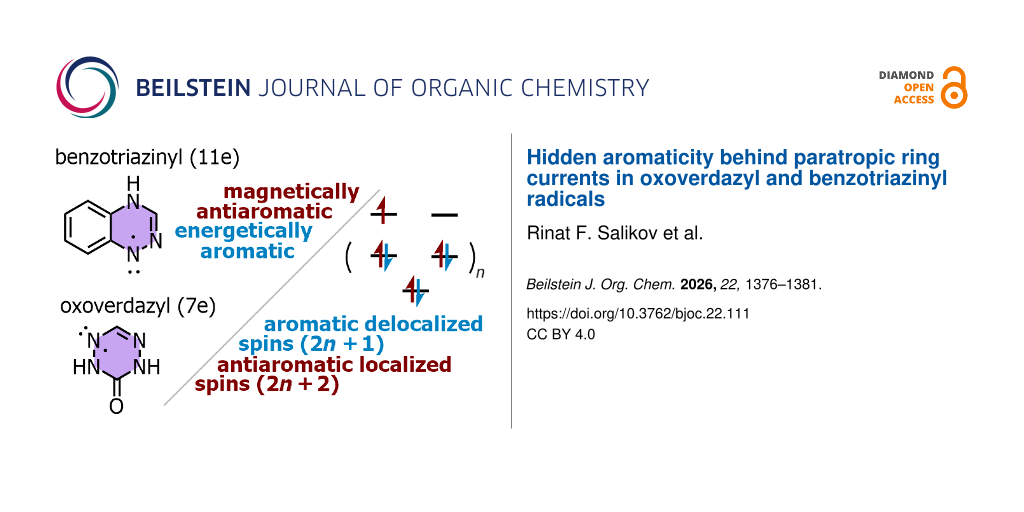
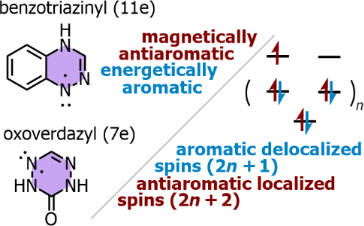
Monoradicals occupy a theoretically underdetermined state in aromaticity theory, possessing both aromatic (2n + 1) and antiaromatic (2n) spin populations. We systematically investigate benzotriazinyl and oxoverdazyl radicals by disentangling their energetic and magnetic aromaticity through isodesmic reactions, NICS calculations, and EDDB analysis. Our results reveal that both systems are energetically aromatic, yet sustain paratropic ring currents, revealing the divergence of energetic and magnetic criteria. EDDB analysis unveils the electronic origin of this divergence: the antiaromatic α-spins with the unpaired electron are largely localized, whereas the aromatic β-spins are extensively delocalized within the heterocyclic rings. This spin-specific localization provides a direct electronic rationale for the observed dichotomy and contributes to the refinement of Mandado's electron rule for odd-electron systems, demonstrating that the two spin populations influence energetic and magnetic properties differently. Oxidation and reduction of the parent radicals lead to convergence of these criteria in closed-shell ions, offering insights into their reversible redox behavior. This study provides a quantitative framework for understanding aromaticity in odd-electron species.
Graphical Abstract
Introduction
Stable heterocyclic radicals have long fascinated chemists, not only for their intriguing electronic structures but also for their growing utility across materials science, spintronics, spectroscopy and organic synthesis [1-7]. Among these, nitrogen-centered heterocyclic radicals with fully conjugated cyclic systems – such as oxoverdazyls and benzotriazinyls (Blatter radicals) – stand out for their remarkable stability and unique magnetic properties. The stability of these systems is often attributed to extensive spin delocalization over the heterocyclic core [8]. Yet, a fundamental question remains: How do we quantify and reconcile their aromatic character?
The aromaticity of cyclic conjugated radicals presents a fascinating paradox. Mandado [9,10] combined the classical Hückel and Baird rules [11,12] into a single spin-based framework, establishing that aromaticity is achieved when the number of electrons with the same spin equals 2n + 1. In Hückel-aromatic singlet species, both α- and β-spin sets contain 2n + 1 electrons, whereas in Baird-aromatic triplet species, one spin population holds 2n + 1 electrons and the other 2n + 3, both odd numbers. This elegant rule, however, leaves monoradicals in a theoretically underdetermined state. A radical with an odd total number of π-electrons necessarily possesses 2n + 1 electrons of one spin (an aromatic configuration) and 2m of the other (an antiaromatic configuration). This intrinsic duality raises a critical question: Is the aromaticity of such a species defined by its energetic stabilization or by its magnetic response? Previous investigations by Mandado [9,10] and, recently, by Foroutan-Nejad [13] as well as by Proos Vedin et al. [14,15] have suggested that these two criteria can indeed diverge, hinting that radicals, ion-radicals and n,π* excited states occupy a unique crossroads between aromatic and antiaromatic regimes. The divergence between the magnetic properties and other aromaticity criteria was also noted for several other open-shell systems [11,16-18].
Our study aims to systematically dissect this dichotomy in the context of oxoverdazyl and benzotriazinyl radicals which possess 2n + 1 and 2n + 2 electrons of different spins (Figure 1). It is well-established that magnetic indices of antiaromaticity (paratropic ring current) – such as positive nuclear independent chemical shift (NICS) values (the magnetic shielding at a specific point in space using a "ghost atom") [19-24] – often exhibit a significantly larger magnitude than their aromatic counterparts [25]; consequently, the antiaromatic spin component in radicals is expected to dominate the observed magnetic response properties. However, the corresponding energetic consequences, specifically the aromatic stabilization energies (ASEs) arising from both spin populations, remain largely unexplored and form the central focus of our work. By employing the isodesmic reaction approach [26], we will quantify the energetic contribution of cyclic conjugation independently of magnetic criteria, thereby disentangling these two facets of aromaticity and providing a clearer picture of the fundamental forces governing stability in these important radical systems.
![[1860-5397-22-111-1]](/bjoc/content/figures/1860-5397-22-111-1.svg?scale=2.0&max-width=1024&background=FFFFFF)
Figure 1: Oxoverdazyl and Blatter radicals (top) and orbital diagram of cyclic-conjugated radicals with 4n + 3 π-electrons (bottom).
Figure 1: Oxoverdazyl and Blatter radicals (top) and orbital diagram of cyclic-conjugated radicals with 4n + ...
Results and Discussion
The aromatic stabilization energy (ASE) of the parent Blatter radical was estimated by calculating the free energy change for the isomerization of its 5-methyl derivative into its regioisomer with interrupted conjugation in both rings (Scheme 1, reaction 1) using a combination of DFT and ab initio post HF methods [27-30] (see Supporting Information File 1). This approach yielded a value of 33 kcal/mol. Interestingly, this value closely matches the ASE of benzene determined by a similar method [31] and smaller than that of naphthalene (51 kcal/mol). To dissect the relative contributions of each ring, we calculated the free energy change for a rearrangement that disrupts conjugation exclusively in the benzene ring, affording a value of 25 kcal/mol. The difference between these two values – 8 kcal/mol – therefore represents the aromatic stabilization specifically attributed to the triazinyl radical ring.
![[1860-5397-22-111-i1]](/bjoc/content/inline/1860-5397-22-111-i1.svg?scale=2.0&max-width=1024&background=FFFFFF)
Scheme 1: Isodesmic reaction to estimate aromatic stabilization energy of Blatter and oxoverdazyl radicals (top). Energetic vs magnetic criteria of aromaticity of radicals (bottom). Energies were calculated using the dlpno-ccsd(t)/aug-ccTZVP//MP2/def2-TZVP level of theory. NICS(1)zz values were obtained using the PBE0/pcSseg2//MP2/def2-TZVP level of theory.
Scheme 1: Isodesmic reaction to estimate aromatic stabilization energy of Blatter and oxoverdazyl radicals (t...
Extending the isodesmic approach to oxoverdazyl is not straightforward, as isomerization would fundamentally alter the conjugated system. We therefore calculated the free energy change for the isomerization of 2-methylverdazyl into its regioisomer with exchanged methylene and amide NH groups (reaction 3). Because this reaction converts a urea fragment into an acyl hydrazide, it would overestimate the ASE. To correct this, we used the reverse reaction with closed-shell hydrogenated analogues lacking cyclic conjugation (reaction 4). The sum of the free energy changes from both reactions gave an ASE of 18 kcal/mol for the oxoverdazyl radical – approximately half that of benzene. Both values obtained are consistent with the near-planar geometry of the heterocyclic rings, unlike the puckered 8-electron 1,4-thiazines [32].
The magnetic aromatic properties of several oxoverdazyl radicals have been investigated using the gauge-including magnetically induced current-density (GIMIC) method [33], revealing a weakly antiaromatic character. More recently, NICS(1)zz values were calculated for a series of Blatter radicals, indicating a paratropic (antiaromatic) ring current in the triazinyl ring and a diatropic (aromatic) ring current in the benzene ring [34]. To complete this picture, we calculated NICS(1)zz values for the heterocyclic rings of both parent radicals and visualized the ring currents using anisotropy of the induced current density (ACID) diagrams [35] (Scheme 1, Figure 2). Our calculations confirm the presence of weak paratropic ring currents in both heterocyclic cores. These magnetic signatures, however, contrast with the energetic aromaticity quantified in the previous section, underscoring the dichotomy between magnetic and energetic criteria in these systems.
![[1860-5397-22-111-2]](/bjoc/content/figures/1860-5397-22-111-2.png?scale=2.0&max-width=1024&background=FFFFFF)
Figure 2: Anisotropy of the induced current density (ACID) diagrams of verdazyl and benzotriazinyl radicals (left) with the directions of ring currents in each ring (the magnetic field is directed towards the viewer). Visualization of delocalized electron density populations with the EDDB method (right); the plot for the oxoverdazyl radical was generated with a tracking pathway.
Figure 2: Anisotropy of the induced current density (ACID) diagrams of verdazyl and benzotriazinyl radicals (...
Previous studies [9,10,13,33,36-38] have revealed that the magnetic response of odd-electron systems is often dominated by the stronger paratropic component arising from the antiaromatic α-spin populations (2n). To elucidate the electronic origin of the divergence between energetic and magnetic aromaticity, we performed electron density of delocalized bonds (EDDB) analysis [40], which isolates and plots the spatial distribution of delocalized electrons (Table 1, Figure 2). The Blatter radical, owing to the fused benzene ring, demonstrated robust delocalization for both spin populations – 60% of α-electrons (3.6 of 6) and 76% of β-electrons (3.8 of 5), relative to 89% in benzene. However, pathway tracking through the heterocyclic rings, excluding the benzene ring and the carbonyl group, revealed a striking disparity between the two spin sets in both radicals. Notably, the electron density (ED) in the heterocyclic ring in benzotriazinyl corresponds to 6.4 (3.4 α and 3.0 β) electrons (not 7) as it is shifted to the benzene ring. The antiaromatic α-spins were found to be largely localized, with delocalized populations of only 10–18% (0.3 of 3.4 in Blatter’s radical and 0.7 of 4 in oxoverdazyl), whereas the aromatic β-spins were significantly more delocalized, reaching 57–60% (1.7 of 3.0 in Blatter’s radical and 1.8 of 3 in oxoverdazyl). Our EDDB analysis reveals that the stability of these radicals has been mistakenly attributed to delocalization of the unpaired electron. In fact, the dominant contribution to thermodynamic stabilization comes from the delocalization of the electrons with the opposite spin – the aromatic β-spins – within the heterocyclic ring.
Table 1: EDDB analysis in benzotriazinyl and oxoverdazyl radicals.
| Benzotriazinyl | Oxoverdazyl | |
| ED | 11 (6.4)* | 7 |
| ED (α) | 6 (3.4)* | 4 |
| ED (β) | 5 (3.0)* | 3 |
| EDDB | 7.4 (2.09)* | 2.56 |
| EDDB (α) | 3.6 (0.3)* | 0.7 |
| EDDB (β) | 3.8 (1.7)* | 1.8 |
*Values in parentheses correspond to the heterocyclic ring in benzotriazinyl.
Both classes of radicals are known for their reversed oxidation and reduction processes as evidenced from cyclic voltammetry data [40,41]. Notably, oxidation gives 4n + 2 electron cations, whereas reduction affords 4n-electron anions. To explore the aromatic character of these redox products, we calculated NICS(1)zz values and ASEs for the cations and anions derived from the parent radicals, using the same isodesmic approach employed for the neutral species. Oxidation of the Blatter radical yields a strongly negative NICS(1)zz value in the heterocyclic ring – characteristic of aromatic systems – accompanied by an increase in ASE to 46 kcal/mol, a value close to that of naphthalene (≈50 kcal/mol) [31]. Conversely, reduction amplifies the positive NICS(1)zz value and decreases the ASE to 21 kcal/mol, indicating a slight destabilization induced by the formation of an 8-electron ring system (Scheme 2). The oxoverdazyl radical exhibited a similar magnetic response upon redox transformation. Oxidation led to a significant decrease in the ASE value showing a unique case with stronger stabilization in a seven-electron state relative to that in the six-electron cation. However, the lower value could also be underestimated. For the reduced anion, estimation of an antiaromatic destabilization energy even proved inadequate (see Supporting Information File 1), as the negative charge cannot be effectively delocalized in any suitable reference molecule.
![[1860-5397-22-111-i2]](/bjoc/content/inline/1860-5397-22-111-i2.svg?scale=2.0&max-width=1024&background=FFFFFF)
Scheme 2: Oxidation and reduction of oxoverdazyl and Blatter radicals and aromatic indices of corresponding cations and anions.
Scheme 2: Oxidation and reduction of oxoverdazyl and Blatter radicals and aromatic indices of corresponding c...
Conclusion
Through this investigation, we have determined that the two classes of nitrogen-heterocyclic radicals – benzotriazinyl and oxoverdazyl – are best described as energetically aromatic systems that happen to sustain a paratropic (antiaromatic) ring current – a manifestation of α/β conflicting aromaticity. The hidden energetic aromaticity is directly responsible for the planarity of the heterocyclic rings and the remarkable stability observed in both radical classes. Applying an isodesmic approach, we have quantified the aromatic stabilization energies of these systems and established that their magnetic signatures alone do not reflect their true thermodynamic stability.
The mechanistic basis for this dichotomy was uncovered through analysis of electron density of delocalized bonds (EDDB). By tracking delocalization pathways through the heterocyclic rings, we found that the antiaromatic α-spins, including the unpaired electron, are predominantly localized, whereas the aromatic β-spins exhibit extensive delocalization. This asymmetry confirms that the β-spins are primarily responsible for the energetic stabilization, while the α-spins govern the magnetic response – a finding that directly rationalizes the divergence between the two aromaticity criteria. Ultimately, our study offers a contribution to the interpretation of Mandado's spin-separated rule for aromaticity in open-shell systems.
Additionally, our analysis of the redox products reveals how aromatic indices reconverge in closed-shell ions upon oxidation and reduction, offering a deeper understanding of the reversible electrochemistry that characterizes these radicals.
Computational Methods
Quantum chemical calculations were performed using ORCA 5.0.4 [42,43]. Initial geometries were optimized and frequencies were calculated at the r2SCAN-3c level of theory [30], verifying minima with zero imaginary frequencies [31]. Next, the geometries were improved at the MP2/def2-TZVP level of theory, single-point energies were obtained at the DLPNO-CCSD(T)/aug-cc-pVTZ level of theory [27,28]. At the MP2 level of theory, the RIJCOSX approximation was used together with the auxiliary basis sets def2/J and def2-TZVP/C. At the DLPNO-CCSD(T) level of theory, the RIJK approximation was used together with the auxiliary basis sets aug-cc-pVTZ/C and aug-cc-pVTZ/JK, and the TightSCF keyword was applied. In both cases, the FROZENCORE approximation, which is enabled by default in ORCA 5.0.4, was employed.
NICS values were calculated at the PBE0(D4)/pcsSeg-2// MP2/def2-TZVP level of theory. ACID diagrams were obtained at the B3LYP/6-31G(d)//MP2/def2-TZVP level of theory and visualized in AICD-3.0.4 program [36]. The magnetic field is directed towards the viewer, POV is placed on the Z-axis. Electron Density of Delocalized Bonds (EDDB) calculations were performed with runEDDB [39] (https://aromaticity.uj.edu.pl/runeddb/). The electron density was calculated in ORCA 6.1.0, at the B3LYP/def2-TZVP theory level.
Supporting Information
| Supporting Information File 1: Quantum chemical calculation details. | ||
| Format: PDF | Size: 731.5 KB | Download |
| Supporting Information File 2: Anisotropy of the induced current density (ACID) diagrams. | ||
| Format: PDF | Size: 12.3 MB | Download |
| Supporting Information File 3: xyz-Files. | ||
| Format: ZIP | Size: 19.4 KB | Download |
Data Availability Statement
All data that supports the findings of this study is available in the published article and/or the supporting information of this article.
References
-
Lalov, A. V.; Egorov, M. P.; Aysin, R. R. Mendeleev Commun. 2022, 32, 732–734. doi:10.1016/j.mencom.2022.11.008
Return to citation in text: [1] -
Zayakin, I. A.; Petunin, P. V.; Postnikov, P. S.; Dmitriev, A. A.; Gritsan, N. P.; Dorovatovskii, P.; Korlyukov, A.; Fedin, M. V.; Bogomyakov, A. S.; Akyeva, A. Y.; Novikov, R. A.; Shangin, P. G.; Syroeshkin, M. A.; Burykina, J. V.; Tretyakov, E. V. J. Am. Chem. Soc. 2024, 146, 13666–13675. doi:10.1021/jacs.4c04391
Return to citation in text: [1] -
Gulyaev, D.; Serykh, A.; Gadimov, N.; Shangin, P.; Syroeshkin, M.; Sosunov, E.; Tretyakov, E. Eur. J. Org. Chem. 2024, 27, e202400494. doi:10.1002/ejoc.202400494
Return to citation in text: [1] -
Gulyaev, D. A.; Gadimov, N. V.; Gritsan, N. P.; Kadilenko, E. M.; Shangin, P. G.; Syroeshkin, M. A.; Sosunov, E. A.; Tretyakov, E. V. Mendeleev Commun. 2025, 35, 169–171. doi:10.71267/mencom.7724
Return to citation in text: [1] -
Meckes, J. A.; Schroeder, Z. W.; Sarkar, D.; Hooper, R. W.; Faraday-Smith, C. E.; Brown, A.; Tykwinski, R. R.; Michaelis, V. K. J. Am. Chem. Soc. 2025, 147, 7293–7304. doi:10.1021/jacs.4c13374
Return to citation in text: [1] -
Lipunova, G. N.; Fedorchenko, T. G.; Shchepochkin, A. V.; Chupakhin, O. N. Russ. Chem. Bull. 2025, 74, 328–353. doi:10.1007/s11172-025-4526-5
Return to citation in text: [1] -
Mujahed, S.; Janabel, J.; Shaw, K.; Cagliani, R.; Amatov, T. Angew. Chem. 2025, 137, e202511233. doi:10.1002/ange.202511233
Return to citation in text: [1] -
Ji, Y.; Long, L.; Zheng, Y. Mater. Chem. Front. 2020, 4, 3433–3443. doi:10.1039/d0qm00122h
Return to citation in text: [1] -
Mandado, M.; Graña, A. M.; Pérez-Juste, I. J. Chem. Phys. 2008, 129, 164114. doi:10.1063/1.2999562
Return to citation in text: [1] [2] [3] -
Lago‐Saavedra, R.; Pérez‐Juste, I.; Mandado, M. ChemPhysChem 2025, 26, e202400529. doi:10.1002/cphc.202400529
Return to citation in text: [1] [2] [3] -
Liu, C.; Ni, Y.; Lu, X.; Li, G.; Wu, J. Acc. Chem. Res. 2019, 52, 2309–2321. doi:10.1021/acs.accounts.9b00257
Return to citation in text: [1] [2] -
Casademont-Reig, I.; Ramos-Cordoba, E.; Torrent-Sucarrat, M.; Matito, E. Molecules 2020, 25, 711. doi:10.3390/molecules25030711
Return to citation in text: [1] -
Foroutan-Nejad, C. J. Org. Chem. 2023, 88, 14831–14835. doi:10.1021/acs.joc.3c01807
Return to citation in text: [1] [2] -
Proos Vedin, N.; Escayola, S.; Radenković, S.; Solà, M.; Ottosson, H. J. Phys. Chem. A 2024, 128, 4493–4506. doi:10.1021/acs.jpca.4c02580
Return to citation in text: [1] -
Proos Vedin, N.; Toldo, J. M.; Escayola, S.; Radenković, S.; Solà, M.; Ottosson, H. J. Org. Chem. 2025, 90, 9743–9756. doi:10.1021/acs.joc.5c00578
Return to citation in text: [1] -
Rosokha, S. V.; Kochi, J. K. J. Org. Chem. 2006, 71, 9357–9365. doi:10.1021/jo061695a
Return to citation in text: [1] -
Foroutan-Nejad, C. Theor. Chem. Acc. 2015, 134, 8. doi:10.1007/s00214-015-1617-7
Return to citation in text: [1] -
Preethalayam, P.; Proos Vedin, N.; Radenković, S.; Ottosson, H. J. Phys. Org. Chem. 2023, 36, e4455. doi:10.1002/poc.4455
Return to citation in text: [1] -
Fallah-Bagher-Shaidaei, H.; Wannere, C. S.; Corminboeuf, C.; Puchta, R.; Schleyer, P. v. R. Org. Lett. 2006, 8, 863–866. doi:10.1021/ol0529546
Return to citation in text: [1] -
Gershoni-Poranne, R.; Stanger, A. Chem. Soc. Rev. 2015, 44, 6597–6615. doi:10.1039/c5cs00114e
Return to citation in text: [1] -
Schleyer, P. v. R.; Maerker, C.; Dransfeld, A.; Jiao, H.; van Eikema Hommes, N. J. R. J. Am. Chem. Soc. 1996, 118, 6317–6318. doi:10.1021/ja960582d
Return to citation in text: [1] -
Chen, Z.; Wannere, C. S.; Corminboeuf, C.; Puchta, R.; Schleyer, P. v. R. Chem. Rev. 2005, 105, 3842–3888. doi:10.1021/cr030088+
Return to citation in text: [1] -
Puchta, R.; Djordjevic, S.; Radenkovic, S.; Jiao, H.; van Eikema Hommes, N. J. R. J. Serb. Chem. Soc. 2022, 87, 1439–1446. doi:10.2298/jsc211203057p
Return to citation in text: [1] -
Puchta, R.; Capponi, T.; Ćoćić, D.; Alzoubi, B. M.; Shook, I. Chemia Naissensis 2022, 5, 1–15. doi:10.46793/chemn5.1.01p
Return to citation in text: [1] -
Salikov, R. F.; Belyy, A. Y.; Ilyushchenko, M. K.; Platonov, D. N.; Sokolova, A. D.; Tomilov, Y. V. Chem. – Eur. J. 2024, 30, e202401041. doi:10.1002/chem.202401041
Return to citation in text: [1] -
Ponomarev, D. A.; Takhistov, V. V. J. Chem. Educ. 1997, 74, 201. doi:10.1021/ed074p201
Return to citation in text: [1] -
Riplinger, C.; Sandhoefer, B.; Hansen, A.; Neese, F. J. Chem. Phys. 2013, 139, 134101. doi:10.1063/1.4821834
Return to citation in text: [1] [2] -
Liakos, D. G.; Guo, Y.; Neese, F. J. Phys. Chem. A 2020, 124, 90–100. doi:10.1021/acs.jpca.9b05734
Return to citation in text: [1] [2] -
Grimme, S.; Hansen, A.; Ehlert, S.; Mewes, J.-M. J. Chem. Phys. 2021, 154, 064103. doi:10.1063/5.0040021
Return to citation in text: [1] -
Kesharwani, M. K.; Brauer, B.; Martin, J. M. L. J. Phys. Chem. A 2015, 119, 1701–1714. doi:10.1021/jp508422u
Return to citation in text: [1] [2] -
Schleyer, P. v. R.; Pühlhofer, F. Org. Lett. 2002, 4, 2873–2876. doi:10.1021/ol0261332
Return to citation in text: [1] [2] [3] -
Aitken, R. A.; Aitken, K. M. 1,4-Thiazines and Their Benzo Derivatives. Comprehensive Heterocyclic Chemistry III; Elsevier, 2008; Vol. 8, pp 607–675. doi:10.1016/b978-008044992-0.00709-4
Return to citation in text: [1] -
Valiev, R. R.; Drozdova, A. K.; Petunin, P. V.; Postnikov, P. S.; Trusova, M. E.; Cherepanov, V. N.; Sundholm, D. New J. Chem. 2018, 42, 19987–19994. doi:10.1039/c8nj04341h
Return to citation in text: [1] [2] -
Wang, Y.; Guo, W.; Yue, S.; Duan, R.; Yuan, Z.; Yao, Y.; Jiang, H.; Guo, J.; Rajca, A. Res. Square 2026. doi:10.21203/rs.3.rs-9661849/v1
Return to citation in text: [1] -
Geuenich, D.; Hess, K.; Köhler, F.; Herges, R. Chem. Rev. 2005, 105, 3758–3772. doi:10.1021/cr0300901
Return to citation in text: [1] -
Nagami, T.; Fujiyoshi, J.-y.; Tonami, T.; Watanabe, K.-i.; Yamane, M.; Okada, K.; Kishi, R.; Nakano, M.; Champagne, B.; Liégeois, V. Chem. – Eur. J. 2018, 24, 13457–13466. doi:10.1002/chem.201802696
Return to citation in text: [1] [2] -
Soncini, A.; Fowler, P. W. Chem. Phys. Lett. 2008, 450, 431–436. doi:10.1016/j.cplett.2007.11.053
Return to citation in text: [1] -
Soncini, A.; Fowler, P. W. Chem. – Eur. J. 2013, 19, 1740–1746. doi:10.1002/chem.201202572
Return to citation in text: [1] -
Szczepanik, D. W.; Andrzejak, M.; Dominikowska, J.; Pawełek, B.; Krygowski, T. M.; Szatylowicz, H.; Solà, M. Phys. Chem. Chem. Phys. 2017, 19, 28970–28981. doi:10.1039/c7cp06114e
Return to citation in text: [1] -
Steen, J. S.; Nuismer, J. L.; Eiva, V.; Wiglema, A. E. T.; Daub, N.; Hjelm, J.; Otten, E. J. Am. Chem. Soc. 2022, 144, 5051–5058. doi:10.1021/jacs.1c13543
Return to citation in text: [1] [2] -
Horst, E. S.; Sowa, K.; Lezius, L.; Fehlings, N.; Daniliuc, C.; Nowak, S.; Grünebaum, M.; Winter, M.; Studer, A. ChemElectroChem 2026, 13, e202500465. doi:10.1002/celc.202500465
Return to citation in text: [1] -
Neese, F. Wiley Interdiscip. Rev.: Comput. Mol. Sci. 2022, 12, e1606. doi:10.1002/wcms.1606
Return to citation in text: [1] -
Neese, F. Wiley Interdiscip. Rev.: Comput. Mol. Sci. 2012, 2, 73–78. doi:10.1002/wcms.81
Return to citation in text: [1]
| 1. | Lalov, A. V.; Egorov, M. P.; Aysin, R. R. Mendeleev Commun. 2022, 32, 732–734. doi:10.1016/j.mencom.2022.11.008 |
| 2. | Zayakin, I. A.; Petunin, P. V.; Postnikov, P. S.; Dmitriev, A. A.; Gritsan, N. P.; Dorovatovskii, P.; Korlyukov, A.; Fedin, M. V.; Bogomyakov, A. S.; Akyeva, A. Y.; Novikov, R. A.; Shangin, P. G.; Syroeshkin, M. A.; Burykina, J. V.; Tretyakov, E. V. J. Am. Chem. Soc. 2024, 146, 13666–13675. doi:10.1021/jacs.4c04391 |
| 3. | Gulyaev, D.; Serykh, A.; Gadimov, N.; Shangin, P.; Syroeshkin, M.; Sosunov, E.; Tretyakov, E. Eur. J. Org. Chem. 2024, 27, e202400494. doi:10.1002/ejoc.202400494 |
| 4. | Gulyaev, D. A.; Gadimov, N. V.; Gritsan, N. P.; Kadilenko, E. M.; Shangin, P. G.; Syroeshkin, M. A.; Sosunov, E. A.; Tretyakov, E. V. Mendeleev Commun. 2025, 35, 169–171. doi:10.71267/mencom.7724 |
| 5. | Meckes, J. A.; Schroeder, Z. W.; Sarkar, D.; Hooper, R. W.; Faraday-Smith, C. E.; Brown, A.; Tykwinski, R. R.; Michaelis, V. K. J. Am. Chem. Soc. 2025, 147, 7293–7304. doi:10.1021/jacs.4c13374 |
| 6. | Lipunova, G. N.; Fedorchenko, T. G.; Shchepochkin, A. V.; Chupakhin, O. N. Russ. Chem. Bull. 2025, 74, 328–353. doi:10.1007/s11172-025-4526-5 |
| 7. | Mujahed, S.; Janabel, J.; Shaw, K.; Cagliani, R.; Amatov, T. Angew. Chem. 2025, 137, e202511233. doi:10.1002/ange.202511233 |
| 9. | Mandado, M.; Graña, A. M.; Pérez-Juste, I. J. Chem. Phys. 2008, 129, 164114. doi:10.1063/1.2999562 |
| 10. | Lago‐Saavedra, R.; Pérez‐Juste, I.; Mandado, M. ChemPhysChem 2025, 26, e202400529. doi:10.1002/cphc.202400529 |
| 33. | Valiev, R. R.; Drozdova, A. K.; Petunin, P. V.; Postnikov, P. S.; Trusova, M. E.; Cherepanov, V. N.; Sundholm, D. New J. Chem. 2018, 42, 19987–19994. doi:10.1039/c8nj04341h |
| 11. | Liu, C.; Ni, Y.; Lu, X.; Li, G.; Wu, J. Acc. Chem. Res. 2019, 52, 2309–2321. doi:10.1021/acs.accounts.9b00257 |
| 12. | Casademont-Reig, I.; Ramos-Cordoba, E.; Torrent-Sucarrat, M.; Matito, E. Molecules 2020, 25, 711. doi:10.3390/molecules25030711 |
| 34. | Wang, Y.; Guo, W.; Yue, S.; Duan, R.; Yuan, Z.; Yao, Y.; Jiang, H.; Guo, J.; Rajca, A. Res. Square 2026. doi:10.21203/rs.3.rs-9661849/v1 |
| 9. | Mandado, M.; Graña, A. M.; Pérez-Juste, I. J. Chem. Phys. 2008, 129, 164114. doi:10.1063/1.2999562 |
| 10. | Lago‐Saavedra, R.; Pérez‐Juste, I.; Mandado, M. ChemPhysChem 2025, 26, e202400529. doi:10.1002/cphc.202400529 |
| 31. | Schleyer, P. v. R.; Pühlhofer, F. Org. Lett. 2002, 4, 2873–2876. doi:10.1021/ol0261332 |
| 8. | Ji, Y.; Long, L.; Zheng, Y. Mater. Chem. Front. 2020, 4, 3433–3443. doi:10.1039/d0qm00122h |
| 32. | Aitken, R. A.; Aitken, K. M. 1,4-Thiazines and Their Benzo Derivatives. Comprehensive Heterocyclic Chemistry III; Elsevier, 2008; Vol. 8, pp 607–675. doi:10.1016/b978-008044992-0.00709-4 |
| 19. | Fallah-Bagher-Shaidaei, H.; Wannere, C. S.; Corminboeuf, C.; Puchta, R.; Schleyer, P. v. R. Org. Lett. 2006, 8, 863–866. doi:10.1021/ol0529546 |
| 20. | Gershoni-Poranne, R.; Stanger, A. Chem. Soc. Rev. 2015, 44, 6597–6615. doi:10.1039/c5cs00114e |
| 21. | Schleyer, P. v. R.; Maerker, C.; Dransfeld, A.; Jiao, H.; van Eikema Hommes, N. J. R. J. Am. Chem. Soc. 1996, 118, 6317–6318. doi:10.1021/ja960582d |
| 22. | Chen, Z.; Wannere, C. S.; Corminboeuf, C.; Puchta, R.; Schleyer, P. v. R. Chem. Rev. 2005, 105, 3842–3888. doi:10.1021/cr030088+ |
| 23. | Puchta, R.; Djordjevic, S.; Radenkovic, S.; Jiao, H.; van Eikema Hommes, N. J. R. J. Serb. Chem. Soc. 2022, 87, 1439–1446. doi:10.2298/jsc211203057p |
| 24. | Puchta, R.; Capponi, T.; Ćoćić, D.; Alzoubi, B. M.; Shook, I. Chemia Naissensis 2022, 5, 1–15. doi:10.46793/chemn5.1.01p |
| 26. | Ponomarev, D. A.; Takhistov, V. V. J. Chem. Educ. 1997, 74, 201. doi:10.1021/ed074p201 |
| 11. | Liu, C.; Ni, Y.; Lu, X.; Li, G.; Wu, J. Acc. Chem. Res. 2019, 52, 2309–2321. doi:10.1021/acs.accounts.9b00257 |
| 16. | Rosokha, S. V.; Kochi, J. K. J. Org. Chem. 2006, 71, 9357–9365. doi:10.1021/jo061695a |
| 17. | Foroutan-Nejad, C. Theor. Chem. Acc. 2015, 134, 8. doi:10.1007/s00214-015-1617-7 |
| 18. | Preethalayam, P.; Proos Vedin, N.; Radenković, S.; Ottosson, H. J. Phys. Org. Chem. 2023, 36, e4455. doi:10.1002/poc.4455 |
| 27. | Riplinger, C.; Sandhoefer, B.; Hansen, A.; Neese, F. J. Chem. Phys. 2013, 139, 134101. doi:10.1063/1.4821834 |
| 28. | Liakos, D. G.; Guo, Y.; Neese, F. J. Phys. Chem. A 2020, 124, 90–100. doi:10.1021/acs.jpca.9b05734 |
| 29. | Grimme, S.; Hansen, A.; Ehlert, S.; Mewes, J.-M. J. Chem. Phys. 2021, 154, 064103. doi:10.1063/5.0040021 |
| 30. | Kesharwani, M. K.; Brauer, B.; Martin, J. M. L. J. Phys. Chem. A 2015, 119, 1701–1714. doi:10.1021/jp508422u |
| 14. | Proos Vedin, N.; Escayola, S.; Radenković, S.; Solà, M.; Ottosson, H. J. Phys. Chem. A 2024, 128, 4493–4506. doi:10.1021/acs.jpca.4c02580 |
| 15. | Proos Vedin, N.; Toldo, J. M.; Escayola, S.; Radenković, S.; Solà, M.; Ottosson, H. J. Org. Chem. 2025, 90, 9743–9756. doi:10.1021/acs.joc.5c00578 |
| 13. | Foroutan-Nejad, C. J. Org. Chem. 2023, 88, 14831–14835. doi:10.1021/acs.joc.3c01807 |
| 25. | Salikov, R. F.; Belyy, A. Y.; Ilyushchenko, M. K.; Platonov, D. N.; Sokolova, A. D.; Tomilov, Y. V. Chem. – Eur. J. 2024, 30, e202401041. doi:10.1002/chem.202401041 |
| 40. | Steen, J. S.; Nuismer, J. L.; Eiva, V.; Wiglema, A. E. T.; Daub, N.; Hjelm, J.; Otten, E. J. Am. Chem. Soc. 2022, 144, 5051–5058. doi:10.1021/jacs.1c13543 |
| 35. | Geuenich, D.; Hess, K.; Köhler, F.; Herges, R. Chem. Rev. 2005, 105, 3758–3772. doi:10.1021/cr0300901 |
| 9. | Mandado, M.; Graña, A. M.; Pérez-Juste, I. J. Chem. Phys. 2008, 129, 164114. doi:10.1063/1.2999562 |
| 10. | Lago‐Saavedra, R.; Pérez‐Juste, I.; Mandado, M. ChemPhysChem 2025, 26, e202400529. doi:10.1002/cphc.202400529 |
| 13. | Foroutan-Nejad, C. J. Org. Chem. 2023, 88, 14831–14835. doi:10.1021/acs.joc.3c01807 |
| 33. | Valiev, R. R.; Drozdova, A. K.; Petunin, P. V.; Postnikov, P. S.; Trusova, M. E.; Cherepanov, V. N.; Sundholm, D. New J. Chem. 2018, 42, 19987–19994. doi:10.1039/c8nj04341h |
| 36. | Nagami, T.; Fujiyoshi, J.-y.; Tonami, T.; Watanabe, K.-i.; Yamane, M.; Okada, K.; Kishi, R.; Nakano, M.; Champagne, B.; Liégeois, V. Chem. – Eur. J. 2018, 24, 13457–13466. doi:10.1002/chem.201802696 |
| 37. | Soncini, A.; Fowler, P. W. Chem. Phys. Lett. 2008, 450, 431–436. doi:10.1016/j.cplett.2007.11.053 |
| 38. | Soncini, A.; Fowler, P. W. Chem. – Eur. J. 2013, 19, 1740–1746. doi:10.1002/chem.201202572 |
| 36. | Nagami, T.; Fujiyoshi, J.-y.; Tonami, T.; Watanabe, K.-i.; Yamane, M.; Okada, K.; Kishi, R.; Nakano, M.; Champagne, B.; Liégeois, V. Chem. – Eur. J. 2018, 24, 13457–13466. doi:10.1002/chem.201802696 |
| 39. | Szczepanik, D. W.; Andrzejak, M.; Dominikowska, J.; Pawełek, B.; Krygowski, T. M.; Szatylowicz, H.; Solà, M. Phys. Chem. Chem. Phys. 2017, 19, 28970–28981. doi:10.1039/c7cp06114e |
| 31. | Schleyer, P. v. R.; Pühlhofer, F. Org. Lett. 2002, 4, 2873–2876. doi:10.1021/ol0261332 |
| 27. | Riplinger, C.; Sandhoefer, B.; Hansen, A.; Neese, F. J. Chem. Phys. 2013, 139, 134101. doi:10.1063/1.4821834 |
| 28. | Liakos, D. G.; Guo, Y.; Neese, F. J. Phys. Chem. A 2020, 124, 90–100. doi:10.1021/acs.jpca.9b05734 |
| 42. | Neese, F. Wiley Interdiscip. Rev.: Comput. Mol. Sci. 2022, 12, e1606. doi:10.1002/wcms.1606 |
| 43. | Neese, F. Wiley Interdiscip. Rev.: Comput. Mol. Sci. 2012, 2, 73–78. doi:10.1002/wcms.81 |
| 30. | Kesharwani, M. K.; Brauer, B.; Martin, J. M. L. J. Phys. Chem. A 2015, 119, 1701–1714. doi:10.1021/jp508422u |
| 40. | Steen, J. S.; Nuismer, J. L.; Eiva, V.; Wiglema, A. E. T.; Daub, N.; Hjelm, J.; Otten, E. J. Am. Chem. Soc. 2022, 144, 5051–5058. doi:10.1021/jacs.1c13543 |
| 41. | Horst, E. S.; Sowa, K.; Lezius, L.; Fehlings, N.; Daniliuc, C.; Nowak, S.; Grünebaum, M.; Winter, M.; Studer, A. ChemElectroChem 2026, 13, e202500465. doi:10.1002/celc.202500465 |
| 31. | Schleyer, P. v. R.; Pühlhofer, F. Org. Lett. 2002, 4, 2873–2876. doi:10.1021/ol0261332 |
© 2026 Salikov et al.; licensee Beilstein-Institut.
This is an open access article licensed under the terms of the Beilstein-Institut Open Access License Agreement (https://www.beilstein-journals.org/bjoc/terms), which is identical to the Creative Commons Attribution 4.0 International License (https://creativecommons.org/licenses/by/4.0). The reuse of material under this license requires that the author(s), source and license are credited. Third-party material in this article could be subject to other licenses (typically indicated in the credit line), and in this case, users are required to obtain permission from the license holder to reuse the material.