Abstract
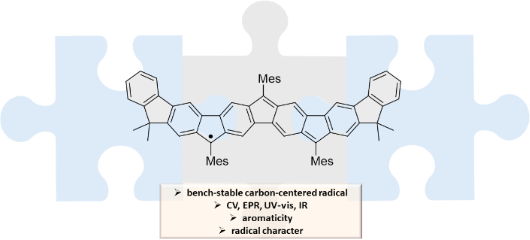
A stable, cyclopenta-fused polyaromatic hydrocarbon (CP-PAH) radical, comprising six six-membered and five five-membered rings alternately fused within an undecacyclic framework, was synthesized via ortho-fusion of a suitably o,o’-substituted difluorenylfluorene, followed by establishment of the π-conjugated system. The target radical was obtained in eight consecutive synthetic steps with an overall yield of 7%, with a Suzuki coupling and cyclization via electrophilic aromatic substitution (SEAr) serving as key steps. Mesityl substituents attached to the five-membered rings provide kinetic stabilization of the radical species. Comprehensive characterization was performed using EPR spectroscopy, UV–vis spectroscopy, and cyclic voltammetry, further supported by quantum-chemical calculations. The computational studies enabled simulation of the UV–vis spectra and provided insights into spin-density distribution, aromaticity, and frontier orbital energies. The radical is best described by the resonance structure in which the unpaired electron is predominantly localized on the outer cyclopentadiene units, maximizing the number of preserved aromatic benzene sextets. Calculations indicate only a minor triradical contribution to the electronic ground state. Notably, the five-membered rings, particularly the central ring, exhibits pronounced antiaromatic character.
Graphical Abstract
Introduction
Polyaromatic hydrocarbons (PHs) [1-6] have found significant interest among the aromatic compounds due to their unique electronic properties, particularly the small gaps of their frontier orbitals. When five-membered rings are part of the polyaromatic systems [7-13], these are commonly referred to as cyclopenta-fused polyaromatic hydrocarbons (CP-PAHs or CPPAs) [14-17], as non-alternant conjugated polycyclic hydrocarbons (CPHs) [18,19], or are classified as compounds featuring quinoidal conjugated units. Since the first report of the triphenylmethyl radical 1 by Gomberg (Figure 1) [20,21], numerous stable carbon-centered hydrocarbon radicals [22] have been synthesized and investigated. However, only a limited number of these radicals turned out to be stable towards air, moisture, and solvents, or showed resistance to dimerization (as in the formation of Gomberg’s dimer 2) or disproportionation. Enhanced radical stability is generally achieved through extended π-conjugation and/or the incorporation of bulky substituents to prevent dimerization [23-26].
![[1860-5397-22-95-1]](/bjoc/content/figures/1860-5397-22-95-1.svg?scale=2.0&max-width=1024&background=FFFFFF)
Figure 1: CP-PAH radicals synthesized in our group.
Figure 1: CP-PAH radicals synthesized in our group.
These compounds are quite special due to their structural features correlated with their radical properties. These give rise to interesting electronic, optical, and magnetic properties and might thus be utilized in organic electronics [4] or in nonlinear optics [27]. They might further find application in spintronics [28,29], as organic magnets [30-32], or in fully organic spintronic devices [33]. Moreover, since the physical properties of hydrocarbon radicals primarily depend on the arrangement of the π electrons, the design and synthesis of novel hydrocarbon radicals remain essential for expanding the library of molecular scaffolds available for spintronic applications [24].
Aromaticity is a fundamental feature of fully conjugated polycyclic systems [34], where aromatic systems are easily identified by applying Hückel’s [4n + 2] π electron rule [35]. Dewar and Breslow later presented the [4n] π electron rule, which allowed for the easy identification of antiaromatic systems [36-38]. While these rules provide a useful framework for assessing aromaticity, they are of limited use for the differentiated characterization of polycyclic systems [39,40]. Furthermore, since aromaticity cannot be measured directly, both its definition and its practical significance have been a subject of controversy [41]. Nevertheless, due to the concept’s practicability, it is continuously applied in basic and even in sophisticated investigations [42]. Computational methods based on density functional theory (DFT) have meanwhile emerged as powerful supplementary tools to elucidate and quantify the aromatic and antiaromatic character of molecular systems. Here, the nucleus-independent chemical shift XY scan (NICS-XY-scan) has proven particularly useful for the evaluation of polycyclic compounds. It allows the visualization and analysis of ring-current effects by calculation of a molecule’s magnetic response to an external magnetic field [43].
We recently reported the synthesis of a series of radical systems based on indenofluorene (IF) cores, including a helical radical 3 [44] and its linearly arranged isomer 4 [45]. Building on these studies, we focused in further investigations on the expansion of the linear framework, where we synthesized nonacyclic radicals 5 and 6 [46].
Herein, we report the synthesis and comprehensive characterization of a new CP-PAH radical 7 as a further rare example of a stable, carbon-centered radical with a further extended π system.
Results and Discussion
Synthesis
The synthesis of radical 7 was initiated by preparation of the corresponding boronated building block 12, followed by Suzuki coupling with a dibromofluorene building block 13, and concluded by a double ortho-cyclization and subsequent rearomatization.
Pinacol (Pin) boronate 12 was synthesized from commercially available fluorene 8. Initial bromination with N-bromosuccinimide (NBS) furnished the brominated intermediate 9, which was subsequently converted into the corresponding iodinated derivative 10 in a Sandmeyer-type reaction (Scheme 1). Treatment of 10 with iPrMgCl·LiCl furnished aldehyde 11 and the synthesis was concluded by a Miyaura borylation to the boronated species 12.
![[1860-5397-22-95-i1]](/bjoc/content/inline/1860-5397-22-95-i1.svg?scale=2.0&max-width=1024&background=FFFFFF)
Scheme 1: Synthesis of the nucleophilic outmost ring systems.
Scheme 1: Synthesis of the nucleophilic outmost ring systems.
The synthesis of mesityl-substituted fluorene 13 from commercially available 2,7-dibromo-9H-fluoren-9-one has already been reported [45]. Its subsequent double Suzuki coupling with boronate 12 generated terfluorene 14 (Scheme 2). The following nucleophilic addition with a mesityl Grignard reagent (MesMgBr) converted dicarbaldehyde 14 into the corresponding secondary dialcohol 15. Subsequent treatment with boron trifluoride etherate furnished precursor 16 as a mixture of diastereoisomers, whose separation was neither expected easy to achieve nor necessary for the following step.
![[1860-5397-22-95-i2]](/bjoc/content/inline/1860-5397-22-95-i2.svg?scale=2.0&max-width=1024&background=FFFFFF)
Scheme 2: Suzuki coupling and establishment of the undecacyclic ring system.
Scheme 2: Suzuki coupling and establishment of the undecacyclic ring system.
In a finalizing step, 16 (as the mixture of isomers) was deprotonated with t-BuOK and immediately oxidized with p-chloranil to yield radical 7 as a dark green solid (Scheme 3).
![[1860-5397-22-95-i3]](/bjoc/content/inline/1860-5397-22-95-i3.svg?scale=2.0&max-width=1024&background=FFFFFF)
Scheme 3: Finalization of the radical synthesis.
Scheme 3: Finalization of the radical synthesis.
Compound 7 was thus synthesized from 8 in eight consecutive reaction steps with an overall yield of 7%. This radical displayed excellent stability under ambient conditions, showing resistance towards air, moisture, daylight, and dimerization. Furthermore, in its solid state and under an inert atmosphere, 7 proved to be stable for over a year.
The paramagnetic nature of radical 7 was demonstrated by the lack of observable resonances in conventional frequency ranges in the respective NMR spectra and by its response in EPR spectroscopy. The measured X-band EPR spectrum of 7 showed a single line centered around g = 2.0038 without any discernible hyperfine couplings (Figure 2).
![[1860-5397-22-95-2]](/bjoc/content/figures/1860-5397-22-95-2.png?scale=2.0&max-width=1024&background=FFFFFF)
Figure 2: CW (continuous wave) X-band (9.4214 GHz) EPR spectrum of 7 in toluene (1 mM) at ambient temperature showing a single resonance signal centered at g = 2.0038.
Figure 2: CW (continuous wave) X-band (9.4214 GHz) EPR spectrum of 7 in toluene (1 mM) at ambient temperature...
The calculated EPR data indicate that the spin density is delocalized over the undecacylic framework, which accounts for the absence of resolved hyperfine structure. Nevertheless, pronounced Mulliken atomic spin densities (Figure 3) are calculated for the mesityl-substituted carbon atoms. Densities at the respective outer carbons C-16 and C-19 show the highest values of 0.40, respectively, whereas position C-7 takes a slightly smaller value of −0.28. Calculation of the natural orbital occupation numbers (NOONs) [47] and application of the Yamaguchi scheme [48,49] led to a y value of 0.26, indicating only marginal contribution of the species’ triradical character. Therefore, resonance structure 7-I (cf. Scheme 4) and its mirror image should thus have the highest relevance in the ensemble of possible resonance structures, which is in good agreement with prior results from our group [45,46].
![[1860-5397-22-95-3]](/bjoc/content/figures/1860-5397-22-95-3.png?scale=2.4&max-width=1024&background=FFFFFF)
Figure 3: Calculated spin densities of 7; blue: α spin, green: β spin (isovalue: 0.004 electrons per bohr; calculated at the upbe0/def2-TZVP/GD3BJ level).
Figure 3: Calculated spin densities of 7; blue: α spin, green: β spin (isovalue: 0.004 electrons per bohr; ca...
![[1860-5397-22-95-i4]](/bjoc/content/inline/1860-5397-22-95-i4.svg?scale=2.0&max-width=1024&background=FFFFFF)
Scheme 4: Resonance formulas of radical 7. Fully intact benzene rings are highlighted in blue; the indacene unit is highlighted in red. The fully conjugated central core is marked in magenta.
Scheme 4: Resonance formulas of radical 7. Fully intact benzene rings are highlighted in blue; the indacene u...
The SOMOs of 7 (also termed SOMO and SUMO in the literature [50], Figure 4) feature a nodal plane through the center of the molecule; their energies are −4.89 and −3.11 eV, respectively, for the α and the β spin.
![[1860-5397-22-95-4]](/bjoc/content/figures/1860-5397-22-95-4.png?scale=2.0&max-width=1024&background=FFFFFF)
Figure 4: Calculated SOMOs of α (left) and β electrons (right) for radical 7 (also termed SOMO and SUMO in the literature [50]; isovalue: 0.02 electrons1/2 bohr−3/2; calculated at the upbe0/def2-TZVP/GD3BJ level).
Figure 4: Calculated SOMOs of α (left) and β electrons (right) for radical 7 (also termed SOMO and SUMO in th...
The electrochemical characteristics of 7 were evaluated by cyclic voltammetry, where the redox potentials were determined vs the ferrocene/ferrocenium couple, Fc/Fc+ using decamethylferrocene Fc* as internal standard (Figure 5) [51]. In tetrahydrofuran we observed one irreversible and three quasi-reversible redox processes centered at ![[Graphic 1]](/bjoc/content/inline/1860-5397-22-95-i5.svg?max-width=637&scale=1.18182) (THF) values of −2.58, −2.08, −1.09, and +0.06 V (vs Fc/Fc+). These values are well in line with the results from previous investigations in our group [45]. They allow the assignment of these potentials to specific redox processes, where the first three values indicate reductions to the tri-, radical di- and monoanion, respectively, and the last value most likely refers to the oxidation to the monocation [45].
(THF) values of −2.58, −2.08, −1.09, and +0.06 V (vs Fc/Fc+). These values are well in line with the results from previous investigations in our group [45]. They allow the assignment of these potentials to specific redox processes, where the first three values indicate reductions to the tri-, radical di- and monoanion, respectively, and the last value most likely refers to the oxidation to the monocation [45].
![[1860-5397-22-95-5]](/bjoc/content/figures/1860-5397-22-95-5.png?scale=2.0&max-width=1024&background=FFFFFF)
Figure 5: Cyclic voltammogram of 7 recorded in THF at room temperature (vs Fc/Fc+, v (THF) = 100 mV s−1; Pt/[NBu4][PF6]/Ag, internal standard: Fc*).
Figure 5: Cyclic voltammogram of 7 recorded in THF at room temperature (vs Fc/Fc+, v (THF) = 100 mV s−1; Pt/[...
A UV–vis spectrum of radical 7 was recorded in CH2Cl2 (Figure 6, top). It displays a series of intense bands across a broad spectral range, extending from the ultraviolet into the visible region. The absorption spectrum is in good agreement with a calculated UV–vis spectrum of 7, obtained by time-dependent (TD) DFT calculation [upbe0/def2tzvp/GD3BJ level] with a simulated solvent field of methylene chloride (Figure 6, bottom). A substantial peak with lowest energy is observed at 740 nm in the experimental spectrum. According to the TD calculation it is mostly due to a SOMO → LUMO transition. This low-energy transition is well in line with the relatively small negative reduction potential determined by cyclic voltammetry. Further significant absorptions in the visible range follow at 680 and 640 nm. The peak of greatest intensity has several shoulders and is observed between 320 and 410 nm with an absorption maximum at 367 nm. An enlarged and expanded version of Figure 6 is given in Supporting Information File 1 together with significant transitions. No fluorescence activity was observed for this compound, consistent with previous reports on related systems [44,46]. This is presumably attributable to the extremely short excited-state lifetimes reported for indenofluorenes, likely caused by rapid non-radiative decay via conical intersection [52].
![[1860-5397-22-95-6]](/bjoc/content/figures/1860-5397-22-95-6.png?scale=2.0&max-width=1024&background=FFFFFF)
Figure 6: UV–vis spectrum of radical 7 in CH2Cl2: measured (top), calculated (bottom).
Figure 6: UV–vis spectrum of radical 7 in CH2Cl2: measured (top), calculated (bottom).
Obviously, an aromatic or antiaromatic character is an outstanding feature of a fully conjugated cyclic or polycyclic system. Especially an antiaromatic contribution in these systems is often correlated with useful optoelectronic properties [34]. Aromaticity is most simply estimated by the rule of Clar [53-55], later extended by Glidewell and Lloyd [56], which describes the tendency of polyaromatic systems to maximize the number of fully aromatic benzene rings in their Lewis structures. This approach not only explains the relative thermodynamic stability of isomeric structures but also enables the identification of dominant resonance contributors within the resonance ensemble.
A detailed analysis of the possible resonance structures of radical 7 (Scheme 4) reveals clear correlations with previously described conclusions [45]. Among these, structures 7-I and its mirror image (monoradical species) and 7-III (triradical species) are particularly significant, preserving five and six intact benzene units, respectively. In contrast, structure 7-II (monoradical species) only retains intact units at the terminal rings and should therefore be the least significant of the depicted resonance formulas. The terminal benzene rings do not significantly contribute to the electronic delocalization of the system, due to the interruption of conjugation by the dimethyl-substituted carbons in the outer cyclopentadiene units. Under this assumption, the presented compound would formally be equivalent to the linear heptacyclic system 4 (cf. Figure 1). In conclusion, the incorporation of building block 12 enabled the expansion of the molecular framework, while having only a limited effect on the intrinsic electronic properties of the radical system.
Aromatic properties are most conveniently investigated by computing NICS (nucleus-independent chemical shift) values to simulate a response of an aromatic system to an external magnetic field. These are commonly calculated at a 1 Å distance from the center of each ring [NICSzz(1.0) values] [43,57-60] and allow for a quantification of the local aromaticity of individual rings: Negative values indicate aromatic character and positive values correspond to antiaromaticity. NICS-XY-scans are constructed by calculation of NICS values (typically again at a 1 Å distance to the ring system) along a path through the core of the compound passing all ring centers. This approach is especially suitable for polyaromatic systems with condensed rings showing more than one ring current [61] and thus allows for a differentiated estimation of the aromaticity pattern in polycycles. The shielding behavior of the undecacyclic system was investigated by employing a NICS-XY-scan (Figure 7). The results indicate that all five-membered rings exhibit antiaromatic character, which is particularly pronounced in rings E’, C’, C, and E. The inner six-membered rings D’, B’, B, and D display a borderline behavior, as they are neither distinctly aromatic nor antiaromatic. This is likely a consequence of the antiaromatic indacene subunits embedded in the molecular framework (Scheme 4, highlighted in red) within the framework [36,37,62], particularly of the C’, B’, A fragment and its mirror image. In contrast, pronounced aromatic character is observed exclusively in the outer six-membered rings (F and F’), whereas the remainder of the framework predominantly shows antiaromatic character. The outmost rings are not part of the fully conjugated core, but could be considered as phenyl substituents attached to rings D and D’, which accounts for the fully retained aromaticity.
![[1860-5397-22-95-7]](/bjoc/content/figures/1860-5397-22-95-7.png?scale=2.0&max-width=1024&background=FFFFFF)
Figure 7: NICS(1)πzz-XY-scan of radical 7 (calculated without mesityl and methyl groups).
Figure 7: NICS(1)πzz-XY-scan of radical 7 (calculated without mesityl and methyl groups).
Aromaticity can further be quantified by the investigation of ring currents in the π system. The anisotropy of the induced current density can be calculated and visualized with Herges’ ACID (anisotropy of the induced current density) method (Figure 8) [63,64]. The results suggest antiaromatic behavior for the five-membered rings. For rings B’, B, D’, and D, again a combination of aromatic and antiaromatic character is observed, which is in agreement with the corresponding NICS-XY-scan. In contrast, clear aromatic behavior is exclusively observed in the terminal rings F’ and F.
![[1860-5397-22-95-8]](/bjoc/content/figures/1860-5397-22-95-8.png?scale=2.0&max-width=1024&background=FFFFFF)
Figure 8: ACID isosurface plot of 7 (calculated without mesityl and methyl groups; isosurface value 0.02).
Figure 8: ACID isosurface plot of 7 (calculated without mesityl and methyl groups; isosurface value 0.02).
Conclusion
In conclusion, we have synthesized a π-extended open-shell CP-PAH composed of six benzene and five cyclopentadiene rings, representing a further example of a stable carbon-centered radical. The compound was obtained via cyclization of an o,o’-substituted difluorenylfluorene, followed by reestablishment of the conjugation. The radical is best described with the unpaired electron predominantly localized on the outer cyclopentadiene units, thereby maximizing the number of fully aromatic benzene rings. It exhibits vanishingly small triradical character as well as a small SOMO–LUMO gap. Overall, the synthesis of radical 7 provides a fundamental basis for further investigation of π-extended radical systems. It not only demonstrates the feasibility of accessing larger, structurally related species with notable stability, but also provides a valuable basis for the development of more complex and intriguing molecular systems.
Supporting Information
| Supporting Information File 1: Experimental procedures, NMR and further spectra for new compounds and details of DFT calculations. | ||
| Format: PDF | Size: 1.7 MB | Download |
Acknowledgements
This work is based on Ali S. Acan’s doctoral thesis (“Synthesis and Characterization of Cyclopentadiene-fused Polyaromatic Hydrocarbon Radicals”, Karlsruhe Institute of Technology (KIT), 2025). We are greatly indebted to Prof. Dr. Frank Breher for his continuous support in the measurement of EPR spectra and cyclovoltammograms.
Funding
The authors acknowledge support of the German Research Foundation (DFG, PO 463/19-1) and by the state of Baden-Württemberg through bwHPC and the DFG through grant no INST 40/575-1 FUGG (JUSTUS 2 cluster). J. W. thanks the Verband der Chemischen Industrie for financial support by a Kekulé scholarship.
Data Availability Statement
All data that supports the findings of this study is available in the published article and/or the supporting information of this article.
References
-
Hellwinkel, D.; Reiff, G. Angew. Chem., Int. Ed. Engl. 1970, 9, 527–528. doi:10.1002/anie.197005271
Return to citation in text: [1] -
Hellwinkel, D.; Reiff, G.; Nykodym, V. Justus Liebigs Ann. Chem. 1977, 1013–1025. doi:10.1002/jlac.197719770615
Return to citation in text: [1] -
Das, S.; Wu, J. Open-Shell Benzenoid Polycyclic Hydrocarbons. In Polycyclic Arenes and Heteroarenes: Synthesis, Properties, and Applications; Miao, Q., Ed.; Wiley-VCH: Weinheim, Germany, 2016; pp 3–36. doi:10.1002/9783527689545.ch1
Return to citation in text: [1] -
Yang, X.; Shi, X.; Aratani, N.; Gonçalves, T. P.; Huang, K.-W.; Yamada, H.; Chi, C.; Miao, Q. Chem. Sci. 2016, 7, 6176–6181. doi:10.1039/c6sc01795a
Return to citation in text: [1] [2] -
Das, S.; Wu, J. Phys. Sci. Rev. 2017, 2, 20160109. doi:10.1515/psr-2016-0109
Return to citation in text: [1] -
Yamamoto, K.; Ie, Y.; Tohnai, N.; Kakiuchi, F.; Aso, Y. Sci. Rep. 2018, 8, 17663. doi:10.1038/s41598-018-35839-w
Return to citation in text: [1] -
Hopf, H. Angew. Chem., Int. Ed. 2013, 52, 12224–12226. doi:10.1002/anie.201307162
Return to citation in text: [1] -
Frederickson, C. K.; Zakharov, L. N.; Haley, M. M. J. Am. Chem. Soc. 2016, 138, 16827–16838. doi:10.1021/jacs.6b11397
Return to citation in text: [1] -
Ma, J.; Liu, J.; Baumgarten, M.; Fu, Y.; Tan, Y.-Z.; Schellhammer, K. S.; Ortmann, F.; Cuniberti, G.; Komber, H.; Berger, R.; Müllen, K.; Feng, X. Angew. Chem., Int. Ed. 2017, 56, 3280–3284. doi:10.1002/anie.201611689
Return to citation in text: [1] -
Miyoshi, H.; Hisaki, I.; Tobe, Y. Eur. J. Org. Chem. 2021, 3528–3534. doi:10.1002/ejoc.202100503
Return to citation in text: [1] -
Chen, Q.; Baumgarten, M.; Wagner, M.; Hu, Y.; Hou, I. C.-Y.; Narita, A.; Müllen, K. Angew. Chem., Int. Ed. 2021, 133, 11300–11304. doi:10.1002/anie.202102932
Return to citation in text: [1] -
Borissov, A.; Chmielewski, P. J.; Gómez García, C. J.; Lis, T.; Stępień, M. Angew. Chem., Int. Ed. 2023, 62, e202309238. doi:10.1002/anie.202309238
Return to citation in text: [1] -
Misselwitz, E.; Spengler, J.; Rominger, F.; Kivala, M. Chem. – Eur. J. 2024, 30, e202400696. doi:10.1002/chem.202400696
Return to citation in text: [1] -
Plunkett, K. N. Synlett 2013, 24, 898–902. doi:10.1055/s-0032-1318434
Return to citation in text: [1] -
Rudebusch, G. E.; Haley, M. M. Planar Cyclopenta-Fused Polycyclic Arenes. In Polycyclic Arenes and Heteroarenes: Synthesis, Properties, and Applications; Miao, Q., Ed.; Wiley-VCH: Weinheim, Germany, 2015; pp 37–60. doi:10.1002/9783527689545.ch2
Return to citation in text: [1] -
Bheemireddy, S. R.; Plunkett, K. N. Polym. Chem. 2016, 7, 292–296. doi:10.1039/c5py01582k
Return to citation in text: [1] -
Jousselin‐Oba, T.; Deal, P. E.; Fix, A. G.; Frederickson, C. K.; Vonnegut, C. L.; Yassar, A.; Zakharov, L. N.; Frigoli, M.; Haley, M. M. Chem. – Asian J. 2019, 14, 1737–1744. doi:10.1002/asia.201801684
Return to citation in text: [1] -
Tobe, Y. Chem. Rec. 2015, 15, 86–96. doi:10.1002/tcr.201402077
Return to citation in text: [1] -
Konishi, A.; Yasuda, M. Chem. Lett. 2021, 50, 195–212. doi:10.1246/cl.200650
Return to citation in text: [1] -
Gomberg, M. J. Am. Chem. Soc. 1900, 22, 757–771. doi:10.1021/ja02049a006
Return to citation in text: [1] -
Lewars, E. G. Hexaphenylethane. In Modeling Marvels: Computational Anticipation of Novel Molecules; Lewars, E. G., Ed.; Springer: Dordrecht, Netherlands, 2008; pp 115–129. doi:10.1007/978-1-4020-6973-4_8
Return to citation in text: [1] -
Nishida, S.; Morita, Y. Air-Stable Redox-Active Neutral Radicals. In Organic Redox Systems: Synthesis, Properties, and Applications; Nishinaga, T., Ed.; John Wiley & Sons: Hoboken, NJ, USA, 2016; pp 177–243. doi:10.1002/9781118858981.ch6
Return to citation in text: [1] -
Gostowski, R. C.; Bailey, T.; Bonner, S. D.; Emrich, E. E.; Steelman, S. L. J. Phys. Org. Chem. 2000, 13, 735–739. doi:10.1002/1099-1395(200011)13:11<735::aid-poc310>3.0.co;2-z
Return to citation in text: [1] -
Tian, Y.; Uchida, K.; Kurata, H.; Hirao, Y.; Nishiuchi, T.; Kubo, T. J. Am. Chem. Soc. 2014, 136, 12784–12793. doi:10.1021/ja507005c
Return to citation in text: [1] [2] -
Hogan, D. T.; Sutherland, T. C. J. Phys. Chem. Lett. 2018, 9, 2825–2829. doi:10.1021/acs.jpclett.8b01128
Return to citation in text: [1] -
Nishiuchi, T.; Ito, R.; Takada, A.; Yasuda, Y.; Nagata, T.; Stratmann, E.; Kubo, T. Chem. – Asian J. 2019, 14, 1830–1836. doi:10.1002/asia.201801806
Return to citation in text: [1] -
Fukuda, K.; Fujiyoshi, J.-y.; Matsui, H.; Nagami, T.; Takamuku, S.; Kitagawa, Y.; Champagne, B.; Nakano, M. Org. Chem. Front. 2017, 4, 779–789. doi:10.1039/c7qo00108h
Return to citation in text: [1] -
Yeo, H.; Debnath, S.; Krishnan, B. P.; Boudouris, B. W. RSC Appl. Polym. 2024, 2, 7–25. doi:10.1039/d3lp00213f
Return to citation in text: [1] -
Nowik-Boltyk, E. M.; Junghoefer, T.; Giangrisostomi, E.; Ovsyannikov, R.; Shu, C.; Rajca, A.; Droghetti, A.; Casu, M. B. Angew. Chem., Int. Ed. 2024, 63, e202403495. doi:10.1002/anie.202403495
Return to citation in text: [1] -
Deumal, M.; Vela, S.; Fumanal, M.; Ribas-Arino, J.; Novoa, J. J. J. Mater. Chem. C 2021, 9, 10624–10646. doi:10.1039/d1tc01376a
Return to citation in text: [1] -
Datta, S. N.; Pal, A. K.; Panda, A. Chem. Phys. Impact 2023, 7, 100379. doi:10.1016/j.chphi.2023.100379
Return to citation in text: [1] -
Kumar, S.; Kumar, Y.; Keshri, S. K.; Mukhopadhyay, P. Magnetochemistry 2016, 2, 42. doi:10.3390/magnetochemistry2040042
Return to citation in text: [1] -
Nicolaides, C.; Bazzi, F.; Vouros, E.; Flesariu, D. F.; Chrysochos, N.; Koutentis, P. A.; Constantinides, C. P.; Trypiniotis, T. Nano Lett. 2023, 23, 4579–4586. doi:10.1021/acs.nanolett.3c01044
Return to citation in text: [1] -
Solá, M.; Boldyrev, A. I.; Cyrański, M. K.; Krygowski, T. M.; Merino, G. Aromaticity and Antiaromaticity: Concepts and Applications; John Wiley & Sons: Chichester, UK, 2023. doi:10.1002/9781119085928
Return to citation in text: [1] [2] -
Hückel, E. Z. Phys. 1931, 70, 204–286. doi:10.1007/bf01339530
Return to citation in text: [1] -
Breslow, R. Chem. Eng. News 1965, 43 (10), 90–100. doi:10.1021/cen-v043n010.p090
Return to citation in text: [1] [2] -
Breslow, R.; Brown, J.; Gajewski, J. J. J. Am. Chem. Soc. 1967, 89, 4383–4390. doi:10.1021/ja00993a023
Return to citation in text: [1] [2] -
Dewar, M. J. S. Chemical Reactivity. In Advances in Chemical Physics: The Application of Wave Mechanical Methods to the Study of Molecular Properties; Doudel, R., Ed.; John Wiley & Sons: Hoboken, NJ, USA, 1965; Vol. 8, pp 64–131. doi:10.1002/9780470143544.ch6
Return to citation in text: [1] -
Stanger, A. Chem. Commun. 2009, 1939–1947. doi:10.1039/b816811c
Return to citation in text: [1] -
Randić, M. Chem. Rev. 2003, 103, 3449–3606. doi:10.1021/cr9903656
Return to citation in text: [1] -
Merino, G.; Solà, M.; Fernández, I.; Foroutan-Nejad, C.; Lazzeretti, P.; Frenking, G.; Anderson, H. L.; Sundholm, D.; Cossío, F. P.; Petrukhina, M. A.; Wu, J.; Wu, J. I.; Restrepo, A. Chem. Sci. 2023, 14, 5569–5576. doi:10.1039/d2sc04998h
Return to citation in text: [1] -
Krygowski, T. M.; Cyrañski, M. K.; Czarnocki, Z.; Häfelinger, G.; Katritzky, A. R. Tetrahedron 2000, 56, 1783–1796. doi:10.1016/s0040-4020(99)00979-5
Return to citation in text: [1] -
Stanger, A. Eur. J. Org. Chem. 2020, 3120–3127. doi:10.1002/ejoc.201901829
Return to citation in text: [1] [2] -
Herzog, S.; Hinz, A.; Breher, F.; Podlech, J. Org. Biomol. Chem. 2022, 20, 2873–2880. doi:10.1039/d2ob00172a
Return to citation in text: [1] [2] -
Acan, A. S.; Wenzel, J. O.; Breher, F.; Podlech, J. Chem. – Eur. J. 2025, 31, e202403670. doi:10.1002/chem.202403670
Return to citation in text: [1] [2] [3] [4] [5] [6] -
Acan, A. S.; Wenzel, J. O.; Podlech, J. Chem. – Eur. J. 2025, 31, e02467. doi:10.1002/chem.202502467
Return to citation in text: [1] [2] [3] -
Döhnert, D.; Koutecký, J. J. Am. Chem. Soc. 1980, 102, 1789–1796. doi:10.1021/ja00526a005
Return to citation in text: [1] -
Yamaguchi, K. Chem. Phys. Lett. 1975, 33, 330–335. doi:10.1016/0009-2614(75)80169-2
Return to citation in text: [1] -
Kamada, K.; Ohta, K.; Shimizu, A.; Kubo, T.; Kishi, R.; Takahashi, H.; Botek, E.; Champagne, B.; Nakano, M. J. Phys. Chem. Lett. 2010, 1, 937–940. doi:10.1021/jz100155s
Return to citation in text: [1] -
Kasemthaveechok, S.; Abella, L.; Crassous, J.; Autschbach, J.; Favereau, L. Chem. Sci. 2022, 13, 9833–9847. doi:10.1039/d2sc02480b
Return to citation in text: [1] [2] -
Noviandri, I.; Brown, K. N.; Fleming, D. S.; Gulyas, P. T.; Lay, P. A.; Masters, A. F.; Phillips, L. J. Phys. Chem. B 1999, 103, 6713–6722. doi:10.1021/jp991381+
Return to citation in text: [1] -
Rose, B. D.; Shoer, L. E.; Wasielewski, M. R.; Haley, M. M. Chem. Phys. Lett. 2014, 616–617, 137–141. doi:10.1016/j.cplett.2014.10.031
Return to citation in text: [1] -
Clar, E. The Aromatic Sextet and its Significance in Relation to the Stability of Aromatic Systems. Polycyclic Hydrocarbons; Springer: Berlin, Heidelberg, Germany, 1964; pp 32–39. doi:10.1007/978-3-662-01665-7_6
Return to citation in text: [1] -
Zdetsis, A. D. J. Phys. Chem. C 2018, 122, 17526–17536. doi:10.1021/acs.jpcc.8b05020
Return to citation in text: [1] -
Wang, Y. J. Phys. Chem. A 2022, 126, 164–176. doi:10.1021/acs.jpca.1c08661
Return to citation in text: [1] -
Glidewell, C.; Lloyd, D. Tetrahedron 1984, 40, 4455–4472. doi:10.1016/s0040-4020(01)98821-0
Return to citation in text: [1] -
Gomes, J. A. N. F.; Mallion, R. B. Chem. Rev. 2001, 101, 1349–1384. doi:10.1021/cr990323h
Return to citation in text: [1] -
Chen, Z.; Wannere, C. S.; Corminboeuf, C.; Puchta, R.; Schleyer, P. v. R. Chem. Rev. 2005, 105, 3842–3888. doi:10.1021/cr030088+
Return to citation in text: [1] -
Stanger, A. J. Org. Chem. 2006, 71, 883–893. doi:10.1021/jo051746o
Return to citation in text: [1] -
Fallah-Bagher-Shaidaei, H.; Wannere, C. S.; Corminboeuf, C.; Puchta, R.; Schleyer, P. v. R. Org. Lett. 2006, 8, 863–866. doi:10.1021/ol0529546
Return to citation in text: [1] -
Gershoni‐Poranne, R.; Stanger, A. Chem. – Eur. J. 2014, 20, 5673–5688. doi:10.1002/chem.201304307
Return to citation in text: [1] -
Nendel, M.; Goldfuss, B.; Houk, K. N.; Hafner, K. J. Mol. Struct.: THEOCHEM 1999, 461–462, 23–28. doi:10.1016/s0166-1280(98)00421-7
Return to citation in text: [1] -
Herges, R.; Geuenich, D. J. Phys. Chem. A 2001, 105, 3214–3220. doi:10.1021/jp0034426
Return to citation in text: [1] -
Geuenich, D.; Hess, K.; Köhler, F.; Herges, R. Chem. Rev. 2005, 105, 3758–3772. doi:10.1021/cr0300901
Return to citation in text: [1]
| 50. | Kasemthaveechok, S.; Abella, L.; Crassous, J.; Autschbach, J.; Favereau, L. Chem. Sci. 2022, 13, 9833–9847. doi:10.1039/d2sc02480b |
| 50. | Kasemthaveechok, S.; Abella, L.; Crassous, J.; Autschbach, J.; Favereau, L. Chem. Sci. 2022, 13, 9833–9847. doi:10.1039/d2sc02480b |
| 51. | Noviandri, I.; Brown, K. N.; Fleming, D. S.; Gulyas, P. T.; Lay, P. A.; Masters, A. F.; Phillips, L. J. Phys. Chem. B 1999, 103, 6713–6722. doi:10.1021/jp991381+ |
| 1. | Hellwinkel, D.; Reiff, G. Angew. Chem., Int. Ed. Engl. 1970, 9, 527–528. doi:10.1002/anie.197005271 |
| 2. | Hellwinkel, D.; Reiff, G.; Nykodym, V. Justus Liebigs Ann. Chem. 1977, 1013–1025. doi:10.1002/jlac.197719770615 |
| 3. | Das, S.; Wu, J. Open-Shell Benzenoid Polycyclic Hydrocarbons. In Polycyclic Arenes and Heteroarenes: Synthesis, Properties, and Applications; Miao, Q., Ed.; Wiley-VCH: Weinheim, Germany, 2016; pp 3–36. doi:10.1002/9783527689545.ch1 |
| 4. | Yang, X.; Shi, X.; Aratani, N.; Gonçalves, T. P.; Huang, K.-W.; Yamada, H.; Chi, C.; Miao, Q. Chem. Sci. 2016, 7, 6176–6181. doi:10.1039/c6sc01795a |
| 5. | Das, S.; Wu, J. Phys. Sci. Rev. 2017, 2, 20160109. doi:10.1515/psr-2016-0109 |
| 6. | Yamamoto, K.; Ie, Y.; Tohnai, N.; Kakiuchi, F.; Aso, Y. Sci. Rep. 2018, 8, 17663. doi:10.1038/s41598-018-35839-w |
| 20. | Gomberg, M. J. Am. Chem. Soc. 1900, 22, 757–771. doi:10.1021/ja02049a006 |
| 21. | Lewars, E. G. Hexaphenylethane. In Modeling Marvels: Computational Anticipation of Novel Molecules; Lewars, E. G., Ed.; Springer: Dordrecht, Netherlands, 2008; pp 115–129. doi:10.1007/978-1-4020-6973-4_8 |
| 56. | Glidewell, C.; Lloyd, D. Tetrahedron 1984, 40, 4455–4472. doi:10.1016/s0040-4020(01)98821-0 |
| 18. | Tobe, Y. Chem. Rec. 2015, 15, 86–96. doi:10.1002/tcr.201402077 |
| 19. | Konishi, A.; Yasuda, M. Chem. Lett. 2021, 50, 195–212. doi:10.1246/cl.200650 |
| 36. | Breslow, R. Chem. Eng. News 1965, 43 (10), 90–100. doi:10.1021/cen-v043n010.p090 |
| 37. | Breslow, R.; Brown, J.; Gajewski, J. J. J. Am. Chem. Soc. 1967, 89, 4383–4390. doi:10.1021/ja00993a023 |
| 38. | Dewar, M. J. S. Chemical Reactivity. In Advances in Chemical Physics: The Application of Wave Mechanical Methods to the Study of Molecular Properties; Doudel, R., Ed.; John Wiley & Sons: Hoboken, NJ, USA, 1965; Vol. 8, pp 64–131. doi:10.1002/9780470143544.ch6 |
| 45. | Acan, A. S.; Wenzel, J. O.; Breher, F.; Podlech, J. Chem. – Eur. J. 2025, 31, e202403670. doi:10.1002/chem.202403670 |
| 14. | Plunkett, K. N. Synlett 2013, 24, 898–902. doi:10.1055/s-0032-1318434 |
| 15. | Rudebusch, G. E.; Haley, M. M. Planar Cyclopenta-Fused Polycyclic Arenes. In Polycyclic Arenes and Heteroarenes: Synthesis, Properties, and Applications; Miao, Q., Ed.; Wiley-VCH: Weinheim, Germany, 2015; pp 37–60. doi:10.1002/9783527689545.ch2 |
| 16. | Bheemireddy, S. R.; Plunkett, K. N. Polym. Chem. 2016, 7, 292–296. doi:10.1039/c5py01582k |
| 17. | Jousselin‐Oba, T.; Deal, P. E.; Fix, A. G.; Frederickson, C. K.; Vonnegut, C. L.; Yassar, A.; Zakharov, L. N.; Frigoli, M.; Haley, M. M. Chem. – Asian J. 2019, 14, 1737–1744. doi:10.1002/asia.201801684 |
| 24. | Tian, Y.; Uchida, K.; Kurata, H.; Hirao, Y.; Nishiuchi, T.; Kubo, T. J. Am. Chem. Soc. 2014, 136, 12784–12793. doi:10.1021/ja507005c |
| 34. | Solá, M.; Boldyrev, A. I.; Cyrański, M. K.; Krygowski, T. M.; Merino, G. Aromaticity and Antiaromaticity: Concepts and Applications; John Wiley & Sons: Chichester, UK, 2023. doi:10.1002/9781119085928 |
| 7. | Hopf, H. Angew. Chem., Int. Ed. 2013, 52, 12224–12226. doi:10.1002/anie.201307162 |
| 8. | Frederickson, C. K.; Zakharov, L. N.; Haley, M. M. J. Am. Chem. Soc. 2016, 138, 16827–16838. doi:10.1021/jacs.6b11397 |
| 9. | Ma, J.; Liu, J.; Baumgarten, M.; Fu, Y.; Tan, Y.-Z.; Schellhammer, K. S.; Ortmann, F.; Cuniberti, G.; Komber, H.; Berger, R.; Müllen, K.; Feng, X. Angew. Chem., Int. Ed. 2017, 56, 3280–3284. doi:10.1002/anie.201611689 |
| 10. | Miyoshi, H.; Hisaki, I.; Tobe, Y. Eur. J. Org. Chem. 2021, 3528–3534. doi:10.1002/ejoc.202100503 |
| 11. | Chen, Q.; Baumgarten, M.; Wagner, M.; Hu, Y.; Hou, I. C.-Y.; Narita, A.; Müllen, K. Angew. Chem., Int. Ed. 2021, 133, 11300–11304. doi:10.1002/anie.202102932 |
| 12. | Borissov, A.; Chmielewski, P. J.; Gómez García, C. J.; Lis, T.; Stępień, M. Angew. Chem., Int. Ed. 2023, 62, e202309238. doi:10.1002/anie.202309238 |
| 13. | Misselwitz, E.; Spengler, J.; Rominger, F.; Kivala, M. Chem. – Eur. J. 2024, 30, e202400696. doi:10.1002/chem.202400696 |
| 34. | Solá, M.; Boldyrev, A. I.; Cyrański, M. K.; Krygowski, T. M.; Merino, G. Aromaticity and Antiaromaticity: Concepts and Applications; John Wiley & Sons: Chichester, UK, 2023. doi:10.1002/9781119085928 |
| 53. | Clar, E. The Aromatic Sextet and its Significance in Relation to the Stability of Aromatic Systems. Polycyclic Hydrocarbons; Springer: Berlin, Heidelberg, Germany, 1964; pp 32–39. doi:10.1007/978-3-662-01665-7_6 |
| 54. | Zdetsis, A. D. J. Phys. Chem. C 2018, 122, 17526–17536. doi:10.1021/acs.jpcc.8b05020 |
| 55. | Wang, Y. J. Phys. Chem. A 2022, 126, 164–176. doi:10.1021/acs.jpca.1c08661 |
| 27. | Fukuda, K.; Fujiyoshi, J.-y.; Matsui, H.; Nagami, T.; Takamuku, S.; Kitagawa, Y.; Champagne, B.; Nakano, M. Org. Chem. Front. 2017, 4, 779–789. doi:10.1039/c7qo00108h |
| 30. | Deumal, M.; Vela, S.; Fumanal, M.; Ribas-Arino, J.; Novoa, J. J. J. Mater. Chem. C 2021, 9, 10624–10646. doi:10.1039/d1tc01376a |
| 31. | Datta, S. N.; Pal, A. K.; Panda, A. Chem. Phys. Impact 2023, 7, 100379. doi:10.1016/j.chphi.2023.100379 |
| 32. | Kumar, S.; Kumar, Y.; Keshri, S. K.; Mukhopadhyay, P. Magnetochemistry 2016, 2, 42. doi:10.3390/magnetochemistry2040042 |
| 44. | Herzog, S.; Hinz, A.; Breher, F.; Podlech, J. Org. Biomol. Chem. 2022, 20, 2873–2880. doi:10.1039/d2ob00172a |
| 46. | Acan, A. S.; Wenzel, J. O.; Podlech, J. Chem. – Eur. J. 2025, 31, e02467. doi:10.1002/chem.202502467 |
| 4. | Yang, X.; Shi, X.; Aratani, N.; Gonçalves, T. P.; Huang, K.-W.; Yamada, H.; Chi, C.; Miao, Q. Chem. Sci. 2016, 7, 6176–6181. doi:10.1039/c6sc01795a |
| 33. | Nicolaides, C.; Bazzi, F.; Vouros, E.; Flesariu, D. F.; Chrysochos, N.; Koutentis, P. A.; Constantinides, C. P.; Trypiniotis, T. Nano Lett. 2023, 23, 4579–4586. doi:10.1021/acs.nanolett.3c01044 |
| 52. | Rose, B. D.; Shoer, L. E.; Wasielewski, M. R.; Haley, M. M. Chem. Phys. Lett. 2014, 616–617, 137–141. doi:10.1016/j.cplett.2014.10.031 |
| 23. | Gostowski, R. C.; Bailey, T.; Bonner, S. D.; Emrich, E. E.; Steelman, S. L. J. Phys. Org. Chem. 2000, 13, 735–739. doi:10.1002/1099-1395(200011)13:11<735::aid-poc310>3.0.co;2-z |
| 24. | Tian, Y.; Uchida, K.; Kurata, H.; Hirao, Y.; Nishiuchi, T.; Kubo, T. J. Am. Chem. Soc. 2014, 136, 12784–12793. doi:10.1021/ja507005c |
| 25. | Hogan, D. T.; Sutherland, T. C. J. Phys. Chem. Lett. 2018, 9, 2825–2829. doi:10.1021/acs.jpclett.8b01128 |
| 26. | Nishiuchi, T.; Ito, R.; Takada, A.; Yasuda, Y.; Nagata, T.; Stratmann, E.; Kubo, T. Chem. – Asian J. 2019, 14, 1830–1836. doi:10.1002/asia.201801806 |
| 45. | Acan, A. S.; Wenzel, J. O.; Breher, F.; Podlech, J. Chem. – Eur. J. 2025, 31, e202403670. doi:10.1002/chem.202403670 |
| 22. | Nishida, S.; Morita, Y. Air-Stable Redox-Active Neutral Radicals. In Organic Redox Systems: Synthesis, Properties, and Applications; Nishinaga, T., Ed.; John Wiley & Sons: Hoboken, NJ, USA, 2016; pp 177–243. doi:10.1002/9781118858981.ch6 |
| 28. | Yeo, H.; Debnath, S.; Krishnan, B. P.; Boudouris, B. W. RSC Appl. Polym. 2024, 2, 7–25. doi:10.1039/d3lp00213f |
| 29. | Nowik-Boltyk, E. M.; Junghoefer, T.; Giangrisostomi, E.; Ovsyannikov, R.; Shu, C.; Rajca, A.; Droghetti, A.; Casu, M. B. Angew. Chem., Int. Ed. 2024, 63, e202403495. doi:10.1002/anie.202403495 |
| 45. | Acan, A. S.; Wenzel, J. O.; Breher, F.; Podlech, J. Chem. – Eur. J. 2025, 31, e202403670. doi:10.1002/chem.202403670 |
| 42. | Krygowski, T. M.; Cyrañski, M. K.; Czarnocki, Z.; Häfelinger, G.; Katritzky, A. R. Tetrahedron 2000, 56, 1783–1796. doi:10.1016/s0040-4020(99)00979-5 |
| 39. | Stanger, A. Chem. Commun. 2009, 1939–1947. doi:10.1039/b816811c |
| 40. | Randić, M. Chem. Rev. 2003, 103, 3449–3606. doi:10.1021/cr9903656 |
| 43. | Stanger, A. Eur. J. Org. Chem. 2020, 3120–3127. doi:10.1002/ejoc.201901829 |
| 57. | Gomes, J. A. N. F.; Mallion, R. B. Chem. Rev. 2001, 101, 1349–1384. doi:10.1021/cr990323h |
| 58. | Chen, Z.; Wannere, C. S.; Corminboeuf, C.; Puchta, R.; Schleyer, P. v. R. Chem. Rev. 2005, 105, 3842–3888. doi:10.1021/cr030088+ |
| 59. | Stanger, A. J. Org. Chem. 2006, 71, 883–893. doi:10.1021/jo051746o |
| 60. | Fallah-Bagher-Shaidaei, H.; Wannere, C. S.; Corminboeuf, C.; Puchta, R.; Schleyer, P. v. R. Org. Lett. 2006, 8, 863–866. doi:10.1021/ol0529546 |
| 41. | Merino, G.; Solà, M.; Fernández, I.; Foroutan-Nejad, C.; Lazzeretti, P.; Frenking, G.; Anderson, H. L.; Sundholm, D.; Cossío, F. P.; Petrukhina, M. A.; Wu, J.; Wu, J. I.; Restrepo, A. Chem. Sci. 2023, 14, 5569–5576. doi:10.1039/d2sc04998h |
| 61. | Gershoni‐Poranne, R.; Stanger, A. Chem. – Eur. J. 2014, 20, 5673–5688. doi:10.1002/chem.201304307 |
| 36. | Breslow, R. Chem. Eng. News 1965, 43 (10), 90–100. doi:10.1021/cen-v043n010.p090 |
| 37. | Breslow, R.; Brown, J.; Gajewski, J. J. J. Am. Chem. Soc. 1967, 89, 4383–4390. doi:10.1021/ja00993a023 |
| 62. | Nendel, M.; Goldfuss, B.; Houk, K. N.; Hafner, K. J. Mol. Struct.: THEOCHEM 1999, 461–462, 23–28. doi:10.1016/s0166-1280(98)00421-7 |
| 48. | Yamaguchi, K. Chem. Phys. Lett. 1975, 33, 330–335. doi:10.1016/0009-2614(75)80169-2 |
| 49. | Kamada, K.; Ohta, K.; Shimizu, A.; Kubo, T.; Kishi, R.; Takahashi, H.; Botek, E.; Champagne, B.; Nakano, M. J. Phys. Chem. Lett. 2010, 1, 937–940. doi:10.1021/jz100155s |
| 45. | Acan, A. S.; Wenzel, J. O.; Breher, F.; Podlech, J. Chem. – Eur. J. 2025, 31, e202403670. doi:10.1002/chem.202403670 |
| 46. | Acan, A. S.; Wenzel, J. O.; Podlech, J. Chem. – Eur. J. 2025, 31, e02467. doi:10.1002/chem.202502467 |
| 45. | Acan, A. S.; Wenzel, J. O.; Breher, F.; Podlech, J. Chem. – Eur. J. 2025, 31, e202403670. doi:10.1002/chem.202403670 |
| 47. | Döhnert, D.; Koutecký, J. J. Am. Chem. Soc. 1980, 102, 1789–1796. doi:10.1021/ja00526a005 |
| 45. | Acan, A. S.; Wenzel, J. O.; Breher, F.; Podlech, J. Chem. – Eur. J. 2025, 31, e202403670. doi:10.1002/chem.202403670 |
| 46. | Acan, A. S.; Wenzel, J. O.; Podlech, J. Chem. – Eur. J. 2025, 31, e02467. doi:10.1002/chem.202502467 |
| 63. | Herges, R.; Geuenich, D. J. Phys. Chem. A 2001, 105, 3214–3220. doi:10.1021/jp0034426 |
| 64. | Geuenich, D.; Hess, K.; Köhler, F.; Herges, R. Chem. Rev. 2005, 105, 3758–3772. doi:10.1021/cr0300901 |
| 44. | Herzog, S.; Hinz, A.; Breher, F.; Podlech, J. Org. Biomol. Chem. 2022, 20, 2873–2880. doi:10.1039/d2ob00172a |
© 2026 Acan et al.; licensee Beilstein-Institut.
This is an open access article licensed under the terms of the Beilstein-Institut Open Access License Agreement (https://www.beilstein-journals.org/bjoc/terms), which is identical to the Creative Commons Attribution 4.0 International License (https://creativecommons.org/licenses/by/4.0). The reuse of material under this license requires that the author(s), source and license are credited. Third-party material in this article could be subject to other licenses (typically indicated in the credit line), and in this case, users are required to obtain permission from the license holder to reuse the material.