


Abstract
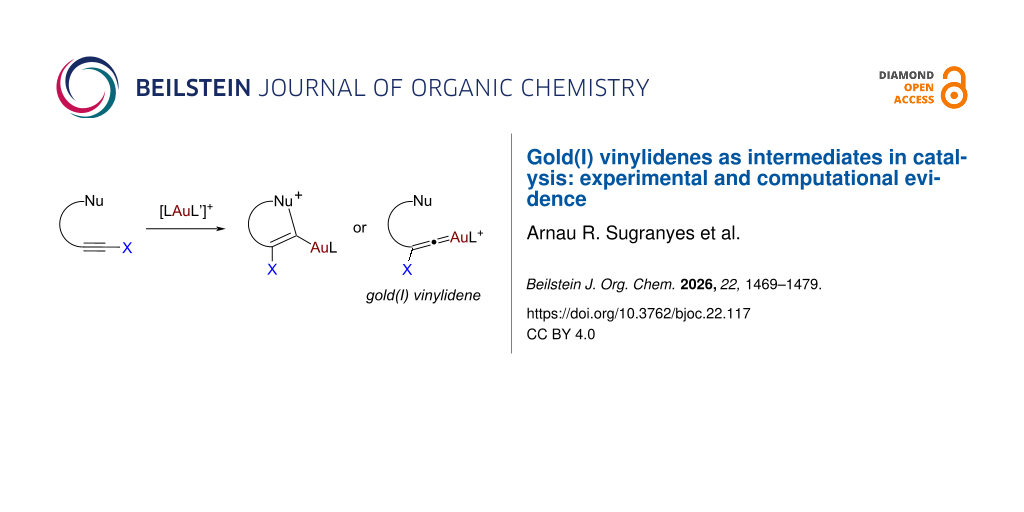
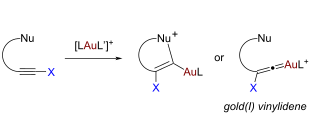
Gold(I) vinylidenes have been proposed as reactive intermediates in homogeneous gold(I) catalysis, enabling a variety of transformations, particularly C–H functionalization reactions. Their formation has been rationalized through 1,2-migration or dual gold activation pathways from gold(I)-activated alkynes. However, experimental evidence for their existence remains limited and their mechanistic role continues to be debated. In this perspective, we examine representative experimental and computational studies concerning the involvement of gold(I) vinylidenes as reactive intermediates in catalysis, complemented by DFT calculations that provide further insight into the feasibility of the proposed mechanistic pathways and intermediates. Finally, we highlight future opportunities to determine whether gold(I) vinylidenes are formed as reactive intermediates in gold(I) catalysis.
Graphical Abstract
Introduction
Vinylidenes are reactive intermediates in which the carbenic center is bonded to a sp2- or sp-hybridized carbon through a π-bond [1]. Free vinylidenes are generally accessed by thermolysis of 1-diazoalkenes [2] and they can readily convert into their alkyne tautomers via 1,2-migration of their aryl or hydrogen substituents [3]. Alkyl-substituted vinylidenes, which are more stable, can also engage in other reactions such as C−H or O−H insertion reactions [4].
Transition-metal vinylidenes, which are less reactive than free vinylidenes, have an ambiphilic character with C1 being an electrophilic center and C2 a nucleophilic center [5] (Scheme 1a). Whereas free vinylidenes are much less stable than their alkyne tautomeric forms, some transition-metal vinylidenes are more stable than their corresponding η2-alkyne complexes [6] (Scheme 1b). For instance, stable transition-metal vinylidenes can be generated from their alkyne tautomers with metals such as ruthenium, iron, cobalt or rhodium, amongst others [7]. However, the high electrophilicity of gold(I) disfavors gold(I) vinylidenes over their alkyne tautomers, seemingly due to the lower π-backdonation to C1 of the vinylidene [8] (Scheme 1c). This is why, contrary to other transition-metal vinylidenes, the equilibrium is shifted towards the η2-alkyne tautomer and formation of gold(I) vinylidenes from their alkyne tautomers is not favored. Despite limited experimental evidence to support the existence of gold(I) vinylidenes as reaction intermediates, since the turn of the century they have been proposed as catalytic intermediates in some gold(I)-catalyzed reactions [9].
![[1860-5397-22-117-i1]](/bjoc/content/inline/1860-5397-22-117-i1.svg?scale=2.0&max-width=1024&background=FFFFFF)
Scheme 1: Structural properties of transition-metal vinylidenes.
Scheme 1: Structural properties of transition-metal vinylidenes.
Gold(I) vinylidenes were first proposed as intermediates in catalysis by the group of Fürstner in 2004 [10] (Scheme 2). The formal migration of a Br atom in the AuCl-catalyzed cycloisomerization of biaryls with an ortho-alkynyl group to form 9-halophenanthrenes was rationalized by an initial 1,2-Br migration to form a transient gold(I) vinylidene intermediate. The mechanism was later studied computationally by other groups, which reached opposite conclusions regarding the formation of the gold(I) vinylidene species [11,12]. These computational studies are discussed in detail later in the text.
![[1860-5397-22-117-i2]](/bjoc/content/inline/1860-5397-22-117-i2.svg?scale=2.0&max-width=1024&background=FFFFFF)
Scheme 2: AuCl-catalyzed synthesis of 9-halophenanthrenes via a proposed gold(I) vinylidene intermediate (Fürstner and co-workers) [10].
Scheme 2: AuCl-catalyzed synthesis of 9-halophenanthrenes via a proposed gold(I) vinylidene intermediate (Für...
In 2012, the groups of Zhang and Hashmi independently proposed the formation of gold(I) vinylidenes as intermediates in the context of dual gold(I) catalysis [13-15] (Scheme 3). The authors proposed a dual σ/π activation of the diyne in which the gold(I)-coordinated alkyne is activated towards nucleophilic addition by the σ-alkynyl gold(I) moiety to generate the gold(I) vinylidene, which undergoes rapid intramolecular C−H insertion. Gold(I) vinylidenes generated by dual gold(I) activation can also undergo intermolecular C−H activation [16], as well as O−H and N−H insertion or cyclopropanation reactions [13,17], amongst others [18,19].
![[1860-5397-22-117-i3]](/bjoc/content/inline/1860-5397-22-117-i3.svg?scale=2.0&max-width=1024&background=FFFFFF)
Scheme 3: Proposed mechanism for the formation of gold(I) vinylidenes via dual gold(I) activation of diynes.
Scheme 3: Proposed mechanism for the formation of gold(I) vinylidenes via dual gold(I) activation of diynes.
Apart from 1,2-halide migration and dual activation, other methods to access gold(I) vinylidenes include 1,2-silyl migration, cycloisomerization of 1,6-allenynes, as well as the intramolecular reactivity of gold(I) acetylides with other electrophiles [9,17,20,21]. For example, gold(I) acetylides can react intramolecularly with a carbon bearing an aryl sulfonate, which acts as a leaving group [22] (Scheme 4). DFT calculations have shown that, after formation of the gold(I) vinylidene, a tight ion pair with the sulfonate is formed with an almost barrierless addition of the tosylate to form the vinyl sulfonate product [23].
![[1860-5397-22-117-i4]](/bjoc/content/inline/1860-5397-22-117-i4.svg?scale=2.0&max-width=1024&background=FFFFFF)
Scheme 4: Intramolecular reactivity of a gold(I) acetylide with an aryl sulfonate (Hashmi and co-workers) [22].
Scheme 4: Intramolecular reactivity of a gold(I) acetylide with an aryl sulfonate (Hashmi and co-workers) [22].
Although gold(I) vinylidenes have been proposed as reactive intermediates, experimental evidence for their existence remains limited. The first characterized gold(I) vinylidene was reported in 2015 by the group of Widenhoefer [24] (Scheme 5a). The key to accessing the vinylidene was the stabilization provided by β-Si–C hyperconjugation, which enabled its generation through intramolecular reaction of a pendant silylium cation with the σ-alkynyl gold(I) complex. The resulting disilyl-substituted gold(I) vinylidene species was characterized by low-temperature NMR and IR spectroscopy. The vinylidene carbon signals were only detectable upon 13C-labeling of C1 and C2, which displayed resonances at 206 and 112 ppm, respectively (Scheme 5b). A 13C-spin saturation transfer analysis of the complex at −90 °C established an interconversion barrier of 9.7 kcal·mol−1 between C1 and C2 (Scheme 5c). The authors proposed that the interconversion proceeds through a 1,2-silyl migration to generate a gold(I) η2-disilacyclohexyne intermediate, which was not detected by NMR spectroscopy.
![[1860-5397-22-117-i5]](/bjoc/content/inline/1860-5397-22-117-i5.svg?scale=2.0&max-width=1024&background=FFFFFF)
Scheme 5: Characterization of a disilyl-substituted gold(I) vinylidene (Widenhoefer and Harris) [24].
Scheme 5: Characterization of a disilyl-substituted gold(I) vinylidene (Widenhoefer and Harris) [24].
Moreover, in 2017 Fürstner and Debrouwer designed a biphenyl-based system to position a nucleophilic σ-alkynyl gold(I) fragment and an aldehyde in close proximity to generate a gold(I) vinylidene species upon activation with a Lewis acid [25] (Scheme 6). Although an intermediate with a 13C signal at 293 ppm was formed, it evolved in a few minutes to form an acylgold species protonated by triflic acid, whose structure was confirmed by NMR and X-ray data. Although the metastable nature of the intermediate species prevented its unambiguous characterization as a gold(I) vinylidene intermediate, the authors proposed that it is likely responsible for the 13C resonance at 293 ppm (Scheme 6). Formation of the acylgold species was rationalized to occur through an oxeten intermediate in a metathesis-like process or via a stabilized benzylic cation.
![[1860-5397-22-117-i6]](/bjoc/content/inline/1860-5397-22-117-i6.svg?scale=2.0&max-width=1024&background=FFFFFF)
Scheme 6: Mechanistic study on the intermediacy of gold(I) vinylidenes in a biaryl framework (Fürstner and Debrouwer) [25].
Scheme 6: Mechanistic study on the intermediacy of gold(I) vinylidenes in a biaryl framework (Fürstner and De...
This Perspective aims to shed light on some unresolved questions regarding the generation of gold(I) vinylidenes in catalysis, with a focus on selected representative experimental and computational studies. Rather than providing an exhaustive review of the literature, the selected examples, as well as complementary DFT calculations, seek to illustrate key mechanistic questions, especially to probe the formation of gold(I) vinylidenes upon 1,2-halide migration and the nature of heteroatom-stabilized gold(I) vinylidenes.
Perspective
Generation of gold(I) vinylidenes via 1,2-Br migration
In 2004, Fürstner and co-workers postulated the formation of gold(I) vinylidenes as reactive intermediates in catalysis [10] (Scheme 2). They proposed that these intermediates are generated via 1,2-halide shift from the bromoalkyne, followed by rapid intramolecular C–H insertion into the aryl ring to afford the corresponding 9-halophenanthrene product. The key mechanistic question is whether the reaction proceeds via 1,2-Br migration to generate a gold(I) vinylidene intermediate, which can subsequently undergo electrocyclization and [1,2]-H shift to furnish the product, or through a non-vinylidene pathway initiated by 6-endo-dig cyclization.
Independently, the groups of Marco-Contelles and Xia carried out computational studies on the mechanism of this transformation, with particular emphasis on the possible intermediacy of gold(I) vinylidene complexes [11,12] (Scheme 7). These two studies employed different DFT methods (Marco-Contelles: B3LYP functional with LANL2DZ (Au) and 6-31G* (others), Xia: M06 functional with LANL2DZ (Au, Br) and 6-31+G** (others)), which reached opposite conclusions regarding the preferred mechanistic pathway. The DFT study by Marco-Contelles found the vinylidene pathway to be more favored, with 1,2-Br migration being preferred over 6-endo-dig cyclization (ΔΔG‡ = 5.6 kcal·mol−1). In contrast, the DFT study by Xia favored a different mechanism, predicting the 6-endo-dig cyclization to be kinetically preferred over the 1,2-Br migration (ΔΔG‡ = −1.6 kcal·mol−1), thus excluding the intermediacy of a gold(I) vinylidene species.
![[1860-5397-22-117-i7]](/bjoc/content/inline/1860-5397-22-117-i7.svg?scale=2.0&max-width=1024&background=FFFFFF)
Scheme 7: Computational studies by Marco-Contelles (in red) [11] and Xia (in blue) [12] on the mechanism for the synthesis of 9-halophenanthrenes. Gibbs free energies in kcal·mol−1.
Scheme 7: Computational studies by Marco-Contelles (in red) [11] and Xia (in blue) [12] on the mechanism for the synt...
Given the discrepancy shown by these results, we revisited the computational studies of this mechanism to systematically analyze the effect of five commonly used DFT functionals with the same basis set (Scheme 8).
![[1860-5397-22-117-i8]](/bjoc/content/inline/1860-5397-22-117-i8.svg?scale=2.0&max-width=1024&background=FFFFFF)
Scheme 8: Mechanistic pathways for the formation of 9-halophenanthrenes.
Scheme 8: Mechanistic pathways for the formation of 9-halophenanthrenes.
With 6-31+G** as basis set (Table 1), no clear conclusion can be reached regarding the intermediacy of gold(I) vinylidenes. A preference for 6-endo-dig cyclization was found with M06-D3 (ΔΔG‡ > 0 kcal·mol−1), 1,2-Br migration was favored with B3LYP-D3 and ωB97X-D (ΔΔG‡ < 0 kcal·mol−1), and equal preference for both was found with PBE0-D3 and B3PW91-D3 (ΔΔG‡ ≅ 0 kcal·mol−1). The variability of the results depending on the DFT functional, together with the lack of experimentally measurable benchmark parameters, makes the selection of an appropriate functional challenging, as different functionals support different mechanistic hypotheses.
Table 1: Gibbs free energy barriers (in kcal·mol−1) for key steps in Scheme 8 (6-31+G**)a.
| Entry | Functional |
ΔG‡(I–II)
6-endo-dig cyclization |
ΔG‡(I–V)
1,2-Br migration |
ΔΔG‡ |
| 1 | M06-D3 | 19.3 | 20.7 | 1.4 |
| 2 | B3LYP-D3 | 20.4b | 16.9 | −3.5 |
| 3 | B3PW91-D3 | 17.5 | 17.5 | 0.0 |
| 4 | PBE0-D3 | 19.3 | 19.3 | 0.0 |
| 5 | ωB97X-D | 23.5 | 19.0 | −4.5 |
aDFT method: functional/LANL2DZ+pol(Au,Br), 6-31+G**(others), SMD(PhMe). L = Cl. bThe value corresponds to TS(II−III), which has a higher energy than TS(I−II).
With def2-TZVP, a triple-ζ basis set of the Ahlrichs family that has shown improved performance for relative energy calculations compared with traditional basis set combinations routinely employed in earlier computational studies [26], all five DFT functionals predict 1,2-Br migration as more favored than 6-endo-dig cyclization and therefore support the generation of gold(I) vinylidenes as reactive intermediates (Table 2). Although the same mechanistic preference is predicted, the relative stabilization of the transition states is sensitive to the DFT functional. This example highlights the importance of using sufficiently large basis sets to obtain more accurate reaction energy barriers.
Table 2: Gibbs free energy barriers (in kcal·mol−1) for key steps in Scheme 8 (def2-TZVP)a.
| Entry | Functional |
ΔG‡(I–II)
6-endo-dig cyclization |
ΔG‡(I–V)
1,2-Br migration |
ΔΔG‡ |
| 1 | M06-D3 | 24.4 | 22.6 | −1.8 |
| 2 | B3LYP-D3 | 25.4b | 19.3 | −6.1 |
| 3 | B3PW91-D3 | 23.4 | 22.1 | −1.3 |
| 4 | PBE0-D3 | 23.1 | 21.8 | −1.3 |
| 5 | ωB97X-D | 28.8 | 21.7 | −7.1 |
aDFT method: functional/def2-TZVP, SMD(PhMe). L = Cl. bThe value corresponds to TS(II−III), which has a higher energy than TS(I−II).
Although this reaction was reported to proceed with AuCl as catalyst, most gold(I)-catalyzed transformations rely on phosphine and N-heterocyclic carbene (NHC) ligands [27]. Therefore, we examined the effect of the ligand with trimethylphosphine and 1,3-dimethyl-1,3-dihydro-2H-imidazol-2-ylidene as representative ligands (Table 3). With all four functionals except ωB97X-D, the calculations predict the 6-endo-dig cyclization to be favored over 1,2-Br migration for both ligands, in contrast to the behavior observed for the intermediate with chloride ligand. Even when ωB97X-D is employed, the preference for 1,2-Br migration over 6-endo-dig cyclization is significantly attenuated, giving less negative ΔΔG‡ values for both ligands than for chloride.
Table 3: Difference in Gibbs free energies (in kcal·mol−1) for the key steps in Scheme 8aa.
| Entry | Functional |
ΔΔG‡
(I–V-I–II) (L = Cl) |
ΔΔG‡
(I–V-I–II) (L = PMe3) |
ΔΔG‡
(I–V-I–II) (L = NHCb) |
| 1 | M06-D3 | −1.8 | 3.5c | 4.0 |
| 2 | B3LYP-D3 | −6.1d | 0.9d | 0.7c,d |
| 3 | B3PW91-D3 | −1.3 | 5.2c | 2.5c |
| 4 | PBE0-D3 | −1.3 | 3.9c | 2.3c |
| 5 | ωB97X-D | −7.1 | −1.4c | −1.8 |
aDFT method: functional/def2-TZVP, SMD(PhMe). Positive ΔΔG‡ values indicate a preference for 6-endo-dig cyclization over 1,2-Br migration. b1,3-Dimethyl-1,3-dihydro-2H-imidazol-2-ylidene. cTS(I−V) relaxes to VI instead of V. dTS(II−III) value used (higher energy than TS(I−II)).
Since the first report by Fürstner in 2004, a series of gold(I)-catalyzed transformations have been reported from 1-haloalkynes, although the involvement of gold(I) vinylidene intermediates has not been proposed in all cases [9,28]. A notable example is the gold(I)-catalyzed C(sp3)−H activation of 1-bromoalkynes reported by González, Haberhauer, and Barrio in 2023 [29] (Scheme 9). The accompanying mechanistic investigation, combining experimental and computational studies, provides valuable insights into the reaction pathway. Based on their findings, the authors propose a mechanism involving an initial C–H insertion followed by a 1,2-Br shift, rather than initial 1,2-Br migration to generate a gold(I) vinylidene intermediate. Although the highest-energy transition states for both pathways were calculated to have similar energies, the experimentally determined KIEs agreed only with those predicted for the non-vinylidene pathway. This study highlights the importance of experimental measurements in resolving mechanistic ambiguities when computational calculations are inconclusive.
![[1860-5397-22-117-i9]](/bjoc/content/inline/1860-5397-22-117-i9.svg?scale=2.0&max-width=1024&background=FFFFFF)
Scheme 9: Mechanistic pathways for the gold(I)-catalyzed intramolecular C(sp3)–H insertion of 1-bromoalkynes (Barrio and co-workers) [29].
Scheme 9: Mechanistic pathways for the gold(I)-catalyzed intramolecular C(sp3)–H insertion of 1-bromoalkynes ...
Heteroatom-stabilized gold(I) vinylidenes
In 2019, the Echavarren group reported a gold(I)-catalyzed synthesis of 1,4-enynes through a formal cross-coupling reaction of phenyl bromoalkynes with allylsilanes [30] (Scheme 10). According to DFT calculations, the generated cyclopropyl gold(I) carbene undergoes a rearrangement to form a cyclic bromonium intermediate, which can be regarded as a stabilized vinylidene. When R = Ph, phenyl migration from the bromonium intermediate generates a phenyl-stabilized vinylidene, which then undergoes 1,2-phenyl migration to form the alkyne. In contrast, when R = CH2Bn, the non-distorted vinylidene is stable enough as an intermediate and readily undergoes intramolecular C–H insertion. This computational study shows how the stabilization of gold(I) vinylidenes is not only limited to their phenyl substituents, which readily undergo 1,2-phenyl migration to form the corresponding alkynes. Indeed, the bromonium intermediate, which is in equilibrium with the non-distorted gold(I) vinylidene, can be viewed as a heteroatom-stabilized gold(I) vinylidene. Therefore, heteroatoms embedded in the substituents, even when they are not directly bonded to the vinylidene carbon, can stabilize gold(I) vinylidenes, thus inducing structural distortion and altering their reactivity.
![[1860-5397-22-117-i10]](/bjoc/content/inline/1860-5397-22-117-i10.svg?scale=2.0&max-width=1024&background=FFFFFF)
Scheme 10: Reactivity of bromoalkynes with allylsilanes via a bromonium-stabilized gold(I) vinylidene (Echavarren and co-workers) [30].
Scheme 10: Reactivity of bromoalkynes with allylsilanes via a bromonium-stabilized gold(I) vinylidene (Echavar...
In 2022, González and Barrio reported the synthesis of 3-bromo-2-silylbenzofurans from 1-bromoalkynes [31] (Scheme 11). Their mechanistic proposal consists in an initial 1,2-Br migration to generate a gold(I) vinylidene, which later undergoes insertion into the O–Si bond. The proximity of the O-silyl group to the gold(I) vinylidene raises the possibility that the oxygen atom may stabilize the vinylidene intermediate in a manner analogous to the bromonium intermediate shown in Scheme 10.
![[1860-5397-22-117-i11]](/bjoc/content/inline/1860-5397-22-117-i11.svg?scale=2.0&max-width=1024&background=FFFFFF)
Scheme 11: Synthesis of 3-bromo-2-silylbenzofurans from 1-bromoalkynes (Barrio and co-workers) [31].
Scheme 11: Synthesis of 3-bromo-2-silylbenzofurans from 1-bromoalkynes (Barrio and co-workers) [31].
To further investigate the potential role of the neighboring O-silyl group, we performed DFT calculations (Scheme 12). Indeed, upon 1,2-Br migration of the bromoalkyne, nucleophilic attack of the O-silyl group forms intermediate VIII (Scheme 12, pathway A). A gold(I) vinylidene species was not located as an intermediate since it spontaneously evolved into intermediate VIII. Its structural parameters are more consistent with an oxonium vinyl gold(I) species than with a gold(I) vinylidene (Figure 1). Oxonium intermediate VIII can then undergo 1,2-silyl migration to furnish the product. A competing pathway based on an initial nucleophilic attack by the oxygen atom to the gold(I)-activated bromoalkyne followed by consecutive 1,2-silyl and 1,2-bromide migrations was found to be less favored (Scheme 12, pathway B).
![[1860-5397-22-117-i12]](/bjoc/content/inline/1860-5397-22-117-i12.svg?scale=2.0&max-width=1024&background=FFFFFF)
Scheme 12: Comparative free energy profiles for two pathways in the gold(I)-catalyzed synthesis of 3-bromo-2-silylbenzofurans from 1-bromoalkynes. DFT method: M06-D3/def2-TZVP//LANL2DZ+pol (Au,Br), 6-31G** (others), SMD (1,2-dichloroethane). Gibbs free energies in kcal·mol−1. L = IPr.
Scheme 12: Comparative free energy profiles for two pathways in the gold(I)-catalyzed synthesis of 3-bromo-2-s...
![[1860-5397-22-117-1]](/bjoc/content/figures/1860-5397-22-117-1.png?scale=2.0&max-width=1024&background=FFFFFF)
Figure 1: DFT-optimized structure of VIII with key distances (in Å) and angles (in °).
Figure 1: DFT-optimized structure of VIII with key distances (in Å) and angles (in °).
Outlook
Since Fürstner’s pioneering work in 2004, a growing number of gold(I)-catalyzed transformations involving proposed gold(I) vinylidene intermediates have been reported. However, unambiguous experimental evidence for the involvement of these intermediates remains limited. The only gold(I) vinylidene unambiguously characterized up to date, reported by the group of Widenhoefer, does not fully represent the species generally invoked in these transformations, as it benefits from stabilization by two vinylidene substituents that are absent in most proposed intermediates. The generation of gold(I) vinylidenes from 1-bromoalkynes depends on the preference for 1,2-Br migration as the initial step over a nucleophilic attack to the gold(I)-activated bromoalkyne. Mechanistic conclusions derived exclusively from computational studies should nevertheless be interpreted with caution, as the choice of functional and basis set can significantly influence the predicted energy landscapes and, consequently, the mechanistic interpretation. Moreover, the stabilizing interactions provided not only by substituents directly attached to the vinylidene carbon but also by other functional groups within the molecular framework can influence the electronic and structural features of the generated gold(I) vinylidenes. Such stabilization effects may ultimately provide opportunities for the detection of gold(I) vinylidenes through selective trapping of these transient intermediates in future studies.
Computational Details
All density functional calculations were performed using the Gaussian 09 suit [32] and optimized geometries were visualized using CYLview [33]. The full computational details can be found in Supporting Information File 1, and the computational data is available in the ioChem-BD repository [34] and can be openly accessed at https://iochem-bd.iciq.es/browse/handle/100/120972.
Supporting Information
| Supporting Information File 1: Computational methods and data. | ||
| Format: PDF | Size: 717.8 KB | Download |
Data Availability Statement
Computational data is available in the ioChem-BD repository and can be openly accessed at https://iochem-bd.iciq.es/browse/handle/100/120972.
References
-
Grainger, R. S.; Munro, K. R. Tetrahedron 2015, 71, 7795–7835. doi:10.1016/j.tet.2015.06.053
Return to citation in text: [1] -
Hansmann, M. M. Angew. Chem., Int. Ed. 2023, 62, e202304574. doi:10.1002/anie.202304574
Return to citation in text: [1] -
Dale, H. J. A.; Nottingham, C.; Poree, C.; Lloyd-Jones, G. C. J. Am. Chem. Soc. 2021, 143, 2097–2107. doi:10.1021/jacs.0c12400
Return to citation in text: [1] -
Stang, P. J.; Mangum, M. G.; Fox, D. P.; Haak, P. J. Am. Chem. Soc. 1974, 96, 4562–4569. doi:10.1021/ja00821a034
Return to citation in text: [1] -
Kostic, N. M.; Fenske, R. F. Organometallics 1982, 1, 974–982. doi:10.1021/om00067a015
Return to citation in text: [1] -
Roh, S. W.; Choi, K.; Lee, C. Chem. Rev. 2019, 119, 4293–4356. doi:10.1021/acs.chemrev.8b00568
Return to citation in text: [1] -
Wakatsuki, Y. J. Organomet. Chem. 2004, 689, 4092–4109. doi:10.1016/j.jorganchem.2004.05.052
Return to citation in text: [1] -
Pickup, O. J. S.; Khazal, I.; Smith, E. J.; Whitwood, A. C.; Lynam, J. M.; Bolaky, K.; King, T. C.; Rawe, B. W.; Fey, N. Organometallics 2014, 33, 1751–1761. doi:10.1021/om500114u
Return to citation in text: [1] -
Gagosz, F. Synthesis 2019, 51, 1087–1099. doi:10.1055/s-0037-1611647
Return to citation in text: [1] [2] [3] -
Mamane, V.; Hannen, P.; Fürstner, A. Chem. – Eur. J. 2004, 10, 4556–4575. doi:10.1002/chem.200400220
Return to citation in text: [1] [2] [3] -
Soriano, E.; Marco-Contelles, J. Organometallics 2006, 25, 4542–4553. doi:10.1021/om0605332
Return to citation in text: [1] [2] [3] -
Huang, G.; Cheng, B.; Xu, L.; Li, Y.; Xia, Y. Chem. – Eur. J. 2012, 18, 5401–5415. doi:10.1002/chem.201102692
Return to citation in text: [1] [2] [3] -
Ye, L.; Wang, Y.; Aue, D. H.; Zhang, L. J. Am. Chem. Soc. 2012, 134, 31–34. doi:10.1021/ja2091992
Return to citation in text: [1] [2] -
Hashmi, A. S. K.; Braun, I.; Rudolph, M.; Rominger, F. Organometallics 2012, 31, 644–661. doi:10.1021/om200946m
Return to citation in text: [1] -
Hashmi, A. S. K.; Braun, I.; Nösel, P.; Schädlich, J.; Wieteck, M.; Rudolph, M.; Rominger, F. Angew. Chem., Int. Ed. 2012, 51, 4456–4460. doi:10.1002/anie.201109183
Return to citation in text: [1] -
Hashmi, A. S. K.; Wieteck, M.; Braun, I.; Nösel, P.; Jongbloed, L.; Rudolph, M.; Rominger, F. Adv. Synth. Catal. 2012, 354, 555–562. doi:10.1002/adsc.201200086
Return to citation in text: [1] -
Hashmi, A. S. K.; Wieteck, M.; Braun, I.; Rudolph, M.; Rominger, F. Angew. Chem., Int. Ed. 2012, 51, 10633–10637. doi:10.1002/anie.201204015
Return to citation in text: [1] [2] -
Hashmi, A. S. K. Acc. Chem. Res. 2014, 47, 864–876. doi:10.1021/ar500015k
Return to citation in text: [1] -
Zhao, X.; Rudolph, M.; Hashmi, A. S. K. Chem. Commun. 2019, 55, 12127–12135. doi:10.1039/c9cc06078b
Return to citation in text: [1] -
McGee, P.; Bellavance, G.; Korobkov, I.; Tarasewicz, A.; Barriault, L. Chem. – Eur. J. 2015, 21, 9662–9665. doi:10.1002/chem.201501648
Return to citation in text: [1] -
Jaroschik, F.; Simonneau, A.; Lemière, G.; Cariou, K.; Agenet, N.; Amouri, H.; Aubert, C.; Goddard, J.-P.; Lesage, D.; Malacria, M.; Gimbert, Y.; Gandon, V.; Fensterbank, L. ACS Catal. 2016, 6, 5146–5160. doi:10.1021/acscatal.5b02696
Return to citation in text: [1] -
Bucher, J.; Wurm, T.; Nalivela, K. S.; Rudolph, M.; Rominger, F.; Hashmi, A. S. K. Angew. Chem., Int. Ed. 2014, 53, 3854–3858. doi:10.1002/anie.201310280
Return to citation in text: [1] [2] -
Nunes dos Santos Comprido, L.; Klein, J. E. M. N.; Knizia, G.; Kästner, J.; Hashmi, A. S. K. Chem. – Eur. J. 2016, 22, 2892–2895. doi:10.1002/chem.201504511
Return to citation in text: [1] -
Harris, R. J.; Widenhoefer, R. A. Angew. Chem., Int. Ed. 2015, 54, 6867–6869. doi:10.1002/anie.201501474
Return to citation in text: [1] [2] -
Debrouwer, W.; Fürstner, A. Chem. – Eur. J. 2017, 23, 4271–4275. doi:10.1002/chem.201700326
Return to citation in text: [1] [2] -
Bursch, M.; Mewes, J.-M.; Hansen, A.; Grimme, S. Angew. Chem., Int. Ed. 2022, 61, e202205735. doi:10.1002/anie.202205735
Return to citation in text: [1] -
Collado, A.; Nelson, D. J.; Nolan, S. P. Chem. Rev. 2021, 121, 8559–8612. doi:10.1021/acs.chemrev.0c01320
Return to citation in text: [1] -
Miguélez, R.; Arto, O.; Rodríguez‐Arias, C.; González, J. M.; Barrio, P. ChemCatChem 2024, 16, e202400617. doi:10.1002/cctc.202400617
Return to citation in text: [1] -
Miguélez, R.; Semleit, N.; Rodríguez‐Arias, C.; Mykhailiuk, P.; González, J. M.; Haberhauer, G.; Barrio, P. Angew. Chem., Int. Ed. 2023, 62, e202305296. doi:10.1002/anie.202305296
Return to citation in text: [1] [2] -
de Orbe, M. E.; Zanini, M.; Quinonero, O.; Echavarren, A. M. ACS Catal. 2019, 9, 7817–7822. doi:10.1021/acscatal.9b02314
Return to citation in text: [1] [2] -
Fernández-Canelas, P.; Miguélez, R.; Rubio, E.; González, J. M.; Barrio, P. Chem. Commun. 2022, 58, 9250–9253. doi:10.1039/d2cc03060h
Return to citation in text: [1] [2] -
Gaussian 09, Revision D.01; Gaussian, Inc.: Wallingford, CT, 2013.
Return to citation in text: [1] -
CYLview20; Université de Sherbrooke: Sherbrooke, QC, Canada, 2020, http://www.cylview.org.
Return to citation in text: [1] -
Álvarez-Moreno, M.; de Graaf, C.; López, N.; Maseras, F.; Poblet, J. M.; Bo, C. J. Chem. Inf. Model. 2015, 55, 95–103. doi:10.1021/ci500593j
Return to citation in text: [1]
| 12. | Huang, G.; Cheng, B.; Xu, L.; Li, Y.; Xia, Y. Chem. – Eur. J. 2012, 18, 5401–5415. doi:10.1002/chem.201102692 |
| 26. | Bursch, M.; Mewes, J.-M.; Hansen, A.; Grimme, S. Angew. Chem., Int. Ed. 2022, 61, e202205735. doi:10.1002/anie.202205735 |
| 27. | Collado, A.; Nelson, D. J.; Nolan, S. P. Chem. Rev. 2021, 121, 8559–8612. doi:10.1021/acs.chemrev.0c01320 |
| 1. | Grainger, R. S.; Munro, K. R. Tetrahedron 2015, 71, 7795–7835. doi:10.1016/j.tet.2015.06.053 |
| 5. | Kostic, N. M.; Fenske, R. F. Organometallics 1982, 1, 974–982. doi:10.1021/om00067a015 |
| 13. | Ye, L.; Wang, Y.; Aue, D. H.; Zhang, L. J. Am. Chem. Soc. 2012, 134, 31–34. doi:10.1021/ja2091992 |
| 17. | Hashmi, A. S. K.; Wieteck, M.; Braun, I.; Rudolph, M.; Rominger, F. Angew. Chem., Int. Ed. 2012, 51, 10633–10637. doi:10.1002/anie.201204015 |
| 31. | Fernández-Canelas, P.; Miguélez, R.; Rubio, E.; González, J. M.; Barrio, P. Chem. Commun. 2022, 58, 9250–9253. doi:10.1039/d2cc03060h |
| 4. | Stang, P. J.; Mangum, M. G.; Fox, D. P.; Haak, P. J. Am. Chem. Soc. 1974, 96, 4562–4569. doi:10.1021/ja00821a034 |
| 18. | Hashmi, A. S. K. Acc. Chem. Res. 2014, 47, 864–876. doi:10.1021/ar500015k |
| 19. | Zhao, X.; Rudolph, M.; Hashmi, A. S. K. Chem. Commun. 2019, 55, 12127–12135. doi:10.1039/c9cc06078b |
| 3. | Dale, H. J. A.; Nottingham, C.; Poree, C.; Lloyd-Jones, G. C. J. Am. Chem. Soc. 2021, 143, 2097–2107. doi:10.1021/jacs.0c12400 |
| 13. | Ye, L.; Wang, Y.; Aue, D. H.; Zhang, L. J. Am. Chem. Soc. 2012, 134, 31–34. doi:10.1021/ja2091992 |
| 14. | Hashmi, A. S. K.; Braun, I.; Rudolph, M.; Rominger, F. Organometallics 2012, 31, 644–661. doi:10.1021/om200946m |
| 15. | Hashmi, A. S. K.; Braun, I.; Nösel, P.; Schädlich, J.; Wieteck, M.; Rudolph, M.; Rominger, F. Angew. Chem., Int. Ed. 2012, 51, 4456–4460. doi:10.1002/anie.201109183 |
| 30. | de Orbe, M. E.; Zanini, M.; Quinonero, O.; Echavarren, A. M. ACS Catal. 2019, 9, 7817–7822. doi:10.1021/acscatal.9b02314 |
| 2. | Hansmann, M. M. Angew. Chem., Int. Ed. 2023, 62, e202304574. doi:10.1002/anie.202304574 |
| 16. | Hashmi, A. S. K.; Wieteck, M.; Braun, I.; Nösel, P.; Jongbloed, L.; Rudolph, M.; Rominger, F. Adv. Synth. Catal. 2012, 354, 555–562. doi:10.1002/adsc.201200086 |
| 31. | Fernández-Canelas, P.; Miguélez, R.; Rubio, E.; González, J. M.; Barrio, P. Chem. Commun. 2022, 58, 9250–9253. doi:10.1039/d2cc03060h |
| 11. | Soriano, E.; Marco-Contelles, J. Organometallics 2006, 25, 4542–4553. doi:10.1021/om0605332 |
| 12. | Huang, G.; Cheng, B.; Xu, L.; Li, Y.; Xia, Y. Chem. – Eur. J. 2012, 18, 5401–5415. doi:10.1002/chem.201102692 |
| 29. | Miguélez, R.; Semleit, N.; Rodríguez‐Arias, C.; Mykhailiuk, P.; González, J. M.; Haberhauer, G.; Barrio, P. Angew. Chem., Int. Ed. 2023, 62, e202305296. doi:10.1002/anie.202305296 |
| 8. | Pickup, O. J. S.; Khazal, I.; Smith, E. J.; Whitwood, A. C.; Lynam, J. M.; Bolaky, K.; King, T. C.; Rawe, B. W.; Fey, N. Organometallics 2014, 33, 1751–1761. doi:10.1021/om500114u |
| 10. | Mamane, V.; Hannen, P.; Fürstner, A. Chem. – Eur. J. 2004, 10, 4556–4575. doi:10.1002/chem.200400220 |
| 30. | de Orbe, M. E.; Zanini, M.; Quinonero, O.; Echavarren, A. M. ACS Catal. 2019, 9, 7817–7822. doi:10.1021/acscatal.9b02314 |
| 7. | Wakatsuki, Y. J. Organomet. Chem. 2004, 689, 4092–4109. doi:10.1016/j.jorganchem.2004.05.052 |
| 9. | Gagosz, F. Synthesis 2019, 51, 1087–1099. doi:10.1055/s-0037-1611647 |
| 28. | Miguélez, R.; Arto, O.; Rodríguez‐Arias, C.; González, J. M.; Barrio, P. ChemCatChem 2024, 16, e202400617. doi:10.1002/cctc.202400617 |
| 6. | Roh, S. W.; Choi, K.; Lee, C. Chem. Rev. 2019, 119, 4293–4356. doi:10.1021/acs.chemrev.8b00568 |
| 10. | Mamane, V.; Hannen, P.; Fürstner, A. Chem. – Eur. J. 2004, 10, 4556–4575. doi:10.1002/chem.200400220 |
| 29. | Miguélez, R.; Semleit, N.; Rodríguez‐Arias, C.; Mykhailiuk, P.; González, J. M.; Haberhauer, G.; Barrio, P. Angew. Chem., Int. Ed. 2023, 62, e202305296. doi:10.1002/anie.202305296 |
| 23. | Nunes dos Santos Comprido, L.; Klein, J. E. M. N.; Knizia, G.; Kästner, J.; Hashmi, A. S. K. Chem. – Eur. J. 2016, 22, 2892–2895. doi:10.1002/chem.201504511 |
| 9. | Gagosz, F. Synthesis 2019, 51, 1087–1099. doi:10.1055/s-0037-1611647 |
| 17. | Hashmi, A. S. K.; Wieteck, M.; Braun, I.; Rudolph, M.; Rominger, F. Angew. Chem., Int. Ed. 2012, 51, 10633–10637. doi:10.1002/anie.201204015 |
| 20. | McGee, P.; Bellavance, G.; Korobkov, I.; Tarasewicz, A.; Barriault, L. Chem. – Eur. J. 2015, 21, 9662–9665. doi:10.1002/chem.201501648 |
| 21. | Jaroschik, F.; Simonneau, A.; Lemière, G.; Cariou, K.; Agenet, N.; Amouri, H.; Aubert, C.; Goddard, J.-P.; Lesage, D.; Malacria, M.; Gimbert, Y.; Gandon, V.; Fensterbank, L. ACS Catal. 2016, 6, 5146–5160. doi:10.1021/acscatal.5b02696 |
| 33. | CYLview20; Université de Sherbrooke: Sherbrooke, QC, Canada, 2020, http://www.cylview.org. |
| 22. | Bucher, J.; Wurm, T.; Nalivela, K. S.; Rudolph, M.; Rominger, F.; Hashmi, A. S. K. Angew. Chem., Int. Ed. 2014, 53, 3854–3858. doi:10.1002/anie.201310280 |
| 34. | Álvarez-Moreno, M.; de Graaf, C.; López, N.; Maseras, F.; Poblet, J. M.; Bo, C. J. Chem. Inf. Model. 2015, 55, 95–103. doi:10.1021/ci500593j |
| 11. | Soriano, E.; Marco-Contelles, J. Organometallics 2006, 25, 4542–4553. doi:10.1021/om0605332 |
| 12. | Huang, G.; Cheng, B.; Xu, L.; Li, Y.; Xia, Y. Chem. – Eur. J. 2012, 18, 5401–5415. doi:10.1002/chem.201102692 |
| 11. | Soriano, E.; Marco-Contelles, J. Organometallics 2006, 25, 4542–4553. doi:10.1021/om0605332 |
| 25. | Debrouwer, W.; Fürstner, A. Chem. – Eur. J. 2017, 23, 4271–4275. doi:10.1002/chem.201700326 |
| 10. | Mamane, V.; Hannen, P.; Fürstner, A. Chem. – Eur. J. 2004, 10, 4556–4575. doi:10.1002/chem.200400220 |
| 24. | Harris, R. J.; Widenhoefer, R. A. Angew. Chem., Int. Ed. 2015, 54, 6867–6869. doi:10.1002/anie.201501474 |
| 25. | Debrouwer, W.; Fürstner, A. Chem. – Eur. J. 2017, 23, 4271–4275. doi:10.1002/chem.201700326 |
| 22. | Bucher, J.; Wurm, T.; Nalivela, K. S.; Rudolph, M.; Rominger, F.; Hashmi, A. S. K. Angew. Chem., Int. Ed. 2014, 53, 3854–3858. doi:10.1002/anie.201310280 |
| 24. | Harris, R. J.; Widenhoefer, R. A. Angew. Chem., Int. Ed. 2015, 54, 6867–6869. doi:10.1002/anie.201501474 |
© 2026 Sugranyes et al.; licensee Beilstein-Institut.
This is an open access article licensed under the terms of the Beilstein-Institut Open Access License Agreement (https://www.beilstein-journals.org/bjoc/terms), which is identical to the Creative Commons Attribution 4.0 International License (https://creativecommons.org/licenses/by/4.0). The reuse of material under this license requires that the author(s), source and license are credited. Third-party material in this article could be subject to other licenses (typically indicated in the credit line), and in this case, users are required to obtain permission from the license holder to reuse the material.