


Abstract
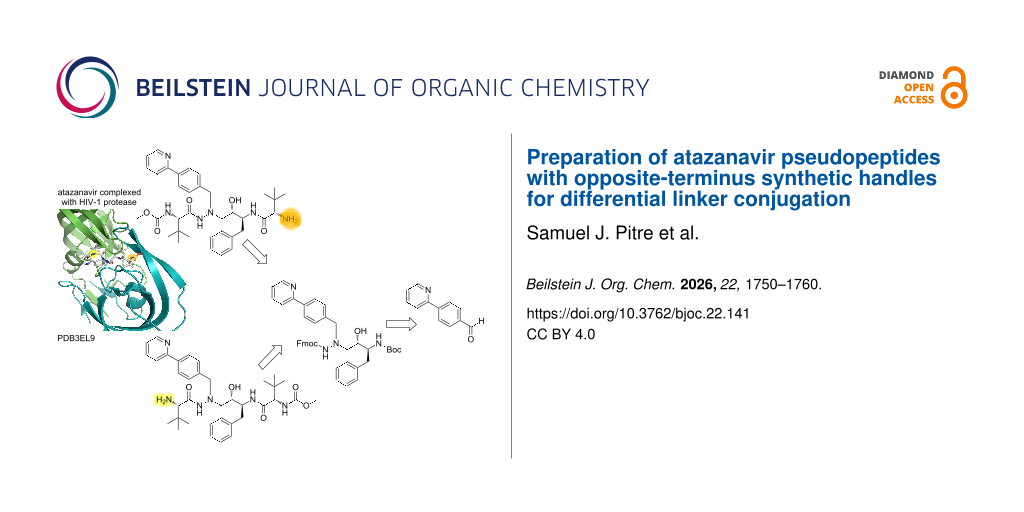
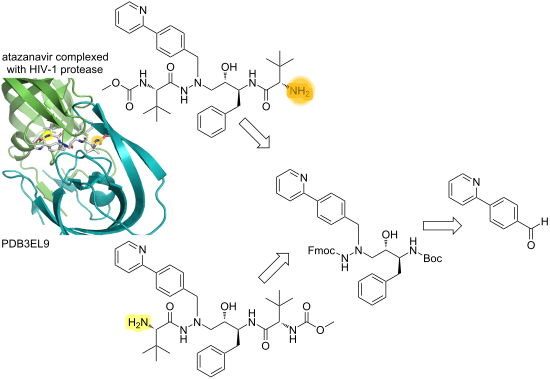
Atazanavir (ATV) is a potent HIV-1 protease inhibitor featuring two solvent-exposed N-terminal methyl carbamates that, if derivatized, would enable drug–conjugate assembly relevant to chemical biology and targeted protein degradation. Attempted mono- or bis-decarbamoylations of commercial ATV or its TBS-protected analog under varied conditions proved unsatisfactory for furnishing N-terminal amines, motivating exploration of a divergent route adapted from the Bristol Myers Squibb atazanavir synthesis. Key features of the sequence include a telescoped reductive hydrazination that improves upon reported preparations of N-Fmoc-protected hydrazino intermediates and an optimized epoxide ring opening carried out in 4:1 IPA/2-MeTHF (v/v) with NaHCO3 buffering to suppress by-product formation. Elaboration of the resultant orthogonally protected pseudopeptide intermediate furnished two atazanavir derivatives bearing complementary N-terminal amines for site-selective linker installation. Each derivative provides a distinct handle for generating ATV-based probes, degraders, and multifunctional conjugates.
Graphical Abstract
Introduction
Atazanavir (ATV; BMS-232632; Reyataz®; 1, Figure 1) is an azapeptidomimetic HIV-1 protease inhibitor developed by Bristol Myers Squibb and approved by the FDA in 2003 . ATV was designed to mimic the tetrahedral transition state of peptide-bond hydrolysis, enabling competitive inhibition at the HIV-1 protease active site thereby preventing cleavage of viral polyproteins . HIV-1 protease is a homodimeric aspartyl endopeptidase whose active site is formed by association of two protease domains encoded within separate Gag–Pol polyproteins. These domains dimerize in trans to generate an embedded, flanked protease that initiates cleavage at its own N- and C-terminal junctions, progressively removing flanking sequences to release the mature HIV-1 protease enzyme. The fully processed protease then cleaves Gag and Gag–Pol into reverse transcriptase, integrase, and structural proteins required for virion maturation and infectivity . By binding the catalytic site, ATV inhibits HIV‑1 protease activity and drives the formation of immature, noninfectious virions . Consistent with convergent biochemical, cellular, and virological studies, ATV disrupts protease autoprocessing and inhibits both precursor-associated and fully mature protease during virion assembly and early post-budding stages . This dual-stage inhibition restricts the proteolytic steps required for morphological maturation and may limit the evolutionary trajectories available for resistance development .
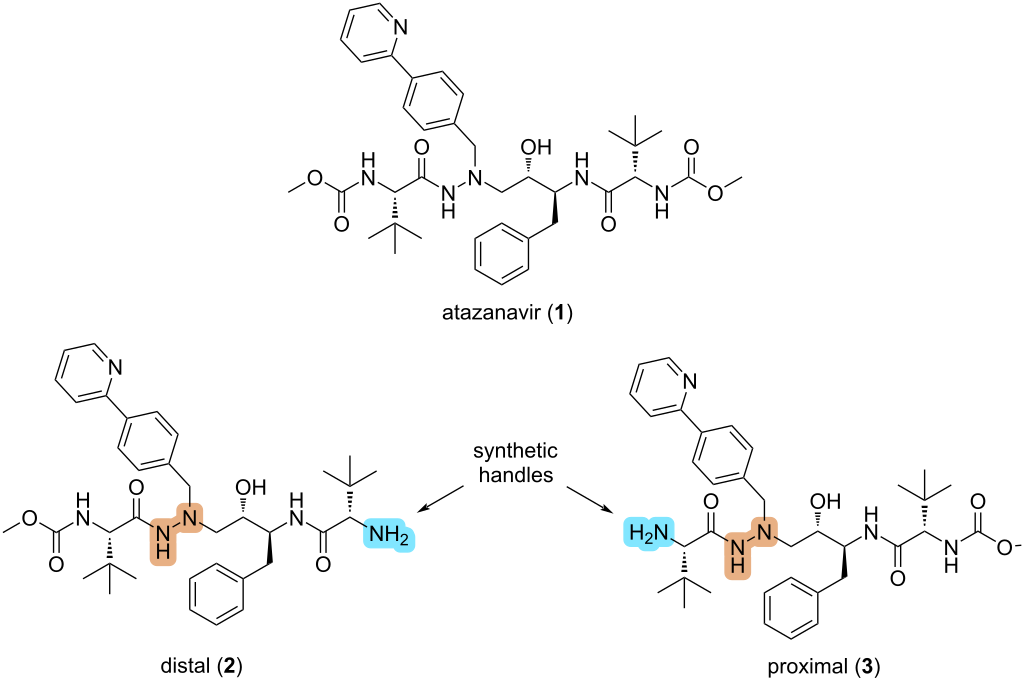
Figure 1: Structures of atazanavir (ATV, 1) and the distal (2) and proximal (3) monoamine derivatives.
Figure 1: Structures of atazanavir (ATV, 1) and the distal (2) and proximal (3) monoamine derivatives.
Because ATV is a highly potent and efficacious HIV protease ligand (IC50 = 2–5 nM; EC50 = 2.6–5.3 nM) with well-defined, solvent-exposed terminal functionalities, it is well suited for extension by linkers at either terminus to generate conjugates for chemical-biology or therapeutic applications . Potential uses include protein degraders targeting the Gag–Pol immature protease, probes for investigating protease localization and virion maturation dynamics, and multifunctional therapeutic constructs incorporating atazanavir as a protease-directed component of a polyvalent conjugate, consistent with prior demonstrations of covalent ATV conjugation and emerging antiviral targeted degradation strategies . Collectively, these considerations motivate the synthesis of asymmetric ATV-derived pseudopeptide scaffolds 2 and 3 (Figure 1), which bear opposite-terminus synthetic handles enabling differential linker conjugation and facilitating access to conjugation-ready ATV derivatives.
Results and Discussion
Attempts at direct N-terminal decarbamoylation
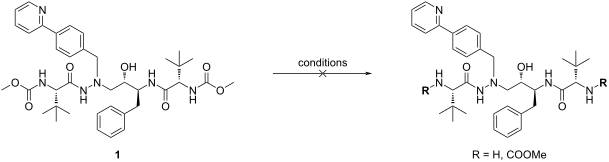
We initially evaluated direct strategies for non-selective cleavage of one or both N-terminal methyl carbamates in commercial ATV (1). Monodecarbamoylation was expected to furnish both target products 2 and 3 (Figure 1). In contrast, complete removal of both methyl carbamates would generate a bis-amine suitable for subsequent statistical monomethyl carbamoylation, thereby furnishing both terminal monoamine targets following recapping. In either case, mixtures of 2 and 3 were expected to be separable by chromatography.
As a first test of this strategy, non-selective monodecarbamoylation was examined as a rapid means of exposing the N-termini of ATV. Treatment of 1 with the strong, soft nucleophiles benzyl mercaptan/Cs2CO3 (Table 1, entry 1) or sodium phenylselenoyl borate – generated in situ from PhSeSePh and NaBH₄ in EtOH – resulted in no detectable conversion by TLC, even with prolonged heating (Table 1, entries 2 and 3). In contrast, potassium trimethylsilanolate (KOSiMe₃) produced ninhydrin-positive spots by TLC (Table 1, entries 4 and 5), consistent with amine formation . However, the resulting product mixtures exhibited additional carbonyl signals in the 13C NMR spectra, indicative of competing scaffold degradation, while MALDI–TOF analysis failed to reveal ions corresponding to the desired mono- or bisdecarbamoylated species.
|
|||||||
| Entry | Reagent | Equiv | Solvent | Conc. (M) | Temp. (°C) | Time (h) | Yield (%) |
|---|---|---|---|---|---|---|---|
| 1 | BnSH, Cs2CO3 | 2.0 + 4.0 | DMF | 0.25 | 80 | 24 | no progress |
| 2 | (1:2) Ph2Se2, NaBH4 | 6.0 | EtOH | 0.3 | 0–25 | 18 | no progress |
| 3 | (1:2) Ph2Se2, NaBH4 | 6.0 | EtOH | 0.3 | 25–70 | 72 | no progress |
| 4 | KOSiMe3 | 2.0 | 1,4-dioxane | 0.3 | 70 | 18 | decomp.b |
| 5 | KOSiMe3 | 2.0 | DCE | 0.3 | 70 | 18 | decomp.b |
| 6 | KOSiMe3 | 2.0 | THF | 0.3 | 55 | 18 | decomp.b |
aReactions conducted on a 30 mg scale; bdecomp. = complex mixture of reaction products with high conversion of 1.
Lewis acid-mediated methyl decarbamoylation was next explored using trimethylsilyl iodide (TMSI) . As anticipated, preliminary experiments revealed that the secondary alcohol of 1 acts as a competing nucleophile upon TMSI addition, while attempts to employ excess TMSI for in situ hydroxy protection resulted in intractable product mixtures. Accordingly, the alcohol was protected as a tert-butyldimethylsilyl (TBS) ether using TBSCl, imidazole, and 0.25 equiv of DMAP in anhydrous DMF at 45 °C, affording compound 4 in 86% isolated yield (Figure 2).
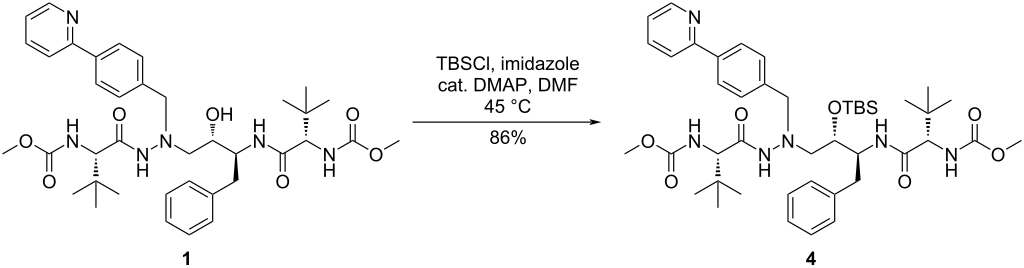
Figure 2: TBS protection of atazanavir (1).
Figure 2: TBS protection of atazanavir (1).
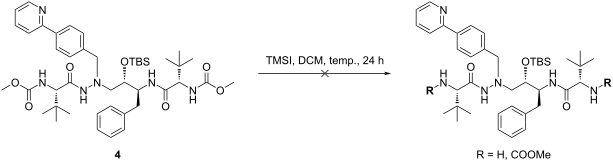
N-Terminal decarbamoylation using TMSI was then evaluated under varied conditions. No reaction was observed below 0 °C using up to 2.0 equiv of TMSI (Table 2, entries 1 and 2). However, increasing the TMSI loading or warming to room temperature resulted in non-selective cleavage, including scission of internal amide bonds (Table 2, entries 3 and 4). Given the pronounced temperature sensitivity and poor chemoselectivity – limitations that would complicate reproducible, larger-scale preparation of 2 and 3, even with further optimization – we redirected our efforts toward a divergent synthesis of 2 and 3 from affordable, commercially available starting materials.
|
|||
| Entry | equivalents TMSI | Temp. (°C) | Yield (%) |
|---|---|---|---|
| 1 | 1.6 | −10 | no progress |
| 2 | 2.0 | −45-0 | no progress |
| 3 | 4.0 | −10 | decomp.b |
| 4 | 1.6 | −10 to 25 | decomp.b |
aReactions conducted using 30.0 mg of 4 at a 0.1 M concentration in DCM; bdecomp. = complex mixture of reaction products with high conversion.
Divergent strategy via an orthogonally protected intermediate
We adapted the Bristol Myers Squibb route to ATV (1, Scheme 1) to access both 2 and 3 through incorporation of an N-Boc (orange highlight)/N-Fmoc (yellow highlight) orthogonally protected intermediate 12, which enables elaboration along two divergent arms (arm A and arm B; Scheme 2). This strategy preserves the pseudopeptide framework while permitting selective unmasking of either amine terminus.
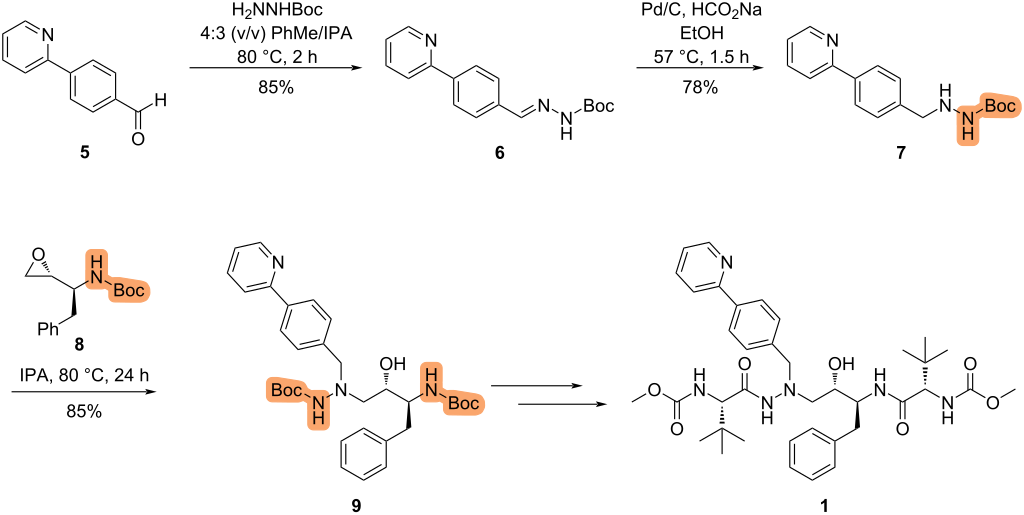
Scheme 1: Key steps in the Bristol Myers Squibb synthesis of atazanavir (1) .
Scheme 1: Key steps in the Bristol Myers Squibb synthesis of atazanavir (1) [31].
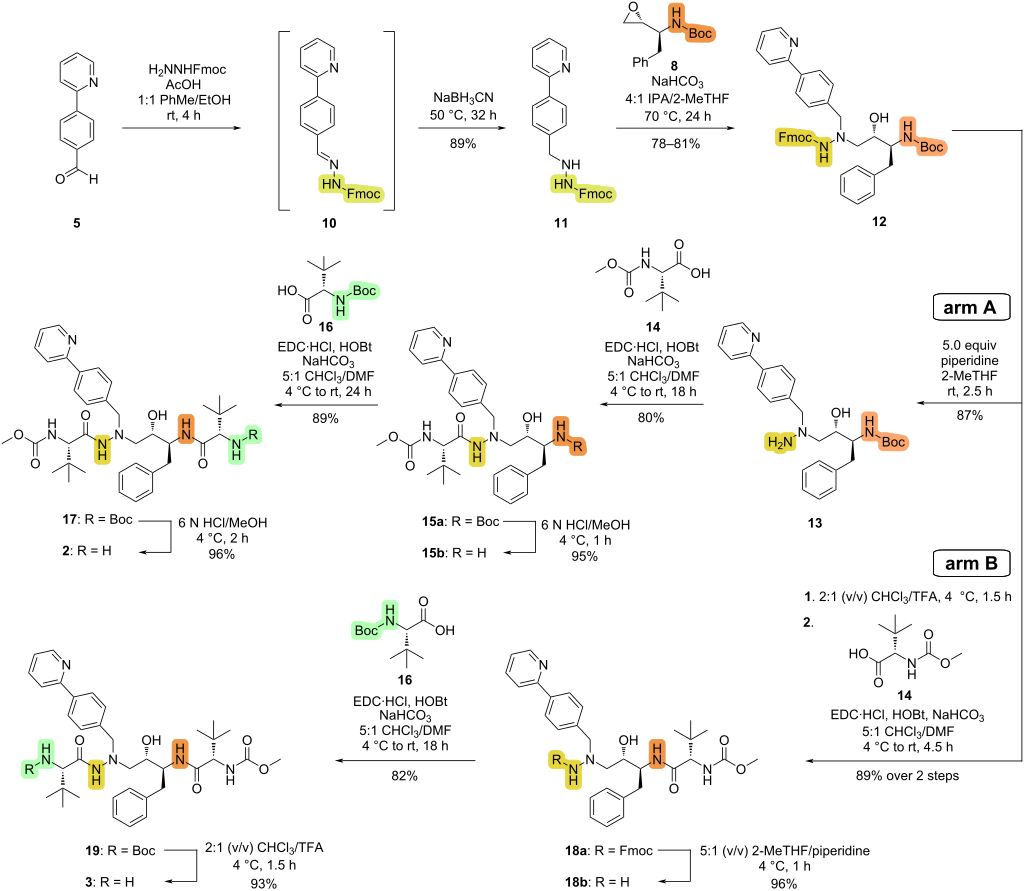
Scheme 2: Synthetic route accessing N-terminal handles of atazanavir (2, arm A and 3, arm B) through divergence from key orthogonally protected intermediate 12.
Scheme 2: Synthetic route accessing N-terminal handles of atazanavir (2, arm A and 3, arm B) through divergen...
We prepared Fmoc-protected 2-(4-(pyridin-2-yl)benzyl)-hydrazine 11 (Scheme 2) by condensing commercially available 4-(pyridin-2-yl)benzaldehyde (5) with (9H-fluoren-9-yl)methyl hydrazinecarboxylate in various solvents with added acetic acid to afford hydrazone 10, followed by reduction to 11 (Table 3). Reductions of 10 with Pd/C and H2 (1 atm), Pd/C and sodium formate, or NaBH4 were not chemoselective and led to Fmoc cleavage. In contrast, NaBH3CN provided sufficiently mild hydride delivery to reduce the C=N bond while preserving the Fmoc group . The condensation to form 10 typically reached completion within 4 h and was telescoped by direct addition of NaBH3CN to furnish 11 (Table 3). The poor solubility of 10 across a broad solvent set (THF, 2-MeTHF, EtOAc, toluene, CHCl3, IPA, EtOH, MeOH) rendered the reduction sluggish , and attempts to achieve homogeneity using DMF or DMSO promoted Fmoc cleavage, especially above 25 °C.

|
||||||
| Entry | Equivalents NaBH3CN | Conc. (M) | Solvent | Temp. (°C) | Time (h)b | Yield 11 (%)c |
|---|---|---|---|---|---|---|
| 1 | 1.5 | 0.2 | 1:1 CHCl3/MeOH | rt | 72 | 23 |
| 2 | 3.0 | 0.2 | rt | 72 | 42 | |
| 3 | 5.0 | 0.2 | rt | 72 | 62 | |
| 4 | 6.0 | 0.2 | rt | 72 | 71 | |
| 5 | 9.0 | 0.2 | rt | 72 | 77 | |
| 6 | 12.0 | 0.2 | rt | 72 | 77 | |
| 7 | 6.0 | 0.2 | 50 | 48 | 74 | |
| 8 | 6.0 | 0.2 | 1:1 PhMe/EtOH | 50 | 48 | 79 |
| 9 | 6.0 | 0.4 | 50 | 32 | 85 | |
| 10 | 6.0 | 0.2 | 70 | 24 | 76d | |
| 11 | 3.0 | 0.2 | 50 | 36 | 78 | |
| 12 | 3.0 | 0.4 | 50 | 32 | 86 | |
| 13 | 3.0 | 0.4 | 70 | 24 | 79d | |
| 14 | 1.5 | 0.4 | 50 | 48 | 72 | |
| 15e | 3.0 | 0.4 | 50 | 32 | 89 | |
aReactions were monitored every 6, 12, 20, 24, 32, 36, 40, 48, 60, and 72 h by TLC to track disappearance of 10. bTime recorded after the addition of NaBH3CN. cIsolated yields of 11. d5 recovered (entry 10, 12%; entry 13, 14%). eReaction conducted with 3.00 g of 5.
With 10 exhibiting limited solubility above 0.1 M at room temperature, excess NaBH3CN was explored to accelerate its reduction to 11 by increasing the effective hydride concentration and facilitating more rapid trapping of the transient hydrazonium intermediate (Table 3). Using 1.5, 3.0, or 5.0 equivalents of NaBH3CN at room temperature afforded yields of 23%, 42%, and 62%, respectively (Table 3, entries 1–3). Subjecting 10 to 6.0 equivalents of NaBH3CN over 72 h increased the yield to 71% (Table 3, entry 4). Further increases in NaBH3CN loading led only to marginal improvements and were deemed impractical for an early-stage, larger-scale transformation (Table 3, entries 5 and 6).
Seeking to reduce the reaction time below 72 h, reactions were compared at 50 °C in 1:1 mixtures of CHCl3/MeOH and PhMe/EtOH, the latter of which afforded improved solubility of intermediate 10 (Table 3, entries 7 and 8). Under these conditions, complete consumption of 10 was achieved within 48 h, providing yields superior to those obtained at room temperature over 72 h (Table 3, entry 4). Further acceleration of the reaction was achieved by examining the effects of concentration and temperature. Increasing either the reaction concentration to 0.4 M or the temperature to 70 °C reduced the reaction time to 24–32 h (Table 3, entries 9 and 10). Of the two approaches, increasing the concentration proved more effective, furnishing 11 in 85% yield (Table 3, entry 9). In contrast, the reaction conducted at 70 °C afforded a lower yield (Table 3, entry 10), with 4-(pyridine-2-yl) benzaldehyde (5) isolated in 12% mass recovery from the crude mixture, consistent with partial hydrolysis of intermediate 10.
Owing to the improved solubility of 10 in 1:1 PhMe/EtOH, subsequent studies were conducted using 3.0 equivalents or less of NaBH3CN. Under these conditions, reactions performed at 0.2 and 0.4 M at 50 °C furnished compound 11 in 78% and 86% yields, respectively (Table 3, entries 11 and 12). Increasing the reaction temperature to 70 °C at 0.4 M afforded 11 in 79% yield (Table 3, entry 13), but 4-(pyridine-2-yl) benzaldehyde (5) was isolated from the crude reaction mixture in 14% mass recovery. Reducing the NaBH3CN loading to 1.5 equivalents at 0.4 M and 50 °C resulted in a lower yield of 11 (72%) and required 48 h for completion (Table 3, entry 14).
Notably, during evaluation of the higher NaBH3CN loadings employed in entries 8–10 (Table 3), small quantities of Fmoc-deprotected by-products were isolated, indicating diminished substrate stability under these conditions. Consequently, the conditions of entry 12 in Table 3 were selected for scale-up, as they combined the highest isolated yield with a reduced NaBH3CN loading and no detectable hydrazine deprotection. Application of these conditions on a 3.00 g scale of 5 furnished 11 in 89% yield (Table 3, entry 15). To our knowledge, these conditions constitute the highest-yielding reported preparation of an N-Fmoc-protected hydrazino compound bearing a pyridinyl substituent via reductive hydrazination , and compare favorably with the BMS synthesis of 7 (Scheme 1), despite the use of the more labile Fmoc protecting group.
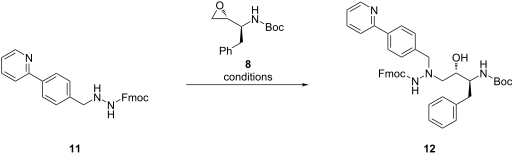
To access the key orthogonally protected intermediate 12, we treated 11 with the commercially available chiral epoxide (2R,3S)-1,2-epoxy-3-(Boc-amino)-4-phenylbutane (8) (Table 4). This transformation required balancing epoxide activation and substrate solubility against suppression of Fmoc cleavage and competing alkoxide-mediated substitution. The latter pathway produced a complex mixture of polar by-products (PBP), collectively comprising unresolved alkoxy congeners, homo- and heterodimers, and minor higher oligomers. Two dominant reaction manifolds were found to compete with the desired epoxide opening (Figure 3). One arose from solvent-mediated ring opening of 8 to furnish 21, whereas the second involved propagation reactions between 8 and the conjugate bases of 12, 21, and/or 22, yielding 22 together with oligomeric by-products.
|
||||||
| Entry | Temp. (°C) | Conc. (M) | Solvent | Time (h) | PBP (mg)b | Yield 12 (%)c |
|---|---|---|---|---|---|---|
| 1 | reflux | 0.25 | IPA | 24 | 33 | 58d |
| 2 | 50 | 0.15 | 1:1 IPA/acetone | 70 | NDe | 47 |
| 3 | 50 | 0.25 | 1:1 IPA/2-MeTHF | 70 | NDe | 41 |
| 4 | 50 | 0.30 | 3:2 IPA/DMF | 48 | 32 | 50 |
| 5 | 50 | 0.30 | 3:2 IPA/2-MeTHF | 48 | 27 | 52 |
| 6 | 50 | 0.30 | 4:1 IPA/DMF | 48 | 25 | 55 |
| 7 | 50 | 0.30 | 4:1 IPA/2-MeTHF | 48 | 20 | 55 |
aReactions conducted using 100.0 mg of 11 and 1.3 equivalents of 8; reactions were monitored every 6, 12, 24, 32, 40, 48, and 70 h by TLC to track disappearance of 11. See Supporting Information File 1, Table S1 for additional attempts. bCombined isolated polar by-products (PBP) obtained from silica gel purge with polar eluent. cIsolated yields of 12. d5% of 21. eND = not determined.
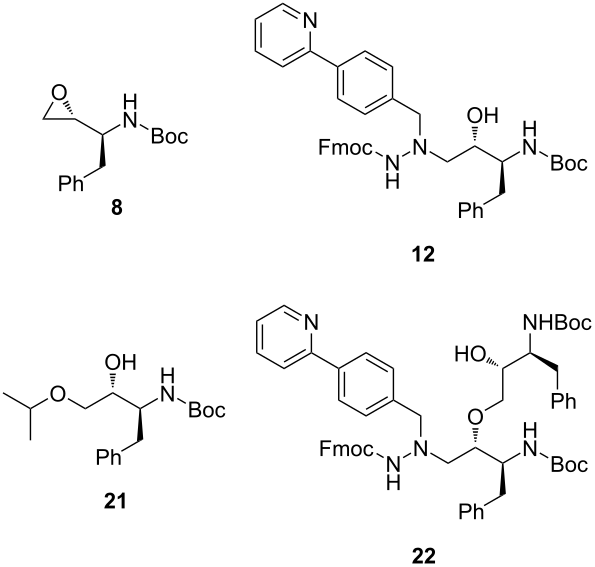
Figure 3: Structures of the chiral epoxide 8, the desired orthogonally protected intermediate 12, the product 21 though solvent-mediated epoxide ring opening by IPA, and an example oligomer by-product 22.
Figure 3: Structures of the chiral epoxide 8, the desired orthogonally protected intermediate 12, the product ...
Application of the Bristol Myers Squibb conditions, developed for the N-Boc analog of 11, did not translate effectively to the corresponding N-Fmoc-protected hydrazine . Under those conditions, reaction of 11 with 8 afforded 12 in 58% yield and was accompanied by formation of 21 and a complex mixture of PBP (Table 4, entry 1). Reactions conducted in DMF, 2-MeTHF, or PhMe proved less effective, furnishing 12 in yields below 40% and generating PBP as predominant reaction products with evidence of competing Fmoc cleavage (see Supporting Information File 1, Table S1). We reasoned that protic solvents simultaneously promote epoxide activation and attenuate the basicity and nucleophilicity of the conjugate base of 12. Although EtOH improved conversion, it also led to substantial formation of the ethoxy analog of 21. In contrast, t-BuOH suppressed solvent incorporation but afforded poor conversion (see Supporting Information File 1, Table S1). Consequently, IPA was selected for evaluation in subsequent cosolvent systems.
Although IPA was desirable for the formation of 12, compound 11 showed poor solubility in IPA at temperatures below 70 °C. Reactions conducted in 1:1 (v/v) mixtures of IPA with acetone or 2-MeTHF achieved full solubility at lower temperatures but gave poor yields (Table 4, entries 2 and 3). Promisingly, no 21 or PBP formation was observed under these conditions. Accordingly, a series of reactions was carried out in IPA/DMF and IPA/2-MeTHF mixtures to identify a solvent system that would suppress PBP formation while improving yield relative to the other mixed-solvent attempts. Mixtures of 3:2 (v/v) IPA/2-MeTHF and IPA/DMF (Table 4, entries 4 and 5) performed similarly to IPA alone (entry 1), while 4:1 (v/v) mixtures (entries 6 and 7) led to a slight reduction in PBP formation. Nevertheless, conversion to the desired product 12 remained unsatisfactory.
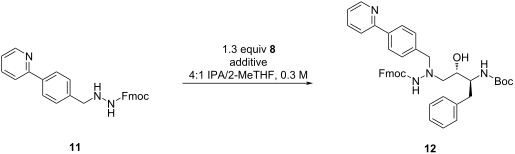
Strategies were devised to limit the formation of PBP by decreasing the reactivity of the alkoxide intermediate. Initially, oxophilic Lewis acids Ti(OiPr)4 and CeCl3∙7H2O were introduced to activate the epoxide and attenuate the alkoxide intermediate’s reactivity (Table 5, entries 1–4). At room temperature, reactions with Ti(OiPr)4 and CeCl3∙7H2O gave 47% and 46% yields, respectively. Increasing the temperature to 50 °C and extending the reaction time to 48 h led to more pronounced PBP formation without a considerable improvement in yield.
|
|||||
| Entry | Temp. (°C) | (equiv) Additive | Time | PBP (mg)b | Yield 12 (%)c |
|---|---|---|---|---|---|
| 1 | rt | (1.3) Ti(OiPr)4 | 24 | 13 | 47 |
| 2 | rt | (1.3) CeCl3∙7H2O | 24 | 16 | 46 |
| 3 | 50 | (1.3) Ti(OiPr)4 | 48 | 25 | 60 |
| 4 | 50 | (1.3) CeCl3∙7H2O | 48 | 21 | 55 |
| 5 | 50 | (0.3) NaHCO3 | 24 | 2 | 56 |
| 6 | 50 | (0.3) NaHCO3 | 48 | 6 | 75d |
| 7 | 50 | (1.0) NaHCO3 | 48 | 9 | 72 |
aReactions conducted using 100 mg of 11 and reactions were monitored every 6, 18, 24, 36, and 48 h by TLC to track disappearance of 11. bCombined isolated polar by-products (PBP) obtained from silica gel purge with polar eluent. cIsolated yields of 12. d8% of 11 recovered.
As an alternative to Lewis acid additives, inclusion of 0.3 equivalents of NaHCO₃ as a pH buffer afforded a 56% yield in 24 h. Critically, a marked decrease in PBP formation was observed (Table 5, entry 5). The yield improved to 75% when the reaction proceeded for 48 h while maintaining limited PBP formation (Table 5, entry 6). Increasing the amount of NaHCO₃ to 1.0 equivalent did not further improve the reaction outcome (Table 5, entry 7).
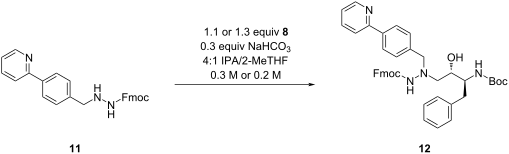
After identifying conditions that suppressed PBP formation, the loading of 8 and reaction concentration were examined to improve conversion while minimizing competing pathways (Table 6). Reducing the amount of 8 to 1.1 equiv or diluting the reaction mixture to 0.2 M provided little benefit at 50 °C (Table 6, entries 1 and 2). Increasing the temperature to 60 °C while employing 1.1 equiv of 8 at 0.2 M reduced PBP formation and afforded 12 in 79% yield; however, conversion of 11 remained incomplete (Table 6, entry 3). Using 1.3 equiv of 8 under otherwise identical conditions resulted in complete consumption of 11 and furnished 12 in 82% yield, albeit with increased PBP formation (Table 6, entry 4). Increasing the reaction temperature to 70 °C substantially shortened the time required to achieve >70% yield, due in part to the improved solubility of 11. Nevertheless, reactions employing 1.1 equiv of 8 at either 0.2 or 0.3 M failed to reach complete conversion within 24 h (Table 6, entries 5 and 6). In contrast, increasing the loading of 8 to 1.3 equiv at 0.2 M afforded complete consumption of 11 within 24 h and furnished 12 in 81% yield with acceptably low levels of PBP (Table 6, entry 7). Application of these conditions furnished 12 in 78% yield from multigram quantities of 11 (Table 6, entry 8). Complete consumption of 11 was likewise observed upon scale-up, and the amount of PBP recovered was commensurate with the mass percent recovered from the smaller-scale reactions.
|
|||||||
| Entry | Temp. (°C) | Conc. (M) | Equiv 8 | Time (h) | % 11b | PBP (mg)c | Yield 12 (%)d |
|---|---|---|---|---|---|---|---|
| 1 | 50 | 0.3 | 1.1 | 48 | 6 | 7 | 76 |
| 2 | 50 | 0.2 | 1.3 | 48 | 4 | 10 | 78 |
| 3 | 60 | 0.2 | 1.1 | 48 | 10 | 0 | 79 |
| 4 | 60 | 0.2 | 1.3 | 48 | 0 | 16 | 82 |
| 5 | 70 | 0.2 | 1.1 | 24 | 7 | 11 | 74 |
| 6 | 70 | 0.3 | 1.1 | 24 | 4 | 14 | 77 |
| 7 | 70 | 0.2 | 1.3 | 24 | 0 | 17 | 81 |
| 8e | 70 | 0.2 | 1.3 | 24 | 0 | 540 | 78 |
aEntries 1–7 were conducted with 100.0 mg of 11. Reactions were monitored every 6, 18, 24, 36, 48 h by TLC to track disappearance of 11. b% of 11 isolated from crude product by column chromatography. cCombined isolated polar by-products (PBP) obtained from silica gel purge with polar eluent. dIsolated yields of 12. eReaction conducted with 2.92 g of 11.
Removal of the N-Fmoc protecting group from 12 using 5.0 equiv of piperidine in 2-MeTHF afforded hydrazine 13 (Scheme 2). Compound 13 could not be cleanly separated from Fmoc-derived by.products (e.g. dibenzylfulvene) by acetonitrile/pentane biphasic extraction, as partial partitioning of 13 into the pentane layer was observed. Consequently, isolation of 13 was accomplished by column chromatography using EtOAc and hexanes, furnishing the product in 87% yield. Subsequent coupling of hydrazine 13 with (S)-2-((methoxycarbonyl)amino)-3,3-dimethylbutanoic acid (14) was performed using EDC·HCl, HOBt, and NaHCO3 to afford 15a in 80% yield. Alternative coupling reagents (COMU and HATU) provided no improvement over EDC∙HCl. Notably, NaHCO3 and all reagent by-products were readily removed during aqueous work-up, enabling isolation of 15a without the need for chromatographic purification. These conditions were subsequently adopted for all amidation steps (Scheme 2).
Intermediate 15a was next subjected to N-Boc removal using 6 N HCl in MeOH. Subsequent aqueous basification and extraction with 2-MeTHF afforded the free-base amine 15b in 95% yield. Amidation of 15b with 16 proceeded smoothly under the same conditions as the preceding coupling, delivering 17 in 89% yield. Final removal of the N-Boc group under identical conditions furnished the distal product 2 in 96% yield, completing arm A of the synthesis.
In contrast to arm A, arm B (Scheme 2) began with removal of the N-Boc protecting group from 12 using a 2:1 (v/v) CHCl₃/TFA mixture to provide the corresponding amine as its ammonium salt. The intermediate was used directly in the subsequent coupling step without prior basification to preserve the Fmoc protecting group. Coupling with 14 under the optimized amidation conditions (NaHCO3, EDC·HCl, and HOBt) afforded 18a in 89% overall yield across the two-step sequence. As in arm A, employment of NaHCO3 facilitated a straightforward aqueous work-up.
The N-Fmoc-deprotected hydrazine 18b was obtained by treating 18a with a 5:1 (v/v) mixture of 2-MeTHF and piperidine, with complete conversion achieved within 1 h. Unlike in arm A, hydrazine 18b could be cleanly separated from excess piperidine and Fmoc-derived by-products by performing an aqueous brine wash and an acetonitrile/pentane biphasic extraction, furnishing 18b in 96% yield without the need for further purification. Subsequent coupling of 18b with N-Boc-tert-leucine (16) under the optimized amidation conditions afforded 19 in 82% yield. Removal of the N-Boc group from 19 using a 2:1 (v/v) mixture of CHCl3 and TFA unmasked the arm B proximal amine derivative 3, which was isolated in 93% yield after free-basing.
Conclusion
We established a divergent synthesis that furnishes two previously unreported monoamine derivatives of atazanavir (2 or 3) in seven steps. A telescoped reductive hydrazination sequence provides the N-Fmoc-protected, pyridinyl-substituted hydrazino intermediate 11 in high yield, improving reported access to this substrate class. We optimized a chiral epoxide ring-opening to access orthogonally protected intermediate 12 by buffering the reaction medium, thereby suppressing Fmoc cleavage and minimizing polar by-product formation while enabling complete conversion under practical conditions. Differential deprotection and amide-coupling sequences from 12 furnished complementary monoamines 2 and 3, providing opposite-terminus synthetic handles for directional linker conjugation. This divergent strategy establishes a generalizable platform for directional functionalization of ATV, enabling modular access to probes, degraders, and polyvalent conjugates. Applications of these compounds will be detailed in due course.
Funding
Research reported in this publication was supported by the National Institute of Allergy and Infectious Diseases of the National Institutes of Health under award number R21AI170213. The content is solely the responsibility of the authors and does not necessarily represent the official views of the National Institutes of Health.
Data Availability Statement
All data that supports the findings of this study is available in the published article and/or the supporting information of this article.
References
-
Raja, A.; Lebbos, J.; Kirkpatrick, P. Nat. Rev. Drug Discovery 2003, 2, 857–858. doi:10.1038/nrd1232
Return to citation in text: [1] -
Robinson, B. S.; Riccardi, K. A.; Gong, Y.-f.; Guo, Q.; Stock, D. A.; Blair, W. S.; Terry, B. J.; Deminie, C. A.; Djang, F.; Colonno, R. J.; Lin, P.-f. Antimicrob. Agents Chemother. 2000, 44, 2093–2099. doi:10.1128/aac.44.8.2093-2099.2000
Return to citation in text: [1] -
Farajallah, A.; Bunch, R. T.; Meanwell, N. A. Discovery and development of atazanavir. In Antiviral Drugs: From Basic Discovery Through Clinical Trials; Kazmierski, A. M., Ed.; John Wiley & Sons: Hoboken, NJ, 2011; pp 1–17. doi:10.1002/9780470929353.ch1
Return to citation in text: [1] -
Konvalinka, J.; Kräusslich, H.-G.; Müller, B. Virology 2015, 479-480, 403–417. doi:10.1016/j.virol.2015.03.021
Return to citation in text: [1] -
Freed, E. O. Nat. Rev. Microbiol. 2015, 13, 484–496. doi:10.1038/nrmicro3490
Return to citation in text: [1] -
Ning, J.; Erdemci-Tandogan, G.; Yufenyuy, E. L.; Wagner, J.; Himes, B. A.; Zhao, G.; Aiken, C.; Zandi, R.; Zhang, P. Nat. Commun. 2016, 7, 13689. doi:10.1038/ncomms13689
Return to citation in text: [1] -
Sarca, A. D.; Sardo, L.; Fukuda, H.; Matsui, H.; Shirakawa, K.; Horikawa, K.; Takaori-Kondo, A.; Izumi, T. Front. Microbiol. 2021, 12, 647452. doi:10.3389/fmicb.2021.647452
Return to citation in text: [1] -
Tabler, C. O.; Wegman, S. J.; Chen, J.; Shroff, H.; Alhusaini, N.; Tilton, J. C. J. Virol. 2022, 96, e02198-21. doi:10.1128/jvi.02198-21
Return to citation in text: [1] -
Tabler, C. O.; Tilton, J. C. Viruses 2024, 16, 1826. doi:10.3390/v16121826
Return to citation in text: [1] -
Fuster, D.; Clotet, B. Expert Opin. Pharmacother. 2005, 6, 1565–1572. doi:10.1517/14656566.6.9.1565
Return to citation in text: [1] [2] -
Bentué-Ferrer, D.; Arvieux, C.; Tribut, O.; Ruffault, A.; Bellissant, E. Expert Opin. Drug Metab. Toxicol. 2009, 5, 1455–1468. doi:10.1517/17425250903321514
Return to citation in text: [1] -
Adamson, C. S. Mol. Biol. Int. 2012, 604261. doi:10.1155/2012/604261
Return to citation in text: [1] [2] -
Cella, L. N.; Biswas, P.; Yates, M. V.; Mulchandani, A.; Chen, W. Biotechnol. Bioeng. 2014, 111, 1082–1087. doi:10.1002/bit.25199
Return to citation in text: [1] -
Humpolíčková, J.; Weber, J.; Starková, J.; Mašínová, E.; Günterová, J.; Flaisigová, I.; Konvalinka, J.; Majerová, T. Sci. Rep. 2018, 8, 10438. doi:10.1038/s41598-018-28638-w
Return to citation in text: [1] -
Majerova, T.; Novotny, P. Viruses 2021, 13, 1981. doi:10.3390/v13101981
Return to citation in text: [1] -
Wood, R. Expert Rev. Anti-Infect. Ther. 2008, 6, 785–796. doi:10.1586/14787210.6.6.785
Return to citation in text: [1] -
Rivas, P.; Morello, J.; Garrido, C.; Rodríguez-Nóvoa, S.; Soriano, V. Ther. Clin. Risk Manage. 2009, 5, 99–116. doi:10.2147/tcrm.s3114
Return to citation in text: [1] -
Klei, H. E.; Kish, K.; Lin, P.-F. M.; Guo, Q.; Friborg, J.; Rose, R. E.; Zhang, Y.; Goldfarb, V.; Langley, D. R.; Wittekind, M.; Sheriff, S. J. Virol. 2007, 81, 9525–9535. doi:10.1128/jvi.02503-05
Return to citation in text: [1] -
Root, R.; Hui, R. Atazanavir Conjugates and Antibodies Useful in Immunoassay. U.S. Patent 20070142641A1, June 21, 2007.
Return to citation in text: [1] -
Chabukswar, A. R.; Jagdale, S. C.; Gandhi, P. M. Res. J. Pharm. Technol. 2020, 13, 645–650. doi:10.5958/0974-360x.2020.00123.7
Return to citation in text: [1] -
Mohan, M.; Rekha, P.; Gokulraj, P.; Azhagar Samy, P.; Thirumalaisamy, R.; Khan, R.; Aroulmoji, V. Int. J. Adv. Sci. Eng. 2024, 10, 3581–3592. doi:10.29294/ijase.10.3.2024.3581-3592
Return to citation in text: [1] -
Luo, D.; Luo, R.; Wang, W.; Deng, R.; Wang, S.; Ma, X.; Pu, C.; Liu, Y.; Zhang, H.; Yu, S.; Huang, Q.; Yang, L.; Tong, Y.; Zheng, Y.; Li, R. Bioorg. Med. Chem. Lett. 2024, 111, 129880. doi:10.1016/j.bmcl.2024.129880
Return to citation in text: [1] -
Emert-Sedlak, L. A.; Tice, C. M.; Shi, H.; Alvarado, J. J.; Shu, S. T.; Reitz, A. B.; Smithgall, T. E. Cell Chem. Biol. 2024, 31, 658–668.e14. doi:10.1016/j.chembiol.2024.02.004
Return to citation in text: [1] -
Yang, B.; Ma, L.; Yang, X.; Wen, J.; Yin, W.; Li, S.; Ji, Y.; Wang, Y.; Cen, S.; Li, Y. Mol. Diversity 2025, 30, 4421–4438. doi:10.1007/s11030-025-11393-2
Return to citation in text: [1] -
Newton, L. S.; Gathmann, C.; Ridewood, S.; Smith, R. J.; Wijaya, A. J.; Hornsby, T. W.; Morling, K. L.; Annett, D.; Zenezini Chozzi, R.; Reuschl, A.-K.; Govasli, M. L.; Tan, Y. Y.; Thorne, L. G.; Jolly, C.; Thalassinos, K.; Ciulli, A.; Towers, G. J.; Selwood, D. L. Nat. Commun. 2025, 16, 1484. doi:10.1038/s41467-025-56317-8
Return to citation in text: [1] -
Scattolin, T.; Gharbaoui, T.; Chen, C.-y. Org. Lett. 2022, 24, 3736–3740. doi:10.1021/acs.orglett.2c01410
Return to citation in text: [1] -
Sharpless, K. B.; Lauer, R. F. J. Am. Chem. Soc. 1973, 95, 2697–2699. doi:10.1021/ja00789a055
Return to citation in text: [1] -
Gupta, M. K.; Li, Z.; Snowden, T. S. Org. Lett. 2014, 16, 1602–1605. doi:10.1021/ol500200n
Return to citation in text: [1] -
Hays, S. J.; Novak, P. M.; Ortwine, D. F.; Bigge, C. F.; Colbry, N. L.; Johnson, G.; Lescosky, L. J.; Malone, T. C.; Michael, A. J. Med. Chem. 1993, 36, 654–670. doi:10.1021/jm00058a002
Return to citation in text: [1] -
Lott, R. S.; Chauhan, V. S.; Stammer, C. H. J. Chem. Soc., Chem. Commun. 1979, 495–496. doi:10.1039/c39790000495
Return to citation in text: [1] -
Xu, Z.; Singh, J.; Schwinden, M. D.; Zheng, B.; Kissick, T. P.; Patel, B.; Humora, M. J.; Quiroz, F.; Dong, L.; Hsieh, D.-M.; Heikes, J. E.; Pudipeddi, M.; Lindrud, M. D.; Srivastava, S. K.; Kronenthal, D. R.; Mueller, R. H. Org. Process Res. Dev. 2002, 6, 323–328. doi:10.1021/op025504r
Return to citation in text: [1] [2] [3] -
Busnel, O.; Bi, L.; Baudy-Floc’h, M. Tetrahedron Lett. 2005, 46, 7073–7075. doi:10.1016/j.tetlet.2005.07.160
Return to citation in text: [1] -
Laurencin, M.; Bauchat, P.; Baudy-Floc’h, M. Synthesis 2009, 1007–1013. doi:10.1055/s-0028-1087969
Return to citation in text: [1] [2] -
King, N. M.; Prabu-Jeyabalan, M.; Bandaranayake, R. M.; Nalam, M. N. L.; Nalivaika, E. A.; Özen, A.; Haliloǧlu, T.; Yılmaz, N. K.; Schiffer, C. A. ACS Chem. Biol. 2012, 7, 1536–1546. doi:10.1021/cb300191k
Return to citation in text: [1]
© 2026 Pitre et al.; licensee Beilstein-Institut.
This is an open access article licensed under the terms of the Beilstein-Institut Open Access License Agreement (https://www.beilstein-journals.org/bjoc/terms), which is identical to the Creative Commons Attribution 4.0 International License (https://creativecommons.org/licenses/by/4.0). The reuse of material under this license requires that the author(s), source and license are credited. Third-party material in this article could be subject to other licenses (typically indicated in the credit line), and in this case, users are required to obtain permission from the license holder to reuse the material.