Search results
Search for "equilibrium" in Full Text gives 679 result(s) in Beilstein Journal of Organic Chemistry. Showing first 200.
Controlled supramolecular assemblies of luminescent tridentate cyclometalated alkynylgold(III) amphiphiles in aqueous media
Beilstein J. Org. Chem. 2026, 22, 1097–1106, doi:10.3762/bjoc.22.88
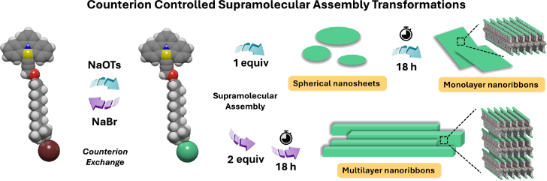
- d–d state of gold(III) complexes quenches the luminescent excited state through thermal equilibrium and energy transfer [53]. Cyclometalated gold(III) complexes incorporated with strong σ-donating alkynyl ligands, reported by Yam, exhibit enhanced luminescent properties under ambient conditions


Synthesis of sterically shielded piperidine nitroxides via acid-catalyzed heterocyclization of β-aminoketone derivatives with ketones
Beilstein J. Org. Chem. 2026, 22, 948–954, doi:10.3762/bjoc.22.74
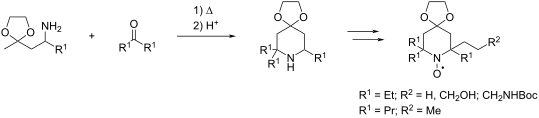
- nitroxide-mediated polymerization (NMP), because shielding with ethyl or bulkier alkyl groups decreases accessibility of the nitroxide moiety and improves the equilibrium parameters in the reversible trapping of alkyl radical of the growing polymer chain [11]. This shielding also alters the redox properties


Recent advances in copper-catalyzed direct hydroamination of alkenes with (hetero)aromatic amines
Beilstein J. Org. Chem. 2026, 22, 925–947, doi:10.3762/bjoc.22.73
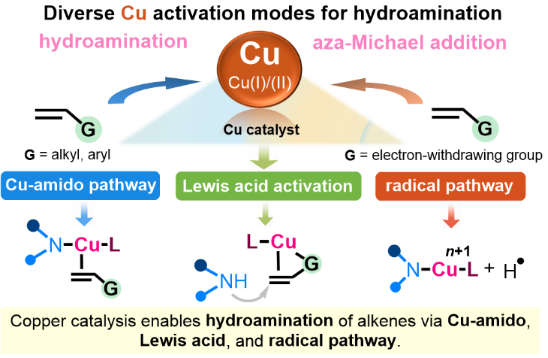
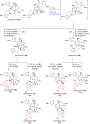
- addition of 2-arylethynylaniline 29 to form β-amino ketone intermediate II, which existed in equilibrium with its enol form. Subsequent coordination of the alkyne to the copper center promoted intramolecular 5-endo-dig hydroamination, yielding indole product 32 after proton transfer. Overall, the copper







A practical CO2-mediated synthesis of 5,6-carboxylated silicon-rhodamines for targeted probe development
Beilstein J. Org. Chem. 2026, 22, 915–924, doi:10.3762/bjoc.22.72
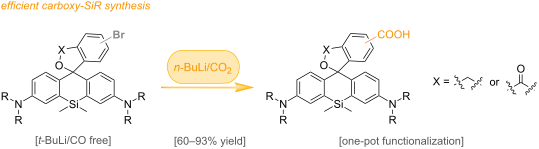
- .22.72 Abstract Silicon-rhodamine (SiR) dyes are among the most important fluorophores for super-resolution imaging owing to their far-red emission, high photostability, and tunable lactone–zwitterion equilibrium. However, their broader application in targeted probe development has been limited by the
- emerged as one of the most important fluorophores for live-cell bioimaging [3][4][5][6][7] by virtue of their high brightness, excellent photostability [8][9][10], and, most importantly, tunable lactone–zwitterion (L–Z) equilibrium [11][12][13]. This distinctive feature enables controllable fluorescence
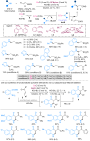
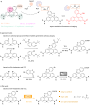
- cell permeability [25][26]. Johnsson and co-workers further showed that SiRs can exist in a nonfluorescent spirolactone form, whereas target binding shifts the equilibrium toward the fluorescent zwitterionic form, thereby generating a strong fluorogenic response (Figure 1a) [27][28][29]. This behavior



Cascade transformation of 2-(diazoacetyl)-2H-azirines to 2-aroyl-3-hydroxy-1H-pyrroles via condensation with aromatic aldehydes
Beilstein J. Org. Chem. 2026, 22, 897–904, doi:10.3762/bjoc.22.70
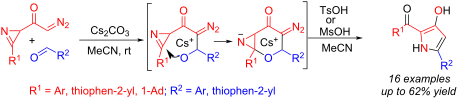
- ring. The intermediate (RR,RR)-B immediately yields a more stable conformer with the Ph group from benzaldehyde in the equatorial position (1RR,3RR,6RR)-Phe-C, but the equilibrium as a whole is shifted towards the most stable isomer (1RR,3SR,6RR)-Phe-C isomer. According to the calculation, the
- diastereoisomer (1RR,3RR,6RR)-Phe-4 has a Gibbs free energy 1.95 kcal/mol higher than the diastereoisomer (1RR,3SR,6RR)-Phe-4 (Scheme 3), i.e., under the conditions of the equilibrium reaction at 298 K, the diastereoisomer (1RR,3SR,6RR)-Phe-4 should be the main product (the ratio of diastereoisomers (1RR,3SR,6RR
- -methylpyrrole-2-carbaldehyde and 4-hydroxybenzaldehyde, likely due to a shift in equilibrium toward the starting compounds. The reaction with strongly electrophilic, acceptor-substituted aromatic aldehydes, 4-nitro-, 4-cyanobenzaldehydes, and pyridine-4-carbaldehyde, is accompanied by complete resinification of


Unsymmetrical sulfoxides with sterically hindered catechol fragment: synthesis, structure, electrochemical properties, and antiradical activity
Beilstein J. Org. Chem. 2026, 22, 828–837, doi:10.3762/bjoc.22.65
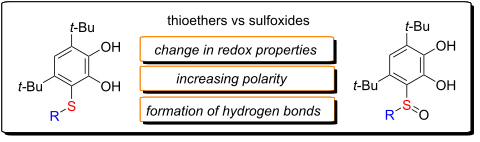
- ). Addition of the target catechols to a DPPH radical solution leads to a decrease in absorbance at the 517 nm maximum. The antiradical activities of CatH2-S-R and CatH2-SO-R were evaluated through the determination of IC50 and the time to reach the steady-state equilibrium (TEC50) values, together with the


Synthesis and structural elucidation of a novel bis-spirooxindole from isatin and ethylenediamine
Beilstein J. Org. Chem. 2026, 22, 813–820, doi:10.3762/bjoc.22.63
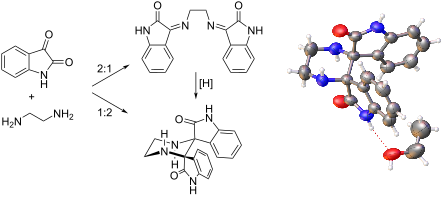
- and 24 may coexist in equilibrium. The diimine 24 could also be in equilibrium with its tautomeric form 27. If the enol present in 27 attacks intramolecularly the other imine, it would produce a non-stabilised imine 28, which would be electrophilic and hence susceptible to reduction either by the


Knoevenagel condensation of 4,5- and 1,8-diazafluorenes
Beilstein J. Org. Chem. 2026, 22, 803–812, doi:10.3762/bjoc.22.62
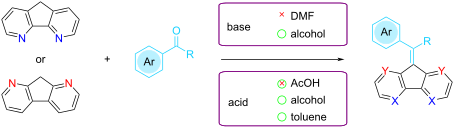
- mesomeric effect. On the other hand, diazafluorenes are potentially capable of reversible protonation by acetic acid, which is a competing process decreasing the equilibrium concentration of the enamine form (Scheme 2). Furthermore, an electrostatic repulsion between the protonated diazafluorene (1A/1A’ or
- ). Contrary, both the neutral (2) and protonated (2A’) forms of 1,8-diazafluorene were identified in both solvents (see Supporting Information File 1, Figure S2) with relatively high ratio (2 to 2A’ = 1:0.4 in CD3OD and 1:0.9 in CD3COOD). This equilibrium was reached immediately after the addition of the acid
- into 1,8-diazafluorenone by oxygen present in the reaction mixture. Therefore, the position of nitrogen atoms in diazafluorenes strongly affects their reactivity in acidic media via protonation, electrostatic repulsion, and stability of the condensation products. Therefore, the equilibrium in the




Synthetic study of vic-bromination of diarylacetylenes, easy purification and separation
Beilstein J. Org. Chem. 2026, 22, 795–802, doi:10.3762/bjoc.22.61
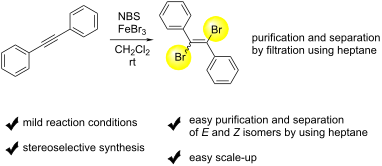
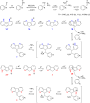
- isomers are formed together might be due to the equilibrium between A and C, although there are many unknown points. Conclusion In summary, we have developed a simple and selective procedure of the synthesis of (E)-1,2-dibromo-1,2-diphenylethylene from diphenylacetylene by using NBS and FeBr3 in CH2Cl2



Hydrogen production from formic acid catalyzed by NHC–Cu complexes
Beilstein J. Org. Chem. 2026, 22, 620–627, doi:10.3762/bjoc.22.48
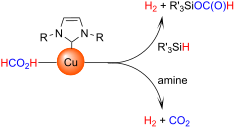
- deprotonation of the acid; indeed, their coordination to the copper center must also be taken into account [45]. Moreover, the reaction between FA and amines occurs in a more complex manner than a common acid–base equilibrium. In fact, calorimetric studies on the formation of FA/triethylamine adducts showed



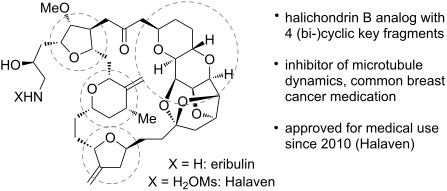
Modern synthetic pathways towards eribulin and its subunits
Beilstein J. Org. Chem. 2026, 22, 495–526, doi:10.3762/bjoc.22.37
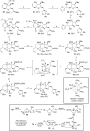
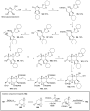
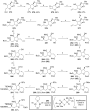
- aldehyde motif (equilibrium of lactol to aldehyde and alcohol) was trapped by HWE reaction to obtain 95. The secondary alcohol unit of 95 was protected and the ester reduced to the respective alcohol, before Sharpless epoxidation, oxidation of the alcohol and subsequent Wittig reaction yielded allylic
- cyclization also considerable amounts of dimerized product were observed. Again, reduction with DIBAL-H led to the regioselective deprotection of the alcohols and reduction to an intermediate lactol unit, which is in equilibrium with its acyclic aldehyde and alcohol. The aldehyde was trapped by HWE reaction
- conditions, which led to a cyclization, and benzylated with BnBr towards 321. Stereoselective Michael addition of a Gilman reagent yielded 322. Reduction of the lactone unit yielded a lactol, which is in equilibrium with acyclic aldehyde and alcohol. The aldehyde was trapped via HWE reaction and the obtained








Synthesis and uranyl(VI) extraction performance of a calix[4]pyrrole–tetrahydroxamic acid receptor
Beilstein J. Org. Chem. 2026, 22, 486–494, doi:10.3762/bjoc.22.36
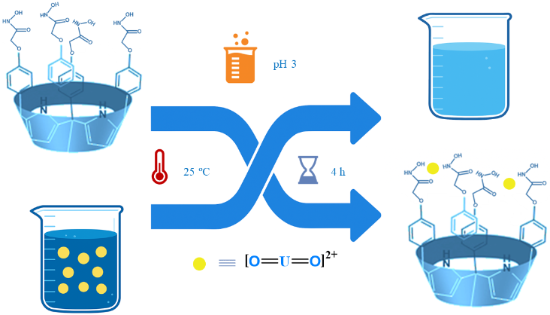
- . This time was estimated to be sufficient to reach equilibrium. The heterogeneous solution was centrifuged and the aqueous layer was filtered prior to gamma spectroscopy analysis. Uranium activity concentrations before and after extraction were determined, and extraction efficiencies were calculated
- uranyl ion and the Z-isomer of hydroxamic acid effectively shifts the Z/E equilibrium [70] towards the Z-conformation through a metal-induced fit mechanism [71][72]. Consistent with known hydroxamate coordination chemistry, coordination-induced deprotonation of the hydroxamic acid at low pH provides the


Arene activation via π-bond localization: concepts and opportunities
Beilstein J. Org. Chem. 2026, 22, 257–273, doi:10.3762/bjoc.22.19
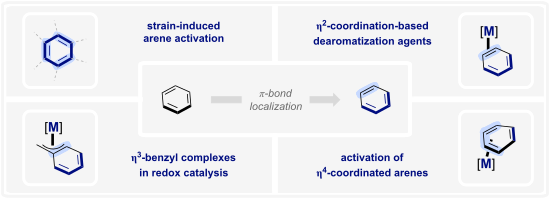
- ]. Building on Kekulé’s early oscillation model for benzene, they proposed that small-ring annelation perturbs the equilibrium between the two assumed cyclohexatriene structures, shifting it to one side [17]. Although this original hypothesis was incorrect, its implications have been the topic of longstanding
- early example was reported by Stille and co-worker in 1978, who elegantly demonstrated the formation of an η3-benzyl–palladium complex via oxidative addition of Pd(0) to a benzyl halide (Scheme 5C) [73]. Detailed stereochemical and NMR analyses revealed a temperature- and solvent-dependent equilibrium




A mild and atom-efficient four-component cascade strategy for the construction of biologically relevant 4-hydroxyquinolin-2(1H)-one derivatives
Beilstein J. Org. Chem. 2026, 22, 244–256, doi:10.3762/bjoc.22.18
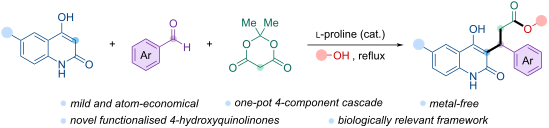
- ; pyranoquinoline was the major product. Attempts at equilibrium transesterification using sodium isopropylate in isopropanol also failed to yield the desired product. Similar efforts to synthesize cyclohexyl esters via this approach were unsuccessful. Due to the inability to obtain the target isopropyl and


Conformational analysis of difluoromethylornithine: factors influencing its gas-phase and bioactive conformations
Beilstein J. Org. Chem. 2026, 22, 237–243, doi:10.3762/bjoc.22.17
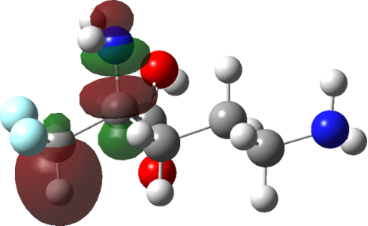
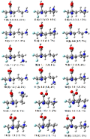
- conformational stability. High-level DLPNO-CCSD(T)/CBS calculations revealed that type-I conformers – those maximizing gauche interactions between C–F and C–N bonds – dominate the equilibrium population, confirming the presence of the fluorine gauche effect. natural bond orbital (NBO) analysis showed that this
- account for about 62% of the equilibrium population. By contrast, type-II and type-III structures contribute only 7% and 0%, respectively (Figure 2). These results demonstrate that DFMO exhibits the gauche effect, unlike 1,1,2-trifluoroethane and 1,1,2,2-tetrafluoroethane, whose preferred geometries
- remains insufficient to overcome the stronger intermolecular interactions present in biological environments. Conclusion DFMO exhibits the fluorine gauche effect, as type-I conformers – those maximizing gauche interactions between the C–F and C–N bonds – dominate the conformational equilibrium by a large




Synthesis of diaryl phosphates using phytic acid as a phosphorus source
Beilstein J. Org. Chem. 2026, 22, 213–223, doi:10.3762/bjoc.22.15
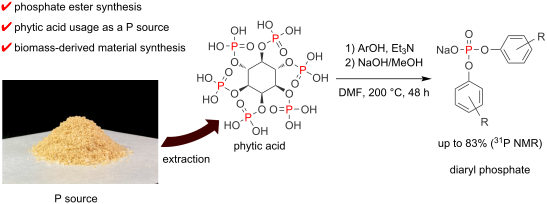
- groups [49][50][51][52], and thus phosphate esters easily undergo transesterification or hydrolysis reactions. Considering these factors, we assumed that shifting the reaction equilibrium of compounds derived from phenols containing strong electron-withdrawing groups toward phosphate diester formation




Design and synthesis of an axially chiral platinum(II) complex and its CPL properties in PMMA matrix
Beilstein J. Org. Chem. 2026, 22, 143–150, doi:10.3762/bjoc.22.7
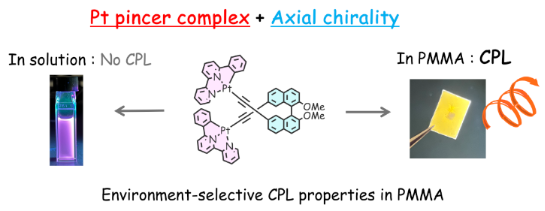
- P-1030 polarimeter using the sodium D line (λ = 589 nm). All calculations were performed by using the Gaussian 16 rev C.02 program package. Density functional theory (DFT) calculations were performed at the level of CAM-B3LYP/LANL2DZ for Pt atoms. The optimized equilibrium structures were confirmed


Reactivity umpolung of the cycloheptatriene core in hexa(methoxycarbonyl)cycloheptatriene
Beilstein J. Org. Chem. 2026, 22, 64–70, doi:10.3762/bjoc.22.2
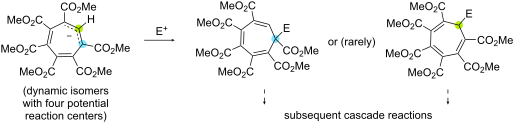
- dynamic equilibrium or total rearrangement of 5 into 6 upon formation. Thus, halogenation of hexa(methoxycarbonyl)cycloheptatrienyl anion 2 formed from 3 led to different outcomes with chlorine, bromine and iodine (Scheme 1). Chlorination gave exclusively i-substituted symmetric cycloheptatriene 4a in an
- halogenation reactions. The reactions with methyl iodide and propargyl bromide resulted in equilibrium mixtures of α-alkylated cycloheptatrienes 5d,e and the corresponding norcaradienes 6d,e. At the same time, benzyl bromide afforded pure norcaradiene 6f in a good yield. Apparently, the formation of a pure


Thiazolidinones: novel insights from microwave synthesis, computational studies, and potentially bioactive hybrids
Beilstein J. Org. Chem. 2025, 21, 2618–2636, doi:10.3762/bjoc.21.203
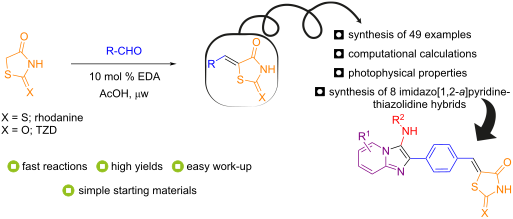
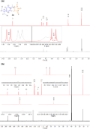
- multiple tautomers (Scheme 7a) [37][39]. Relative stability of these tautomers is ranked as follows: 2-i > 2-ii > 2-iii > 2-iv > 2-v [74][75][76]. Therefore, compounds 3n and 4n may exist in equilibrium, with the enolic form being slightly more stable, which could explain the unusual behavior in their NMR






Efficient solid-phase synthesis and structural characterization of segetalins A–H, J and K
Beilstein J. Org. Chem. 2025, 21, 2612–2617, doi:10.3762/bjoc.21.202
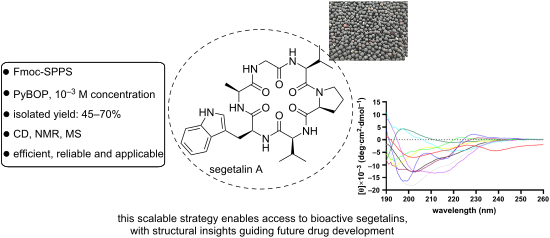
- , demonstrating unequivocal structural identity with the natural isolates. Analytical HPLC confirmed the high purity (>95%) of all synthetic segetalins. However, experimental data for segetalin C revealed the existence of a multi-state conformational equilibrium in solution, which is dependent on solvent polarity


Silica gel with covalently attached bambusuril macrocycle for dicyanoaurate sorption from water
Beilstein J. Org. Chem. 2025, 21, 2604–2611, doi:10.3762/bjoc.21.201
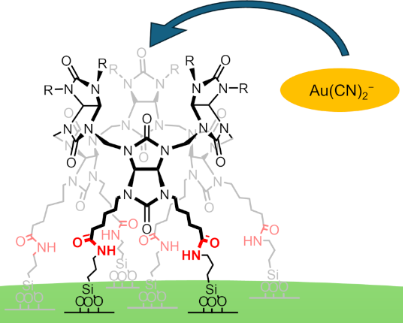
- concentration in solution reached equilibrium after 15 minutes, consistent with the equilibration time previously established for the non-covalent system SG-BnBU (Supporting Information File 1, Figure S5). Therefore, all subsequent sorption experiments were performed with an equilibration time of 15 minutes


Recent advances in total synthesis of illisimonin A
Beilstein J. Org. Chem. 2025, 21, 2571–2583, doi:10.3762/bjoc.21.199
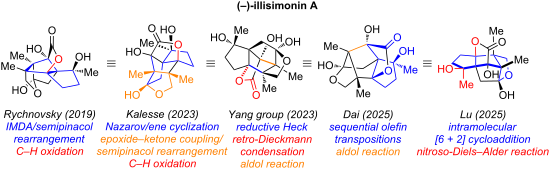
- reaction of 87 was employed, generating both the kinetic product 88 and the desired thermodynamic product 89. Heating 88 promoted a retro-Diels–Alder/Diels–Alder equilibrium, favoring the more stable isomer 89. Palladium-catalyzed hydrogenation of the 1,2-disubstituted alkene in 89, followed by Mo(CO)6






Ex-situ generation of gaseous nitriles in two-chamber glassware for facile haloacetimidate synthesis
Beilstein J. Org. Chem. 2025, 21, 2465–2469, doi:10.3762/bjoc.21.188
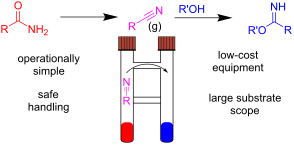
- turned out to be unsuccessful as the reaction seemed to achieve an equilibrium, with some amount of hemiacetal left. Generally, it was observed that the trifluoroacetimidates were somewhat more sensitive to flash column chromatography, suggesting a higher reactivity compared to the trichloroacetimidates


The intramolecular stabilizing effects of O-benzoyl substituents as a driving force of the acid-promoted pyranoside-into-furanoside rearrangement
Beilstein J. Org. Chem. 2025, 21, 2456–2464, doi:10.3762/bjoc.21.187
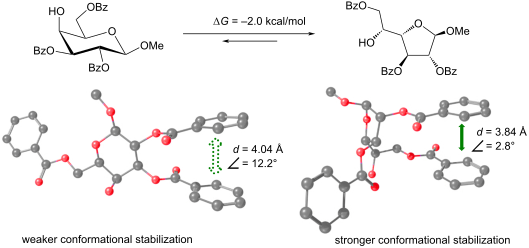
- development of a new methodology for the synthesis of galactofuranoside building blocks, we encountered an unexpected predominance of the furanoside form in the equilibrium mixture of benzoylated β-galactosides. Since the furanoside form is typically less stable and is usually present only in minor amounts
- equilibrium lie outside the carbohydrate ring system. Consideration of such effects is essential to rationalize the reactivity of structurally complex and densely protected carbohydrate compounds. Keywords: benzoylated galactofuranosides; DFT; DLPNO-CCSD(T); pyranoside-into-furanoside rearrangement
- pyranoside form is generally considered to be thermodynamically more stable [20][21][22]. Only several approaches towards shifting this equilibrium in favor for the galactofuranoside form are known, which are listed below. In one such study [23], the authors demonstrated a shift in the equilibrium towards a




Recent advances in Norrish–Yang cyclization and dicarbonyl photoredox reactions for natural product synthesis
Beilstein J. Org. Chem. 2025, 21, 2315–2333, doi:10.3762/bjoc.21.177
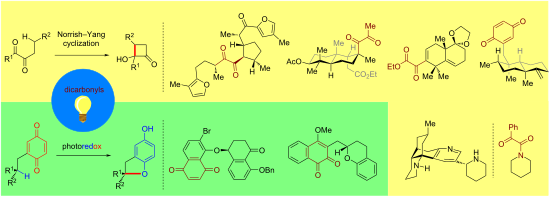
- less favorable pathway compared to the previously employed 1,5-HAT. Initial feasibility studies revealed that the non-brominated substrate exhibited poor reactivity in the photochemical 1,6-HAT reaction (Scheme 14), as its unreactive conformer J dominated the equilibrium. In contrast, the brominated