Search results
Search for "synthetic method" in Full Text gives 162 result(s) in Beilstein Journal of Organic Chemistry.
Electrochemical reduction of unsaturated carbon–carbon bonds via 3d transition-metal catalysis
Beilstein J. Org. Chem. 2026, 22, 955–981, doi:10.3762/bjoc.22.75
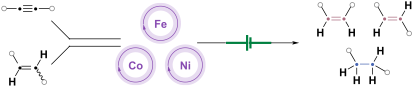
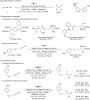
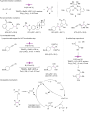
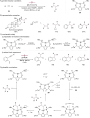
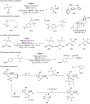
- ; electroorganic synthesis; reaction mechanism; 3d transition metals; unsaturated C–C bonds; Introduction Reductions of unsaturated C–C bonds Reduction of unsaturated C–C bonds, most notably, alkynes and alkenes, is a synthetic method that has been widely and extensively discussed with a long and rich history


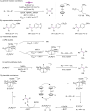

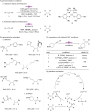





Synthetic study of vic-bromination of diarylacetylenes, easy purification and separation
Beilstein J. Org. Chem. 2026, 22, 795–802, doi:10.3762/bjoc.22.61
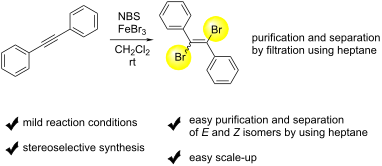
- (VII)) to give (E)-1,2-dibromo-1,2-diphenylethylene, selectively (Scheme 1a) [3]. However, MTO is an expensive reagent and a more versatile synthetic method is highly needed. As a simple method, the reaction of diphenylacetylene and Br2 in CH2Cl2 was reported by Glorius in 2007 [4], but the selectivity



A facile and practical method for the synthesis of trans-(±)-taxifolin and its derivatives via Darzens reaction
Beilstein J. Org. Chem. 2026, 22, 443–450, doi:10.3762/bjoc.22.31
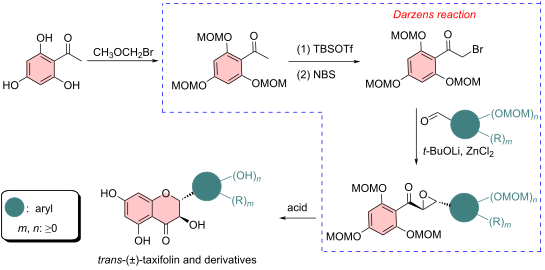
- derivatives. The development of an economical and practical synthetic route to trans-(±)-taxifolin, a key precursor to the enantiomerically pure trans-taxifolin, is therefore of great importance and significance. In this work, we developed a new synthetic method for trans-(±)-taxifolin and its derivatives
- compounds [31][32]. Inspired by this, in the present work, we designed a new synthetic method to trans-(±)-taxifolin and its derivatives based on the Darzens reaction (Scheme 1b). Starting from trihydroxyacetophenone, which was protected and α-brominated, the α,β-epoxycarbonyl intermediates were obtained
- bioactive trans-(+)-taxifolin. The currently most widely applied synthetic method for trans-(±)-taxifolin and its derivatives (a) and the new method via Darzens reaction reported in this work (b). Darzens reaction of 2 with various arylaldehydes under the optimized conditions. Reaction conditions: 2 (0.81


Transformation of the cyclohexane ring to the cyclopentane fragment of biologically active compounds
Beilstein J. Org. Chem. 2025, 21, 2416–2446, doi:10.3762/bjoc.21.185
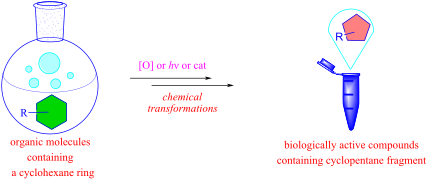
- unprecedentedly highly oxygenated five-membered D-ring. These compounds exhibit potent anti-inflammatory and analgesic activity both in vitro and in vivo [44]. The synthetic method for the preparation of dactylicapnosines A (63) and B (64) was based on the known phenol 65 and involved the ring contraction of p


Enantioselective radical chemistry: a bright future ahead
Beilstein J. Org. Chem. 2025, 21, 2283–2296, doi:10.3762/bjoc.21.174
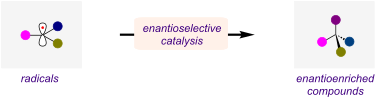
- enantioselectivities. A radical chaperone methodology is based on a multicatalytic system in which a chiral Cu(I) catalyst, Brønsted acid (camphoric acid) and Ir photocatalyst work synergistically. An asymmetric synthetic method based on radical C–H functionalization was reported by Nagib and co-workers for the


Synthesis of triazolo- and tetrazolo-fused 1,4-benzodiazepines via one-pot Ugi–azide and Cu-free click reactions
Beilstein J. Org. Chem. 2025, 21, 2202–2210, doi:10.3762/bjoc.21.167
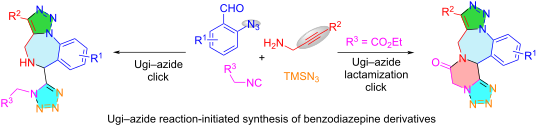
- spectra are provided in Supporting Information File 1. To evaluate the scalability of this protocol, we performed the synthesis of diazepine 8a on a gram scale with 10 mmol of 1a, which led to the formation of product 8a in 91% yield (Scheme 8). Conclusion We have developed a new synthetic method to


Influence of the cation in hypophosphite-mediated catalyst-free reductive amination
Beilstein J. Org. Chem. 2025, 21, 1661–1670, doi:10.3762/bjoc.21.130
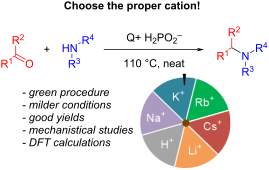
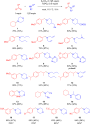
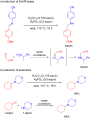
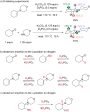
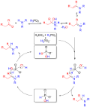
- , the synthesis of the remedy for Parkinson’s disease, piribedil (9), in high yield (80%) demonstrated the practical utility of the elaborated synthetic method (Figure 1). To get insight into the mechanism of the developed approach the reaction mixtures were thoroughly analyzed and several control


Azide–alkyne cycloaddition (click) reaction in biomass-derived solvent CyreneTM under one-pot conditions
Beilstein J. Org. Chem. 2025, 21, 1544–1551, doi:10.3762/bjoc.21.117
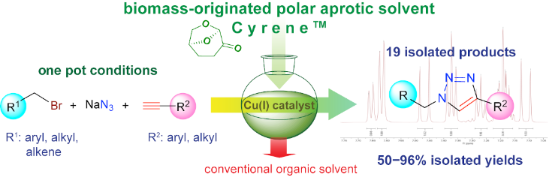
- further the applicability of the present synthetic method. Due to the excellent solvating power of CyreneTM, the “one-pot” synthesis of 1,2,3-triazoles could be proposed to eliminate the preparation and isolation steps of azide components. This could open an even greener and facile protocol for CuAAC


Recent advances in oxidative radical difunctionalization of N-arylacrylamides enabled by carbon radical reagents
Beilstein J. Org. Chem. 2025, 21, 1207–1271, doi:10.3762/bjoc.21.98
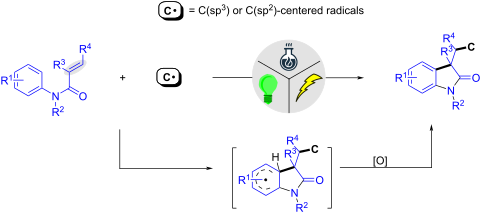
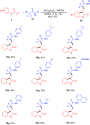
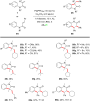
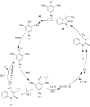
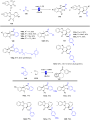
- -free synthetic method for 3,3-disubstituted oxindoles via 1,2-alkylarylation of activated alkenes with alcohols [4]. N-Arylacrylamides and simple alcohols were employed as substrates, proceeding through an oxidative radical cyclization mechanism. The standard reaction conditions involved the use of an
- oxidant and initiator, enabling an efficient intermolecular cascade cyclization process (Scheme 5) [5]. In this strategy, a novel, selective, metal-free synthetic method was introduced for the synthesis of isoxazoline-featured oxindoles through iminoxyl radical-promoted cascade oxyalkylation












Salen–scandium(III) complex-catalyzed asymmetric (3 + 2) annulation of aziridines and aldehydes
Beilstein J. Org. Chem. 2025, 21, 1087–1094, doi:10.3762/bjoc.21.86
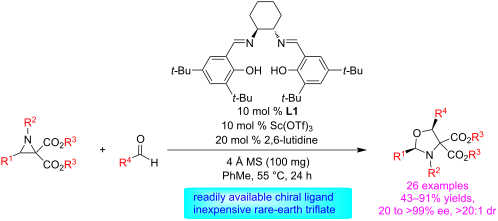
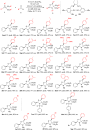
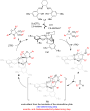
- enantioselectivity obviously was lower compared to the smaller scale reaction. Conclusion A convenient and efficient synthetic method for the synthesis of optically active (2R,5S)-oxazolidines has been developed with aldehydes and dialkyl 3-aryl-1-sulfonylaziridine-2,2-dicarboxylates as starting materials. The



Recent advances in controllable/divergent synthesis
Beilstein J. Org. Chem. 2025, 21, 890–914, doi:10.3762/bjoc.21.73

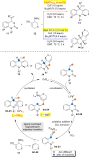
- ensuring high regioselectivity. In 2018, the Jiang group developed a regiodivergent synthetic method for indolo[3,2-c]coumarins 10 and benzofuro[3,2-c]quinolinones 9 via controllable palladium(II)-catalyzed carbonylative cyclization (Scheme 3) [21]. When ligand L3 coordinates with the palladium center, the




Recent advances in the electrochemical synthesis of organophosphorus compounds
Beilstein J. Org. Chem. 2025, 21, 770–797, doi:10.3762/bjoc.21.61
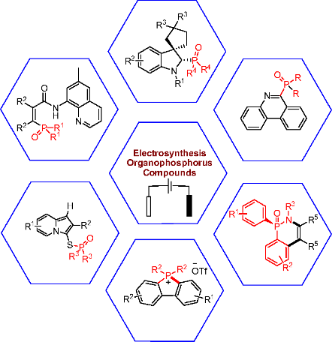
- technologies [37][38], and microwave irradiation [39][40][41][42] have been developed. The electrochemical synthetic method is a creative, simple, and new process for preparing organophosphorus compounds [43]. In recent years, various articles have been reported on the electrochemical synthesis of


Unraveling aromaticity: the dual worlds of pyrazole, pyrazoline, and 3D carborane
Beilstein J. Org. Chem. 2025, 21, 412–420, doi:10.3762/bjoc.21.29
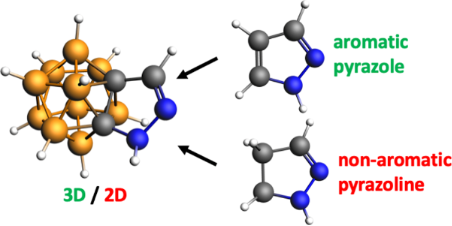
- their broader use. With this in mind, Lee and colleagues have recently developed an efficient synthetic method for producing o-carborane-fused pyrazoles as a novel scaffold, without using transition metals. Their approach involves reacting B(4)-acylmethyl and B(3,5)-diacylmethyl o-carborane with 2-azido


Synthesis of disulfides and 3-sulfenylchromones from sodium sulfinates catalyzed by TBAI
Beilstein J. Org. Chem. 2025, 21, 253–261, doi:10.3762/bjoc.21.17
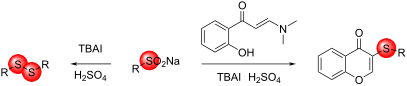
- -derived Functional Oligosaccharides Engineering Technology Research Center of Anhui Province, Fuyang Normal University, Fuyang, Anhui, 236037, P. R. China 10.3762/bjoc.21.17 Abstract A new synthetic method for disulfides and 3-sulfenylchromones is reported. This innovative approach is based on the




Recent advances in electrochemical copper catalysis for modern organic synthesis
Beilstein J. Org. Chem. 2025, 21, 155–178, doi:10.3762/bjoc.21.9

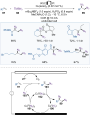
- has emerged as a potential synthetic tool for the formation of new C–C, and C–heteroatom bonds using electricity to replace the stoichiometric amounts of conventional chemical redox reagents [47]. C–C Bond formation In 2019, the Ackermann group established a synthetic method for isoindolones using a








Cu(OTf)2-catalyzed multicomponent reactions
Beilstein J. Org. Chem. 2025, 21, 122–145, doi:10.3762/bjoc.21.7

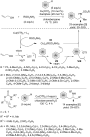
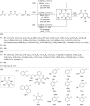
- intermediate XXXV. Finally, the final product 35 is yielded via a 1,3-hydride shift. The reaction between diazo derivatives, nitriles, and azodicarboxylates catalyzed by Cu(OTf)2 is an efficient synthetic method to obtain 2,3-dihydro-1,2,4-triazole derivatives 36 (Scheme 27) [45]. The reaction proceeds via a






Efficient synthesis of fluorinated triphenylenes with enhanced arene–perfluoroarene interactions in columnar mesophases
Beilstein J. Org. Chem. 2024, 20, 3263–3273, doi:10.3762/bjoc.20.270
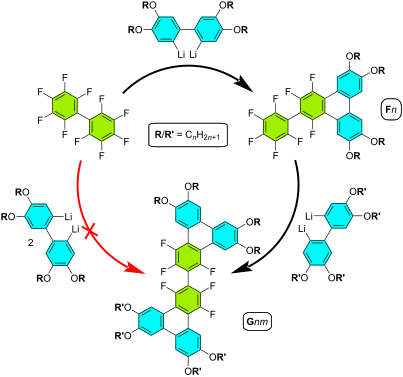
- , obtained in 50% yield, opening great possibilities in structural variations. The facile synthesis of G55, G66, and G48 demonstrates again the versatility of this synthetic method. The synthesis and detailed characterization of compounds F6 and G66 have been the subject of a preliminary patent description




Cyclodextrin-based rotaxanes for polymer materials: challenge on simultaneous realization of inexpensive production and defined structures
Beilstein J. Org. Chem. 2024, 20, 3026–3049, doi:10.3762/bjoc.20.252
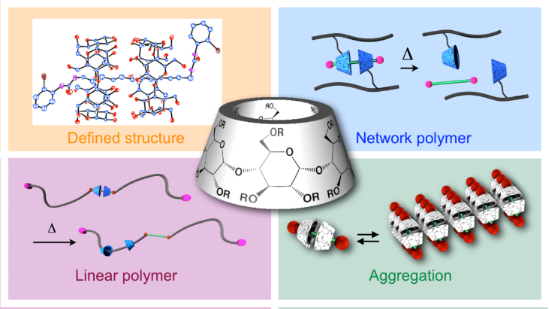
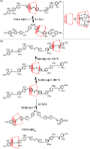
- interactions could fix the rotaxane structure. Such a fundamental systematic study was first possible because of the efficient urea end-capping synthetic method that supported its utility. Notably, other types of rotaxane frameworks have been developed using the pseudo[3]rotaxane-formation or urea end-capping
- species. As these modifications proceeded effectively with high yields (>90%) without any taxing purification by chromatography, a simple filtration-based purification was sufficient. This synthetic method enabled a flexible molecular design of the CD-based rotaxane framework in an easy, scalable manner






C–H Trifluoromethylthiolation of aldehyde hydrazones
Beilstein J. Org. Chem. 2024, 20, 2883–2890, doi:10.3762/bjoc.20.242
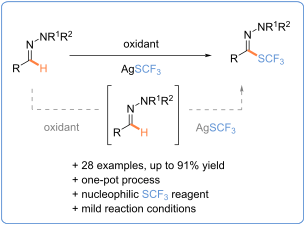
- ). Mechanistic investigations revealed that AgSCF3 was the active species in the transformation. Keywords: C–H bond functionalization; C–S bond formation; hydrazones; synthetic method; trifluoromethylthiolation; Introduction Fluorinated molecules are of paramount importance [1][2][3][4][5][6][7][8][9][10][11


Transition-metal-free decarbonylation–oxidation of 3-arylbenzofuran-2(3H)-ones: access to 2-hydroxybenzophenones
Beilstein J. Org. Chem. 2024, 20, 2655–2667, doi:10.3762/bjoc.20.223
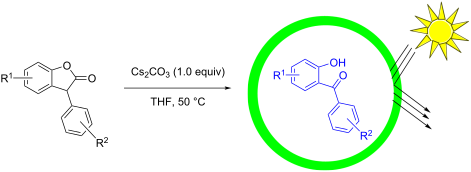
- very weak estrogenic activity [8]. Although a detailed SAR is still warranted, the initial reports prompted us to find a suitable synthetic method for 5-substituted 2-hydroxybenzopheneones, and to evaluate their UV-absorbing properties. Various methods for the synthesis of benzophenones have been


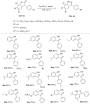


Selective hydrolysis of α-oxo ketene N,S-acetals in water: switchable aqueous synthesis of β-keto thioesters and β-keto amides
Beilstein J. Org. Chem. 2024, 20, 2225–2233, doi:10.3762/bjoc.20.190

- synthetic method for the preparation of β-keto thioesters and β-keto amides remains imperative. Organic reactions in water are an important and exciting research topic of green chemistry because water as a solvent exhibits fascinating features, such as low cost, good environmental compatibility, nontoxicity
- dithioacetals and nitroethane/amines [72][73]. As part of our continuous research in this context, more recently we investigated the selective hydrolysis of α-oxo ketene N,S-acetals in water to gain an environmentally compliant synthetic method for β-keto thioesters and β-keto amides (Scheme 1c). Herein, we

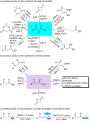


Efficacy of radical reactions of isocyanides with heteroatom radicals in organic synthesis
Beilstein J. Org. Chem. 2024, 20, 2114–2128, doi:10.3762/bjoc.20.182
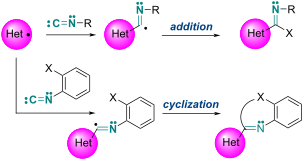
- understand the conditions for the generation of heteroatom radicals. In addition, from the perspective of recent green chemistry, the development of environmentally friendly synthetic methods is strongly demanded. In other words, a new synthetic method should have excellent atom economy, produce no waste, be
- thermally induced [71]. Radical cyclization of 2-isocyanobiarenes The cycloaddition reaction with 2-isocyanobiaryls 29 under radical conditions is an excellent synthetic method for nitrogen-containing fused heterocycles such as phenanthridine derivatives 31 (Scheme 20) [72][73]. The reaction proceeds by


Cage-like microstructures via sequential Ugi reactions in aqueous emulsions
Beilstein J. Org. Chem. 2024, 20, 2078–2083, doi:10.3762/bjoc.20.179
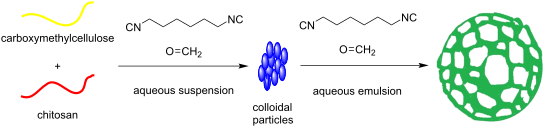
- colloidosomes is the presence of pores, the sizes of which depend on the parameters of the original colloidal particles and the synthetic method [6]. Pores provide controlled permeability of these structures and open up rich opportunities for practical uses as catalysts, sorbents, and carriers of medicinal


A facile three-component route to powerful 5-aryldeazaalloxazine photocatalysts
Beilstein J. Org. Chem. 2024, 20, 1831–1838, doi:10.3762/bjoc.20.161
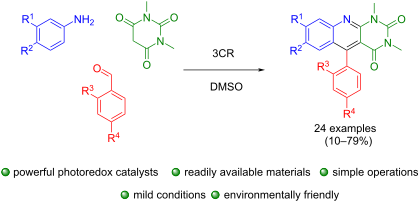
- of photocatalysts by tuning their redox and photophysical properties. Thus, we successfully developed a one-pot, three-component synthetic method with those substituents in 5-aryldeazaflavins 1 on the deazaisoalloxazine core or on the phenyl ring by condensation of N-substituted anilines, aromatic




Chiral bifunctional sulfide-catalyzed enantioselective bromolactonizations of α- and β-substituted 5-hexenoic acids
Beilstein J. Org. Chem. 2024, 20, 1794–1799, doi:10.3762/bjoc.20.158
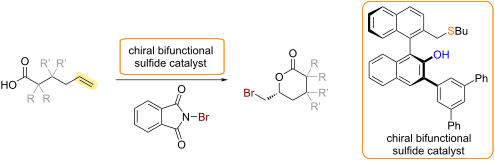
- were explored to demonstrate the broader applicability of the current synthetic method (Scheme 5). Asymmetric bromolactonization of α,α-diphenyl-5-hexenoic acid (2a), using a chiral bifunctional sulfide catalyst (S)-1g, was scaled up to a 1.0 mmol scale to obtain the optically active bromolactonization