


Search results
Search for "Claisen condensation" in Full Text gives 35 result(s) in Beilstein Journal of Organic Chemistry.
Synthesis of the furo[2,3-b]chromene ring system of hyperaspindols A and B
Beilstein J. Org. Chem. 2015, 11, 265–270, doi:10.3762/bjoc.11.29
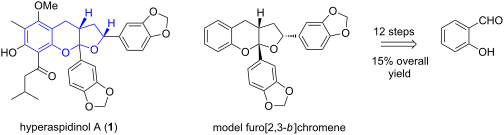
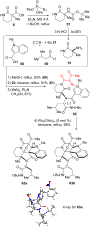
- -ester 14 resulting from an additional Claisen condensation was the only isolated product. It was therefore decided to functionalise the ester moiety first. This was achieved by direct conversion of ester 12 into Weinreb amide 15 in 81% yield, followed by addition of lithiate 16 (formed from 1-bromo-3,4


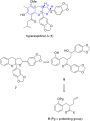


Copper-catalyzed cascade reactions of α,β-unsaturated esters with keto esters
Beilstein J. Org. Chem. 2015, 11, 213–218, doi:10.3762/bjoc.11.23

- the linker’s length is expected to yield δ-carboxymethyl-δ-lactones. Copper-catalyzed reductive intermolecular aldolization reactions have been discussed previously [17][18][19]. Constantino has demonstrated that aldol reactions of enolates with ketones or aldehydes are much faster than the Claisen
- condensation [20]. Therefore, it is rationalized that an α,β-unsaturated monoester-derived enolate should react preferentially with the keto group in the keto ester to yield the alkoxide, which further lactonizes with an intramolecular ester group to form the lactone. It should provide a novel three-step


(2R,1'S,2'R)- and (2S,1'S,2'R)-3-[2-Mono(di,tri)fluoromethylcyclopropyl]alanines and their incorporation into hormaomycin analogues
Beilstein J. Org. Chem. 2014, 10, 2844–2857, doi:10.3762/bjoc.10.302
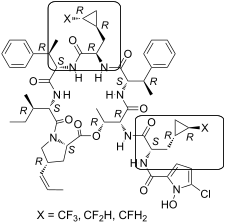
- trans-(2-trifluoromethyl)cyclopropanecarboxylic acid 23 by way of the Claisen condensation product of ethyl trifluoroacetate (17) with diethyl succinate (18) [25] was used. The conditions for two of the known further steps [26][27] (Scheme 2) had to be modified to achieve acceptable yields. The


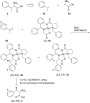


(CF3CO)2O/CF3SO3H-mediated synthesis of 1,3-diketones from carboxylic acids and aromatic ketones
Beilstein J. Org. Chem. 2014, 10, 2270–2278, doi:10.3762/bjoc.10.236
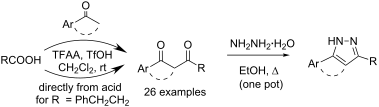
- application of the proposed protocol allowed for the synthesis of selected polysubstituted pyrazoles in a one-pot procedure directly from acids and ketones. Keywords: Claisen condensation; 1,3-diketones; heterocycles; triflic acid; trifluoroacetic acid anhydride; Introduction 1,3-Diketones represent one of
- the most important class of organic compounds, since they are applied as key structural blocks in organic syntheses, exhibit different kinds of biological activities, and display a broad range of ionophoric properties [1][2][3]. The method most frequently used for 1,3-diketone synthesis is the Claisen
- condensation, which comprises the C-acylation of the α-position of ketones in the form of their metal enolates, enamines or silyl ethers, with or without a catalyst. To appear as an acylating agent one of the following compounds could be required: acyl halides and acid esters, including formates and oxalates


Recent applications of the divinylcyclopropane–cycloheptadiene rearrangement in organic synthesis
Beilstein J. Org. Chem. 2014, 10, 163–193, doi:10.3762/bjoc.10.14
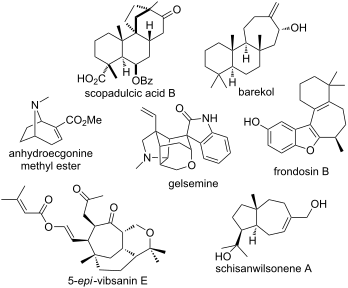
- tetracycle 283. The carboxylic acid was converted into the corresponding acyl chloride, followed by addition of diazomethane and subsequent Arndt–Eistert homologation [215] to obtain methyl ester 284. Claisen condensation furnished the intermediate β-cyano-ketone, which was subjected to diazotransfer




Synthesis and biological activities of the respiratory chain inhibitor aurachin D and new ring versus chain analogues
Beilstein J. Org. Chem. 2013, 9, 1551–1558, doi:10.3762/bjoc.9.176
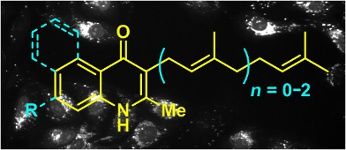
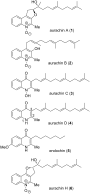
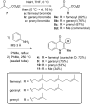
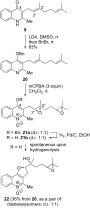
- treatment with aniline, a Conrad–Limpach process [22][23][24][25] gave aurachin D (4) in 72% yield. This transformation was performed in toluene under reflux over 3 Å molecular sieves by formation of an imine intermediate, which was cyclized at 250 °C by Claisen condensation. Precipitation of the product by


Parallel and four-step synthesis of natural-product-inspired scaffolds through modular assembly and divergent cyclization
Beilstein J. Org. Chem. 2012, 8, 930–940, doi:10.3762/bjoc.8.105
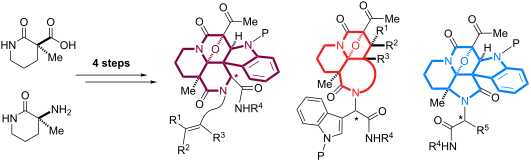
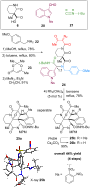
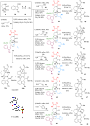
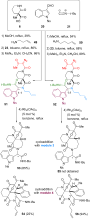
- CoA as a starter unit, modular and iterative assembly of malonate extender units produces a linear tetraketide intermediate capable of being folded in at least two ways [5]. Intramolecular Claisen condensation and subsequent enolization produce phloracetophenone (path A), while aldol condensation



Organic synthesis using (diacetoxyiodo)benzene (DIB): Unexpected and novel oxidation of 3-oxo-butanamides to 2,2-dihalo-N-phenylacetamides
Beilstein J. Org. Chem. 2012, 8, 344–348, doi:10.3762/bjoc.8.38
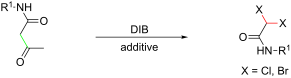
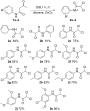
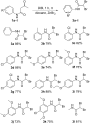
- carbonyl carbon atom affords intermediate 7. A subsequent carbon–carbon bond cleavage of the labile α,α-dichloro β-keto amide through a retro-Claisen condensation reaction [41] generates intermediate 8. Finally, the electrophilic attack of a proton on the carbon–carbon double bond resulted in the final




High chemoselectivity in the phenol synthesis
Beilstein J. Org. Chem. 2011, 7, 794–801, doi:10.3762/bjoc.7.90
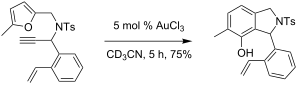
- b). The latter would form intermediate H, which could then either afford product 17 via intramolecular 1,3-dipolar cycloaddition with the olefin, or could form the diene 19 by proton migration. The synthesis of 16 was only possible by a 9-step sequence (Scheme 8). The starting point was a Claisen
- condensation of ester 20 and tert-butyl acetate (21) in the presence of lithium hexamethyldisilazide as the base. Ketoester 22 was obtained in 56% yield, however, the two-fold addition of 21 could not be suppressed completely and 14% of the corresponding tertiary alcohol 30 was also obtained. Reduction of the


Application of the diastereoselective photodeconjugation of α,β-unsaturated esters to the synthesis of gymnastatin H
Beilstein J. Org. Chem. 2011, 7, 151–155, doi:10.3762/bjoc.7.21
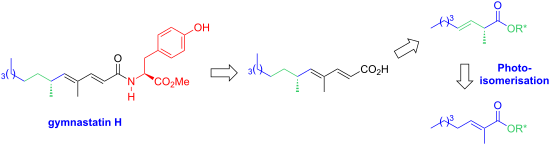
- dienoate chain. The configuration at the C-2 carbon atom of this precursor was controlled by using a diastereoselective alkylation of an acyl oxazolidinone. In some cases, a Claisen condensation took place and afforded a β-ketoamide in noticeable amounts diminishing the overall yield of the sequence [15





