Search results
Search for "bond dissociation energy" in Full Text gives 42 result(s) in Beilstein Journal of Organic Chemistry.
Metal-free glycosylation with glycosyl fluorides in liquid SO2
Beilstein J. Org. Chem. 2021, 17, 964–976, doi:10.3762/bjoc.17.78
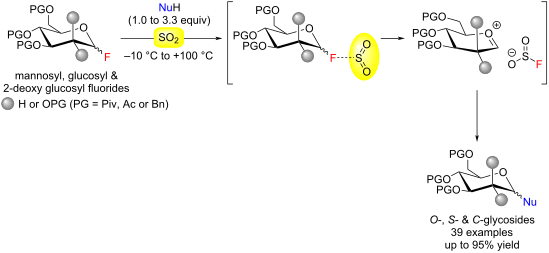
- groups, promoter, solvent and temperature has to be applied. In 1981, Mukaiyama et al. introduced glycosyl fluorides [5] as a new class of glycosyl donors [6]. The C–F bond is one of the strongest single bonds in the realm of organic compounds with a bond dissociation energy (BDE) of 570 kJ/mol [7]. Thus
- dissociation energy (ΔΔG) by 10.6 kcal/mol. The formation of the neighboring group stabilized the oxocarbenium ion (dioxolenium ion) and its reaction with alcohol leads to the experimentally observed glycosides and the FSO2H adduct. We assume that due to the formation of the latter also substrates, which do
- performed on the model reaction α-11 + MeOH → α-13c to elucidate the influence of SO2 on the dissociation of the glycosidic C–F bond [78] (Figure 2). Indeed, it was found that the coordination of the Lewis acidic SO2 to the fluoride (transition state TS-A≠ versus TS-A(SO2)≠) decreases the C–F bond



Photosensitized direct C–H fluorination and trifluoromethylation in organic synthesis
Beilstein J. Org. Chem. 2020, 16, 2151–2192, doi:10.3762/bjoc.16.183
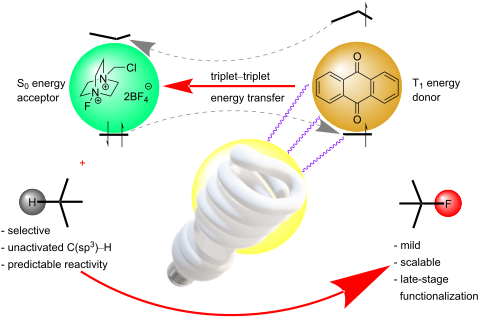
- . Moreover, the inertness of C(sp3)–H bonds due to their high homolytic bond dissociation energy and low polarity necessitate highly reactive reagents/intermediates for their activation, which may encourage off-site activity with other functional groups present in the target molecule and lead to a poor




Oxime radicals: generation, properties and application in organic synthesis
Beilstein J. Org. Chem. 2020, 16, 1234–1276, doi:10.3762/bjoc.16.107
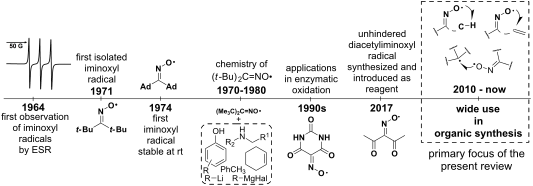
- was explained by the decrease of the O–H bond dissociation energy by the electron-donating substituent Y [35][79][80][81][82][83][84]. The result of these reactions depends on the phenol structure. 4-Methylphenol (27a) and 2,6-di-tert-butyl-4-methylphenol (BHT, 27b) gave 4-methyl-4




Recent applications of porphyrins as photocatalysts in organic synthesis: batch and continuous flow approaches
Beilstein J. Org. Chem. 2020, 16, 917–955, doi:10.3762/bjoc.16.83
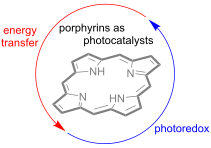
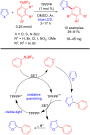
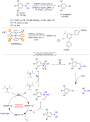
- products were obtained with good TON (up to 880) and high selectivity (91–99.5%), even though the aryl C–F bonds present a high bond dissociation energy (BDE) (Scheme 13). Using a similar photocatalytic system, 2-methyl-2,3-dihydrobenzofuran was produced by an intramolecular hydro-functionalization of






Insertion of [1.1.1]propellane into aromatic disulfides
Beilstein J. Org. Chem. 2019, 15, 1172–1180, doi:10.3762/bjoc.15.114
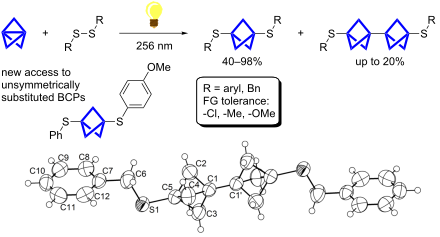
- ]. Presumably, there are two factors contributing to the lowered yield. The bond dissociation energy (BDE) of dialkyldisulfides is higher than the BDE of diaryl disulfides [30]. Therefore lower concentrations of thiyl radicals are present to initiate the reaction. The second reason could be the absorption of


Photochemical generation of the 2,2,6,6-tetramethylpiperidine-1-oxyl (TEMPO) radical from caged nitroxides by near-infrared two-photon irradiation and its cytocidal effect on lung cancer cells
Beilstein J. Org. Chem. 2019, 15, 863–873, doi:10.3762/bjoc.15.84
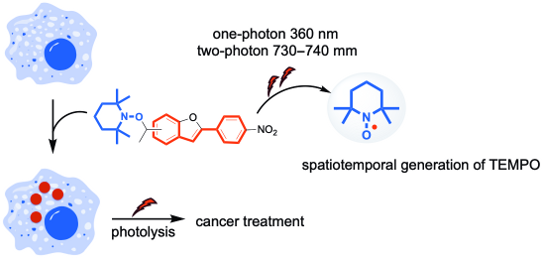
- ). However, in general, chromophores do not absorb at such long wavelengths and the photon energy is too low for bond-cleavage reactions to generate (i.e., uncage) functional molecules. For example, the bond-dissociation energy of the weak PhCH2–OPh, linkage is reported to be 52.1 kcal mol−1 [43]. These




Dirhodium(II)-catalyzed [3 + 2] cycloaddition of N-arylaminocyclopropane with alkyne derivatives
Beilstein J. Org. Chem. 2019, 15, 542–550, doi:10.3762/bjoc.15.48
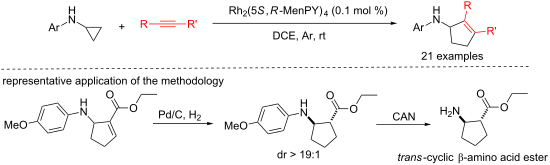
- 3,5-dimethyl compound 1d afforded the desired product 3d with an excellent yield of 91% (Table 2, entry 3). We reasoned the electron-withdrawing groups on the arene increased the nitrogen–hydrogen bond dissociation energy (BDEN–H) of compound 1 [21], decreasing the rate of ring opening. Substrates 1i
- (Rh2(II,II)), that efficiently catalyzes the ring opening of 1 to achieve cycloaddition with alkene substrates under an argon atmosphere [18]. During the reaction, no metal valence changes were observed. We proposed that Rh2(II,II) may coordinate with the nitrogen in 1 to decrease the bond dissociation
- energy of N–H bonds, which may be beneficial to N-centered radical formation. However, due to the characteristics of the radical reaction, the resulting cycloaddition product mixtures have a low diastereoisomeric ratio, which increases the difficulty of separation and limits applications. In view of this


Organometallic vs organic photoredox catalysts for photocuring reactions in the visible region
Beilstein J. Org. Chem. 2018, 14, 3025–3046, doi:10.3762/bjoc.14.282
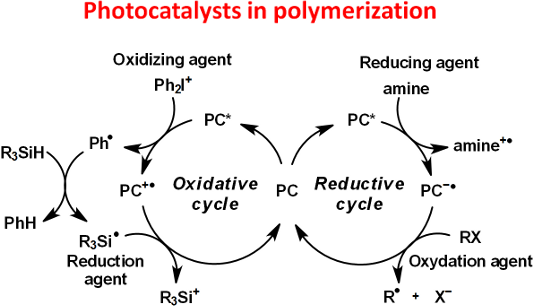
- presented in Table 1 because the driving force of its reactivity is more its bond dissociation energy (BDE) than its redox potential. Indeed, this compound obeys to a pure hydrogen transfer mechanism. This corresponds to a hydrogen transfer from (TMS)3SiH to the triplet excited state of the PC. Thus, to
- react, the PC must have a lifetime of its triplet excited state that is long enough. The bond dissociation energy of the Si–H of (TMS)3SiH has been calculated: 79.8 kcal/mol (methods of calculation optimized at the B3LYP/6-31G* level as referred in [32]). Polymerization performances of photoredox


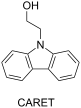

Recent advances on organic blue thermally activated delayed fluorescence (TADF) emitters for organic light-emitting diodes (OLEDs)
Beilstein J. Org. Chem. 2018, 14, 282–308, doi:10.3762/bjoc.14.18
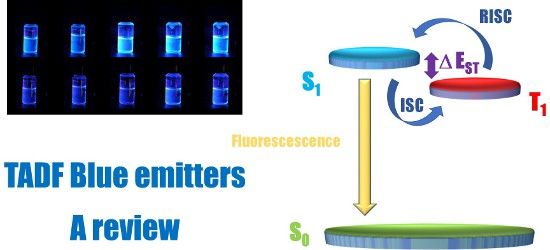


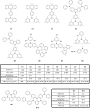


A new paradigm for designing ring construction strategies for green organic synthesis: implications for the discovery of multicomponent reactions to build molecules containing a single ring
Beilstein J. Org. Chem. 2016, 12, 2420–2442, doi:10.3762/bjoc.12.236
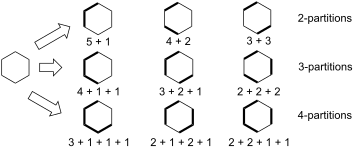
- greenness. In research practice, synthetic organic chemists rely on a combination of retrosynthetic analysis [91][92][93][94][95][96][97], similarity and analogy patterning to known reactions, bond dissociation energy and bond polarity analysis (forward and umpolung), chemical intuition, and random






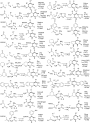
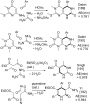


Cp2TiCl/D2O/Mn, a formidable reagent for the deuteration of organic compounds
Beilstein J. Org. Chem. 2016, 12, 1585–1589, doi:10.3762/bjoc.12.154
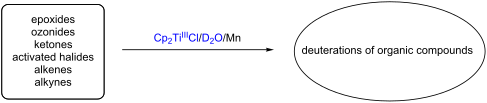
- O–H bond, indicating a bond-dissociation energy (BDE) for the intermediate aqua-complex of only 49 kcal/mol. This points to a decrease of almost 60 kcal/mol compared to the calculated BDE of water. Later, Gansäuer et al. proposed a modified structure of the intermediate aqua-complex on the basis of


Ring-whizzing in polyene-PtL2 complexes revisited
Beilstein J. Org. Chem. 2016, 12, 1410–1420, doi:10.3762/bjoc.12.135
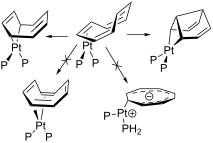
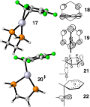
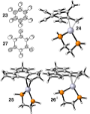
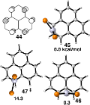
- to consider a lower lying filled orbital of b1 symmetry, 7. Polyene–ML2 complexes are very fragile which in turn makes it somewhat difficult to compute the reaction path. The bond dissociation energy for ethylene–Pt(PH3)2 is only about 17 kcal/mol [23]. There are two ways in which the metal–polyene
- ]. So the computed ground state for Pt(PH3)2, shown in 8, is calculated to be 29 kcal/mol more stable than one where the P–Pt–P bond angle was constrained to be 99°. This of course is not the case for Pt(dpe), 9. The P–Pt–P angle remains at 98°. Thus, the bond dissociation energy in polyene–Pt(dpe
- b1g. On the other hand, the Pt 5d AO is more diffuse and consequently more bonding is lost at η4 than its Ni congener. But this cannot be the whole story. Massera and Frenking [23] have shown that there is essentially no energy difference between the bond dissociation energy (BDE) in ethylene–Ni(dpe






Cascade alkylarylation of substituted N-allylbenzamides for the construction of dihydroisoquinolin-1(2H)-ones and isoquinoline-1,3(2H,4H)-diones
Beilstein J. Org. Chem. 2016, 12, 301–308, doi:10.3762/bjoc.12.32
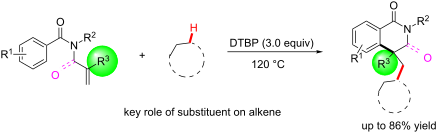
- -initiated cyclization [30][31] and other radical reactions [32][33][34]. Due to their low polarity and high bond-dissociation energy, the functionalization of unactivated sp3 C–H bonds in simple alkanes remains as a challenging task. The direct cascade, 1,2-alkyarylation of alkenes to construct multi


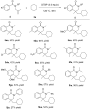


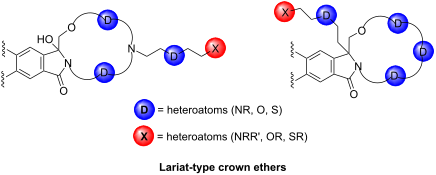
Direct and indirect single electron transfer (SET)-photochemical approaches for the preparation of novel phthalimide and naphthalimide-based lariat-type crown ethers
Beilstein J. Org. Chem. 2014, 10, 514–527, doi:10.3762/bjoc.10.47
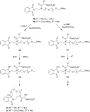
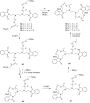
- delocalization arising by the orbital overlap, lowers the σC-Si bond dissociation energy and makes the silicon center more electropositive. Consequently, short-lived α-silyl cation radicals typically undergo fast, silophile-promoted desilylation to form the carbon centered free radicals 19 (Scheme 4). Based on




Damage of polyesters by the atmospheric free radical oxidant NO3•: a product study involving model systems
Beilstein J. Org. Chem. 2013, 9, 1907–1916, doi:10.3762/bjoc.9.225

- studies by Coote et al. clearly revealed that polymers possessing only saturated alkyl chains, for example polyesters, will not propagate autoxidation, particularly because the ROO–H bond-dissociation energy (BDE) is usually less than the BDE for unactivated R–H bonds [6]. Polymer surface coatings, which


Metal-free aerobic oxidations mediated by N-hydroxyphthalimide. A concise review
Beilstein J. Org. Chem. 2013, 9, 1296–1310, doi:10.3762/bjoc.9.146
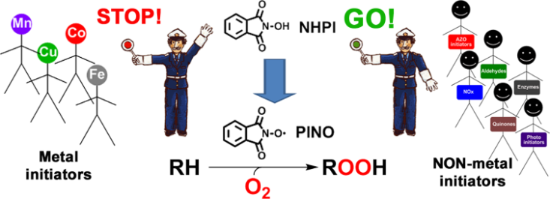
- oxidation of organic substrates [7][8][9][10][11]. NHPI acts as a precursor of the phthalimide N-oxyl (PINO) radical, which is the effective catalyst promoting hydrogen-abstraction processes (Scheme 1). The reactivity of NHPI and PINO is related to the bond dissociation energy (BDE) of the O–H group, which


Part 3. Triethylborane- air: a suitable initiator for intermolecular radical additions of S-2-oxoalkyl- thionocarbonates (S-xanthates) to olefins
Beilstein J. Org. Chem. 2007, 3, No. 47, doi:10.1186/1860-5397-3-47

- . Fortunately, such an increase of reaction temperature enhances route c much more than route b. For planar radicals, Rüchardt and Beckwith established that the C-H bond dissociation energy (BDE) for H-CXYZ compounds displays a good linear correlation with the measured α and β-proton ESR hyperfine splitting