


Search results
Search for "bromine" in Full Text gives 350 result(s) in Beilstein Journal of Organic Chemistry. Showing first 200.
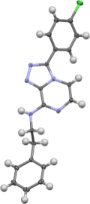
Investigations of amination reactions on an antimalarial 1,2,4-triazolo[4,3-a]pyrazine scaffold
Beilstein J. Org. Chem. 2025, 21, 1126–1134, doi:10.3762/bjoc.21.90
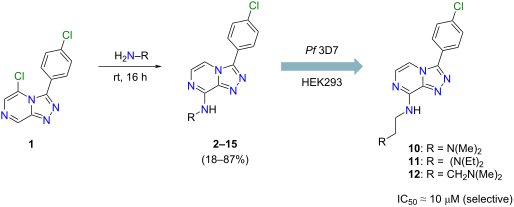
- et al. for 5-position halogenated scaffolds [10]. Several different triazolopyrazine compounds bearing chlorine, bromine or iodine at the 5-position, gave no ipso-substituted (5-substituted) products when refluxed in toluene with phenethylamine, with all major products being substituted at the 8




On the photoluminescence in triarylmethyl-centered mono-, di-, and multiradicals
Beilstein J. Org. Chem. 2025, 21, 964–998, doi:10.3762/bjoc.21.80
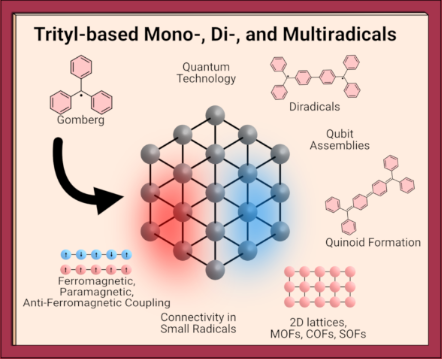
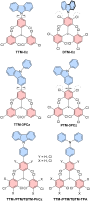
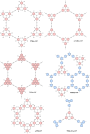
- strong increase in ϕ; however, no further information is given to support this claim. While substitution of all para-positions with hetero-halogens or chalcogens does not induce a different symmetry in the ground state of the molecule, substitution of only one of the para-chlorines of PTM with bromine or
- low ϕ (see Figure 2a) [50][51]. Perfluorinated triphenylmethyl radicals have been reported as well; however, neither UV–vis nor photoluminescence data are available [54]. Mixed perhalogenated triphenylmethyl radicals with fluorine, chlorine, and bromine substituents have been synthesized in an attempt
- bromine substitution decreases the spin–lattice relaxation time T1 of the radical electron. This is due to increased spin–orbit coupling in the brominated species. By contrast, the phase memory time Tm becomes longer for successively brominated radicals, visible from the concurrent spectral broadening in









Recent advances in controllable/divergent synthesis
Beilstein J. Org. Chem. 2025, 21, 890–914, doi:10.3762/bjoc.21.73

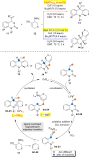
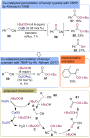
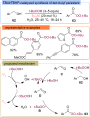
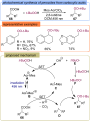
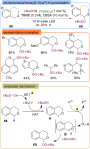
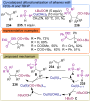
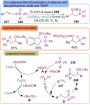
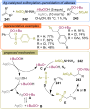
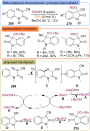
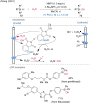
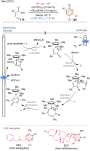
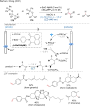
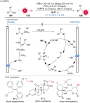
- is used as the inorganic base, bromine radicals abstract hydrogen to form product 75; whereas when Na2HPO4 is used as the inorganic base, its weaker basicity leads to protonation of complex Int-72 to form intermediate Int-73, which then preferentially undergoes single-electron transfer with the DPZ




Cu–Bpin-mediated dimerization of 4,4-dichloro-2-butenoic acid derivatives enables the synthesis of densely functionalized cyclopropanes
Beilstein J. Org. Chem. 2025, 21, 877–883, doi:10.3762/bjoc.21.71
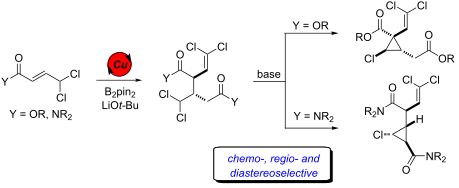
- reaction was carried out under standard conditions with ethyl crotonate derivatives bearing a methyl group, hydrogen or bromine atoms at the γ position. Either β-borylation or decomposition products were obtained in those cases (Scheme 3c). On the basis of our experimental results, we propose the following


Chitosan-supported CuI-catalyzed cascade reaction of 2-halobenzoic acids and amidines for the synthesis of quinazolinones
Beilstein J. Org. Chem. 2025, 21, 839–844, doi:10.3762/bjoc.21.67
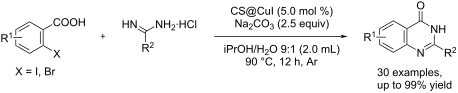
- 10.3762/bjoc.21.67 Abstract A chitosan-supported CuI (CS@CuI) catalyst was developed for the synthesis of quinazolinones from 2-halobenzoic acids (including iodine and bromine) and amidines. The reaction proceeds under mild reaction conditions, demonstrating a broad substrate scope (30 examples) and good
- methods, the cascade reaction between ortho-halogen (e.g., chlorine, bromine or iodine) substituted benzoic acids and amidines has become a prominent route to synthesize the corresponding quinazolinones [10][11][12][13][14][15][16][17][18]. In 2009, Fu and co-workers found that copper(I) could effectively
- analysis of the filtered aqueous solution after the reaction confirmed no detectable leaching of CuI. Conclusion In summary, we have developed a CS@CuI-catalyzed cascade reaction of 2-halobenzoic acids (including iodine and bromine derivatives) and amidines for the synthesis of quinazolinones. This


Recent advances in the electrochemical synthesis of organophosphorus compounds
Beilstein J. Org. Chem. 2025, 21, 770–797, doi:10.3762/bjoc.21.61
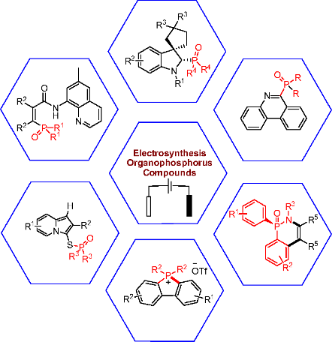
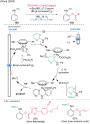
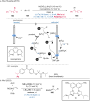
- nickel as the cathode in the presence of tetrabutylammonium bromide (TBAB) at the constant current of 6 mA. The electrodes used in the reaction are all in plate form. The presence of TBAB causes the resulting bromide anion to oxidize to bromine radical and react with R2P(O)–H to produce a radical
- anode at a constant current at 50 °C in methanol for 6 h. This method also obtained a small amount of over-phosphorylated products. Phosphorylation occurred even when no functional group was present at the α-position of the aryl ring. Products with good yields were synthesized despite methyl, bromine
- desired products were obtained with moderate yields for aldehydes containing strong electron-withdrawing groups, indicating that this method is suitable for forming P–C bonds. Products with nitro, chlorine, or bromine groups at the para position had higher yields compared to those with the groups at the


Semisynthetic derivatives of massarilactone D with cytotoxic and nematicidal activities
Beilstein J. Org. Chem. 2025, 21, 607–615, doi:10.3762/bjoc.21.48
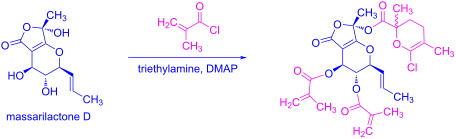
- the presence of catalytic amounts of 4-dimethylaminopyridine, 82% yield) was proposed as C32H23Br3O9 based on the molecular ion cluster sodium adducts [M + Na]+ depicted at m/z 810.96, 812.94, 814.92, and 816.90 characteristic for the presence of three bromine atoms [22]. In addition to signals


Total synthesis of (±)-simonsol C using dearomatization as key reaction under acidic conditions
Beilstein J. Org. Chem. 2025, 21, 601–606, doi:10.3762/bjoc.21.47
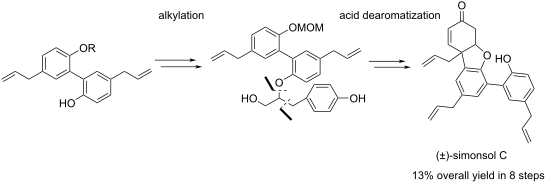
- alcohol 19 was isolated in 89% yield. The copper-catalyzed replacement of the bromine substituent in 19 with a hydroxy group was achieved in the presence of a catalytic amount of oxalamide ligand I [13]. This transformation is critical for enabling further functionalization and the reaction conditions


Synthesis of N-acetyl diazocine derivatives via cross-coupling reaction
Beilstein J. Org. Chem. 2025, 21, 490–499, doi:10.3762/bjoc.21.36
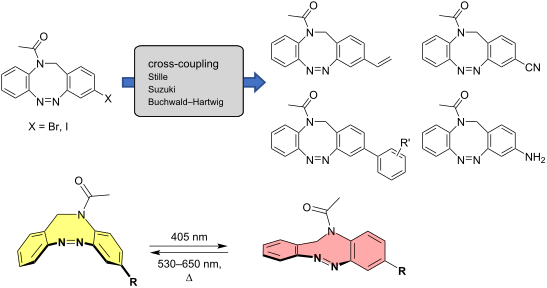
- of 74% for bromine 2 and 78% for iodo starting material 3 (Table 3) [24]. To overcome the problems of poor yields in the arylation of N-acetyl diazocines via Stille coupling we used Suzuki–Miyaura reactions of the diazocines 2 and 3 with different arylboronic acids [25][26]. There are several
- 1. If electron-withdrawing substituents are added in ortho-position of the additional phenyl ring (12 and 13) the half-life is not affected significantly as well. An increase of about 10% of the half-lives has been observed for the weak +M substituents bromine (10) and fluorine (11) or methyl groups
- the switching behavior while weak +M substituents like bromine and fluorine as well as electron-poor heteroaromatic systems lead to increased thermal half-lives. An amino-substituted derivative 21 was obtained via Buchwald–Hartwig coupling with Boc-carbamate and subsequent deprotection. Amino


Electrochemical synthesis of cyclic biaryl λ3-bromanes from 2,2’-dibromobiphenyls
Beilstein J. Org. Chem. 2025, 21, 451–457, doi:10.3762/bjoc.21.32
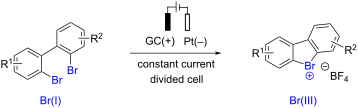
- ; electrochemistry; hypervalent bromine; Introduction Chemistry of hypervalent bromine(III) species has experienced rapid advancements during the recent years [1][2]. The remarkable nucleofugality of aryl bromides in hypervalent bromine(III) compounds has been exploited in the generation of arynes from cyclic
- molecular nitrogen in diazonium compounds. Accordingly, pre-formed [12] or in situ-generated 2,2’-bromodiazonium salts 2 [11][13][14] furnish cyclic bromine(III) species 1 under thermal decomposition conditions (Scheme 1, reaction 1). The diazonium intermediates 2 are obtained by diazotation of 2'-bromo
- an electrochemical synthesis of cyclic diaryl λ3-bromanes under anodic oxidation conditions. Results and Discussion Symmetric 2,2'-dibromo-1,1'-biphenyl 4a possessing ethoxycarbonyl groups ortho to the bromine was chosen as a model compound for our study. We anticipated that the presence of the ester


Synthesis, characterization, antimicrobial, cytotoxic and carbonic anhydrase inhibition activities of multifunctional pyrazolo-1,2-benzothiazine acetamides
Beilstein J. Org. Chem. 2025, 21, 348–357, doi:10.3762/bjoc.21.25
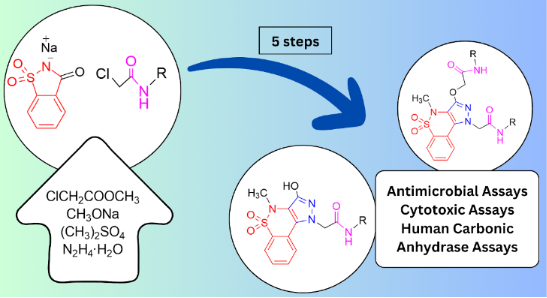
- potent. Interestingly, the presence of a halogen, preferably a bromine substituent at the para-position of the acetamide group increased the antibiotic potential against S. aureus. A comparative analysis of the antimicrobial data between mono/dialkylated derivatives revealed that O-alkylation did not


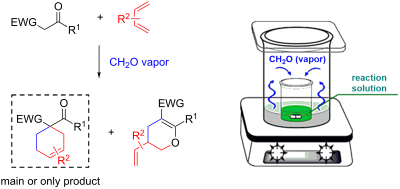
Three-component reactions of conjugated dienes, CH acids and formaldehyde under diffusion mixing conditions
Beilstein J. Org. Chem. 2025, 21, 262–269, doi:10.3762/bjoc.21.18
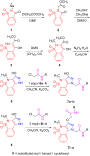
- derivatives 8 and 9. Interaction of 4a/4b and 5a/5b mixtures with bromine. Interaction of diketone 1 with formaldehyde under various conditions. Supporting Information Supporting Information File 112: 1H and 13C NMR spectra of synthesized compounds. Funding This research was financially supported by the


Visible-light-promoted radical cyclisation of unactivated alkenes in benzimidazoles: synthesis of difluoromethyl- and aryldifluoromethyl-substituted polycyclic imidazoles
Beilstein J. Org. Chem. 2025, 21, 234–241, doi:10.3762/bjoc.21.15
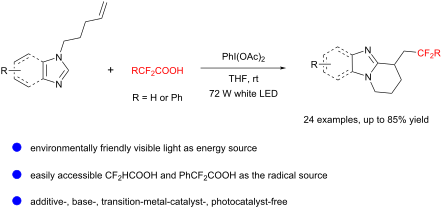
- good tolerance for both electron-withdrawing groups such as fluorine (–F), bromine (–Br), and chlorine (–Cl), as well as electron-donating substituents like methoxy (–OMe) and methyl (–Me), yielding the corresponding 6-membered tricyclic imidazoles in moderate to good yields (3b–h). Benzene rings
- example, substrates with a bromine atom occupying the 4-position and a methoxy group at the 7-position could be successfully converted into the target products (3s and 3t). In addition, doubly substituted benzimidazoles (3u–w), as well as the single imidazole (3x), were also found to be applicable. This


Recent advances in electrochemical copper catalysis for modern organic synthesis
Beilstein J. Org. Chem. 2025, 21, 155–178, doi:10.3762/bjoc.21.9

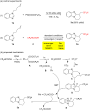
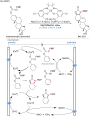
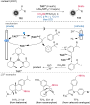
- bromine radical attack that leads to the formation of a cationic brominated copper complex 77. Anodic oxidation and subsequent proton transfer provide the desired product 73 and regenerate the copper catalyst. Olefin addition Hydrofunctionalization and difunctionalization of alkenes are valuable methods






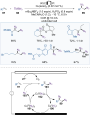


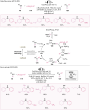
Recent advances in organocatalytic atroposelective reactions
Beilstein J. Org. Chem. 2025, 21, 55–121, doi:10.3762/bjoc.21.6
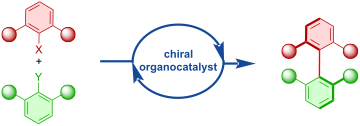


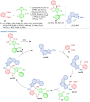




Synthesis of acenaphthylene-fused heteroarenes and polyoxygenated benzo[j]fluoranthenes via a Pd-catalyzed Suzuki–Miyaura/C–H arylation cascade
Beilstein J. Org. Chem. 2024, 20, 3290–3298, doi:10.3762/bjoc.20.273
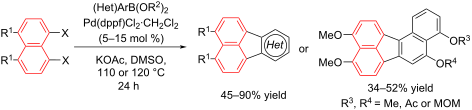
- ring with the -OMe group on 25, while the halogen (bromine) is on the opposite ring with the -OMe group on naphthalene 30. This small yet important difference allowed us to synthesize benzo[j]fluoranthenes 23 and 28 selectively with free -OH groups at different positions. Bromonaphthalene 30 was


Ceratinadin G, a new psammaplysin derivative possessing a cyano group from a sponge of the genus Pseudoceratina
Beilstein J. Org. Chem. 2024, 20, 3215–3220, doi:10.3762/bjoc.20.267
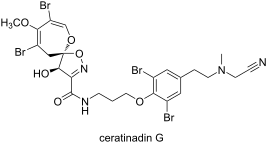
- , colorless, amorphous solid. ESIMS analysis of compound 1 revealed pseudomolecular ion peaks at m/z 805, 807, 809, 811, and 813 (1:4:6:4:1 [M + Na]+), which is indicative of the presence of four bromine atoms. The molecular formula of compound 1, determined by HRESIMS, was identified as C24H26Br4N4O6. The


Discovery of ianthelliformisamines D–G from the sponge Suberea ianthelliformis and the total synthesis of ianthelliformisamine D
Beilstein J. Org. Chem. 2024, 20, 3205–3214, doi:10.3762/bjoc.20.266
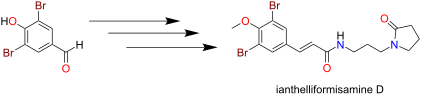
- brown gum. The LRESIMS of 4 indicated the presence of two bromine atoms due to a 1:2:1 ion cluster at m/z 459/461/463 [M + H]+, whilst the HRESIMS data allowed a molecular formula of C17H20Br2N2O3 to be assigned. The 1H NMR (Table 1) and edited HSQC spectra of 4 in DMSO-d6 indicated the presence of one
- due to the N-(3-aminopropyl)-2-pyrrolidone moiety, which is rarely found in natural products with <30 metabolites reported to date. The TFA salt of ianthelliformisamine E (5) was obtained as a stable brown gum. The LRESIMS of 5 indicated the presence of two bromine atoms, displaying a 1:2:1 ion
- C17H22Br2N2O4. Ianthelliformisamine F (6) was isolated as a stable brown gum. The LRESIMS of 6 indicated the presence of two bromine atoms due to a 1:2:1 ion cluster at m/z 334/336/338 [M + H]+, whilst the HRESIMS data enabled a molecular formula of C10H9Br2NO2 to be assigned. Comparison of the 1D NMR data of 6


![[Graphic 1]](/bjoc/content/inline/1860-5397-20-266-i2.svg?max-width=637&scale=1.18182)
![[Graphic 2]](/bjoc/content/inline/1860-5397-20-266-i3.svg?max-width=637&scale=1.18182)
![[Graphic 3]](/bjoc/content/inline/1860-5397-20-266-i4.svg?max-width=637&scale=1.18182)

![[Graphic 4]](/bjoc/content/inline/1860-5397-20-266-i5.svg?max-width=637&scale=1.18182)
![[Graphic 5]](/bjoc/content/inline/1860-5397-20-266-i6.svg?max-width=637&scale=1.18182)

Hypervalent iodine-mediated intramolecular alkene halocyclisation
Beilstein J. Org. Chem. 2024, 20, 3113–3133, doi:10.3762/bjoc.20.258
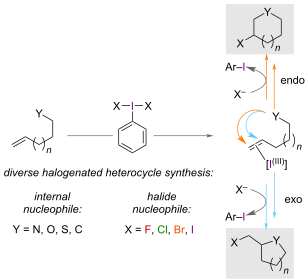
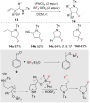
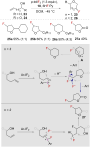
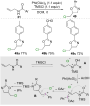
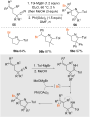
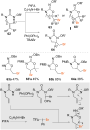
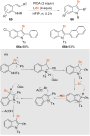
- functional groups and avoids the use of highly toxic and corrosive bromine. Approaches using this approach are outlined below. Nitrogen nucleophiles In 2007, aminobromocyclisation of homoallylic sulfonamides 53 was reported by Fan, Wang and co-workers (Scheme 29) [50]. Using PhI(OAc)2 as an oxidant with KBr
- as the bromine source and Bu4NBr as a reaction promoter, racemic brominated pyrrolidines 54 were synthesised from a range of homoallylic sulfonamides 53 in excellent yields under mild conditions at room temperature. A mechanism was suggested by the authors (Scheme 29), whereby ligand exchange on PhI
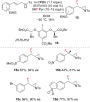
- (OAc)2 with a bromide ion forms unstable PhIOAcBr. Elimination of bromoacetate then gives a reactive electrophilic bromine source, which forms a bromonium intermediate A after reaction with the alkene. Intramolecular nucleophilic attack from nitrogen forms the product 54. Chiba and co-worker reported








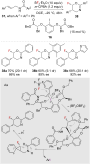
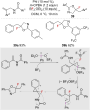


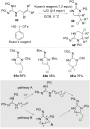
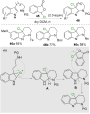









Advances in radical peroxidation with hydroperoxides
Beilstein J. Org. Chem. 2024, 20, 2959–3006, doi:10.3762/bjoc.20.249
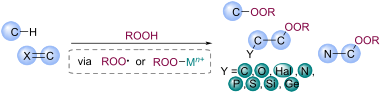
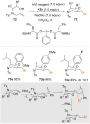
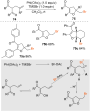
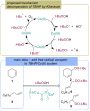
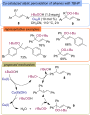
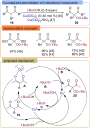
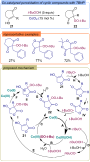
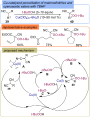
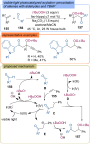
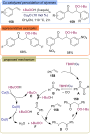
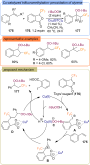
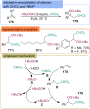
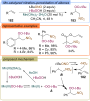
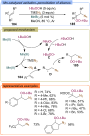
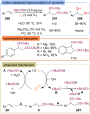
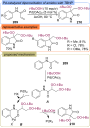
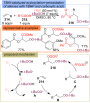
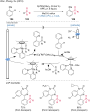
- -Butoxy and tert-butylperoxy radicals are generated through the redox reaction of bromine. Vanadium(IV) oxychloride (VOCl2) was found to be an efficient catalyst to achieve peroxidation–carbonylation of styrenes 152 with TBHP and aldehydes 153 to give β-peroxy ketones 154 (Scheme 48) [112]. V(IV)OCl2 is































C–C Coupling in sterically demanding porphyrin environments
Beilstein J. Org. Chem. 2024, 20, 2784–2798, doi:10.3762/bjoc.20.234
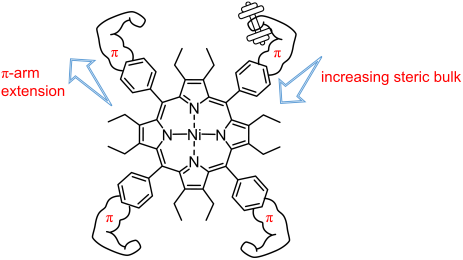
- illustrates that coupling phenyl, thiophene or other aryl moieties at this position would be extremely difficult. Furthermore, the distance between the o-bromine atoms and the nearest carbon neighbor of the β-ethyl groups is 3.7 Å, further complicates the success of coupling at this position. As discussed
- previously, enrichment to the αβαβ, isomer may be necessary to remove the impact of opposing bromine atoms on the coupling reaction. Separation of the four individual atropisomers (αβαβ, α2β2, α3β, α4) has been accomplished before in dodecasubstituted porphyrins through Ni(II) metalation [15]. The core


Access to optically active tetrafluoroethylenated amines based on [1,3]-proton shift reaction
Beilstein J. Org. Chem. 2024, 20, 2776–2783, doi:10.3762/bjoc.20.233
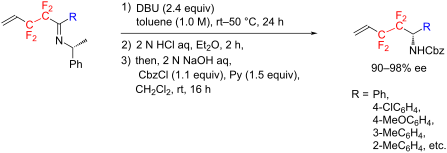
- (R)-16 (Scheme 5). When the substituent R is an aromatic ring substituted by a halogen such as chlorine and bromine atoms, the amides (S)-23 were obtained in 22–27% yield and with very high optical purity ((S)-23b, (S)-23c), although as for (S)-23a, a satisfactory result (92% ee) could be obtained



Synthesis of fluoroalkenes and fluoroenynes via cross-coupling reactions using novel multihalogenated vinyl ethers
Beilstein J. Org. Chem. 2024, 20, 2691–2703, doi:10.3762/bjoc.20.226

- fluorovinyl ethers, which contains a reactive bromine atom, to afford a series of fluoroalkenes and fluoroenynes in moderate to high yields. Keywords: fluoroalkenes; fluoroenynes; multihalogenated vinyl ethers; Suzuki–Miyaura cross-coupling reactions; Sonogashira cross-coupling reactions; Introduction
- -chloro-1,1,1-trifluoroethane (halothane) in good yields (Scheme 1D) [42]. Compound 1 has a unique structure possessing three types of halogen atoms, namely bromine, chlorine, and fluorine, and it would be expected to afford multisubstituted fluoroalkenes by installing various substituents to bromine or


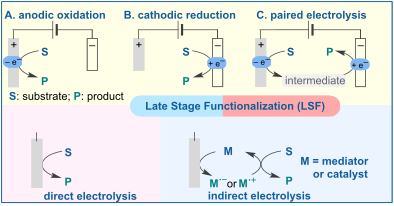
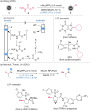
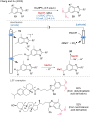
A review of recent advances in electrochemical and photoelectrochemical late-stage functionalization classified by anodic oxidation, cathodic reduction, and paired electrolysis
Beilstein J. Org. Chem. 2024, 20, 2500–2566, doi:10.3762/bjoc.20.214


























Synthesis and conformational analysis of pyran inter-halide analogues of ᴅ-talose
Beilstein J. Org. Chem. 2024, 20, 2442–2454, doi:10.3762/bjoc.20.208
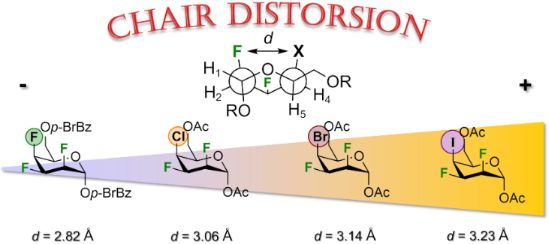
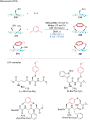
- depending on the incorporated halogen on the pyran core at C4: −208.33 ppm for 12 (fluorine), −197.95 ppm for 13 (chlorine), −192.80 ppm for 14 (bromine), and −184.56 ppm for 15 (iodine). Similarly, the increase in chemical shift of F2 is smaller as exemplified with an upfield shift of −205.46 ppm for 12 to
- exception being bromine). Dipole moments for the 4C1 structures are 2 Debye larger than for 1C4 structures, making them substantially more stable in chloroform. Both chair structures have multiple C–F bonds in gauche arrangements which are stable due to hyperconjugation: there is donation from C–H bonding
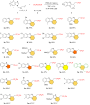
- , 17, and α-ᴅ-talose 18. ORTEP diagram showing 50% thermal ellipsoid probability (except for 18): carbon (gray), oxygen (red), fluorine (green), chlorine (orange), bromine (dark red), iodine (purple), and hydrogen (white). Packing arrangement of compound compound 15; a) View down the b axis; b





