


Search results
Search for "silver salt" in Full Text gives 37 result(s) in Beilstein Journal of Organic Chemistry.
Gold-catalyzed glycosidation for the synthesis of trisaccharides by applying the armed–disarmed strategy
Beilstein J. Org. Chem. 2013, 9, 2147–2155, doi:10.3762/bjoc.9.252
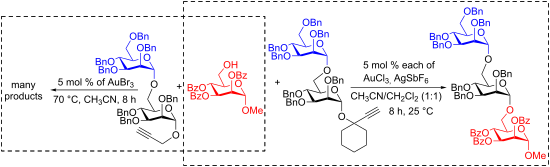
- bond along with side reactions like benzyl deprotection. These observations were then successfully applied for PMB deprotection and one-pot glycosidation. Subsequent experiments proved the significance of the alkyne moiety. It was also observed that the addition of the silver salt AgSbF6 during the


Gold(I)-catalysed one-pot synthesis of chromans using allylic alcohols and phenols
Beilstein J. Org. Chem. 2013, 9, 1797–1806, doi:10.3762/bjoc.9.209
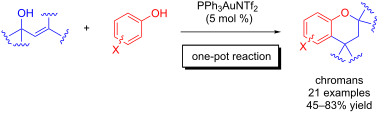
- , entries 8–10). Firstly, no reaction is observed in the absence of a catalyst (Table 1, entry 8). The Brønsted acid catalyst HNTf2 does form chroman 8, but in a poorer isolated yield (21%, Table 1, entry 9) and the silver salt [76] AgNTf2 as a catalyst does not provide any 8, yielding only 9 and 10 (Table


Synthesis of phenanthridines via palladium-catalyzed picolinamide-directed sequential C–H functionalization
Beilstein J. Org. Chem. 2013, 9, 891–899, doi:10.3762/bjoc.9.102
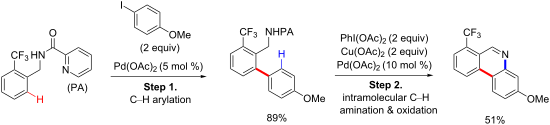
- desired arylated product 3 in good yield (Table 1, entry 1). This method, however, required the use of expensive silver salt as an additive and high reaction temperature (150 °C). We next sought to replace the silver salts with cheaper reagents and lower the reaction temperature [12]. Not surprisingly


Antifreeze glycopeptide diastereomers
Beilstein J. Org. Chem. 2012, 8, 1657–1667, doi:10.3762/bjoc.8.190
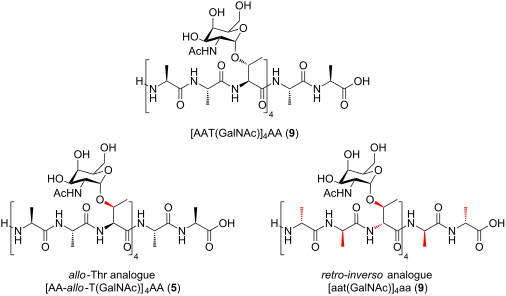
- silver salt promoter AgClO4 (0.25 equiv) was added at room temperature and stirring was continued for 30 min. Subsequently, the 2-azido-2-deoxy-3,4,6-tri-O-acetyl-α-D-galactopyranosyl chloride (1.5 equiv) was added dissolved in abs toluene (30–40 mL) and methylene chloride (30–40 mL), and the solution


Efficient gold(I)/silver(I)-cocatalyzed cascade intermolecular N-Michael addition/intramolecular hydroalkylation of unactivated alkenes with α-ketones
Beilstein J. Org. Chem. 2011, 7, 1100–1107, doi:10.3762/bjoc.7.126
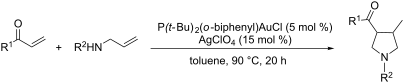
- amount of silver salt may have remained in the reaction system when the mol ratio of silver salt to gold complex was 1:1, see [45]). Upon further increase of the AgOTf loading to 10 mol %, the corresponding product 3a was formed in 58% yield with a diastereomeric ratio of 5.4:1 (Table 1, entry 3) [46
- mixture did not have a noticeable effect on the yield of 3a (Table 1, entries 8–11). To identify further the optimal reaction conditions for the gold(I)/silver(I)-cocatalyzed cascade reaction, a number of dual-metal catalyst systems, composed of 15 mol % of silver salt with 5 mol % of gold(I) complex in
- different organic solvents, were tested in the reaction of phenyl vinyl ketone (1a) with 1.5 equiv of N-tosylallylamine (2a) (Table 2). AgClO4 was found to be the best silver salt for this reaction (Table 2, entries 1–5). A panel of Au(I) complexes with different ancillary ligands was also screened for


Chiral gold(I) vs chiral silver complexes as catalysts for the enantioselective synthesis of the second generation GSK-hepatitis C virus inhibitor
Beilstein J. Org. Chem. 2011, 7, 988–996, doi:10.3762/bjoc.7.111
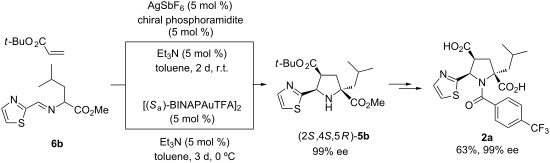
- [36] and, finally, underwent anion interchange in the presence of the corresponding silver salt. The precipitate was filtered through a celite pad and used without any other additional treatment. All of the reactions were performed at room temperature, employing a 5 mol % of both catalyst and base
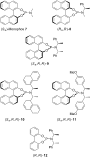
- represented in Scheme 2. The chiral ligand (Sa)-BINAP (13) was also tested in the standard reaction to access key molecule endo-5b (Scheme 3). AgClO4 was found to be the most appropriate silver salt to achieve the highest enantioselectivity (88% ee) compared to the results obtained when other silver salts




The role of silver additives in gold-mediated C–H functionalisation
Beilstein J. Org. Chem. 2011, 7, 892–896, doi:10.3762/bjoc.7.102
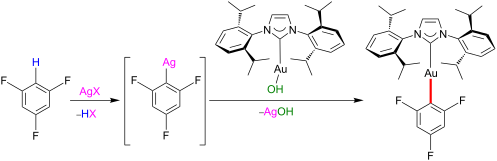
- functionalisation of aromatic C–H bonds. Doubt is cast on the commonly cited route of halide abstraction from gold and evidence of substrate activation is given. Keywords: C–H functionalisation; gold catalyst; halide abstraction; N-heterocyclic carbene; silver salt; substrate activation; Introduction The use of
- suggests that complex 3 is indeed an intermediate. However, the use of a silver salt was essential for the reaction to proceed. The silver salt was suspected of abstracting the halide from [AuCl(IPr)] to generate a possibly active cationic gold(I) species [20]. To test this hypothesis, the well-defined
- presence of Ag2O, suggesting that silver does not generate cationic gold. The reaction with pivalic acid gave a better conversion, indicating that the gold proceeded via complex 3. Further reactions used 1 as the gold species and no longer included PivOH. The stoichiometric dependence of the silver salt


When gold can do what iodine cannot do: A critical comparison
Beilstein J. Org. Chem. 2011, 7, 847–859, doi:10.3762/bjoc.7.97
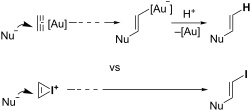
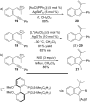
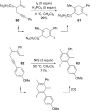
- , although all ligands tested with the gold complexes and silver salt AgSbF6 allowed full conversion to the indene. From these results, Sanz and co-workers also reported the corresponding halocyclization of o-alkynylstyrenes to yield 3-halo-1H-indenes by employing NIS as the iodonium source (Scheme 7b) [92






When cyclopropenes meet gold catalysts
Beilstein J. Org. Chem. 2011, 7, 717–734, doi:10.3762/bjoc.7.82
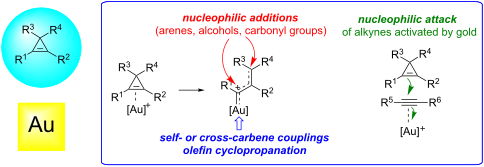
- activators [31]. Since AgOTf and BF3·OEt2 led to the same naphthalene product 21, the authors suspected that traces of the Brønsted acid (HOTf) present in the silver salt may be the actual catalyst and may also modify the regioselectivity observed in the gold-catalyzed reaction. Thus, several basic additives




Rh(I)-catalyzed intramolecular [2 + 2 + 1] cycloaddition of allenenes: Construction of bicyclo[4.3.0]nonenones with an angular methyl group and tricyclo[6.4.0.01,5]dodecenone
Beilstein J. Org. Chem. 2011, 7, 404–409, doi:10.3762/bjoc.7.52
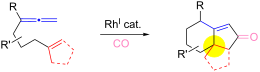
- an atmosphere consisting of 0.2 atm of CO and 0.8 atm of Ar, or of 0.05 atm of CO and 0.95 atm of Ar to produce 8a in 71% and 74% yields, respectively (Table 1, entries 4 and 5). Next, the reaction with [RhCl(CO)dppp]2 in the presence or absence of a silver salt [27][28][29][30][31][32][33][34] was


Synthesis of cationic dibenzosemibullvalene-based phase-transfer catalysts by di-π-methane rearrangements of pyrrolinium-annelated dibenzobarrelene derivatives
Beilstein J. Org. Chem. 2011, 7, 119–126, doi:10.3762/bjoc.7.17

- this purpose, an anionic derivative of benzophenone was prepared and associated with the ammonium functionality of the dibenzobarrelene 2b by anion metathesis (Scheme 5). The known sulfonic acid 4 [20] was transformed to the corresponding silver salt Ag-4 by reaction with Ag2O, and subsequent ion


Diels- Alder reactions using 4,7-dioxygenated indanones as dienophiles for regioselective construction of oxygenated 2,3-dihydrobenz[f]indenone skeleton
Beilstein J. Org. Chem. 2008, 4, No. 15, doi:10.3762/bjoc.4.15
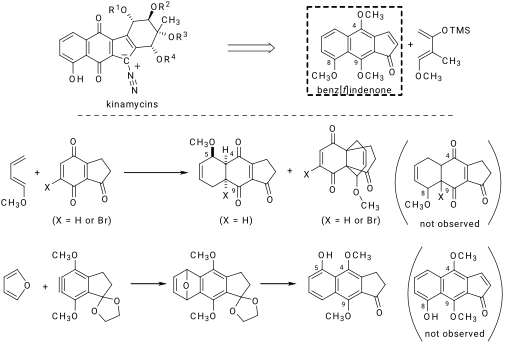
- ], regioselective synthesis of 4,8,9-trioxygenated 2,3-dihydrobenz[f]indenone 4 [22] was a key issue, which was achieved via C ring construction with intramolecular Friedel-Crafts reaction of naphthalenepropanoic acid 5 (path A, Scheme 1) [23]. However, the utilization of a stoichiometric amount of expensive silver
- salt for the synthesis of bromonaphthalene 6 [24] hampered large-scale synthesis of 4. Towards a solution to this problem, we planned the synthesis of 4 via A-ring construction by DAR of indanone-type compounds and oxygenated dienes: i. e. 1) DAR of indanetrione 8 and 1-methoxy-1,3-butadiene (7) (path





