Search results
Search for "trifluoroacetic acid" in Full Text gives 317 result(s) in Beilstein Journal of Organic Chemistry. Showing first 200.
Tunable full-color dual-state (solution and solid) emission of push–pull molecules containing the 1-pyrindane moiety
Beilstein J. Org. Chem. 2024, 20, 3016–3025, doi:10.3762/bjoc.20.251

- 511 nm), in the region of solvents with medium polarity. Protonation of the dimethylamino group was additionally confirmed by titration of pyrindane 1i in toluene using trifluoroacetic acid (see Figure S2, Supporting Information File 1). According to the data obtained, an increasing amount of acid
- caused a blue shift of the maximum at 511 nm, and a new maximum in the region of 380–400 nm appeared in the absorption spectra. The intensity of the short-wavelength band also increased upon addition of trifluoroacetic acid. At the same time, a second band centered at 440 nm also appeared in the emission
- , compound 1i could form the salt 1iH+. Therefore, the effect of acid vapors on the solid-state emission was studied. It was found that pyrindane 1i was sensitive to formic and trifluoroacetic acid vapors. As a result of protonation, a significant blue shift of the emission maximum from 762 nm down to 493 nm


Synthesis of fluorinated acid-functionalized, electron-rich nickel porphyrins
Beilstein J. Org. Chem. 2024, 20, 2954–2958, doi:10.3762/bjoc.20.248
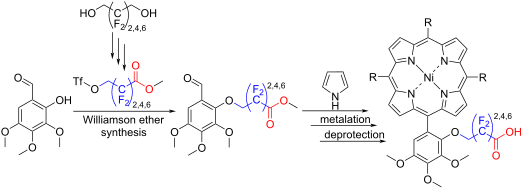
- electrocatalytic hydrogen evolution reactions, a proton source is needed [11]. In this context, trifluoroacetic acid is very frequently chosen as the proton source, because it is a strong acid but just not strong enough to destroy (demetallate) the Ni porphyrin [10]. Covalent attachment of acids facilitates proton
- transfer and increases the efficiency [12]. Three conditions should be met for the target porphyrins of this study. 1. The acid covalently bound to the porphyrin should have an acid strength similar to trifluoroacetic acid. 2. The length of the tether with which the acid group is bound should be sufficient
- -synthetic modification of this porphyrin proved to be difficult. Therefore, we have integrated the acid group into the aldehyde component of the Rothemund reaction to prepare the target porphyrin. In initial tests, we have established that trifluoroacetic acid can be replaced by perfluorinated alkyl


5th International Symposium on Synthesis and Catalysis (ISySyCat2023)
Beilstein J. Org. Chem. 2024, 20, 2704–2707, doi:10.3762/bjoc.20.227
- in MeOH at room temperature with a short reaction time. Some of them were further functionalized with a 1,2,3-triazole ring via copper-catalyzed azide–alkyne cycloaddition (CuAAC) and deprotected with trifluoroacetic acid. Several hybrids were evaluated against six cancer cell lines, displaying GI50

A review of recent advances in electrochemical and photoelectrochemical late-stage functionalization classified by anodic oxidation, cathodic reduction, and paired electrolysis
Beilstein J. Org. Chem. 2024, 20, 2500–2566, doi:10.3762/bjoc.20.214
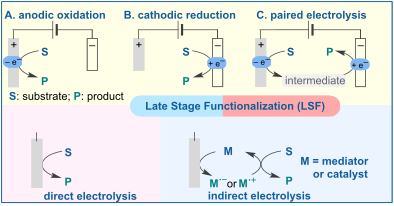
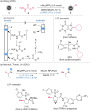
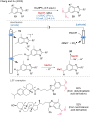
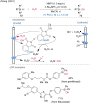
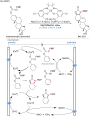
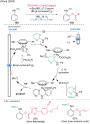
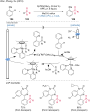
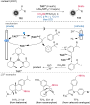
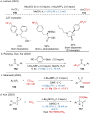
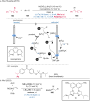
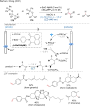
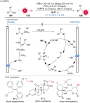
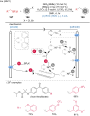
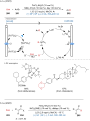
- disclosed a similar trifluoromethylation of arenes under photoelectrochemical reaction conditions but without the addition of a photocatalyst, using trifluoroacetic acid as the CF3 source (Scheme 47b) [71]. This alternative approach further underscores the versatility and applicability of
























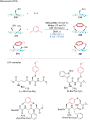


Hypervalent iodine-mediated cyclization of bishomoallylamides to prolinols
Beilstein J. Org. Chem. 2024, 20, 2455–2460, doi:10.3762/bjoc.20.209
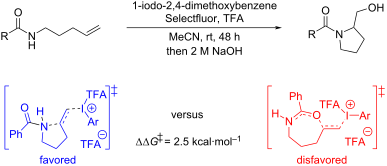
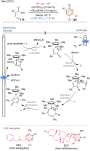
- that the transition state was stabilized by 4.1 kcal·mol−1 by an extra molecule of trifluoroacetic acid. A similar stabilizing interaction was not identified in this case with 3a, despite significant effort, but it cannot be ruled out. The cyclization of 9 was shown to be possible by attack of the


Phenylseleno trifluoromethoxylation of alkenes
Beilstein J. Org. Chem. 2024, 20, 2434–2441, doi:10.3762/bjoc.20.207
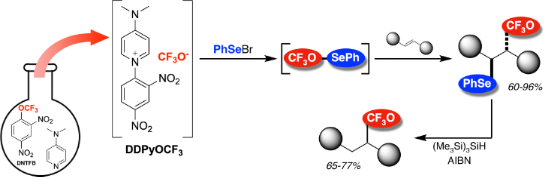
- derivative 2k, and the estrone derivative 2l were also successfully bis-functionalized. Some products appeared to be sensitive during purification by chromatography on silica gel. Suspecting acid sensitivity, compound 2a was treated with trifluoroacetic acid to confirm this hypothesis (Scheme 3). The product


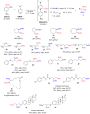


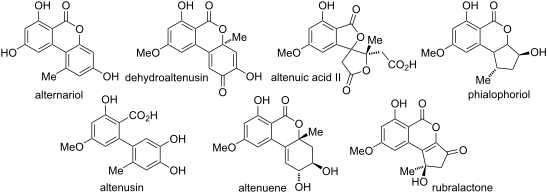
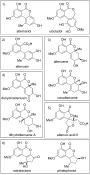
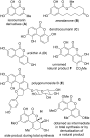
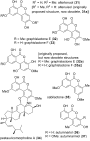
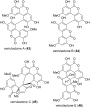
Natural resorcylic lactones derived from alternariol
Beilstein J. Org. Chem. 2024, 20, 2171–2207, doi:10.3762/bjoc.20.187






Novel truxene-based dipyrromethanes (DPMs): synthesis, spectroscopic characterization and photophysical properties
Beilstein J. Org. Chem. 2024, 20, 2163–2170, doi:10.3762/bjoc.20.186
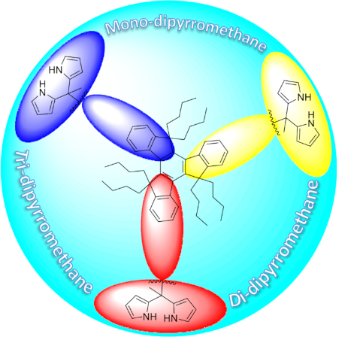
- –80%) along with their preliminary photophysical (absorption, emission and time resolved fluorescence lifetime) properties. The condensation reaction for assembling the required DPMs were catalyzed with trifluoroacetic acid (TFA) at 0 °C to room temperature (rt), and the stable dipyrromethanes were
- truxenes with freshly distilled pyrrole using trifluoroacetic acid (TFA) as an acidic catalyst afforded the anticipated DPM-appended truxene derivatives (14, 16 and 18) in good yields (60–80%). All the newly prepared DPM-linked truxene-hybrid molecules as well as the intermediate acetylated truxene
- in freshly distilled pyrrole with different amounts (5 equiv for 14, 10 equiv for 16, and 15 equiv for 18). Then trifluoroacetic acid (TFA, 0.1 equiv for 14, 0.2 equiv for 16 and 0.3 equiv for 18) was added to the reaction mixture, and the resulting mixture was stirred at 0 °C (16) or 0 °C to rt (14


O,S,Se-containing Biginelli products based on cyclic β-ketosulfone and their postfunctionalization
Beilstein J. Org. Chem. 2024, 20, 2143–2151, doi:10.3762/bjoc.20.184
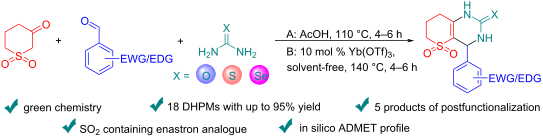
- ). However, increasing acidity and using trifluoroacetic acid (Table 1, entry 17) did not improve the overall yield. We also tried microwave activation conditions since this is a known technique for reactions of this type [32], but unfortunately, we did not find any improvement in the yield (Table 1, entry



Harnessing the versatility of hydrazones through electrosynthetic oxidative transformations
Beilstein J. Org. Chem. 2024, 20, 1988–2004, doi:10.3762/bjoc.20.175
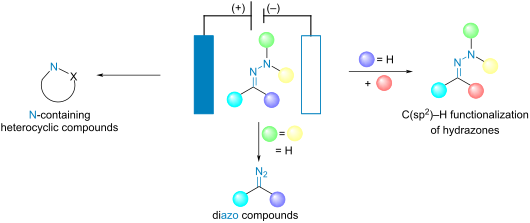
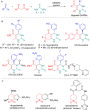
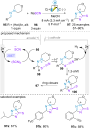
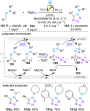
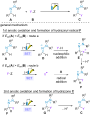
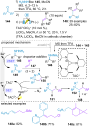
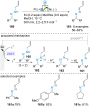
- photocatalyst TAC+. The electrolysis was carried out at a constant cell potential of 1.5 V under white light irradiation. The carbonyl compound 144 was initially treated with tert-butyl carbazate (145) in acetonitrile in the presence of molecular sieves, followed by the addition of trifluoroacetic acid (TFA) to









Development of a flow photochemical process for a π-Lewis acidic metal-catalyzed cyclization/radical addition sequence: in situ-generated 2-benzopyrylium as photoredox catalyst and reactive intermediate
Beilstein J. Org. Chem. 2024, 20, 1973–1980, doi:10.3762/bjoc.20.173
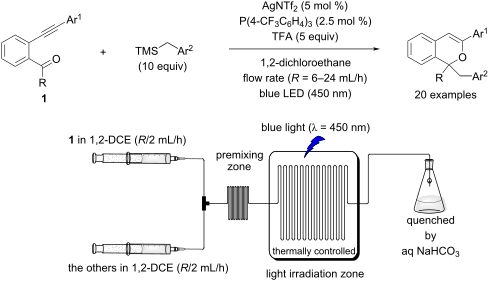
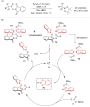
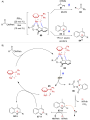
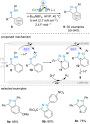
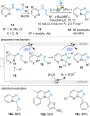
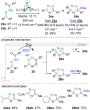
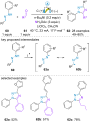
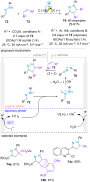
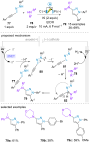
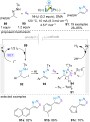
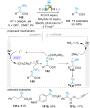
- generated in the flow reaction system through the intramolecular cyclization of ortho-carbonyl alkynylbenzene derivatives by the π-Lewis acidic metal catalyst AgNTf2 and the subsequent proto-demetalation with trifluoroacetic acid. The 2-benzopyrylium intermediates underwent further photoreactions with
- intramolecular cyclization followed by proto-demetalation with trifluoroacetic acid (TFA). In catalytic cycle II, photoexcitation of the generated 2-benzopyrylium intermediates A under light irradiation facilitates single-electron transfer (SET) from benzyltrimethylsilane derivatives 2 as the donor molecule


Novel oxidative routes to N-arylpyridoindazolium salts
Beilstein J. Org. Chem. 2024, 20, 1906–1913, doi:10.3762/bjoc.20.166
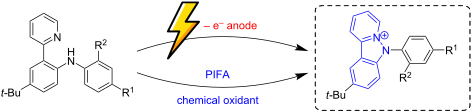
- intermediate (i.e., the diarylamines’ radical cation) and indicates the dominance of the intramolecular cyclization over the intermolecular C–N coupling process. Oxidation of diarylamines in the presence of an excess of trifluoroacetic acid gave no targeted pyridoindazolium salts, whereas the amount of


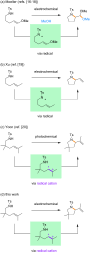
Electrochemical radical cation aza-Wacker cyclizations
Beilstein J. Org. Chem. 2024, 20, 1900–1905, doi:10.3762/bjoc.20.165
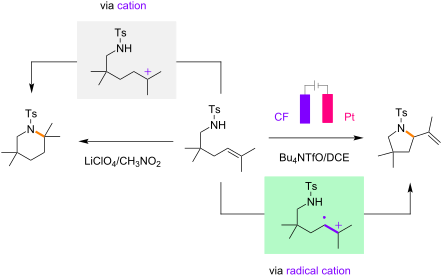
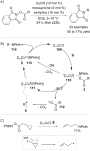
- due to the increased conductivity of the electrolyte solution (Table 1, entry 1). The reaction did not take place without electricity and most of the starting material was recovered (Table 1, entry 3). The addition of trifluoroacetic acid (TFA) was advantageous in terms of the reproducibility, which




The Groebke–Blackburn–Bienaymé reaction in its maturity: innovation and improvements since its 21st birthday (2019–2023)
Beilstein J. Org. Chem. 2024, 20, 1839–1879, doi:10.3762/bjoc.20.162
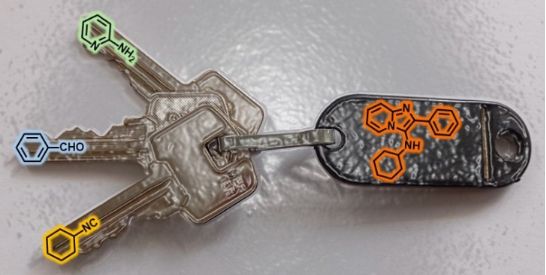
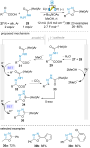
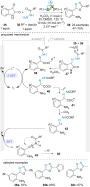
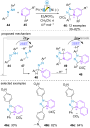
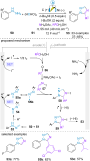
- reaction conditions. The authors performed the optimization study using 5-HMF (23), 2-aminothiazole (24) and tert-butyl isocyanide (5, Scheme 10). Inspired by a procedure reported by Demjén et al. [37], they found the best conditions using EtOH as a green solvent, trifluoroacetic acid (TFA, 20 mol %) or Yb






Diameter-selective extraction of single-walled carbon nanotubes by interlocking with Cu-tethered square nanobrackets
Beilstein J. Org. Chem. 2024, 20, 1298–1307, doi:10.3762/bjoc.20.113
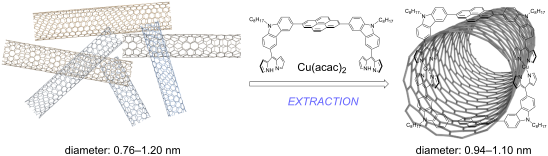
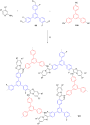
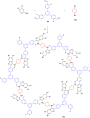
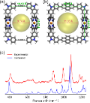
- @(12,2)-SWNT complexes. Chemical structures of Cu-tethered tetragonal nanobrackets 1a and 1b. Synthesis of nanobracket 4. Reaction conditions: i) XPhos Pd G2, XPhos, B2(OH)4, KOAc, EtOH, 80 °C, 2 h; ii) Br-Ar-Br, K2CO3, tetrahydrofuran (THF)/toluene, 80 °C, 16 h; iii) trifluoroacetic acid (TFA), pyrrole




The Ugi4CR as effective tool to access promising anticancer isatin-based α-acetamide carboxamide oxindole hybrids
Beilstein J. Org. Chem. 2024, 20, 1213–1220, doi:10.3762/bjoc.20.104
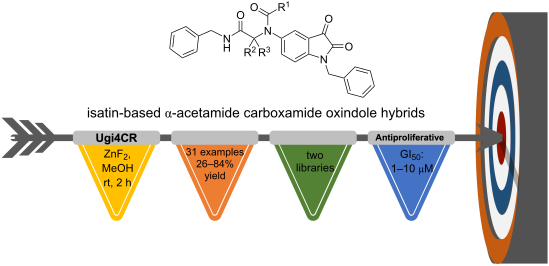
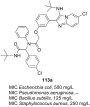
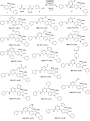
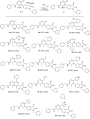
- conditions (120 ºC, 30 minutes) (Scheme 3). Resourcefulness of the Ugi4CR and preliminary SAR studies [16] lead us to synthesize a third library of oxindole derivatives, using trifluoroacetic acid (TFA), under mild reaction conditions, to afford the corresponding α-acetamide carboxamide isatin hybrids 8 from
- -acetamide carboxamide isatin hybrids 8 easy accessed via deprotection reaction on the Ugi-adducts 5 and 7. TFA: trifluoroacetic acid. Supporting Information Supporting Information File 56: Experimental procedures, analytical data, NMR spectra and biological assays. Funding C. S. M. thanks the Norma





Introduction of peripheral nitrogen atoms to cyclo-meta-phenylenes
Beilstein J. Org. Chem. 2024, 20, 1207–1212, doi:10.3762/bjoc.20.103
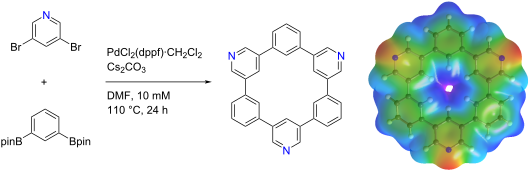
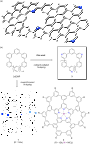
- -doped CMPs. Thus, when trifluoroacetic acid (TFA) was added to a solution of 3a in chloroform, bathochromic shifts in UV spectra were observed, indicating protonation-induced changes in the electronic properties [10]. Because of the weakly acidic nature of pyridinic nitrogen atoms, an excess amount of
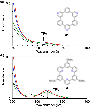
- on the 0.0067 e·Å−3 isosurface for the electron density. Response towards acid treatment with nitrogen-doped CMPs. (a) Absorption spectra of 3a (CHCl3, 2.3 × 10⁻⁶ M) in the absence (black) and presence of trifluoroacetic acid (green: 4.3 × 10⁻² M, blue: 2.1 × 10⁻¹ M, red: 4.2 × 10⁻¹ M). (b
- ) Absorption spectra of 6 (CHCl3, 1.9 × 10⁻⁶ M) in the absence (black) and presence of trifluoroacetic acid (green: 4.3 × 10⁻² M, blue: 2.1 × 10⁻¹ M, red: 4.2 × 10⁻¹ M). Syntheses of 3a and 3b. Supporting Information Supporting Information File 50: Experimental and copies of spectra. Supporting Information



Cofactor-independent C–C bond cleavage reactions catalyzed by the AlpJ family of oxygenases in atypical angucycline biosynthesis
Beilstein J. Org. Chem. 2024, 20, 1198–1206, doi:10.3762/bjoc.20.102
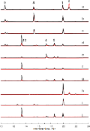
- analyzed on a Waters HPLC system equipped with a 1525 pump and a 2487 dual λ UV detector using an Agilent ZORBAX SB-C18 reversed-phase column (5 μm, 4.6 × 250 mm) or a SilGreen C18AB reversed-phase column (5 μm, 4.6 × 250 mm). The elution solvents were water with 0.1% (v/v) trifluoroacetic acid (solvent A
- ) and acetonitrile with 0.1% (v/v) trifluoroacetic acid (solvent B). A 20-min linear gradient from 25% (v/v) to 100% (v/v) solvent B was used with a flow rate of 1.0 mL⋅min−1. Absorbance at 266 and 313 nm was monitored. For SOD quench experiments, the reaction mixtures were analyzed on an Agilent 1260




Synthesis of 1,4-azaphosphinine nucleosides and evaluation as inhibitors of human cytidine deaminase and APOBEC3A
Beilstein J. Org. Chem. 2024, 20, 1088–1098, doi:10.3762/bjoc.20.96
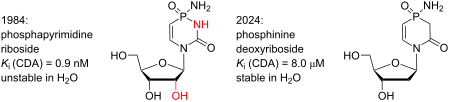
- obtained in 84% yield after silica gel purification. Removal of the Boc protecting group from 6 in the presence of trifluoroacetic acid in DCM at room temperature overnight, followed by cyclisation in boiling pyridine/triethylamine, led to 4-hydroxy-1,4-azaphosphinan-2,4-dione (7) in 84% yield. The free
- the linear amide 11 was performed in DCM using a 10-fold excess of trifluoroacetic acid at room temperature, providing 1,4-azaphosphinine 12 in 68% yield. Various conditions used for the coupling of nucleobase 8, such as using silylated derivatives (HMDS, BSA) or salts obtained by base treatment (NaH
- chloroacetate, Et3N, TMSCl, CH2Cl2, rt, 5 d, 84% yield; v) trifluoroacetic acid, CH2Cl2, rt, overnight, then 5 h reflux in pyridine/Et3N, 84% yield; vi) BnOH, O-(benzotriazol-1-yl)-N,N,N′,N′-tetramethyluronium tetrafluoroborate (TBTU), Et3N, DCE, reflux, 3 h, 65% yield; vii) BnOH, absolute Et2O, pyridine, −78


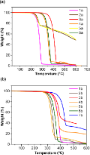
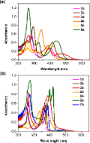
Structure–property relationships in dicyanopyrazinoquinoxalines and their hydrogen-bonding-capable dihydropyrazinoquinoxalinedione derivatives
Beilstein J. Org. Chem. 2024, 20, 1037–1052, doi:10.3762/bjoc.20.92
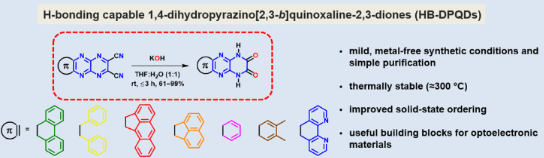
- ]pyrazine-2,3-dicarbonitrile (5a) Compound 5a was synthesized by a modified literature method [31]. To an oven dried sealed tube was added 5,6-diaminopyrazine-2,3-dicarbonitrile (12, 306 mg, 1.91 mmol), diphenylethanedione (benzil) (365 mg, 1.74 mmol), glacial acetic acid (7 mL), trifluoroacetic acid (1 mL




Auxiliary strategy for the general and practical synthesis of diaryliodonium(III) salts with diverse organocarboxylate counterions
Beilstein J. Org. Chem. 2024, 20, 1020–1028, doi:10.3762/bjoc.20.90
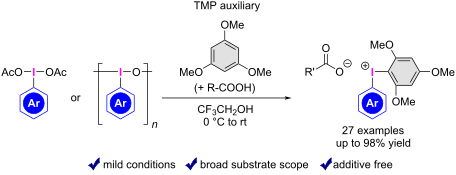
- trifluoroacetic acid, followed by coupling with 1,3,5-trimethoxybenzene [18] (Scheme 1A). This process demonstrated tolerance for a wide range of electron-rich and electron-deficient (hetero)aryl iodine(III) compounds. Wirth and colleagues reported the flow synthesis of diaryliodonium(III) trifluoroacetates using
- compared to trifluoroacetic acid, TfOH, HBF4, and p-TsOH, present a wider substrate scope, including acid-sensitive groups, in the preparation of diaryliodonium(III) salts. While the counterion exchange of diaryliodonium(III) chloride with silver acetate was reported [20], this method required heating
- the diaryliodonium(III) salt by irradiating with 365 nm UV light. The counterion exchange in umbelliferone carboxylate salt 7aj with trifluoroacetic acid was rapid, and after 30 s, the completion of the reaction was confirmed by the emergence of strong blue fluorescence emission due to the liberation


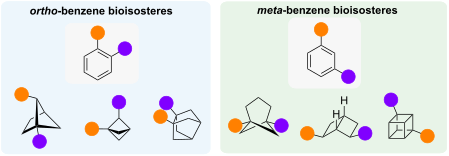
(Bio)isosteres of ortho- and meta-substituted benzenes
Beilstein J. Org. Chem. 2024, 20, 859–890, doi:10.3762/bjoc.20.78




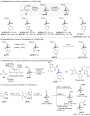


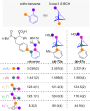


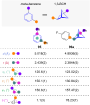


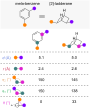




Synthesis and characterization of water-soluble C60–peptide conjugates
Beilstein J. Org. Chem. 2024, 20, 777–786, doi:10.3762/bjoc.20.71
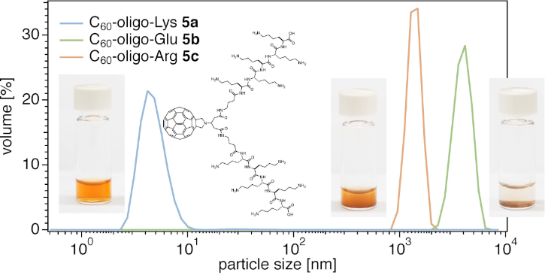
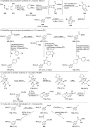
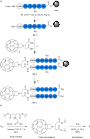
- , ii) HBTU, DIPEA, in DMF, rt, overnight, and iii) trifluoroacetic acid (TFA)/triisopropylsilane (TIPS)/H2O, rt, 1.5–2 h. AA and PG stand for amino acid and protecting group, respectively. All AAs in 1a–c, 2a–c, and 4a–c were protected. Structure of C60–oligo-Lys (5a), C60–oligo-Glu (5b), and C60–oligo




Development of a chemical scaffold for inhibiting nonribosomal peptide synthetases in live bacterial cells
Beilstein J. Org. Chem. 2024, 20, 445–451, doi:10.3762/bjoc.20.39
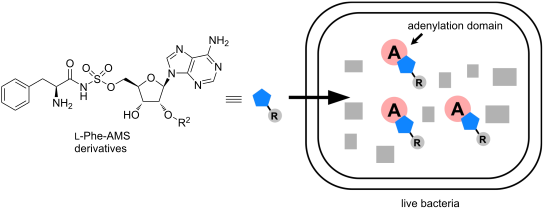
- deprotection of the 5′-OH group using 25% trifluoroacetic acid in tetrahydrofuran. Subsequently, the 5′-OH group of compounds 12a–e were reacted with sulfamoyl chloride in the presence of NaH. Compounds 13a–e were coupled to pre-activated Boc-ʟ-Phe-OSu in the presence of Cs2CO3. Removal of the Boc and TBS


Mechanisms for radical reactions initiating from N-hydroxyphthalimide esters
Beilstein J. Org. Chem. 2024, 20, 346–378, doi:10.3762/bjoc.20.35
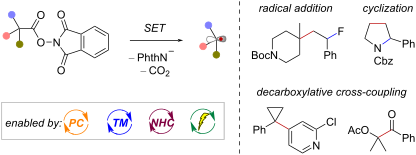
- photocatalyst 4CzIPN, which typically requires the use of strong H+ donors such as trifluoroacetic acid [49][50][51][52]. While many reports, including Okada’s original work, have suggested that a proton donor can accelerate the fragmentation rate of RAEs [29][49][53], specific values comparing the