


Search results
Search for "adamantane" in Full Text gives 60 result(s) in Beilstein Journal of Organic Chemistry.
Superstructures of fluorescent cyclodextrin via click-reaction
Beilstein J. Org. Chem. 2013, 9, 827–831, doi:10.3762/bjoc.9.94
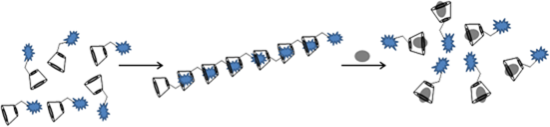
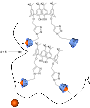
- )-interactions. The supramolecular structures were characterized by 1H NMR-ROESY spectroscopy, dynamic light scattering, UV–vis spectroscopy, fluorescence spectroscopy, and asymmetric flow field-flow fractionation. By adding potassium adamantane-1-carboxylate, the thiazol dye is displaced from the CD-cavity and
- spectroscopy and fluorescence spectroscopy. Figure 2 shows the UV–vis absorption spectra of 3 in water with the characteristic band at λmax= 340 nm. The addition of a 10-fold excess of potassium adamantane-1-carboxylate, as competitive guest for CD leads to a hypsochromic shift with λmax = 336 nm, through the
- exclusion of the fluorophore moiety from the hydrophobic cavity of CD. This exchange causes a change in the HOMO–LUMO gap [14][15]. Figure 3 shows the fluorescence spectra of 3 in aqueous solution. Upon addition of potassium adamantane-1-carboxylate the maximum wavelength changes from 417 to 442 nm and the


Influence of intramolecular hydrogen bonds on the binding potential of methylated β-cyclodextrin derivatives
Beilstein J. Org. Chem. 2012, 8, 1890–1895, doi:10.3762/bjoc.8.218
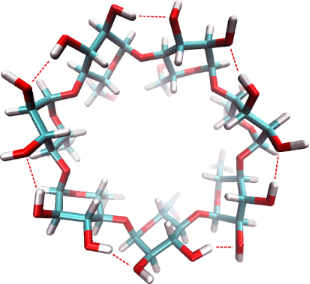
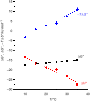
- regioselective methods. Binding free energies and binding enthalpies of these hosts towards 4-tert-butylbenzoate and adamantane-1-carboxylate were determined by isothermal titration microcalorimetry (ITC). It was found that methyl substituents at the secondary positions of β-CD lead to a tremendous reduction of
- hydrophobic cavity of β-CD and therefore improve the binding potential for hydrophobic guest molecules. Up to now, only little is known about the influence of methyl substituents on the inclusion potential of β-CD [26][27]. The dimethyl derivative 2 binds adamantane derivatives with a similar binding
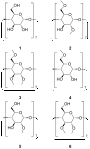
- pattern of methylation on the complexation of amphiphilic guests, we synthesized well-defined model compounds 2–6 (Figure 1) of methylated β-CD, using regioselective procedures already published [30]. 4-tert-Butylbenzoate and adamantane-1-carboxylate were chosen as representative guests. Complexation of


Mannose-decorated cyclodextrin vesicles: The interplay of multivalency and surface density in lectin–carbohydrate recognition
Beilstein J. Org. Chem. 2012, 8, 1543–1551, doi:10.3762/bjoc.8.175
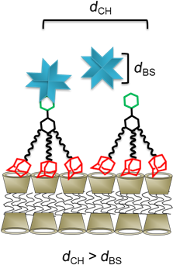
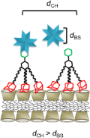
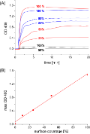
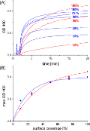
- be modified by host–guest interactions with functional guest molecules. In this article, we investigate the multivalent interaction of the lectin concanavalin A (ConA) with cyclodextrin vesicles decorated with mannose–adamantane conjugates with one, two or three adamantane units as well as one or two
- multivalent interaction with ConA, and the most efficient interaction (i.e., fastest agglutination at lowest concentration) was observed for mannose–adamantane conjugates, in which both the cyclodextrin–adamantane and the lectin–mannose interaction is inherently multivalent. Keywords: carbohydrates
- and extrusion through a 0.1 μm polycarbonate membrane [27]. The cavities of each cyclodextrin are available to form inclusion complexes with hydrophobic guest molecules. Adamantane is known to be an excellent guest for β-cyclodextrin cavities (Ka = (2–3) × 104 M−1). We were able to recently





Synthesis of multivalent host and guest molecules for the construction of multithreaded diamide pseudorotaxanes
Beilstein J. Org. Chem. 2012, 8, 234–245, doi:10.3762/bjoc.8.24
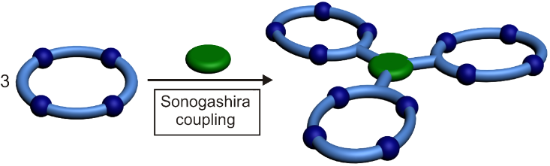
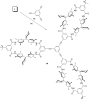
- multivalent axles that fit to the wheels described above, the same spacers 9, 11 and 13 were also used for the synthesis of multivalent guests 17–19, respectively (Scheme 5). In addition, a triethynyl-adamantane derivative 20 [109][110] was employed in order to prepare an axle component with a slightly


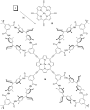
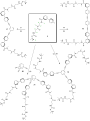
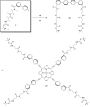
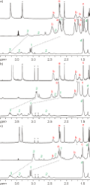
Hyperbranched polyethylenimine bearing cyclodextrin moieties showing temperature and pH controlled dye release
Beilstein J. Org. Chem. 2011, 7, 1130–1134, doi:10.3762/bjoc.7.130
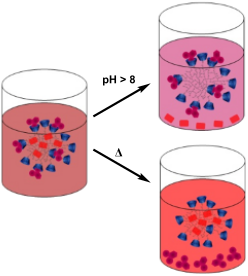
- exploited to complex various hydrophobic guests such as proteins, dyes and anti tumor drugs [17][18][19][20][21][22]. Inclusion complexes with, e.g., adamantane derivates, are relatively stable due to their high binding constants [23][24]. These kinds of supramolecular complexes become less stable under


Synthesis of chiral mono(N-heterocyclic carbene) palladium and gold complexes with a 1,1'-biphenyl scaffold and their applications in catalysis
Beilstein J. Org. Chem. 2011, 7, 555–564, doi:10.3762/bjoc.7.64
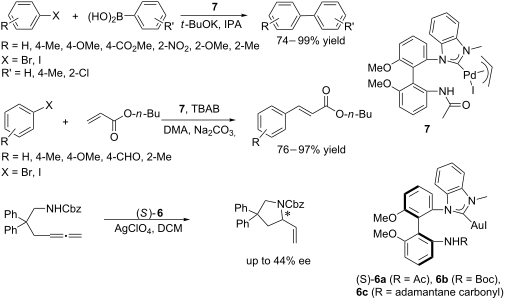
- '-dimethoxybiphenyl-2,2'-diamine was treated with adamantane-2-carbonyl chloride in the presence of Et3N at room temperature (25 °C) in DCM to afford the corresponding amide (S)-1c in 71% yield. According to the synthetic method for the synthesis of compound (S)-6a, NHC–Au complex (S)-6c was successfully prepared in




Photoinduced homolytic C–H activation in N-(4-homoadamantyl)phthalimide
Beilstein J. Org. Chem. 2011, 7, 270–277, doi:10.3762/bjoc.7.36
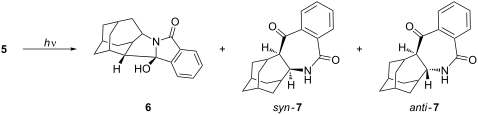
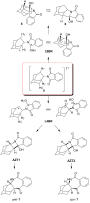
- was conducted to investigate the availability of different C–H bonds in the homoadamantane skeleton for the homolytic activation, that is, abstraction by the phthalimide. The research was, furthermore, sparked by the discovery that numerous poly-azaheterocyclic adamantane derivatives show antiviral


Calix[4]arene-click-cyclodextrin and supramolecular structures with watersoluble NIPAAM-copolymers bearing adamantyl units: “Rings on ring on chain”
Beilstein J. Org. Chem. 2010, 6, 784–788, doi:10.3762/bjoc.6.83
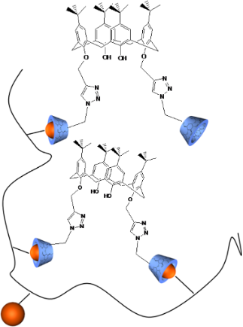
- intermolecular electrostatic repulsion. Accordingly, the hydrodynamic diameter of 4 decreased in NaOH solution from 150 nm to 9.0 nm, which can actually be attributed to the existence of trimers. Host–guest complexion of 4 and 5 An adamantane containing copolymer 5 was prepared via free radical polymerization of
- 6-acrylamido-N-adamantyl-hexane amide and NIPAAM. Copolymer 5 was mixed with 4 subsequently (Scheme 2) to form supermolecular structures. The hydrodynamic diameter of copolymer 5 increased from 8.5 nm to 53 nm after addition of 4. This clearly indicates the inclusion of a polymer attached adamantane
- moiety into the cavity of CD. The adamantane moiety is known to be one of the best guest molecules for β-CD [15]. A relatively high complex stability constant for a polymer attached adamantane groups with CD is about 5000 M−1 [16]. Therefore, as shown in Scheme 2, compound 4 obviously is expected to act

Synthesis of spiroannulated and 3-arylated 1,2,4-trioxanes from mesitylol and methyl 4-hydroxytiglate by photooxygenation and peroxyacetalization
Beilstein J. Org. Chem. 2010, 6, No. 61, doi:10.3762/bjoc.6.61
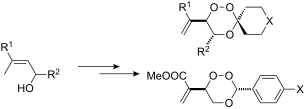
- effects as the natural compound (Figure 1) [12]. An apparently useful structural feature is a large 3,3-spirofused hydrophobic group. The adamantane skeleton is a unique motif in other cyclic peroxides with antimalarial activities [13][14] which additionally exhibit other remarkable pharmaceutical
- exception of the adamantane derivative 5d which has a remarkably shorter O-O bond distance. 4-Arylated 1,2,4-trioxanes The 1,2,4-trioxanes 10 were formed in moderate to good yields, with the Hock-type cleavage product from the ß-hydroperdiol as the only side-product, from 4 and substituted benzaldehydes


Free radical homopolymerization of a vinylferrocene/cyclodextrin complex in water
Beilstein J. Org. Chem. 2010, 6, No. 60, doi:10.3762/bjoc.6.60
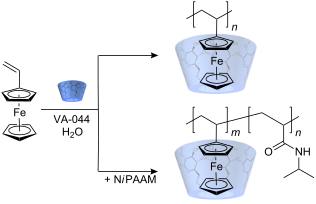
- cyclodextrin (Figure 3c). In addition, when potassium 1-adamantane carboxylate was added as a guest molecule, which competes with the complexed homopolymer solution, the polymer precipitated due to the hydrophobic character of the uncomplexed ferrocene. This uncomplexed polyvinylferrocene was investigated by
- complexation with cyclodextrin. The strong polymer-CD complex obtained remained unchanged up to about 90 °C. The removal of cyclodextrin by the addition of a competing guest, potassium 1-adamantane carboxylate, was demonstrated. Additionally, the polymer shows redox behavior even in the presence of the


Other Beilstein-Institut Open Science Activities



