


Search results
Search for "monosaccharides" in Full Text gives 85 result(s) in Beilstein Journal of Organic Chemistry.
De novo synthesis of D- and L-fucosamine containing disaccharides
Beilstein J. Org. Chem. 2013, 9, 332–341, doi:10.3762/bjoc.9.38
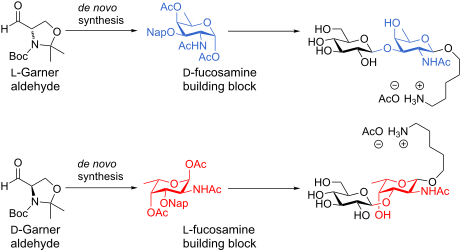
- availability of rare monosaccharides that cannot be isolated from natural sources is currently limiting the access to the synthesis and the biological evaluation of complex bacterial cell-surface glycans. Here, we report the synthesis of D- and L-fucosamine building blocks by a de novo approach from L- and D
- glycoproteins and express them on cell surfaces. This evidence makes it particularly relevant especially for the identification of novel antibacterial agents as well as vaccines [7][8][9]. Those bacterial glycans often contain unusual monosaccharides that are not present in the human body. An immune response
- (four steps, two chromatographic purifications) that after the direct oxidation–dihydroxylation–peracetylation protocol yielded the desired L-fucosamine building block L-8a (Scheme 5). Synthesis of fucosamine-containing disaccharides To facilitate the use of the bacterial monosaccharides in the glycan



Synthesis of a derivative of α-D-Glcp(1->2)-D-Galf suitable for further glycosylation and of α-D-Glcp(1->2)-D-Gal, a disaccharide fragment obtained from varianose
Beilstein J. Org. Chem. 2012, 8, 2142–2148, doi:10.3762/bjoc.8.241

- linkages of varianose (Figure 1) in accordance with the higher stability of the β-galactofuranosidic linkages [32]. After column chromatography on a Biogel P-2 column, the disaccharide in the included fraction (Figure 2A) could be separated by further chromatography from the monosaccharides (not shown). As
- (disaccharides): 100 mM NaOH, isocratically at a flow rate of 1 mL/min. Condition 2 (monosaccharides): 18 mm NaOH, isocratically, at a flow rate of 1 mL/min. Repeating unit of varianose. HPAEC-PAD analysis of disaccharide α-D-Glcp(1→2)-D-Gal (1) obtained by hydrolysis of varianose and by chemical synthesis. The
- separation was performed on a CarboPac PA-10 column under condition 1, as described in the Experimental section. (A) Varianose isolated from a P. varians culture was hydrolyzed with 0.1 M TFA for 90 min at 85 °C. The included fraction of Biogel P-2 contains monosaccharides (tR 4.4 min) and disaccharide 1 (tR


Automated synthesis of sialylated oligosaccharides
Beilstein J. Org. Chem. 2012, 8, 1601–1609, doi:10.3762/bjoc.8.183
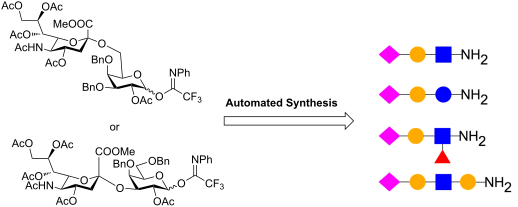
- ; sialosides; Introduction Sialic acid (Sia) belongs to a family of nonulosonic acids, i.e., monosaccharides equipped with a carboxylic moiety and a nine-carbon backbone, which play a unique role in glycobiology. Sia-containing glycans mediate pathogen invasion [1] and are involved in signalling cascades


The use of glycoinformatics in glycochemistry
Beilstein J. Org. Chem. 2012, 8, 915–929, doi:10.3762/bjoc.8.104
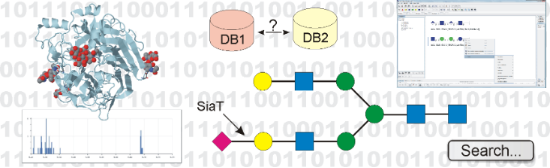
- ; Introduction Carbohydrates, often referred to as glycans, differ from other biopolymers such as proteins or nucleic acids in various ways. The number of different monosaccharides that are present in naturally occurring glycans is significantly higher than the number of proteogenic amino acids, or of
- nucleotides that form DNA or RNA strands [1][2]. Furthermore, the monosaccharides can be linked to each other in several ways, including the possibility to form branched structures. Another important difference between glycans, on the one hand, and proteins and nucleic acids, on the other hand, is visible in
- their biosynthesis: DNA, RNA and proteins are synthesized by copying, transcription or translation, respectively, of nucleic acids, whereas carbohydrates are built in a non-template-driven approach by the sequential action of various glycosyltransferases (GT) that add monosaccharides to an existing

Triterpenoid saponins from the roots of Acanthophyllum gypsophiloides Regel
Beilstein J. Org. Chem. 2012, 8, 763–775, doi:10.3762/bjoc.8.87
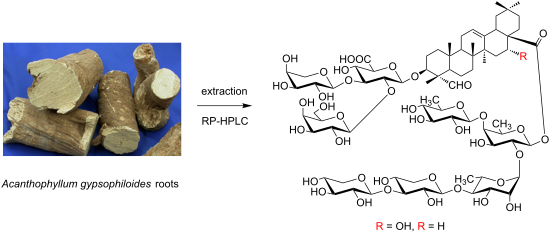
- analyses. Compounds 1 and 2 were hydrolyzed with 2 M CF3CO2H (120 °C, 2 h) and the absolute configurations of the monosaccharides were determined by GLC of acetylated (S)-(+)-2-octyl glycosides according to the published method [29]. GLC was performed using an Agilent 7820A chromatograph equipped with an


Amine-linked diglycosides: Synthesis facilitated by the enhanced reactivity of allylic electrophiles, and glycosidase inhibition assays
Beilstein J. Org. Chem. 2011, 7, 1115–1123, doi:10.3762/bjoc.7.128
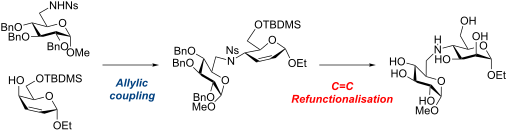
- , England 10.3762/bjoc.7.128 Abstract Diglycose derivatives, consisting of two monosaccharides linked at non-anomeric positions by a bridging nitrogen atom, have been synthesised. Conversion of one of the precursor monosaccharide coupling components into an unsaturated derivative enhances its
- glycosidase inhibitory activity. Keywords: amination; glycomimetics; glycosidases; Mitsunobu; pseudodisaccharides; Introduction We have been interested in synthesising molecules consisting of two monosaccharides linked by formal condensation without using the anomeric position [1]. Such molecules, termed
- investigations into this area [6] we found that the installation of amine linkages between primary–primary carbons of monosaccharides was relatively straightforward; this was achieved by Mitsunobu coupling between carbohydrate C-6 alcohols and carbohydrate C-6 sulfonamides. Primary–secondary linkages were more




Preparation of aminoethyl glycosides for glycoconjugation
Beilstein J. Org. Chem. 2010, 6, 699–703, doi:10.3762/bjoc.6.81

- Method A led to attempts to improve the method further and to use microwave irradiation as in method B. Method B also works well for monosaccharides and maltoside. Given the problems with purification, the use of azidoethanol as a glycosyl acceptor was also investigated. This reaction (Table 1) was much


New amphiphilic glycopolymers by click functionalization of random copolymers – application to the colloidal stabilisation of polymer nanoparticles and their interaction with concanavalin A lectin
Beilstein J. Org. Chem. 2010, 6, No. 58, doi:10.3762/bjoc.6.58
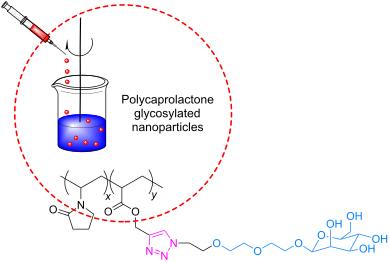
- and α-D-galactopyranosides, and shows no affinity at all towards β-D-monosaccharides [21]. Consequently, the addition of a tetravalent lectin to a suspension of nanoparticles covered with large amounts of its specific ligands should lead to agglutination of the particles, thus giving rise to


Bioorthogonal metabolic glycoengineering of human larynx carcinoma (HEp-2) cells targeting sialic acid
Beilstein J. Org. Chem. 2010, 6, No. 24, doi:10.3762/bjoc.6.24
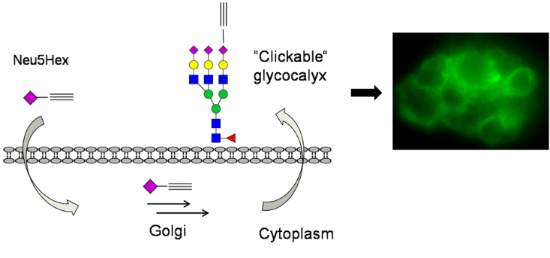
- , functionalized carbohydrates both in vitro and in vivo [2][3]. Acetylated monosaccharides, for example 2-azidoacetylamino-2-deoxy-1,3,4,6-tetraacetyl-β-D-glucopyranoside (Ac4GlcNAz, 16), are believed to permeate the cell membrane by diffusion processes [4]. Recently, it was reported that neuraminic acid




Recognition properties of receptors consisting of imidazole and indole recognition units towards carbohydrates
Beilstein J. Org. Chem. 2010, 6, No. 9, doi:10.3762/bjoc.6.9
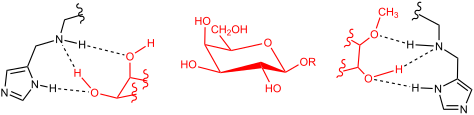
- complexation between receptors 4 or 5 and the monosaccharides was evidenced by several changes in the NMR spectra (for examples, see Table 2 and Figure 5a and Figure 5b). The addition of the monosaccharides 6a, 7a or 8a to a CDCl3 solution of receptors 4 or 5 caused significant downfield shift of the amine NHA
- and 5 with these monosaccharides to be much more favorable than those with the α-anomers 7a and 9. The curve fitting of the titration data for 4 and β-glucoside 6a suggested the existence of 1:1 and 2:1 receptor–sugar complexes in CDCl3 solutions with a stronger association constant for 1:1 binding




Other Beilstein-Institut Open Science Activities



