


Search results
Search for "oligosaccharide" in Full Text gives 107 result(s) in Beilstein Journal of Organic Chemistry.
(Pseudo)amide-linked oligosaccharide mimetics: molecular recognition and supramolecular properties
Beilstein J. Org. Chem. 2010, 6, No. 20, doi:10.3762/bjoc.6.20
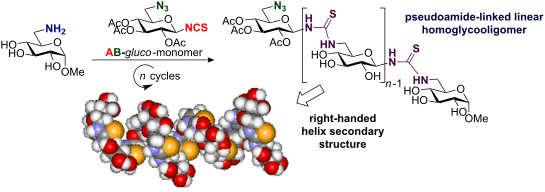
- carbohydrates. Such oligosaccharide mimetics are potential therapeutic agents against HIV and other infections, against cancer, diabetes and other metabolic diseases. An efficient strategy to access this type of compounds is the replacement of the glycosidic linkage by amide or pseudoamide functions such as
- thiourea, urea and guanidine. In this review we summarise the advances over the last decade in the synthesis of oligosaccharide mimetics that possess amide and pseudoamide linkages, as well as studies focussing on their supramolecular and recognition properties. Keywords: carbopeptoids; glycoclusters
- centres (α or β), the presence of additional substituents such as sulfate or acyl groups and the overall degree of branching. The molecular diversity of oligosaccharide offers a valuable tool for drug discovery in the areas of biologically important oligosaccharides, glycoconjugates and molecular


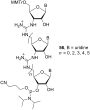

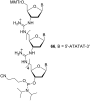
Chemical synthesis using enzymatically generated building units for construction of the human milk pentasaccharides sialyllacto-N-tetraose and sialyllacto-N-neotetraose epimer
Beilstein J. Org. Chem. 2010, 6, No. 18, doi:10.3762/bjoc.6.18
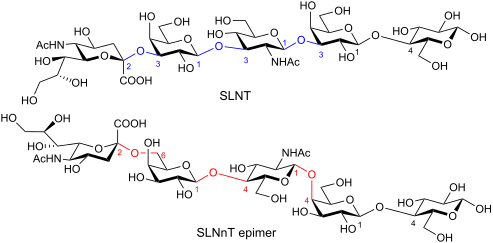
- majority is performed either by classical chemical methods or exclusively by enzymatic procedures. Even although considerable progress has been reported during the recent decades, every synthesis of a complex heterooligosaccharide still represents a challenge. To arrive at an oligosaccharide structure with


Synthesis in the glycosciences
Beilstein J. Org. Chem. 2010, 6, No. 16, doi:10.3762/bjoc.6.16
- . Since the isolation of those complex glycans which are active in cellular communication is problematic, oligosaccharide synthesis is an important area of research. Moreover, what Professor Hans Paulsen, one of the greatest exponents of glycoside synthesis, observed in 1982 [2] still holds true today
- : “Although we have now learned to synthesize oligosaccharides, it should be emphasized that each oligosaccharide synthesis remains an independent problem, whose resolution requires considerable systematic research and a good deal of know-how. There are no universal reaction conditions for oligosaccharide
- syntheses”. It is therefore not surprising that the majority of contributions collected in this Thematic Series deal with methods, both chemical and enzymatic, for oligosaccharide synthesis. One approach to deal with the problem of glycoside synthesis is the preparation of so-called glycomimetics. This is a
Synthesis of a new class of aminocyclitol analogues with the conduramine D-2 configuration
Beilstein J. Org. Chem. 2010, 6, No. 15, doi:10.3762/bjoc.6.15
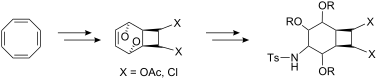
- ][10][11], many of which are widely used for the treatment of diseases in humans, animals and plants [1][2][3][4][5][6][7][8][9][10][11][12][13][14][15]. Glycosidase and related enzymes are involved in the biosynthesis of the oligosaccharide chains [1][2][3][4][5][6][7][8][9][10][11][12][13][14][15


Acid- mediated reactions under microfluidic conditions: A new strategy for practical synthesis of biofunctional natural products
Beilstein J. Org. Chem. 2009, 5, No. 40, doi:10.3762/bjoc.5.40
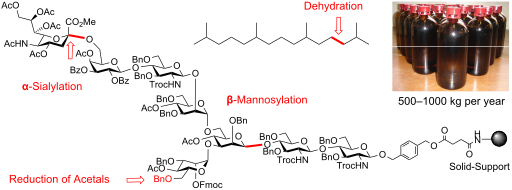
- prominent biological activity in a “practical” and a “industrial” manner. Keywords: acid-mediated reaction; microreactor; natural products synthesis; oligosaccharide; pristane; Introduction A continuous flow microreactor, an innovative technology, has been used to realize efficient mixing and fast heat
- conditions enabled the preparation of key synthetic intermediates for oligosaccharides on a multi-gram scale, eventually leading to a total synthesis of the asparagine-linked oligosaccharide (N-glycan) [32]. A significant improvement has also been achieved for dehydration, which resulted in the industrial
- industrial synthesis of the bioactive natural products. Review 1. Application of microfluidic systems to the synthesis of asparagine-linked oligosaccharides Among the various types of oligosaccharide structures, asparagine-linked oligosaccharides (N-glycans) are prominent in terms of diversity and complexity


Dimerization of propargyl and homopropargyl 6-azido- 6-deoxy- glycosides upon 1,3-dipolar cycloaddition
Beilstein J. Org. Chem. 2008, 4, No. 30, doi:10.3762/bjoc.4.30
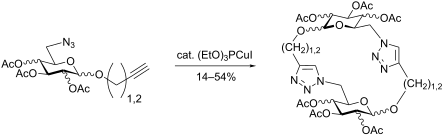
- of highly glycosylated beta-peptides that can mimic specific oligosaccharide-protein interactions prompted us to further search for efficient routes toward glycosylated amino acid building blocks derived from asparaginic acid in which the glycon is bound to C-1 of the asparaginic acid through
- libraries of highly glycosylated peptides, some members of which were indeed shown to behave like oligosaccharide mimics capable to specifically bind lectins [1][4]. In order to increase the structural diversity of the aforementioned building blocks, we contemplated using as the spacer entity 1,2,3


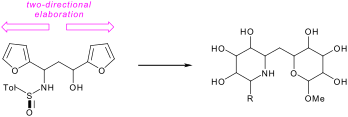
Methods for the synthesis of polyhydroxylated piperidines by diastereoselective dihydroxylation: Exploitation in the two-directional synthesis of aza-C-linked disaccharide derivatives
Beilstein J. Org. Chem. 2005, 1, No. 2, doi:10.1186/1860-5397-1-2
- LS2 9JT, UK School of Chemistry, University of Leeds, Leeds LS2 9JT, UK 10.1186/1860-5397-1-2 Abstract Background Many polyhydroxylated piperidines are inhibitors of the oligosaccharide processing enzymes, glycosidases and glycosyltransferases. Aza-C-linked disaccharide mimetics are compounds in
- configurations to be prepared. The work demonstrates that highly unsymmetrical molecules may be prepared using a two directional approach. The deprotected compounds may have potential as inhibitors of oligosaccharide-processing enzymes and as tools in chemical genetic investigations. Introduction Many
- polyhydroxylated piperidines are potent inhibitors of the oligosaccharide processing enzymes, glycosidases and glycosyltransferases.[1][2][3] For example, deoxymannojirimycin, 1, and deoxynojirimycin, 2, are selective mannosidase and glucosidase inhibitors respectively.[4][5] In these molecules, the nitrogen atom





Other Beilstein-Institut Open Science Activities



