


Search results
Search for "saponification" in Full Text gives 112 result(s) in Beilstein Journal of Organic Chemistry.
An overview of the key routes to the best selling 5-membered ring heterocyclic pharmaceuticals
Beilstein J. Org. Chem. 2011, 7, 442–495, doi:10.3762/bjoc.7.57
- ethyl 3-oxopropanoate followed by saponification of the ester to yield etodolac (Scheme 31) [44]. The second described route [45][46] is similar but starts with a more readily available carbonyl surrogate; 2,3-dihydrofuran 154. The Fischer indole reaction provides a primary alcohol which is TMS
- -protected and condensed with methyl 3-oxopentanoate under Lewis acid conditions. The use of the temporary silyl mask was found beneficial as it circumvents the need for chromatographic purification. Finally, simple saponification furnishes etodolac (Scheme 32). Extensive biological studies have found that





Oxidative allylic rearrangement of cycloalkenols: Formal total synthesis of enantiomerically pure trisporic acid B
Beilstein J. Org. Chem. 2011, 7, 421–425, doi:10.3762/bjoc.7.54
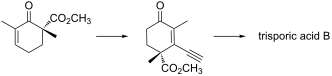
- synthesis of this stereogenic unit and solutions have been found, e.g., by Christoffers and d’Angelo [9][10][11]. We have already disclosed our results to obtain these products highly enantiomerically enriched by pig liver esterase (PLE) catalyzed saponification of α-substituted β-ketoesters [12][13]. We
- have now extended this methodology towards the saponification of unsaturated β-ketoesters (±)-1a,b (Scheme 1) to provide a convenient access to highly functionalized cyclohexenones in optically pure form. In addition, we show that non-racemic chiral α-substituted, β-ketoesters such as (−)-1c can be
- -ketoester 1c, the racemate 1c is resolved by a pig liver esterase (PLE)-catalyzed saponification reaction. As in other cases reported earlier, the racemic β-ketoesters are hydrolyzed with high stereoselectivity allowing the isolation of optically pure esters (–)-1. The corresponding hydrolysis products, the


A two step synthesis of a key unit B precursor of cryptophycins by asymmetric hydrogenation
Beilstein J. Org. Chem. 2011, 7, 243–245, doi:10.3762/bjoc.7.32
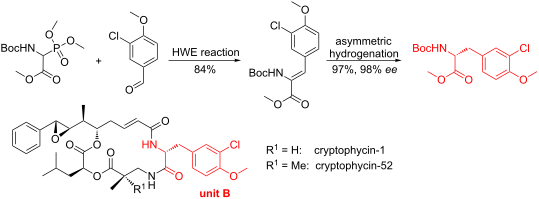
- final saponification reaction to give carboxylic acid 5 (Scheme 1). A number of experimental procedures for this route have been published [5][6][7]. The selective monochlorination of D-tyrosine is quite cumbersome since the formation of the dichlorinated product must be minimized and the presence of


Application of the diastereoselective photodeconjugation of α,β-unsaturated esters to the synthesis of gymnastatin H
Beilstein J. Org. Chem. 2011, 7, 151–155, doi:10.3762/bjoc.7.21
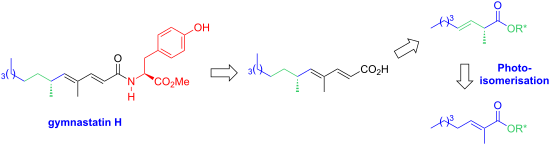
- ) configuration at the C-6 carbon. By saponification under mild conditions, 24 was converted into carboxylic acid 25 which was implicated into a free-epimerising amidation procedure with HOBt [22] and the readily available O-protected tyrosine derivative 26. Finally, the TBS group of the amino ester moiety was


Synthesis, electronic properties and self-assembly on Au{111} of thiolated (oligo)phenothiazines
Beilstein J. Org. Chem. 2010, 6, No. 72, doi:10.3762/bjoc.6.72
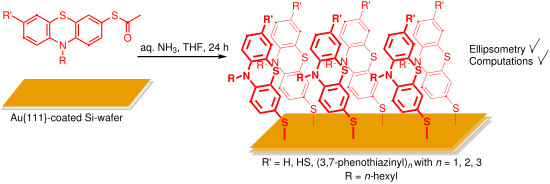
- prepared from (oligo)phenothiazinyl thioacetates 2 or 4 by in situ saponification with degassed aqueous ammonia in THF at room temperature for 24 h (Scheme 2). Based upon thorough surface analysis of the previously studied thiolated phenylethynyl phenothiazines chemisorbed on Au{111} by ellipsometry


Efficient and improved synthesis of Telmisartan
Beilstein J. Org. Chem. 2010, 6, No. 25, doi:10.3762/bjoc.6.25
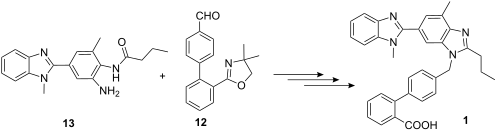
- the benzimidazole derivative 3. After saponification, the free carboxyl group is condensed with N-methyl-1,2-phenylenediamine to afford the bis-benzimidazole 4, which is then alkylated with the 4′-(bromomethyl)-2-biphenylcarboxylic acid tert-butyl ester (8) to give, after hydrolysis of the ester group


Enantioselective synthesis of tricyclic amino acid derivatives based on a rigid 4-azatricyclo[5.2.1.02,6]decane skeleton
Beilstein J. Org. Chem. 2009, 5, No. 81, doi:10.3762/bjoc.5.81
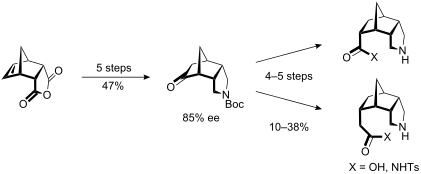
- , after saponification, the endo-configured acid 21 as a single diastereomer. The further conversion of 21 into the target molecules was carried out in analogy to the preparation of 7a/b•HCl from 19 (see Scheme 4), giving 8a•HCl in overall 24% yield from 9 (four steps) and 8b•HCl in overall 10% yield




Ring strain and total syntheses of modified macrocycles of the isoplagiochin type
Beilstein J. Org. Chem. 2009, 5, No. 71, doi:10.3762/bjoc.5.71
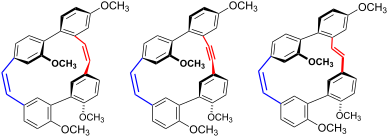
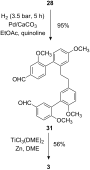
- and 26 were prepared as the “d” ring for Suzuki coupling with the bromoarene 16 (Scheme 5). First, iodination of 3-hydroxybenzoic acid (18) followed by double methylation and saponification of the methyl ester yielded 4-iodo-3-methoxybenzoic acid (19) which could be reduced in two steps [27] to the




Recent progress on the total synthesis of acetogenins from Annonaceae
Beilstein J. Org. Chem. 2008, 4, No. 48, doi:10.3762/bjoc.4.48
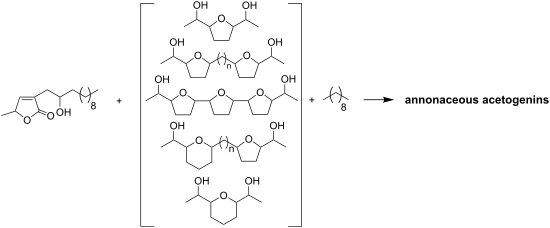
- macrocyclization. Hydrogenation of the olefins followed by saponification of macrolactones 106 and 107 with NaOMe and subsequent MOM protection gave the common intermediate 108 with identical physical data independent of the route used. The lithium enolate formed from 108 with LDA was treated with 109 and the


Diastereoselective and enantioselective reduction of tetralin- 1,4-dione
Beilstein J. Org. Chem. 2008, 4, No. 37, doi:10.3762/bjoc.4.37
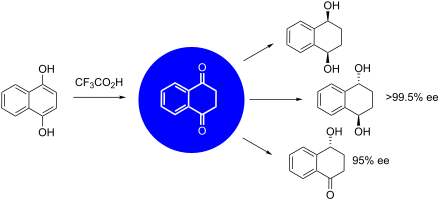
- % yield). Saponification and fractional recrystallization from MeOH / Et2O then afforded pure 6 and 7 though isolated yields were not reported [9]. The meso-diol 6 has been used as substrate in enantioselective oxidation [10] and in asymmetric acylation [9][11]. We conclude that while conditions for an


Sordarin, an antifungal agent with a unique mode of action
Beilstein J. Org. Chem. 2008, 4, No. 31, doi:10.3762/bjoc.4.31
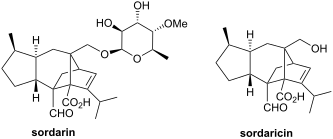
- into 75 by protection of the OH group with TBDPSCl and saponification of the benzoate ester (LiOH). Lewis acid-induced glycosylation [46] of 75 with trichloroacetimidate 76 gave 77. The latter was then subjected to TBAF deprotection, PCC oxidation, and Pd/C hydrogenation, to afford analog 78. Isopentyl
- ether 80 was prepared via ethylene glycol protection, saponification, alkylation by prenyl bromide, hydrogenation and acetonide cleavage. Two other analogs were assembled from 70 by LiOH hydrolysis of the benzoate ester and Pd/C hydrogenolysis of the benzyl one. While biological tests indicated that


Stereoselective α-fluoroamide and α-fluoro- γ-lactone synthesis by an asymmetric zwitterionic aza-Claisen rearrangement
Beilstein J. Org. Chem. 2005, 1, No. 13, doi:10.1186/1860-5397-1-13
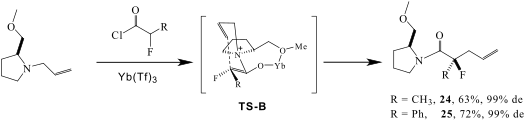
- -fluoropropionyl chloride 9 were explored but the method of choice involved nucleophilic fluorination of the mesylate 7 with KF to give ethyl 2-fluoropropionate 8 (Scheme 2).[19] Saponification and then treatment with phthaloyl dichloride gave 9 after distillation. 2-Fluorophenylacetyl chloride was prepared from





