


Search results
Search for "asymmetric catalysis" in Full Text gives 156 result(s) in Beilstein Journal of Organic Chemistry.
C2- symmetric bisamidines: Chiral Brønsted bases catalysing the Diels- Alder reaction of anthrones
Beilstein J. Org. Chem. 2008, 4, No. 28, doi:10.3762/bjoc.4.28
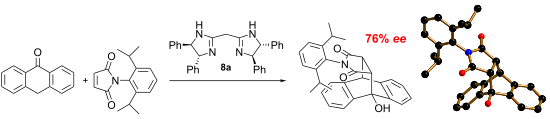
- a cycloaddition step stereoselectively controlled by the chiral ion pair. Keywords: Asymmetric Catalysis; Bisamidines; Brønsted base; Diels-Alder reaction; Organocatalysis; Introduction The cycloadditions of anthrones 1 and N-substituted maleimides 2 are prominent examples of asymmetric catalysis


DBFOX- Ph/metal complexes: Evaluation as catalysts for enantioselective fluorination of 3-(2-arylacetyl)-2-thiazolidinones
Beilstein J. Org. Chem. 2008, 4, No. 16, doi:10.3762/bjoc.4.16
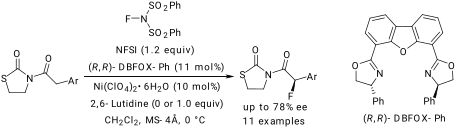
- availability of commonly used classes of ligands for asymmetric catalysis, such as, TADDOLs [37][39][41][47], BINAPs [38][40][43][44][46][49][51][53][55][56][57] and bis(oxazoline) [33][34][36][42][45]. Of particular importance are BINAP ligands. Sodeoka et al. have used the latter ligands in asymmetric


The use of chiral lithium amides in the desymmetrisation of N-trialkylsilyl dimethyl sulfoximines
Beilstein J. Org. Chem. 2007, 3, No. 33, doi:10.1186/1860-5397-3-33
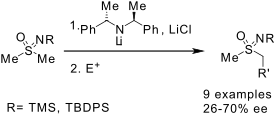
- potential for use in asymmetric catalysis. Results Asymmetric deprotonation of N-trialkylsilyl dimethyl sulfoximines with either enantiomer of lithium N,N-bis(1-phenylethyl)amide in the presence of lithium chloride affords enantioenriched sulfoximines on electrophilic trapping. Ketones, ketimines
- dimethyl sulfoximines is possible. Introduction The preparation of enantioenriched sulfoximines is an important goal in synthesis as these S-chiral compounds make interesting ligands for asymmetric catalysis and have been used in the construction of pseudopeptides. [1][2][3][4] Enantiomerically enriched


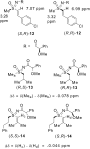


Conformational rigidity of silicon- stereogenic silanes in asymmetric catalysis: A comparative study
Beilstein J. Org. Chem. 2007, 3, No. 9, doi:10.1186/1860-5397-3-9
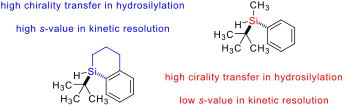
- stereochemical outcome of both diastereoselective carbon-silicon and silicon-oxygen bond formation. Based on this insight, further research will be devoted to the extension chiral silicon-based asymmetric catalysis. Cyclic and acyclic sterically encumbered silanes. Cyclic and acyclic chiral silanes as potent


Mixtures of monodentate P-ligands as a means to control the diastereoselectivity in Rh-catalyzed hydrogenation of chiral alkenes
Beilstein J. Org. Chem. 2005, 1, No. 3, doi:10.1186/1860-5397-1-3
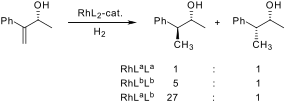
- catalytic profiles without the need to prepare new ligands. The application of combinatorial chemical methods in asymmetric catalysis has emerged as a promising area of research, and indeed several reviews covering the subject have appeared.[1][2][3][4][5][6][7][8] It is based on the preparation of


Beilstein Journal of Organic Chemistry
Beilstein J. Org. Chem. 2005, 1, No. 1, doi:10.1186/1860-5397-1-1
- still to be discovered. Four years ago, the Nobel prize in chemistry celebrated chemists' achievements in asymmetric catalysis – and even since then the face of catalysis is changing, with for example metathesis and organocatalytic methods constantly breaking into new areas. Synthesis is changing too
Other Beilstein-Institut Open Science Activities



