


Search results
Search for "atom-economy" in Full Text gives 159 result(s) in Beilstein Journal of Organic Chemistry.
Metathesis access to monocyclic iminocyclitol-based therapeutic agents
Beilstein J. Org. Chem. 2011, 7, 699–716, doi:10.3762/bjoc.7.81

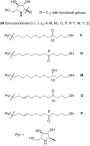
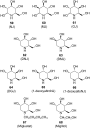
- atom economy. However, before carrying out the RCM reaction, the basic amino group (incompatible with most metathesis catalysts because of chelation to the metal center) [48] must either be protected (as N–Boc, N–Cbz, etc.), masked by incorporation into a cleavable heteroatom-containing cycle





Ene–yne cross-metathesis with ruthenium carbene catalysts
Beilstein J. Org. Chem. 2011, 7, 156–166, doi:10.3762/bjoc.7.22
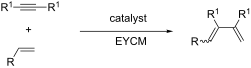
- to perform the EYCM with stoichiometric amounts of olefin and alkyne. This represents an economical and technical advantage compared to the classical strategy using an excess of olefin [87]. Conclusion The EYCM is a very efficient transformation which creates conjugated diene structures with atom
- economy. It has not been developed as rapidly as the olefin cross-metathesis because it suffers from some reactivity and selectivity issues that have not yet been solved. Regioselectivity of the cross-coupling reaction is usually good as no problem is encountered starting from symmetrical alkynes; and in


Recent advances in the development of alkyne metathesis catalysts
Beilstein J. Org. Chem. 2011, 7, 82–93, doi:10.3762/bjoc.7.12
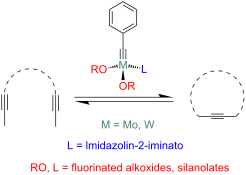
- such as higher atom economy, easier operation and suitability for both tungsten and molybdenum [68][69][70] in comparison with the high-oxidation-state route (on the left- hand side in Scheme 5) starting from tungsten hexachloride [71][72][73]. The use of partially fluorinated alkoxides such as




Tandem catalysis of ring-closing metathesis/atom transfer radical reactions with homobimetallic ruthenium–arene complexes
Beilstein J. Org. Chem. 2010, 6, 1167–1173, doi:10.3762/bjoc.6.133
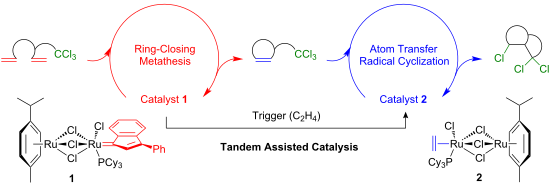
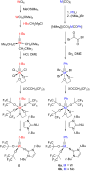
- (Scheme 2). This process, known as assisted tandem catalysis [6], presents significant advantages over multistep synthesis for increasing molecular complexity, particularly in terms of time- and cost-savings, atom economy, environmental friendliness, or applicability to diversity-oriented high-throughput


Can we measure catalyst efficiency in asymmetric chemical reactions? A theoretical approach
Beilstein J. Org. Chem. 2009, 5, No. 67, doi:10.3762/bjoc.5.67
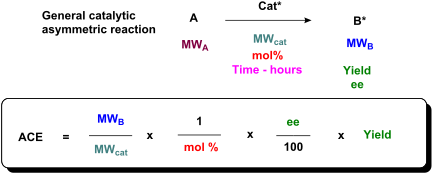
- efficient that one of high molecular mass: the catalyst requires fewer atoms to achieve a relative stabilisation of the transition state. In a parallel with Trost’s assessment of organic reaction “atom economy,” a lower molecular weight catalyst is more atom-efficient [2]. The ratio of the molecular weight
- a comparison of reactions commonly described in the academic chemical literature, the main emphasis of this commentary is on a consideration of atom economy applied to an asymmetric reaction. Thus a small ligand with few atoms able to catalyse a reaction as effectively as a larger ligand requiring


Zeolite catalyzed solvent- free one-pot synthesis of dihydropyrimidin- 2(1H)-ones – A practical synthesis of monastrol
Beilstein J. Org. Chem. 2009, 5, No. 4, doi:10.3762/bjoc.5.4
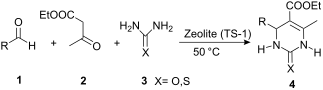
- ) have recently gained tremendous importance in organic and medicinal chemistry. The main contributing factors are the high atom economy, wide application in combinatorial chemistry and diversity-oriented synthesis [4][5][6][7][8][9][10]. In general, the dihydropyrimidones (DHPMs) are known for their


Catalytic synthesis of (E)-α,β-unsaturated esters from aldehydes and 1,1-diethoxyethylene
Beilstein J. Org. Chem. 2009, 5, No. 3, doi:10.3762/bjoc.5.3
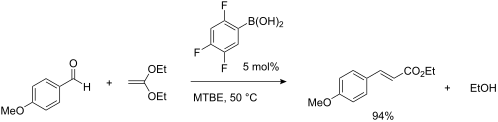
- variants are widely used [1]. A general problem with these approaches, however, is their unsatisfactory atom economy resulting in significant by-product formation (Scheme 1, eq 1–2). Alternatives have been suggested but a solution that is both as general and efficient as the Wittig procedures and
- satisfactory with respect to the demand for atom economy is still needed [2][3][4][5][6][7][8][9][10][11][12][13][14][15][16][17][18][19][20][21][22]. We have recently developed a new approach based on the Knoevenagel condensation of readily available and inexpensive malonate half esters with aldehydes which


One-pot preparation of substituted pyrroles from α-diazocarbonyl compounds
Beilstein J. Org. Chem. 2008, 4, No. 45, doi:10.3762/bjoc.4.45
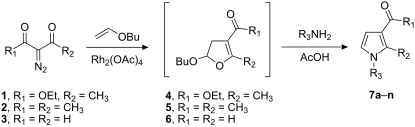
- yield, with high atom economy, and be more convergent than one or two-component reactions. α-Diazocarbonyl compounds have a long history of useful applications in organic chemistry. They are easily prepared from readily accessible precursors and can be used in a wide variety of chemical transformations


EcoScale, a semi- quantitative tool to select an organic preparation based on economical and ecological parameters
Beilstein J. Org. Chem. 2006, 2, No. 3, doi:10.1186/1860-5397-2-3
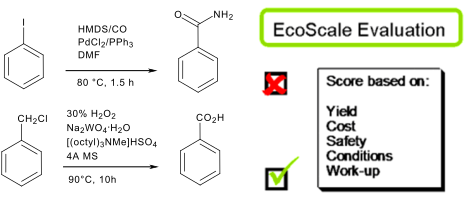
- alternative. [1][2] The main parameters and approaches are briefly discussed as follows. Atom economy [3][4] This parameter is the ratio of the molecular weight of the target molecule to the sum total of the molecular weights of all the substances produced in the stoichiometric equation for the reaction
- involved. It takes into account the amount of the reagents incorporated into the end product. Cycloadditions are examples of transformations with 100% atom economy. For other reactions (e.g. substitution reaction), a 100 % economy can never be reached due to the intrinsic nature of the reaction. The main
- use of this parameter is to adapt reaction sequences in a way that transformations with low atom economy are limited to a minimum. Environmental factor (E-factor) [5][6][7][8] This factor is the ratio of the weight of generated waste to the total weight of the end product. It is a useful tool for


Other Beilstein-Institut Open Science Activities



