


Search results
Search for "DNA binders" in Full Text gives 7 result(s) in Beilstein Journal of Organic Chemistry.
Synthesis of functionalized, 13-alkyl-substituted coralyne derivatives and investigation of their interactions with duplex and abasic site-containing DNA
Beilstein J. Org. Chem. 2026, 22, 1057–1066, doi:10.3762/bjoc.22.84
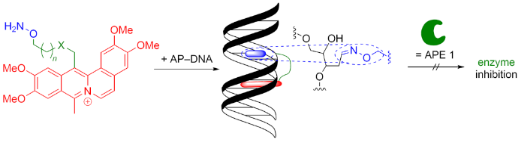
- released from a Boc-protected precursor and that the corresponding coralyne–alkoxyamine conjugate can operate as a ligand for AP-DNA and as inhibitor of enzymatic repair of abasic sites. Keywords: APE1 inhibition; DNA binders; N-hetarenes; papaverine; protoberberines; Introduction DNA is a main target in


Streamlined modular synthesis of saframycin substructure via copper-catalyzed three-component assembly and gold-promoted 6-endo cyclization
Beilstein J. Org. Chem. 2025, 21, 226–233, doi:10.3762/bjoc.21.14
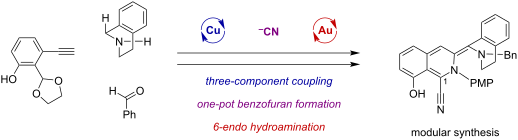
- of lower oxidation state aromatic rings at the A- and E-rings of saframycins. Rational and systematic modification of both ends of the THIQ scaffolds would facilitate the development of reversible covalent DNA binders with tailored sequence preferences. Biosynthetically, the pentacyclic core scaffold


Synthesis and investigation of quadruplex-DNA-binding, 9-O-substituted berberine derivatives
Beilstein J. Org. Chem. 2020, 16, 2795–2806, doi:10.3762/bjoc.16.230
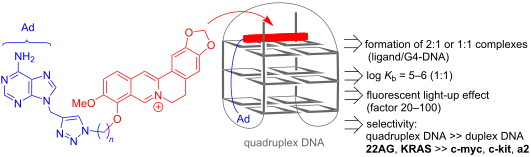
- , G4-DNA-targeting ligands are searched for that bind selectively and sufficiently strong to quadruplex DNA and thereby influence the biological function of G-rich DNA sequences [17][18][19][20][21][22]. Among the numerous classes of compounds, mostly related to traditional DNA binders, that have been
- (Figure 3). Notably, weak, but significant ICD bands were observed in the absorption range of the ligands. Such ICD signals of DNA binders result from the dipole–dipole coupling of the ligands with the DNA bases and are typically observed for duplex DNA ligands [63][64][65]. In the case of the G4-DNA


Reversible photoswitching of the DNA-binding properties of styrylquinolizinium derivatives through photochromic [2 + 2] cycloaddition and cycloreversion
Beilstein J. Org. Chem. 2020, 16, 111–124, doi:10.3762/bjoc.16.13
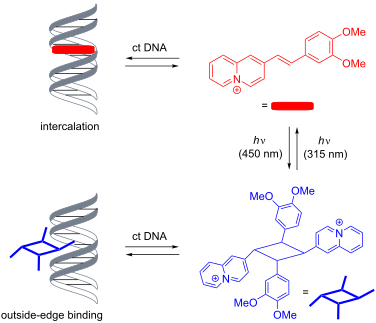
- attempts have also been made to develop photochromic DNA binders. Thus, it has been shown with spiropyran [19][20][21], stilbene [22][23], azobenzene [24][25][26][27][28], dithienylethene [29][30][31][32], chromene [33], and spirooxazine [34] derivatives that specifically modified photochromic ligands bind
- electrocyclization or E-to-Z isomerization reactions, whereas the well-established photochromic cycloaddition–cycloreversion equilibrium to establish photoswitchable DNA binders has so far been widely neglected. In fact, there is only one reported example for the use of the reversible photoinduced dimerization of
- particular cationic ones, were shown to be efficient DNA binders [47][48][49][50][51][52][53][54][55][56][57][58]. Nevertheless, the photochromic nature of DNA-binding styryl dyes has not been applied to use them as photoswitchable DNA binders. Although, there is one reported example that demonstrates the





In search of visible-light photoresponsive peptide nucleic acids (PNAs) for reversible control of DNA hybridization
Beilstein J. Org. Chem. 2019, 15, 2500–2508, doi:10.3762/bjoc.15.243
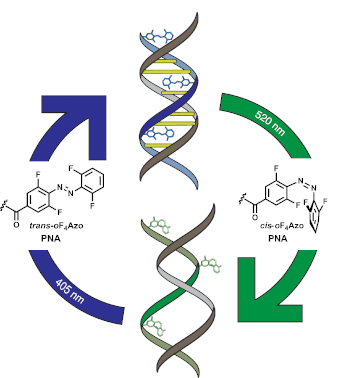
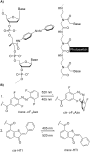
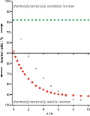
- cis ratio was also reported in photoswitchable peptides and DNA binders equipped with oF4Azo [47][48]. Regarding stability, the cis-PNA12(oF4Azo) (3) was stable at least for 24 h at 37 °C, while under the same conditions the thermodynamically unstable isomer of PNA12(HTI) (4) reverted after 6 h at



An overview of recent advances in duplex DNA recognition by small molecules
Beilstein J. Org. Chem. 2018, 14, 1051–1086, doi:10.3762/bjoc.14.93
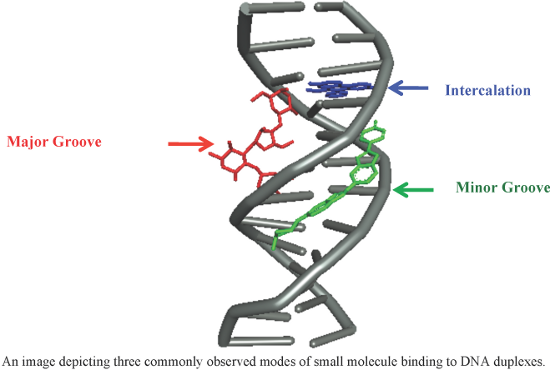
- . This review presents the latest findings in the pursuit of novel synthetic DNA binders. This article provides recent coverage of major strategies (such as groove recognition, intercalation and cross-linking) adopted in the duplex DNA recognition by small molecules, with an emphasis on major works of
- discovered and designed to competitively inhibit such interactions. Additionally, molecules that are capable of insertion between the DNA base pairs can also disfavor DNA–protein interactions directly or allosterically. Consequently, small molecule DNA binders have been in the limelight of drug-discovery
- play a significant role in target selectivity and specificity. Several focused reviews on small molecule DNA binding agents have been published in recent years. A few have updated the progresses made in disease specific DNA binders [14][15] while others have included class specific or site-specific DNA




A Wittig-olefination–Claisen-rearrangement approach to the 3-methylquinoline-4-carbaldehyde synthesis
Beilstein J. Org. Chem. 2012, 8, 1725–1729, doi:10.3762/bjoc.8.197

- sites in the midgorge and peripheral sites of butyrylcholinesterase (BuChE) [7]. These derivatives are also exploited in the synthesis of DNA binders [8], macrolides [9], antitumor agents [10] and for the treatment of viral and parasitic infections [11]. Though there are a number of quite efficient


Other Beilstein-Institut Open Science Activities



