


Search results
Search for "ethyl 4,4,4-trifluoroacetoacetate" in Full Text gives 5 result(s) in Beilstein Journal of Organic Chemistry.
Competitive cyclization of ethyl trifluoroacetoacetate and methyl ketones with 1,3-diamino-2-propanol into hydrogenated oxazolo- and pyrimido-condensed pyridones
Beilstein J. Org. Chem. 2025, 21, 2716–2729, doi:10.3762/bjoc.21.209
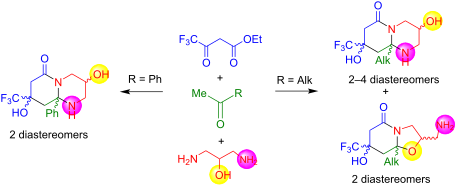
- , causes the formation of two to four diastereomers, the structure of which has been determined with 1H, 19F, 13C, 2D 1H-13C HSQC/HMBC, 1H-1H COSY/NOESY NMR and X-ray diffraction analysis. Keywords: condensed pyridones; 1,3-diamino-2-propanol; ethyl 4,4,4-trifluoroacetoacetate; methyl ketones; three
- , 620066 Ekaterinburg, Russian Federation Saint-Petersburg Pasteur Institute, Mira St. 14, 197101 Saint-Petersburg, Russian Federation 10.3762/bjoc.21.209 Abstract The use of 1,3-diamino-2-propanol with competitive N- and O-nucleophilic centers in a three-component cyclization with ethyl 4,4,4
- -trifluoroacetoacetate and methyl ketones enables the synthesis to be carried out for octahydropyrido[1,2-a]pyrimidin-6-ones and hexahydrooxazolo[3,2-a]pyridin-5-ones, the preferential formation of which depends on the substituent in the methyl ketone component. Dual acid–base catalysis of the reactions with alkyl


Multicomponent syntheses of pyrazoles via (3 + 2)-cyclocondensation and (3 + 2)-cycloaddition key steps
Beilstein J. Org. Chem. 2024, 20, 2024–2077, doi:10.3762/bjoc.20.178

- feature of the method is the regioselectivity with asymmetric diketones. In addition to β-ketoesters, acetylacetone can be used in the concept. The same research group employed ethyl 4,4,4-trifluoroacetoacetate as a substrate in this method. The pyrazoline oxidation proved to be critical, and the addition




In water multicomponent synthesis of low-molecular-mass 4,7-dihydrotetrazolo[1,5-a]pyrimidines
Beilstein J. Org. Chem. 2019, 15, 2390–2397, doi:10.3762/bjoc.15.231
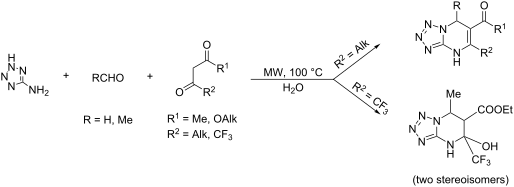
- catalyst. Another example of a 1,3-dicarbonyl compound that often exhibits unusual behavior in the three-component synthesis of azolopyrimidines [27][29] is ethyl 4,4,4-trifluoroacetoacetate (13). In these transformations, the last reaction step, a water elimination, sometimes does not occur, and the final
- (14). In a vial, a solution of 5-aminotetrazole (1, 1.7 mmol), acetaldehyde (7b, 0.15 g, ≈2 mmol) and ethyl 4,4,4-trifluoroacetoacetate (13, 1.77 mmol) in water (3.5 mL) was irradiated in a microwave reactor at 100 °C for 25–30 min. The crystalline product started to separate either during the course
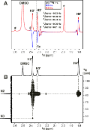
- ) and ethyl 4,4,4-trifluoroacetoacetate (13); b) structure investigation of 14 by NMR. Free radical scavenging activity of 9d,f, 11, and 14. Supporting Information Supporting Information File 363: Copies of 1H and 13C NMR spectra for 9a–g, 12, and 14. Supporting Information File 364: Crystal data of 9a


Reagent-controlled regiodivergent intermolecular cyclization of 2-aminobenzothiazoles with β-ketoesters and β-ketoamides
Beilstein J. Org. Chem. 2017, 13, 2739–2750, doi:10.3762/bjoc.13.270
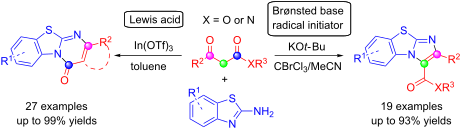
- yields were obtained for β-ketoesters with n-propyl and n-butyl moieties at the C-4 carbon (Scheme 3, 5l and 5m). Bulkier isopropyl and tert-butyl substituents were less well tolerated, with significantly lower yields (Scheme 3, 5n and 5o). The best yield of 99% was obtained when ethyl 4,4,4
- -trifluoroacetoacetate was employed while the reaction with diethyl 3-oxopentanedioate proceeded with 92% yield (Scheme 3, 5p and 5q). β-Ketoesters with methyl or ethyl substituent at the α-carbon were well suited for this reaction (Scheme 3, 5r and 5s). Gratifyingly, the reaction also proceeded smoothly with various


15N-Labelling and structure determination of adamantylated azolo-azines in solution
Beilstein J. Org. Chem. 2017, 13, 2535–2548, doi:10.3762/bjoc.13.250
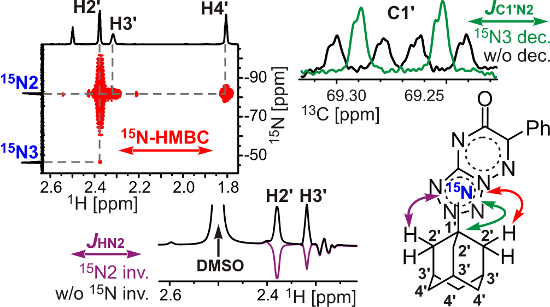
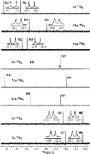
- -amino-1,2,4-triazole 16-15N2 was synthesized by the interaction of 15N2-hydrazine sulphate (98%, 15N) with S-methyl isothiourea sulphate and consecutive cyclization with formic acid (see the Supporting Information File 1). The use of 16-15N2 in a reaction with ethyl 4,4,4-trifluoroacetoacetate (22





Other Beilstein-Institut Open Science Activities



