


Search results
Search for "intramolecular click reaction" in Full Text gives 5 result(s) in Beilstein Journal of Organic Chemistry.
Synthesis of triazolo- and tetrazolo-fused 1,4-benzodiazepines via one-pot Ugi–azide and Cu-free click reactions
Beilstein J. Org. Chem. 2025, 21, 2202–2210, doi:10.3762/bjoc.21.167
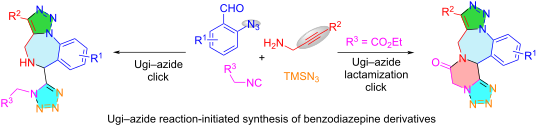
- . After evaporation of the solvent MeOH, the residue was redissolved in 2 mL of MeCN and heated at 130 °C for 2 h in a sealed vial to give product 7a in 90% yield after purification via Cu-free intramolecular click reaction (Scheme 3C) [46]. This Cu-free intramolecular cyclization provides key practical
- , the reaction of 0.2 mmol each of 1a and 2a led to the formation of Int-I which then reacted with 0.2 mmol each of 9 and 4 to form 1,5-DS-T 5b which consequently underwent lactamization to form 6a followed by an intramolecular click reaction to afford highly condensed polycyclic product 8a in 92
- were conducted to study the reaction process. The reaction of 1a, 2a, 3b, and 4 at 40 °C afforded the Ugi–azide product 10 in 85% yield without formation of a triazole ring, which indicates that the intramolecular click reaction needs a higher temperature (Scheme 7A). The reaction involving the


Decarboxylative 1,3-dipolar cycloaddition of amino acids for the synthesis of heterocyclic compounds
Beilstein J. Org. Chem. 2023, 19, 1677–1693, doi:10.3762/bjoc.19.123
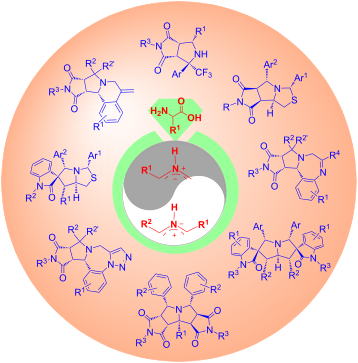
- -aminoisobutyric acid, phenylglycine and valine with Ph or iPr groups could also be used for the synthesis of the monocycloaddition products for the post-condensation reactions. It is worth noting that in the one-pot synthesis involving an intramolecular click reaction, no Cu catalyst was used. A similar reaction




A novel bis-triazole scaffold accessed via two tandem [3 + 2] cycloaddition events including an uncatalyzed, room temperature azide–alkyne click reaction
Beilstein J. Org. Chem. 2022, 18, 1636–1641, doi:10.3762/bjoc.18.175
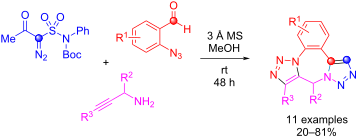
- proceeded further, in uncatalyzed fashion at room temperature and yielded, after intramolecular azide–alkyne click reaction novel, structurally intriguing bistriazoles. Keywords: α-acetyl-α-diazomethane sulfonamide; intramolecular click reaction; uncatalyzed; room temperature; 1,2,3-triazoles


Nucleoside macrocycles formed by intramolecular click reaction: efficient cyclization of pyrimidine nucleosides decorated with 5'-azido residues and 5-octadiynyl side chains
Beilstein J. Org. Chem. 2018, 14, 2404–2410, doi:10.3762/bjoc.14.217
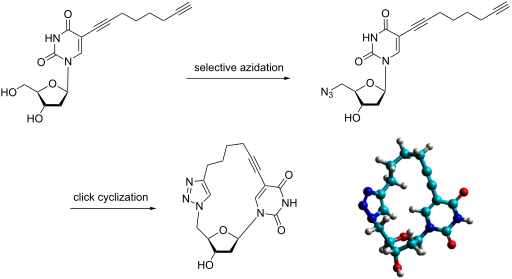
- were not detected. Apparently, cyclization is favored over the formation of dimers due to acceleration of the reaction and the rather low concentration of starting materials (Ruggli–Ziegler dilution principle) [43]. To test the utility of the intramolecular “click” reaction, the reaction sequence
- intramolecular cyclization to a macrocycle was not observed. Next, the 5’-azido compound 2 was employed in the copper(I)-catalyzed azide–alkyne cycloaddition (CuAAC) "click" reaction [38][39] to build up macrocycle 3. In this regard, two reaction pathways have to be considered: (i) an intramolecular “click
- ” reaction leading to a macrocycle or (ii) an intermolecular “click” reaction forming dimeric or oligomeric compounds. For a deeper insight, the “click” reaction was executed under different reaction conditions. First, the copper(I)-promoted “click” reaction was performed on 2 in the presence of copper(II


Intramolecular bridges formed by photoswitchable click amino acids
Beilstein J. Org. Chem. 2012, 8, 884–889, doi:10.3762/bjoc.8.100
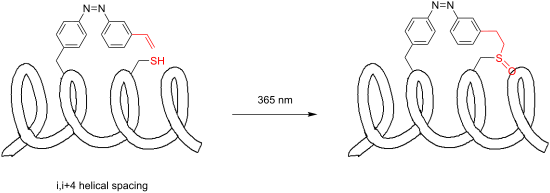
- a photoswitchable unit elongated with a functional group that allows for a specific click reaction, such as an alkene that can react with the thiol group of a cysteine residue. An intramolecular click reaction results in the formation of a photoswitchable bridge, which can be used for controlling
- occurs in its cis form, which is predominantly formed under the conditions of the inducing light (λ = 365 nm). The distribution of calculated end-to-end distances of the cis form (4–11 Å) is compatible with the i,i+4 spacing (5.4 Å) in a helical peptide. Accordingly, the intramolecular click reaction
- ,i+7 spacings. Our results indicate that our PSCaa incorporated into helical domains of proteins may allow the formation of photoswitchable bridges for controlling the conformation of biologically important protein domains. The intramolecular click reaction takes place even under reducing conditions



Other Beilstein-Institut Open Science Activities



