


Search results
Search for "stereochemistry" in Full Text gives 614 result(s) in Beilstein Journal of Organic Chemistry. Showing first 200.
Construction of CF2 moieties in FDA-approved drugs (2016–2025): industrial routes, mechanisms, and scale-up considerations
Beilstein J. Org. Chem. 2026, 22, 1122–1150, doi:10.3762/bjoc.22.91
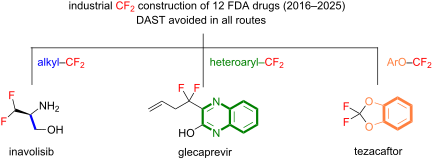
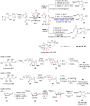
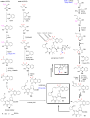
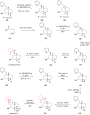
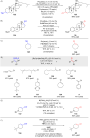
- ]. The Corey–Chaykovsky cyclopropanation is a powerful method for constructing cyclopropane rings. Given the stereochemistry of 18, the key to this method lies in the construction of the E-olefin 26. However, in route c, the first step, a Horner–Wadsworth–Emmons reaction, tends to give the Z-olefin as






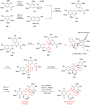
Discovery of sugarnitriles A and B, and structural reassignment of SF-2140, from a sugarcane endophytic actinomycete Amycolatopsis sp. JS-O27
Beilstein J. Org. Chem. 2026, 22, 1114–1121, doi:10.3762/bjoc.22.90
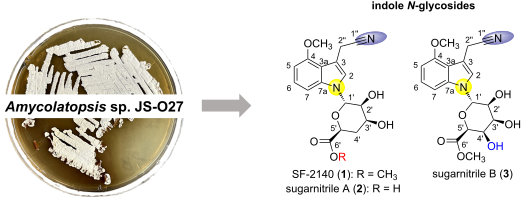
- of 3 was confirmed by detailed analysis of 2D NMR data (Table S4, Supporting Information File 1, and Figure 2). The relative stereochemistry was deduced through 3JH−H coupling constants and NOESY data analysis (Table S4, Supporting Information File 1, and Figure 2b). NOESY correlations of H-3'/H-4


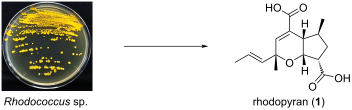
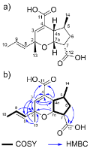
Rhodopyran, a carboxylated hexahydrocyclopenta[b]pyran from Rhodococcus
Beilstein J. Org. Chem. 2026, 22, 1107–1113, doi:10.3762/bjoc.22.89
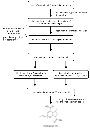
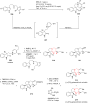
- ). Intermediates are depicted as generic structural classes; regiochemistry, stereochemistry, carbon-by-carbon mapping, and the order of ring closure are not implied. The carbon framework of 1 could plausibly arise from a linear acyl- or polyketide-like intermediate derived from acetyl-CoA/malonyl-CoA-based


Synthesis and structural elucidation of a novel bis-spirooxindole from isatin and ethylenediamine
Beilstein J. Org. Chem. 2026, 22, 813–820, doi:10.3762/bjoc.22.63
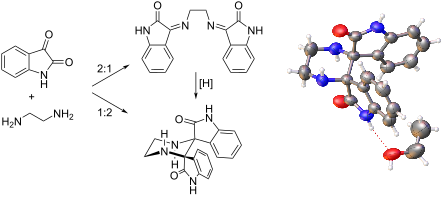
- observed relative stereochemistry in 25. However, alternative pathways, cannot be excluded. To address the generality of this transformation, a small set of substituted isatins was examined under the conditions used for the formation of 25. Reactions with 5-bromoisatin and 5-nitroisatin led to complex


Design, synthesis, and biological evaluation of FXR/ASK1 dual-target modulators
Beilstein J. Org. Chem. 2026, 22, 771–781, doi:10.3762/bjoc.22.59
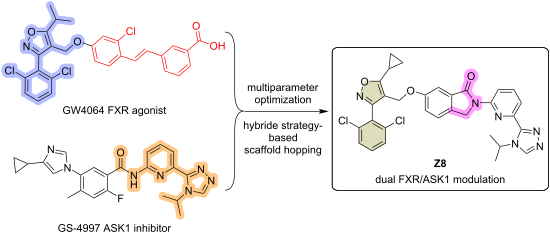
- afford triazoles IXa,c,d or, in case of product IXb with (R)-alanine methyl ester. The absolute stereochemistry of IXb is R. All compounds with defined absolute configuration described below were synthesized from IXb, thereby preserving the absolute stereochemistry and affording the corresponding R
- % yield. Synthesis of compounds IXa–d. Conditions: (a) N2H4·H2O, MeOH, rt, 12 h; (b) DMF–DMA, 80 °C, 12 h; (c) amines (for IXa,c,d) or (R)-alanine methyl ester (for IXb), AcOH, MeCN, 90 °C, 16 h, 66–80% yield; (d) absolute stereochemistry is R. Synthesis of compounds Z1–15. Conditions: (a) K2CO3, KI, MeCN
- , 50 °C, 6 h, 86–96% yield; (b) Pd2(dba)3, Xantphos, Cs2CO3, 1,4-dioxane, 80 °C, 12 h, 80–91% yield; (c) LiOH·H2O, THF/MeOH/H2O, rt, 4 h, 55–76% yield; (d) LiAlH4, THF, 0 °C, 4 h, 43–89% yield; (e) absolute stereochemistry is R. Synthesis of compounds Z16–29. Conditions: (a) Pd(PPh3)4, Na2CO3, 1,4


Synthesis and biological evaluation of new brassinosteroid analogs with C-22 benzoate function
Beilstein J. Org. Chem. 2026, 22, 753–762, doi:10.3762/bjoc.22.57
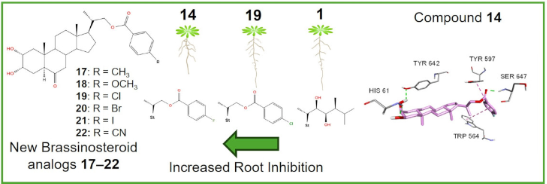
- HSQC NMR and 1H,13C HMBC NMR spectra data, respectively (Figures S35 and S36, Supporting Information File 1). Previous studies have shown that Sharpless dihydroxylation of 2,3-steroidal alkenes with OsO4/DHQD-CLB system, leads to formation of "cis" glycols with C-2(R) and C-3(S) stereochemistry in the


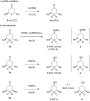
Rongalite addition to dienones: diastereoselectivity in cyclic sulfone synthesis; stereochemical rationalization and prospects as a general conjugate nucleophile
Beilstein J. Org. Chem. 2026, 22, 742–752, doi:10.3762/bjoc.22.56

- 1995 paper [22] revealed a slight ambiguity – the 1H NMR signals that were discussed and used to assign relative stereochemistry in the main text were found to be swapped over in the experimental section. We had no reason to think that this was anything but a typographical error, but we nevertheless
- 1b was provided by derivatization of both molecules in ways that confirmed their relative stereochemistry by taking advantage of the different symmetry elements present in each case. Thus, both reductive amination and hydride reduction of C2-symmetric 1a led to the isolation of the only possible
- stereochemistry by i) sulfide oxidation and ii) derivatization. Reactions of sterically hindered substrates. Initial reactivity comparison with p-toluenesulfinate. Preparation of anticipated products in competition experiments with Rongalite and other sulfinates. Exchange experiment. Double intermolecular




Anti-invasive and cytotoxic evaluation of a (+)-pinoresinol-based semisynthetic library against glioblastoma
Beilstein J. Org. Chem. 2026, 22, 691–704, doi:10.3762/bjoc.22.54
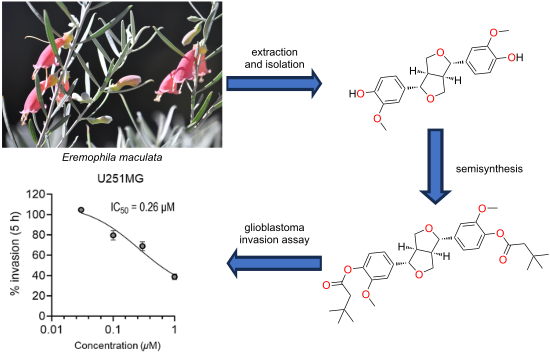
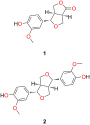
- analysis. During our comparison of spectroscopic and chiro-optical data for (+)-salicifoliol (1) with reported literature values [16], we noted that an earlier paper [15] reporting the chemical structure of 1 had misdrawn the stereochemistry. The stereochemical assignment for (+)-salicifoliol (1) has been



Melifoliox B, a novel phloroglucin derivative isolated from Melicope barbigera (Rutaceae) and synthesis of new oxidation products from melifoliones A and B
Beilstein J. Org. Chem. 2026, 22, 535–546, doi:10.3762/bjoc.22.39
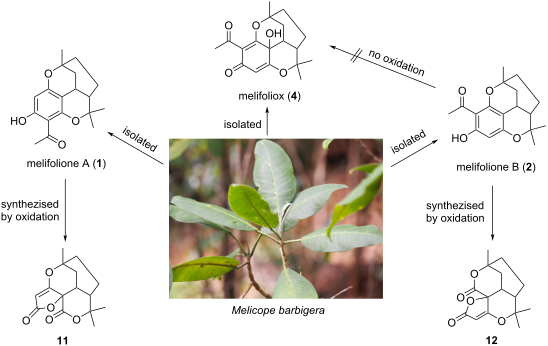
- -10b-hydroxy-6,6,9-trimethyl-1,9-epoxy-6H-dibenzo[b,d]pyran-3(10bH)-one and also propose the common name: melifoliox B for this new natural compound. The stereochemistry of 4 is characterized by the three centers of asymmetry of the isomeric melifoliones at position 6a, 9, and 10a. Since the two



Modern synthetic pathways towards eribulin and its subunits
Beilstein J. Org. Chem. 2026, 22, 495–526, doi:10.3762/bjoc.22.37
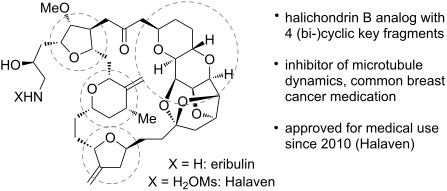
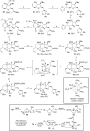
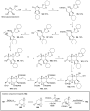
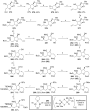
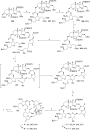
- under basic conditions triggered an Achmatowicz rearrangement (shown in Scheme 8, below) to assemble a hydropyranone ring [83]. Eventual acetylation of the free alcohol units afforded 70 in 3:1 dr. C-Glycolysation with allyl-TMS and oxidative cleavage of the PMB moiety yielded 71. The stereochemistry of
- using acetic anhydride. Oxidative cleavage of olefin 73, followed by treatment with ʟ-proline led to an intermediate β-aldehyde with inverted stereochemistry at the β-C (4:1 dr). Subsequent reduction with NaBH4 yielded alcohol 74. Piv-protection of the primary alcohol, reductive deprotection of the Bn
- stereochemistry of the central protected alcohol unit was inverted within a sequence involving deprotection of all acetates, protection of the 1,2-diol as an acetonide, oxidation of the central alcohol with DMP and stereospecific reduction, which yielded alcohol 78. Finally, the silyl protecting group was cleaved








Recent advances in the stereoselective synthesis of distal biaxially chiral molecules
Beilstein J. Org. Chem. 2026, 22, 461–479, doi:10.3762/bjoc.22.34
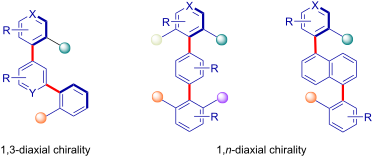
- construction of remote biaxial chiral molecules. These strategies enable precise control over the stereochemistry of multiple axes in a single reaction, allowing efficient formation of distal biaxial chiral scaffolds while maintaining excellent enantio- and diastereoselectivity. Recent studies have
- the stereochemistry in a single transformation. This has motivated the development of sequential strategies, in which one chiral axis is constructed first, followed by the introduction of the second axis in a subsequent step. Such stepwise approaches allow precise control over each axis, improving the


Synthesis and stereochemical analysis of dynamic planar chiral oxa[7]orthocyclophene
Beilstein J. Org. Chem. 2026, 22, 436–442, doi:10.3762/bjoc.22.30

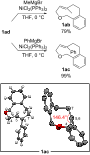
- °C: 24.5 kcal/mol), respectively, which are within the predicted range of stereochemical stability (Figure 6). For the determination of absolute stereochemistry of 1ab and 1ad, we performed HPLC analysis using circular dichroism (CD) detector [17]. The HPLC analyses with OJ-H column of 1ab and 1ad
- shape for the CD spectra of the first eluates, thus we determined that the absolute stereochemistry of the first and second eluates corresponds to the (R)- and (S)-isomers, respectively. Transformation of planar chirality of 1ab to central chirality The planar chirality of the methyl-substituted




Arene activation via π-bond localization: concepts and opportunities
Beilstein J. Org. Chem. 2026, 22, 257–273, doi:10.3762/bjoc.22.19
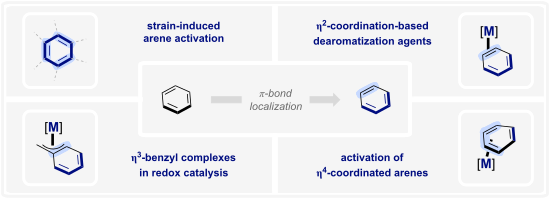
- aromatic ligand is necessary to set the absolute stereochemistry of the organic product. This relative stereochemistry depends on which face of the arene is coordinated and can be governed by high chiral recognition for binding (coordination diastereomer ratio, cdr) or stereoelectronic differentiation




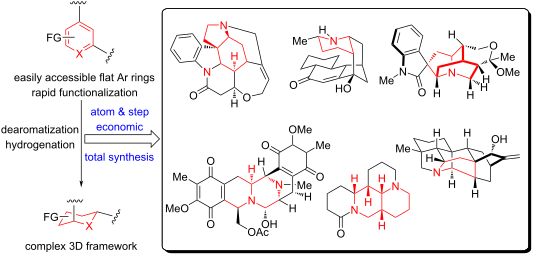
Total synthesis of natural products based on hydrogenation of aromatic rings
Beilstein J. Org. Chem. 2026, 22, 88–122, doi:10.3762/bjoc.22.4
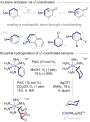
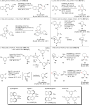
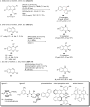
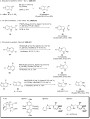
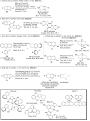
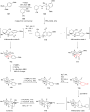
- Dacquet, 1997 An unavoidable challenge for aromatic ring hydrogenations is controlling the stereochemistry of the product during the hydrogenation reduction process. In 1997, Dacquet and co-workers conducted a hydrogenation reduction of the natural product (−)-tabersonine using platinum dioxide as a











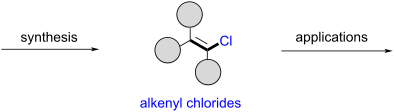
Synthesis and applications of alkenyl chlorides (vinyl chlorides): a review
Beilstein J. Org. Chem. 2026, 22, 1–63, doi:10.3762/bjoc.22.1























Total synthesis of asperdinones B, C, D, E and terezine D
Beilstein J. Org. Chem. 2025, 21, 2730–2738, doi:10.3762/bjoc.21.210
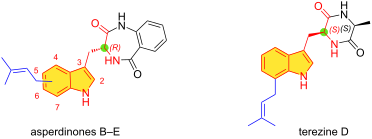
- activity [20]. A related metabolite lacking the C7 prenyl group had been isolated from the cultures of Aspergillus chevalieri in 1976 [21]. The structure and absolute stereochemistry were confirmed by synthesis from tryptophan and ʟ-alanine [22]. The isolation of terezine D (6) and more recently, the (3R


Recent advancements in the synthesis of Veratrum alkaloids
Beilstein J. Org. Chem. 2025, 21, 2657–2693, doi:10.3762/bjoc.21.206
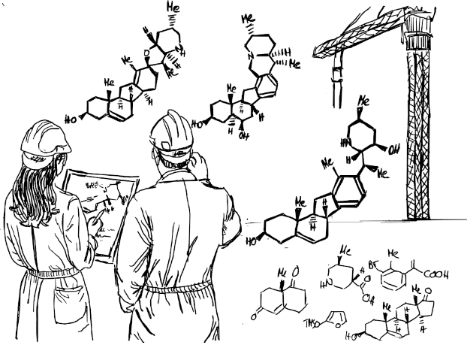
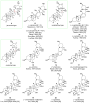
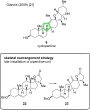
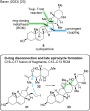
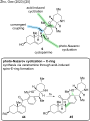
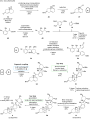
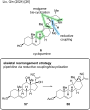
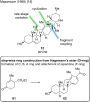
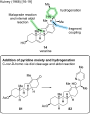
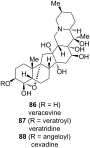
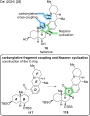
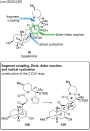
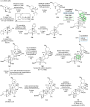
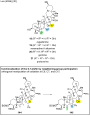
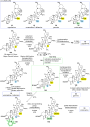
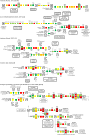
- dense stereochemistry and, thus, have stood long as benchmarks in chemical synthesis. Recently, these steroid alkaloids gained popularity as challenging targets in total synthesis, with a clear shift toward convergent strategies. Not only do these syntheses feature rapid assembly of their challenging







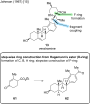

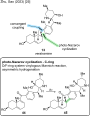

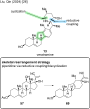

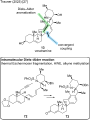






Synthesis of new tetra- and pentacyclic, methylenedioxy- and ethylenedioxy-substituted derivatives of the dibenzo[c,f][1,2]thiazepine ring system
Beilstein J. Org. Chem. 2025, 21, 2645–2656, doi:10.3762/bjoc.21.205
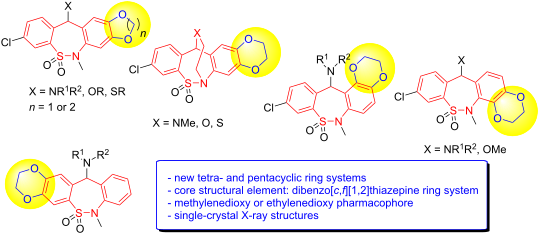
- Gabor Berecz Andras Dancso Maria Tothne Lauritz Lorand Kiss Gyula Simig Balazs Volk Egis Pharmaceuticals Plc., Directorate of Drug Substance Development, P. O. Box 100, H-1475 Budapest, Hungary HUN-REN Research Centre for Natural Sciences, Institute of Organic Chemistry, Stereochemistry Research


Thiazolidinones: novel insights from microwave synthesis, computational studies, and potentially bioactive hybrids
Beilstein J. Org. Chem. 2025, 21, 2618–2636, doi:10.3762/bjoc.21.203
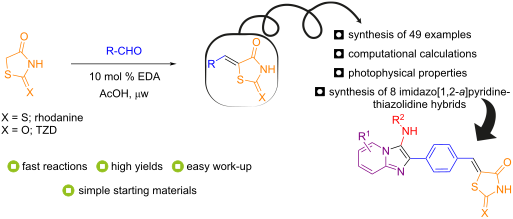
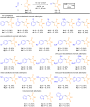
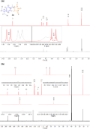
- crystal XRD analysis confirmed the presence of the expected products and the stereochemistry of the newly created olefinic compound as being Z, as expected. Compound 3n crystallizes in the monoclinic crystal system with four molecules in the asymmetric unit whereas 4n crystallizes in the triclinic crystal






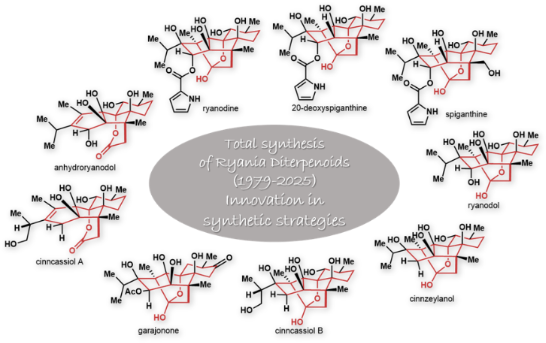
Total syntheses of highly oxidative Ryania diterpenoids facilitated by innovations in synthetic strategies
Beilstein J. Org. Chem. 2025, 21, 2553–2570, doi:10.3762/bjoc.21.198
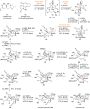
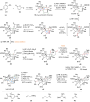
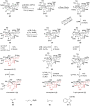
- carbonyl, a silyl transform, and oxidation of the C2 secondary hydroxy group afforded intermediate 54. This sequence successfully installed the C3 hydroxy group with the requisite stereochemistry for 3-epi-ryanodol (5). Subsequent introduction of an isopropyl group at C2 and global deprotection yielded the
- C10 stereochemistry, thereby completing the total synthesis of anhydroryanodol (10). By applying established strategies developed by Deslongchamps and Reisman to this intermediate, they enabled the formal total syntheses of ryanodol (4) and ryanodine (1). Summary and Outlook Ryania diterpenoid natural







Rapid access to the core of malayamycin A by intramolecular dipolar cycloaddition
Beilstein J. Org. Chem. 2025, 21, 2542–2547, doi:10.3762/bjoc.21.196
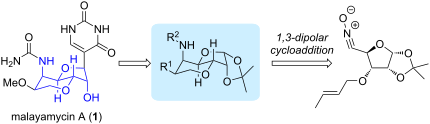
- stereochemistry of substituents, as well as the heterocyclic anomeric unit. Uncertainty regarding the mode of action, along with inadequate synthetic approaches toward a lead compound, remains elusive. The well-established synthetic route reported by Hanessian and co-workers began with ᴅ-ribonolactone which bears
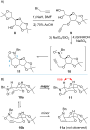
- undesired stereochemistry at C3 due to a possible chair-like transition state like 10a (Scheme 2B). This phenomenon is consistent with the observations from previous syntheses [31][35][36]. We anticipated that late-stage epimerization might invert the configuration once the acyl group is revealed at the C2




Transformation of the cyclohexane ring to the cyclopentane fragment of biologically active compounds
Beilstein J. Org. Chem. 2025, 21, 2416–2446, doi:10.3762/bjoc.21.185
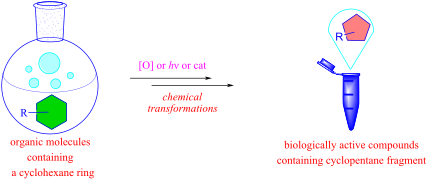
- regioselectivity (>99:1) and complete preservation of the stereochemistry at both quaternary carbon centers (Scheme 17). Through a series of synthetic transformations, the target products (+)-cuparene (91) and (+)-tochuinylacetate (92) were synthesized from acids 96a and 96b with high regioselectivity. In [53


Recent advances in Norrish–Yang cyclization and dicarbonyl photoredox reactions for natural product synthesis
Beilstein J. Org. Chem. 2025, 21, 2315–2333, doi:10.3762/bjoc.21.177
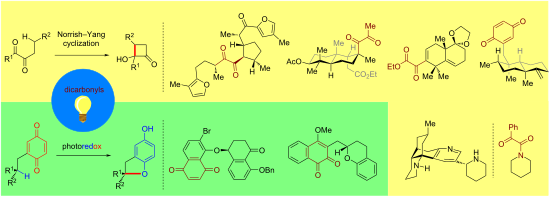
- difference between TS30b (ΔΔG‡ = 0.3 kcal/mol) and TS30a (ΔΔG‡ = 0), resulting in the formation of 31 as a 1:1 mixture of regioisomers (Scheme 5c). In this work, to address unsatisfactory C4 stereochemistry in initial synthesis, the authors introduced a double bond to alter substrate conformation, enabling




Enantioselective radical chemistry: a bright future ahead
Beilstein J. Org. Chem. 2025, 21, 2283–2296, doi:10.3762/bjoc.21.174
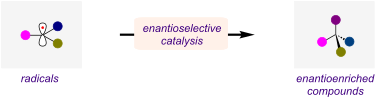
- synthesis. Strategies for asymmetric radical reactions Stereoselectivity in radical reactions can be challenging to control. Many radicals are highly reactive, and radicals moreover have typically low inversion barriers, resulting in no permanent chirality at the radical center. Stereochemistry in radical
- occurred in an anti fashion. Products were obtained with up to 97% ee via catalysis by complexes of magnesium or copper(II) with ligand L1. The absolute stereochemistry of the product could be controlled by a simple change from copper(II) to magnesium Lewis acids while using the same chiral ligand, thus


A chiral LC–MS strategy for stereochemical assignment of natural products sharing a 3-methylpent-4-en-2-ol moiety in their terminal structures
Beilstein J. Org. Chem. 2025, 21, 2243–2249, doi:10.3762/bjoc.21.171
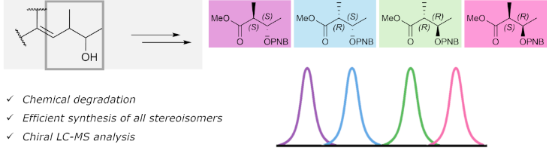
- terminal position of various polyketide natural products such as a series of azaphilones including chaetomugilins [14], chaetoviridins [14][15], and some other α-pyrone polyketides [16][17][18] (Figure 1). Among the available strategies for elucidating the stereochemistry of MPO, X-ray crystallographic





