


Search results
Search for "trans-influence" in Full Text gives 6 result(s) in Beilstein Journal of Organic Chemistry.
The trans-influence in gold chemistry from a catalytic perspective
Beilstein J. Org. Chem. 2026, 22, 838–856, doi:10.3762/bjoc.22.66
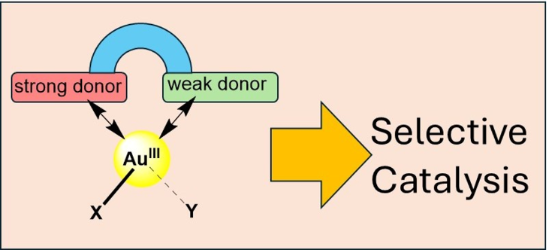
- gold(III) complexes has more recently become a focus of interest. Although often underestimated or not considered, the ligand trans-influence is a crucial factor in determining the reactivity of gold(III) compounds; it modifies not only bond polarisation, dissociation energies and thermal stability but
- also controls the nature of the gold frontier orbitals. This Perspective highlights recent insights into the origins and consequences of the ligand trans-influence and its importance for the energetics of gold-catalysed reactions, with special emphasis on the trans-influence in gold(III) hydrides and
- recent mechanistic insights. Keywords: catalysis; gold; ligands; reaction mechanism; trans-influence; Introduction Gold catalysts have emerged as catalysts of choice in a multitude of organic transformations, not least due to their high functional group tolerance. Their applications have been widely


A tutorial review of stereoretentive olefin metathesis based on ruthenium dithiolate catalysts
Beilstein J. Org. Chem. 2018, 14, 2999–3010, doi:10.3762/bjoc.14.279
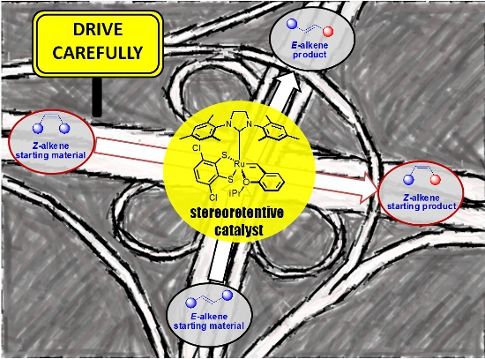
- which leads to the formation of methylidene-ruthenium species Ru-A (Scheme 4). Once complex Ru-A is formed, it is prone to be attacked by the electron-rich sulfide ligand positioned opposite to the NHC ligand (trans-influence). This 1,2-sulfide shift generates a new ruthenium complex Ru-B which is




A modular approach to neutral P,N-ligands: synthesis and coordination chemistry
Beilstein J. Org. Chem. 2016, 12, 846–853, doi:10.3762/bjoc.12.83
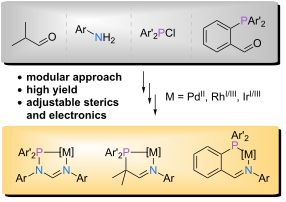
- a dominant trans influence of the phosphorus donor function compared to the imino group. The differing bond lengths within the N−C−N unit (mean 1.30 vs 1.35 Å) may indicate little or no delocalization of the positive charge via the metallacycle. Remarkably, introduction of the sterically more


Synthesis of 1-[bis(trifluoromethyl)phosphine]-1’-oxazolinylferrocene ligands and their application in regio- and enantioselective Pd-catalyzed allylic alkylation of monosubstituted allyl substrates
Beilstein J. Org. Chem. 2014, 10, 1261–1266, doi:10.3762/bjoc.10.126
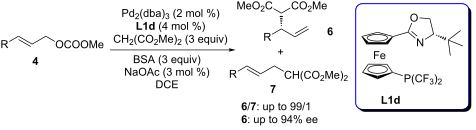
- branched product will be formed. The introduction of the CF3 group on the phosphorus atom further increases the trans influence of the P(CF3)2 moiety and enhances the electronic factor, providing a better branched-product selectivity. Further experimental studies and computational investigation are still


True and masked three-coordinate T-shaped platinum(II) intermediates
Beilstein J. Org. Chem. 2013, 9, 1352–1382, doi:10.3762/bjoc.9.153
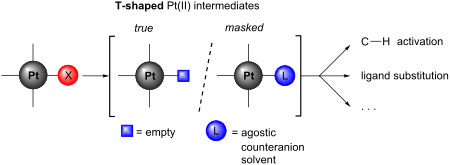
- demanding models [Pt(R)2(Im)] (R = SiMe3, Me; Im = imidazol-2-ylidene) appealed to the trans influence of both NHC and silyl ligands to explain the structure. However, a recent DFT investigation concluded that Y1 is better described as a Pt(0) σ-disilane complex [16] than as a Pt(II) disilyl species
- = Cl, CH3, SiH3, Si(OH)3) demonstrated the importance of the trans influence in governing the stability of T-shaped isomers. In the most stable isomer, the ligand with the smaller trans influence is located trans to the PH3 ligand [18]. Structurally characterized compounds The T-shaped structure is
- lack of agostic interactions in these complexes. This absence has been attributed to the strong trans influence exerted by the ligand in trans position with respect to the vacant site [23][24]. Moreover, in the past few years the synthesis of 14-electron Pt(II) complexes was extended by using N





Electronic differentiation competes with transition state sensitivity in palladium- catalyzed allylic substitutions
Beilstein J. Org. Chem. 2007, 3, No. 36, doi:10.1186/1860-5397-3-36
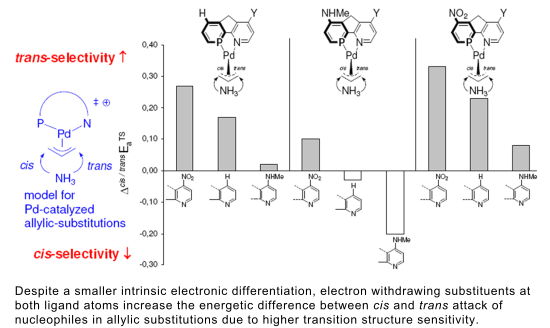
- -ligands (e.g. phosphinooxazolines, phox) [23][24][25][26][27] provide in addition to steric control the possibility for "electronic differentiation", originating from the trans-influence [28] of different donor atoms. Nucleophiles (e.g. dimethylmalonate) normally favour addition to the "trans to




Other Beilstein-Institut Open Science Activities



