Search results
Search for "dynamics" in Full Text gives 562 result(s) in Beilstein Journal of Nanotechnology. Showing first 200.
Nanocarrier strategies to overcome P-glycoprotein-mediated drug resistance in cancer therapy
Beilstein J. Nanotechnol. 2026, 17, 882–921, doi:10.3762/bjnano.17.64
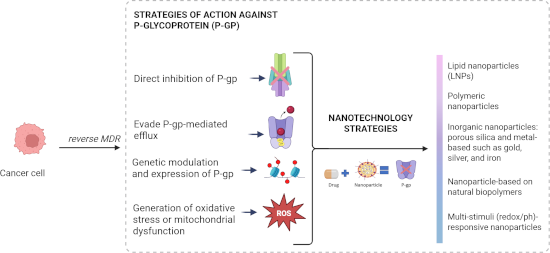
- dynamics, from its nucleotide-binding domains to the conformational changes that drive substrate translocation, is therefore foundational to designing strategies that durably overcome MDR [14]. Escalating chemotherapeutic doses or increasing administration frequency are not viable solutions to P-gp


Light-driven ammonia electrooxidation via carbon nitride–ruthenium molecular interfaces
Beilstein J. Nanotechnol. 2026, 17, 854–862, doi:10.3762/bjnano.17.61
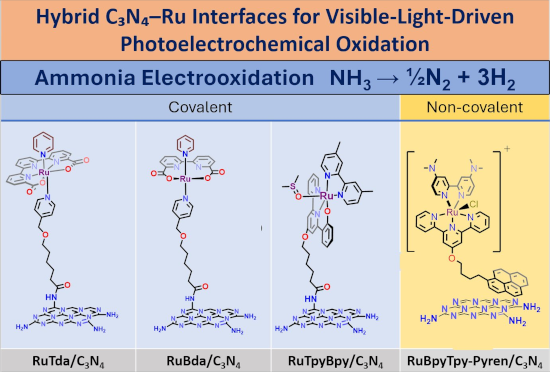
- optimizing charge carrier dynamics at the hybrid interface. Finally, photoelectrocatalysis is the enabling configuration: Simultaneous illumination and electrochemical bias reduce the thermodynamic penalty, suppress charge recombination, and provide independent control over product selectivity. Despite
- carrier dynamics, suppresses recombination by sweeping carriers away from the semiconductor bulk, and enables product selectivity to be tuned by adjusting the electrode potential. Photoelectrocatalytic ammonia oxidation offers an unexplored and underappreciated advantage. Ammonia oxidation requires the
- high-surface-area amorphous S-doped variants, provides a tunable platform for exploring how semiconductor structure controls charge carrier dynamics and thereby catalytic performance. The step forward is clear in its direction if not yet in its details: It includes fabrication and characterisation of


Cross-scale design of chemosensor arrays: from molecular self-assembly in water to paper-based devices for metal ion detection
Beilstein J. Nanotechnol. 2026, 17, 828–838, doi:10.3762/bjnano.17.59
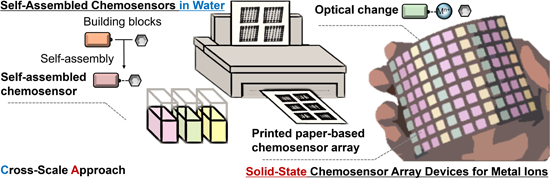
- , Tokyo 153-8505, Japan 10.3762/bjnano.17.59 Abstract Monitoring metal ions in aquatic environments is essential for understanding ecosystem dynamics and assessing water quality. Chemosensors have emerged as powerful analytical tools at the molecular level that transduce ion-recognition events into
- and further amplified by optical manipulators. To induce recognizable optical responses, molecular dynamics during the association and dissociation of color manipulators are significant [36]. Dynamic covalent bonds are key motifs that contribute to the formation of self-assembled chemosensors and


Glycerol photoelectrochemical oxidation reaction at carbon nitrides/BiVO4 materials
Beilstein J. Nanotechnol. 2026, 17, 806–817, doi:10.3762/bjnano.17.57
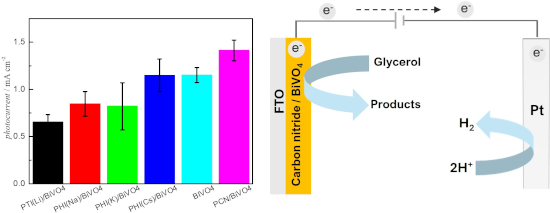
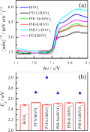
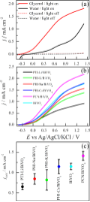
- -defined long-range order [15][16][39]. Although it was not possible to confirm these CN structural features by XRD analysis, the photoactivity toward glycerol oxidation follows this trend. In this scenario, the dependence of photoactivity with the CN type could arise from the charge transfer dynamics




Substrate-dependent pore formation in molybdenum disulfide monolayers under ion irradiation
Beilstein J. Nanotechnol. 2026, 17, 769–780, doi:10.3762/bjnano.17.54
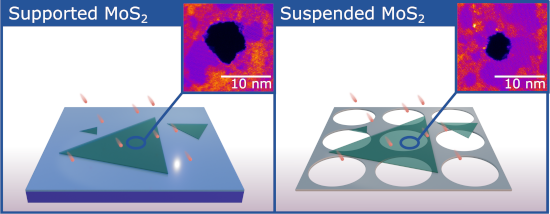
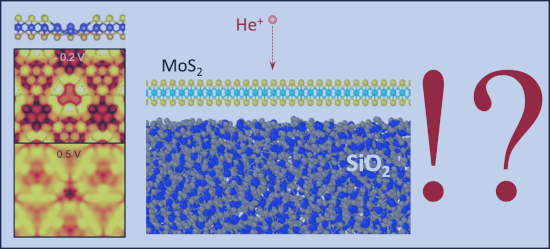
- the MoS2/Au samples (see Supporting Information File 1, Figure S2) shows splitting of the out-of-plane A1g mode and strong PL quenching relative to MoS2 on SiO2, indicating that the interface modifies both lattice dynamics and carrier recombination in the as-prepared samples. The microscopic origin of


Superconducting artificial neural networks and quantum circuits
Beilstein J. Nanotechnol. 2026, 17, 744–747, doi:10.3762/bjnano.17.51

- triplet pairing [30], and fast vortex dynamics and relaxation processes in NbRe-based heterostructures, which may serve as a basis for devices requiring ultrafast relaxation times [31]. The concept of this thematic issue emerged during the 10th International Conference on Superconductivity and Magnetism
Cellulose as a photocatalyst support material: extraction, structural features, and environmental applications
Beilstein J. Nanotechnol. 2026, 17, 635–652, doi:10.3762/bjnano.17.44
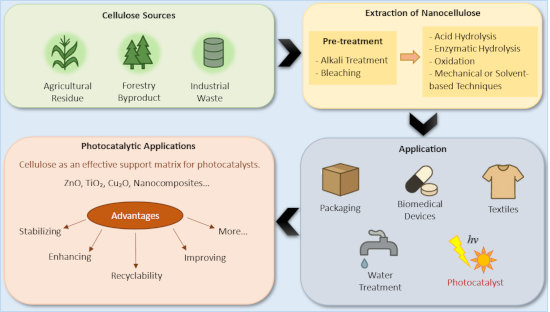
- enhancing charge-transfer dynamics [89]. Recently, nanocellulose has emerged as a promising support material for the synthesis of metal, metal oxide, and non-metallic nanoparticles, and when these components are combined, they often act synergistically to enhance photodegradation processes. Noble and


Recent progress in enhancing built-in electric fields of perovskite solar cells via junction engineering
Beilstein J. Nanotechnol. 2026, 17, 602–621, doi:10.3762/bjnano.17.42
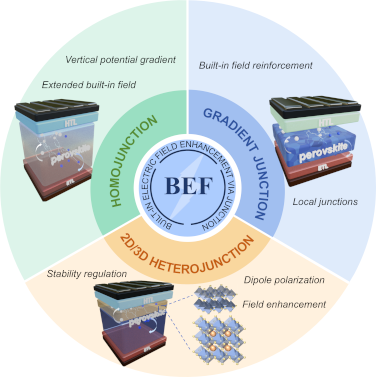
- , optimizing the BEF provides a powerful lever for advancing power conversion efficiency, open-circuit voltage, and long-term operational stability in state-of-the-art PSCs, while avoiding the introduction of parasitic energy barriers. Keywords: band alignment; built-in electric field; carrier dynamics
- . Understanding the role of homojunctions in BEF modulation and degradation, along with effective suppression strategies, offers solutions to improve long-term stability. Additionally, homojunctions enhance carrier dynamics by improving directional transport and reducing trap-state capture, which boosts carrier
- limitations of various device architectures and precisely designing vertical or interfacial band gradients to optimize carrier dynamics in a customized manner [54]. Yang et al. [48] tackled charge localization and barrier-blocking issues in perovskite quantum dot (PeQD) devices caused by long-chain ligands by



Probing tribological evolution in atomically thin MoS2 at different scales
Beilstein J. Nanotechnol. 2026, 17, 586–597, doi:10.3762/bjnano.17.40
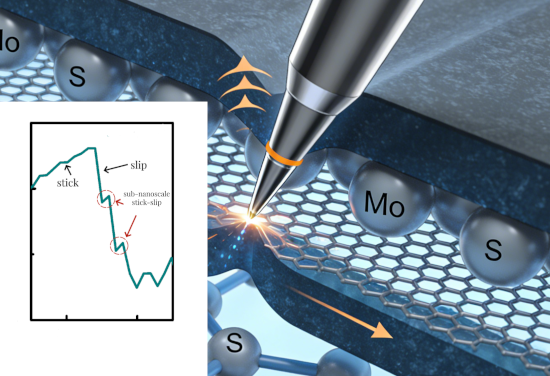
- –slip events driven by in-plane tip apex motion and modulated by contact geometry via molecular dynamics (MD) simulations and frictional force microscopy (FFM) [11][12]. Despite these theoretical and simulation insights, experimental observation and quantification of sub-nanoscale stick–slip motion in
- thin MoS2 poses considerable challenges, primarily due to the ultrasmall time and length scales involved. According to molecular dynamics simulations by Yoon et al. [11], this sub-nanoscale motion is strongly correlated with the in-plane displacement of the AFM tip apex, a motion that can be modulated


Impacts of annealing on structural and photophysical properties of zinc phthalocyanine adsorbed on graphene
Beilstein J. Nanotechnol. 2026, 17, 576–585, doi:10.3762/bjnano.17.39
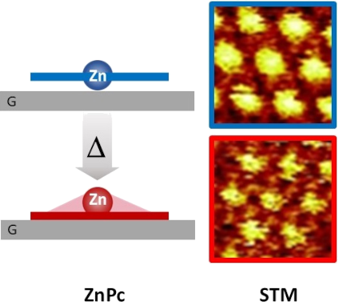
- treatments, as often shown for example with α and β phases of zinc phthalocyanines (ZnPc), with consequences on molecule orientations relative to the substrate and absorbance efficiency [21] or dynamics of charge migration and charge transfer to substrate [22]. Even inside a given phase, minute structural


Laser–material interactions in liquids for the synthesis of nanomaterials: current status and perspectives
Beilstein J. Nanotechnol. 2026, 17, 571–575, doi:10.3762/bjnano.17.38
- longer-term cavitation bubble dynamics, remains challenging even for shadowgraphy employing ultrafast cameras [34]. Pump–probe reflectometry provides the required picosecond and even femtosecond resolution [35]. However, interpretation of the multi-stage reflectivity response is nontrivial and often
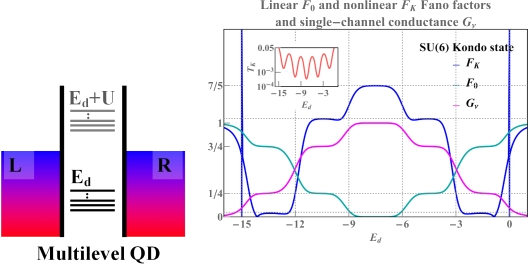
Fractional shot noise of an SU(N) Kondo system
Beilstein J. Nanotechnol. 2026, 17, 515–540, doi:10.3762/bjnano.17.34


![[Graphic 127]](/bjnano/content/inline/2190-4286-17-34-i187.svg?max-width=637&scale=1.18182)

Probing internal continua and atomic ultrafast charge transfer within size-controlled nanoparticles by post-collision interaction in core-hole clock spectroscopy
Beilstein J. Nanotechnol. 2026, 17, 505–514, doi:10.3762/bjnano.17.33
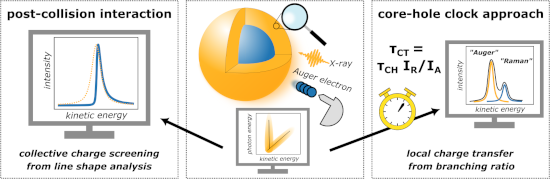
- local charge transfer dynamics and internal continuum states. We observe an acceleration of charge transfer times by almost one order of magnitude in thin-shell quantum dots, comprising only one or three double layers of ZnS, before reaching a size-independent limit. This size-dependence is governed by
- experimental approach enables the simultaneous observation of collective electronic properties and atom-specific dynamics within in a single measurement under identical sample conditions, an advance particularly valuable for complex, sensitive materials. Keywords: core-hole clock; nanoparticles; post



Upcycling agroindustrial waste into graphene oxide supports for gold nanoparticles: toward sustainable nanomaterials
Beilstein J. Nanotechnol. 2026, 17, 489–504, doi:10.3762/bjnano.17.32
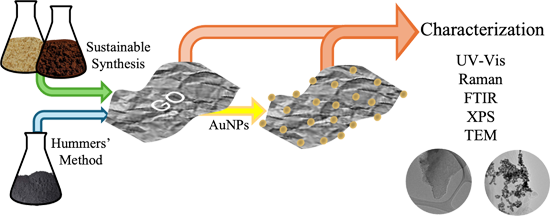
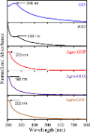
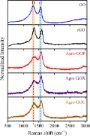
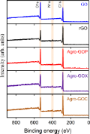
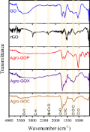
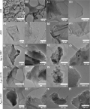
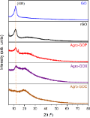
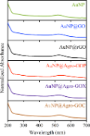
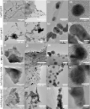
- dynamics of AuNPs [34][35]. This study compares GO produced by the modified Hummers' method and its reduced form (rGO) with Agro-GO derived from fast, low-temperature pyrolysis of agroindustrial residues (peanut shells and spent coffee grounds), examining how the carbon source affects the type and content



Defects and defect-mediated engineering of two-dimensional materials: challenges and open questions
Beilstein J. Nanotechnol. 2026, 17, 454–488, doi:10.3762/bjnano.17.31
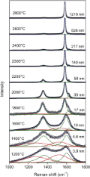
- . Despite the high reactivity of larger S vacancy clusters, several challenges remain in describing the oxidation kinetics. O2 is bound weakly to TMD surfaces with a binding energy of ≈0.14 eV [55][63][64][65]. Ab initio molecular dynamics (MD) simulations show that O2 is therefore mobile on the pristine
- density and their random distribution, which makes it computationally extremely demanding to determine structural dynamics, whether from molecular dynamics or from harmonic approximation plus finite displacements. This can nowadays be overcome by using machine learning interatomic potentials (MLIPs



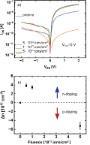


Nanoinformatics: spanning scales, systems and solutions
Beilstein J. Nanotechnol. 2026, 17, 423–427, doi:10.3762/bjnano.17.28
- nanomaterial’s behaviour, preparation, or test conditions) [2]. Voyiatzis et al. computationally studied, using atomistic molecular dynamics simulations, the morphological transformations (from molten/amorphous to crystalline) during rapid cooling of 1–8 nm spherical gold and platinum nanoparticles (NPs), which
- reactivity [3]. Amini et al. combined atomistic molecular dynamics, a coarse-grained model of protein adsorption, and kinetic Monte Carlo simulations to predict the protein corona composition formed on aluminium surfaces with different crystal faces, (i.e., (100), (110), and (111)) from a simplified model of
- classical molecular dynamics and ab initio calculations revealed that TA preferentially binds to the most reactive sites on GO surfaces via oxygen-containing groups or the carbon matrix. The binding energy was dominated by van der Waals interaction forces. A dose-dependent mitigating effect of TA on the

Ferroelectric nanodot reservoir for neuromorphic computing
Beilstein J. Nanotechnol. 2026, 17, 352–364, doi:10.3762/bjnano.17.24
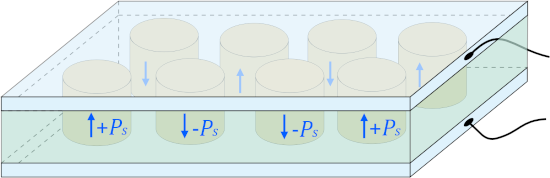
- node within a predefined circuit. However, such approaches often neglect the rich collective dynamics emerging from ensembles of interacting nonlinear elements, an aspect especially compelling when analyzed through the lens of statistical physics models such as the Ising spin system with disorder
- -Ising energy landscape, and outline practical interface schemes for signal injection and readout. Altogether, the presented framework connects the collective polarization dynamics of ferroelectric nanodots with emergent nonlinear and memory effects, providing a solid foundation for developing and
- processing by exploiting polarization dynamics under external input signals. Figure 1 illustrates two conceptual configurations of the ferroelectric-based reservoir and its integration into a neuromorphic computing framework. In Figure 1a, a single input channel delivers time-dependent electrical or optical


Beam shaping techniques for pulsed laser ablation in liquids: Unlocking tunable control of nanoparticle synthesis in liquids
Beilstein J. Nanotechnol. 2026, 17, 309–342, doi:10.3762/bjnano.17.22
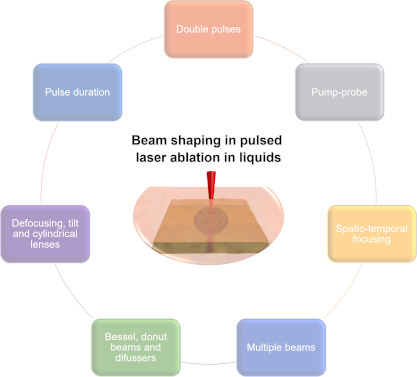
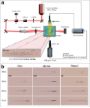
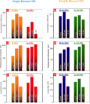
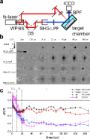
- shaping have demonstrated their potential to revolutionise pulsed laser ablation in liquids by enabling more precise energy deposition and modified nanoparticle production dynamics. This review highlights the critical role of beam shaping, encompassing spatial shaping of the beam to influence laser
- achieved in chemical synthesis using microfluidics-based reactors [14]. PLAL mechanisms and the ablation dynamics can be described starting with the pulsed emission from the laser source [16]. The laser beam travels through the transparent liquid layer, ideally minimising energy losses due to absorption
- governs critical features of PLAL, from the laser interaction with the liquid and the target to the subsequent modifications in the shape and dynamics of the CB, and rate, depth and area of ablation. These interdependent processes ultimately define the properties of the NPs, such as their size and







Calculation of the dynamic stiffness of a cantilever under torsional oscillation
Beilstein J. Nanotechnol. 2026, 17, 303–308, doi:10.3762/bjnano.17.21
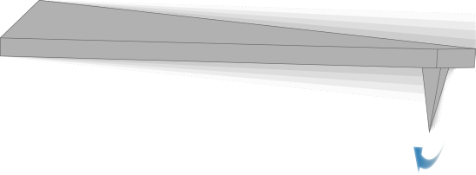
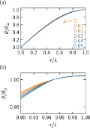
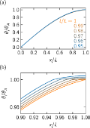
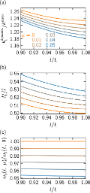
- from the geometrical structure [2], an accurate evaluation of dynamic stiffness requires detailed analyses of the oscillator dynamics. The modification from static to dynamic stiffness depends on the oscillation mode because each mode is governed by a different equation of motion reflecting the

Fast vortex dynamics and relaxation times in NbRe-based heterostructures
Beilstein J. Nanotechnol. 2026, 17, 292–302, doi:10.3762/bjnano.17.20
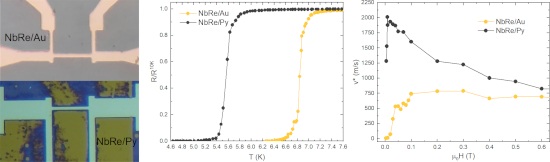
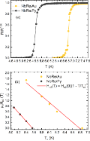
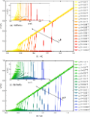
- analysis of Abrikosov vortex dynamics and flux-flow instabilities was performed in NbRe/Au and NbRe/Py bilayers to compare superconducting/normal metal (S/N) and superconducting/ferromagnetic (S/F) heterostructures based on the same superconducting layer. The heterostructures, fabricated by sputtering
- ; superconductivity; vortex dynamics; Introduction Vortex dynamics plays a central role in the electrical transport under magnetic fields in type-II superconductors and is an essential subject of research in superconductivity [1]. In inhomogeneous type-II superconductors, structural defects create pinning centers
- ]. The enhancement of vortex dynamics and the reduction of τE are strongly linked to the optimization of quasiparticle relaxation mechanisms. Excited quasiparticles can relax primarily through two processes, namely thermal electron–phonon (e–ph) interaction and electron–electron (e–e) recombination [1


Advancing nanolithography: a comprehensive review of materials for local anodic oxidation with AFM
Beilstein J. Nanotechnol. 2026, 17, 275–291, doi:10.3762/bjnano.17.19
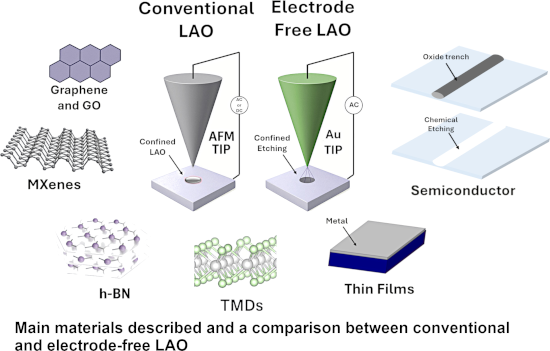
- (MXenes) that may introduce new oxidation dynamics. Regrettably, key factors such as oxygen, humidity, and light, which contribute to the ambient degradation of few-layer BP [107], may present significant challenges for the application of LAO. The conductive properties of MXenes range from metallic to


Micro- and nanoscale effects in biological and bioinspired materials and surfaces
Beilstein J. Nanotechnol. 2026, 17, 214–217, doi:10.3762/bjnano.17.14
- characterization of functional plant tissues [19] integrating experiments and finite element models, and animal tissues [20] incorporating molecular dynamics and finite element methods. Investigating the anisotropic hygroscopic behavior of the involved materials in bending in pine cone scales, Ulrich et al. [19
- adhesion. They combined molecular dynamics for the simulation of the adhesive contact between the gecko spatula and the substrate with finite element modeling of the mechanical behavior of the adhesive seta to understand key aspects of gecko seta adhesion across scales. Besides these studies, focusing on
Structure-dependent thermochromism of PAZO thin films: theory and experiment
Beilstein J. Nanotechnol. 2026, 17, 186–199, doi:10.3762/bjnano.17.12
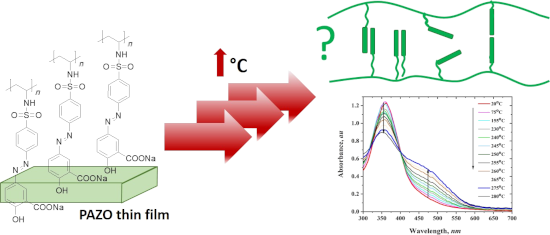
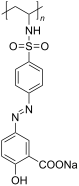
- thermal molecular motion of polymer chains in thin films is essential for tailoring the properties and enhancing the performance of polymer-based devices. By precisely controlling these factors, researchers can fine-tune the structure and dynamics of the film to achieve specific characteristics suited for


Safe and sustainable by design with ML/AI: A transformative approach to advancing nanotechnology
Beilstein J. Nanotechnol. 2026, 17, 176–185, doi:10.3762/bjnano.17.11
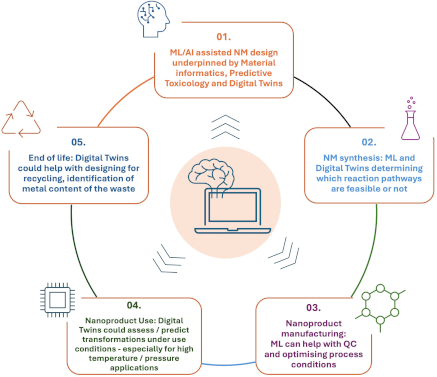
- powerful aspects of materials informatics lies in its ability to integrate machine learning with multiscale simulation tools – ranging from molecular dynamics to density functional theory – which helps researchers correlate nanoscale features such as particle size, shape, and surface functionalization with
- remediation measures on the particle concentrations in specific environmental compartments (e.g., [59] and made accessible via a web application at https://sb4n.cloud.nanosolveit.eu/). These models integrate geospatial data, fluid dynamics, and chemical reactivity, offering a geographically and temporally


Influence of surface characteristics on the in vitro stability and cell uptake of nanoliposomes for brain delivery
Beilstein J. Nanotechnol. 2026, 17, 139–158, doi:10.3762/bjnano.17.9
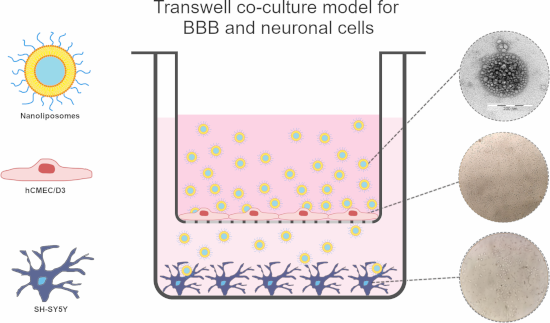
- true dynamics of NLs and drug absorption or trafficking within brain cells. Finally, optimized experimental conditions help reduce variability between cell uptake experiments and ensure that results are consistent across different cell passages, laboratories, or research conditions which is