


Search results
Search for "surface topography" in Full Text gives 138 result(s) in Beilstein Journal of Nanotechnology.
He+ FIBID-fabricated 3D AFM tip architectures: an exploratory study of hollow pillars, helices, and spirals
Beilstein J. Nanotechnol. 2026, 17, 863–871, doi:10.3762/bjnano.17.62
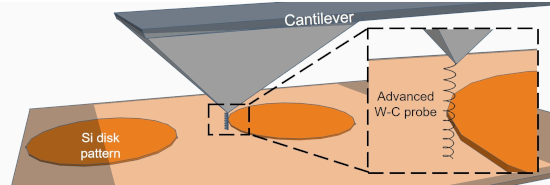
- required. Keywords: 3D-printed tips; AFM tips; beam induced nanomanufacturing; focused ion beam induced deposition (FIBID); helium ion microscope; nanohelix; nanopillar; nanospiral; scanning tip microscopy; surface topography; tungsten carbide; Introduction The atomic force microscope (AFM) is a


Development and in vitro evaluation of liposomes and immunoliposomes containing 5-fluorouracil and R-phycoerythrin as a potential phototheranostic system for colorectal cancer
Beilstein J. Nanotechnol. 2026, 17, 97–121, doi:10.3762/bjnano.17.7
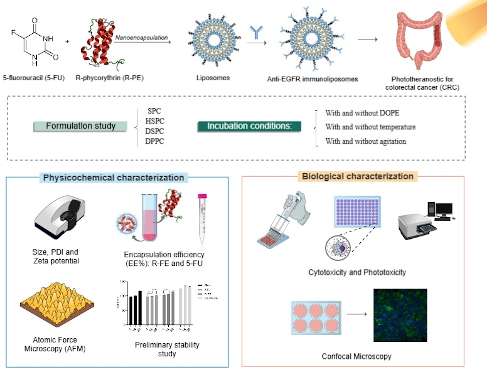
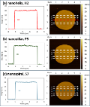
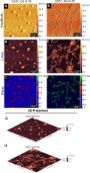
- HSPC IM 07 formulation exhibits the most favorable characteristics for application in delivery systems, balancing nanoscale size, acceptable PDI, and high conjugation efficiency. 3.3 Atomic force microscopy assays Atomic force microscopy assays were used to characterize the surface topography of



Ultrathin water layers on mannosylated gold nanoparticles
Beilstein J. Nanotechnol. 2025, 16, 2183–2198, doi:10.3762/bjnano.16.151
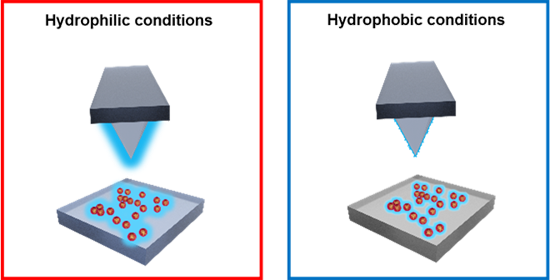
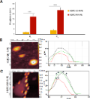
- , Section S1). We used heavy metal staining in STEM on the nanometer scale, to distinguish the organic ligand shell from the gold core. The main method, however, was “noncontact” (AC mode) AFM. Its advantage lies in obtaining a very detailed surface topography through height images. This also includes



Mechanical property measurements enabled by short-term Fourier-transform of atomic force microscopy thermal deflection analysis
Beilstein J. Nanotechnol. 2025, 16, 1952–1962, doi:10.3762/bjnano.16.136
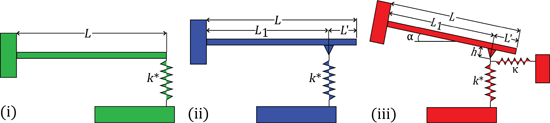
- ); mechanical property measurements; surface science; Introduction Atomic force microscopy (AFM) has become an indispensable tool for imaging the surface topography on a variety of surfaces [1]. Since the invention of the AFM [2], several other modes of AFM have been developed, including friction force




Low-temperature AFM with a microwave cavity optomechanical transducer
Beilstein J. Nanotechnol. 2025, 16, 1873–1882, doi:10.3762/bjnano.16.130
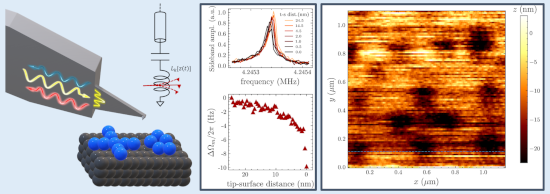
- resolution of 100 pixels/line. In order to track the surface topography while scanning, we developed a proportional-integral-derivative (PID) control firmware running on the embedded real-time processing unit of the microwave multifrequency lock-in amplifier (Presto by Intermodulation Products AB). The


Electrical, photocatalytic, and sensory properties of graphene oxide and polyimide implanted with low- and medium-energy silver ions
Beilstein J. Nanotechnol. 2025, 16, 1794–1811, doi:10.3762/bjnano.16.123
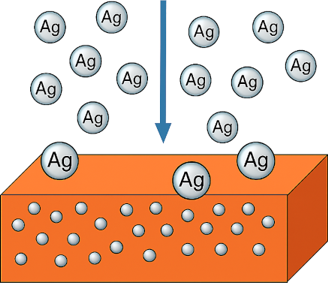
- lowest fluence (GO and PI, 3.75 × 1012 cm−2), suggesting that, at greater implantation depths, subsurface effects and Ag-induced electronic modifications play a more important role than surface topography alone. These results indicate that the key to maximizing photocatalytic efficiency is not to


Mechanical stability of individual bacterial cells under different osmotic pressure conditions: a nanoindentation study of Pseudomonas aeruginosa
Beilstein J. Nanotechnol. 2025, 16, 1171–1183, doi:10.3762/bjnano.16.86
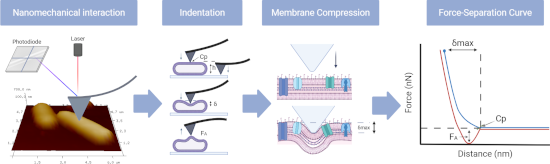
- specific molecular agents is critical in generating strategies to control their undesired propagation. Atomic force microscopy (AFM) is a powerful, sensitive technique that scans the surface topography of a sample with an ultra-sharp tip while monitoring the interaction forces between this tip and the
- hypertonic conditions. Force–volume AFM demonstrated its capacity for testing the mechanical properties of multiple bacteria at once. This mechanical nanoscale mapping allowed us to successfully discriminate the minute variations in the surface topography of bacteria (h), their mechanical resistance to


Influence of ion beam current on the structural, optical, and mechanical properties of TiO2 coatings: ion beam-assisted vs conventional electron beam evaporation
Beilstein J. Nanotechnol. 2025, 16, 1097–1112, doi:10.3762/bjnano.16.81
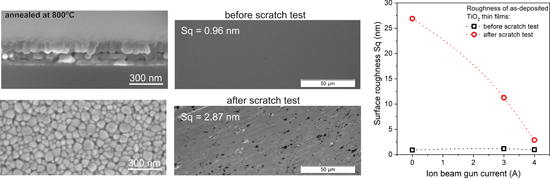
- properties tests. The results of surface topography measurements before and after abrasion tests for the annealed TiO2 thin films are included in Figure 9. Before the abrasion test, all coatings were homogeneous and had low roughness values from 2.0 to 2.5 nm. However, after the steel wool tests, the film
- surface topography measurements before and after abrasion tests of TiO2 thin films deposited by EBE (a) without and with IBAD with ion beam gun currents of (b) Iibg = 3 A and (c) Iibg = 4 A. Results of surface topography measurements before and after abrasion tests of TiO2 thin films deposited by EBE (a




Performance optimization of a microwave-coupled plasma-based ultralow-energy ECR ion source for silicon nanostructuring
Beilstein J. Nanotechnol. 2025, 16, 484–494, doi:10.3762/bjnano.16.37

- the transformative impact of nanopatterning through low-energy inert ions. Keywords: optimization of ion current; surface topography; TEM; ultralow-energy ECR-based ion source; UV–vis spectroscopy; Introduction Ion sources serve as fundamental components in numerous scientific and industrial
- ions at different incidence angles and for various irradiation times is investigated using AFM in tapping mode. Si cantilevers with tip radii of 10 nm were employed, with scan rate of 1 µm/s and a fixed scan size of 5 µm × 5 µm. Quantitative analysis of the surface topography was conducted using WSxM
- formation of well-defined parallel ripples at off-normal incidence. Figure 7 illustrates the surface topography after 450 eV Ar-ion bombardment of the silicon surface at an angle of 72.5° as function of the bombardment time. 3D AFM images are presented along with 2D surface topography images. Generally, the


Tailoring of physical properties of RF-sputtered ZnTe films: role of substrate temperature
Beilstein J. Nanotechnol. 2025, 16, 333–348, doi:10.3762/bjnano.16.25
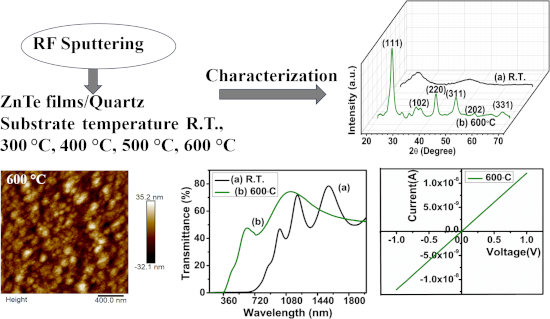
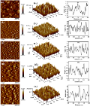
- ) spectrophotometer under 320 nm excitation produced by a xenon arc lamp. For investigating the surface topography, atomic force microscopy (AFM) micrographs of ZnTe/Qz films were recorded (scan area 2 × 2 µm2) using a Bruker multimode-8 AFM in the ScanAsyst mode at the Ion Beam Centre, Kurukshetra University. The




Direct electron beam writing of silver using a β-diketonate precursor: first insights
Beilstein J. Nanotechnol. 2024, 15, 1117–1124, doi:10.3762/bjnano.15.90

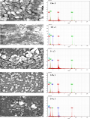
- fluorine in the halo region but showed a significant amount of both in the carbon-rich deposit (cf. Supporting Information File 1 for more details). Of note is that the surrounding of the deposit as well as the surface topography changed after deposition. Tiny particles of few nanometers in size appeared


The effect of age on the attachment ability of stick insects (Phasmatodea)
Beilstein J. Nanotechnol. 2024, 15, 867–883, doi:10.3762/bjnano.15.72

- different attachment mechanisms evolved in insects, namely, hairy pads consisting of flexible setae, which adapt to the surface topography, and smooth pads possessing a soft and deformable cuticle to comply with the substrate profile [9]. Both pad types, hairy and smooth, aim to maximize contact area with
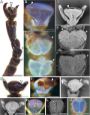
- could also be due to contamination. SEM revealed most of such cases as not being caused by contaminations. They rather arose from a strong alteration of the cuticle (Figure 8E), also including changes of the surface topography of the terminal layer of the attachment pad cuticle. Profound hardening of


Effect of repeating hydrothermal growth processes and rapid thermal annealing on CuO thin film properties
Beilstein J. Nanotechnol. 2024, 15, 743–754, doi:10.3762/bjnano.15.62
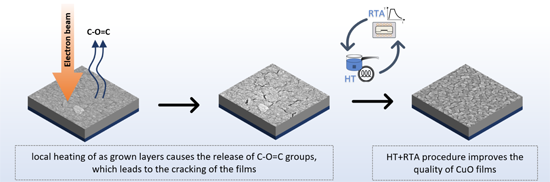
- , which allowed for the investigation of both topography and electrical properties of the films. Surface topography analysis was performed by utilizing an atomic force microscopy (AFM) operating in Peak Force Tapping mode. The surface was scanned at a resolution of 1024 × 1024 measurement points using a
- as-grown films, the distribution of carriers is homogeneous and does not show any correlation with the surface topography. The results obtained for the sequenced samples are different. With each successive cycle there is an increasing differentiation of the values of capacitance changes. In the case




Level set simulation of focused ion beam sputtering of a multilayer substrate
Beilstein J. Nanotechnol. 2024, 15, 733–742, doi:10.3762/bjnano.15.61
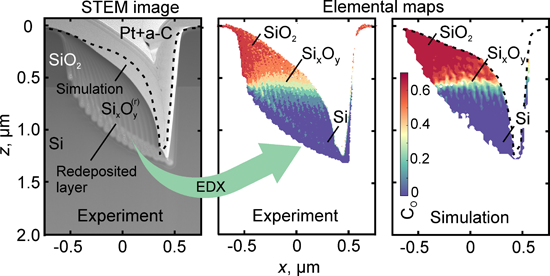
- application of the FIB method requires the creation and optimization of scanning patterns [16][17] as well as the quantitative prediction of ion-induced surface topography [18], which is a challenging task even for single-component substrates. A straightforward analytical description of surface topography is

![[Graphic 55]](/bjnano/content/inline/2190-4286-15-61-i68.svg?max-width=637&scale=1.18182)


Comparative analysis of the ultrastructure and adhesive secretion pathways of different smooth attachment pads of the stick insect Medauroidea extradentata (Phasmatodea)
Beilstein J. Nanotechnol. 2024, 15, 612–630, doi:10.3762/bjnano.15.52
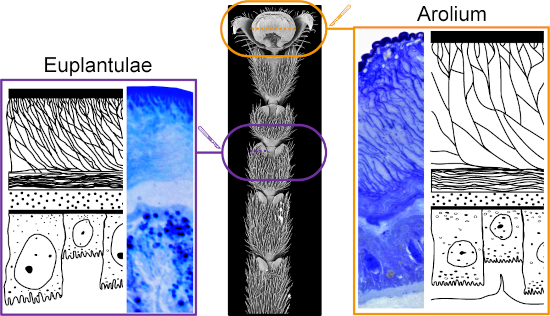
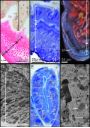
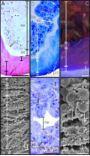
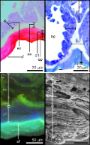
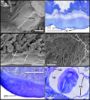
- the ventral side of the euplantulae revealed a dense hull (lighter grey) and a more X-ray transparent body (darker grey) (Figure 4A). Toluidine blue staining detected a darker blue stained hull and a lighter blue body (Figure 4B). The SEM images unveiled a rather smooth surface topography (Figure 4C



Investigating ripple pattern formation and damage profiles in Si and Ge induced by 100 keV Ar+ ion beam: a comparative study
Beilstein J. Nanotechnol. 2024, 15, 367–375, doi:10.3762/bjnano.15.33
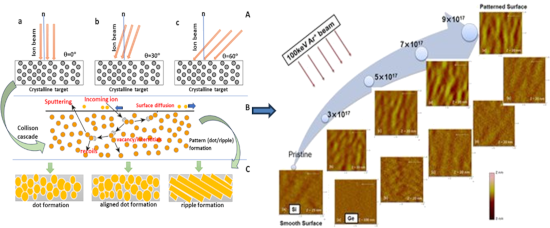
- samples were studied via AFM for the surface topography and change in root-mean-square (RMS) surface roughness. Figure 1 shows AFM images of pristine and 100 keV Ar+ ion-irradiated Si samples. Pristine samples show a smooth surface with a surface roughness of ≈0.5 nm as observed in Figure 1A (a). Figure
- 1A (b–e) shows the surface topography of the irradiated samples at respective ion fluences of (b) 3 × 10¹⁷, (c) 5 × 10¹⁷, (d) 7 × 10¹⁷, and (e) 9 × 10¹⁷ ions/cm2. The surface roughness (Rq) is found to be increased with ion fluence from ≈1.0 nm to 1.6 nm due to ion-induced sputtering at a 60


Quantitative wear evaluation of tips based on sharp structures
Beilstein J. Nanotechnol. 2024, 15, 230–241, doi:10.3762/bjnano.15.22
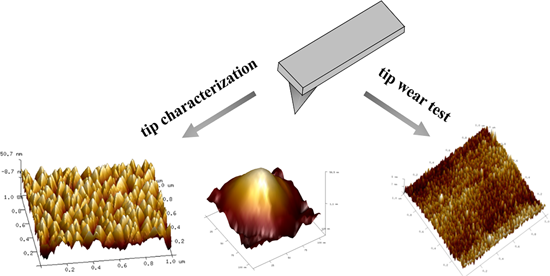
- surface topography [7]. A sharper needle tip leads to more accurate measurements [8]. During the scanning process, tip and sample come into mutual contact, causing wear on the tip [9]. Tip wear or damage in practical applications can have severe consequences, including reduced image quality and erroneous
- , and S represents the accurate surface topography of the sample. An accurate reflection of the tip morphology information is possible when the sample surface S exhibits sharp and rapidly changing morphology features. A blind modeling algorithm utilizes the topography information of each pixel and its
- surface changes, altering the measured surface roughness. A decrease in Ra indicates changes of the tip shape due to wear, leading to a decrease in image quality. Conversely, a constant Ra implies minimal tip wear and a more accurate representation of the sample surface topography. By comparing the




Enhanced feedback performance in off-resonance AFM modes through pulse train sampling
Beilstein J. Nanotechnol. 2024, 15, 134–143, doi:10.3762/bjnano.15.13
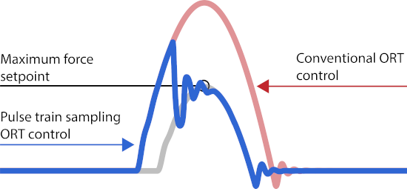
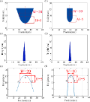
- simulate a surface topography with a known disturbance signal, while the feedback controller drove the second piezo to compensate for the disturbance and apply the ORT actuation signal as shown in Figure 3B. We selected a 30 Hz triangular waveform (Figure 3C) as the disturbance. Such a triangular


Spatial variations of conductivity of self-assembled monolayers of dodecanethiol on Au/mica and Au/Si substrates
Beilstein J. Nanotechnol. 2023, 14, 1169–1177, doi:10.3762/bjnano.14.97
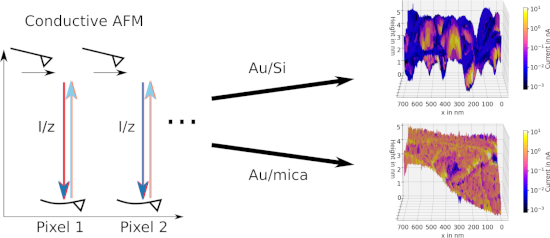
- applied method uses conductive atomic force microscopy (CAFM). In this technique, a conductive probe is used in an AFM, which allows for imaging the surface topography (and other characteristics such as adhesion and stiffness) with lateral resolution while simultaneously being able to measure current
- the surface topography, the conductance obtained from averaging over random points on the surface [12][21][22][23][24] is prone to incorrect averaging. The lateral variation of the conductive properties limits strongly the amount of lateral probe positions over which measurements of such


Exploring internal structures and properties of terpolymer fibers via real-space characterizations
Beilstein J. Nanotechnol. 2023, 14, 1004–1017, doi:10.3762/bjnano.14.83
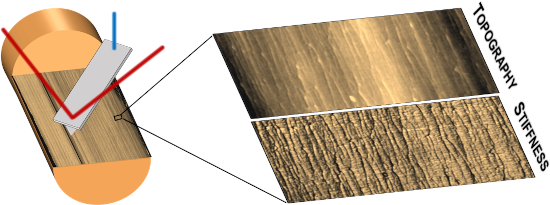
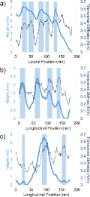
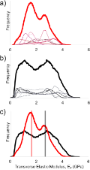
- ) to the first and second modes, respectively), maps of surface topography, transverse stiffness, and transverse elastic modulus across the fiber were obtained. Typical (setpoint/free air) amplitudes for the first mode were ca. 25/50 nm. Second mode amplitudes (always held constant, in and out of






High–low Kelvin probe force spectroscopy for measuring the interface state density
Beilstein J. Nanotechnol. 2023, 14, 175–189, doi:10.3762/bjnano.14.18
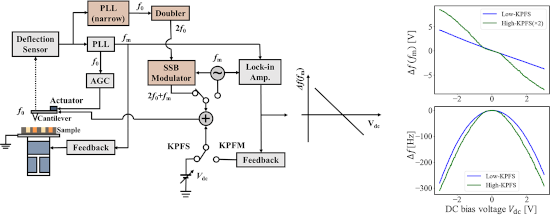
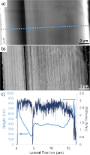
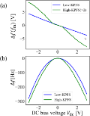
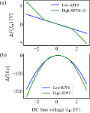
- the measurement. (a) Surface topography and (b) CPD image of the pn-patterned Si surface. The CPD image was obtained by KPFM using an AC bias voltage with a low modulation frequency of fm = 100 Hz. The scan size was 7 μm × 2.1 μm. (c) Line profile corresponding to the white line in panel (a); (d) line



Growing up in a rough world: scaling of frictional adhesion and morphology of the Tokay gecko (Gekko gecko)
Beilstein J. Nanotechnol. 2022, 13, 1292–1302, doi:10.3762/bjnano.13.107
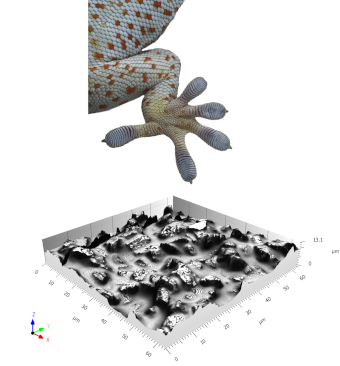
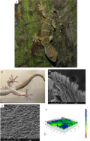
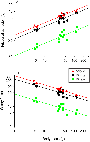
- , performance, and 3D surface topography, revealed key aspects of scaling that have significant impacts on our understanding of gecko adhesion. Setal diameter and density did not change with body size, whereas toepad area, and setal length, and therefore setal aspect ratio, increased with body size. Frictional
- . Surfaces Our experiments were carried out using a series of artificial surfaces that varied in surface topography and asperity size. In considering both the appropriate length-scale of animal adhesive structures and relevant manufactured artificial surfaces, we chose 7 different sandpapers that encompassed


Laser-processed antiadhesive bionic combs for handling nanofibers inspired by nanostructures on the legs of cribellate spiders
Beilstein J. Nanotechnol. 2022, 13, 1268–1283, doi:10.3762/bjnano.13.105
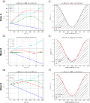
- deflect the fiber in order to obtain the interaction energy, but not all to the bottom of the sinusoidal surface topography. Thus, a clear total energy minimum exists. Finally, in state C, bending requires less energy than can be gained by the van der Waals interaction. Thus, the fiber adapts completely
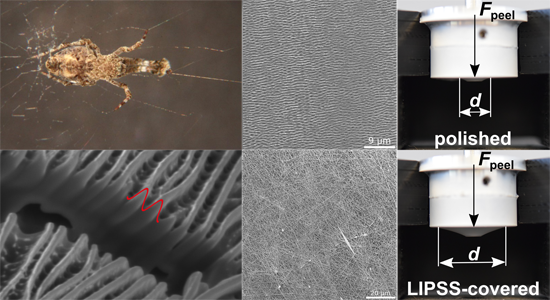
- scale bars of 0.8 mm length. Data is presented in Table S1 of Supporting Information File 1. Principle geometry of the interaction of a nanofiber with a periodic sinusoidal surface topography (a) and as single length unit when cut free (b). The periodic surface structure is drawn in black, the fiber is
- ) Photography of a laser-structured titanium alloy sample after ultrafast laser processing. The colorful appearance arises from optical diffraction of the ambient natural light at the grating-like LIPSS-covered surface topography (structural colors). (b) Scanning electron micrograph of the LIPSS-covered






Roll-to-roll fabrication of superhydrophobic pads covered with nanofur for the efficient clean-up of oil spills
Beilstein J. Nanotechnol. 2022, 13, 1228–1239, doi:10.3762/bjnano.13.102
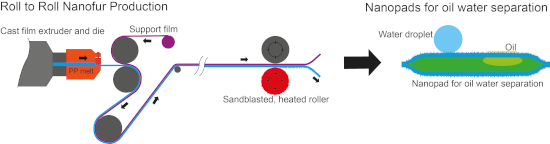
- of 53–75 µm. This procedure results in a surface topography of craters and edges with finer spikes on top. This sandblasted roller is mounted in a two-roller calender (Figure 2b) and heated (Figure 2c). Best quality nanofur in terms of high contact angles is obtained if the temperature is set




Comparing the performance of single and multifrequency Kelvin probe force microscopy techniques in air and water
Beilstein J. Nanotechnol. 2022, 13, 922–943, doi:10.3762/bjnano.13.82
- , force volume mapping, surface topography limitations, or positioning of the tip with respect to double layer overlap, it is clear that the purely electrical modes offer significant performance enhancement over mechanically coupled modes. When implementation of KPFM at z ≤ R becomes feasible, the



