


Search results
Search for "topography" in Full Text gives 451 result(s) in Beilstein Journal of Nanotechnology. Showing first 200.
He+ FIBID-fabricated 3D AFM tip architectures: an exploratory study of hollow pillars, helices, and spirals
Beilstein J. Nanotechnol. 2026, 17, 863–871, doi:10.3762/bjnano.17.62
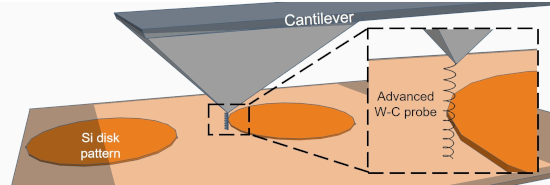
- required. Keywords: 3D-printed tips; AFM tips; beam induced nanomanufacturing; focused ion beam induced deposition (FIBID); helium ion microscope; nanohelix; nanopillar; nanospiral; scanning tip microscopy; surface topography; tungsten carbide; Introduction The atomic force microscope (AFM) is a


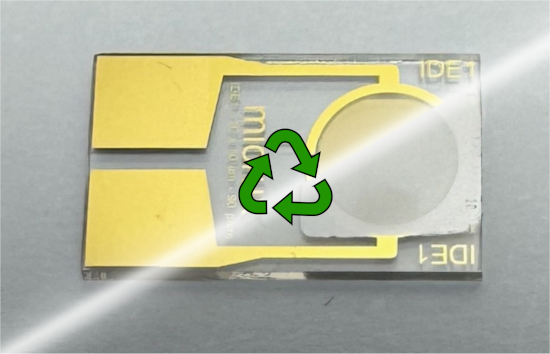
Sustainable fabrication of 2D-based devices through reuse of substrates with microfabricated electrodes
Beilstein J. Nanotechnol. 2026, 17, 818–827, doi:10.3762/bjnano.17.58
- AC voltage of 1.5 V applied to the tip. Both large-area and higher-magnification scans were collected to compare the topography and surface-potential (SP) distribution before and after processing. SP histograms were extracted from the mapped regions to compare the width of the surface-potential


Two-step laser synthesis of Ag@TiO2 nanomaterials for the photocatalytic degradation of rhodamine B
Beilstein J. Nanotechnol. 2026, 17, 622–634, doi:10.3762/bjnano.17.43
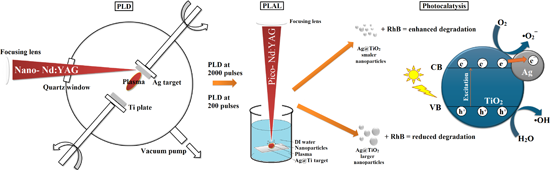
- resolution by detecting emitted secondary electrons (SE) for topography showed that there is a small difference in surface morphology between Ag@TiO2 200p and Ag@TiO2 2000p plates. This could be correlated with the silver distribution and concentration on the titanium plate. EDS analysis showed a homogeneous


Polycatecholamine nanocoatings on stainless steel: the effect on attachment of human fibroblasts and platelets
Beilstein J. Nanotechnol. 2026, 17, 365–380, doi:10.3762/bjnano.17.25
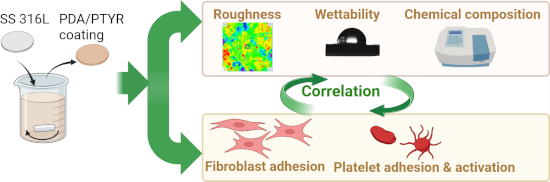
- nanoparticulate morphology, improved nanostructural stability, and were more repellent for platelets. This is an important finding in terms of searching for robust and versatile hemocompatible coatings, as platelet–surface interactions are strongly influenced by nanoscale chemistry and topography. PTYR




Advancing nanolithography: a comprehensive review of materials for local anodic oxidation with AFM
Beilstein J. Nanotechnol. 2026, 17, 275–291, doi:10.3762/bjnano.17.19
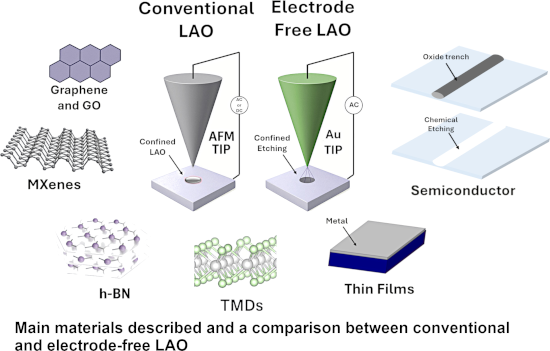
- ] or modified LAO setups. Topography also plays a significant role: While low-roughness surfaces facilitate the process, RMS roughness above roughly 1–2 nm can distort the meniscus and induce lateral broadening of the oxide features. Notably, Ryu et al. demonstrated that oxygen plasma pretreatment of
- small as 10 nm, demonstrating superior etching quality comparable to natural edges. Figure 3e shows the topography of an ultrathin graphene nanoribbon with width of ≈10 nm and edge roughness of ≈2 nm. As an etching method that operates without the need for an external electrode, once parameters such as
- AFM topography and cross-sectional views of an array of oxide masks (top) and their corresponding etched silicon nanowires (bottom). Panel (e) adapted from [42], with the permission of AIP Publishing. This content is not subject to CC BY4.0. Examples of oxide nanostructures fabricated by local anodic


Time of flight secondary ion mass spectrometry imaging of contaminant species in chemical vapour deposited graphene on copper
Beilstein J. Nanotechnol. 2026, 17, 200–213, doi:10.3762/bjnano.17.13
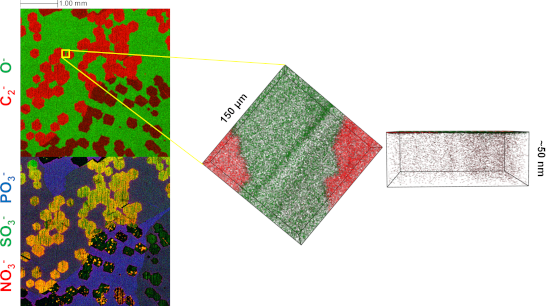
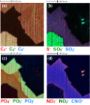
- this species detected from the domain in the upper right of the image. While ToF-SIMS is very sensitive to trace amounts of material, actual quantification of the amount present is difficult without having reliable reference materials, with minimal topography and consistent crystal or grain orientation





Development and in vitro evaluation of liposomes and immunoliposomes containing 5-fluorouracil and R-phycoerythrin as a potential phototheranostic system for colorectal cancer
Beilstein J. Nanotechnol. 2026, 17, 97–121, doi:10.3762/bjnano.17.7
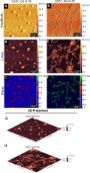
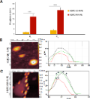
- HSPC IM 07 formulation exhibits the most favorable characteristics for application in delivery systems, balancing nanoscale size, acceptable PDI, and high conjugation efficiency. 3.3 Atomic force microscopy assays Atomic force microscopy assays were used to characterize the surface topography of
- dehydration process and adhesion forces onto the substrate [57][58]. On the other hand, the z-axis and 3D projections for HSPC-IM-R-PE (Figure 3E and Figure 3H, respectively) demonstrated a more irregular nanoparticle surface, with visibly rougher and more heterogeneous topography, a result consistent with
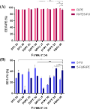
- results, the Rq values also support these findings (Figure 4A, right pair of bars). HSPC-50-R-PE maintained a low Rq of 3.874 ± 0.9706 nm, reinforcing the existence of a smooth topography without extreme height variations. In contrast, HSPC-IM-R-PE reached 23.61 ± 2.225 nm (p < 0.0001 vs liposomes



Quantitative estimation of nanoparticle/substrate adhesion by atomic force microscopy
Beilstein J. Nanotechnol. 2026, 17, 1–14, doi:10.3762/bjnano.17.1

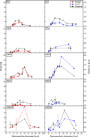
- applied in contact mode, with nominal force constants of 0.08–0.15 N·m−1 and tip curvature radii smaller than 10 nm. AFM topography images and lateral force data of the samples were processed using the open source software Gwyddion (version 2.63) [30]. For statistical analysis of the measured data
- resolution. These scans captured both topography signals from vertical cantilever movement and lateral signals from twisting of the cantilever (Figure 1a). The vertical bending of the cantilever, which is linked to the height of the NPs and to their diameter (assuming spherical NPs), was recorded to provide
- topography images. Lateral forces were measured by observing the twisting of the cantilever during forward and backward scans. If a higher set point is chosen, that is, a larger normal force is applied to the cantilever (Figure 1b), the respective NP is pushed from its original position (as evidenced by the



Ultrathin water layers on mannosylated gold nanoparticles
Beilstein J. Nanotechnol. 2025, 16, 2183–2198, doi:10.3762/bjnano.16.151
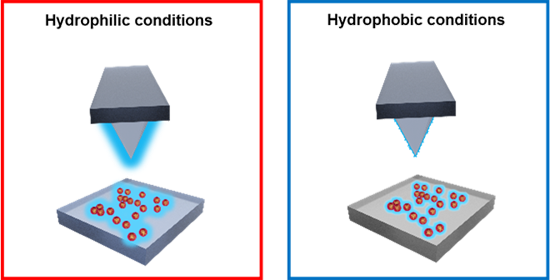
- hydrophobic tips. While VSFG indicated preferential hydration of the dimannoside and proved conformational changes in the organic ligands, AFM provided sub-nanometer changes in particle topography due to water adsorption. In general, the dimannoside nanoparticles condense ultrathin water layers upon humidity
- , Section S1). We used heavy metal staining in STEM on the nanometer scale, to distinguish the organic ligand shell from the gold core. The main method, however, was “noncontact” (AC mode) AFM. Its advantage lies in obtaining a very detailed surface topography through height images. This also includes
- to the nanoscale, we found a homogenous dispersion of the particles (Figure 6B). This is supported by AFM topography images at the nanoscale (Figure 6C). In contrast, PEG AuNPs are not well dispersed, with more agglomerates (see the analogous Figure 6G–I), and particle clusters form microscale



Microplastic pollution in Himalayan lakes: assessment, risks, and sustainable remediation strategies
Beilstein J. Nanotechnol. 2025, 16, 2144–2167, doi:10.3762/bjnano.16.148
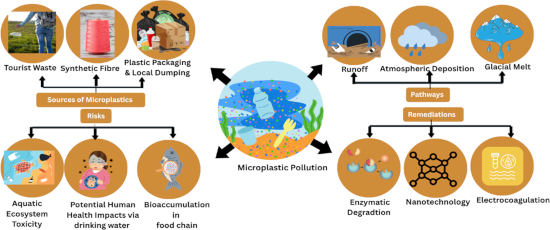
- widely used to simulate groundwater flow and contaminant transport processes [20]. Such models have been adapted to cold mountain environments by adding glacier-fed recharge zones, freeze–thaw processes in soils, and topography-induced flow [21]. Semi-distributed models such as SWAT and MIKE SHE have


Multifrequency AFM integrating PeakForce tapping and higher eigenmodes for heterogeneous surface characterization
Beilstein J. Nanotechnol. 2025, 16, 2077–2085, doi:10.3762/bjnano.16.142
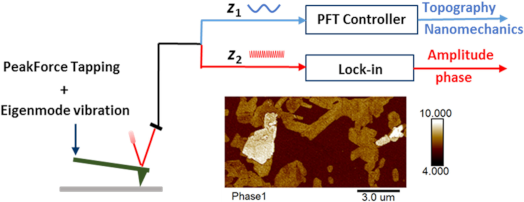
- withdraw with the sample surface periodically, forming a force curve. The peak force, identified within this curve, is utilized as a feedback parameter. By sustaining a constant peak force between the probe and the sample, the topography of the sample can be obtained. Quantitative mechanical properties of
- -frequency noise and baseline drift, ensuring stable force feedback for accurate topography and quantitative mechanical mapping. These processing routines are factory-implemented and operate transparently to the user [23]. The unfiltered signal branch of the high-eigenmode detection path is routed directly
- stiffness, insufficient sample deformation led to significant variability in modulus measurements (Figure 3b), indicating the ScanAsyst-Air probe was unsuitable for reliable Young’s modulus quantification. Comparative analysis revealed a high degree of similarity in the topography, modulus, and adhesion


Mechanical property measurements enabled by short-term Fourier-transform of atomic force microscopy thermal deflection analysis
Beilstein J. Nanotechnol. 2025, 16, 1952–1962, doi:10.3762/bjnano.16.136
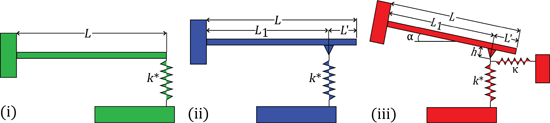
- ); mechanical property measurements; surface science; Introduction Atomic force microscopy (AFM) has become an indispensable tool for imaging the surface topography on a variety of surfaces [1]. Since the invention of the AFM [2], several other modes of AFM have been developed, including friction force
- their polymerization/deposition. The topography of the surface was measured before acquiring a force-versus-distance measurement to ensure that these measurements were acquired on clean and flat regions of the substrate. To observe how the resonant frequency of the AFM cantilever changes as the attached




Low-temperature AFM with a microwave cavity optomechanical transducer
Beilstein J. Nanotechnol. 2025, 16, 1873–1882, doi:10.3762/bjnano.16.130
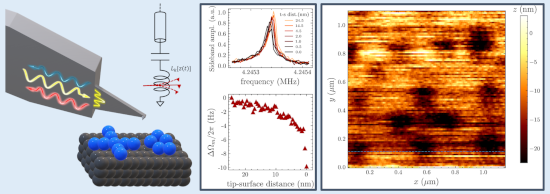
- –surface distance, oscillation amplitude of the driven cantilever, sharpness of the tip, and pickup of environmental vibrations and noise, such as noise from the actuator driving the cantilever oscillation as well as feedback noise and sample topography. We perform initial positioning of the microscope by
- resolution of 100 pixels/line. In order to track the surface topography while scanning, we developed a proportional-integral-derivative (PID) control firmware running on the embedded real-time processing unit of the microwave multifrequency lock-in amplifier (Presto by Intermodulation Products AB). The
- feedback system must be able to follow rapid changes in topography while avoiding feedback oscillation. Depending on the mode of operation, AM-AFM or FM-AFM, the PID setpoint and error signal are determined, respectively, from the amplitude or phase of the motional sideband, which is the up-converted


Electrical, photocatalytic, and sensory properties of graphene oxide and polyimide implanted with low- and medium-energy silver ions
Beilstein J. Nanotechnol. 2025, 16, 1794–1811, doi:10.3762/bjnano.16.123
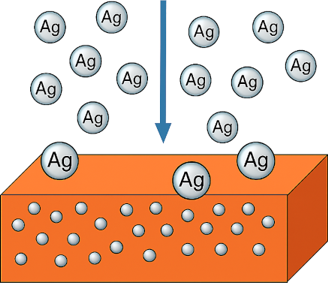
- lowest fluence (GO and PI, 3.75 × 1012 cm−2), suggesting that, at greater implantation depths, subsurface effects and Ag-induced electronic modifications play a more important role than surface topography alone. These results indicate that the key to maximizing photocatalytic efficiency is not to


Mechanical stability of individual bacterial cells under different osmotic pressure conditions: a nanoindentation study of Pseudomonas aeruginosa
Beilstein J. Nanotechnol. 2025, 16, 1171–1183, doi:10.3762/bjnano.16.86
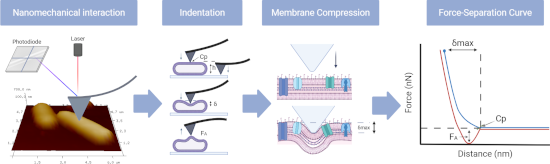
- specific molecular agents is critical in generating strategies to control their undesired propagation. Atomic force microscopy (AFM) is a powerful, sensitive technique that scans the surface topography of a sample with an ultra-sharp tip while monitoring the interaction forces between this tip and the
- force–separation curve analyzed in real time by the software. A color-coded map is obtained according to the physical parameters extracted from the curve, as shown in Figure 1B,C. Figure 2 shows an FV image of the topography or height channel for several individual PA bacteria on the substrate. An
- hypertonic conditions. Force–volume AFM demonstrated its capacity for testing the mechanical properties of multiple bacteria at once. This mechanical nanoscale mapping allowed us to successfully discriminate the minute variations in the surface topography of bacteria (h), their mechanical resistance to


Influence of ion beam current on the structural, optical, and mechanical properties of TiO2 coatings: ion beam-assisted vs conventional electron beam evaporation
Beilstein J. Nanotechnol. 2025, 16, 1097–1112, doi:10.3762/bjnano.16.81
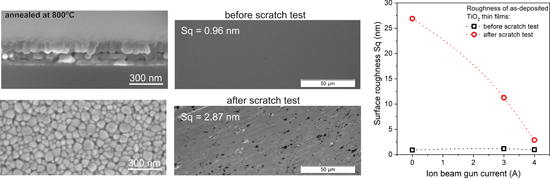
- properties tests. The results of surface topography measurements before and after abrasion tests for the annealed TiO2 thin films are included in Figure 9. Before the abrasion test, all coatings were homogeneous and had low roughness values from 2.0 to 2.5 nm. However, after the steel wool tests, the film
- surface topography measurements before and after abrasion tests of TiO2 thin films deposited by EBE (a) without and with IBAD with ion beam gun currents of (b) Iibg = 3 A and (c) Iibg = 4 A. Results of surface topography measurements before and after abrasion tests of TiO2 thin films deposited by EBE (a




Shape, membrane morphology, and morphodynamic response of metabolically active human mitochondria revealed by scanning ion conductance microscopy
Beilstein J. Nanotechnol. 2025, 16, 951–967, doi:10.3762/bjnano.16.73
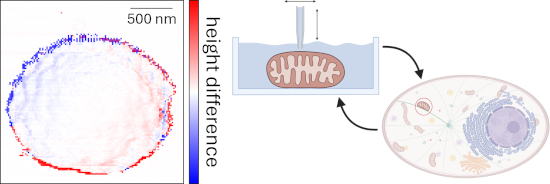
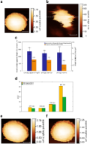
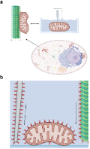
- topography is acquired. SICM is particularly well suited for biological applications, as it is a non-contact method with minimal interaction forces, preserving the native state of the sample [27]. To date, SICM investigations of mitochondria have been limited to subsarcolemmal mitochondria, specifically in
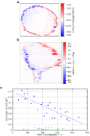
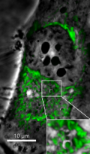
- this work, we employ SICM to investigate the shape, dynamics, and nanomorphology of metabolically active, isolated mitochondria, with a specific focus on the outer mitochondrial membrane. Furthermore, we identify and characterise two distinct dynamic effects observed in time-dependent topography data
- . Apparent heights varied between 0.2 and 2.8 μm, with an average of 1.2 μm. The topography shows shallow irregular undulations with an amplitude and spatial dimension of approximately 100 nm. Statistical analyses comparing the spherical or ellipsoidal with the irregular mitochondria are provided in Figure



Tendency in tip polarity changes in non-contact atomic force microscopy imaging on a fluorite surface
Beilstein J. Nanotechnol. 2025, 16, 944–950, doi:10.3762/bjnano.16.72
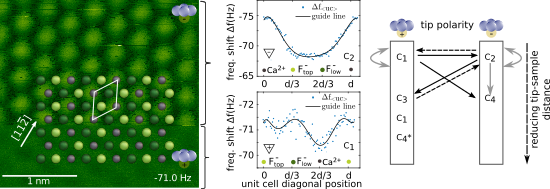
- acquiring data in the constant height mode, we invert Δf images so that a steeper force gradient appears as a brighter feature corresponding to an elevation in an image of the same feature taken in the constant frequency shift (topography) mode. Arrows in the upper right corner of Δf images represent the


Ar+ implantation-induced tailoring of RF-sputtered ZnO films: structural, morphological, and optical properties
Beilstein J. Nanotechnol. 2025, 16, 872–886, doi:10.3762/bjnano.16.66
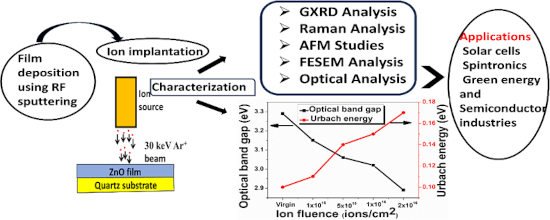
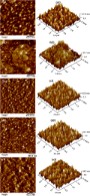
- using a WITec alpha300 RA Raman spectrometer under excitation with a 532 nm solid-state diode laser operated at 10 mW. The topography of the films is examined using atomic force microscopy (AFM) with a Bruker Multimode 8 instrument. The surface morphology of pristine and implanted films is further






Thickness dependent oxidation in CrCl3: a scanning X-ray photoemission and Kelvin probe microscopies study
Beilstein J. Nanotechnol. 2025, 16, 749–761, doi:10.3762/bjnano.16.58
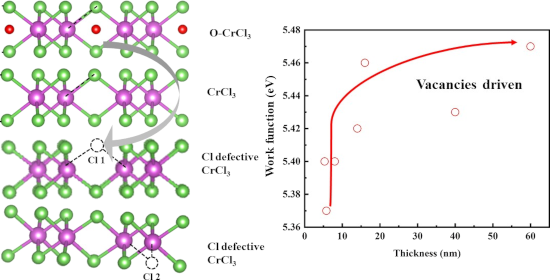
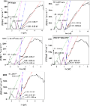
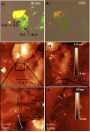
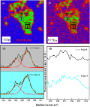
- ) AFM images of mechanically exfoliated CrCl3 flakes on the native Si (1 nm SiO2) substrate. (c) AFM thickness profile scans along the various flakes as denoted in Figure 1b. Optical contrast on ITO substrates (a) before and (b) after the SPEM measurements. (c, d) AFM topography images of CrCl3 on the
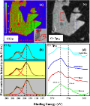
- SiO2/Si substrate. (a) Topography from non-contact mode AFM of two flakes with different thicknesses; (b) Kelvin surface potential of the samples on SiO2; (c) z-profiles of the two flakes; (d) Kelvin surface potential scans along the profiles of (a). A Pt-coated tip was used. (a)Topography from non





The impact of tris(pentafluorophenyl)borane hole transport layer doping on interfacial charge extraction and recombination
Beilstein J. Nanotechnol. 2025, 16, 678–689, doi:10.3762/bjnano.16.52
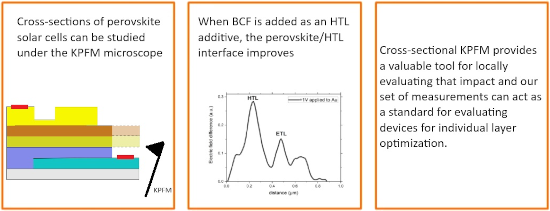
- during the amplitude modulation topography scan. Supporting Information File 1, Figure S4 and Table S1, show the layered structure and layer thickness for each of the ion polished devices from the four batches. An important note that is highlighted by these measurements is that the optimal HTL thickness


Nanoscale capacitance spectroscopy based on multifrequency electrostatic force microscopy
Beilstein J. Nanotechnol. 2025, 16, 637–651, doi:10.3762/bjnano.16.49

- parts [93], leading to a strong nanoscale contrast in the dielectric signal. On the silicon substrate, F14H20 formed groups of spherical particles with a diameter of 40 ± 5 nm (Figure 7a) [94][95]. Simultaneously with the topography, we recorded the C″ amplitude and phase at electrical excitation
- the Pt/Ir-coated conductive cantilevers (NuNano SPARK-150Pt and MikroMasch HQ:NSC18/Pt) was ≈75 kHz; the levers had a spring constant of 2–3 N·m−1, a tip radius of 18 nm, and a tip height of 10–18 μm. The topography feedback measurements were performed with amplitude modulation on the first eigenmode
- part shows the excitation frequencies () and the detection frequencies () of the applied frequencies. The red arrow corresponds to topography, and the blue arrow corresponds to the electrical signal. The representation of Figure 1 was inspired by [18][26]. A comparison of heterodyne Kelvin probe force




Electron beam-based direct writing of nanostructures using a palladium β-ketoesterate complex
Beilstein J. Nanotechnol. 2025, 16, 530–539, doi:10.3762/bjnano.16.41
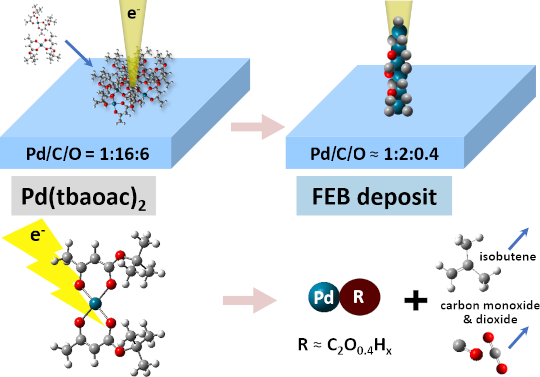
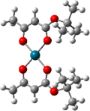
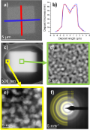
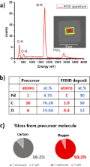
- topography and overall uniformity of the deposit (Figure 2a). The thickness profile extracted from the AFM data (Figure 2b) shows a dip at the center of the deposit. This shape is typical of the spiral scanning method when the rate of adsorbate dissociation exceeds the rate of adsorbate supply. The resulting


Performance optimization of a microwave-coupled plasma-based ultralow-energy ECR ion source for silicon nanostructuring
Beilstein J. Nanotechnol. 2025, 16, 484–494, doi:10.3762/bjnano.16.37

- the transformative impact of nanopatterning through low-energy inert ions. Keywords: optimization of ion current; surface topography; TEM; ultralow-energy ECR-based ion source; UV–vis spectroscopy; Introduction Ion sources serve as fundamental components in numerous scientific and industrial
- ions at different incidence angles and for various irradiation times is investigated using AFM in tapping mode. Si cantilevers with tip radii of 10 nm were employed, with scan rate of 1 µm/s and a fixed scan size of 5 µm × 5 µm. Quantitative analysis of the surface topography was conducted using WSxM
- formation of well-defined parallel ripples at off-normal incidence. Figure 7 illustrates the surface topography after 450 eV Ar-ion bombardment of the silicon surface at an angle of 72.5° as function of the bombardment time. 3D AFM images are presented along with 2D surface topography images. Generally, the


ReactorAFM/STM – dynamic reactions on surfaces at elevated temperature and atmospheric pressure
Beilstein J. Nanotechnol. 2025, 16, 397–406, doi:10.3762/bjnano.16.30
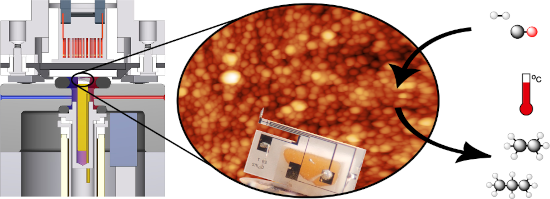
- the same color contrast as in Figure 5c). By observing the root-mean-squared (RMS) surface roughness (Rq) under UHV conditions of 0.17 nm in topography and 50 pA in the current signal, we determine that the surface is rather smooth and flat. In contrast, under oxidation conditions, the surface
- roughness in topography is increased to 0.63 nm because of the more challenging scanning conditions. However, the current signal surface roughness increases by an order of magnitude to 760 pA with respect to Figure 5c. This significant increase in surface roughness, which can be observed as the appearance
- images are topography images, and the bottom two images show the simultaneous current signal. (a) and (c) were taken under UHV conditions with dF = 7 Hz and bias voltage of −500 mV applied to the sample. (b) and (d) show the surface under 0.5 bar of O2 pressure and were taken with dF = 5 Hz and bias





