Search results
Search for "batteries" in Full Text gives 185 result(s) in Beilstein Journal of Nanotechnology.
Controllable physicochemical properties of WOx thin films grown under glancing angle
Beilstein J. Nanotechnol. 2024, 15, 350–359, doi:10.3762/bjnano.15.31
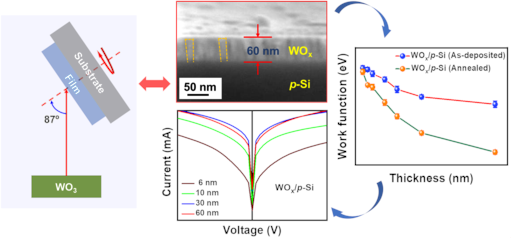
- [2]. WOx nanostructures, exhibiting high chemical and thermal stability, and structural flexibility, have obvious relevance in areas such as photocatalysis [22], electrochromism [23], supercapacitors [24], and lithium batteries [25] and have undergone extensive investigations during the last decades


Properties of tin oxide films grown by atomic layer deposition from tin tetraiodide and ozone
Beilstein J. Nanotechnol. 2023, 14, 1085–1092, doi:10.3762/bjnano.14.89
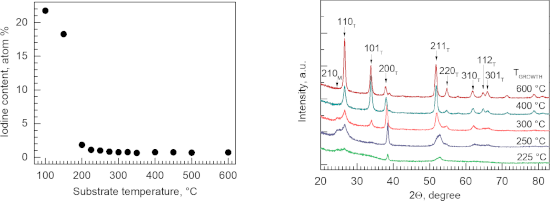
- have been studied from many perspectives. For example, one can mention anodes for Li-ion batteries [1], gas sensors [2], catalytic activities [3], and stable buffer [4] or base [5] layers in solar cells. More applications can be found, when SnO2 is considered as constituent of a nanostructure or a
- nanocomposite layer. ZrO2–SnO2 stacked layers have been shown to perform as mechanically elastic and magnetizable films [6]. SnO2-coated carbon nanotubes have been studied as catalysts [7] and ZnO–SnO2 as functional composite in Li-ion batteries [8]. A recent review article from 2022 lists 27 different


Isolation of cubic Si3P4 in the form of nanocrystals
Beilstein J. Nanotechnol. 2023, 14, 971–979, doi:10.3762/bjnano.14.80
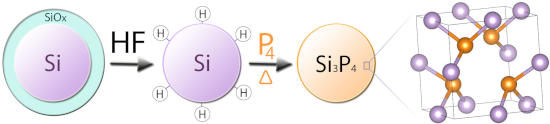
- precursor for diffusion doping of wafers and as anode material for Li-ion batteries. A similar method with a hydrogenation step offers the possibility to obtain other compounds, such as silicon selenides, arsenides, and sulfides. Keywords: ampoule annealing; defective zinc blende structure; DFT
- batteries. For the practical application of the materials, however, the problems of low conductivity and dramatic volume expansion of Si after full lithiation must still be solved [15]. To this end, silicon phosphides are actively studied. Layered silicon phosphide and diphosphide, for example, provide
- respect to the zinc blende structure. The expansion problem, however, is likely to be mitigated by the presence of interparticular voids, making the synthesized cubic Si3P4 nanocrystallites a prospective material for Li-ion batteries. Additionally, NPs may prove promising in the preparation of


In situ magnesiothermic reduction synthesis of a Ge@C composite for high-performance lithium-ion batterie anodes
Beilstein J. Nanotechnol. 2023, 14, 751–761, doi:10.3762/bjnano.14.62
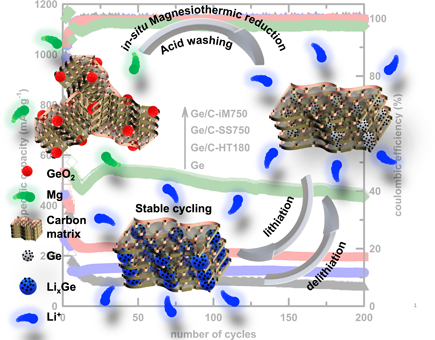
- report an in situ magnesiothermic reduction to synthesize a composite of Ge@C as an anode material for lithium-ion batteries. The obtained electrode delivered a specific capacity of 454.2 mAh·g−1 after 200 cycles at a specific current of 1000 mA·g−1. The stable electrochemical performance and good rate
- contact formation during in situ synthesis. Keywords: Ge anode; in situ synthesis; lithium-ion batteries; magnesiothermic reduction; Introduction The significantly increasing energy consumption leads to the exhaustion of fossil fuel sources such as coal, oil, and natural gas. Additionally, there are
- number of electric vehicles (EVs) [5][6]. The most important component of EVs are suitable energy storage systems, the further development of which will be key to a more widespread use of this kind of transportation [7]. Commercialized first by Sony company, lithium-ion batteries (LIBs) and related


Nanoarchitectonics for advanced applications in energy, environment and biology: Method for everything in materials science
Beilstein J. Nanotechnol. 2023, 14, 738–740, doi:10.3762/bjnano.14.60

- also discuss coordination-assembled myricetin nanoarchitectonics [32], nanoarchitectonics for membranes with enhanced gas separation capabilities [33], nanoarchitectonics of the cathode of Li–O2 batteries [34], nanoarchitectonics in moist-electric generation [35], nanoarchitectonics for drug delivery

The microstrain-accompanied structural phase transition from h-MoO3 to α-MoO3 investigated by in situ X-ray diffraction
Beilstein J. Nanotechnol. 2023, 14, 692–700, doi:10.3762/bjnano.14.55
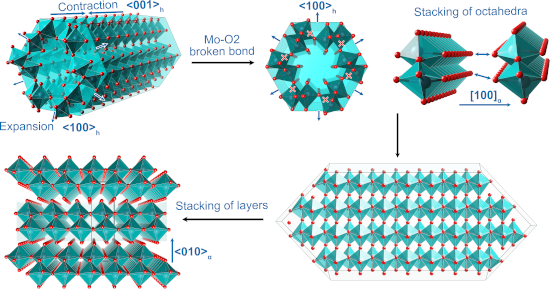
- , making them multifunctional electronic and optical materials for applications in ion batteries [3][4], lubricants [5], gas detectors [6][7], photochromism [8][9], photocatalysis [10][11], and superconductors [12][13]. The molybdenum oxide MoO3 can crystalize into several structures, including α-MoO3 [14


Utilizing the surface potential of a solid electrolyte region as the potential reference in Kelvin probe force microscopy
Beilstein J. Nanotechnol. 2022, 13, 1558–1563, doi:10.3762/bjnano.13.129
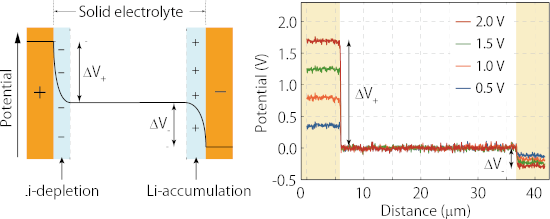
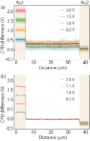
- , in the case of electrochemical devices such as batteries, the redox reactions that occur at the electrode are determined by the potential difference across the electrode–electrolyte interface, not the electrode potential relative to ground. This prevents the accurate consideration of redox reactions




Structural studies and selected physical investigations of LiCoO2 obtained by combustion synthesis
Beilstein J. Nanotechnol. 2022, 13, 1473–1482, doi:10.3762/bjnano.13.121
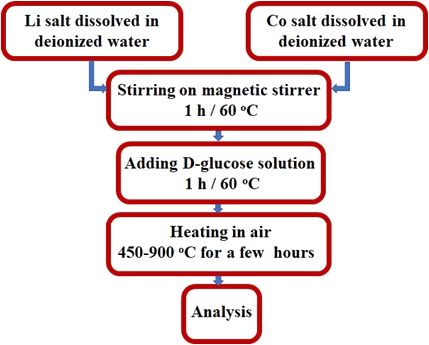
- capable of reversibly intercalating lithium ions [2]. The commercialization of lithium-ion cells was achieved in the early 1990s by Sony Corporation and in 1992 by a joint venture company (Asahi Kasai and Toshiba) [2][3][4]. Almost 90% of commercial Li-ion batteries consist of a lithium cobalt oxide
- conversion devices, such as Li-ion batteries, solar cells, solid oxide fuel cells, and thermoelectrics. Unusual and unexpected properties and also unique microstructures (and shapes), such as high porosity, high surface area, short reaction pathways, and diffusion length for Li-ion transport, eventually




Laser-processed antiadhesive bionic combs for handling nanofibers inspired by nanostructures on the legs of cribellate spiders
Beilstein J. Nanotechnol. 2022, 13, 1268–1283, doi:10.3762/bjnano.13.105
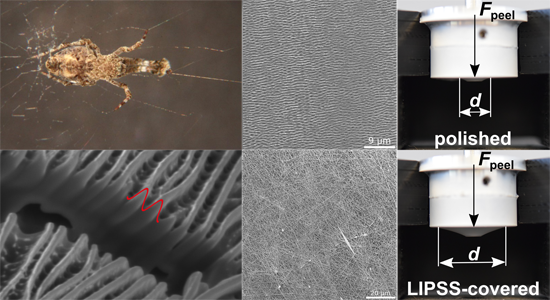
- .13.105 Abstract Nanofibers are drawing the attention of engineers and scientists because their large surface-to-volume ratio is favorable for applications in medicine, filter technology, textile industry, lithium-air batteries, and optical sensors. However, when transferring nanofibers to a technical
- applications in medicine, filter technology, textile industry, lithium-air batteries, and optical sensors [1][2][3][4][5][6][7]. The inherently small scale makes production as well as further processing of nanofibers challenging [8]. For the technical production of artificial nanofibers, different methods such








Role of titanium and organic precursors in molecular layer deposition of “titanicone” hybrid materials
Beilstein J. Nanotechnol. 2022, 13, 1240–1255, doi:10.3762/bjnano.13.103
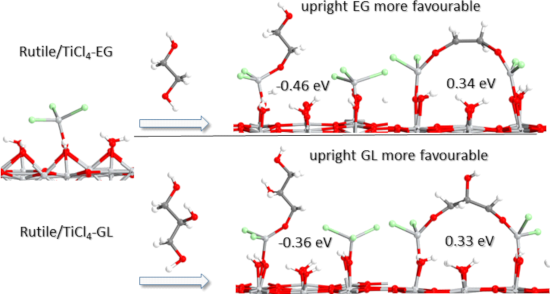
- organic–inorganic hybrid films for applications in several technological application areas, including packaging/encapsulation, electronics, batteries and biomedical applications [1][2][3][4]. MLD is very similar to the widely used atomic layer deposition (ALD) technique, which involves the fabrication of
- Li ion batteries or pseudocapacitance supercapacitors [31]. These films were also employed as coatings of nano Si electrodes and successfully improved their performance [48]. As described above, different titanicone and Ti–organic MLD processes have been developed and although first principles


Application of nanoarchitectonics in moist-electric generation
Beilstein J. Nanotechnol. 2022, 13, 1185–1200, doi:10.3762/bjnano.13.99
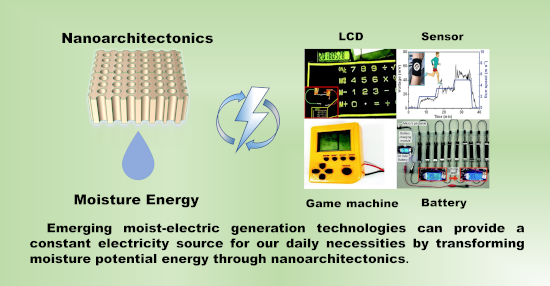
- , current MEGs can directly power low-power electronic devices such as LCDs and LEDs, or charge capacitors and batteries to drive higher-power devices (Figure 10a–d) [55][90]. Because MEG devices can be rapidly mass-fabricated by methods such as stencil printing [91], MEGs should become a strong candidate
- traditional chemical batteries. Therefore, the application and development of MEGs in the future should focus on miniaturization and increased power output. Also, MEGs can be used in a similar way to solar cells but with fewer limitations. It is probably not too long before MEGs will be successfully applied


Electrocatalytic oxygen reduction activity of AgCoCu oxides on reduced graphene oxide in alkaline media
Beilstein J. Nanotechnol. 2022, 13, 1020–1029, doi:10.3762/bjnano.13.89
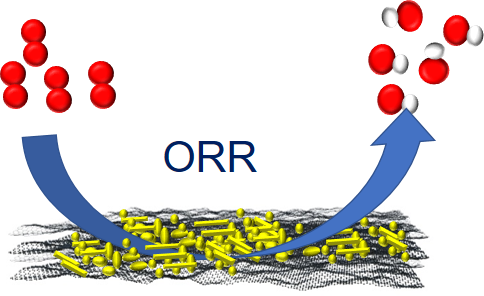
- ; microwave synthesis; oxygen electroreduction; reduced graphene oxide; silver NPs; Introduction Fuel cells and rechargeable metal–air batteries have become an integral part of the renewable energy system because of their superior efficiency, high power density, and reliability. Also, they are


Recent advances in nanoarchitectures of monocrystalline coordination polymers through confined assembly
Beilstein J. Nanotechnol. 2022, 13, 763–777, doi:10.3762/bjnano.13.67

- to form monocrystalline coordination polymers embedding a fast electron transfer route [110]. The mixed ion-electron of Prussian blue crystals could be significantly enhanced under low temperature (i.e., −20 °C), which is important for the use of batteries in cold regions. To encapsulate conductive
- the bottom of the reactor. Through this strategy, various networks with different compositions could be encapsulated into monocrystalline coordination polymers (Figure 4) [111]. The rate performance and cycling stability of sodium ion batteries, potassium ion batteries, and seawater batteries were
- single crystals could also serve as templates to derive microporous CoSe2@C, which was used as cathode for aluminum-ion batteries [119]. The connected macropores could facilitate the diffusion of large chloroaluminate anions and provide more exposed active sites, thus, showing excellent rate capacity






Nanoarchitectonics of the cathode to improve the reversibility of Li–O2 batteries
Beilstein J. Nanotechnol. 2022, 13, 689–698, doi:10.3762/bjnano.13.61
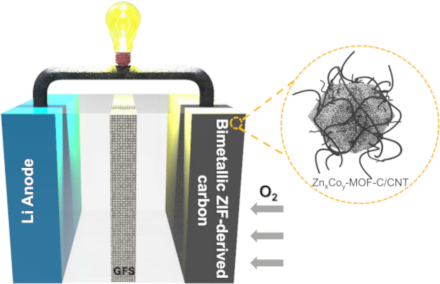
- -trip efficiency and cycling performance of nonaqueous lithium–oxygen batteries are governed by minimizing the discharge products, such as Li2O and Li2O2. Recently, a metal–organic framework has been directly pyrolyzed into a carbon frame with controllable pore volume and size. Furthermore, selective
- for lowering the overpotential of the cathode during cycling, even at the high current density of 2,000 mA·g−1. Keywords: cathode composition; electrochemistry; Li–O2 battery; metal–organic framework; nanoarchitectonics; zeolitic imidazolate framework; Introduction Recently, lithium–oxygen batteries
- (LOBs) have received great attention as a future energy storage solution since they offer a tremendously high energy density compared to commercial lithium-ion batteries (LIBs) [1][2]. An aprotic LOB is composed of a porous air cathode and a metallic Li anode, which are separated by a porous separator



Piezoelectric nanogenerator for bio-mechanical strain measurement
Beilstein J. Nanotechnol. 2022, 13, 192–200, doi:10.3762/bjnano.13.14
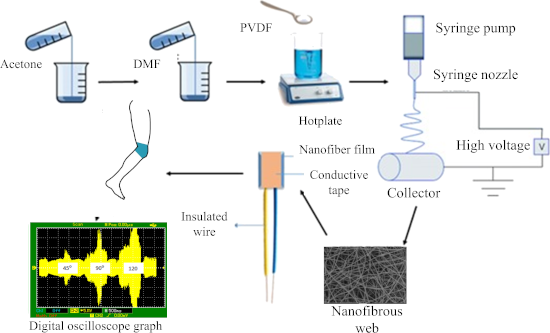
- posture, shape, and gesture. They primarily focused on studying a leg pad that was able to perceive the knee movement and posture [10]. Piezoelectric sensors have a wide range of applications including sidewalks or crosswalks that collect energy from vibrations, which can be store in batteries [11


A comprehensive review on electrospun nanohybrid membranes for wastewater treatment
Beilstein J. Nanotechnol. 2022, 13, 137–159, doi:10.3762/bjnano.13.10
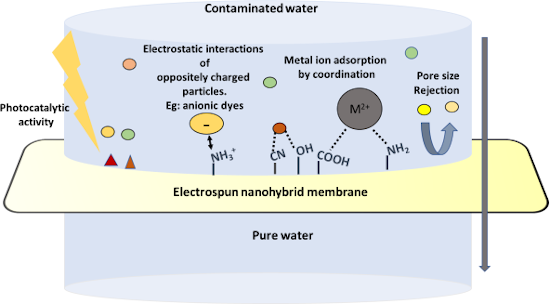
- predominant PEMs [13]. Zhang et al. developed nanohybrid PVDF membranes by incorporating zeolite with enhanced thermal and electrochemical performance for lithium-ion batteries [14]. ENHs have also been used as a heterogeneous catalyst in indole synthesis by Savva et al. by incorporating gold nanoparticles





Tin dioxide nanomaterial-based photocatalysts for nitrogen oxide oxidation: a review
Beilstein J. Nanotechnol. 2022, 13, 96–113, doi:10.3762/bjnano.13.7
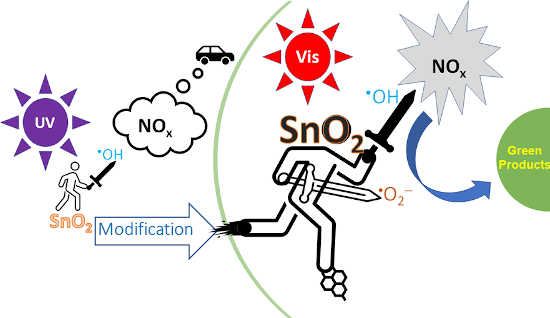
- vacancy defects (OVs) [15][16]. Therefore, SnO2 is considered a potential material in various technological fields such as catalysis, optoelectronic devices, rechargeable lithium batteries, electrocatalysis, photocatalysis, solar energy conversion, and gas sensing [17][18][19][20][21][22][23][24]. In the


Electrical, electrochemical and structural studies of a chlorine-derived ionic liquid-based polymer gel electrolyte
Beilstein J. Nanotechnol. 2021, 12, 1252–1261, doi:10.3762/bjnano.12.92
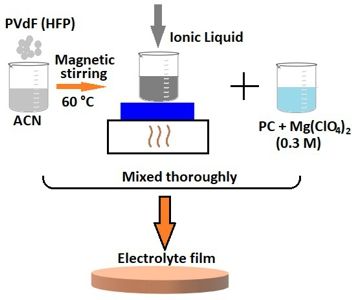
- , researchers have been developing polymer electrolytes (solid/gel) as an alternative to commercial liquid-based electrolytes which are suitable for electrochemical devices, such as Li-ion batteries, solar cells, fuel cells, and supercapacitors [1][2][3][4][5]. The main aim is to increase the amorphous content



Morphology-driven gas sensing by fabricated fractals: A review
Beilstein J. Nanotechnol. 2021, 12, 1187–1208, doi:10.3762/bjnano.12.88











The effect of cobalt on morphology, structure, and ORR activity of electrospun carbon fibre mats in aqueous alkaline environments
Beilstein J. Nanotechnol. 2021, 12, 1173–1186, doi:10.3762/bjnano.12.87
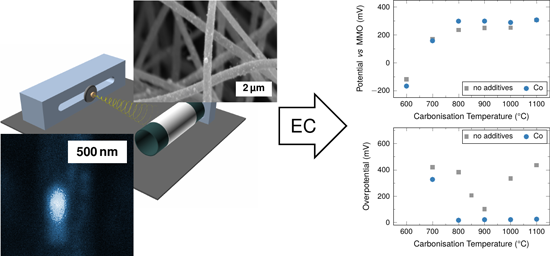
- , Institute of Physical Chemistry, 52056 Aachen, Germany IM2NP, CNRS, Aix-Marseille Université, Université de Toulon, Toulon, France 10.3762/bjnano.12.87 Abstract An innovative approach for the design of air electrodes for metal–air batteries are free-standing scaffolds made of electrospun polyacrylonitrile
- at an overpotential of 100 mV and low overpotentials at current densities of 333 μA·cm−2 were found for all electrodes made from cobalt-decorated fibre mats carbonised at temperatures between 800 and 1000 °C. Keywords: carbon fibres; cobalt-decorated fibres; electrospinning; metal–air batteries
- batteries based on zinc or iron anodes are such promising systems due to their high specific energy densities of [2] for zinc and [2] for iron. However, even with increasing research effort over the past decades, these systems do not live up to their potential; the performance of the cathodes limits the


Progress and innovation of nanostructured sulfur cathodes and metal-free anodes for room-temperature Na–S batteries
Beilstein J. Nanotechnol. 2021, 12, 995–1020, doi:10.3762/bjnano.12.75
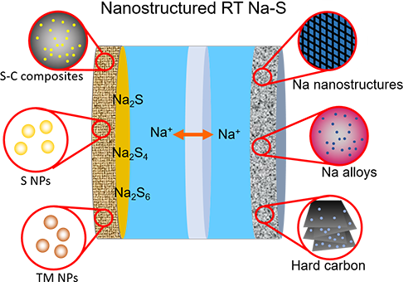
- Marina Tabuyo-Martinez Bernd Wicklein Pilar Aranda Instituto de Ciencia de Materiales de Madrid (ICMM), Consejo Superior de Investigaciones Científicas (CSIC), 28049 Madrid, Spain 10.3762/bjnano.12.75 Abstract Rechargeable batteries are a major element in the transition to renewable energie
- systems, but the current lithium-ion battery technology may face limitations in the future concerning the availability of raw materials and socio-economic insecurities. Sodium–sulfur (Na–S) batteries are a promising alternative energy storage device for small- to large-scale applications driven by more
- favorable environmental and economic perspectives. However, scientific and technological problems are still hindering a commercial breakthrough of these batteries. This review discusses strategies to remedy some of the current drawbacks such as the polysulfide shuttle effect, catastrophic volume expansion




A Au/CuNiCoS4/p-Si photodiode: electrical and morphological characterization
Beilstein J. Nanotechnol. 2021, 12, 984–994, doi:10.3762/bjnano.12.74
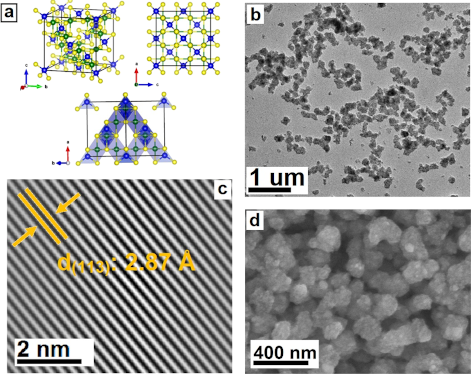
- great attention due their unique electronic, magnetic, optical, and gas sensing properties. Spinel compounds can be employed in data storage applications, lithium-ion batteries, gas sensors, and medical diagnostics [1][2]. Spinels have a cubic crystal structure with the general chemical formula AB2X4
- to their remarkable crystal, electric, thermoelectric, magnetic, and optical properties [6][7]. There are many studies on the usage of thiospinels in batteries, super-capacitors, and electrochemical reactions [8][9][10][11][12]. However, there are only two studies on the synthesis and application of



Recent progress in actuation technologies of micro/nanorobots
Beilstein J. Nanotechnol. 2021, 12, 756–765, doi:10.3762/bjnano.12.59
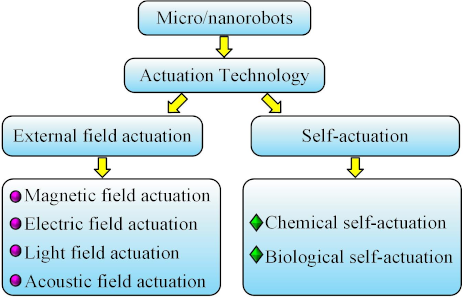
- dominant, and the inertial force is negligible. Hence, micro/nanorobots must be continuously powered for actuation. However, due to the tiny size, power sources such as batteries and engines are difficult to be loaded on micro/nanorobots. Therefore, actuation technologies have been a core content of


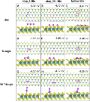
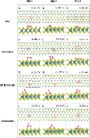
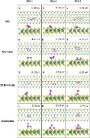
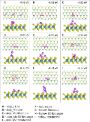
Prediction of Co and Ru nanocluster morphology on 2D MoS2 from interaction energies
Beilstein J. Nanotechnol. 2021, 12, 704–724, doi:10.3762/bjnano.12.56
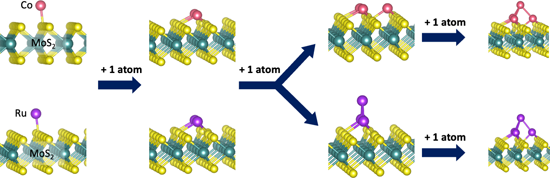
- can be exfoliated into 2D sheets continue to generate significant interest across various disciplines, including batteries [1][2], catalysis [3][4], electronics [5][6][7][8][9][10], photonics [11][12], and sensors [13][14][15][16]. This is due in part to the interesting properties of these 2D



Nanogenerator-based self-powered sensors for data collection
Beilstein J. Nanotechnol. 2021, 12, 680–693, doi:10.3762/bjnano.12.54
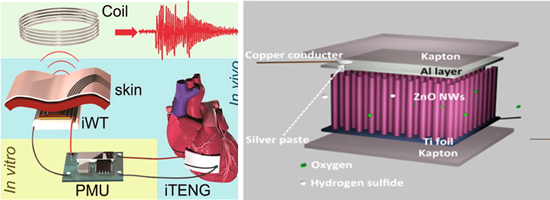
- accelerator pedal under different road conditions [8]. Thus, TENG-based warning and brake systems may be designed for future autonomous vehicles. Intelligent transportation is emerging with the development of IoT technology [106]. Traditional sensor networks are powered by batteries or energy grids. Thus, the