


Search results
Search for "electrical resistance" in Full Text gives 82 result(s) in Beilstein Journal of Nanotechnology.
Multiwalled carbon nanotube based aromatic volatile organic compound sensor: sensitivity enhancement through 1-hexadecanethiol functionalisation
Beilstein J. Nanotechnol. 2019, 10, 2364–2373, doi:10.3762/bjnano.10.227
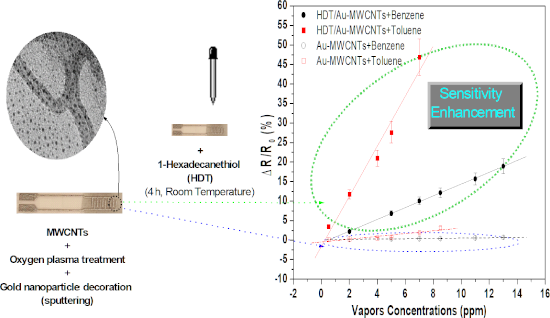
- ., single-wall carbon nanotube (SWCNT), multiwall carbon nanotube (MWCNT), graphene, graphene oxide (GO)) present a sensitive active layer exhibiting an electrical resistance change while in contact with the target gas due to interactions at the molecular level [7][8]. These interactions, depending whether
- operating frequency of 1 kHz. Once a stable electrical resistance was achieved in the presence of the carrier gas (pure dry air, purchased from Air Liquide), we injected the adequate concentration of the target VOC. The flow rate was set to 200 standard cubic centimetres per minute. All measurements were




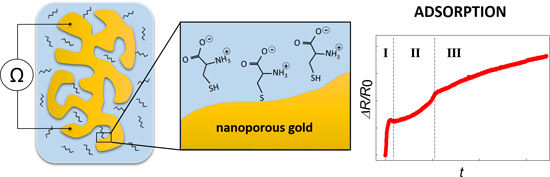
Adsorption and desorption of self-assembled L-cysteine monolayers on nanoporous gold monitored by in situ resistometry
Beilstein J. Nanotechnol. 2019, 10, 2275–2279, doi:10.3762/bjnano.10.219
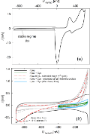
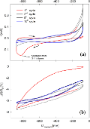
- 20 μF/cm2 (Figure 2b, solid blue curve), which is still significantly lower than the initial value. The relative change in electrical resistance during cysteine desorption from the (111) planes and subsequent cycling between −900 and −50 mV was monitored in situ for sample B, as shown in Figure 3. It
- cysteine concentration in solution, which would affect the time period of the adsorption [24], and the pH value of the solution, which would impact the stability of the SAMs [25], could be examined further. Relative change in electrical resistance measured in situ during the exposure of npAu in 20 mM
- ]. The blue solid curve was recorded after the dashed curves. All CVs were conducted in 1 M KOH at a scan rate of 1 mV/s. Please note the change in x-axis scale between (a) and (b). Cyclic voltammetry of sample B modified with cysteine (a) and concomitantly measured change in relative electrical

High-temperature resistive gas sensors based on ZnO/SiC nanocomposites
Beilstein J. Nanotechnol. 2019, 10, 1537–1547, doi:10.3762/bjnano.10.151
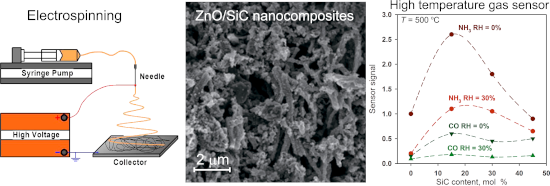
- silicon in the ZnO/SiC_15 nanocomposite. The formation of nanocomposites is accompanied by a significant increase in the electrical resistance of the material, in comparison with ZnO nanofibers, over the entire temperature range studied (Table 1). The resistance of SiC under these conditions is in the
- SiC content in nanocomposites (within the error, Table 1). The growth of the electrical resistance and Ea can be associated with an increase in the concentration of surface oxygen species (confirmed by XPS), which form different acceptor levels at the ZnO surface and at the ZnO/SiC heterojunction. The



Selective gas detection using Mn3O4/WO3 composites as a sensing layer
Beilstein J. Nanotechnol. 2019, 10, 1423–1433, doi:10.3762/bjnano.10.140
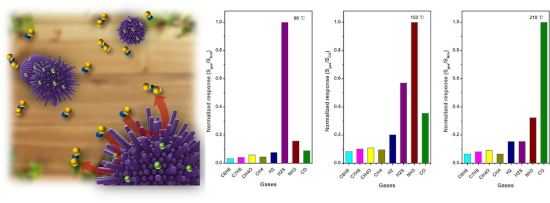
- was defined as: Here, Ra and Rg are the electrical resistance when the sensor is in air or exposed to the target gas, respectively. The time required for the sensor resistance decrease to 10% or recover to 90% of the original value is called response and recovery time, respectively. (a) XRD patterns


Gas sensing properties of individual SnO2 nanowires and SnO2 sol–gel nanocomposites
Beilstein J. Nanotechnol. 2019, 10, 1380–1390, doi:10.3762/bjnano.10.136
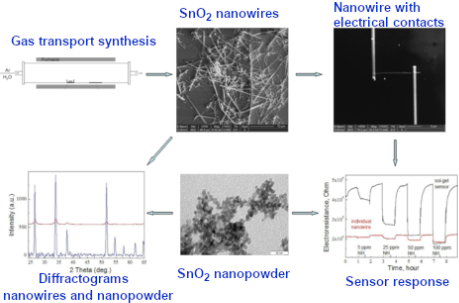
- , while the inner pair is used for the measurement of the electrical potential drop. This 4-electrode scheme of electrical resistance measurement improves the quality of sensor response detection. In spite of the large number of works dedicated to the use of nanowires as conductometric gas sensors, these
- manufactured by the sol–gel method is several times higher than that of the individual nanowire device. The sensor response, S, is defined as the relative difference of electrical resistance: where R0 is the sensor resistance in air, and Rx is the resistance when exposed to ambient in the explored medium. The




Effects of gold and PCL- or PLLA-coated silica nanoparticles on brain endothelial cells and the blood–brain barrier
Beilstein J. Nanotechnol. 2019, 10, 941–954, doi:10.3762/bjnano.10.95
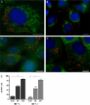
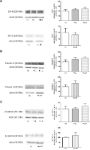
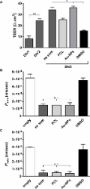
- blood–brain barrier permeability rBCEC4 cells were grown on filter insert membranes to allow for the investigation of NP effects on BBB permeability. The transport of two tracers across the cell monolayer and transendothelial electrical resistance (TEER) were measured. TEER measurements showed a
- formation on DIV3. Except for control filters, cells were exposed for 24 h to either PCL- or Au-NPs or stimulated with 10% DMSO (positive control) on DIV2. Transendothelial electrical resistance (TEER) was measured on DIV1 to DIV3 using the Millicell ERS-2 volt ohm meter (Merck Millipore, Germany). TEER



In situ AFM visualization of Li–O2 battery discharge products during redox cycling in an atmospherically controlled sample cell
Beilstein J. Nanotechnol. 2019, 10, 930–940, doi:10.3762/bjnano.10.94
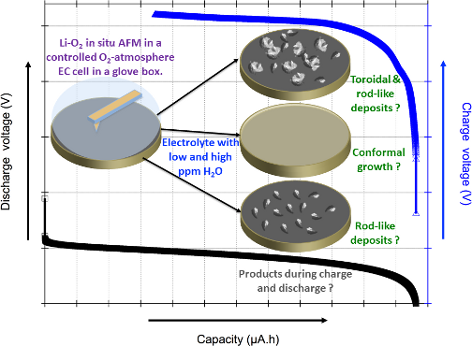
- and the potentiostat inputs. The electrical resistance between them was <10 ohms. This low resistance allowed us to perform EIS. The cell was placed in a glass enclosure on the AFM. A leak-free ultrapure oxygen line from a custom designed glove box flange was connected to the cell enclosure of the AFM


Wearable, stable, highly sensitive hydrogel–graphene strain sensors
Beilstein J. Nanotechnol. 2019, 10, 475–480, doi:10.3762/bjnano.10.47
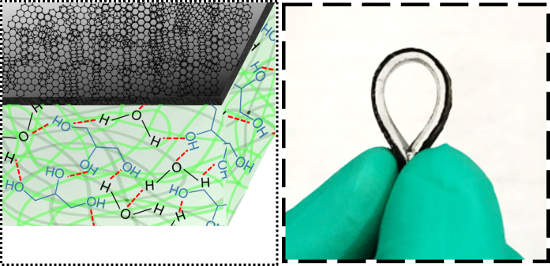
- after the drying of the graphene solution. The sensing performance of the graphene/WG-hydrogel composite material is shown in Figure 3a. The sensitivity of the graphene/WG-hydrogel composite sensor, represented by the gauge factor (the ratio of the relative electrical resistance change ΔR/R to the


Wet chemistry route for the decoration of carbon nanotubes with iron oxide nanoparticles for gas sensing
Beilstein J. Nanotechnol. 2019, 10, 105–118, doi:10.3762/bjnano.10.10
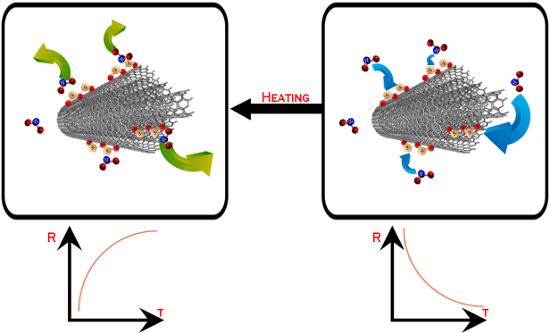
- electrical resistance against time. Nitrogen dioxide was found to strongly interact with carbon nanotube sensors, and as a result, the sensors did not fully recover their baseline resistance value during the cleaning phase, which was conducted at room temperature without heating. Applying mild heating or UV
- an increase in the electrical resistance of the active layer. This fact can be attributed to the p–n junctions formed between the p-type CNTs and the n-type iron oxide nanoparticles, with the formation of associated depletion layers. The p-type behavior of the decorated nanotubes suggests that, when
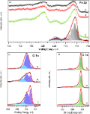
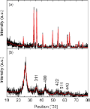
- of Fe 2p with a fitting curve for sample C (a), O 1s (b) and C 1s (c) for the samples A (black curve), B (red curve) and C (green curve). The C 1s spectra has been normalized and aligned. XRD pattern for Fe2O3 nanoparticles (a) and decorated CNTs with Fe2O3 nanoparticles (b). Electrical resistance of




Bidirectional biomimetic flow sensing with antiparallel and curved artificial hair sensors
Beilstein J. Nanotechnol. 2019, 10, 32–46, doi:10.3762/bjnano.10.4
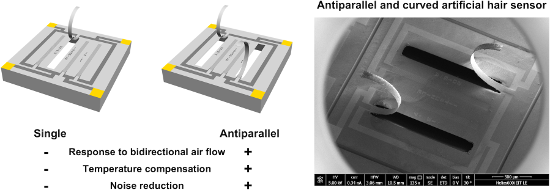
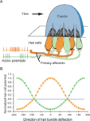
- sensitivity or best direction. Depolarising events are associated with decreasing membrane electrical resistance while hyperpolarization responses with an increase in membrane electrical resistance [15]. A new flow stimulus which occurs on top of already existing flow is difficult to decouple using one sensor
- electrical resistance even at the tiniest stretching and compressing of the beam. A built-in Wheatstone bridge circuit, which implements a half-bridge strain gauge configuration, maximizes the signal transduction and provides measurable differences in voltage proportional to the deformation of the beams
- strain gauge thickness is expected, which in turn decreases the electrical resistance. For a previously described cantilever beam under maximal compression in nitrogen flow, the least possible resistance value was found to be approximately 0.07% smaller than the resistance value in resting, bent position


Graphene-enhanced metal oxide gas sensors at room temperature: a review
Beilstein J. Nanotechnol. 2018, 9, 2832–2844, doi:10.3762/bjnano.9.264
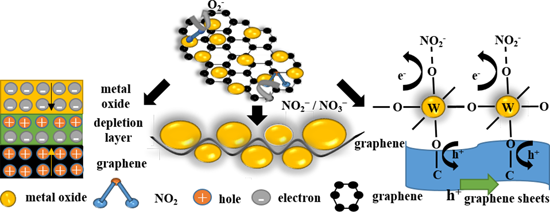
- exposed to oxidizing gases, increasing the electrical resistance. The gas molecules act as electron donors to the semiconductors when exposed to reducing gases, meaning that the width of electron depletion layer decreases, which decreases the resistance of the sensor. For p-type semiconductors, the width



Electrical characterization of single nanometer-wide Si fins in dense arrays
Beilstein J. Nanotechnol. 2018, 9, 1863–1867, doi:10.3762/bjnano.9.178
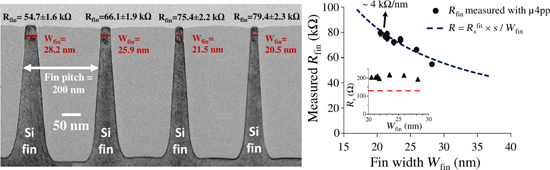
- with a high precision. Finally, we use the technique to determine the electrical resistance of individual fins in a dense array and we demonstrate that the measured resistance correlates with the geometrical width of the fins, as measured with transmission electron microscopy (TEM). Due to the
- ) larger than dcontact, the procedure is identical to the previously described case of blanket materials. The electrical contact is indeed created, i.e., contacts j = 1, 2, 3, 4 are activated, when Ipulse ≥ Ithreshold and the electrical resistance Rfin of the region of the fin included between the two


Surface-plasmon-enhanced ultraviolet emission of Au-decorated ZnO structures for gas sensing and photocatalytic devices
Beilstein J. Nanotechnol. 2018, 9, 771–779, doi:10.3762/bjnano.9.70
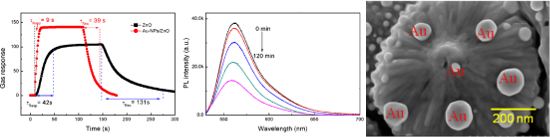
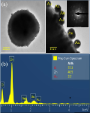
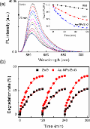
- effective surfaces. The adsorbed oxygen species can be easily captured by the electrons from the conduction band and adsorbed onto the surface, leading to a depletion region that broadens again, and thus the electrical resistance of the sensor increases. By decorating the ZnO nanostructures with plasmonic




Review: Electrostatically actuated nanobeam-based nanoelectromechanical switches – materials solutions and operational conditions
Beilstein J. Nanotechnol. 2018, 9, 271–300, doi:10.3762/bjnano.9.29
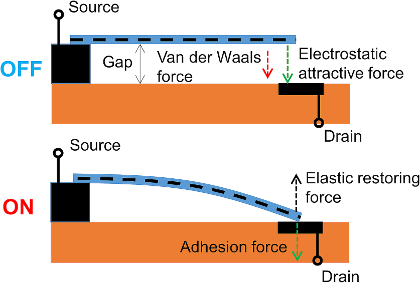
- concluding subsection. Metals Metal–metal contacts in NEM switches are particularly advantageous for radio frequency (RF) applications due to their low electrical resistance. Experimental studies of elastic properties of metals, supported by atomistic simulations, have revealed several different ways the


Comparative study of post-growth annealing of Cu(hfac)2, Co2(CO)8 and Me2Au(acac) metal precursors deposited by FEBID
Beilstein J. Nanotechnol. 2018, 9, 91–101, doi:10.3762/bjnano.9.11
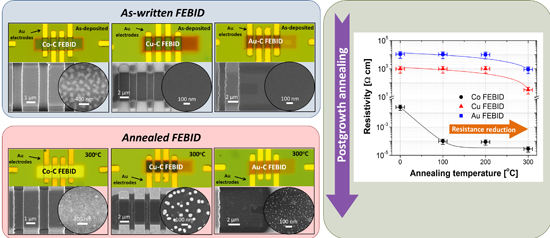
- removing the carbon matrix and drastically reducing the electrical resistance of the deposit. Keywords: copper; gold; cobalt; focused-electron-beam-induced deposition; noble metal; non-noble metals; post-growth annealing; Introduction Focused-electron-beam-induced deposition (FEBID) constitutes a well
- precursor flux, under a pressure of around 3 × 10⁻⁵ mbar. Furthermore, for the H2-assisted purification of Au–C deposits, a 200 ppm H2 atmosphere was utilized while the sample was heated from room temperature to 360 °C over a period of 6.5 h. The electrical resistance was monitored in situ using a two-wire
- increment (Figure 5a). The electrical resistance, which was monitored with a two-wire setup, monotonically decreased three orders of magnitude during this annealing procedure. The initial resistance of 2 GΩ decreased down to around 500 MΩ below 300 °C, where it abruptly decreases to 2 MΩ. Then, as the


Gas-sensing behaviour of ZnO/diamond nanostructures
Beilstein J. Nanotechnol. 2018, 9, 22–29, doi:10.3762/bjnano.9.4
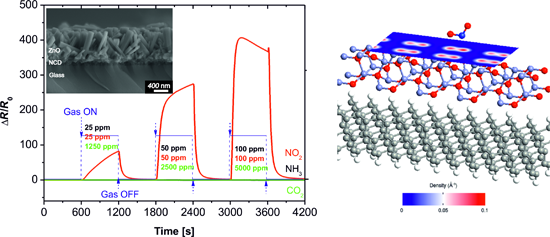
- tube (λ = 0.178901 nm) and Göbel mirror in primary beam and parallel plate collimator with divergence 0.09° in diffracted beam were used. The gas sensing experiments for all sensor designs were performed in an airtight chamber with electrical feedthroughs. The electrical resistance of the sensor


The role of ligands in coinage-metal nanoparticles for electronics
Beilstein J. Nanotechnol. 2017, 8, 2625–2639, doi:10.3762/bjnano.8.263
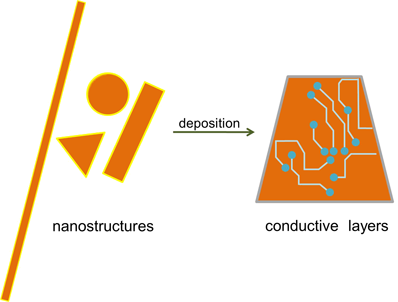
- interface, and transferred to a substrate by using a Langmuir–Blodgett trough. The single-layer nanomembrane that formed on the water surface had excellent optical transmittance of 90–97% and an electrical resistance of 1.14 × 10⁶ Ω/sq; it reacted to mechanical bending with a 14% increase in resistance


Au nanostructure fabrication by pulsed laser deposition in open air: Influence of the deposition geometry
Beilstein J. Nanotechnol. 2017, 8, 2438–2445, doi:10.3762/bjnano.8.242
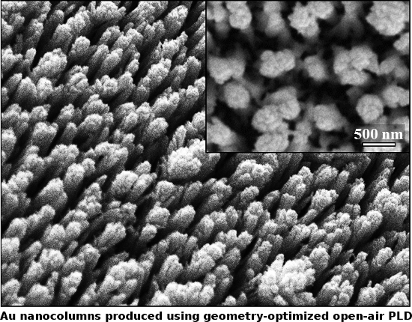
- conductive properties of the structures produced, we measured their electrical resistance. Table 2 shows the electrical resistance of the Au samples discussed in this study. As can be seen, the open-air laser deposition resulted in the formation of conductive structures. The resistance of the structures was
- measured in the range from a few ohms to several kΩ. It was found that the electrical properties of nanostructures produced by PLD in open air strongly depend on the density and morphology of the structure. The columnar structure presented in Figure 4c demonstrates an electrical resistance twice as a high
- adequate simulation based on thermal effects cannot be performed due to the complicated morphology and unknown thermophysical parameters values of the produced structures. It should be mentioned that the observed effect is more pronounced for the samples with electrical resistance in the range of kΩ


Process-specific mechanisms of vertically oriented graphene growth in plasmas
Beilstein J. Nanotechnol. 2017, 8, 1658–1670, doi:10.3762/bjnano.8.166
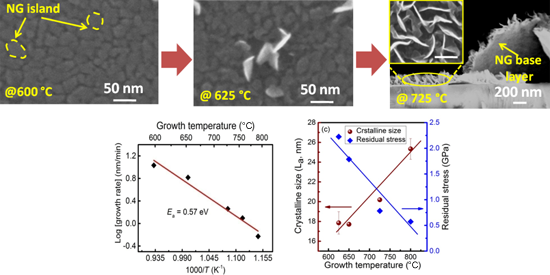
- transmission electron microscopy (HRTEM) and Raman spectroscopy. Contact angle and electrical resistance measurements of the VGNs are carried out as well. Results and Discussion Growth and optimization Case I: Influence of growth temperature We investigated the early-stage nucleation and growth of VGNs over a


Low uptake of silica nanoparticles in Caco-2 intestinal epithelial barriers
Beilstein J. Nanotechnol. 2017, 8, 1396–1406, doi:10.3762/bjnano.8.141
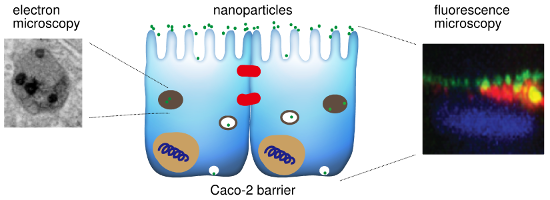
- . Transepithelial electrical resistance (TEER) was used to further confirm barrier formation and test the integrity of the barriers before and after exposure to the nanoparticles. TEER measurements confirmed that the Caco-2 cell-monolayers exerted high resistance values (up to 1000 Ω·cm2 on a 12-well transwell



BTEX detection with composites of ethylenevinyl acetate and nanostructured carbon
Beilstein J. Nanotechnol. 2017, 8, 982–988, doi:10.3762/bjnano.8.100
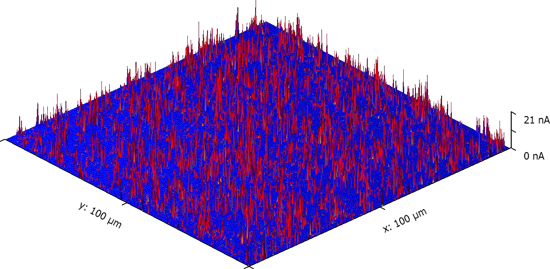
- specialized sample holder and an Agilent 34972A (Keysight 34972A data acquisition/data logger switch unit) were used to measure the electrical resistance of the sample during the tests. The Agilent 34972A also was used for gasoline and ethylbenzene vapour measurements. The composite was characterized using
- change of the electrical resistance is measured when VOC vapours are applied in a certain concentration for a certain amount of time. Stage 3 is the relaxation: The electrical resistance gradually decreases to the initial value. During the three stages the relative change of the electrical resistance
- varies as shown in Figure 2. The highest peak of this curve is marked as ΔR/R0 max. This is the maximal relative change of the electrical resistance at the end of the exposure time, for example, at 60 s. By changing the exposure time, the value of ΔR/R0 max and the relaxation time will change. If the


Synthesis of coaxial nanotubes of polyaniline and poly(hydroxyethyl methacrylate) by oxidative/initiated chemical vapor deposition
Beilstein J. Nanotechnol. 2017, 8, 872–882, doi:10.3762/bjnano.8.89
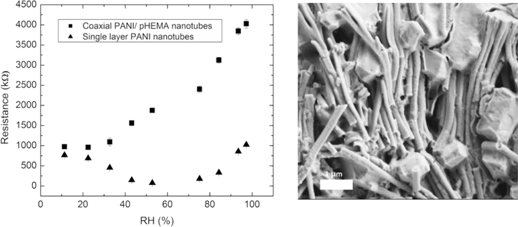
- humidity increased due to charge transfer between CeO2 and PANI. However, incorporating CeO2 in the polymer decreases flexibility and increases the overall electrical resistance, which may limit the range of applications. Lin et al. [35] fabricated electrospun PANI nanofibers and introduced hydrophilic


Synthesis of graphene–transition metal oxide hybrid nanoparticles and their application in various fields
Beilstein J. Nanotechnol. 2017, 8, 688–714, doi:10.3762/bjnano.8.74
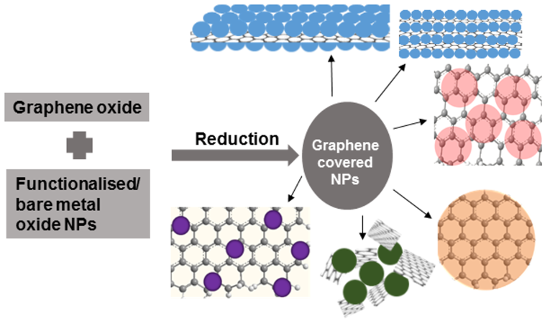
- material for both organic and aqueous LIB owing to high capacity, unique structure and suitable electrode potential. However, its cyclic performance is limited by its high charge-transfer resistance. The incorporation of graphene solves its electrical resistance problem with the VO2 electrodes and it acts






Gas sensing properties of MWCNT layers electrochemically decorated with Au and Pd nanoparticles
Beilstein J. Nanotechnol. 2017, 8, 592–603, doi:10.3762/bjnano.8.64
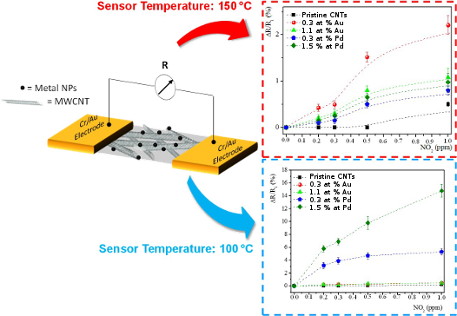
- and active layer surface. The response at a defined gas concentration was evaluated as the relative resistance variation in percentage, ΔR/Ri (%), where ΔR is the resistance variation between the values of the steady-state of the electrical resistance of the sensor under the target gas and under the
- conductivity of MWCNTs [46]. This results in the consequent lowering of the energy barrier, and therefore, a decrease of the sensing response [47][48]. Considering the specific optimum operating temperature of each hybrid sensing system, the sensing response, in terms of electrical resistance variation (ΔR
- ), towards NO2 of pristine and metal-doped MWCNTs at 150 °C and 100 °C are reported in Figure 6A,B, and Figure 7A,B, respectively. In all cases, at both operating temperatures, the sensing response, in terms of electrical resistance change (ΔR), of functionalized MWCNTs is higher compared to pristine MWCNTs


Anodization-based process for the fabrication of all niobium nitride Josephson junction structures
Beilstein J. Nanotechnol. 2017, 8, 539–546, doi:10.3762/bjnano.8.58
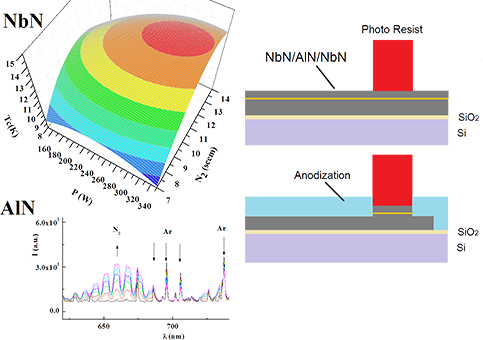
- function of the dc power applied on the target and the N2 flux inlet in the deposition chamber for 40 different recipes. Tc is the temperature for which the electrical resistance, measured with the four-point probe technique, drops to zero. We have fabricated more than 100 films with a thickness maintained





