


Search results
Search for "electron energy loss spectroscopy" in Full Text gives 48 result(s) in Beilstein Journal of Nanotechnology.
Possibilities and limitations of advanced transmission electron microscopy for carbon-based nanomaterials
Beilstein J. Nanotechnol. 2015, 6, 1541–1557, doi:10.3762/bjnano.6.158
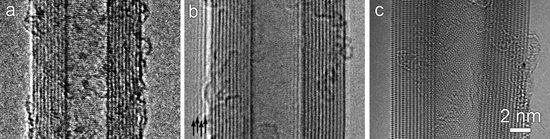
- , different from optical microscopes, accelerated electrons carry high energy and interact with the material in a highly dynamic manner. Elastically scattered electrons, inelastically scattered electrons (for electron energy loss spectroscopy, i.e., EELS) and X-rays (for energy dispersive X-ray spectroscopy


Formation of pure Cu nanocrystals upon post-growth annealing of Cu–C material obtained from focused electron beam induced deposition: comparison of different methods
Beilstein J. Nanotechnol. 2015, 6, 1508–1517, doi:10.3762/bjnano.6.156
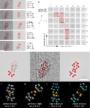
- ) images were taken at 200 keV. Selected area diffraction (SAD) was taken using the second smallest selected area aperture corresponding to an area of 400 nm in diameter on the sample. Chemical mapping was obtained using electron energy loss spectroscopy (EELS) operated in the scanning TEM (STEM) mode. The
- resistance measurement. Supporting Information Supporting Information features additional information about the chemical mapping with electron energy loss spectroscopy, the estimation of Cu precipitation on deposit, and the distribution of Cu nanocrystals along the Cu–C lines after conventional and IR laser




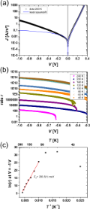
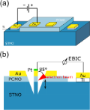
Current–voltage characteristics of manganite–titanite perovskite junctions
Beilstein J. Nanotechnol. 2015, 6, 1467–1484, doi:10.3762/bjnano.6.152
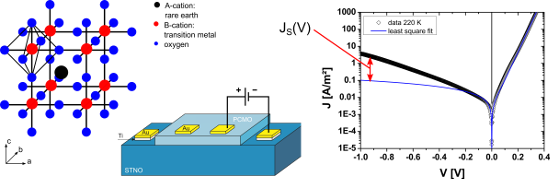
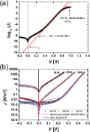
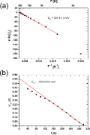
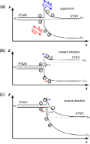
- width of the SCR is on the order of one unit cell or even less, the rigid band model is not applied. Nevertheless, the calculated values roughly agree with the band bending region deduced from electron energy loss spectroscopy [22]. The strength of the electron lattice coupling also strongly affects the





Influence of the shape and surface oxidation in the magnetization reversal of thin iron nanowires grown by focused electron beam induced deposition
Beilstein J. Nanotechnol. 2015, 6, 1319–1331, doi:10.3762/bjnano.6.136
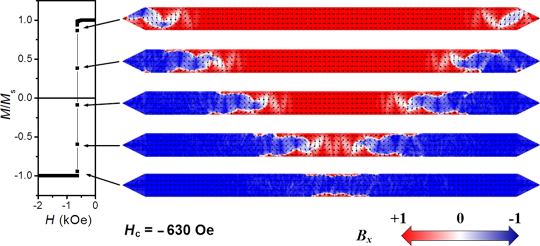
- microstructure were determined by bright field (BF) TEM and high resolution TEM (HRTEM) imaging, and chemical composition of the sections was determined by combining high angle annular dark field (HAADF) imaging and electron energy loss spectroscopy (EELS) in scanning transmission electron microscopy (STEM) mode


Surface excitations in the modelling of electron transport for electron-beam-induced deposition experiments
Beilstein J. Nanotechnol. 2015, 6, 1260–1267, doi:10.3762/bjnano.6.129
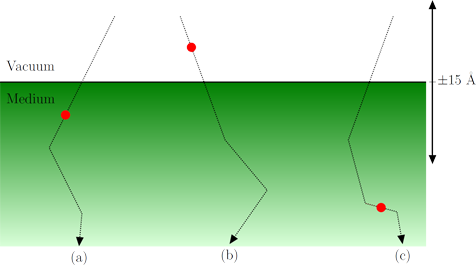
- , including a number of spectroscopies (electron-energy-loss spectroscopy, X-ray photoelectron spectroscopy, and Auger-electron spectroscopy), electron microscopy, and the focused-electron-beam-induced deposition (FEBID) of nanostructures, on which we focus here. This technique employs beams of focussed


Applications of three-dimensional carbon nanotube networks
Beilstein J. Nanotechnol. 2015, 6, 792–798, doi:10.3762/bjnano.6.82

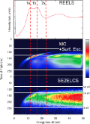
- studies described in [13]. SEM micrographs obtained at higher magnification evidence the presence of interconnected and curled CNTs as shown in Figure 2b. The electron energy loss spectroscopy analysis performed in reflection mode further supports the predominance of C-sp2 hybridization in the nanotubes


Tm-doped TiO2 and Tm2Ti2O7 pyrochlore nanoparticles: enhancing the photocatalytic activity of rutile with a pyrochlore phase
Beilstein J. Nanotechnol. 2015, 6, 605–616, doi:10.3762/bjnano.6.62
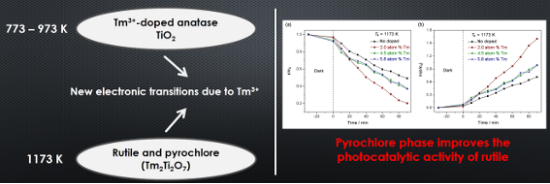
- , solid state, 532 nm laser (CNI, MSL-III-532nm-50mW). The Raman study was carried out using a portable system (B&W Tek Raman, i-Raman) equipped with a diode laser (BAC100-785C, 785 nm) as an illumination source. Additionally, transmission electron microscopy (TEM) imaging and electron energy loss
- spectroscopy (EELS) analysis were carried out on samples of different Tm concentrations (2 and 5.8 atom %) which underwent different annealing conditions in order to evaluate the Tm distribution in the nanoparticle. As EELS provides information relating the material with the resulting electron inelastic


Overview of nanoscale NEXAFS performed with soft X-ray microscopes
Beilstein J. Nanotechnol. 2015, 6, 595–604, doi:10.3762/bjnano.6.61
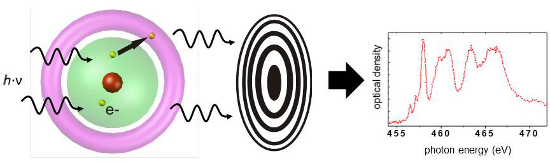
- spectromicroscopy having the capability of offering both spatial and chemical/physical information opens avenues for detailed characterization of nanostructures. Other spatially resolved techniques or spectromicroscopy as, e.g., electron energy loss spectroscopy (EELS) [14] have been chosen to study individual
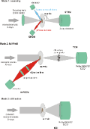


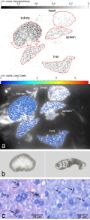
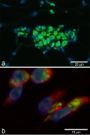
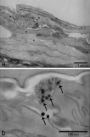
Overview about the localization of nanoparticles in tissue and cellular context by different imaging techniques
Beilstein J. Nanotechnol. 2015, 6, 263–280, doi:10.3762/bjnano.6.25
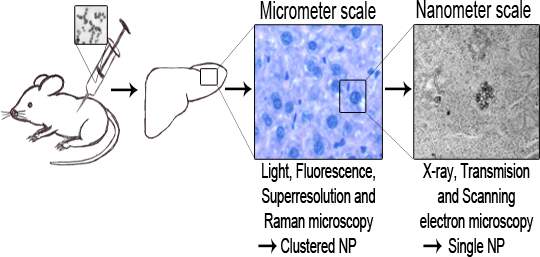
- microscope [35]. Energy dispersive X-ray (EDX) analysis and electron energy loss spectroscopy (EELS) allow one to identify the elemental composition of a sample [167][168]. An elemental analysis may be of prime interest to distinguish NP in the tissue from artifacts that may be produced by staining



X-ray photoelectron spectroscopy of graphitic carbon nanomaterials doped with heteroatoms
Beilstein J. Nanotechnol. 2015, 6, 177–192, doi:10.3762/bjnano.6.17
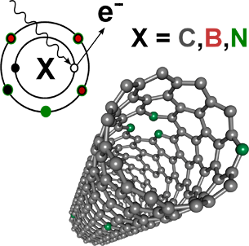
- in their properties or in the distribution of dopants poses additional challenges for characterization. Furthermore, although local methods such as scanning tunneling microscopy (STM) [24][25] and transmission electron microscopy based electron energy loss spectroscopy (TEM/EELS) [23][26] can these


Two-dimensional and tubular structures of misfit compounds: Structural and electronic properties
Beilstein J. Nanotechnol. 2014, 5, 2171–2178, doi:10.3762/bjnano.5.226

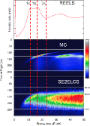
- addition to theoretical considerations, the electronic structure is discernible by spectroscopy as Ohno [12][35] presented in 1991. By performing X-ray photoelectron and absorption spectroscopy (XPS, XAS) and reflection electron energy loss spectroscopy (REELS), it was revealed that the electronic


Current state of laser synthesis of metal and alloy nanoparticles as ligand-free reference materials for nano-toxicological assays
Beilstein J. Nanotechnol. 2014, 5, 1523–1541, doi:10.3762/bjnano.5.165
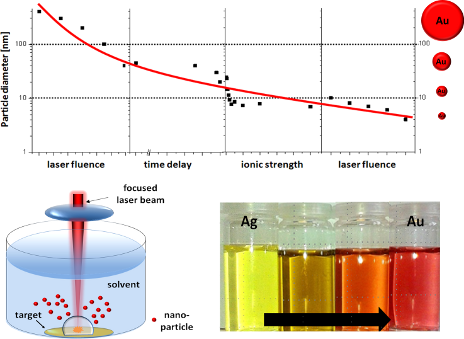
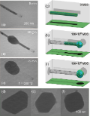
- EELS (electron energy loss spectroscopy) were used to analyze the ultrastructure of the particle by localizing nickel on a single-particle basis. Single particle EELS of a NiTi particle, laser-fabricated in acetone and embedded in a polymer, revealed a totally homogeneous ultrastructure [115] (Figure


Growth and characterization of CNT–TiO2 heterostructures
Beilstein J. Nanotechnol. 2014, 5, 946–955, doi:10.3762/bjnano.5.108
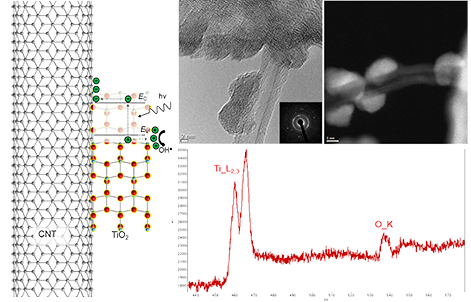
- the topic of synthesis and characterization of the CNT–TiO2 interface. In particular, atomic layer deposition (ALD) offers a good control of the size, crystallinity and morphology of TiO2 on CNTs. Analytical transmission electron microscopy (TEM) techniques such as electron energy loss spectroscopy
- /metal oxide material systems. Keywords: atomic layer deposition (ALD); carbon nanotubes; electron energy loss spectroscopy (EELS); interface; titanium dioxide (TiO2); transmission electron microscopy (TEM); Introduction Since the discovery by Iijima in 1991, carbon nanotubes (CNTs) have always been on
- has already been demonstrated [40]. On the other hand, analytical TEM provides chemical and electronic information about nanomaterials with an increasingly improved energy resolution. One powerful analytical TEM technique is electron energy loss spectroscopy (EELS). It detects electrons that lose a


Oriented attachment explains cobalt ferrite nanoparticle growth in bioinspired syntheses
Beilstein J. Nanotechnol. 2014, 5, 210–218, doi:10.3762/bjnano.5.23
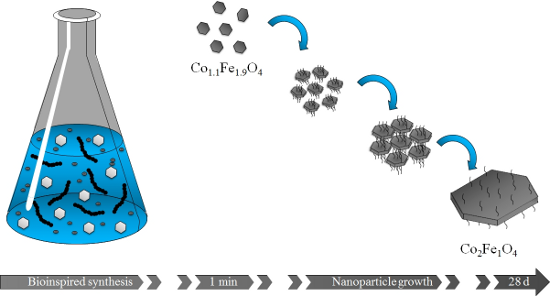
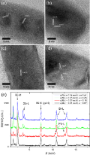
- stages of the growth process using transmission electron microscopy (TEM), high resolution transmission electron microscopy (HRTEM), electron energy loss spectroscopy (EELS) and electron diffraction measurements. Results In this bioinspired synthesis, stoichiometric Co2FeO4 discs of hexagonal, diamond


Probing the plasmonic near-field by one- and two-photon excited surface enhanced Raman scattering
Beilstein J. Nanotechnol. 2013, 4, 834–842, doi:10.3762/bjnano.4.94
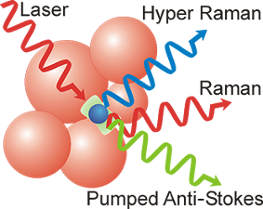
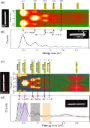
- variations. However, surface plasmons can be also excited by low energy [12] and high energy electrons [13][14]. Therefore, as an alternative to optical methods, electron energy loss spectroscopy (EELS) is emerging as a novel tool to probe plasmonic near-fields of metal nanostructures at nanometer




Influence of particle size and fluorination ratio of CFx precursor compounds on the electrochemical performance of C–FeF2 nanocomposites for reversible lithium storage
Beilstein J. Nanotechnol. 2013, 4, 705–713, doi:10.3762/bjnano.4.80
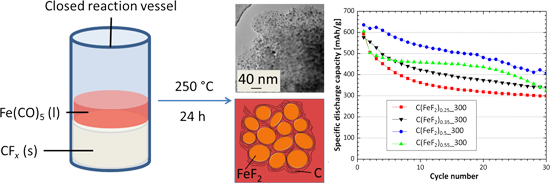
- 25 cycles. The composites were characterized by Raman spectroscopy, X-Ray diffraction measurements, electron energy loss spectroscopy and TEM measurements. The electrochemical performances of the materials were tested by galvanostatic measurements. Keywords: conducting carbon; conversion material


Characterization and properties of micro- and nanowires of controlled size, composition, and geometry fabricated by electrodeposition and ion-track technology
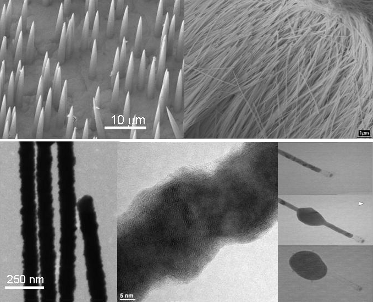
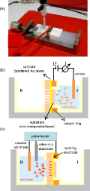
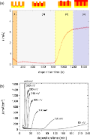
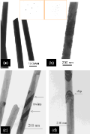
Beilstein J. Nanotechnol. 2012, 3, 860–883, doi:10.3762/bjnano.3.97








Tuning the properties of magnetic thin films by interaction with periodic nanostructures
Beilstein J. Nanotechnol. 2012, 3, 831–842, doi:10.3762/bjnano.3.93
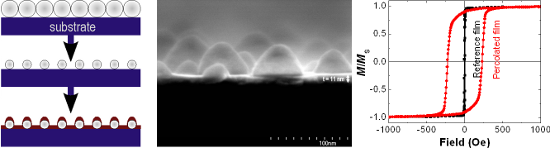
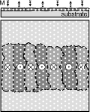
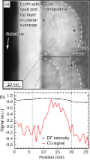
- particle size, the multilayer (with a nominal thickness of 16.8 nm) follows the curvature of the particle array (Figure 8a). By electron energy loss spectroscopy (EELS) along the line displayed in Figure 8a, the Co content was probed by using intensity profiling of the Co-L3,2 edges. Figure 8b shows the Co


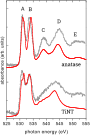
Towards atomic resolution in sodium titanate nanotubes using near-edge X-ray-absorption fine-structure spectromicroscopy combined with multichannel multiple-scattering calculations
Beilstein J. Nanotechnol. 2012, 3, 789–797, doi:10.3762/bjnano.3.88
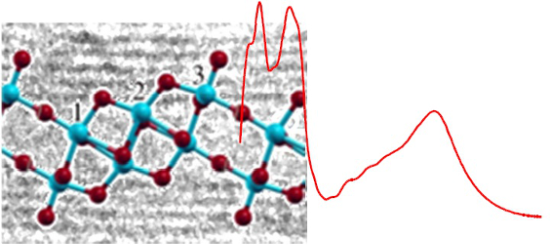
- as electron energy loss spectroscopy (EELS) performed in aberration-corrected transmission electron microscopes operated at low electron acceleration voltages [30]. Alkali titanate nanostructures are very sensitive to electron-beam irradiation, which has prevented detailed studies at high energetic



Focused electron beam induced deposition: A perspective
Beilstein J. Nanotechnol. 2012, 3, 597–619, doi:10.3762/bjnano.3.70
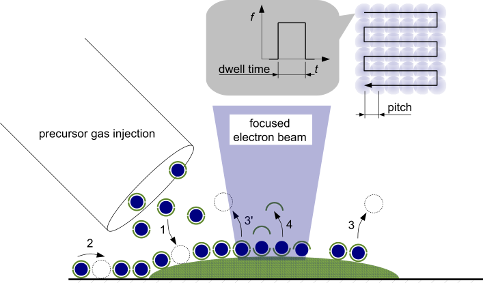
- microscopy (TEM) investigations which show a progression from nanocrystalline fcc Pt particles in a carbon matrix for Si-free deposits, towards an amorphous structure of the granules. Since only a direct local probe, such as electron energy loss spectroscopy (EELS) in a TEM, would be able to unequivocally


Nano-structuring, surface and bulk modification with a focused helium ion beam
Beilstein J. Nanotechnol. 2012, 3, 579–585, doi:10.3762/bjnano.3.67
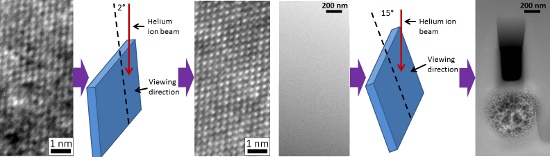
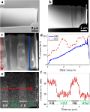
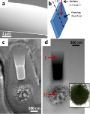
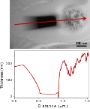
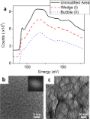
- surface and structure using advanced transmission electron microscopy (TEM) techniques such as energy filtered TEM (EFTEM) and electron energy loss spectroscopy (EELS). We also present the limitations of this surface modification technique. Results and Discussion Sample 1 is a silicon lamella shown after


Investigation on structural, thermal, optical and sensing properties of meta-stable hexagonal MoO3 nanocrystals of one dimensional structure
Beilstein J. Nanotechnol. 2011, 2, 585–592, doi:10.3762/bjnano.2.62
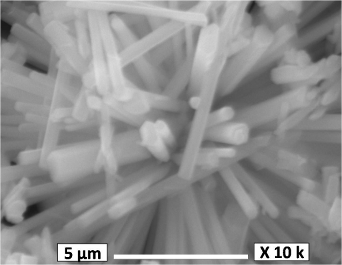
- microscopy (TEM) images clearly depicted the morphology and size of h-MoO3. The morphology study showed that the product comprises one-dimensional (1D) hexagonal rods. From the electron energy loss spectroscopy (EELS) measurement, the elemental composition was investigated and confirmed from the


Simulation of bonding effects in HRTEM images of light element materials
Beilstein J. Nanotechnol. 2011, 2, 394–404, doi:10.3762/bjnano.2.45
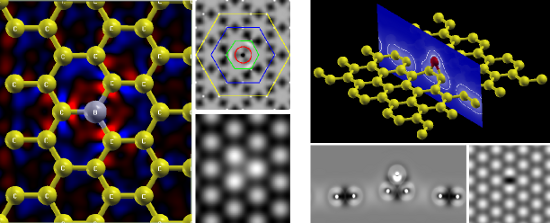
- changes in the electronic state, such as electron energy loss spectroscopy [4] or scanning tunneling microscopy [5], make use of advanced simulation methods to model the specimen. In 1997, Gemming and Möbus performed ab-initio HRTEM simulations of ionic crystals and justified the use of conventional image





